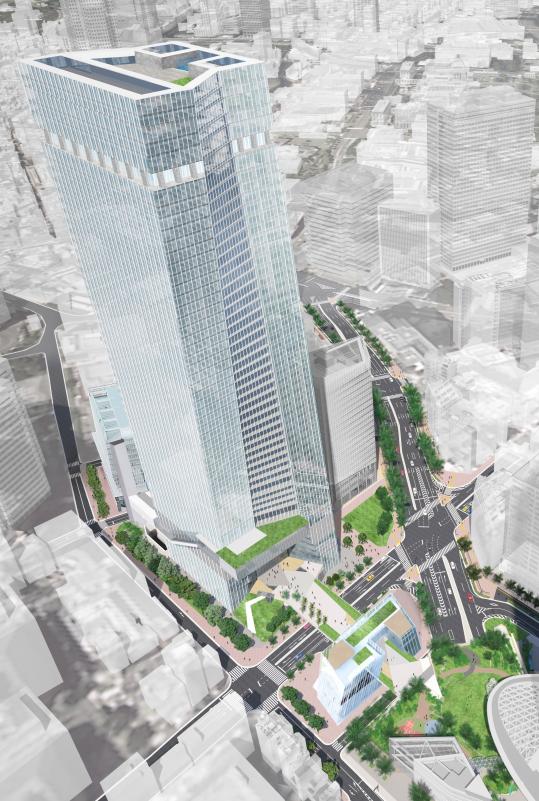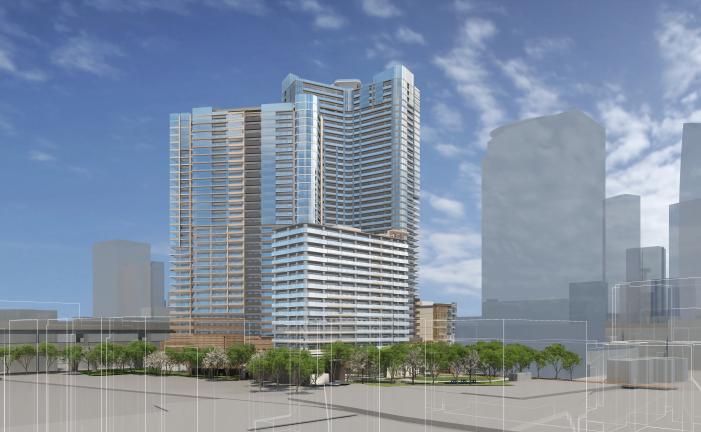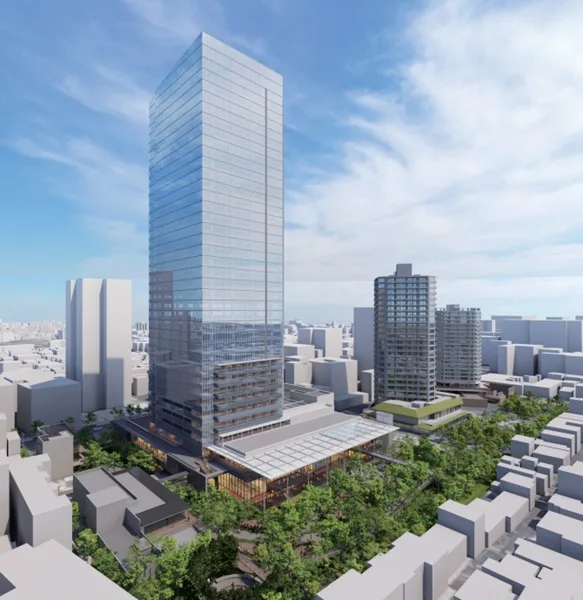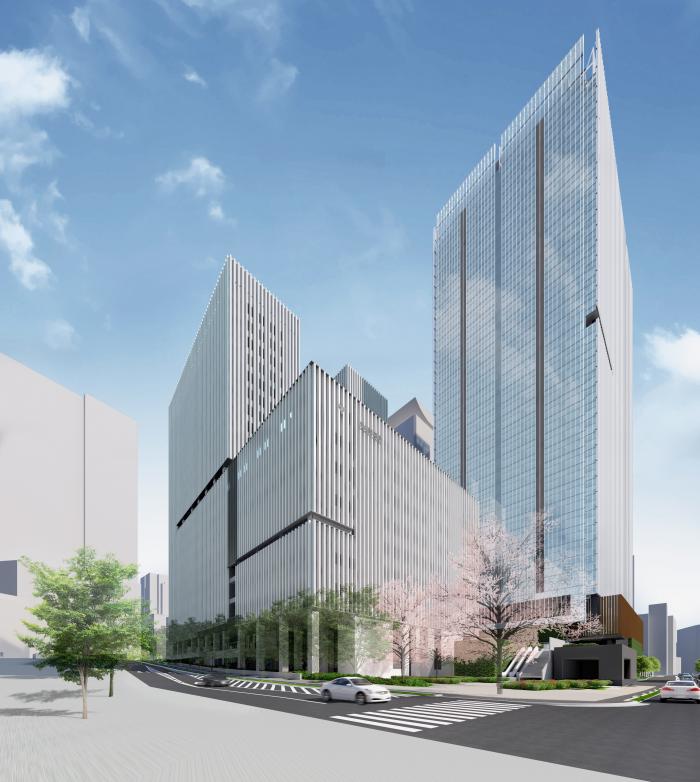
Toranomon 2-chome District Type 1 Urban Redevelopment Project is an urban renewal project that integrates a hospital, offices, stores, and parking lots over an area of approximately 2.9 ha spanning Toranomon 2-chome and Akasaka 1-chome. Although there is no number of residential units, we believe that the plan is to raise the working style and value of staying in the Toranomon area by combining medical care, international business, disaster prevention, and pedestrian circulation.
This article is based on information published as of December 2025.
Key points of this article
- The redevelopment of the Toranomon 2-chome district is not about providing housing, but rather strengthening medical, business, and disaster prevention functions.
- Construction for the hospital building was completed in April 2019 and for the business building in February 2025, so it must be viewed as a completed project.
- Redevelopment of special ward roads and cross decks are important in the development of public facilities, which will affect pedestrian circulation.
- Real estate owners should check not only for rent increases, but also for changes in recruitment channels, tenant attributes, and management quality.
Looking at the completed drawings, you can see that this project is more than simply rebuilding an office building. The essence is that Toranomon's business center has hospital functions and urban disaster prevention facilities.
What is the Toranomon 2-chome District Type 1 Urban Redevelopment Project?
The Toranomon 2-chome Area Type 1 Urban Redevelopment Project is an urban redevelopment project that was carried out within Toranomon 2-chome and Akasaka 1-chome, Minato-ku, Tokyo. In Minato City's published materials, the representative implementer is the Urban Renaissance Agency, an independent administrative agency, and the joint implementer is the Federation of National Public Employees Mutual Aid Associations.
The target area is approximately 2.9 ha. The main uses are hospitals, offices, stores, and parking lots, and the number of residential units is specified as "none." This is a major difference from recent station-front tower condominium redevelopments.
Toranomon is a business cluster near Toranomon Hills, Torano Gate, Kasumigaseki, Akasaka 1-chome, and Tameike Sanno. As summarized in Toranomon/Toranogate Redevelopment 2027, offices, hotels, commercial, and international business functions are being continuously updated in this area.
However, the Toranomon 2-chome district is not only characterized by its glamorous commercial nature. It combines medical care, international medical care, disaster prevention response, and business support, while separating the hospital and business buildings. For rental owners, it is more practical to view this as a plan to change the quality of workers and visitors rather than an increase in the number of residents.
Plan overview: What is the difference between the hospital building and the business building?
The redevelopment plan for the Toranomon 2-chome area will be easier to understand if you look at the hospital building and business building separately. The hospital building is the core of medical care and disaster response, and the business building is the core of offices, stores, and business support.
| Item | Content |
|---|---|
| Project name | Toranomon 2-chome area Type 1 urban redevelopment project |
| Location | Toranomon 2-chome and Akasaka 1-chome, Minato-ku, Tokyo |
| Executor | Independent Administrative Agency Urban Renaissance Agency, National Public Service Mutual Aid Association Federation |
| Area area | Approx. 2.9 ha |
| Project cost | Approx. 150.7 billion yen |
| Main use | Hospital, office Office, store, parking lot |
| Total area | Approx. 266,100 square meters |
| Business building | 38 floors above ground, 2 floors underground, approximately 180m |
| Hospital Building | 19 floors above ground, 3 floors underground, approximately 99m |
| Number of housing units | None |
| Parking lot | 542 spaces |
According to Minato City documents, implementation approval was granted in July 2014, rights conversion plan was approved in February 2015, and construction of the hospital building began in June 2016. Construction of the hospital building was completed in April 2019, and construction of the business building began in September 2020 and is expected to be completed in February 2025.
In other words, the Toranomon 2-chome area Type 1 urban redevelopment project that is covered in this article is not a project that is scheduled to be completed in the future. Major building improvements have already been completed, and the next stage is to verify the area value, tenant composition, and changes in the flow of people after completion.
When looking at recruitment conditions on-site, it is necessary to distinguish between the expected value before construction is completed and the actual demand after construction. At the preliminary stage, the appeal is "future potential," but after completion, the ease of walking from the station, nearby stores, day and night traffic, and management status will be directly linked to the decision to move in.
What has changed in public facilities and urban infrastructure development?
The easily overlooked value of this redevelopment lies not in the size of the building but in the development of the urban infrastructure. Materials from the Tokyo Metropolitan Bureau of Urban Development show the development of special ward roads and the construction of a crossing deck, which will be an element that will change the flow of pedestrians in Toranomon 2-chome.
| Classification | Contents that can be confirmed in official materials |
|---|---|
| Roads | Development of special ward roads No. 1014, No. 1032, and No. 1009 |
| Cross deck | Development of special ward road No. 1032 cross deck |
| Medical functions | Hospital and international medical facilities located in the hospital building |
| Business Administrative functions | Office, store, business/life support facilities located in the business building |
| Disaster prevention function | Disaster treatment/accommodation facilities located in the hospital/business building |
| Greenway/open space | td>Tokyo Metropolitan Government documents describe the development of a complex urban area with green roads and plazas |
| Station plaza/bicycle parking lot | Details not disclosed as far as can be confirmed from published documents |
What can be seen from the exterior image is the relationship between the lower floors and the pedestrian space. If your attention is focused only on the scale of the high-rise area, you will overlook the ease of use at ground level, which affects the actual value of real estate.
For property owners, the maintenance of roads and decks will affect the viewing route. The perceived distance from the station to the property, the safety of the sidewalks, the visibility during the day and night, and the ease of movement in rainy weather all have different impressions, even if the distance is the same.
As far as we can see in the recruitment field in the city center, prospective tenants are not judged solely by the distance on the map. For example, in business areas such as Toranomon and Akasaka 1-chome, the location of lunch flow lines, station exits, medical facilities, cafes, and convenience stores are evaluated as daily comfort.
How will this affect the Toranomon/Akasaka 1-chome area?
The redevelopment of the Toranomon 2-chome area must be seen in conjunction with the redevelopment of the surrounding Minato area. This is because it is not a standalone building, but part of an urban renewal that connects Toranomon Hills, Torano Gate, Kasumigaseki, and Akasaka 1-chome.
Looking at the location map, Toranomon 2-chome is located in an area where administrative, medical, business, hotel, and commercial areas overlap. In urban redevelopment, the value of a building is determined by its connection to surrounding functions rather than the floor space itself.
As mentioned in Tokyo Redevelopment Area Major Project Survey Report, redevelopment not only supplies new buildings but also changes the usage mix of the area. In the case of Toranomon 2-chome, the focus is not on population growth due to housing supply, but on the accumulation of medical, business, and visitor visitors.
The impact on rental housing is not just a simple increase in rent. In fact, your job offer may be more persuasive to professionals working nearby, foreign companies, medical personnel, and people who value short commutes.
On the other hand, competition within Minato Ward will become tougher. Sengakuji Station Area Type 2 Urban Redevelopment and Roppongi 5-chome West District Twin Tower Redevelopment.
That's why it's dangerous to look only at Toranomon 2-chome and think that Minato Ward is strong. It is necessary to create a competitive edge that includes the strengths of each property, management quality, tenant response, and the proposal capabilities of human resources.
What are the practical points that real estate owners should consider?
What real estate owners should look at is not the expected value of redevelopment, but the behavioral patterns that have changed after completion. Please separately check the flow of people, tenant attributes, viewing directions, surrounding rents, and visibility of existing properties.
Firstly, being within walking distance of Toranomon is not enough as a recruitment condition. If you want to promote the proximity of the Toranomon 2-chome District Type 1 Urban Redevelopment Project, you will need to explain in detail the location of work, medical institutions, dining, station exits, and bus routes.
Secondly, update the photos and guide lines. When a redeveloped block and pedestrian flow lines are in place, old photos cannot convey the impression of the area. Recruitment drawings and photos posted on the portal should be reviewed based on how the city will look after completion.
Third, when it comes to capital investment, prioritize areas that improve the tenant experience rather than flashy renovations. Entrance lighting, cleaning of common areas, delivery boxes, internet, security, and organization of notices are more different than you might think in a city center.
At an old property in Minato Ward, the impression upon viewing the building changed noticeably by simply installing lighting in the common areas and mailboxes before looking at the exterior. In areas near redevelopment sites, the ``feeling of security that the buildings are well-maintained'' is more important to compare than the age of the individual buildings.
When considering reviewing your management company or redesigning your recruitment strategy, it is important not to just look at a completed redevelopment map. Walk from the station, observe the day and night traffic, and see what tenants find convenient.
INA's opinion
The Toranomon 2-chome District Type 1 urban redevelopment project is not a redevelopment project to increase housing. However, this is not to say that the value is small; rather, we plan to change the evaluation axis of surrounding real estate by strengthening medical, business, and disaster prevention functions.
I believe that the value of real estate in the city center is not determined solely by building specifications. Stations, roads, medical care, workplaces, stores, disaster prevention, and daily management quality all overlap to create a sense of satisfaction for residents.
What is important here is management that takes advantage of human resources. It is not enough just to have a property near redevelopment; the results will depend on whether the staff at the site understand the changes in the city and incorporate this into their recruitment letters and explanations during previews.
If you only aim for short-term rent increases, you will make mistakes based on the difference between expected value and actual demand. Rather, it is important to carefully consider how the town will be used after completion and reorganize capital investment, recruitment conditions, and exit strategies in a sustainable manner.
The Toranomon 2-chome District Type 1 Urban Redevelopment Project is an important completion example for understanding the urban renewal of Minato Ward. By looking at hospital buildings, business buildings, roads, cross decks, and even disaster prevention functions, it becomes easier to understand the true impact that redevelopment will have on real estate management.
Frequently Asked Questions (FAQ)
Q1. Has the Toranomon 2-chome District Type 1 Urban Redevelopment Project been completed?
A. Construction of the hospital building will be completed in April 2019 and the business building will be completed in February 2025. The next step is to verify the flow of people and surrounding demand after completion.
Q2. Does this redevelopment include housing?
A. According to Minato City materials, the number of housing units is "none." The main uses are hospitals, offices, stores, and parking lots.
Q3. What impact will this have on rental housing owners?
A. Recruitment strategies are not affected by direct housing supply, but by the movement of nearby workers, visitors, and medical personnel. It is important to review the inspection guideline and management quality.
Q4. Should we look at it along with other redevelopment projects around Toranomon?
A. We should watch it together. In conjunction with the renewal of Toranomon Hills, Torano Gate, and Akasaka 1-chome, the usage composition of the entire area is changing.
Quotes/references