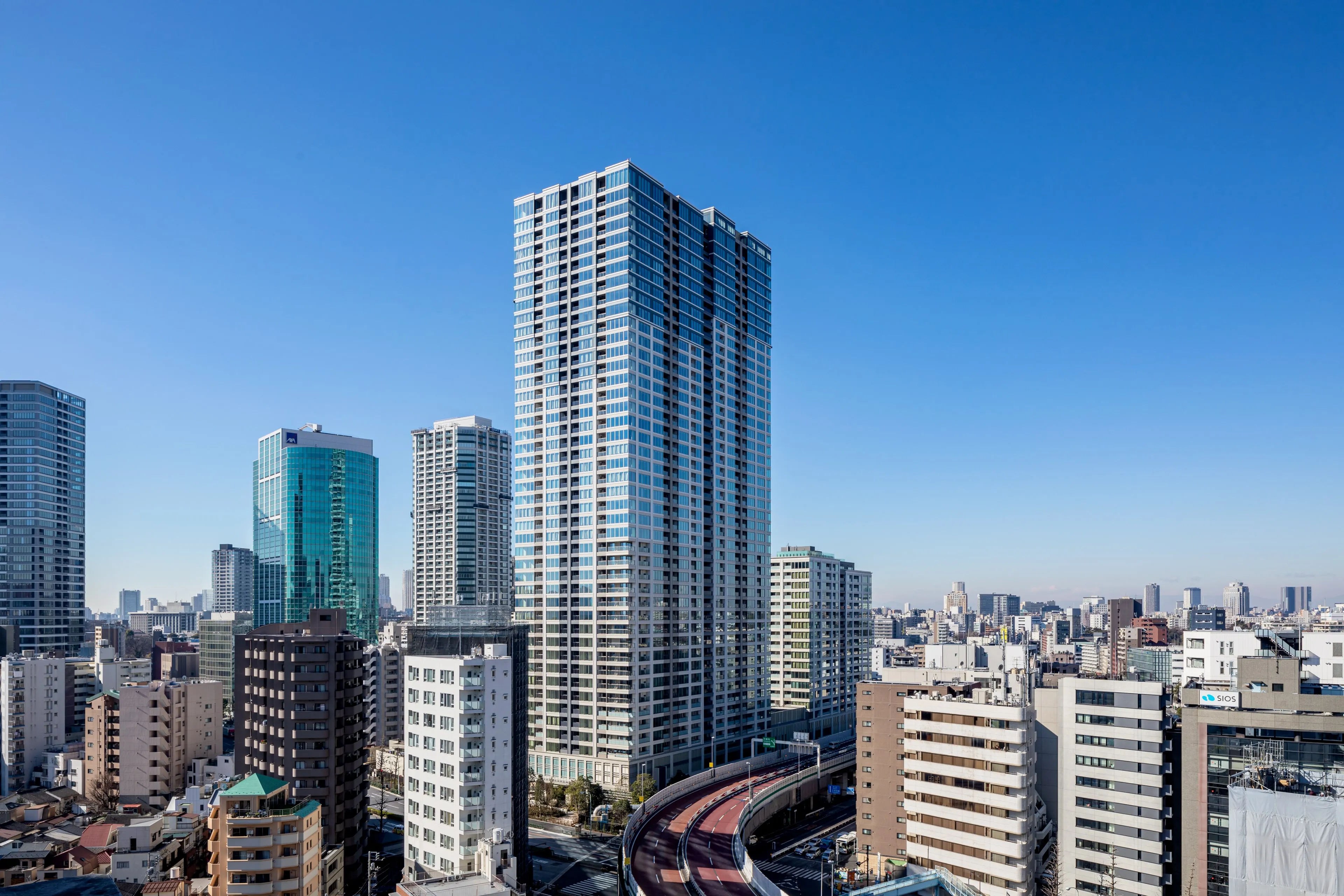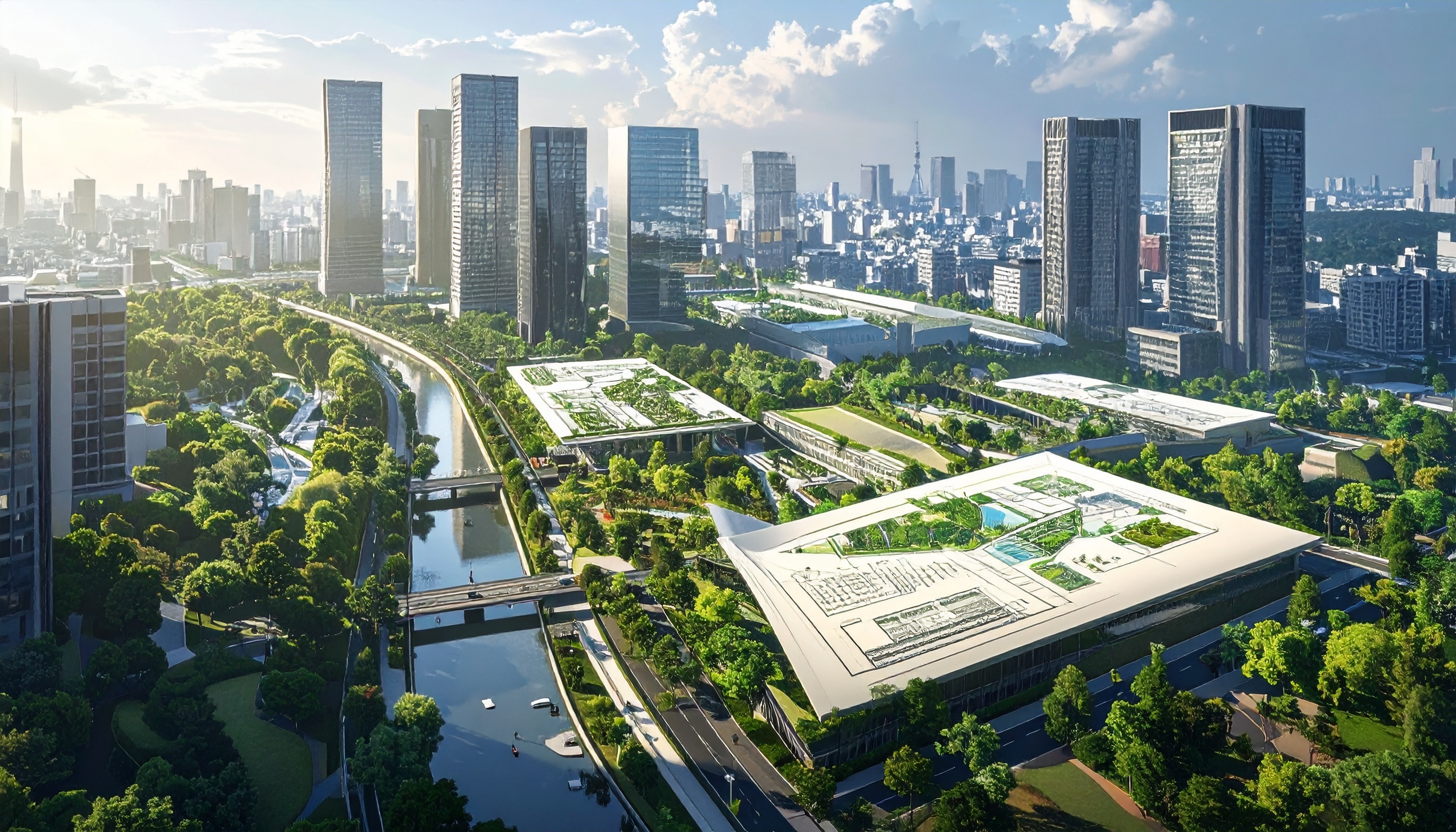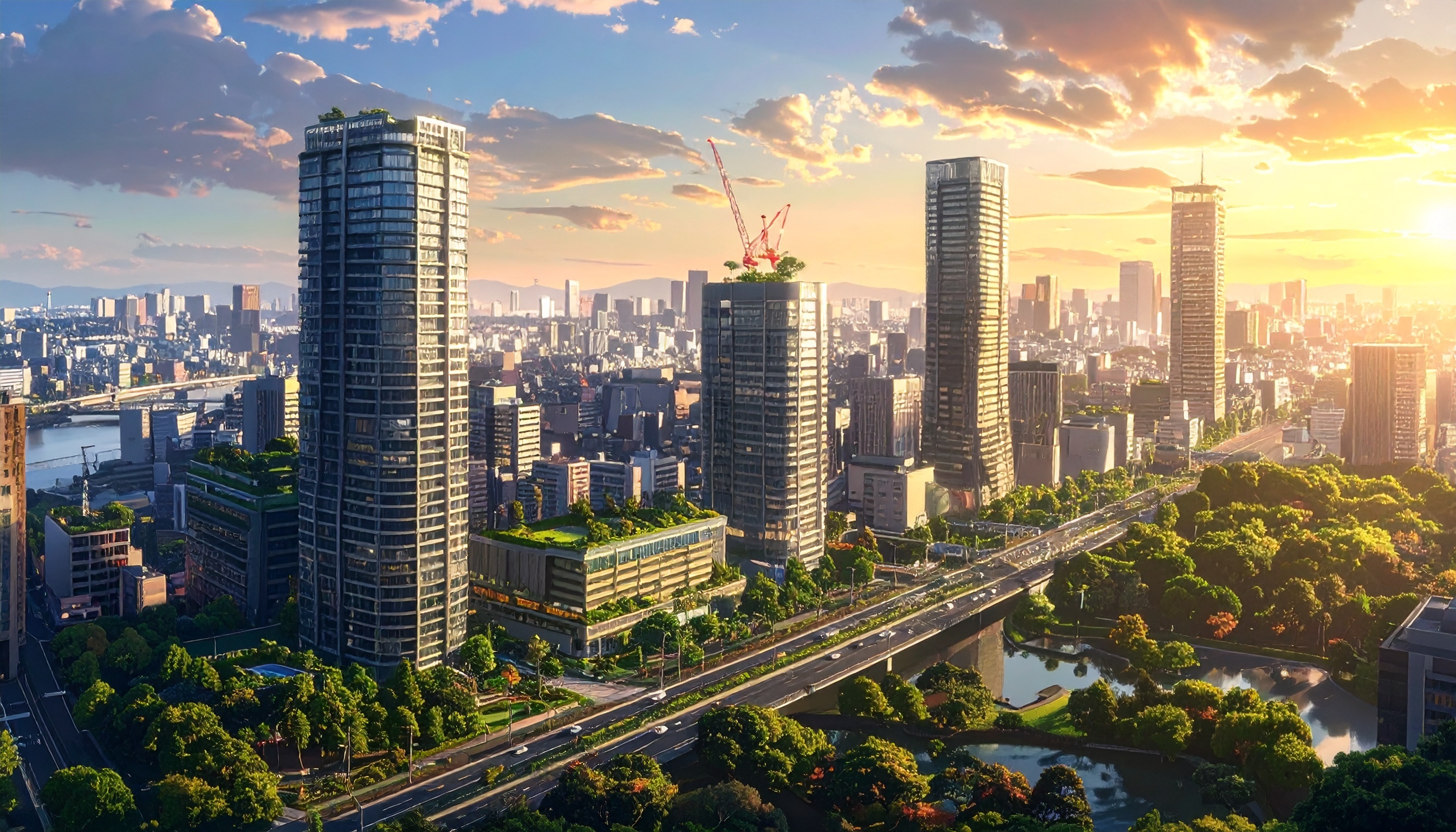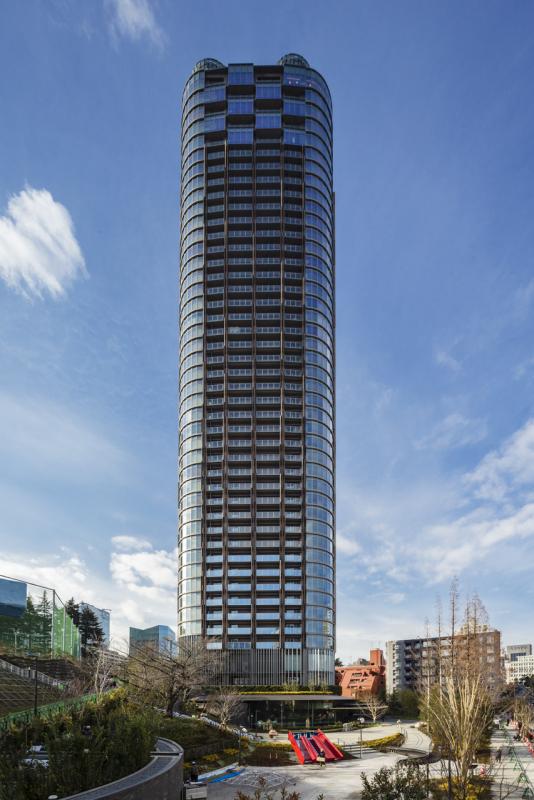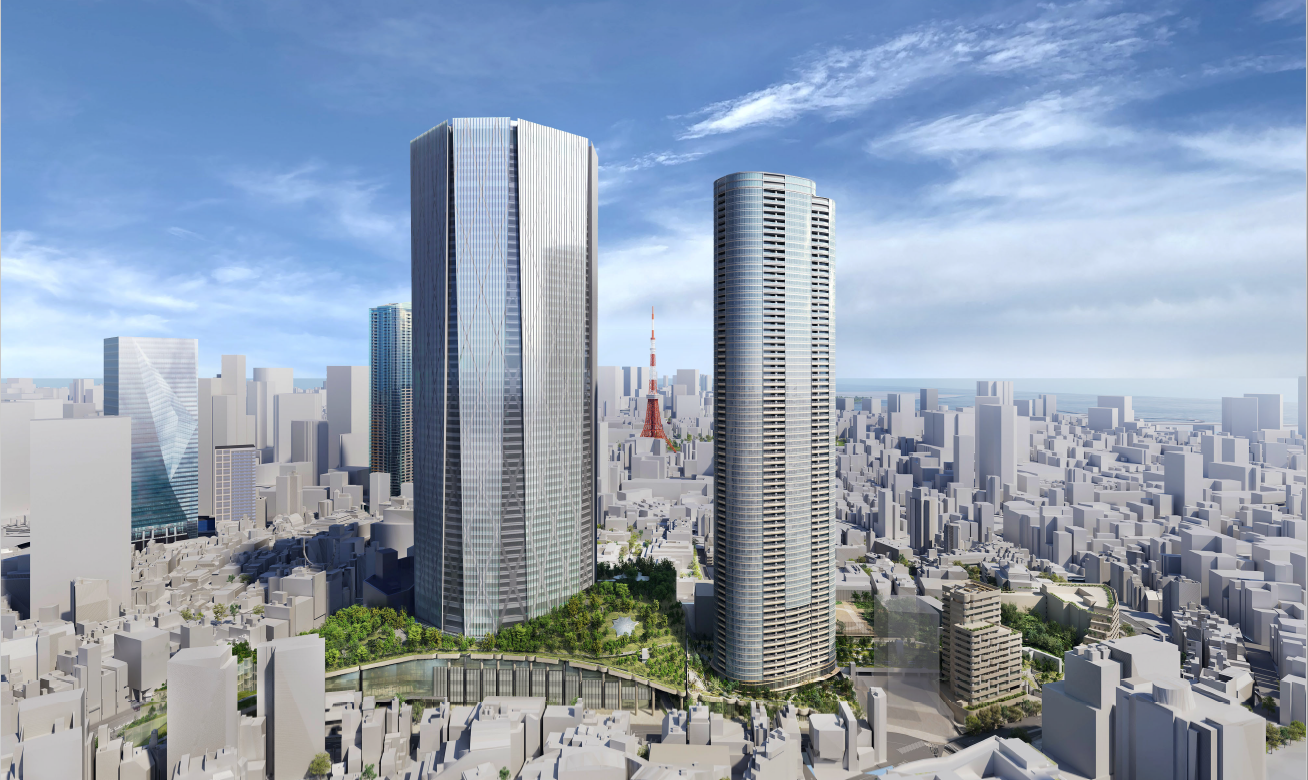
The Class 1 Urban Redevelopment Project planned for the Roppongi 5-chome West District is one of Japan's largest urban development projects, with a total floor area of approximately 1.08 million m² and a total project cost of approximately ¥800 billion. Twin towers—an office building of 66 floors and 327m, and a residential tower of 70 floors and 288m—are set to completely transform the Roppongi cityscape.
Demolition work on existing buildings has already begun in fiscal year 2025, and the project is steadily moving forward. This article analyzes the latest developments as of March 2026 and the impact on real estate values in the Minato Ward area, for real estate investors and property owners.
What is the Roppongi 5-chome West District Redevelopment Plan?
The Roppongi 5-chome West District Class 1 Urban Redevelopment Project is a large-scale project with Mori Building and Sumitomo Realty & Development as project cooperators. Operating under the concept of "a safe, secure, and verdant hillside city," it targets an area of approximately 8 hectares to the southwest of the Roppongi intersection.
The core of the plan is two ultra-high-rise towers. Block A-1 will see the construction of a 66-floor, 8-basement-level, 327m ultra-high-rise building, composed of mixed uses including offices, a hotel, shops, and observation facilities. The total floor area will reach approximately 794,000 m². Meanwhile, Block B has a planned 70-floor, 5-basement-level, 288m ultra-high-rise tower condominium. It will include approximately 850 residential units as well as shops and offices, with a total floor area of approximately 239,000 m².
Of note is that the combined total floor area of both buildings reaches approximately 1.08 million m², with a total project cost estimated at approximately ¥800 billion. This exceeds the current Roppongi Hills (approximately 760,000 m²) by approximately 1.4 times. It will be among the largest project costs of any domestic redevelopment project. Upon completion, a new landmark will be born in the heart of Tokyo.
The preparatory association was established in March 2008, and the urban plan was determined on April 8, 2024. In November of the same year, the Environmental Impact Assessment Report by the Tokyo Metropolitan Bureau of Environment was released. The project is progressing with a target of main body construction starting in fiscal year 2026 and completion in fiscal year 2030.
Why are the 327m and 288m Twin Towers Attracting Attention?
Block A-1's height of 327m comes within just 6 meters of Tokyo Tower (333m). The tallest building in Tokyo today is the Azabudai Hills Mori JP Tower (325.4m), but Block A-1 of the Roppongi 5-chome West District will surpass even this. Upon completion, it has the potential to become Japan's tallest skyscraper.
Furthermore, Block B's 288m is among the highest for residential use in Japan. Even compared to the Roppongi Hills Residences at approximately 43 floors and approximately 186m, it greatly exceeds both in floors and height. With observation facilities also planned, its presence as a new symbol of Roppongi will be extraordinarily significant.
Such super-tall buildings have an effect of boosting the brand value of the entire surrounding area, not just as landmarks. This trend is clearly evidenced by the observed rise in land prices around Azabudai Hills after its opening.
Latest 2026 Developments: Start of Demolition and Impact of Soaring Construction Costs
The Roppongi 5-chome West District redevelopment commenced demolition work on existing buildings in fiscal year 2025. The construction period including demolition is estimated at approximately 60 months, and the planned completion in fiscal year 2030 is maintained. This marks a major milestone in the transition from the planning to the execution stage.
Mori Building President Shingo Tsuji revealed in an interview with the Nikkei Shimbun in March 2026 that the project was in the final stages toward construction. However, the reality that soaring construction costs are having a significant impact on business plans has also come to light.
Overall construction sector costs have risen 25–29% compared to January 2021. The primary causes are soaring labor and material costs, further accelerated by the labor shortages resulting from the so-called "2024 problem" and "2025 problem." While there is a forecast of a gradual easing after 2026, a significant price decrease is not expected.
Under these circumstances, the total project cost is estimated to reach approximately ¥800 billion. Mori Building frankly acknowledged at its interim financial results briefing that construction costs continue to rise, also mentioning design changes including building use. There is a possibility that modifications from the original plan will be made.
Investors need to pay attention to this point. Rising construction costs will also be reflected in the selling prices of residential properties and office rent levels. However, Mori Building has a track record of overcoming similar challenges at Azabudai Hills and completing that project. The possibility of the project being canceled is considered low.
Is the Roppongi 5-chome Redevelopment "Delayed"? Schedule Revised to Fiscal 2032 Completion
At an earnings briefing on May 15, 2026, Mori Building's incoming president Yasuhiro Kogo (who took office on June 23 of the same year) stated regarding the previously announced fiscal 2030 completion target that "completion in FY30 is now quite difficult. In response to soaring construction costs and longer construction periods, we want to plan rationally and aim for efficient construction," revealing a policy of revising the schedule due to rising construction costs and interest rates.
Subsequently, an urban plan amendment presented to the Minato Ward Assembly on July 29, 2026 newly added "District F" (approximately 2,030 m², jointly owned by Mori Building, Sumitomo Realty & Development, and TV Asahi), consisting of offices, a multipurpose hall, and commercial facilities, and "District G" (approximately 2,000 m², adjacent land already acquired by TV Asahi), which will serve a cultural exchange function, to the Roppongi 5-chome West District's urban development. Under this plan, the redevelopment association is to be established within fiscal 2026, rights conversion plan approval is to be obtained in fiscal 2027, construction will then begin, and overall completion is planned for fiscal 2032. This represents a delay of about two years from the original fiscal 2030 target, but with TV Asahi's participation the scope of the project has actually expanded, and the project itself has not been scaled back or canceled. Owners and investors should read references elsewhere in this article to "completion in fiscal 2030" as now referring to this updated "fiscal 2032" target.
How Will Real Estate Values in Minato Ward and the Roppongi Area Change?
Large-scale redevelopment has long-term impacts on real estate values in the surrounding area. We analyze the impact of the Roppongi 5-chome West District redevelopment along with the latest land price data.
Upward pressure on land prices: According to the 2026 published land prices, the average land price in Minato Ward reached ¥5,518,395/m² (up 14.99% year-on-year). Residential land averaged ¥2,577,333/m² (+12.66%), and commercial land averaged ¥6,229,411/m² (+10.97%), with both recording double-digit growth rates. Minato Ward has the 4th highest published land prices in Tokyo. Given the history of significant surrounding land price increases before and after the opening of Roppongi Hills (2003), this redevelopment may create additional upward pressure.
Boosting rent levels: The approximately 794,000 m² of office floor area will impact the office supply across Minato Ward. On the other hand, if the concentration of hotels, observation facilities, and commercial establishments increases the area's attractiveness, there is also an expected effect of boosting rents of existing properties in the vicinity.
Impact on the residential market: Approximately 850 tower condominium units will be supplied, but given the overwhelming height of 288m and Roppongi's location, a price point for the ultra-wealthy is anticipated. This may raise the price level of the surrounding luxury condominium market as a whole.
Improvement of transportation infrastructure: The plan includes strengthening the connection with Roppongi Station, establishing a barrier-free route, and creating a station plaza. Such urban infrastructure development contributes to improved convenience and real estate values for the entire area.
The national published land prices also rose an average of +2.8% in 2026, recording the largest increase since the bubble era. The structure of rising investment money pushing up land prices continues, and this tailwind is also blowing for the Roppongi area.
The General Contractor Has Not Yet Been Decided
Searches such as "Roppongi 5-chome redevelopment general contractor" and "Shimizu Corporation Roppongi 5-chome redevelopment" can be seen, but as of September 2026, the general contractor (designated business agent) for this project has not yet been selected. The Roppongi 5-chome West District Urban Redevelopment Preparatory Association (Chairman: Takuya Tsukahara), the project's operating body, has announced through the Japan Association of Redevelopment (a public interest incorporated association) that it plans to begin a public call for a "designated business agent" during fiscal 2026 (Reiwa 8).
The selection method is a "business proposal competition" that comprehensively evaluates proposals on planning, design, construction, and pricing. Applicants are required to have a track record of constructing high-rise mixed-use facilities exceeding 200m in height completed since 2016 (Heisei 28) for Blocks A-1 and A-2, or a track record of constructing high-rise residential buildings of 40 floors or more for Block B. Therefore, as of the time of writing, no specific general contractor, including Shimizu Corporation, has been formally decided as the constructor.
Key Points for Real Estate Owners and Investors to Consider Now
In light of the Roppongi 5-chome West District redevelopment, we organize key points for real estate owners and investors to consider.
Deciding to continue holding properties near Roppongi: Area value is expected to continue rising toward the completion of the redevelopment (planned for fiscal year 2030). Given that Minato Ward's land prices have risen significantly by +14.99% year-on-year, for owners with properties in the Roppongi, Azabu, and Akasaka areas, medium-to-long-term holding may be more advantageous than short-term sale.
Preparing for temporary supply-demand relaxation due to large-scale supply: The new supply of approximately 794,000 m² of office floor area will have a certain impact on the Minato Ward office market upon completion. In particular, it is important for owners of older office buildings to consider renovation and differentiation strategies.
Timing investment decisions: Demolition work has begun, and the 60-month countdown has started. The period from before construction start to completion is when surrounding real estate prices are gradually being priced in. It is important to monitor redevelopment progress information and identify acquisition timing carefully.
Factoring in the impact of soaring construction costs: Rising construction costs push up the selling prices of new properties, which in turn increases the relative value of existing properties. This is why asset management with an eye toward exit strategies in the era of inflation and soaring construction costs is required.
My Perspective
I believe the Roppongi 5-chome West District redevelopment is a project that will write a new page in the history of Tokyo's urban development. The figures involved—a total floor area of 1.08 million m², a total project cost of approximately ¥800 billion, and a height of 327m—reflect Tokyo's determination to remain a competitive international city in Asia.
What stands out to me is that this redevelopment brings together the multiple functions of "office," "residential," "hotel," "commercial," and "observation facilities" within a single block. This is not simply the construction of a building; it is an initiative to create an entire district. It can be described as a further evolution of the "vertical garden city" philosophy that Mori Building cultivated at Roppongi Hills.
The risks from soaring construction costs must be acknowledged honestly. However, given the potential of the Roppongi area and the execution capabilities of Mori Building and Sumitomo Realty & Development, leading developers representing Japan, I am confident this project will have a positive impact on Tokyo's real estate market as a whole. What kind of value will this record-setting ¥800 billion investment create for the town of Roppongi? I encourage real estate owners to keep a close watch on these developments while building their asset strategies with a medium-to-long-term perspective.
Summary
Key points of the Roppongi 5-chome West District Class 1 Urban Redevelopment Project:
- Block A-1: 66 floors, height 327m; offices, hotel, observation facilities, etc.; total floor area approx. 794,000 m²
- Block B: 70 floors, height 288m; approx. 850 residential units plus shops; total floor area approx. 239,000 m²
- Total floor area of approx. 1.08 million m² is approximately 1.4 times that of Roppongi Hills; total project cost approx. ¥800 billion is among the largest ever for a domestic redevelopment
- Project cooperators are Mori Building and Sumitomo Realty & Development
- Demolition commenced in fiscal year 2025; construction period approx. 60 months; completion planned for fiscal year 2030
- Construction costs have risen 25–29% vs. 2021; possibility of design changes
- Minato Ward's 2026 published land prices averaged ¥5,518,395/m² (up 14.99% year-on-year)
- Rising land prices and boosted rents are expected in the Minato Ward/Roppongi area
Frequently Asked Questions (FAQ)
Q1. When will the Roppongi 5-chome West District redevelopment be completed?
The project is progressing with a target of completion in fiscal year 2030. Demolition of existing buildings has already commenced in fiscal year 2025, and the construction period including demolition is estimated at approximately 60 months. However, there is also a possibility that the schedule may change due to soaring construction costs.
Q2. Will Block A-1's height of 327m become Japan's tallest?
There is a possibility it will become Japan's tallest upon completion. The current tallest in Japan is the Azabudai Hills Mori JP Tower (approximately 325.4m), and Block A-1's 327m exceeds this by approximately 1.6m. It is also just 6m short of Tokyo Tower (333m).
Q3. How significant is the total project cost of approximately ¥800 billion?
It is among the largest project costs ever for a domestic redevelopment project. The backdrop is the surge in building materials and labor costs, with construction costs rising 25–29% compared to 2021. Mori Building is also considering partial design changes, and the final project cost may fluctuate further.
Q4. What impact will there be on real estate prices in the surrounding area?
Large-scale redevelopment is a factor in rising land prices in the surrounding area. Minato Ward's 2026 published land prices have risen significantly to an average of ¥5,518,395/m² (+14.99% year-on-year). Given that land prices also rose significantly around Roppongi Hills when it opened, this redevelopment, being even larger in scale, is expected to have a ripple effect across the entire Roppongi, Azabu, and Akasaka area.
Related Articles
References
- Tokyo Metropolitan Bureau of Urban Development "Roppongi 5-chome West District Class 1 Urban Redevelopment Project"
- Tokyo Metropolitan Bureau of Environment "Environmental Impact Assessment Report" (November 2024)
- Minato Ward "Notices on Urban Redevelopment Projects"
- Nikkei Shimbun "Mori Building President Tsuji: Tokyo Roppongi New Redevelopment 'Heading for Final Stage toward Construction'" (March 9, 2026)
- Nikkan Kensetsu Kogyo Shimbun "Roppongi 5-chome West District Redevelopment / 60-month construction period, demolition commences in FY2025"
- Nikkei Shimbun "Published Land Prices Rise 2.8%, Largest Increase Since Bubble Era" (March 2026)