The Minami-Koiwa 7-chome Station redevelopment (南小岩七丁目駅前地区再開発, Minami-Koiwa nana-chōme ekimae chiku saikaihatsu) is a large-scale renewal of the station-front transport plaza and surrounding streets at the south exit of JR Koiwa Station, combining retail, housing, and public facilities. This is something distinctly Japanese: it is not simply a tower-condominium project. Its practical significance lies in the fact that it reorganizes transport, disaster resilience, and pedestrian flow together with land readjustment.
Around Koiwa Station, several redevelopment and machizukuri (まちづくり, community-building and town-planning) efforts are underway on both the south and north sides. Within that picture, the Minami-Koiwa 7-chome station-front district is viewed as the last large piece that shapes the face of the station's south exit. Unlike many Western station-area projects, where a single private developer typically delivers one building, here the public framework and private participation are deliberately fused. In this article we limit ourselves to what can be confirmed in published materials, and organize the plan outline and the points that property owners should watch.
Key points of this article
- The Minami-Koiwa 7-chome station-front redevelopment is an urban redevelopment covering roughly 1.5 hectares (about 3.7 acres) immediately next to the south exit of Koiwa Station.
- According to Tokyo Metropolitan Government materials, the total floor area is approximately 155,000 m² (about 1.67 million sq ft), with roughly 1,100 residential units, and primary uses of retail, housing, public facilities, and childcare facilities.
- Crucially, the project advances the station-front transport plaza, surrounding roads, and pedestrian space together with a land readjustment project (区画整理事業).
- For rental operations, you need to separate the changes to circulation during construction from the trade-area reshaping after completion—not just the listing terms.
What is the Minami-Koiwa 7-chome station-front redevelopment? A plan to renew the south exit of Koiwa Station
The Minami-Koiwa 7-chome station-front redevelopment is a Type 1 Urban Redevelopment Project (第一種市街地再開発事業, dai-isshu shigaichi saikaihatsu jigyō, a Japan-specific statutory redevelopment scheme in which existing rights holders convert their land and building rights into floor space in the new building) planned within Minami-Koiwa 7-chome, Edogawa Ward, Tokyo. Located on the south side of JR Sōbu Line “Koiwa” Station, the concept renews a built-up area centered on an existing shopping street from the angles of transport, disaster resilience, and vibrancy. For an international reader, the closest comparison is a transit-oriented development, but the Japanese version is grounded in a rights-conversion mechanism that has no direct Western equivalent.
The Tokyo Metropolitan Government Bureau of Urban Development (東京都都市整備局, Tokyo-to Toshi Seibi Kyoku) describes this district as a commercial built-up area where urban infrastructure is underdeveloped and which faces challenges of aging buildings and fire-vulnerable wooden density. That is precisely why the plan calls for it to be carried out integrally with the Minami-Koiwa 7-chome Land Readjustment Project, advancing the station-front transport plaza and widening of surrounding roads.
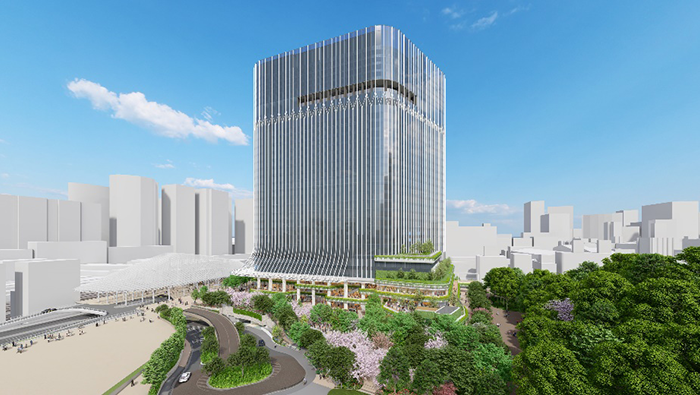
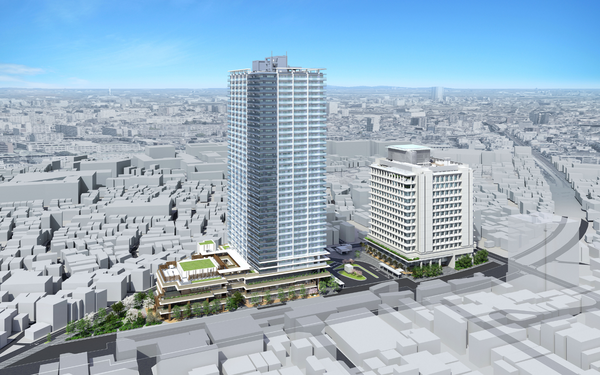
What this rendering reveals is that the plan is not merely about erecting a standalone residential tower at the station front. It is conscious of low-rise vibrancy, the connection to the station plaza, and pedestrian dwell time. A station-front impression affects not only rent levels but also how visitors remember the neighborhood.
When INA advises on an area, we never judge a redevelopment zone by “how glamorous it will look once finished” alone. Rather, we check one by one which roads will widen, which circulation routes will change, and in front of which shops visibility will improve. At the Koiwa south exit, too, this perspective is indispensable.
Plan outline: organizing area, uses, residential units, and height
At present, published figures for the Minami-Koiwa 7-chome station-front redevelopment differ depending on the source. This article anchors on the latest Tokyo Metropolitan Government Bureau of Urban Development page, while treating the environmental impact assessment materials and the business-cooperator announcement as supplementary information.
| Item | Published content |
|---|---|
| Project name | Minami-Koiwa 7-chome Station-front District Type 1 Urban Redevelopment Project |
| Location | Within Minami-Koiwa 7-chome, Edogawa Ward, Tokyo |
| Implementer | Minami-Koiwa 7-chome Station-front District Urban Redevelopment Association (planned) |
| Business cooperators | Nippon Steel Kowa Real Estate, Sumitomo Corporation, Haseko Corporation, Gakken Holdings |
| Implementation area | Approx. 1.5 ha (about 3.7 acres) |
| Total floor area | Approx. 155,000 m² (about 1.67 million sq ft) |
| Building area | Approx. 11,990 m² (about 129,000 sq ft) (business-cooperator announcement) |
| Height | Height limit GL +160 m (about 525 ft) (business-cooperator announcement). The environmental impact assessment anticipates a maximum height of approx. 169 m (about 554 ft). |
| Number of floors | Not disclosed within confirmable published materials |
| Primary uses | Retail, housing, public facilities, childcare facilities, etc. The business-cooperator announcement also lists parking and bicycle parking. |
| Residential units | Approx. 1,100 units. The environmental impact assessment anticipates approx. 1,250 units, so future changes are possible. |
| Project cost | Undetermined |
| City planning decision | October 2023 |
| Future schedule | Approval of the redevelopment association is announced as planned for FY2024. Detailed subsequent steps require confirmation. |
What deserves attention is not residential unit count or height alone. With retail, public facilities, and childcare facilities entering the mix, the hours during which the station front is used may widen. It becomes a mixed-use hub that captures not just morning and evening commuting, but also daytime childcare, shopping, and demand for administrative and community services.
On the other hand, there is room for the numbers to change. The environmental impact assessment materials state a total floor area of approx. 152,000 m² (about 1.64 million sq ft) and approx. 1,250 planned residential units, which differ from the values currently posted by the Tokyo Metropolitan Government Bureau of Urban Development. In investment decisions, you should not treat old figures as fixed information; you need the discipline to track the materials at approval, rights conversion, and groundbreaking.
Why does the Minami-Koiwa 7-chome station-front redevelopment matter? The public-facility and urban-infrastructure view
The importance of this project lies less in building scale and more in the fact that land readjustment and redevelopment advance as one. As the station-front transport plaza, surrounding roads, and pedestrian space improve, what changes is not a single building but how the entire south exit of Koiwa Station is used. Unlike many US or UK schemes where public realm upgrades lag private construction, here they are designed to move together.
| Urban infrastructure / public space | Confirmable content | Practical interpretation |
|---|---|---|
| Station-front transport plaza | Policy to advance development integrally with the land readjustment project | Organizing bus, taxi, and drop-off circulation affects foot traffic in front of shops and rental demand. |
| Surrounding roads | Policy to realize widening of surrounding roads at an early stage | Pedestrian safety, loading/unloading, and the impression during viewings may change. |
| Pedestrian space | Policy to create an attractive, pedestrian-centered environment | As the psychological distance from station to property shrinks, it becomes easier to use in marketing. |
| Disaster prevention | Policy of fireproofing/earthquake resistance and forming a transport and disaster-prevention hub block | Improving the impression of dense wooden areas also bears on long-term holding and explanations to financial institutions. |
| Greenery / landscape | Development policy of creating a green, walkable landscape | Beyond unit price, it affects tenant satisfaction and dwell time. |
| Bicycle parking | Bicycle parking noted as a related city-planning item | In Koiwa's everyday living sphere, organizing bicycle circulation matters for both commercial and residential use. |
For example, even a property a five-minute walk from the station will leave a weak impression after a viewing if the sidewalk is narrow, nighttime visibility is poor, and there is heavy crossing with cars. Conversely, if the sidewalk widens and circulation lets people walk naturally from the station plaza, the perceived value rises at the same distance.
In the Minami-Koiwa 7-chome station-front redevelopment, this change in “perceived value” is the key. If you are considering revising your management company or redesigning listing terms, look not only at the completion rendering but also at the pedestrian routes overlaid with the road plan.
How does it connect with redevelopment around Koiwa Station? Viewing the whole south exit
Community-building around Koiwa Station does not conclude with the Minami-Koiwa 7-chome station-front district alone. Multiple renewals—the Minami-Koiwa 7-chome West District, the Minami-Koiwa 6-chome District, the north exit district, and others—are gradually changing the walkability and trade area around the station.
Looking at the location map, the planned site sits in a position with extremely high station-front character at the south exit of Koiwa Station. Renewal immediately adjacent to a station tends to chain into the value assessment of the surrounding shopping street, existing condominiums, rental housing, and local streets.
Edogawa Ward's district-plan materials also touch on the future addition of a pedestrian passage and pedestrian-deck facility connecting the future Koiwa 7-chome district redevelopment with the Minami-Koiwa 7-chome station-front redevelopment facility. This shows that it is not only the ground-level walking environment but also the three-dimensional station-front circulation that becomes a point of discussion.
This perspective is common to station-front renewals such as the Tobu Hikifune Station-front District Type 1 Urban Redevelopment Project. A neighborhood's valuation is decided not by the specs of a single building, but by the connections among station, plaza, road, retail, and housing.
What should real-estate owners watch? Listing, viewings, renovation, and exit strategy
Real-estate owners are safer if they do not treat redevelopment merely as “news that raises asset value.” During construction, immediately after completion, and after the trade area settles, the points to watch are different.
Design listing terms separately for during construction, not only after completion
During construction, noise, temporary hoarding, and changed pedestrian routes can temporarily make a station-close property's appeal harder to convey. That is precisely why it is important, in listing materials, to explain “the current inconvenience” and “the expected improvement after completion” separately.
Once, when we revised a rental listing in an area where station-front construction continued, we changed how we shot the photos. Rather than avoiding the hoarding, we showed the safe route from station to property, which lowered anxiety before the viewing. The same idea can be used in Koiwa.
Prioritize on-site experience over maps for viewing routes
In redevelopment areas, walking-minutes on portal sites alone do not convey a property's strengths. You need to verify the route tenants actually walk—from the ticket gate to the transport plaza, commercial facilities, sidewalks, and the property entrance.
In INA's free consultation, we check not only rent appraisal but also viewing routes and improvements to photographic appeal. If you own a property near a planned redevelopment site, we recommend reassessing it by separating the on-paper distance from the real-world ease of walking.
Order renovation priorities as exterior, common areas, then security
When the station-front landscape is tidied up, the older the building, the more its exterior and common-area gaps stand out. Beyond large-scale interior renovation, the priority rises for parts that govern first impressions—entrance lighting, mailbox banks, delivery lockers, and security cameras.
Investment to match the post-redevelopment streetscape is best not judged by short-term payback alone. The perspective of nurturing a property that is chosen for the long term is, like investment in human capital (人財, jinzai—INA's philosophy of treating people as the greatest asset), also a hard-to-see accumulation of trust.
For exit strategy, think about “who it resonates with” more than “when to sell”
In a station-front renewal like the Minami-Koiwa 7-chome station-front redevelopment, the future buyer profile changes. It is important to organize for whom the appeal increases—owner-occupiers, unit investors, corporations, inheritance-planning buyers, and so on.
For example, with a whole-building property within walking distance of Koiwa Station, one option is to wait for the post-completion trade-area improvement. However, if you merely wait while neglecting repairs, the building will not keep up with the neighborhood's rising valuation. Exit strategy should be considered as a set with the improvement plan while holding.
What are the cautions for the Minami-Koiwa 7-chome station-front redevelopment? Separate unconfirmed information
In the Minami-Koiwa 7-chome station-front redevelopment, there is information that is currently undisclosed or subject to change. When using it for investment or rental operations, it is important not to mix confirmed information with planned information.
- Project cost is undetermined in the Tokyo Metropolitan Government Bureau of Urban Development listing.
- The number of floors is not disclosed within confirmable published materials.
- For residential units, there is a difference between the approx. 1,100 units listed by the Tokyo Metropolitan Government Bureau of Urban Development and the approx. 1,250 planned units in the environmental impact assessment materials.
- The detailed groundbreaking and completion timing after approval of the redevelopment association requires confirmation via official materials as of the time this article was written.
In redevelopment articles, the larger the numbers, the more memorable they are. But if you value long-term trust, unconfirmed information should be treated as unconfirmed. Honest organization of information is a plus for owners, tenants, and all local stakeholders.
As a station-front renewal similarly advancing across multiple blocks, the Hirakata City Station Area Type 1 Urban Redevelopment Project is also a useful reference. By viewing completion timing and uses block by block, the precision of investment decisions rises.
Summary: the Minami-Koiwa 7-chome station-front redevelopment changes the station front's experiential value
The Minami-Koiwa 7-chome station-front redevelopment is not merely a plan to gather housing, commercial, and public functions onto a site of roughly 1.5 hectares (about 3.7 acres). By organizing the station-front transport plaza, roads, pedestrian space, and disaster resilience together with land readjustment, it is a project that changes the experiential value of the south exit of Koiwa Station.
In real-estate practice, rather than expecting only post-completion price increases, you need to consider listing during construction, the post-completion trade-area change, the building's renovation priorities, and exit strategy as one whole. Redevelopment is not something to wait for; it is something to prepare for and make the most of.
If you own a property around Koiwa Station, or are considering acquiring one, walk the site and observe the circulation while checking the latest official materials. Layering numbers onto on-site experience leads to long-term asset formation.
How transaction prices have actually moved
To see how far expectations for the redevelopment are actually reflected in transaction prices, we checked the real estate transaction price data published by the Ministry of Land, Infrastructure, Transport and Tourism. Because resale condominium transactions at the district level in Minami-Koiwa are few, at 20 to 45 a year, we have aggregated the figures for Edogawa Ward as a whole.
| Year | Transactions | Edogawa Ward price per m² (median) |
|---|---|---|
| 2023 | 846 | ¥600,000 |
| 2024 | 897 | ¥600,000 |
| 2025 | 1,108 | ¥653,000 |
| 2026 (Q1 only) | 216 | ¥693,000 |
From 2023 to 2025 the resale condominium price per m² in Edogawa Ward rose +8.8%. From 2023 to 2024 it stayed flat at ¥600,000 per m², and it began to move only once 2025 arrived.
In absolute terms for Minami-Koiwa alone, transactions from 2025 onward had a median of ¥76.5 million on a floor area of 70 m². This is an aggregate of 60 transactions, however, so it needs to be read with a margin.
Source: Compiled by INA&Associates Inc. from “Real Estate Transaction Price Information” (Ministry of Land, Infrastructure, Transport and Tourism), MLIT Real Estate Information Library (国土交通省 不動産情報ライブラリ, https://www.reinfolib.mlit.go.jp/). Based on data obtainable as of September 2026. The most recent quarter is provisional, because transactions are added later.
INA’s view (as of September 2026)
From here on, this is not published material but our own assessment.
The Minami-Koiwa redevelopment is not yet at the stage of working through into transaction prices. The ward-wide rise in Edogawa, at 8.8% over three years, is on the gentle side among the 23 wards of Tokyo. Nor could we find any sign in the current transaction counts that Minami-Koiwa alone stands out within the ward.
This does not mean the project is a poor one. Until the buildings take shape, owner-occupier buyers judge the price on the town as it is today. As set out in this article, uncertain elements still remain in this project. Prices will reflect them only once those are settled.
How to judge it as an investor
- Assess the returns without pricing expectations for the redevelopment into the figures. Only properties that stand up at today’s rent levels belong on your list.
- Because transactions at the district level are few, it is hard to form a sense of the going rate for a narrowly defined area. It is realistic to base your judgment on the level for Edogawa Ward as a whole.
- The point at which the gap with the ward as a whole begins to widen will be the signal that the market has started to price it in. The transaction price data is updated every quarter, so you can follow it with the same procedure.
FAQ
Where is the Minami-Koiwa 7-chome station-front redevelopment taking place?
It is planned within Minami-Koiwa 7-chome, Edogawa Ward, Tokyo, in an area close to the south exit of JR Koiwa Station. It is a location deeply tied to the development of the station-front transport plaza and surrounding roads.
How many residential units will the Minami-Koiwa 7-chome station-front redevelopment have?
The Tokyo Metropolitan Government Bureau of Urban Development listing states approx. 1,100 residential units. Meanwhile, the environmental impact assessment materials anticipate approx. 1,250 units, so confirmation with the latest materials is needed.
Has the completion timing been decided?
As of the time this article was written, no confirmed completion timing can be verified from official materials. The business-cooperator announcement states that approval of the redevelopment association is planned for FY2024.
What kind of impact will there be on nearby rental properties?
If station-front circulation and the commercial environment improve, there may be a plus for marketing appeal and tenant satisfaction. However, caution is needed regarding noise during construction and changed pedestrian routes.
Has the Minami-Koiwa 7-chome station-front redevelopment "failed"?
Some people search for "Koiwa redevelopment failure," but published materials do not confirm any fact that the Minami-Koiwa 7-chome station-front redevelopment itself has been halted or frozen. The Edogawa Ward Assembly did receive a petition, accepted on September 15, 2011 (Heisei 23), requesting suspension of the land readjustment and redevelopment projects at the south exit of JR Koiwa Station 7-chome (受理: JR小岩駅南口7丁目区画整理事業と再開発事業の中止を求める陳情), and it is a fact that some local residents voiced concern about the plan at that time. However, the project's procedures have continued to move forward since then: it passed the city planning decision in October 2023, and has progressed to the stage where Nippon Steel Kowa Real Estate, Sumitomo Corporation, Haseko Corporation, and Gakken Holdings are listed as business cooperators. The past existence of opposition voices, and the fact that the project is still moving forward today with a completed city planning decision, are both facts that should be kept separate.
References
- Tokyo Metropolitan Government Bureau of Urban Development (東京都都市整備局), “Minami-Koiwa 7-chome Station-front District Type 1 Urban Redevelopment Project”
- Nippon Steel Kowa Real Estate (日鉄興和不動産), on the city planning decision for the “Minami-Koiwa 7-chome Station-front District Type 1 Urban Redevelopment Project”
- Tokyo Metropolitan Government Bureau of Environment (東京都環境局), Environmental Impact Assessment, “Progress of Procedures”
- Edogawa Ward (江戸川区), “JR Koiwa Station Area District Plan (Draft)”
- Edogawa Ward (江戸川区), “JR Koiwa Station Area Community-Building, Minami-Koiwa 7-chome District, No. 64”