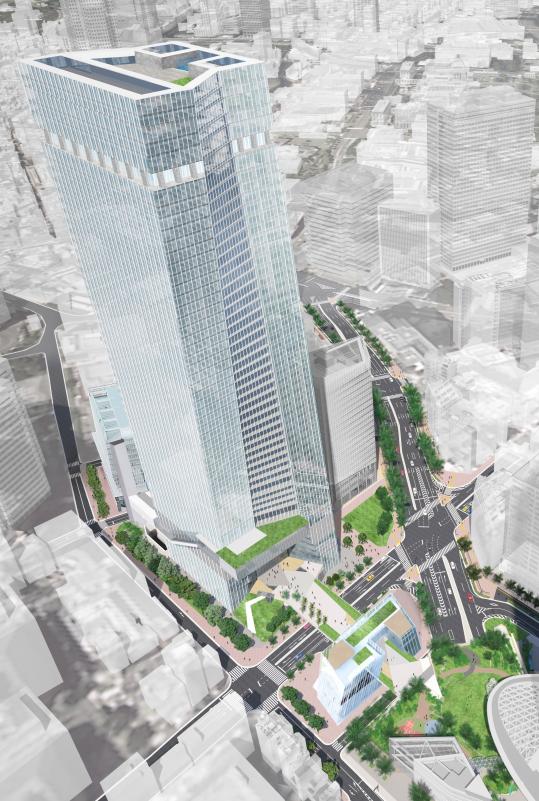
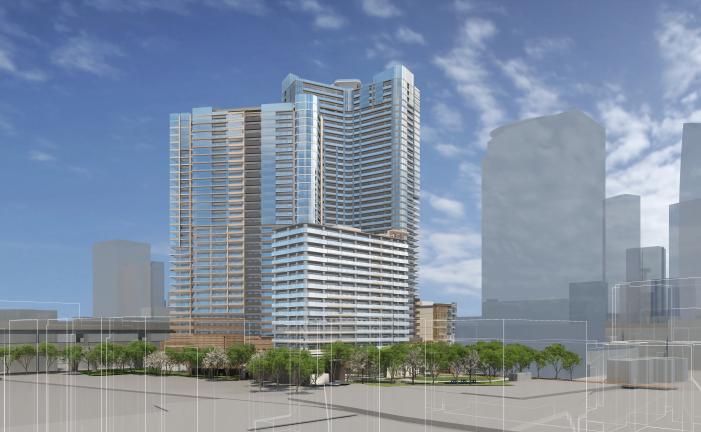
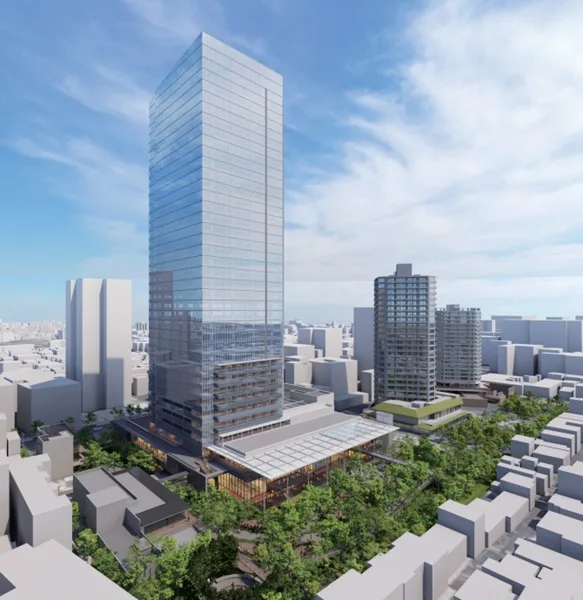
At the north exit of Musashi-Koganei Station on the JR Chuo Line in western Tokyo, a project called the "Musashi-Koganei Station North Exit East District Type 1 Urban Redevelopment Project" (武蔵小金井駅北口駅前東地区第一種市街地再開発事業) is under way. This is a shigaichi saikaihatsu jigyo, a uniquely Japanese form of land readjustment and rebuilding in which fragmented landowners pool their rights into a legal cooperative and receive units in a new building in exchange — a mechanism with no exact equivalent in US or European redevelopment law. Its centrepiece is the South Block, where a 33-storey residential-and-commercial tower of about 122m is planned. According to the City of Koganei's guide (updated 29 May 2026), the first revision of the project plan, approved by the Governor of Tokyo on 7 January 2026, was followed by a second revision approved on 29 May 2026, and the cooperative is now working toward approval of its rights-conversion plan.
This article focuses on the South Block, which faces the station plaza, and lays out the building scale, mix of uses, pedestrian space, plazas, decks and schedule strictly from official sources. The short version: this redevelopment is not simply "a tower going up." It should be read as a project to redesign the walkability of a north-side commercial district that weakened after a large anchor store withdrew — using low-rise retail, new housing supply, sidewalk-like open space, plazas and decks.
Key points of this article
- The South Block is planned at about 3,430 m² of building site area, about 47,300 m² of total floor area, 33 storeys and a height of about 122m.
- The main uses are housing and retail; the housing comprises 1LDK to 3LDK units (one-to-three bedrooms plus living/dining/kitchen), with 415 units planned.
- The South Block adds Plaza No.1 of about 720 m², Plaza No.2 of about 140 m² and sidewalk-like open space, strengthening the pedestrian flow from the station plaza toward Musako-dori.
- Rights-conversion approval is targeted for fiscal 2026, the start of main construction for October 2026, and completion for November 2030.
What is the Musashi-Koganei Station North Exit East District?
The project site sits in Honcho 5-chome, Koganei City, Tokyo, at the north exit of Musashi-Koganei Station, covering roughly 0.6 hectares. The official project name is the "Koganei City Planning Project, Musashi-Koganei Station North Exit East District Type 1 Urban Redevelopment Project," and the implementer is the Musashi-Koganei Station North Exit East District Urban Redevelopment Cooperative.
The official project plan explains that this district long served as a central commercial area of Koganei City, where large stores built in the 1960s and 1970s coexisted with a dining-focused shopping street. At the same time, building renewal had stalled: ageing, underused buildings increased, and the withdrawal of a large store reduced foot traffic. In other words, this project is not merely about making buildings taller. It is an urban-function renewal aimed at regenerating the north-side commercial district. Unlike a typical Western city-centre office tower scheme driven by a single developer assembling a site, here the existing rights-holders themselves form the cooperative that rebuilds the block.
South Block overview: 33 storeys, about 122m, 415 homes
The South Block is the core block of this project, facing the station plaza. Under the project plan as revised in January 2026, the South Block has a building site area of about 3,430 m², a building footprint of about 1,980 m², a total floor area of about 47,300 m², and a floor-area-ratio-counted area of about 30,140 m², with a building coverage ratio of about 58% and a floor area ratio of about 880%.
The building is reinforced concrete, 33 storeys above ground with a penthouse, and about 122m tall. Its uses centre on housing and retail: the 1st floor holds housing, shops and parking; the 2nd floor housing and shops; the 3rd floor housing, bicycle parking and machine rooms; and the 4th floor and above are housing. There are about 213 car spaces and about 512 bicycle spaces.
The housing plan is 1LDK to 3LDK units, about 60 m² of floor area per unit, sold as sectional ownership (区分所有, the Japanese condominium tenure in which each owner holds title to an individual unit), totalling 415 units. The stated aim is to increase the residential population near the station — primarily child-rearing households, but designed for multiple generations — and thereby contribute to local vitality.
| Item | South Block plan |
|---|---|
| Location | Within Honcho 5-chome, Koganei City, Tokyo |
| Building site area | About 3,430 m² |
| Total floor area | About 47,300 m² |
| Structure / scale | Reinforced concrete, 33 storeys above ground, with penthouse |
| Height | About 122m |
| Main uses | Housing, shops, parking, bicycle parking, machine rooms |
| Number of homes | 415 units (1LDK to 3LDK) |
| Car / bicycle parking | About 213 cars, about 512 bicycles |
Low-rise retail and station pedestrian flow are the value drivers
The key to reading the South Block is not only the high-rise housing but the low-rise retail and the pedestrian flow. The project plan sets out that retail facilities will be developed along the street, with merchandise, dining and service-type commercial functions introduced into the low-rise base. This is the element meant to reconnect the station plaza, Musako-dori and the shopping street along City Road No.136.
At the north exit, while redevelopment on the south side and development under the elevated JR Chuo Line have improved walkability around the station, the north side struggled with falling foot traffic after the large store withdrew. Therefore, whether the South Block's low-rise base remains mere housing-attached shops, or instead guides people together with the station plaza, shopping street and deck routes, will determine the commercial value after completion. For an overseas investor, this is the difference between buying floor area and buying a position in a genuinely re-knitted pedestrian network.
Plazas, sidewalk-like open space and decks redesign "from station to shopping street"
What deserves particular attention in the official materials is that two plazas are set within the South Block site. Plaza No.1 is about 720 m² and Plaza No.2 about 140 m², planned to guide people from the station plaza side toward Musako-dori and to serve as spaces for meeting up and for cross-generational interaction. The North Block will also have Plaza No.3 of about 300 m² as a rooftop plaza, intended to double as an evacuation space in a disaster.
Furthermore, the South Block's building is set back 3m from the road to create sidewalk-like open space. Sidewalk-like open space No.1 is 3.0m wide and about 210m long; No.2 is 1.0m wide and about 80m long. A three-dimensional pedestrian passage connecting the north and south sides of Musako-dori is 3.0m wide and about 30m long, planned to link Plaza No.1 with Plaza No.3 on the North Block rooftop.
This composition is not the common station-redevelopment design that "sucks people into the building." It is urban-infrastructure development that circulates people across the station plaza, Musako-dori, the North Block and the rooftop plaza. When considering the South Block's asset value, too, you need to watch not only unit specifications but how the quality of the pedestrian network spreads into the valuation of the whole area. Unlike many Western mixed-use towers where the podium is privatised retail, the public realm here is the project's spine.
Division of roles with the North Block: a high-rise South, a low-rise North
This project includes not only the South Block but also the North Block on the north side of Musako-dori. The North Block is planned as a low-rise commercial facility with a building site area of about 1,770 m², a total floor area of about 3,080 m², a steel-frame structure of 4 storeys above ground, and a height of about 20m. It has about 8 car spaces and about 450 bicycle spaces.
By design, the North Block is to be a low-rise building in harmony with the streetscape of the shopping street, taking on the role of providing a rooftop plaza. While the South Block concentrates housing and retail through high-intensity land use, the North Block functions like a buffer zone connecting to the existing shopping street. Whether the plan can reconcile a landmark presence at the station front with continuity of the shopping street is a key point in evaluating it.
Public facilities: widening City Road No.136 and separating pedestrians from traffic
As for public facilities, City Road No.136, which is Block Road No.1, is to be widened to 6.7m and about 80m long. The purpose is to secure pedestrian safety, with a sidewalk planned as a pedestrian-vehicle separation function.
In station-front redevelopment, building scale tends to attract attention, but what governs long-term local value is the continuity of roads, open space and plazas that let pedestrians head to the shopping street with peace of mind. Since the north exit's challenge is "regenerating the shopping street," the safety of City Road No.136 and the ease with which pedestrians can linger directly affect the success of the commercial floors.
Schedule: main construction start in October 2026, completion targeted for November 2030
According to the City of Koganei's guide, the sequence is: city-planning decision and public notice in December 2024; cooperative establishment approval and public notice in June 2025; establishment of the redevelopment cooperative in July 2025; start of demolition of existing buildings in October 2025; the first project-plan revision in January 2026; and the second project-plan revision in May 2026. Going forward, rights-conversion approval is targeted for fiscal 2026, the start of main construction for October 2026, and completion for November 2030.
The Tokyo Metropolitan Government's announcement of 19 June 2025, which approved the establishment of the cooperative, stated that building completion was scheduled for fiscal 2029, but following subsequent project-plan revisions the City of Koganei's latest guide gives completion as November 2030. Because future timing may change with subsequent approvals and construction progress, for investment or store-opening decisions you need to keep checking the published materials on project-plan revisions and rights-conversion approval.
From a real-estate investment and rental-management view: will the station-front "plane" change?
The South Block's 415 homes are a direct factor in increasing the station-front population. However, from an investment and rental-management view, you will misjudge if you look only at the price or rent of the new tower in isolation. What matters is how far the north-side station plaza, Musako-dori, the existing shopping street and the south-side commercial cluster connect, and whether they can increase dwell time and everyday spending around the station.
If the redevelopment succeeds, the north exit moves closer to being a "station front where people stay and circulate" rather than one they merely pass through. This affects the appeal of nearby rental housing, the visibility of retail units, and the clustering of daily-convenience facilities. On the other hand, if the tenant mix of the commercial floors is weak, or if the pedestrian decks and plazas are not used day to day, the spillover to the surroundings may not be as broad as the landmark presence suggests. To put the scale in international terms, the new tower's homes at roughly 60 m² each sit in a market where central-Tokyo new-build condominiums are often quoted well above ¥1,000,000 per m² (about USD 6,500 per m² as of 2026-05), so suburban station-front renewal like this is watched as a relative-value play.
Owners and investors should continually check not just the completion date but the low-rise tenants, the operation of the plazas, pedestrian volumes on the surrounding roads, and the circulation with the south exit. Station-front redevelopment is not a project whose goal is the completion date; what is tested is whether area value takes root in the operation after completion.
Related reading
- Meguro Station-Front Redevelopment: Three-Phase Urban Renewal and Its Impact on Property Value
- Jujo West Exit Redevelopment "J&TERRACE" One Year On: Land Prices, Retail Challenges and an Investment View
- Akabane 1-chome District 1 Redevelopment: How a 108m Tower Changes the Future of Akabane Station East Exit
Summary
With its scale of 33 storeys, about 122m and 415 homes, the South Block of the Musashi-Koganei Station North Exit East District draws attention as a station-front tower plan. Its essence, however, lies in regenerating the north-side commercial district, rebuilding the pedestrian network, and developing public-realm space including plazas and decks.
The South Block's success depends less on housing supply itself than on how it links the low-rise retail with the station plaza and Musako-dori and raises the walkability of the north exit as a whole. Toward fiscal 2026 rights-conversion approval, the start of main construction in October 2026, and completion in November 2030, the points to watch will be the concrete shape of the tenant mix and plaza operation.
Citations and references
- City of Koganei (小金井市), "Guide to the Musashi-Koganei Station North Exit East District Urban Redevelopment Project" (updated 7 January 2026)
- City of Koganei, "On the public inspection of documents showing the project site and the outline of the design" (updated 7 January 2026)
- Musashi-Koganei Station North Exit East District Type 1 Urban Redevelopment Project, Project Plan (approved 20 June 2025; revised 7 January 2026)
- Tokyo Metropolitan Government (東京都), "We approve the establishment of the Musashi-Koganei Station North Exit East District Urban Redevelopment Cooperative" (19 June 2025)
- City of Koganei, "The area of the Musashi-Koganei Station North Exit East District Urban Redevelopment Preparatory Cooperative has changed" (updated 19 May 2023)