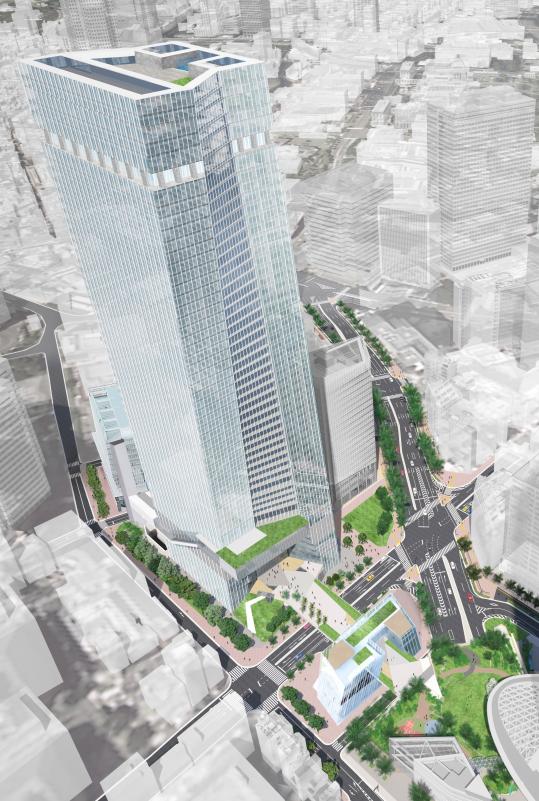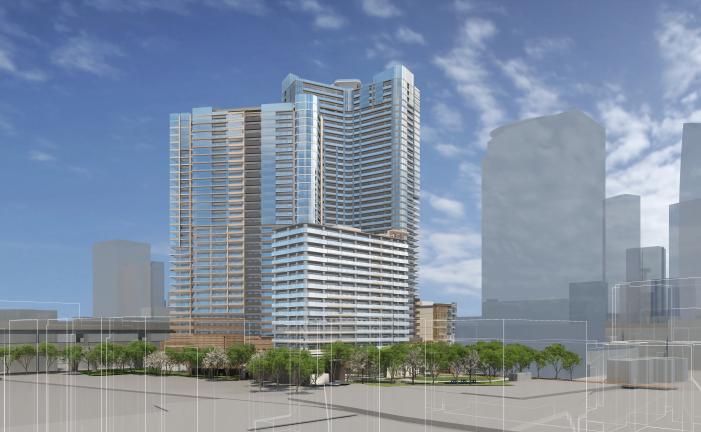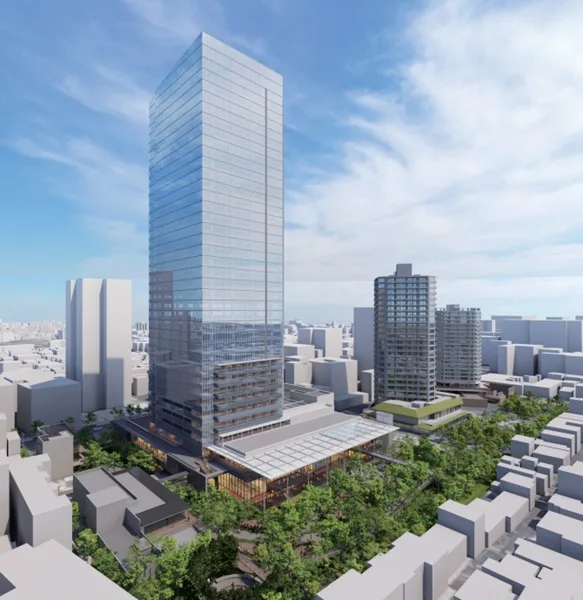
The Kita-Aoyama 3-Chome District Type 1 Urban Redevelopment Project is a Type 1 urban redevelopment project underway in part of Kita-Aoyama 3-chome, Minato City, Tokyo. The planned site lies between Omotesando Station, served by the Tokyo Metro Ginza Line, Hanzomon Line, and Chiyoda Line, and Gaienmae Station on the Ginza Line. It is characterized by pursuing high-intensity land use in an integrated manner, including renewal along Aoyama-dori and the use of metropolitan land. Rather than a single building replacement, it is positioned as a framework for solving district-wide issues such as aging buildings, fragmented parcels, pedestrian space, and disaster resilience by combining building development with public facility development.
The implementing entity is the Urban Renaissance Agency. According to Minato City’s published materials, the project is intended to introduce urban functions such as office, commercial, lodging, public and community facilities, and plazas, and to reorganize the urban infrastructure and the way the district is used along Aoyama-dori. Because the site sits at a junction between the high visitor density on the Omotesando side and the office and transport demand on the Gaienmae side, the project centers not only on land-use composition but also on roads, pedestrian passages, plazas, and streetside spaces. The project was formally decided in the city planning process on December 5, 2022, and approved in August 2023. In the published materials, construction had been scheduled to begin in fiscal 2025, with completion set for fiscal 2029; construction actually began on June 1, 2026, and completion is now scheduled for 2030.
What Changed With the June 2026 Construction Start
The clearest sign of progress on site is the shift from planning to active construction. Tokyo Tatemono and Tokyu Fudosan, working with implementer the Urban Renaissance Agency, announced construction began June 1, 2026, with a groundbreaking ceremony on June 5, confirming the start date and projected 2030 completion. The project pairs road and plaza work with denser land use for offices, retail, lodging, and public facilities, addressing aging buildings and fragmented greenery along Aoyama-dori.
This is a "Type 1 urban redevelopment project" under Japan's City Planning Act, built around rights conversion: landowners exchange old, fragmented rights for floor space in the new building rather than selling and leaving. Such projects are often union-implemented by a redevelopment association of the rightsholders, not a private developer alone, with a public agency or developer partner as project support. It proceeds only after a city planning decision, a government land-use approval loosely comparable to a US rezoning, with rights-conversion bundled in from the start rather than sought separately by a developer.
Project Overview
| Item | Details |
|---|---|
| Project name | Kita-Aoyama 3-Chome District Type 1 Urban Redevelopment Project |
| Location | Part of Kita-Aoyama 3-chome, Minato City, Tokyo |
| Implementing entity | Urban Renaissance Agency |
| Project area | Approx. 2.9 hectares |
| Site area | Block I approx. 20,200 square meters, Block II approx. 1,100 square meters |
| Total floor area | Block I approx. 178,000 square meters (Minato City materials state approx. 178,800 square meters), Block II approx. 2,000 square meters |
| Height and floors | Block I approx. 180 meters, 38 floors above ground and 2 below ground; Block II approx. 20 meters, 3 floors above ground and 2 below ground |
| Main uses | Block I offices, retail, lodging, public and community facilities, etc.; Block II retail, etc. |
| City planning decision | December 5, 2022 |
| Project approval | August 2023 |
| Scheduled start of construction | June 1, 2026 |
| Scheduled completion | 2030 |
| Design and construction | Urban planning and basic design: Nihon Sekkei; detailed design and construction: Obayashi Corporation |
Project Characteristics
The core of the plan is the combination of a high-rise building in Block I and a low-rise building in Block II, balancing high-intensity land use along Aoyama-dori with consideration for the streetscape. Block I concentrates office functions together with commercial, lodging, and public/community facilities, while Block II accommodates retail and related uses. Rather than building only a roughly 180-meter-tall tower on its own, the concept is to renew the entire block, including the liveliness of the lower levels, how it presents to the streetscape, and the continuity of outdoor spaces. The number of housing units and the unit mix have not been disclosed within the scope of publicly available materials.
Reorganization of pedestrian space is also a major element of the project. A plaza is planned on the western urban block side, and pedestrian passages connecting roads and plazas are to be created inside and outside the building to enhance circulation along Aoyama-dori. A pedestrian-like open space along the road is also included, with the intention of securing a place for people to stay rather than simply pass through, even along a major arterial road. The project seeks to improve not only the route from the station into the building but also the walking experience of crossing the block and moving between the Omotesando side and the Gaienmae side, which clearly reflects the character of this district redevelopment.
In road development, new District Road No. 1 will be created with a signalized connection to Aoyama-dori, aiming to ensure safe connections to the southern urban area and surrounding blocks. At the same time, District Road No. 2 will be developed to maintain the traffic function of the existing road while improving the safety of cyclists and pedestrians, and both roads are planned to be undergrounded for utility poles. District Road No. 1 is planned at roughly 23 meters wide and about 160 meters long, and District Road No. 2 at roughly 5.8 to 6 meters wide and about 130 meters long. The fact that the redevelopment is being redesigned not only in terms of building scale but also in terms of street continuity, visibility, and room for disaster resilience is important as an Aoyama-dori streetside renewal project.
On the disaster prevention and environmental side, the plan includes securing plazas and open spaces to improve regional disaster resilience, while strengthening a green network with consideration for biodiversity as part of the design policy. Together with an adjacent district, the project is planned to create roughly one hectare of tree belt, of which about 6,000 square meters falls within this project alone, contributing to a green network connecting nearby large-scale green spaces such as Meiji Jingu Shrine and the Akasaka Imperial Estate. The idea of creating a lush open space in Block II has also been presented, showing that the district renewal is treating the quality of the outdoor environment as part of the project, not just the supply of floor space that comes with vertical development. Within the scope of publicly available materials, no specific environmental certification policy or detailed planting plan name has been disclosed.
As a public and community function, Minato City has announced a sports facility development plan using rights floor space it plans to acquire. A total of 1,858.22 square meters on the basement first floor and first floor of the public facility building would be used to provide a multipurpose gymnasium, multipurpose rooms, changing rooms, shower rooms, and more, with everyday use by nearby residents and workers also envisioned. This is one of the defining features of the district: the functions introduced by redevelopment are not limited to office and retail, but also include public and community uses connected to local life.
Relationship with Surrounding Projects and the Area
The project site sits midway between Omotesando Station and Gaienmae Station, in a location that receives broad pedestrian flows along Aoyama-dori. The Omotesando Station side has a strong concentration of retail and visitor demand, while the Gaienmae Station side also has office use and movement demand during events, so this project should be understood not as a single building replacement but as a project that reorganizes the pedestrian environment between stations, the streetscape, and the quality of stay spaces. As a block facing Aoyama-dori, not only building height and use but also whether pedestrian-like open spaces and plazas function continuously will influence the impact on the surrounding area.
In particular, the fact that the new road, pedestrian passages, pedestrian-like open spaces, and plaza are planned as an integrated package shows a composition that emphasizes connection with surrounding blocks. The design assumes that visitors from the Omotesando side, commuters from the Gaienmae side, nearby workers, and local users will use the same block for different purposes, revealing a design philosophy that ties together movement inside and outside the buildings. Along Aoyama-dori, visibility is high, but there are also situations where pedestrians do not stay long, so whether the plaza and low-rise components actually lead to more circulation will be a key point after completion.
In addition, the sports facility envisioned by Minato City is a public and community function intended for residents of the Akasaka and Aoyama area and for nearby workers. This means the Kita-Aoyama 3-Chome District will be reorganized not only as a new supply of office, commercial, and lodging space, but also as a block with a base for local use. By layering public urban functions onto the location between Omotesando and Gaienmae, the plan can be understood as broadening its character into a mixed-use hub connected not only to daytime populations and visitors but also to everyday local use.
The ripple effects expected in the surrounding area are likely to appear less as the presence of the supertall tower itself and more as changes in the experience of moving between stations and in how Aoyama-dori is used. After completion, the evaluation will be inseparable from not just the building specs, but from how much the plaza is actually used, how the public and community facility is integrated into local movement flows, and how far the pedestrian environment along Aoyama-dori is renewed. Within the scope of publicly available materials, no specific name for an integrated private block development with neighboring sites or additional participating developers has been disclosed.
Practical Points Nearby Owners Should Check Now
Start with pedestrian and vehicle routing during construction. Footpaths and traffic patterns near the site will likely shift in stages before the 2030 completion, so owners of nearby retail, office, and rental units should periodically revisit where they tell prospective tenants to meet for viewings, how they explain taxi and delivery access, and what the walk home looks like after dark.
Next is marketing language. Phrases such as "steps from the Kita-Aoyama 3-Chome redevelopment" are fine to use before completion, but claims that rents will rise as a result should be avoided. The safer approach is to describe, as verifiable fact, that retail, lodging, public facilities, and pedestrian space are being built out in stages, rather than promising a future payoff.
Third is renovation timing. If the surrounding streetscape will look markedly different by 2030, it is worth reviewing exterior finishes, common-area lighting, signage, and marketing photography sooner rather than later, so an older building does not end up looking neglected next to the newly completed block. Setting priorities on a multi-year horizon is safer than scrambling right before the tower opens.
INA Brief
The essence of the Kita-Aoyama 3-Chome District project is not only the construction of a roughly 180-meter-tall tower, but also how pedestrian space, road infrastructure, plazas, and public/community functions along Aoyama-dori will be reconfigured. Given its location midway between Omotesando Station and Gaienmae Station, the completed project will likely be evaluated not as a single building, but by the quality of circulation between stations and use along the street.
Frequently Asked Questions
When will the Kita-Aoyama 3-Chome District redevelopment be completed?
Construction began in June 2026, with completion scheduled for 2030. As work progresses, confirm the exact timing of any operational opening through announcements from the project partners.
Will the project include housing?
Within the scope of publicly available materials, the number of housing units has not been disclosed. The main uses named so far are offices, retail, lodging, and public and community facilities.
How will this affect nearby rental properties?
It is not possible to state with certainty how rents will move. That said, changes to pedestrian routes, retail concentration, and foot traffic are likely to influence marketing language and renovation decisions for owners nearby.
What should nearby owners check right away?
Check viewing routes during construction, marketing photography, how common areas present to passersby, and your renovation plan through 2030. Move-in decisions depend on the quality of what you can explain to tenants while construction is underway, not only on the finished building.
References and Sources