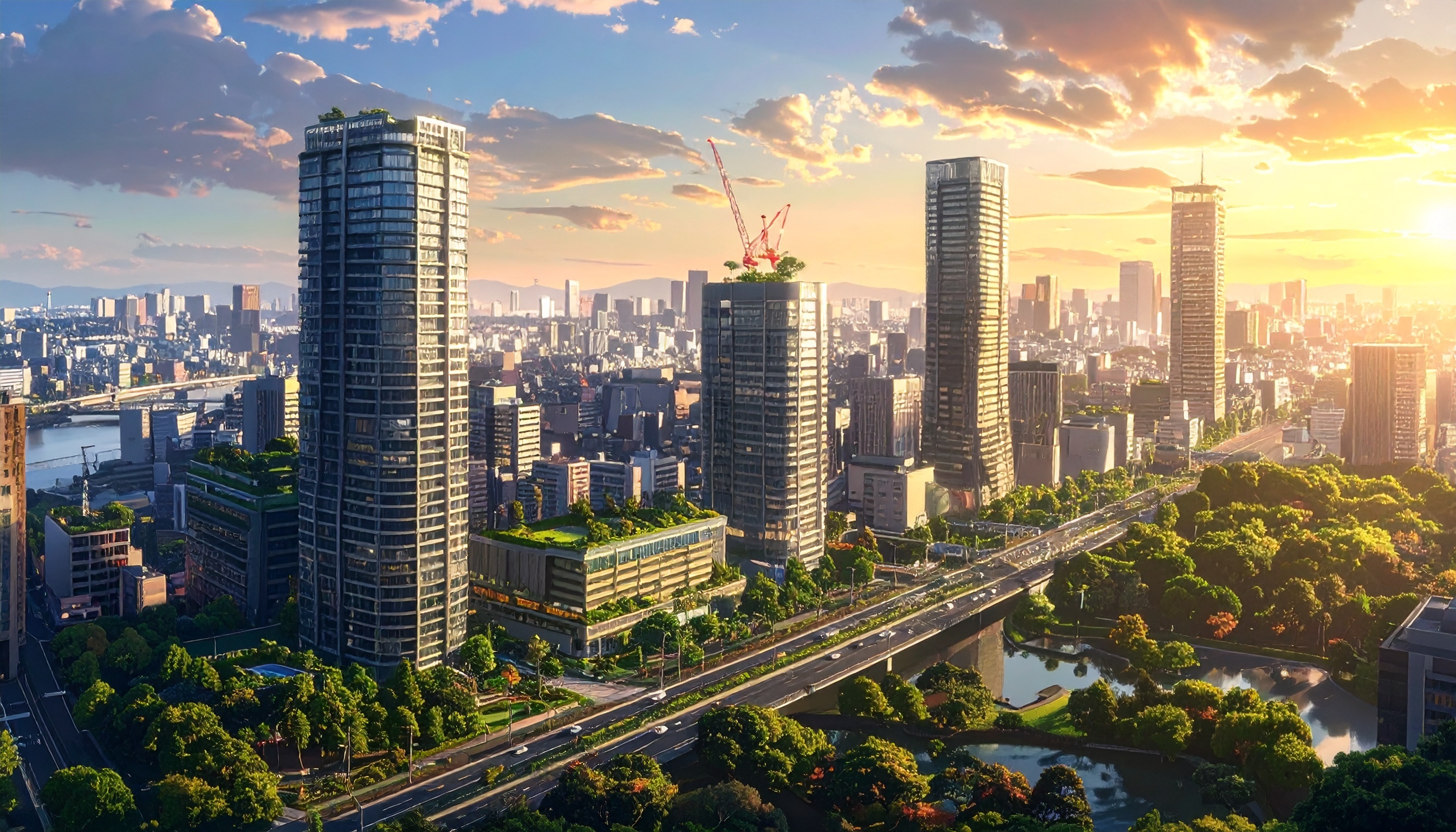
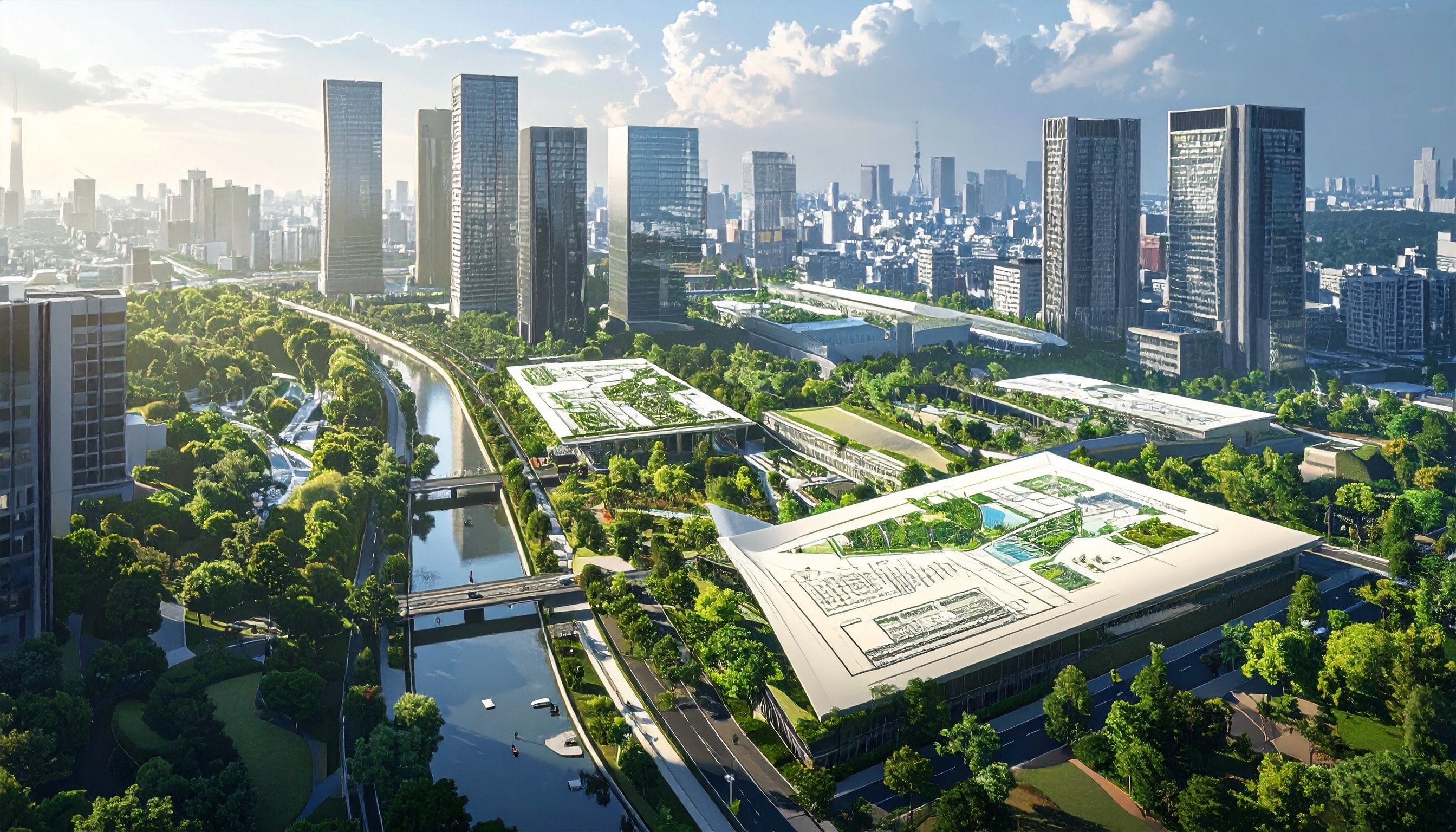
An unprecedented divide has emerged in central Tokyo's office market. In the Otemachi and Marunouchi areas, vacancy rates for Class A buildings stand at0.7%, effectively keeping them fully occupied, while newly built buildings less than one year old have vacancy rates of26.3%, an extraordinary figure. Why do such extreme disparities exist at the same time within the same Tokyo office market? And does the long-held belief that buying in redevelopment areas is a safe bet still hold true today? In this article, we analyze the structural changes in Tokyo's office market using the latest data and present the key investment criteria that wealthy individuals, property owners, and business executives should understand.
Current Data on Polarization in Central Tokyo Offices
The average vacancy rate across Tokyo's five main business wards, Chiyoda, Chuo, Minato, Shinjuku, and Shibuya, was 3.73% as of April 2025, which at first glance appears to be a stable level. However, that average masks the market's true condition.
The vacancy rate in prime areas such as Marunouchi and Otemachi is0.7%. Of 238 Class A buildings, 158, or 66%, are effectively fully occupied. By contrast, the vacancy rate for newly built buildings is26.26%, a serious situation in which more than one in four buildings sits vacant. Miki Shoji's monthly Tokyo Office Market Report also shows that as of February 2026, the vacancy rate for newly built buildings was 9.57%, far above the 2.04% rate for existing buildings, indicating that the market divide continues.
Even more serious is the rapid increase in long-term vacancies. The total long-term vacant floor area in large buildings of more than 5,000 tsubo that have had vacancy rates above 20% for more than a year has reached185,000 square meters, which is12 times higherthan in 2021, an unprecedented pace of expansion. Even as the perception that Tokyo offices are strong takes hold, buildings that are not being chosen are quietly sinking beneath the surface.
The Reversal Between Class A and Newly Built Buildings
The conventional wisdom that newer buildings lease up more easily does not apply in Tokyo's office market today. In fact, the opposite is happening. Why are new buildings sitting empty?
Much of the answer lies inlocation. In waterfront areas such as Harumi, Kachidoki, Toyosu, and Ariake, where large-scale supply has been concentrated, newly completed buildings with state-of-the-art facilities and expansive floor plates have indeed come online one after another. However, access to these areas depends on a limited set of transit lines, making them significantly less convenient for employee commutes than buildings directly connected to major stations in the city center. Now that companies prioritize proximity to stations and access to multiple rail lines above all else when choosing offices, even high-spec buildings are avoided if transportation is inconvenient.
The scarcity of Class A buildings is also accelerating this reversal. The fact that only seven buildings have vacancy rates above 20% illustrates the harsh reality of competition: buildings that are truly chosen continue to be chosen.Is an Office Still Necessary in the Age of Remote Work?As discussed in Is an Office Still Necessary in the Age of Remote Work?, companies are shifting from prioritizing the quantity of office space to the quality of it, and their screening criteria are only becoming more stringent.
Analysis of the Flight to Quality Phenomenon
In the real estate industry, the acceleration of corporate office selection is called a 'Flight to Quality'. The concept is modeled on the movement of investment capital toward safe assets, and the same dynamic is now unfolding in the office market.
There are four main conditions companies currently prioritize when selecting offices. First isproximity to stations and access to multiple rail lines. Convenience in commuting is essential for recruiting and retaining top talent. Second isearthquake resistance and up-to-date facilities for business continuity planning. As awareness of the risk of a Nankai Trough earthquake rises, buildings built under old seismic standards or with aging facilities are no longer being chosen. Third isthe quality of the surrounding environment. Companies value environments where people can work comfortably, including restaurants, retail, and parks. Fourth islarge floor plate design. Companies want one-floor consolidation that strengthens team cohesion, as well as flexibility to accommodate future hiring.
Buildings that satisfy these conditions inevitably cluster around major stations in central Tokyo. That is why vacancy rates in Otemachi and Marunouchi have fallen to 0.7%, while newly built buildings in waterfront areas carry vacancy rates above 26%, creating a structural contradiction. The more a company places investment in people at the center of management, the less willing it is to compromise on office selection.
The Reality of Long-Term Vacancies Concentrated in Waterfront Areas
The geographic concentration of long-term vacancies also shows how serious this issue is. Of the total long-term vacant area,about 61%is concentrated in waterfront areas, with roughly 35% in Harumi, Kachidoki, and Tsukishima, and about 26% in Toyosu, Ariake, and Tatsumi.
This concentration has multiple causes. One is thesurge in office supplydriven by large-scale development that has continued since the late 2010s. Combined with Tokyo Olympics-related projects, the waterfront saw office supply on the scale of hundreds of thousands of tsubo. Another is thestructural limits of transportation access. There are plans for new subway lines and BRT development, but in terms of travel time and number of transfers needed to reach Tokyo's major business hubs, these areas still fall far short of prime sites in Chiyoda and Minato.
What Are the Restoration Obligations When Relocating an Office?As noted in What Are the Restoration Obligations When Relocating an Office?, companies incur restoration costs when relocating offices. Even so, the fact that many companies still choose to leave waterfront areas and return to more convenient central locations demonstrates the fundamental strength of the flight to quality.
The simple equation that redevelopment in waterfront areas automatically leads to rising asset values does not hold, at least in the office market. Redevelopment itself does raise an area's appeal, but in the end a building's profitability depends onwhether tenants move in.
Investment Strategy: Contrarian Use of Secondary Vacancies
From here, I would like to present an investor's perspective on how to turn this polarization into an opportunity.
One side effect of redevelopment that is often overlooked is 'secondary vacancies'. For example, when a company moves into a newly built waterfront office, vacancy is created in the central-city building it leaves behind. These secondary vacancies are often in well-located buildings whose specifications have become outdated or whose facilities have deteriorated. That is why they create arenovation investment opportunity.
When direct investment in Class A buildings is difficult because of pricing or limited supply, acquiring nearby Class B buildings and adding value is a highly effective strategy. Specifically, the goal is to retrofit the features companies prioritize in their flight to quality: redesigned floor layouts, upgraded entrances, and improvements to air conditioning and security systems.
Of course, not every Class B building is an investment target. The prerequisite is superior location. If a building is close to a station and served by multiple rail lines, upgrading its specifications can make it competitive with Class A assets. By contrast, if a building has location disadvantages, renovation alone has limited power to eliminate vacancies.
INA's View
The biggest risk I see islagging information. While some areas have vacancy rates of 0.7%, buildings elsewhere in Tokyo with vacancy rates above 26% continue to increase, and many asset holders still do not fully grasp that reality. It is dangerous to make investment decisions based only on headlines saying Tokyo's office market is strong.
The myth that buying in redevelopment areas is enough for safety is over. Redevelopment certainly improves a neighborhood's appeal and often has a positive impact on the value of residential assets. But when it comes to office assets, no judgment can be made without analyzingwho will lease the space after redevelopment.
What we value is providing essential information from a long-term perspective. Rather than being swayed by short-term market sentiment, our mission at INA&Associates is to build asset strategies together with a 10- to 20-year horizon in mind.
Summary
- Tokyo's office market is undergoing polarization, with Class A buildings at 0.7% vacancy and newly built buildings at 26.3% vacancy existing side by side
- Long-term vacant area has increased 12-fold compared with 2021, and 61% of it is concentrated in waterfront areas such as Harumi, Toyosu, and Ariake
- Corporate flight to quality is accelerating, and the four conditions for buildings that get chosen are proximity to stations, seismic safety, modern facilities, and environment
- The conventional belief that buying in redevelopment areas is safe does not work in the office market
- Renovation investment in Class B buildings that make use of secondary vacancies is drawing attention as a powerful contrarian strategy
- Investment decisions require both an analysis of location advantages and tenant demand trends
Frequently Asked Questions (FAQ)
Q1. By what criteria is a Class A building defined?
A Class A building generally refers to a large-scale office building with a standard floor plate of at least 500 tsubo, completed within the past 20 years, and meeting three conditions: seismic performance, facility specifications, and a strong brand location. There is no single industry-wide definition, and standards differ by research firm, but such buildings are concentrated in areas like Otemachi, Marunouchi, and Toranomon.
Q2. Is the flight to quality likely to continue going forward?
At least in the medium term, meaning the next three to five years, we believe it will. The three trends of intensifying competition for talent, stronger management demand for business continuity planning, and greater emphasis on office quality under hybrid work show no sign of reversing in the short term. That said, if rents for Class A properties rise beyond what companies can tolerate, some demand may spill over into surrounding areas.
Q3. Will the vacancy problem in waterfront areas be resolved in the future?
If subway lines and transportation infrastructure are improved, their disadvantage in access could be reduced. However, transportation upgrades take time on the scale of a decade. In the short term, more realistic solutions may include converting these properties to uses other than offices, such as small hubs designed for remote work, data centers, or residential use.
Q4. What should investors watch out for in renovation investment for Class B buildings?
The most important factor is evaluating location. Without conditions such as being within a five-minute walk of a station and having access to multiple rail lines, it becomes difficult to recover rents no matter how much renovation is done. Next, the accuracy of simulations for investment cost versus rental upside is critical. If a property cannot realistically support rent increases of at least 15% to 20% above current market levels, the payback period may become too long.
Related Reading
Sources and References
- INA&Associates, Analysis of Polarization in the Tokyo Office Market in 2025
- Miki Shoji, Tokyo Office Market (https://www.e-miki.com/rent/tokyo.html)
- Nippon Life Insurance, Current Conditions and Outlook for the Class A Office Building Market in Central Tokyo September 2025
Series: Map of Destruction and Creation: What Is Happening to Cities and Assets Behind Redevelopment
- Part 1:Tokyo's Once-in-a-Century Redevelopment Rush: How the Five Central Wards Are Changing and What It Means for Asset Values
- Part 2: Polarization in Tokyo's Office Market: Why 0.7% and 26% Vacancy Rates Exist at the Same Time This Article
- Part 3:What Is Gentrification? Explaining the Dark Side of Rights Conversion and Risks for Landowners
- Part 4:Jingu Gaien Redevelopment and Landscape Preservation: Why ESG Investment Changes Long-Term Real Estate Value
- Part 5:Will Osaka Follow Tokyo's Path? The Outlook for the Post-Expo Era, IR, and Grand Green Osaka
- Part 6:Destroyer or Creator? Redevelopment Investment Strategies for the Ultra-Wealthy