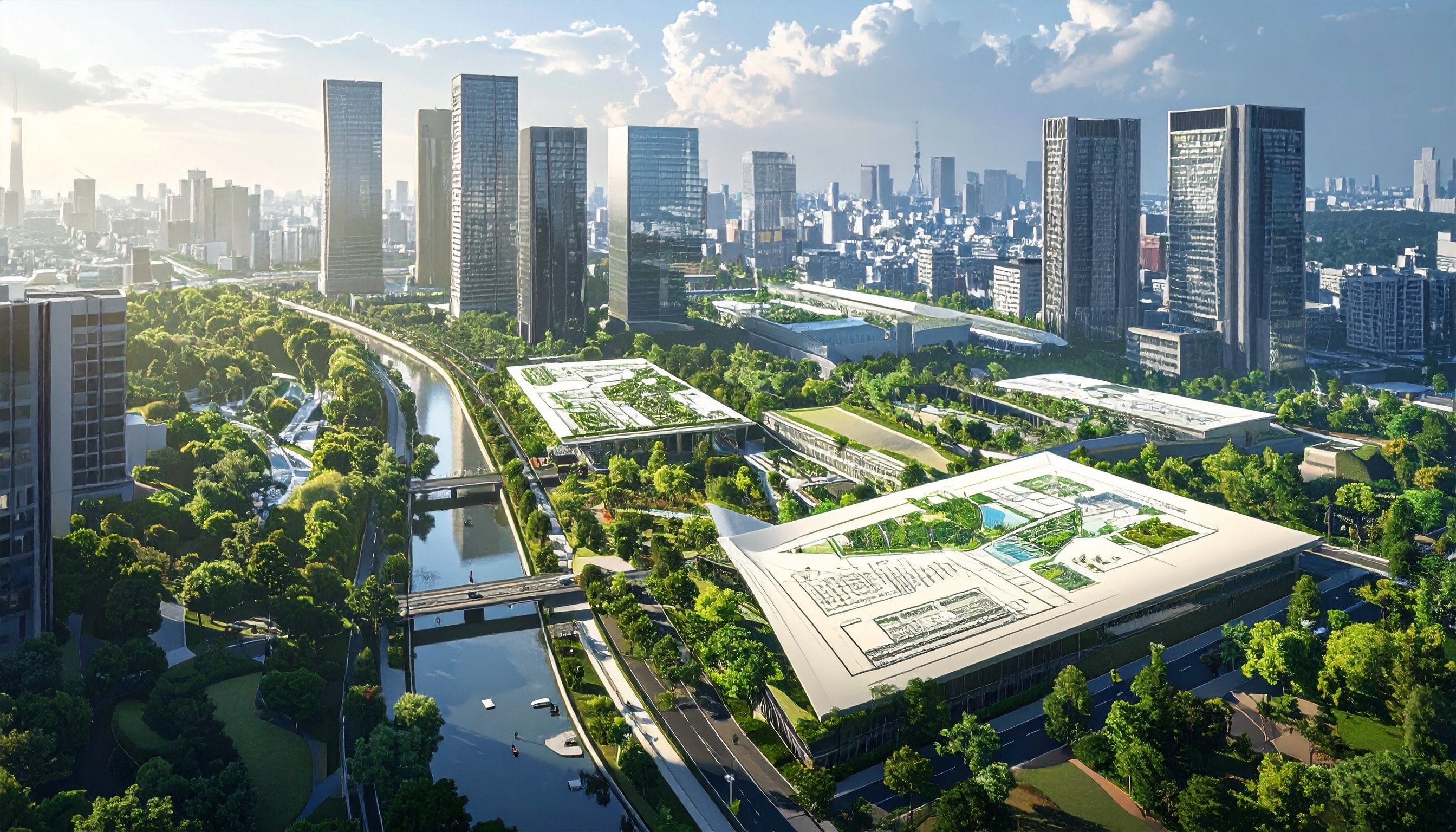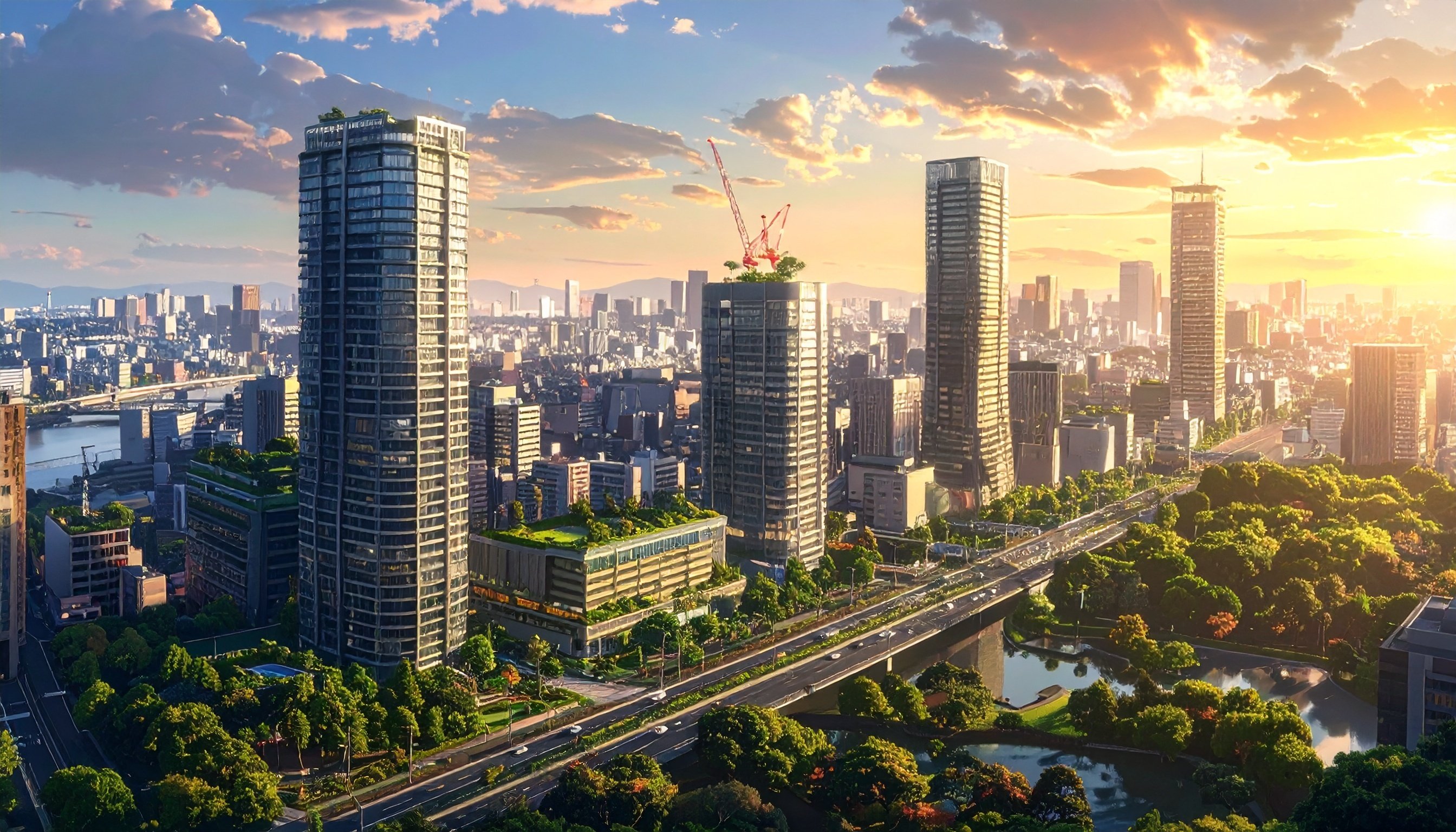
Osaka is undergoing urban transformation on a scale unlike anything in its past. As three major hubs move at once, "Kita" (Grand Green Osaka and the Osaka Marubiru reconstruction), "Minami" (the Namba redevelopment), and "Bay" (the Yumeshima IR), investors are concentrating on one central question: "Will Osaka repeat the path of oversupply that Tokyo has gone through?" We at INA, with our head office in Osaka, have a clear answer to that question.
What is the full picture of Osaka’s three-pole redevelopment?
At present, the Osaka metropolitan area is being "rewritten" around three major hubs.
The first hub, "Kita," is the area centered on Grand Green Osaka (Umekita Phase 2). This development, which held its advance opening in September 2024, is one of Osaka’s largest mixed-use urban development projects, covering a total area of approximately 17 hectares. Of that, 6 hectares have been developed as the urban park "Umekita Park," creating a new urban space that integrates offices, hotels, luxury residences, and commercial facilities. The reconstruction of the adjacent Osaka Marubiru is also under way, and the transformation of "Kita" is still in progress.
The second hub, "Minami," is an area centered on Namba and Dotonbori that is directly tied to inbound tourism demand. Following the rapid recovery in the number of international visitors to Japan, multiple hotel developments and commercial renovations are overlapping, increasing supply at both ends of the market, from accommodation-focused properties to luxury offerings.
The third hub, "Bay," is the highly watched Yumeshima IR. Main construction is under way with the goal of opening in autumn 2030, and Osaka IR Co., Ltd., led by MGM Resorts and Orix, is moving forward as the operating entity.
What is the current status of Grand Green Osaka, and how should it be assessed?
Grand Green Osaka is one of the largest private-sector urban development projects in Japan, undertaken by a major consortium that includes Mitsubishi Estate, Sekisui House, and Takenaka Corporation. It is not simply a redevelopment project. Under the concept of "a forest within the city," it creates a mixed-use urban environment that integrates the functions of working, living, and relaxation.
The impact on the real estate market appeared immediately. In Kita Ward and Chuo Ward, contract unit prices for luxury condominiums have risen, and some properties have already entered price ranges above JPY 8 million per tsubo. Rent levels have also moved upward in tandem, and demand for high-quality office space is concentrating in the Kita area.
That said, there are points we should still view calmly. Grand Green Osaka remains in its early stage, only one to two years after opening. It will take several more years of track record to establish tenant occupancy, operating performance, and the staying power of surrounding commercial activity. It is certainly true that demand emerged ahead of schedule, but it is still too early to say that value has fully settled in.
How far has Yumeshima IR progressed toward its planned 2030 opening?
Osaka IR received its district certification notice from the Ministry of Land, Infrastructure, Transport and Tourism in April 2023 and has formally entered the development phase. Construction costs are projected at roughly JPY 930 billion, and the target is to open in autumn 2030.
Osaka Prefecture and the City of Osaka estimate the annual economic impact at about JPY 1.1 trillion, but I believe it is prudent not to accept that figure at face value. The opening impact of an integrated resort is heavily influenced by surrounding infrastructure, transportation access, and the competitive landscape. The state of BRT development and subway extension for access to Yumeshima will be a critical variable that determines the upper bound of the IR’s opening impact.
Rather, what I want investors to understand is this: the people who benefit most from the IR opening will not be those who rush in after it opens. History shows that real estate prices move ahead of major openings such as this. Preparation now, with an eye on the "second wave" from 2028 to 2029, is the more rational strategy.
Comparison with Tokyo: What are Osaka’s structural strengths as a "city of real demand"?
There is a reasonable basis for the concern that "Osaka may follow Tokyo’s path." Since 2023, Tokyo has seen polarization become visible, particularly in its waterfront areas, due to office oversupply, and the adjustment risk after global money has pulled back has become a real issue.
However, the "quality of the market" is fundamentally different between Osaka and Tokyo.
What has supported Tokyo’s price surge has been foreign-affiliated funds, foreign investment into J-REITs, and yield compression under ultra-low interest rates. When interest rates change and the direction of global money shifts, the structure supporting high prices begins to weaken. That is the essence of bubble risk.
By contrast, in Osaka, domestic institutional investors and end users with real demand are the main market participants. While the city benefits from rising inbound tourism, its dependence on global money is lower, and price formation remains more grounded. I describe this as a "plateau city": it may not rise sharply, but there are also fewer structural factors that would cause it to collapse suddenly.
There is another point that is often overlooked. It is the high population density and transportation convenience of central Osaka. The urban structure centered on Umeda and Namba continues to create a gravitational pull of real demand, where people concentrate both to live and to work, and the geographic and social conditions make it less likely to experience the kind of "return flow after suburban dispersion" seen in Tokyo.
Reading the yield data in the Osaka real estate market
Let us look at what the numbers tell us about the market.
In investment real estate across Osaka’s six central wards (Kita, Chuo, Naniwa, Nishi, Fukushima, and Tennoji), the average gross yield is approximately 4.72% (as of 2025). This is clearly above the roughly 3.8% average for Tokyo’s five central wards (Chiyoda, Chuo, Minato, Shinjuku, and Shibuya).
What this indicates is the possibility that Osaka is still a relatively undervalued market. While yield compression in Tokyo has already advanced considerably, Osaka still offers room to acquire properties at comparatively higher cap rates. For high-net-worth individuals and asset owners, Osaka remains a portfolio option that cannot be ignored, including from the perspective of securing income gain.
At the same time, higher yield alone is not enough. Polarization in Osaka is also progressing, depending on location, building age, and management conditions. What is required is not a rough scenario in which "all of Osaka rises," but a more precise perspective on what will appreciate and what will be left behind in each of the Kita, Minami, and Bay hubs.
Investment timing strategy | From the post-Expo adjustment to the IR second wave
How, then, should we think about the timing of investment in Osaka real estate? I will share my view candidly.
Phase 1 (October 2025 to 2026): the adjustment period after the Expo closes
After the Expo closes in October 2025, demand in construction and tourism may settle temporarily, and the market may move from enthusiasm back toward calm. This period is a moment when "noise declines and underlying real demand becomes easier to see." As the market becomes more selective about properties whose prices have absorbed excessive expectations, investment decisions become easier to make.
Phase 2 (2027 to 2029): the preparation period for the IR second wave
Roughly three years ahead of the IR opening, targeted for autumn 2030, capital inflows into surrounding areas are likely to begin. Development expectations for Yumeshima, Konohana Ward, and the Sakurajima area will trigger a broader reappraisal of the Bay Area as a whole. In that period, it will be important already to hold positions in areas with proven fundamentals.
The rational course of action is a two-stage strategy: wait calmly for the post-Expo market to settle, view any adjustment as an opportunity to add selectively, and position for the second wave before the IR opens. What matters is neither rushing in at elevated prices nor losing the opportunity by standing aside, but entering with a clear basis for timing.
INA’s perspective | A local market pulse that can only be understood from an Osaka head office
We at INA are a real estate company with our head office in Osaka. Rather than talking about Osaka from an outside perspective, as one might with Tokyo, we experience the market’s temperature through our daily work on the ground.
Let me share one point we are seeing in practice. Since 2024, the nature of real estate consultations from affluent clients in Osaka has been changing. Instead of speculative questions such as "Which areas will rise because of the IR?" we are hearing more real-demand-oriented questions such as "Which areas should we choose if we want to hold assets in Osaka over the long term?" I see this as a positive sign of market maturity.
It is also true that inbound tourism has returned to Osaka. At the same time, professional investors have already begun to step back from "inbound-only investing." While continuing to benefit from tourism demand, they are increasingly choosing assets backed by real demand in residential and office uses. I believe that reading this shift accurately is an essential perspective for sustaining success in Osaka investment.
Summary
- In Osaka, the three hubs of "Kita," "Minami," and "Bay" are progressing simultaneously, and the rewriting of the city has already begun in practical terms
- For Osaka IR, main construction is under way with a target opening in autumn 2030. District certification was completed in April 2023
- Tokyo and Osaka differ in the "quality of the market." Osaka is a "plateau market" centered on domestic real demand, and its structure differs from the Tokyo-style bubble driven by dependence on global money
- The average gross yield in Osaka’s six central wards is about 4.72%. This exceeds Tokyo’s five central wards and suggests that relative value remains
- For investment timing, a two-stage strategy is rational: wait calmly for the post-Expo adjustment and prepare for the IR second wave
- From the standpoint of having its head office in Osaka, INA supports long-term investment decisions centered on assets backed by real demand
FAQ
Q1. Will Osaka’s IR (integrated resort) really open in 2030?
A. In April 2023, the Ministry of Land, Infrastructure, Transport and Tourism issued the district certification notice, and Osaka IR Co., Ltd. (led by MGM Resorts and Orix) is advancing main construction as the development entity. The target is to open in autumn 2030, but large-scale infrastructure works always carry delay risk. We recommend investment plans that allow for a certain range in the opening schedule.
Q2. Is there still investment appeal around Grand Green Osaka even now?
A. Following the advance opening of Grand Green Osaka, property prices around Kita Ward have already risen. The risk of buying at a high price cannot be denied, but investment in high-quality residences for long-term holding remains effective as a stabilizing axis within a portfolio. If, over the coming years, the project builds a stronger track record of full occupancy and stable value, further upward revaluation may also be possible.
Q3. Is real estate investment in Osaka lower risk than in Tokyo?
A. It would not be appropriate to state flatly that the risk is "lower," but it is accurate to say that the types of risk are different. Tokyo carries higher volatility risk linked to the inflow and withdrawal of global money, while Osaka, being supported by real demand, can be said to have a relatively lower risk of sharp declines. That said, mistakes in location selection and investment in oversupplied areas can also be sources of loss in Osaka.
Q4. Will real estate prices in Osaka fall after the Expo?
A. After the Expo closes, the sense that the event has passed may bring a temporary decline in attention and price adjustments in speculative properties. However, the medium- to long-term drivers of urban change, such as Grand Green Osaka and the IR development, will continue to move separately from the Expo. At present, we believe it is difficult to envision a scenario in which high-quality properties in central areas experience a substantial decline.
Citations and references
- Japan Association for the 2025 World Exposition, "Official website" (https://www.expo2025.or.jp/)
- City of Osaka, Economic Strategy Bureau (https://www.city.osaka.lg.jp/keizaisenryaku/)
- Ministry of Land, Infrastructure, Transport and Tourism, City Bureau, City Planning (https://www.mlit.go.jp/toshi/city_plan/toshi_city_plan_tk_000092.html)
- INA&Associates, "[2025] Latest developments in Osaka’s major redevelopment projects" (https://media.ina-gr.com/ja/archives/column/osaka-major-redevelopment-projects-2025-overview)
Series: "A Map of Destruction and Creation: What Is Happening to Cities and Assets Behind Redevelopment"
- Part 1: Tokyo’s once-in-a-century redevelopment rush | The transformation of the five central wards and the outlook for asset values
- Part 2: Polarization in Tokyo’s office market: Why 0.7% and 26% vacancy rates exist at the same time
- Part 3: What is gentrification? Explaining the dark side of rights conversion and landowner risk
- Part 4: Jingu Gaien redevelopment and landscape preservation: Why ESG investing changes the long-term value of real estate
- Part 5: Will Osaka repeat Tokyo’s mistakes? The outlook after the Expo, with IR and Grand Green (this article)
- Part 6: On the side that destroys or the side that creates? A redevelopment investment strategy for the ultra-wealthy