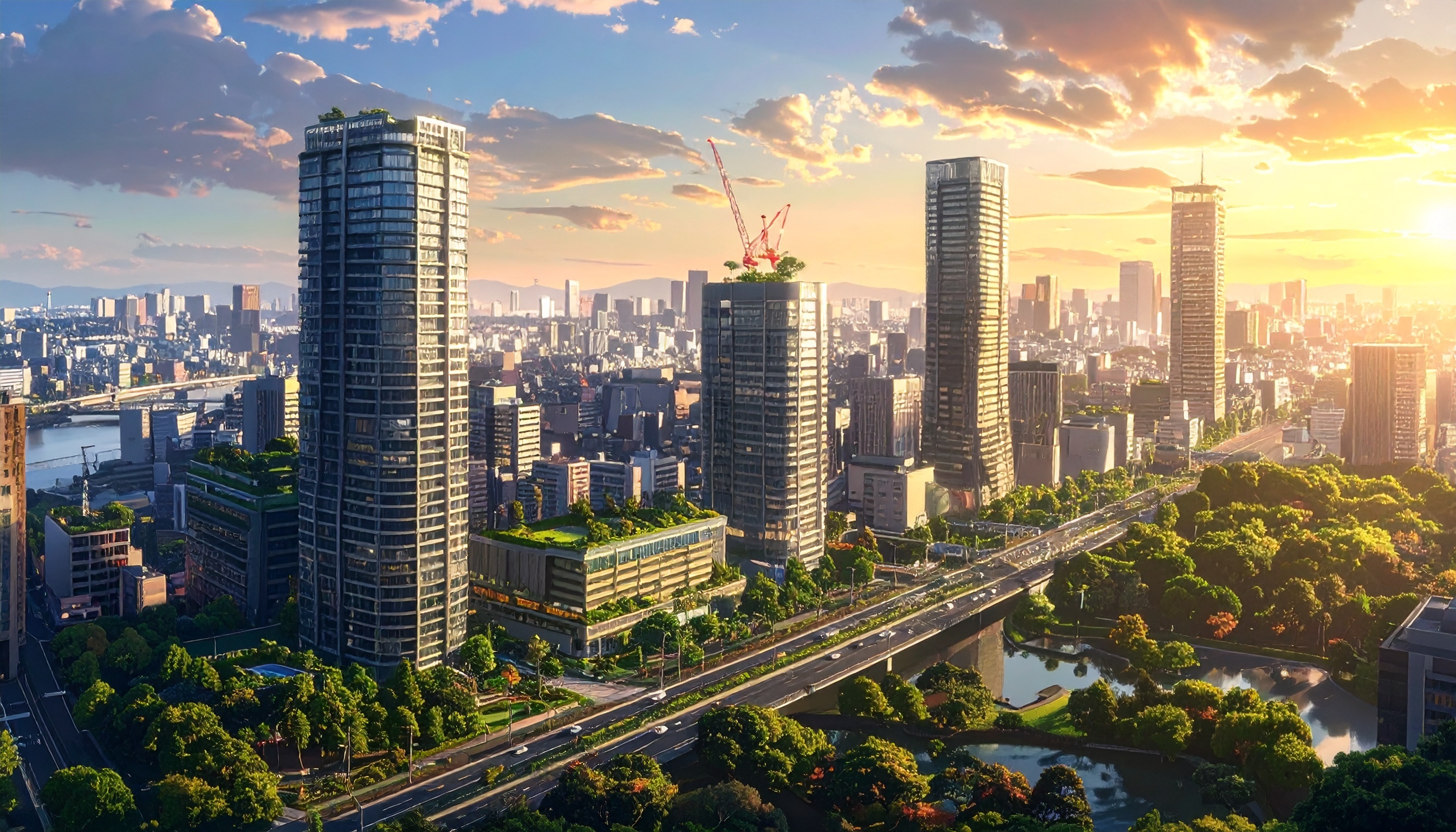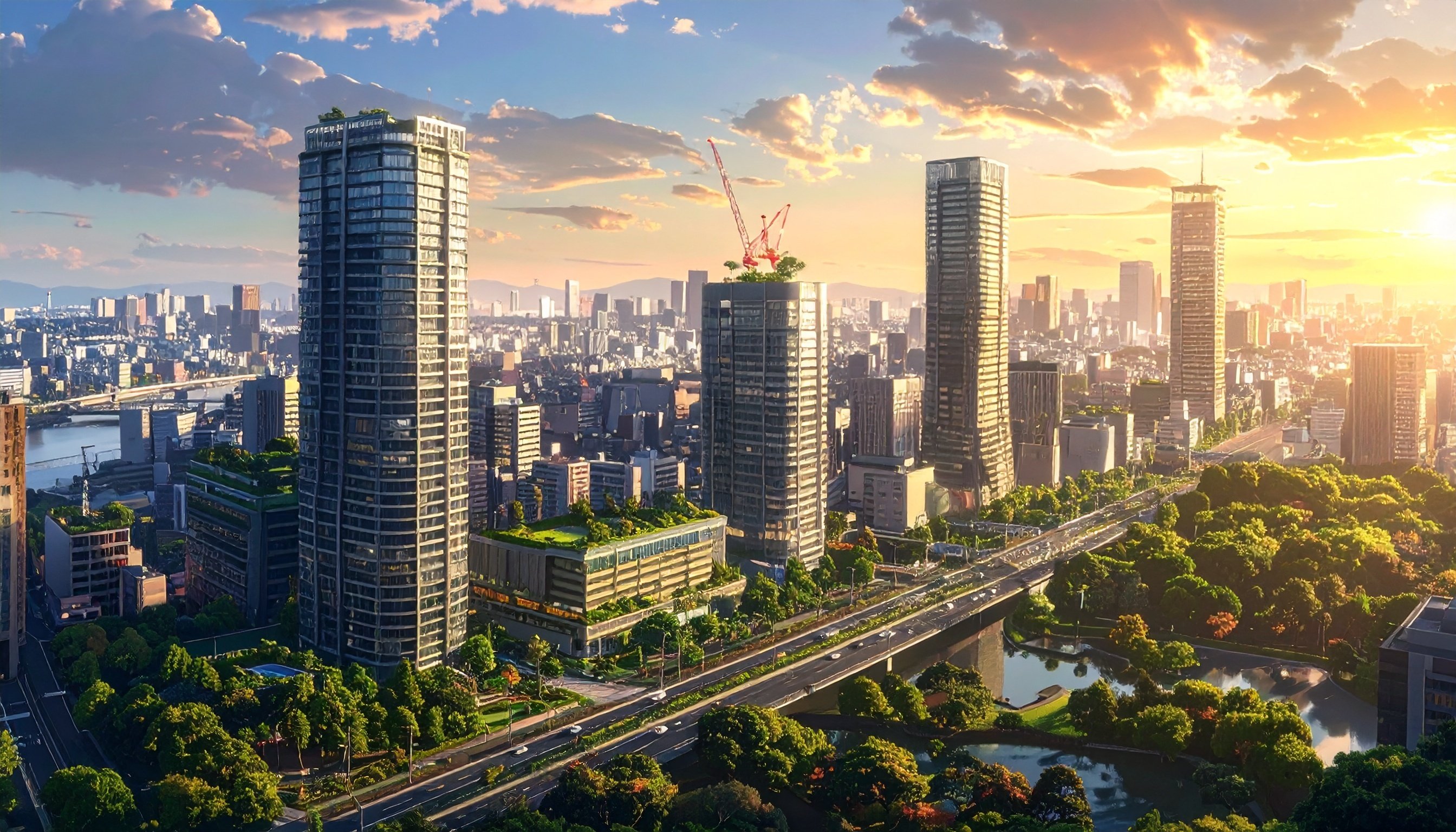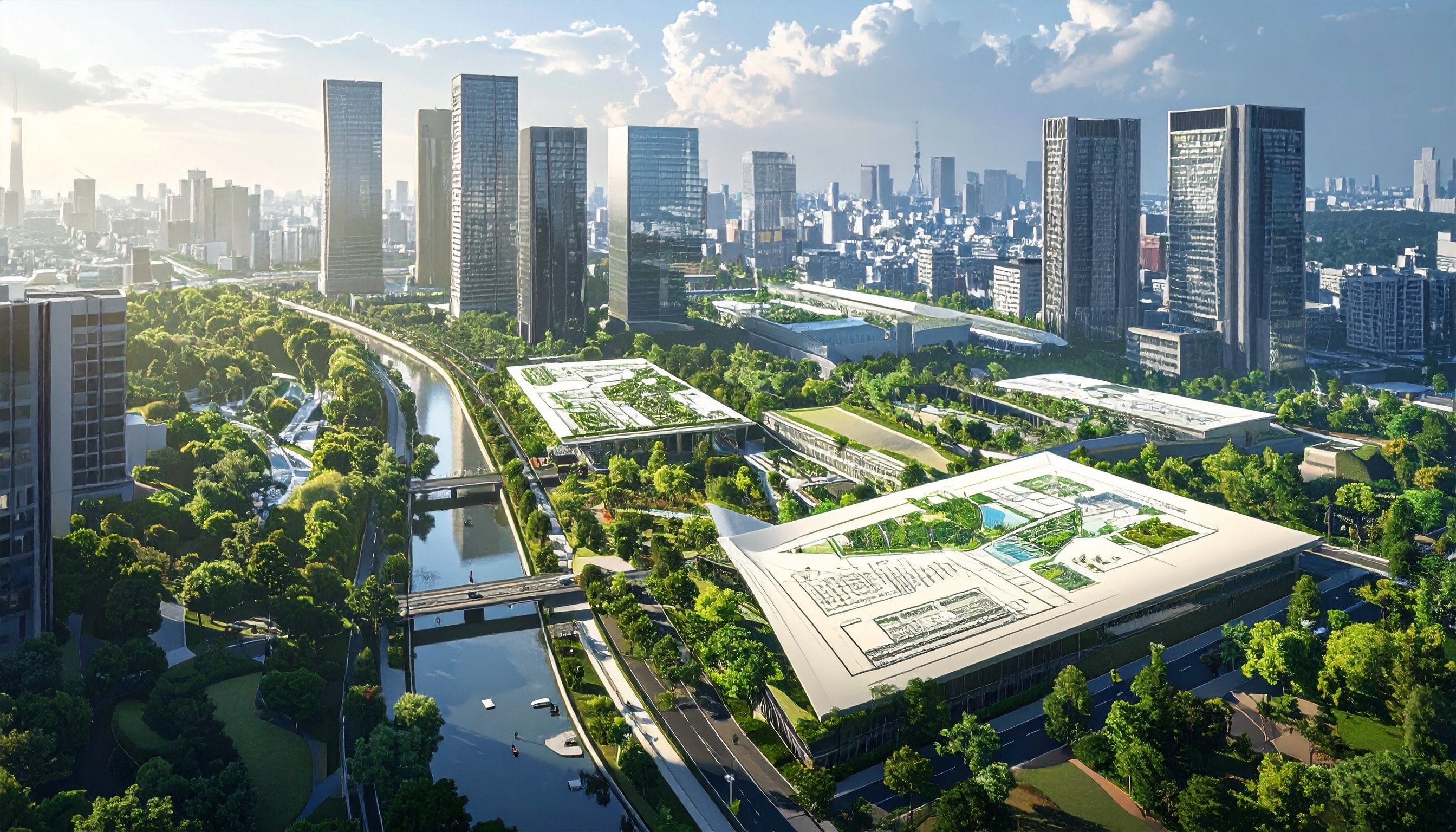
Tokyo is being remade. After the "lost thirty years" that followed the collapse of the bubble economy, Japan's capital is now living through an unprecedented redevelopment boom — a genuine turning point for the city. As of 2026, dozens of large-scale projects are moving forward simultaneously across the five central wards of Chiyoda, Chūō, Minato, Shinjuku, and Shibuya, together accounting for several million square meters of floor space. This wave of "destruction and creation" is reshaping not just the skyline but the underlying structure of real estate value itself. This piece maps out the major projects underway, their expected effect on land prices, and how wealthy owners and investors should think about timing.
Why is so much redevelopment converging on Tokyo right now?
This article is based on information published as of March 2026.
Three mutually reinforcing forces are driving the current wave of redevelopment in Tokyo.
The first is aging buildings. Large office towers and mixed-use complexes completed during the bubble years (roughly 1985 to 1992) are now reaching the end of their useful life all at once. Japan's Ministry of Land, Infrastructure, Transport and Tourism projects that a substantial share of central Tokyo's office stock will hit its aging peak sometime through the 2030s. The fact that so many buildings are reaching "must rebuild" territory at the same time is itself what has produced this cluster of simultaneous redevelopment.
The second is the drive to strengthen international competitiveness. Designation as a National Strategic Special Zone or Urban Renaissance Special District has made possible building heights and floor-area ratios that would previously have been unthinkable. The Tokyo Metropolitan Government's vision of establishing Tokyo as an "international financial city," together with its broader urban vision looking toward 2040, has helped push this trend forward.
The third is urban disaster resilience. Clearing dense, wood-built neighborhoods, widening emergency transport routes, and renewing underground infrastructure have all become urgent priorities. Fireproofing and seismic reinforcement, undertaken as preparation against the risk of a major earthquake directly beneath the capital, are accelerating large-scale redevelopment in their own right.
With these three pressures converging at once, Tokyo finds itself in the middle of what people are calling a once-in-a-century urban renewal.
Readers more familiar with cities in North America or Western Europe should note that what is happening here is institutionally distinct from redevelopment as it typically unfolds abroad. Much of this activity runs through Japan's system of toshi saikaihatsu jigyō (urban redevelopment projects) under the Urban Redevelopment Act, built around three mechanisms with no exact equivalent in the US or UK: kenri henkan (rights conversion, under which existing landowners and tenants receive proportional floor space or shares in the completed building rather than a cash buyout, so ownership converts rather than disappears), kumiai sekō (redevelopment carried out by a cooperative association of the existing rightsholders themselves, rather than by a single private developer or a public authority), and formal designation through toshi keikaku kettei (a city planning decision), which locks in permitted density and use well before construction begins. It is a structure that sits somewhere between the compulsory purchase orders used for regeneration schemes in the UK and the negotiated air-rights transfers and tax-increment financing districts common in large US redevelopment — closer to a consensus-built land-pooling arrangement than to eminent domain, but backed by a statutory process that can still override a reluctant individual holdout once the surrounding rightsholders and the city have agreed to proceed.
Reading the major projects underway across the five central wards
Here is an overview of the major projects currently underway or already confirmed across the five central wards.
Chiyoda: the Otemachi Gate Building and the evolution of Tokyo's financial core
In the Otemachi–Marunouchi area, a large-scale redevelopment led by the Mitsubishi Estate group continues to move forward. One of these, the Otemachi Gate Building, was completed on July 31, 2026 in Uchikanda 1-chome, Chiyoda ward, as a mixed-use tower of 26 floors above ground and three below with a total floor area of approximately 85,398 square meters. Positioned as a node linking the Otemachi-Marunouchi-Yurakucho area with the Kanda area, it has been opening in stages: MINORIWA, a business and industry support facility for agriculture and food, on August 31, 2026, followed by the retail zone and a tourist information center from September 7 of the same year. Seen through the lens of concentrating international financial functions, this is a significant piece of infrastructure in Tokyo's effort to compete with Hong Kong and Singapore.
Chūō: Nihonbashi's Torch Tower will be Japan's tallest building at approximately 385 meters upon completion
In the Tokiwabashi area in front of the Nihonbashi exit of Tokyo Station, the "TOKYO TORCH" project, led by Mitsubishi Estate, is underway. Its centerpiece, Torch Tower, will have 62 floors above ground and four below, stand approximately 385 meters tall with a total floor area of roughly 553,000 square meters, and is scheduled for completion at the end of March 2028. Construction began in September 2023, and steel erection of the above-ground floors started in September 2025. It will be Japan's tallest building at the time of completion, and it will be a mixed-use complex combining offices, a hotel, residences, and retail. Urban design centered on TOKYO TORCH Park, a large plaza of roughly 7,000 square meters at the heart of the block, is expected to lift the value of the surrounding Nihonbashi area as a whole.
Minato: what the full opening of Takanawa Gateway City signals
Led by JR East, Takanawa Gateway City is a large mixed-use development built on an 11-hectare former railway yard just north of Shinagawa Station. Phase one opened in March 2025, and four high-rise towers (the tallest reaching 175 meters) are opening in sequence. The birth of a district that brings together international exchange, technology industries, housing, and retail is significantly redefining real estate values across southern Minato ward. As detailed in our earlier piece on the redevelopment north of Shinagawa Station and its 115-meter twin towers, the rate of land price appreciation around this district stands out even within Minato ward.
Shinjuku: large-scale redevelopment in the southwest and the "Urban Lobby" concept
Multiple redevelopment projects are proceeding simultaneously in Shinjuku. In the Nishi-Shinjuku 3-chōme West district, twin towers of approximately 229 meters (north) and 228 meters (south) with roughly 3,200 housing units are planned, but the schedule has slipped. According to Shinjuku ward's guidance (updated April 2, 2026), approval of the rights conversion plan and the start of demolition work are expected in fiscal 2027, the start of main construction in fiscal 2028, and completion in fiscal 2035. Shinjuku ward's "Urban Lobby" concept, meanwhile, aims to turn the ground level beneath its cluster of high-rises into pedestrian-friendly public space, with a goal of establishing the area as an "international business and cultural tourism" hub by 2040.
Shibuya: the Shibuya 2-chōme West district and the Miyamasuzaka district
In the Shibuya 2-chōme West district, a project plan amendment approved in August 2026 pushed back the completion of building construction for the urban redevelopment project (Blocks A and B) to February 2035 (planned) — the original target had been fiscal year 2029. Under the amended project plan, the tallest block, Block B, is now 38 floors above ground and three below with a maximum height of approximately 192 meters, and the retail-focused Block A is five floors above ground and one below at approximately 46 meters; the mainly residential Block C (a separate joint reconstruction project) stood at 41 floors above ground and two below and approximately 175 meters as of a 2023 announcement; in the Miyamasuzaka district, a project more than 180 meters tall with a project cost of roughly ¥243.1 billion is aiming for completion sometime in the 2030s. Redevelopment around Shibuya Station continues steadily, and the combined weight of commerce, culture, and housing is what underpins real estate values in the ward.
What is the "gravity effect," and how does redevelopment push land prices up?
The effect that large-scale redevelopment has on the land prices around it is known as the "gravity effect." Just as gravity pulls objects toward a large mass, a massive redevelopment project draws in people, capital, and information, and that pull lifts the value of the surrounding real estate.
As detailed in our earlier analysis of the Reiwa 8 official land price survey, both commercial and residential land prices have now risen for five consecutive years. The Kōnan and Takanawa districts of Minato ward, in particular, have seen the effect of Takanawa Gateway City's opening spill over into the surrounding area, recording a notably higher rate of appreciation than neighboring wards. The Ōtemachi–Marunouchi area of Chiyoda ward continues to hold the highest commercial land values nationwide, with expectations tied to the TOKYO TORCH project helping to underpin those prices.
The gravity effect plays out over roughly two stages. The first is the anticipation effect before completion, in which land prices begin rising two to three years ahead of a project's completion, once its announcement and the start of construction make it feel real. The second is the agglomeration effect after completion, in which a growing commercial and working population steadily lifts rents and transaction prices in the surrounding area over the longer term.
How to think about timing an investment: the "two years before completion" rule, and its pitfalls
Looking back at past large-scale Tokyo redevelopments — Roppongi Hills (2003), Tokyo Midtown (2007), Toranomon Hills (2014) — a consistent pattern emerges: the two to three years before completion tend to offer the best balance between acquisition cost and remaining upside in the surrounding real estate. By that point the project feels real enough that prices have begun to climb, yet they remain comparatively restrained next to the peak that follows completion.
That said, this "rule" comes with important caveats.
First, you need to judge the quality of the project itself. The financial strength of the developer, whether the mix of uses actually makes sense, and how well the site connects to public transit all shape how much agglomeration power it will have after completion. A large project whose use mix is out of step with what the area actually needs can still end up plagued by vacant offices and empty storefronts.
Second, you need to read the local context. Which use — office, residential, or commercial — ends up carrying the area's value determines which type of property benefits most directly. Around Takanawa Gateway, housing and premium rentals are likely to see the more direct benefit; around Ōtemachi, office space is likely to benefit more directly.
Third, don't overlook supply risk. Competing projects in the same area often follow a major completion, and that can temporarily push rents and prices back down. As our survey report on Tokyo's major redevelopment projects also points out, a careful read of the supply-demand balance in each specific area is indispensable.
For a reader comparing this to redevelopment cycles in London or New York, the closest parallel to that "two to three years before completion" window is the pre-leasing and pre-sale run-up seen around major regeneration schemes like London's Nine Elms or New York's Hudson Yards — but the Japanese cycle tends to be more predictable, because the rights-conversion process fixes a project's scope and completion timeline earlier and with less risk of the legal challenges that can stall Western megaprojects for years.
Our view at INA
We at INA&Associates see this redevelopment boom as a moment that will test the real worth of the people entrusted with protecting other people's assets. No property gains value simply because it happens to sit "near a redevelopment area." Properties that genuinely benefit from redevelopment and properties whose relative standing declines once the surrounding area is rebuilt are going to diverge sharply.
What I recommend to our wealthy clients and asset owners is not "which project should I jump on," but working together through a different question: which area, which use, and which timing actually fits your own portfolio. Asset planning grounded in a genuinely long-term view is the key to coming out ahead during a once-in-a-century transformation of the city.
Summary
This redevelopment boom is not simply a matter of tearing down and rebuilding buildings. It is a redefinition of Tokyo's competitiveness, safety, and appeal as a city — and, with that, a reshuffling of where asset value sits. Here are the key points.
- Tokyo's redevelopment boom is a historic turning point produced by three forces converging at once: aging buildings, international competition, and disaster resilience.
- Multiple ultra-large-scale projects are proceeding simultaneously across the five central wards, and the city's skyline and function will change substantially through 2035.
- Large-scale redevelopment pushes up surrounding land prices through the "gravity effect." The Reiwa 8 official land price survey shows this appreciation standing out clearly in redevelopment areas.
- The two to three years before completion is often an effective window for investment timing, but it still requires close scrutiny of project quality, local context, and supply risk.
- As "properties that benefit" and "properties left behind" by redevelopment increasingly diverge, sound judgment grounded in a long-term view matters more than ever.
FAQ
Q1. Does any property near a redevelopment area automatically gain value?
A1. Not necessarily. How far the gravity effect of a redevelopment reaches depends heavily on the project's scale, its mix of uses, and its distance from transit hubs. Even within the same redevelopment area, a property within a five-minute walk of the station and one more than ten minutes away often show a clearly different rate of land price appreciation.
Q2. Nihonbashi's Torch Tower is scheduled for completion at the end of March 2028 — is it still worth looking at nearby properties now?
A2. Yes, it can be — but the premise needs checking. Completion is scheduled for the end of March 2028; construction began back in September 2023, and steel erection of the above-ground floors started in September 2025. The window where acquisition cost and remaining upside are best balanced — two to three years before completion — corresponds to around 2025 to 2026, and that phase is already passing. So if you are looking now, the deciding factor is not front-running the anticipation effect before completion but how much of the agglomeration effect after completion — the lift in rent levels and occupancy rates that comes with a growing working population — you can expect. After checking how much of that opening expectation is already priced into the surrounding market, it's important to weigh the holding costs against the expected return.
Q3. Where can I check on redevelopment projects myself?
A3. The most reliable primary sources are the Ministry of Land, Infrastructure, Transport and Tourism's city planning information (https://www.mlit.go.jp/toshi/city_plan/) and the official site of the Tokyo Metropolitan Government's Bureau of Urban Development (https://www.toshiseibi.metro.tokyo.lg.jp/). It's also worth checking official announcements and press releases from the developers themselves.
Q4. Which part of Minato ward benefits most from the opening of Takanawa Gateway City?
A4. The Kōnan and Takanawa districts within roughly a ten-minute walk of Takanawa Gateway Station and Shinagawa Station are seeing the most direct benefit. Growing demand for services tied to a larger working population is pushing up the surrounding commercial, dining, and residential rental markets. Neighboring areas such as Tennōzu and Shibaura, by contrast, tend to see only indirect benefits.
Related reading
Tokyo redevelopment area survey report: investment and livability potential
A survey report evaluating Tokyo's major redevelopment projects along two axes: investment potential and livability.
The full 2026 official land price data, and what property owners should do in response.
Sources and references
- Ministry of Land, Infrastructure, Transport and Tourism, "City Planning and Urban Development"
- Ministry of Land, Infrastructure, Transport and Tourism, "On Urban Redevelopment Projects"
- Tokyo Metropolitan Government Bureau of Urban Development
- Reiwa 8 official land price survey (Ministry of Land, Infrastructure, Transport and Tourism)
Series: "Maps of Destruction and Creation — What Redevelopment Is Really Doing to Cities and Assets"
- Part 1: Tokyo's once-in-a-century redevelopment boom — how the five central wards are transforming, and where asset value is heading (this article)
- Part 2: The polarization of Tokyo's office market — why a 0.7% vacancy rate and a 26% vacancy rate exist side by side
- Part 3: What is gentrification? The dark side of rights conversion and the risks facing existing landowners
- Part 4: The Jingu Gaien redevelopment and landscape preservation — why ESG investing is changing the long-term value of real estate
- Part 5: Will Osaka follow in Tokyo's footsteps? What comes after the Expo, the integrated resort, and Grand Green Osaka
- Part 6: Are you tearing down or building? A redevelopment investment strategy for the ultra-wealthy