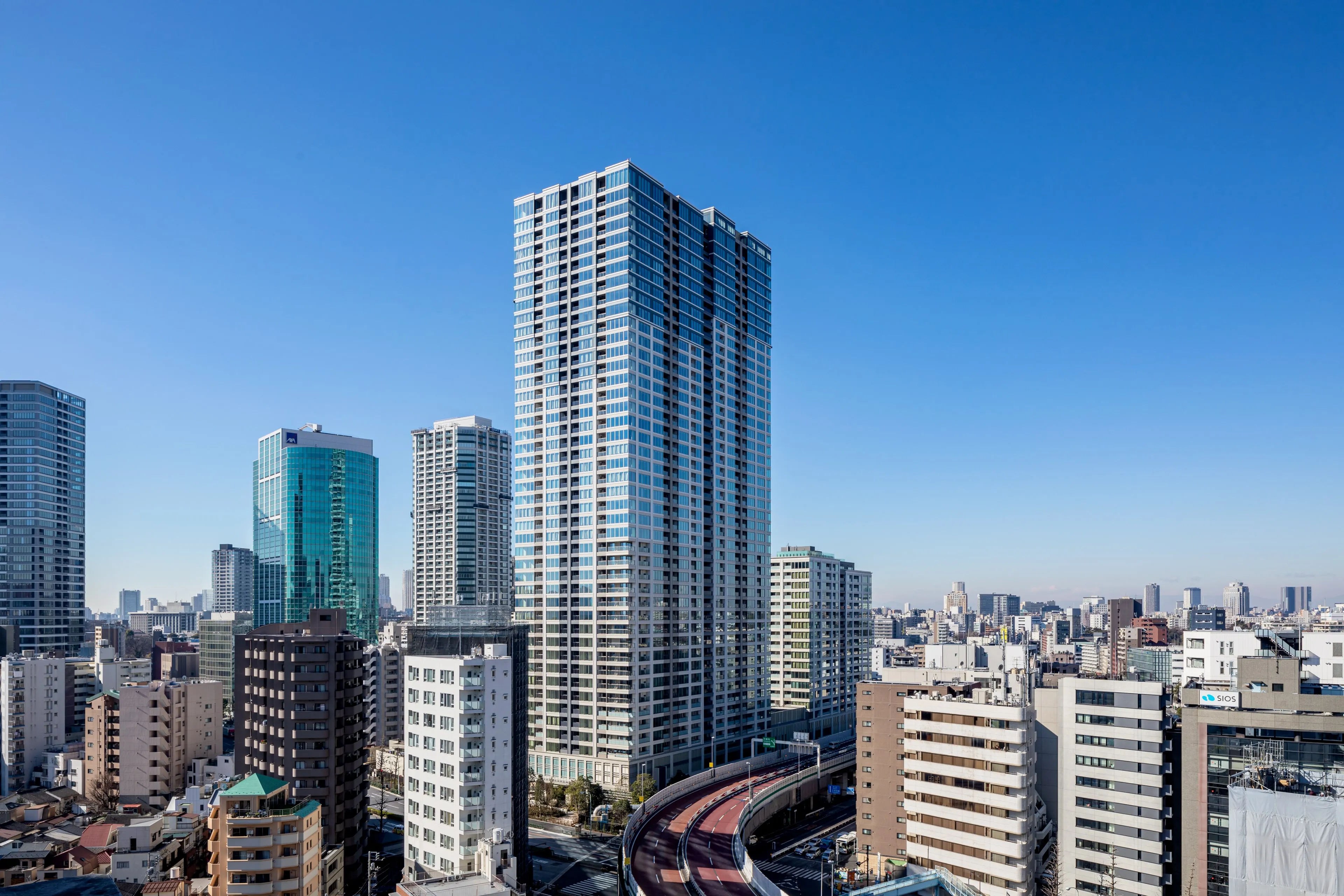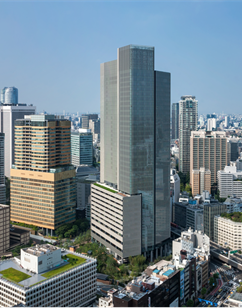
Akasaka Intercity AIR, the 205-meter landmark tower in Akasaka 1-chome, Minato City, Tokyo, earned Platinum — the highest rank awarded by the U.S. Green Building Council (USGBC) under LEED — in July 2025. It is the first large-scale, mixed-use building in Japan to achieve this distinction, and it has renewed attention on the "Akasaka 1-chome District Category I Urban Redevelopment Project," which began with a 2011 urban planning decision, eight years after the building's completion. This article examines, with data, how the redevelopment has affected the surrounding real estate market.
What Was the Akasaka 1-chome District Category I Urban Redevelopment Project?
Background and the 2011 Urban Planning Decision
The area near Tameike-Sanno Station, where Sotobori-dori and Roppongi-dori intersect, was densely packed with aging buildings across roughly 2.5 hectares. Against a long-standing backdrop of unresolved issues — the need for improved road and transportation infrastructure and a direct underground connection to the subway — Minato City (港区) made its urban planning decision in September 2011. The following August, in 2012, the establishment of the Akasaka 1-chome District Urban Redevelopment Association was approved, and the project moved into full swing as a large-scale public-private partnership in the heart of Tokyo.
A Category I urban redevelopment project is a mechanism that uses a "rights conversion" method to convert existing landowners' rights into floor space in the newly built structure. It allows public infrastructure to be developed in an integrated way while sorting out prior rights and interests, making it fundamentally different from a simple building replacement. The scheme's greatest strength is its ability to simultaneously deliver public infrastructure — an underground subway connection, a new plaza, and a strengthened pedestrian network — alongside the private building itself.
For readers used to U.S.-style redevelopment, where a municipality typically exercises eminent domain and pays cash compensation, Japan's rights-conversion model is worth noting. Rather than buying landowners out, it converts their original rights into equivalent floor space in the new tower, so long-time owners become co-owners of the finished building rather than sellers who leave the area. This is a distinctly Japanese approach: it keeps existing stakeholders invested in the outcome, which is one reason Japanese redevelopment associations often spend a decade or more building consensus before construction begins — a timeline that can surprise investors used to faster U.S. entitlement processes.
Project Overview and the Birth of Akasaka Intercity AIR
The project was undertaken by the Akasaka 1-chome District Urban Redevelopment Association, with Nippon Steel Kowa Real Estate Co., Ltd. (日鉄興和不動産, formerly Shin Nippon Steel Kowa Real Estate) participating as a member developer. Nihon Sekkei, Inc. (日本設計) handled the design, and Obayashi Corporation (大林組) served as the general contractor. Construction began in September 2014, the completion notice was issued on August 31, 2017, and the building held its grand opening on September 29 of the same year.
The completed Akasaka Intercity AIR boasts 38 floors above ground, three below ground, and a penthouse level, standing 205.08 meters tall with a total floor area of 178,328.01 square meters. It is a mixed-use landmark tower that integrates office space (82,006 square meters of leasable area), 52 residential units, conference facilities, and retail shops. The building connects directly underground to Tameike-Sanno Station on the Tokyo Metro Ginza and Namboku lines, and its typical floor plate of roughly 782 tsubo (about 2,585 square meters) is large enough to accommodate major corporate office demand. Leading Japanese and international tenants — including NTT DOCOMO and GlaxoSmithKline — occupy the building.
Eight Years After Completion: What the 2025 LEED Platinum Certification Means
What Is LEED O+M Platinum Certification?
LEED (Leadership in Energy and Environmental Design) is an international building environmental rating system developed by the U.S. Green Building Council (USGBC). Among its various tracks, "LEED O+M: Existing Buildings v4.1" evaluates the operation and maintenance of existing buildings — not just design-stage performance, but ongoing, real-world operating performance. It assesses categories such as energy management, water efficiency, indoor environmental quality, and materials use. Platinum is the highest of the certification tiers, and achieving it requires a high score across every evaluation category, not just a single strong area.
According to Nippon Steel Kowa Real Estate's press release (dated July 23, 2025), Akasaka Intercity AIR is the first large-scale, mixed-use building in Japan to obtain LEED Platinum certification. It is the first domestic case to satisfy both the "mixed-use" and "large-scale" conditions simultaneously, and it has drawn attention in the context of international real estate evaluation as well.
For U.S.-based investors, LEED is a familiar, near-default benchmark — a large share of new commercial office space in major American markets pursues some level of LEED certification, and Platinum-rated office towers are not especially rare in gateway cities like New York or San Francisco. In Japan, by contrast, LEED adoption has historically lagged behind domestic systems such as CASBEE, and very few large mixed-use towers have pursued LEED at all, let alone its highest tier. That gap is what makes Akasaka Intercity AIR's achievement significant: a certification unremarkable in Manhattan is a genuine first for Japan's mixed-use building stock, and it signals that Japan's market for ESG-grade office space is still in its early stages — an opportunity for investors who value being early to a structural shift.
Factors Behind Akasaka Intercity AIR's High Evaluation
There are specific reasons the building scored highly across LEED's six evaluation categories — Location and Transportation, Sustainable Sites, Water Efficiency, Energy and Atmosphere, Materials and Resources, and Indoor Environmental Quality. At the core of this achievement is the fact that environmental considerations were consistently built in from the design stage onward.
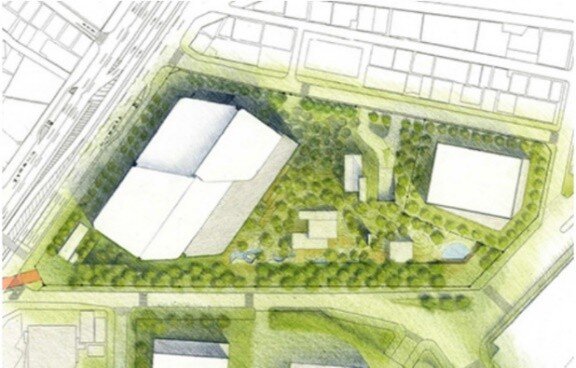
Approximately 5,000 square meters of greenery on the site (a green coverage ratio of over 50%) and a roughly 200-meter tree-lined "Green Avenue" earned high marks for heat-island mitigation and biodiversity conservation. The use of electricity sourced from renewable energy, along with recycled-water use and water-saving equipment, boosted the building's scores in the energy and water-efficiency categories. Its direct underground connection to Tameike-Sanno Station also worked in the building's favor under the "Location and Transportation" category.
As part of its business continuity plan (BCP), the building has dual-fuel emergency generators (3,500 kVA x 2 units) capable of supplying power for up to 200 hours — meeting, at a high level, the resilience requirements companies have prioritized since the 2011 Great East Japan Earthquake, and an important factor for tenants selecting office space. A ceiling height of 2,850mm (3,000mm on select floors) also contributes to livability, factoring into the indoor environmental quality score.
How Redevelopment Changed the Akasaka Real Estate Market: Reading the Ripple Effects Through Land Price Data
Trends in Official Land Prices in the Akasaka Area (2020-2026)
Since the Akasaka 1-chome district redevelopment was completed in 2017, the Akasaka real estate market has shown a sustained upward trend. According to official land price data, the official land price around Akasaka Station has moved as follows.
| Year | Land Price (per m²) | Price per Tsubo | YoY Change |
|---|---|---|---|
| 2020 | ¥3.46M (approx. $23,100) | ¥11.44M (approx. $76,300) | +8.33% |
| 2021 | ¥3.40M (approx. $22,700) | ¥11.25M (approx. $75,000) | -1.27% |
| 2022 | ¥3.42M (approx. $22,800) | ¥11.31M (approx. $75,400) | +0.69% |
| 2023 | ¥3.50M (approx. $23,300) | ¥11.58M (approx. $77,200) | +2.58% |
| 2024 | ¥4.08M (approx. $27,200) | ¥13.49M (approx. $89,900) | +6.18% |
| 2025 | ¥4.57M (approx. $30,500) | ¥15.11M (approx. $100,700) | +12.11% |
| 2026 | ¥5.36M (approx. $35,700) | ¥17.72M (approx. $118,100) | +17.08% |
Land prices rose approximately 55% between 2020 and 2026, and the pace has clearly accelerated since 2024. The residential benchmark point in Akasaka 1-chome recorded one of the highest appreciation rates in all of Japan (+15.6% in 2025). Aside from a brief adjustment during the 2021 pandemic period, prices have risen consistently ever since, underscoring the area's underlying resilience.
As also shown in Tokyo Redevelopment Areas: Major Project Survey — Investment and Residential Suitability, and Future Outlook, the pattern of land prices rising in stages after a large redevelopment is completed has been repeatedly confirmed in areas beyond Akasaka as well.
Three Effects of Redevelopment Completion on the Surrounding Market
The impact of redevelopment on land prices and the broader real estate market extends well beyond simply "constructing a new building." The Akasaka 1-chome district redevelopment has lifted the value of the entire area through three distinct mechanisms.
First is the infrastructure effect. The underground subway connection, new plaza, and improved pedestrian pathways dramatically improved circulation within the area — a benefit that extends well beyond the individual building, spilling over into surrounding commercial and residential demand.
Second is rising international recognition. Attracting major foreign tenants, including GlaxoSmithKline, has established Akasaka's reputation as "an area where international business clusters" — brand formation that is itself a source of long-term support for land prices.
Third is the triggering of chain redevelopment. Akasaka Intercity AIR's success has served as a catalyst accelerating redevelopment nearby. As also analyzed in How Central Tokyo Redevelopment Affects Real Estate Value: An Investment Analysis of Toranomon, Shibuya, and Shinagawa, once a core redevelopment is completed, development appetite in the surrounding area increases and the entire district begins to transform.
Akasaka's Continuing Wave of Redevelopment: The Next Landmark Toward 2028
Building on the success of Akasaka 1-chome, large-scale redevelopment projects continue to proceed one after another across the Akasaka area.
| Project Name | Scale | Status |
|---|---|---|
| Akasaka Intercity AIR (Akasaka 1-chome) | 38 floors above ground, 205m | Completed 2017 |
| Akasaka 2-chome/6-chome District Development Plan | 40 floors above ground (East Block) + 18 floors (West Block) | Scheduled completion 2028 |
| Akasaka 7-chome Block 2 District Category I Urban Redevelopment Project | 46 floors above ground | Under construction |
The Akasaka 2-chome/6-chome district development plan, led by Mitsubishi Estate (三菱地所) and TBS (Tokyo Broadcasting System), is scheduled for completion in 2028 with a 40-story East Block and an 18-story West Block. The Akasaka 7-chome Block 2 project (46 floors), led by Nippon Steel Kowa Real Estate, is also under construction. Both are linked to a broader concept of developing the Akasaka-Toranomon area as a "Green Corridor" within a larger vision for the city's sustainable development. From 2028 onward, this continuing wave of redevelopment could generate further upward pressure on land prices.
Actions Real Estate Owners Should Consider
1. Reassess Asset Value in the Akasaka / Tameike-Sanno Area
The +17% increase in the 2026 official land price should not be read as a single year's figure. What matters is the structural background behind the roughly 55% cumulative increase over the six years from 2020 to 2026. With additional large-scale redevelopment scheduled by 2028, Akasaka is likely to see continued upward pressure on prices — worth weighing when reassessing any asset currently held in the area.
2. Recognize the Impact of "Environmental Certification" on Property Value
Akasaka Intercity AIR's LEED Platinum certification shows that environmental certification can keep strengthening a property's competitiveness years after completion. Amid the expansion of ESG investing, certifications such as LEED, ZEB (Net Zero Energy Building), and CASBEE are becoming important criteria for institutional investors and foreign-affiliated tenants selecting properties. That is exactly why investment in green retrofits for existing buildings is a strategic decision supporting long-term asset value — energy-efficient equipment and recycled-water systems are best viewed not as mere capital expenditure, but as value-enhancement measures.
3. Portfolio Strategy: Diversifying Investment Across Redevelopment Areas
Investing in a completed redevelopment area (Akasaka 1-chome) offers stable asset value with infrastructure already in place, though with the trade-off of more limited room for further appreciation. Areas still under construction, such as Akasaka 7-chome Block 2 or the Akasaka 2-chome/6-chome district, offer opportunities that capture value appreciation ahead of completion. Combining completed and in-progress areas to diversify risk is a basic principle of real estate portfolio strategy.
INA's Perspective: How to Correctly Read the "Results" of Redevelopment
The message I take most strongly from the Akasaka Intercity AIR case is this: the true value of a redevelopment reveals itself not at completion, but over the five to ten years that follow. The LEED Platinum certification, achieved eight years after the building's 2017 completion, is proof of the foresight to place environmental consideration at the core of the design as far back as the 2011 planning stage. That a building already well regarded at completion has continued to hold the highest international standard of evaluation over the long term is no accident — it reflects both the quality of the original design and sustained effort in ongoing operations and management.
For real estate owners, the time horizon that matters when evaluating a redevelopment area is not "how much can it sell for right after completion," but "how will the area have transformed ten years on." Akasaka is currently in the midst of that transformation, and as multiple large-scale projects reach completion toward 2028, it will continue to mature as an international business hub.
Another trend worth watching: environmental certification is increasingly becoming a "must-have," not merely a nice-to-have, in real estate valuation. Alongside the expansion of ESG investing, institutional investors and foreign-affiliated companies now treat environmental performance as an important condition in property selection, and properties without certification risk being excluded from consideration altogether. For owners of existing properties, this shift should prompt a reconsideration of retrofit-investment priorities.
At INA & Associates, we read long-term trends in the real estate market to provide strategic partnership aimed at maximizing our owners' asset value. We will continue to share information on redevelopment trends in central Tokyo, including the Akasaka area, and their impact on individual assets.
Summary
- The Akasaka 1-chome District Category I Urban Redevelopment Project was completed in 2017, giving rise to the 205-meter mixed-use landmark tower, Akasaka Intercity AIR.
- In July 2025, the building became the first large-scale, mixed-use building in Japan to earn LEED O+M Platinum certification, providing international proof of the environmental foresight built into its design from the outset.
- Official land prices in the Akasaka area rose approximately 55% between 2020 and 2026, with the pace accelerating to +17.08% year-over-year in 2026.
- The ripple effects of redevelopment operate through three mechanisms: infrastructure development, rising international recognition, and the triggering of chain redevelopment.
- A continuing wave of redevelopment is underway, including the Akasaka 2-chome/6-chome district (scheduled for 2028) and the Akasaka 7-chome Block 2 district (under construction), and long-term upward pressure on area value is expected to continue.
- Real estate owners are advised to pursue retrofit investment informed by the shifting value of environmental certification, together with a diversified investment strategy across redevelopment areas.
Frequently Asked Questions (FAQ)
Q1. Why is Akasaka Intercity AIR's LEED Platinum certification described as a "first in Japan"?
LEED O+M (the operations and maintenance category for existing buildings) Platinum certification had previously been achieved by single-use buildings in Japan, but Akasaka Intercity AIR is the first case of a large-scale building combining office, residential, commercial, and conference-facility uses to obtain it. In mixed-use buildings, each use type has a different energy consumption pattern, which makes unified environmental management more difficult and achieving the Platinum tier considerably harder.
Q2. Will land prices in the Akasaka area continue to rise?
The 2026 official land price shows a high year-over-year increase of +17.08%, but there is no guarantee this pace continues indefinitely. That said, additional upward pressure is likely around the Akasaka 2-chome/6-chome plan's scheduled 2028 completion and again once the Akasaka 7-chome Block 2 redevelopment finishes. Over the medium to long term, the area's continued maturation as an international business hub is expected to support its underlying resilience.
Q3. How does a Category I urban redevelopment project differ from ordinary private development?
A Category I urban redevelopment project is a public scheme under Japan's Urban Redevelopment Act, converting landowners' rights into floor space in the new structure through the rights-conversion method described above. Unlike the private rebuilding of a sectional-ownership building, its defining feature is the ability to carry out public infrastructure improvements — roads, plazas, underground passageways — as an integrated part of the project, with the government making the planning decision and an association serving as project undertaker. In Akasaka 1-chome, this scheme made possible the direct underground connection to Tameike-Sanno Station.
Q4. Does environmental certification (such as LEED) actually affect real estate rents or vacancy rates?
Studies conducted overseas suggest LEED-certified buildings tend to command rents 5-10% higher than non-certified buildings, with reports of sustained lower vacancy rates as well. In Japan too, alongside expanding ESG investing, more foreign-affiliated tenants and institutional investors are treating environmental certification as an important selection condition. The precise numerical effect varies by location, scale, and use, but the direction is clear: certification affects a property's medium- to long-term competitiveness.
Sources and References
Minato City Urban Development Department (港区都市整備部), "Akasaka 1-chome District Category I Urban Redevelopment Project" (Minato City official website)
Nippon Steel Kowa Real Estate Co., Ltd., "Akasaka Intercity AIR: Building Overview"
Nippon Steel Kowa Real Estate Co., Ltd., "Akasaka-Toranomon Area Development"