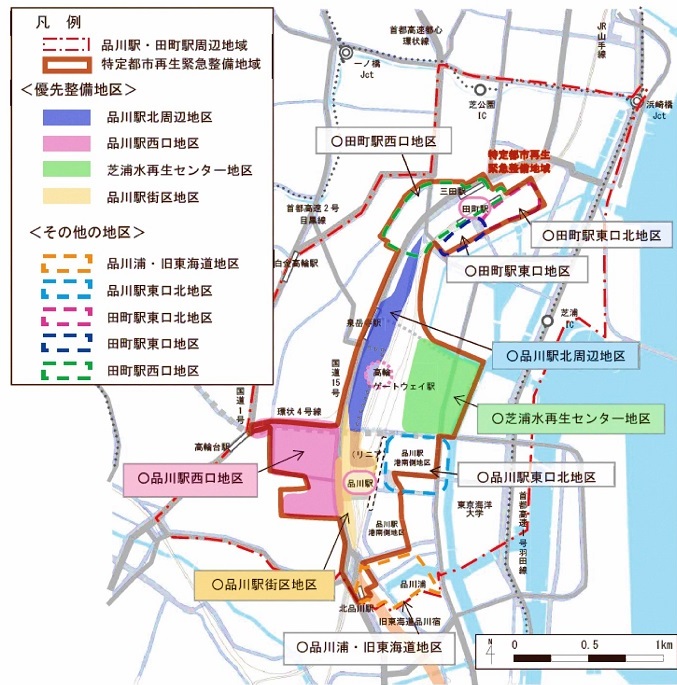
The area around Shinagawa Station's west exit is on the verge of transformation on an unprecedented scale. In June 2023, the "Shinagawa Station West Exit Land Readjustment Project," implemented by the Urban Renaissance Agency (UR), received approval from the Minister of Land, Infrastructure, Transport and Tourism, setting in motion a full-scale urban development effort aimed at creating an "international exchange hub in Shinagawa." Starting with the groundbreaking of District A—a joint venture between Keikyu Corporation and Toyota Motor Corporation—phased openings are planned from fiscal 2029 through fiscal 2032, with the project expected to have a significant impact on surrounding land prices and the real estate market. For real estate owners and investors, the question now is how to interpret these developments and act accordingly.
What Is the Shinagawa Station West Exit Land Readjustment Project?
The Shinagawa Station West Exit Land Readjustment Project is a large-scale urban infrastructure development project implemented by the Urban Renaissance Agency (UR) in the Takanawa 3-chome area of Minato Ward, Tokyo. The project covers approximately 11.9 hectares with a total project cost of approximately 63 billion yen, planned over a long span from fiscal 2023 to fiscal 2050 (including the settlement period).
At the core of this project is a method known as "land readjustment." Land readjustment involves improving urban infrastructure such as roads, parks, and plazas while reorganizing land held by multiple rights holders to improve efficiency of use. In this project, UR is responsible for constructing roads and parks, redesigning the station plaza, partially funding the construction of an elevated deck over National Route 15, and forming an underground road and pedestrian network.
Notably, this project goes far beyond mere infrastructure improvements. Shinagawa Station is a key access point to Haneda Airport and is also planned as the terminal station for the Linear Chuo Shinkansen. The fundamental purpose of this project is to develop the urban foundation needed to attract large private investment in order to further elevate Shinagawa's status as an international hub, through public-private collaboration.
Three Development Zones and Their Plans
The Shinagawa Station West Exit District is divided into three development zones—A, B, and C—each progressing on its own timeline.
District A: International Mixed-Use Complex Led by Keikyu × Toyota
In District A, closest to Shinagawa Station, Keikyu Corporation and Toyota Motor Corporation are jointly developing a large-scale mixed-use complex with a total floor area of approximately 313,100 m², 29 floors above ground, 4 floors below ground, and a height of approximately 160 meters. The design is by world-renowned architectural firm KPF (Kohn Pedersen Fox), ensuring international-standard architectural quality.
The facility will include offices, retail, hotels, and MICE facilities (conference halls and multipurpose halls). Particularly noteworthy is that Toyota Motor Corporation's new Tokyo headquarters will be located in this building. The facility—featuring one of the largest office floor areas in Japan and the largest conference hall in central Tokyo—is expected to become a new hub where companies and human capital from around the world converge.
According to Keikyu Corporation's announcement on the commercialization of the Shinagawa Station West Exit District A New Construction Plan (March 2024), construction began on May 31, 2025, with a target opening in fiscal 2029. UR also broke ground on May 26 of the same year on district road construction in the "Sakurazaka" area adjacent to District A, with public and private sectors jointly accelerating infrastructure development.
District B: Redevelopment of Grand Prince Hotel New Takanawa
District B, located south of District A, is a redevelopment plan led by Seibu Holdings. The currently operating Grand Prince Hotel New Takanawa is scheduled to close in fiscal 2026, and a mixed-use complex (hotel/residential tower and office tower) with a total floor area of approximately 268,000 m² and a height of approximately 140 meters is planned on the site.
Urban planning procedures began in June 2025, with groundbreaking planned for fiscal 2028 and completion for fiscal 2032. Grand Prince Hotel New Takanawa has been an iconic presence in Shinagawa for over 40 years since opening in 1982, but its role will be passed on to a next-generation internationally equipped facility.
District C: Takanawa 3-chome Shinagawa Station Front Urban Redevelopment
District C, located west of District A, is an urban redevelopment project by the "Takanawa 3-chome Shinagawa Station Front Urban Redevelopment Association," established in February 2024. A super high-rise mixed-use building is planned with a total floor area of approximately 186,900 m², 30 floors above ground, and a height of approximately 155 meters, incorporating office, residential, retail, and MICE functions. Groundbreaking is targeted for fiscal 2026, with completion by fiscal 2028.
Division of Roles Between UR and Keikyu Corporation
To understand the redevelopment of Shinagawa Station's west exit, it is important to grasp the division of roles between UR and private developers (especially Keikyu Corporation).
According to UR Urban Renaissance Agency's "Shinagawa Station Area", UR, as the project implementer, is responsible for land reorganization (provisional land substitution was implemented in February 2024) and the development of urban infrastructure facilities. Specifically, this includes constructing roads and parks, enhancing transportation hub functions by redesigning the Shinagawa Station plaza, and partially funding the construction of a "deck" over National Route 15. This deck will connect Shinagawa Station directly to each development building via a pedestrian network, creating a pedestrian space befitting an international city where movement is comfortable even in rainy weather.
Meanwhile, Keikyu Corporation is simultaneously advancing a major project to bring its elevated railway to ground level. Lowering the currently elevated Keikyu Line to ground level will enable effective use of the space beneath the elevated tracks and fundamentally redesign the station plaza area. The combination of this leveling work and UR's land readjustment project will create a unified urban space across the entire Shinagawa Station west exit area.
Impact on the Real Estate Market and Land Prices
The redevelopment of Shinagawa Station's west exit has already begun to affect the surrounding real estate market.
Looking at land price trends in Shinagawa Ward in 2025, residential land recorded a year-on-year increase of +7.0% and commercial land +7.8%, with the average change rate of benchmark land prices reaching +12.54%. In some commercial areas around Shinagawa Station, prices have risen to over 5 million yen per tsubo.
Behind this land price increase is a structural change in demand driven by redevelopment. The concentration of Toyota Motor Corporation's new Tokyo headquarters and international conference facilities is expected to increase demand from foreign companies and international organizations relocating to the area. Furthermore, against the backdrop of a full recovery in inbound demand, demand for internationally competitive hotels is also expanding, and the upward pressure on hotel room rates is expected to further boost surrounding real estate values.
With District A opening in 2029 and District B completing in 2032, the development effects will ripple out in stages. As infrastructure is built first, followed by the phased opening of offices, hotels, and retail, the upward pressure on real estate prices is unlikely to end in a short period—we believe it is highly likely to persist for over 10 years. Shinagawa Station's west exit is attracting particularly high attention from investors as an area with a long-term land price appreciation trend.
For an overview of redevelopment trends across central Tokyo, please also see The Impact of Central Tokyo Redevelopment on Real Estate Value | Investment Analysis of Toranomon, Shibuya, and Shinagawa.
Actions Property Owners Should Take Now
In light of the progress of the Shinagawa Station West Exit Land Readjustment Project, owners of real estate in the surrounding area are at an opportune time to reassess their asset strategies.
The first thing to confirm is the schedule for the final land substitution. In a land readjustment project, a final "land substitution disposition" is ultimately carried out, redistributing the rights holders' land. In this project, land substitution is scheduled for fiscal 2045–2046, and it will be necessary to reconsider land use plans within and around the project zone over the long intervening period.
Reviewing rent levels and tenant targeting is also an important issue. When Toyota's Tokyo headquarters and international conference facilities open, demand for housing from foreign company expatriates and high-income earners is expected to increase in the surrounding area. If current rent levels are below market rates, it is worth considering gradual rent revisions. Strengthening responsiveness to foreign tenants (English-language support systems, guarantor arrangements) is another area where beginning preparations now will lead to a competitive advantage.
Furthermore, the current period before the groundbreaking and opening of District A is an ideal time to consider high-value-added renovation. Completing renovations before the opening, rather than after, makes it possible to turn over tenants in time for increasing demand. If you aim to maximize investment returns, now is the time to act.
For owners considering selling, this period before development fully kicks in is also an important time for decision-making. We recommend calmly comparing both options—selling after prices rise post-opening, or locking in capital gains at the current stage—from a long-term perspective.
My Perspective
What the redevelopment of Shinagawa Station's west exit demonstrates is that Tokyo's real estate market is changing not at individual points, but across a broad area. The structure in which UR, a public agency, acts as the implementer, with Keikyu Corporation, Toyota Motor Corporation, and Seibu Holdings collaborating, transcends mere redevelopment—it is an effort toward "internationalizing the entire neighborhood."
What I am particularly focusing on in this project is its thoroughly long-term vision. The approximately 27-year project period from fiscal 2023 to approximately fiscal 2050 embodies the very concept of "sustainable growth" that I have always kept in mind in real estate investment. The approach of laying out a vision for what the neighborhood will look like decades from now, rather than chasing short-term profits, offers important lessons for owners and investors alike.
At INA&Associates Co., Ltd., we have handled many consultations on asset utilization and property sales in urban regeneration areas including Shinagawa. The key to maximizing the benefits of redevelopment lies in the timing of information gathering and decision-making. Please feel free to contact us.
Summary
- The Shinagawa Station West Exit Land Readjustment Project is a large-scale urban infrastructure development project implemented by UR, covering approximately 11.9 hectares with a total project cost of approximately 63 billion yen (fiscal 2023–2050).
- Districts A (Keikyu × Toyota, opening 2029), B (Seibu HD, completion 2032), and C (redevelopment association, completion 2028) are being developed in sequence.
- Land prices in Shinagawa Ward rose an average of +12.54% in 2025, with redevelopment serving as a continuing upward pressure.
- Increased demand from foreign companies and wealthy foreign residents is anticipated, with upward pressure on rent levels also expected.
- Surrounding property owners should now consider the land substitution schedule, rent revisions, high-value-added renovation, and the timing of any sale.
Frequently Asked Questions (FAQ)
Q1. Who is the implementer of the Shinagawa Station West Exit Land Readjustment Project?
The Urban Renaissance Agency (UR) is the implementer. It received approval for the project plan from the Minister of Land, Infrastructure, Transport and Tourism in June 2023, and is responsible for constructing roads, parks, and the station plaza, as well as land reorganization (provisional land substitution).
Q2. When is District A scheduled to open?
Construction began on May 31, 2025, with a target opening in fiscal 2029. Keikyu Corporation and Toyota Motor Corporation are the joint developers, and the facility—a mixed-use complex with approximately 313,100 m² of total floor area and 29 floors above ground, comprising offices, retail, a hotel, and MICE facilities—is under construction.
Q3. How much have land prices in the surrounding area increased?
The average change rate of benchmark land prices in Shinagawa Ward in 2025 was +12.54%, with residential land up +7.0% and commercial land up +7.8%. Some commercial areas around Shinagawa Station have seen prices exceed 5 million yen per tsubo, and prices are expected to continue rising as the redevelopment progresses.
Q4. How will the land readjustment project affect landowners?
In a land readjustment project, "provisional land substitution" designates the land to be temporarily used, and after the project is completed, "land substitution disposition" redistributes the land. In this project, provisional land substitution was carried out in February 2024, with land substitution disposition scheduled for fiscal 2045–2046. Landowners should confirm the details at UR's consultation counter.
Sources: UR Urban Renaissance Agency "Shinagawa Station Area" / UR "Road Construction for Shinagawa Station West Exit Land Readjustment Project Begins" (May 26, 2025) / Keikyu Corporation "Commercialization Decision for the Shinagawa Station West Exit District A New Construction Plan" (March 22, 2024) / Keikyu Corporation "Keikyu Shinagawa Development Project Officially Launches" (May 26, 2025) / tochidai.info "Shinagawa Station Public Notice Land Prices / Benchmark Land Prices (2025)"