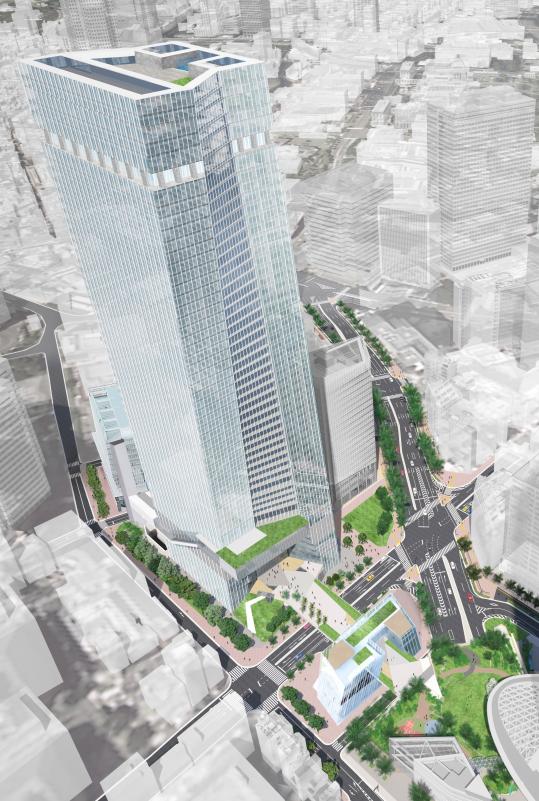
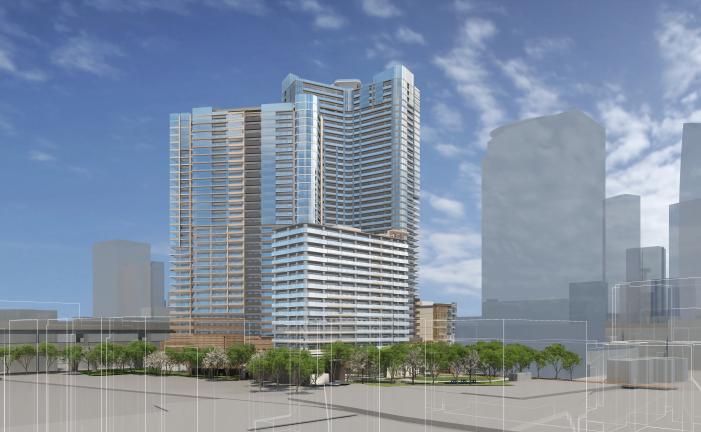
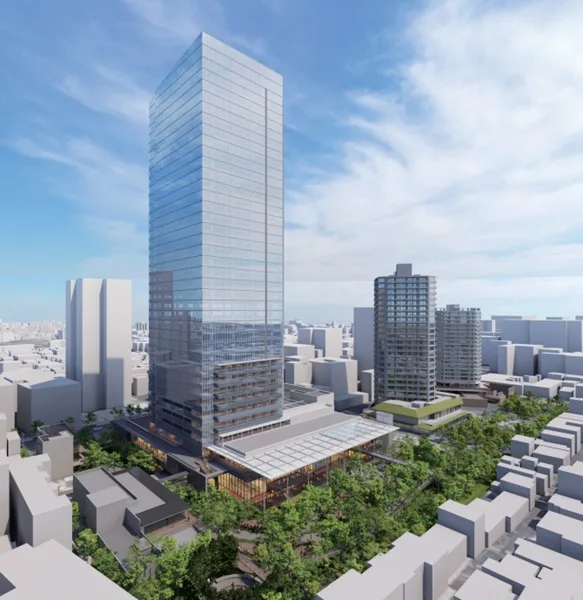
The Kanda Ogawamachi 3-chome West South District Type 1 Urban Redevelopment Project is a Type 1 urban redevelopment project underway within Kanda Ogawamachi 3-chome, Chiyoda Ward, Tokyo. In disclosures from the Tokyo Metropolitan Government's Urban Development Bureau, the project area is 0.6 ha, the executor is redevelopment association-led implementation, and the current status is listed as ongoing.
The plan site is located facing Yasukuni-dori and Meidai-dori, making it an inner-city block where people flowing in from the Jimbocho, Ochanomizu, and Ogawamachi directions are likely to converge. Shops and office functions are layered along the surrounding streets, and university and vocational school users, commuters, and visitors are also expected to move through the area. For that reason, this project is easier to understand as a reorganization of a point where multiple urban functions intersect, rather than as a simple rebuilding of a single lot.
The city planning decision was made on April 6, 2021, and the project authorization and redevelopment association establishment authorization were granted on May 16, 2023. In published materials, the project is presented as a mixed-use complex with housing, offices, shops, a plaza, parking, and related functions. In supplementary plan summaries that circulate publicly, a scale of 22 stories above ground and roughly 110 m in height can also be confirmed, but the site area, total floor area, number of housing units, project cost, construction start date, and planned completion date are not disclosed within the range that can be confirmed from the published materials.
Plan Overview
| Item | Details |
|---|---|
| Project name | Kanda Ogawamachi 3-chome West South District Type 1 Urban Redevelopment Project |
| Location | Kanda Ogawamachi 3-chome, Chiyoda Ward, Tokyo |
| Executor | Redevelopment association-led implementation |
| Project developer | Undisclosed within the range that can be confirmed from the published materials |
| Participating association members | Undisclosed within the range that can be confirmed from the published materials |
| Project partners | Undisclosed within the range that can be confirmed from the published materials |
| Project area | 0.6 ha |
| Site area | Undisclosed within the range that can be confirmed from the published materials |
| Total floor area | Undisclosed within the range that can be confirmed from the published materials |
| Scale | 22 stories above ground, approximately 110 m high |
| Main uses | Housing, offices, shops, plaza, parking, and related functions |
| Number of housing units | Undisclosed within the range that can be confirmed from the published materials |
| City planning decision | April 6, 2021 |
| Project authorization / redevelopment association establishment authorization | May 16, 2023 |
| Current status | Ongoing |
| Construction start | Undisclosed within the range that can be confirmed from the published materials |
| Planned completion | Undisclosed within the range that can be confirmed from the published materials |
| Project cost | Undisclosed within the range that can be confirmed from the published materials |
A project area of 0.6 ha is compact compared with super-block redevelopments, but as an urban block renewal near a major downtown road intersection, it is a size that makes it easier to read the impact on streetscape and pedestrian circulation. Because the published uses include housing, offices, shops, a plaza, and parking, the plan clearly assumes mixed use that includes not only daytime population but also nighttime population.
In addition, under Tokyo's classification, this is a Type 1 urban redevelopment project, which is an undertaking that advances block-level reorganization through a rights conversion framework. A key characteristic is that the project scheme can include the reconfiguration of plazas and circulation paths that are difficult to incorporate through individual lot-by-lot redevelopment. In a dense existing urban district in the city center, one of the important planning issues is how to secure public space.
Project Features
The defining feature of this project is not simply the creation of a tall building, but the reorganization of the block facing Yasukuni-dori and Meidai-dori into a mixed-use program that combines housing, office, commercial, and outdoor spaces. The fact that a plaza is explicitly listed among the published uses is especially important, because it suggests an intention to improve not only the interior floor arrangement of the building but also the quality of open space in the city, including places to stay, meet, and pass through.
The area around Kanda Ogawamachi 3-chome is close to Jimbocho's used-book district and restaurant streets, the university and medical-related facilities on the Ochanomizu side, and the office and commercial concentration on the Ogawamachi and Awajicho side. As a result, weekday business demand, movement by students and visitors, and evening dining use are all likely to overlap at different times of day. By including housing in the use mix, the block can more easily maintain continuity in how it is used.
The scale of 22 stories above ground and roughly 110 m high, confirmed in supplementary materials, is at a level that has strong visibility from the streetscape. However, what matters more in this project than the height figure itself is how the ground-level bustle is created, how the sidewalk connects with the building base, and how sightlines and circulation near the intersection are organized. The impression will change significantly depending on how much the plaza is used as an integrated part of the street network.
Detailed quantitative indicators for disaster resilience and environmental performance, as well as specifications for introduced equipment, are not disclosed within the range that can be confirmed from the published materials. Even so, the fact that an existing urban district that may include aging buildings is being renewed on a block basis while mixed use and public space are advanced at the same time clearly defines its character as a downtown redevelopment project.
Relationship to Surrounding Projects and the Area
To understand this plan site, it is essential to view it not only by administrative neighborhood name but also as a junction point spanning Jimbocho, Ochanomizu, and Ogawamachi. Jimbocho has a used-book district and a highly specialized commercial cluster, Ochanomizu has universities and medical-related facilities, and the Ogawamachi and Awajicho side combines office use with everyday commercial activity. Because this project is advancing at the point where those different purposes for visiting the area intersect, its effects need to be considered not only in terms of functions within the building itself but also in terms of spillover into the surrounding blocks.
Facing Yasukuni-dori and Meidai-dori is also significant in terms of the relationship with the streets. Both are core roads shaping the surrounding area, with high visibility from the street and a location where the quality of sidewalk space and the area around intersections directly affects how visitors move through the district. If the spatial composition at ground level is renewed through redevelopment, it may change the pedestrian experience toward Jimbocho Station, Ogawamachi Station and Awajicho Station, and Ochanomizu Station, though the specific circulation details are limited within the range that can be confirmed from the published materials.
In relation to surrounding projects, this project differs from ultra-large-scale redevelopments such as Otemachi and Marunouchi. It has a stronger character as a block-level renewal project in an area with a dense existing street-based commercial, educational, and cultural fabric, creating a circulation node through the reorganization of a single block. From the Jimbocho side, it adds a new mixed-use hub at the end of the existing commercial sequence. From the Ochanomizu side, it renews a node that receives movement related to universities, medicine, and business use. From the Ogawamachi side, it can be positioned as the reorganization of a connection point linking the office district with residential functions.
Also, because the uses include a plaza, the relationship between the block interior and exterior cannot be fully understood through the building alone. How open the plaza is to the road and to users of nearby facilities, and how the ground-floor retail composition contributes to continuity along the street, will determine the quality of circulation across the boundaries of Jimbocho, Ochanomizu, and Ogawamachi. What can be confirmed at present is the fact that redevelopment combining mixed use and public space is moving forward at an intersection connecting multiple downtown areas.
INA Brief
The Kanda Ogawamachi 3-chome West South District Type 1 Urban Redevelopment Project is notable not only for its 0.6 ha area, but for the high degree of junction value created by facing Yasukuni-dori and Meidai-dori. The city planning decision on April 6, 2021, and the project authorization and redevelopment association establishment authorization on May 16, 2023, make the project stage clear, and at present the biggest point of interest is how the mixed-use program and plaza development will connect with circulation through Jimbocho, Ochanomizu, and Ogawamachi.
References