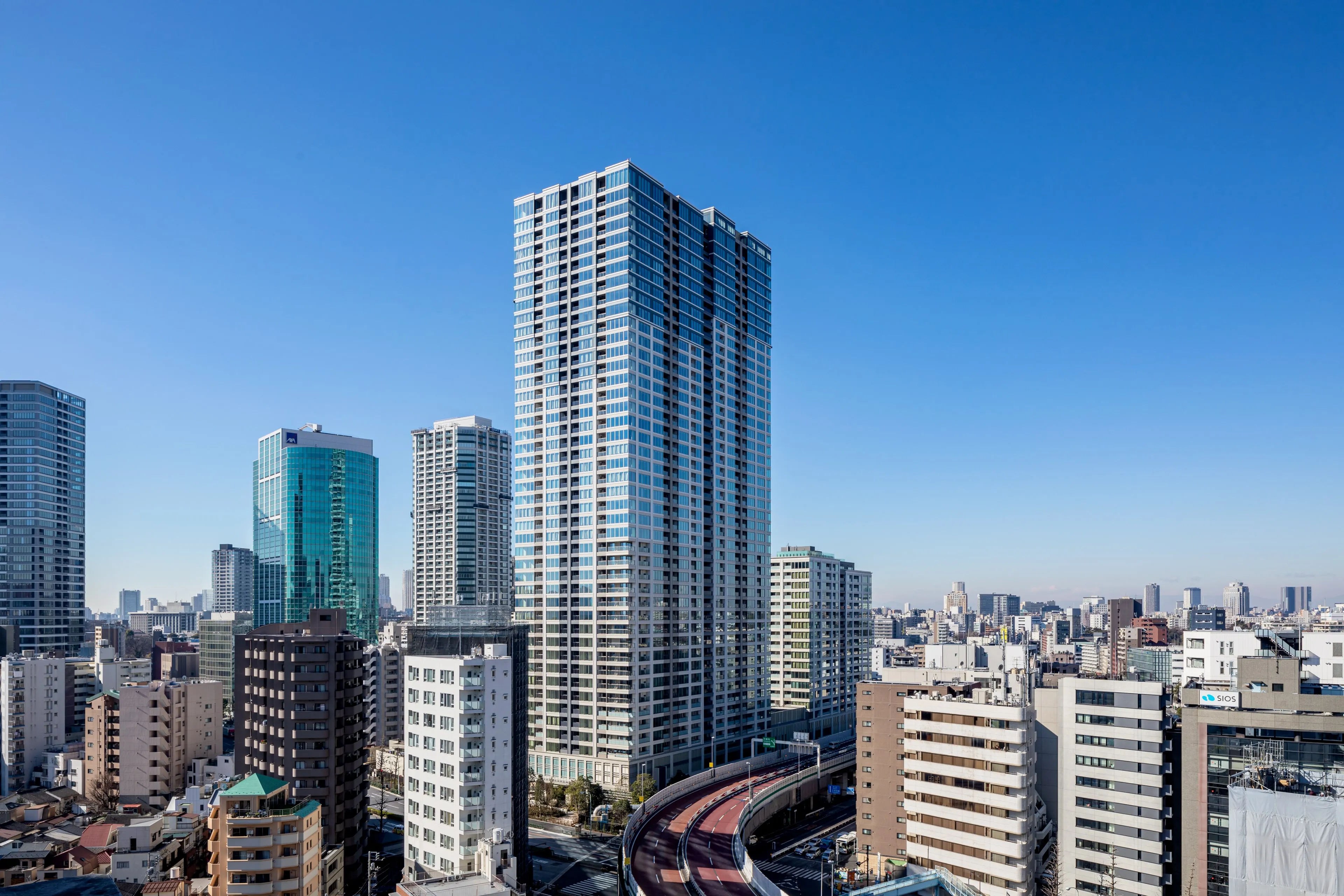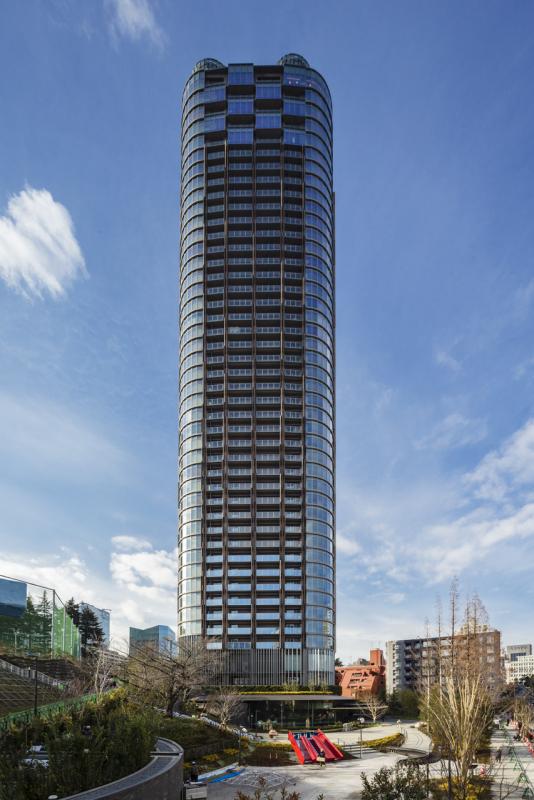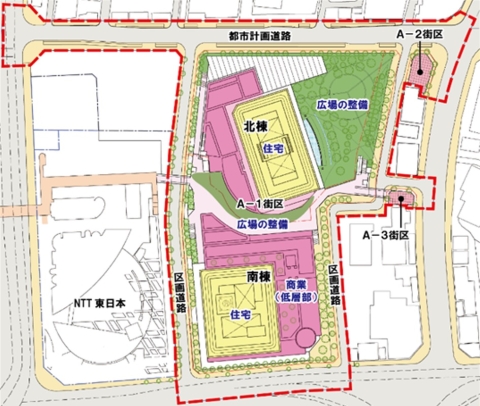
Approximately 1,100 meters southwest of Shinjuku Station, near Keio Line Hatsudai Station, one of Tokyo's largest redevelopment projects is underway in Nishi-Shinjuku 3-chome. This is the "Nishi-Shinjuku 3-chome West District Class 1 Urban Redevelopment Project," centered on twin towers—North Tower at 63 floors and approximately 229m, South Tower at 62 floors and approximately 228m—comprising a large-scale mixed-use complex with approximately 3,200 total units (per the project plan approved in September 2023). The schedule has been revised due to the industry-wide challenge of rising construction costs, making it crucial for real estate investors and area residents and workers to stay current on the latest developments.
The project schedule and plan details in this article are based on information published as of September 2026 (Shinjuku City, "Nishi-Shinjuku 3-chome West District Class 1 Urban Redevelopment Project (Under Construction)", updated April 2, 2026). Timelines may change as the project progresses.
Project Overview and Background
The project area spans approximately 4.6 hectares across parts of Nishi-Shinjuku 2-chome, 3-chome, and 4-chome in Shinjuku Ward. The target zone is densely packed with aging buildings constructed before 1981, and fire prevention issues have been flagged for many years. The project is being developed with the goal of fundamentally improving this urban area and creating a "mixed-use hub for vitality and exchange."
The implementer is the "Nishi-Shinjuku 3-chome West District Urban Redevelopment Association," which received Tokyo Metropolitan Government approval on February 1, 2023. Major developers and public institutions including Nomura Real Estate, Sumitomo Corporation, Tokyo Tatemono, and the Metropolitan Non-Combustible Construction Corporation are participating as member developers, with Maeda Construction Company selected as the designated business contractor. The project cost is approximately ¥238.7 billion (currently under review), positioning it as a large-scale project combining private enterprise and government collaboration.
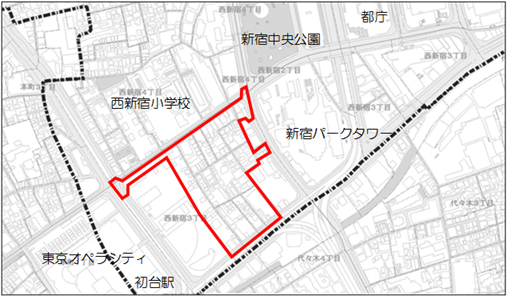
Building and Facility Plan Details
Block A-1 (Twin Towers)
The A-1 block, the core of this project, will feature two side-by-side ultra-high-rise towers. The North Tower stands 63 floors above ground, 4 below, with 2 penthouse levels, at approximately 229.4m with a total floor area of approximately 183,782 m², while the South Tower stands 62 floors above ground, 4 below, with 2 penthouse levels, at approximately 228.4m with a total floor area of approximately 194,987 m²—a magnificent scale (under the project plan as approved with amendments on September 8, 2023). Note that under the association's latest plan currently under consideration (per Shinjuku City, updated April 2026), the total floor area is given as approximately 180,180 m² for the North Tower and approximately 192,845 m² for the South Tower, differing in part from the approved project plan. The A-1 block has approximately 3,200 total units, a site area of approximately 29,630 m², and a combined total floor area for both towers of approximately 378,769 m². The program centers on residential use, with a planned mix of shops, offices, daily life support facilities, nurseries, and parking. The emergence of twin towers of this scale in the Nishi-Shinjuku area will fundamentally transform the city's skyline.
Blocks A-2 and A-3 (Low-Rise Mixed-Use Buildings)
Building A-2 (9 stories above ground, 1 below) and Building A-3 (9 stories above ground), developed in tandem with the towers, incorporate residences and shops, with Building A-3 also including a neighborhood community hall. The design philosophy reflects continuity with the local community while rebuilding the living foundation for existing residents.
Public Contribution (Pedestrian Network and Disaster Prevention)
The project's significance beyond mere private development is also evident in its substantial public contributions. Plans include developing an approximately 4,500 m² disaster prevention plaza, strengthening the safe and comfortable pedestrian network, and improving roads and temporary shelter facilities. It is also aligned with the "Nishi-Shinjuku Urban Lobby Concept" promoted by the Tokyo Metropolitan Government and Shinjuku Ward, as well as the Nishi-Shinjuku Redevelopment Guidelines formulated in February 2025, and is designed to contribute to the overall value enhancement of the area. The Day Nishi-Shinjuku Becomes a "Walkable City" | The 2040 Vision Shown by the Urban Lobby Concept and Redevelopment Guidelines
What Happens to Landowners? The Rights Conversion Mechanism and Misunderstandings About "Eviction"
Searches such as "Nishi-Shinjuku 3-chome redevelopment eviction" reflect the anxiety that a project of this scale often creates about what will happen to existing rights holders. However, Category I urban redevelopment projects legally proceed not through "eviction" but through a mechanism called "rights conversion." According to explanatory materials from the Tokyo Metropolitan Government Bureau of Urban Development, prior rights over land and buildings within the district are, in principle, replaced directly—without any exchange of money—with floor space (rights floor) in the newly constructed building. This mechanism guarantees floor area corresponding to the prior assessed value of the asset, and under the Urban Redevelopment Act, rights holders who submit a request within 30 days of the public notice of the association's establishment approval also have the option to relocate outside the district and receive monetary compensation instead of acquiring rights floor.
The project plan, for which the Nishi-Shinjuku 3-chome West District Urban Redevelopment Association received an approved revision dated September 8, 2023, explicitly states that "because this is a redevelopment project with a large number of local rights holders, the construction start dates and existing building demolition dates for the North and South Towers differ." This indicates that the plan deliberately staggers the demolition and construction start times of the North and South Towers in consideration of the impact on the daily life and business operations of the many landowners. The specific details of the rights floor each individual rights holder will acquire will be finalized upon approval of the rights conversion plan, which is set at fiscal year 2027 (Reiwa 9) under the association's latest plan.
Schedule and Latest Developments
Why Construction Start Was Delayed to Fiscal Year 2028
According to the association's latest plan as posted by Shinjuku City (updated April 2026), approval of the rights conversion plan and the start of demolition of existing buildings are set for fiscal year 2027 (Reiwa 9), the start of main construction for fiscal year 2028 (Reiwa 10), and completion for fiscal year 2035 (Reiwa 17). Construction start is delayed two years from the originally planned fiscal year 2026. The main reason is that soaring construction material prices and labor costs have forced a review of the total project cost. This is a structural challenge facing large-scale redevelopment projects across Japan—not just in Nishi-Shinjuku—and this project is no exception.
The schedule changes are as follows:
| Step | Original Plan | Association's Latest Plan (Target) |
|---|---|---|
| Start of existing building demolition | December 2025 | Fiscal year 2027 |
| Approval of rights conversion plan | Fiscal year 2026 | Fiscal year 2027 |
| Construction start | Fiscal year 2026 | Fiscal year 2028 |
| Project completion (handover) | Fiscal years 2032–2035 | Fiscal year 2035 |
While construction and completion delays may appear as negative news to investors, what matters is the high degree of certainty indicated by "urban planning decision finalized and association established." The rights conversion plan approval has also been pushed back one year to fiscal year 2027, but the risk of the project being abandoned is considered extremely low. Even with the delayed construction start, the framework of the project toward the fiscal year 2035 completion is being maintained.
Impact on Local Real Estate Market
Trends in the Nishi-Shinjuku Area as Seen in the 2026 Published Land Prices
In the 2026 published land prices (Reiwa 8), Shinjuku Ward recorded a strong increase with an average land price of ¥4.33 million/m² (up 12.88% year-on-year). The average commercial land price was ¥6.15 million/m² (up 13.77% year-on-year), and the average residential land price was ¥1.13 million/m² (up 11.21% year-on-year), both far exceeding the national average growth rate. The Nishi-Shinjuku area has continuously priced in redevelopment potential, and the structure is such that additional upward pressure will be added as construction progresses toward completion.
Latest Developments in the Shinjuku Station West Exit District Redevelopment Plan
Impact of Redevelopment on Surrounding Real Estate Values
The large new supply of approximately 3,200 units may appear at first glance to put pressure on surrounding rental prices. However, what is important is that this project will house not just residences, but a complex mix of shops, offices, daily life support facilities, and nurseries. As life convenience significantly improves and the degree to which daily life can be completed within walking distance increases, the overall rental demand for the area is expected to receive a boost.
Furthermore, while the Hatsudai/Nishi-Shinjuku 3-chome area has traditionally been treated as a "slightly lower-profile zone" within Nishi-Shinjuku, the completion of the 230m-class twin towers is expected to significantly raise its profile. This will also support used condominium prices. Given the approximately 10-year timeline until completion in fiscal year 2035, the attention to this area as part of a long-term holding investment strategy is expected to increase further.
Signal Effect of Major Developer Participation
The participation of Nomura Real Estate, Sumitomo Corporation, and Tokyo Tatemono—three of Japan's leading domestic real estate companies—as member developers is an important signal demonstrating the level of risk management and the reliability of revenue projections. These developers decided to participate after conducting their own market research and financial simulations, and their continued involvement signifies a strong commitment to the project. This is valuable information for individual investors evaluating the area.
Actions Owners Should Take
For real estate owners with assets near the Nishi-Shinjuku 3-chome West District, there are points to consider at this stage. First, the approximately 10-year timeline until completion means there is no urgency to decide "whether to sell now." On the other hand, as demolition and construction activity intensifies from fiscal year 2027 onward, there may be temporary changes in the living environment, such as construction noise and traffic restrictions in the vicinity. For those managing rental properties, careful disclosure of information to tenants and consideration of rent and contract condition reviews as needed are advisable.
It is also important to continuously monitor how rental demand in the area will trend with the increase in supply after completion. The impact will differ greatly between properties that compete with new tower condominiums and those that benefit from improved life convenience. Maintaining a stance of closely tracking area market changes and optimizing portfolios will contribute to the long-term maintenance of asset values.
Overview of Shibuya Station Area Redevelopment and Its Impact on Real Estate Values
Our View
When looking at the redevelopment of the Nishi-Shinjuku 3-chome West District, what stands out to us is not the sheer scale of the specifications but the combination of "timeline" and "certainty." The delay of the construction start to fiscal year 2028 is certainly disappointing news for those who had hoped for a faster pace. However, the rise in construction costs stems from a temporary external factor, and for a project that has already received administrative approvals such as the urban planning decision and association establishment, a delay in construction start is fundamentally different from the project's withdrawal.
For redevelopment projects underway in Japan's major cities, the core of real estate investment judgment lies in assessing whether a plan is genuinely certain to proceed. The strong participating member developer lineup of Nomura Real Estate, Sumitomo Corporation, and Tokyo Tatemono, together with the experienced business contractor Maeda Construction Company, can be evaluated as factors that raise the likelihood of the project's completion.
When considering asset building from a long-term perspective, it should not be overlooked that the completion of a mixed-use hub centered on 230m-class twin towers will raise Nishi-Shinjuku 3-chome's standing as an urban district by another notch. With completion scheduled for fiscal year 2035—approximately nine years from now—this is a meaningful timeline for investors accustomed to long-term asset holding. We at INA&Associates Inc. will continue to watch these long-term shifts in area value and provide transparent information so that owners can make decisions based on reliable data.
Summary
Key points of the Nishi-Shinjuku 3-chome West District Class 1 Urban Redevelopment Project:
- Scale: Nishi-Shinjuku's largest development, centered on twin towers—North Tower at 63 floors/~229m and South Tower at 62 floors/~228m—with approximately 3,200 total units (per the project plan approved in September 2023)
- Structure: Nomura Real Estate, Sumitomo Corporation, and Tokyo Tatemono as participating member developers; Maeda Construction Company as designated business contractor
- Schedule: Due to rising construction costs, construction start delayed from fiscal year 2026 to fiscal year 2028. Rights conversion plan approval: fiscal year 2027; completion: fiscal year 2035 (targets per the association's latest plan)
- Land Price Trends: Shinjuku Ward's 2026 published land prices are averaging +12.88%, continuing a high level of increase
- Investment Perspective: Against the backdrop of certainty from finalized urban planning decisions and established association, the long-term value appreciation potential for the area is high
Rather than reacting to the short-term change of the construction delay, it is important to develop an asset strategy with the long-term vision of the fiscal year 2035 completion in mind.
How transaction prices have actually moved
To see how far expectations for the redevelopment are actually reflected in transaction prices, we checked the real estate transaction price data published by the Ministry of Land, Infrastructure, Transport and Tourism. The table below places resale condominium transactions in districts whose name contains “Nishi-Shinjuku” alongside Shinjuku Ward as a whole.
| Year | Transactions | Price per m² in this area (median) | Ward-wide price per m² (median) |
|---|---|---|---|
| 2023 | 231 | ¥1,200,000 | ¥1,150,000 |
| 2024 | 218 | ¥1,326,000 | ¥1,257,000 |
| 2025 | 262 | ¥1,591,000 | ¥1,320,000 |
| 2026 (Q1 only) | 51 | ¥1,560,000 | ¥1,320,000 |
From 2023 to 2025 the rate of increase was +32.6% for Nishi-Shinjuku and +14.8% for Shinjuku Ward as a whole. That is more than double the growth of the ward as a whole, and even in the first quarter of 2026 it has held a level 18% above the ward average.
In absolute terms, resale condominium transactions in Nishi-Shinjuku from 2025 onward had a median of ¥65 million on a floor area of 45 m², with roughly half of all transactions falling between ¥32.5 million and ¥140 million.
Source: Compiled by INA&Associates Inc. from “Real Estate Transaction Price Information” (Ministry of Land, Infrastructure, Transport and Tourism), MLIT Real Estate Information Library (国土交通省 不動産情報ライブラリ, https://www.reinfolib.mlit.go.jp/). Based on data obtainable as of September 2026. The most recent quarter is provisional, because transactions are added later.
A note from the numbers (as of September 2026)
From here on, this is not published material but our own assessment.
Nishi-Shinjuku is one of the few areas where expectations for the redevelopment are showing up in actual transaction prices. In many redevelopment areas the expectation appears first in land prices and only later feeds through to actual resale condominium transactions. As of 2025 Nishi-Shinjuku had already recorded growth of more than double the ward average in actual transactions.
We see the background as the fact that several rebuilding projects are proceeding at the same time across Nishi-Shinjuku as a whole, and not only in the 3-chome West District. In other words, the market has judged that the area as a whole has entered a phase of renewal rather than looking at individual projects.
How to judge it as an investor
- Judge on the premise that pricing-in has already progressed. Numbers that assume further rises from here are at a stage where you should confirm the grounds before putting them together.
- A median of ¥65 million on a floor area of 45 m² shows that the centre of the market is single occupants and DINKS. How you read rental demand needs to be matched to that group.
- The first quarter of 2026 was flat at ¥1,560,000 per m². Whether the rise has paused or this is temporary can be confirmed in the figures for the next quarter.
Frequently Asked Questions (FAQ)
Q1. What phase is the Nishi-Shinjuku 3-chome West District redevelopment currently in?
The Urban Redevelopment Association received establishment approval from the Tokyo Metropolitan Government in February 2023, and the project is currently in the rights conversion plan formulation phase. Under the association's latest plan, both approval of the rights conversion plan and the start of demolition of existing buildings are targeted for fiscal year 2027.
Q2. When is completion? I heard the schedule has changed.
According to the association's latest plan as posted by Shinjuku City (updated April 2026), the construction start has been delayed from the originally planned fiscal year 2026 to fiscal year 2028 in response to soaring construction material prices and labor costs. Accordingly, completion and project finish is expected in fiscal year 2035. The administrative approvals of association establishment and urban planning decision have been completed, and the project's certainty is maintained.
Q3. When will the impact on the rental and sales markets near the redevelopment zone begin to be felt?
The expected value for land prices is already reflected to a certain degree in the 2026 published land prices (up 12.88% year-on-year). Physical impacts (noise, traffic restrictions, etc.) will intensify after demolition work begins in fiscal year 2027, and the demand-boosting effect is expected to materialize fully after completion in fiscal year 2035. However, the psychological premium from increased recognition may begin forming even before completion.
Q4. What is the significance of Nomura Real Estate and Sumitomo Corporation participating?
The participation of major developers as member developers means that professionals have scrutinized the project's profitability and feasibility before committing. This functions as a factor that reduces the risk of any potential project interruption, and positively influences the lending decisions of financial institutions and the valuation of nearby real estate. This is a signal effect that smaller-scale redevelopment projects do not have.
References
- Shinjuku City Official "Nishi-Shinjuku 3-chome West District Class 1 Urban Redevelopment Project (Under Construction)"
- Tokyo Metropolitan Bureau of Urban Development "Nishi-Shinjuku 3-chome West District Class 1 Urban Redevelopment Project"
- Tokyo Metropolitan Government Press Release "Approval of Nishi-Shinjuku 3-chome West District Urban Redevelopment Association Establishment" (January 31, 2023)
- Nomura Real Estate Press Release "Decision on Participating Member Developers for Nishi-Shinjuku 3-chome West District Class 1 Urban Redevelopment Project" (February 2, 2023)
- Shinjuku City "Reiwa 8 Published Land Prices (Summary of Land Prices in the Ward)"