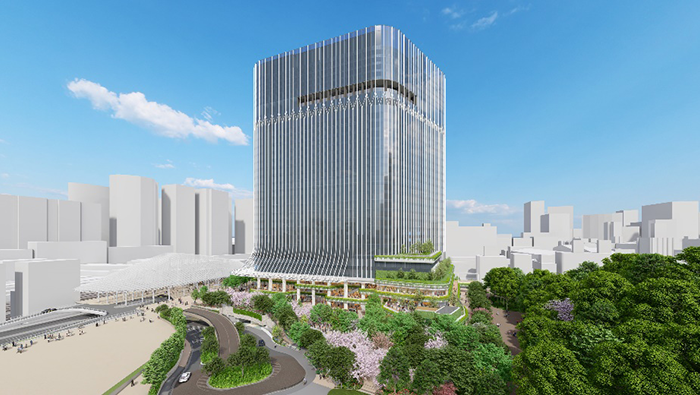
In the Shinagawa Station West Exit A area, a large-scale mixed-use development involving Keikyu Corporation and Toyota Motor Corporation is progressing. Keikyu Corporation announced on May 31, 2025 that it will begin construction on the "(tentative name) Shinagawa Station West Exit District A New Construction Plan" and has defined the future vision of the area around Shinagawa Station as "a port of connection that moves the heart and the world."
This plan is a reorganization of the west exit of Shinagawa Station, centered on the site of the former Shinagawa Goose, and is a complex that combines offices, retail, MICE, and hotels. Toyota has announced plans to open its "New Tokyo Headquarters" in the same planned building in 2029.
In this article, we will summarize the plan for Shinagawa Station West Exit A District, its usage composition, its relationship with surrounding redevelopment, and the impacts that real estate owners and investors should consider.
Site History and Demolition: What Was Here Before, and How the Construction Work Fits Together
Before this redevelopment, the District A site was occupied by a large hotel and event-hall complex known as Shinagawa Goose, formerly branded Hotel Pacific Tokyo. Demolition of that building was carried out by Taisei Corporation, with reporting on the project citing a target of completing demolition by the end of May 2025, clearing the roughly 23,584-square-meter site ahead of the new construction that Keikyu and Toyota began on May 31, 2025.
District A is only one piece of a larger, publicly backed groundwork project around the station. On June 1, 2023, Japan's Minister of Land, Infrastructure, Transport and Tourism approved the "Shinagawa Station West Exit Land Readjustment Project," with the Urban Renaissance Agency (UR) as the implementing body; Keikyu itself announced this approval directly on its own corporate site. According to UR's own announcement, road construction inside the readjustment area began on May 26, 2025, deliberately timed just ahead of the District A groundbreaking on May 31, 2025. In other words, a search for "Shinagawa Station construction" in 2025 is picking up two linked but separate projects running on parallel timelines: Keikyu and Toyota's building itself, and UR's public infrastructure work on the roads and station-front spaces around it.
Plan outline for Shinagawa Station West Exit A area
The new construction plan for Shinagawa Station West Exit District A is the development of the former Shinagawa Goose site located in Takanawa 3-chome, Minato-ku, Tokyo. Keikyu Corporation will be the main business entity, and Toyota Motor Corporation will participate as a joint venturer.
| Item | Contents |
|---|---|
| Plan name | (tentative name) Shinagawa Station West Exit Area A New Construction Plan |
| Location | Takanawa 3-chome, Minato-ku, Tokyo |
| Business entity | Keikyu Corporation |
| Joint Venture | Toyota Motor Corporation |
| Site area | Approximately 23,584 square meters |
| Total area | Approximately 311,802 square meters |
| Scale | 29 floors above ground, 4 floors underground |
| Height | Approx. 152m |
| Main uses | MICE, commercial, conference, office, hotel |
| Construction begins | May 31, 2025 |
| Scheduled opening | Scheduled for 2029 |
Shinagawa is one of Japan's leading transportation hubs, where the Shinkansen, JR conventional lines, and Keikyu lines converge. With the future opening of the Linear Chuo Shinkansen line in mind, Tokyo is strongly aware of its role as a hub for international exchange.
Usage mix: MICE, commercial, office, hotel
According to Keikyu's published materials, District A is not just an office building, but is planned as a complex facility that will generate interaction and stay.
| Floor | Main use | Role |
|---|---|---|
| 2nd basement floor - 1st basement floor | Multipurpose hall (MICE) | In response to demand for international conferences and events |
| 1st basement floor to 4th floor | Commercial facility | Creates circulation and retention in front of the station |
| 5th to 6th floors | Conference facilities | Corporate events/meetings demand |
| 7th to 22nd floors | Office | Large-scale business base |
| 23rd to 29th floors | Hotel | International/Business stay demand |
By having MICE, commercial, office, and hotel facilities in the same facility, usage will be dispersed on weekdays, holidays, daytime, and nighttime. This is important to maintain the liveliness in front of the station.
Meaning of Toyota New Tokyo Headquarters
Toyota has announced that it will open its new Tokyo headquarters in 2029 in a planned building in the west exit area of Shinagawa Station. Shinagawa has excellent access to the airport, the Tokaido Shinkansen, and transportation to other parts of the city, making it a reasonable base for global companies.
Toyota's new Tokyo headquarters is not just a location for large companies. This may have a ripple effect on urban functions around Shinagawa, including related companies, business partners, recruitment, human resource exchange, events, and accommodation demand.
For real estate owners, it is necessary to look at not only the direct demand related to Toyota, but also the indirect impact on surrounding offices, rental housing, hotels, restaurants, and service stores.
Relationship with redevelopment around Shinagawa Station
Several large-scale projects are underway around Shinagawa Station, including Takanawa Gateway City on the east side, station block development, and the Linear Chuo Shinkansen project. Area A is planned to serve as the west entrance.
When evaluating redevelopment, it is necessary to look not only at the scale of a single project but also at its continuity with surrounding projects. Area value changes depending on how east-west movement of the station, pedestrian decks, commercial lines, MICE/hotel demand, and office supply are connected.
Shinagawa is a rare location that has access to the airport, Shinkansen, and the city center at the same time. With the completion of District A, if the accommodation and interaction functions on the west exit side are strengthened, the evaluation axis of the area around Shinagawa Station may change from a transfer station'' to abase for accommodation, business, and interaction.''
Impact on surrounding real estate
Office market
The provision of large-scale offices will increase Shinagawa's business concentration. On the other hand, there will also be competition for existing buildings. Older small and medium-sized offices are easier to compare not only in terms of rent, but also in terms of common areas, earthquake resistance, communication environment, air conditioning, and access control.
Rental housing
The concentration of the new Tokyo headquarters and related companies may have a ripple effect on rental demand in areas with high commuting convenience, such as Shinagawa, Takanawa, Sengakuji, Osaki, Gotanda, and Oimachi. However, as housing rents also depend on the amount of supply, property quality, and household budget burden, increases should not be determined based solely on redevelopment.
Commercial/Stores
The combination of MICE, hotels, and commercial facilities has the potential to extend the length of time visitors spend in the city. For nearby stores, the key is whether they can capture not only daytime business demand, but also event, lodging, and sightseeing demand.
Hotel/Short-term stay
Shinagawa has strong access to Haneda Airport and the Shinkansen, making it ideal for international conferences and corporate events. There is a possibility that demand will spread not only to hotels in District A but also to nearby accommodation facilities.
Indicators checked by owners/investors
| Indicators | Reasons to watch |
|---|---|
| Construction progress | Understand the completion date and demand generation |
| Tenant announcement | Read the actual visitor demographic |
| Surrounding rent | Distinguishing expected advance from actual demand |
| Vacancy rate | Confirming competition from new construction supply |
| Store flow | Determining the value of commercial plots |
| Traffic flow line | Check the flowability of the station's west and east exits |
In redevelopment areas, expectations are high immediately after announcements are made, and then re-evaluated based on actual demand after completion. When making investment decisions, check the location, age, management condition, and exit price of each property, rather than the size of the news.
INA&Associates' philosophy
The Shinagawa Station West Exit A area is an important redevelopment project that connects Tokyo's wide-area transportation and international business. However, redevelopment does not mean that all surrounding real estate will rise in the same way.
While looking at the growth story of a city, we place importance on calmly confirming the income and expenditure, management status, and exit strategy of each property. Redevelopment can be a strong tailwind, but what ultimately determines value is how well an individual property can absorb that change.
Frequently asked questions
Q. When is Shinagawa Station West Exit A area scheduled to open?
According to Keikyu Corporation's published materials, it is scheduled to open in 2029. The timing may change due to construction or plan changes.
Q. Will Toyota be in this facility?
Toyota has announced plans to open its new Tokyo headquarters in 2029. We plan to use part of the planned building as a new office base.
Q. Will the prices of surrounding apartments increase?
Redevelopment is a positive factor, but it does not guarantee price increases. It is necessary to look at station distance, building age, management status, supply volume, and interest rate environment.
Q. When should investors start making moves?
Market views change during the announcement stage, construction begins, tenant announcements, pre-completion, and opening. The faster you move, the higher the risk of buying at the expected price, so please calmly check your income, expenditure, and exit.
Reference/Citation