2026 Edition: What Is the Hirakata-shi Station Area Type 1 Urban Redevelopment Project? Explaining the Current Status of the Three Districts and the Impact on Rental Management
The Hirakata-shi Station Area Type 1 Urban Redevelopment Project is a phased effort to renew the transportation, circulation, and disaster-prevention functions around Hirakata-shi Station by dividing the area into three districts (Phase 1, Phase 2, and Phase 3). In May 2024, the core facility of Phase 3, "Station Hill Hirakata," was completed, and the development of the station plaza and public spaces also entered its final stage. Now that the project has moved into its completion phase, this article organizes, based on official information, how the underlying conditions for rental management are changing.
Key points of this article
- The project consists of three districts. In Phase 3, "Station Hill Hirakata" was completed in May 2024. Phases 1 and 2 are also in the completion stage, and the north station plaza is scheduled for completion by the end of February 2026.
- The total project cost is on the scale of approximately JPY 43.3 billion. The Keihan Group, including Keihan Holdings, Keihan Electric Railway, and Keihan Real Estate, plays a central role as participating association members.
- The effects of rebuilding the station-front area tend to appear first in "shorter vacancy periods" and "stronger leasing competitiveness" rather than directly in rent levels themselves.
- For owners' practical management, it is important to design renovation priorities for held properties and exit strategies at the same time, based on the tenant mix and pedestrian flow in Phase 3.
What is the Hirakata-shi Station Area Type 1 Urban Redevelopment Project?
This project is a Type 1 urban redevelopment initiative that advances public facility improvements and private-sector development in an integrated way around Hirakata-shi Station. Its main pillars are the redevelopment of the station plaza and district roads, the introduction of mixed-use functions, and improvements to pedestrian circulation and disaster resilience. The implementing body is the Hirakata-shi Station Area Urban Redevelopment Association, established on March 26, 2020. Keihan Holdings, Keihan Electric Railway, and Keihan Real Estate participate as association members.
Overview and current status of the three districts (as of May 2026)
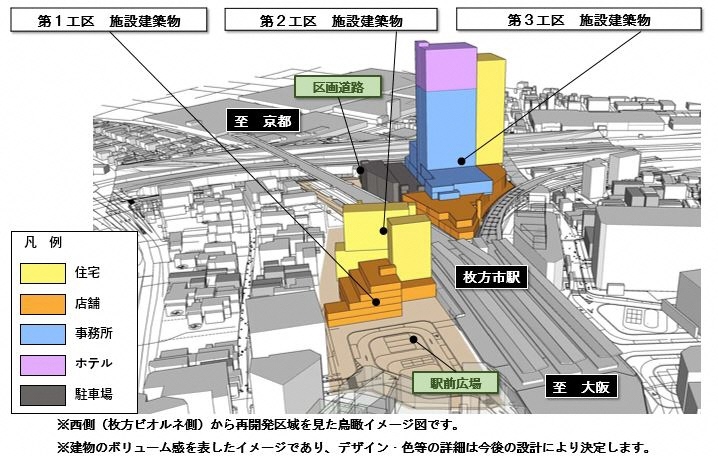
Based on materials published by Hirakata City, we organize the scale, uses, and status of each district.
| Item | Phase 1 | Phase 2 | Phase 3 |
|---|---|---|---|
| Site area | Approx. 1,450㎡ | Approx. 4,950㎡ | Approx. 13,500㎡ (including approx. 1,550㎡ of station plaza) |
| Total floor area | Approx. 5,850㎡ | Approx. 8,850㎡ | Approx. 93,770㎡ |
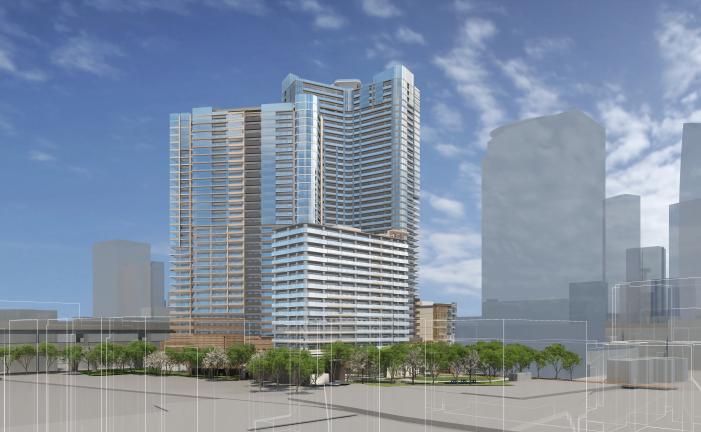
| Number of floors | 6 above ground, 1 basement floor | 14 above ground | 29 above ground (the station-front building has 4 above-ground floors) |
| Main uses | Retail (clinics, merchandise, food and beverage) | Retail and housing | Retail, offices, hotel, housing, public facilities |
| Status | Completed | Completed | Completed on May 31, 2024 (Station Hill Hirakata) |
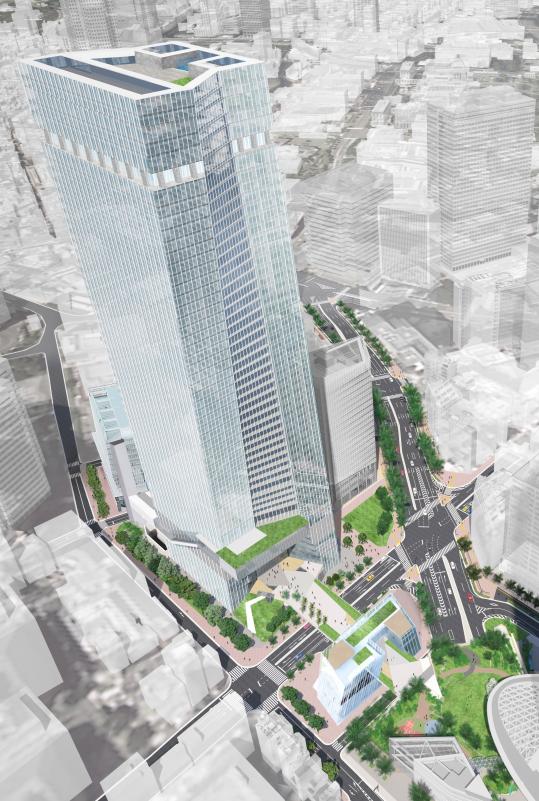
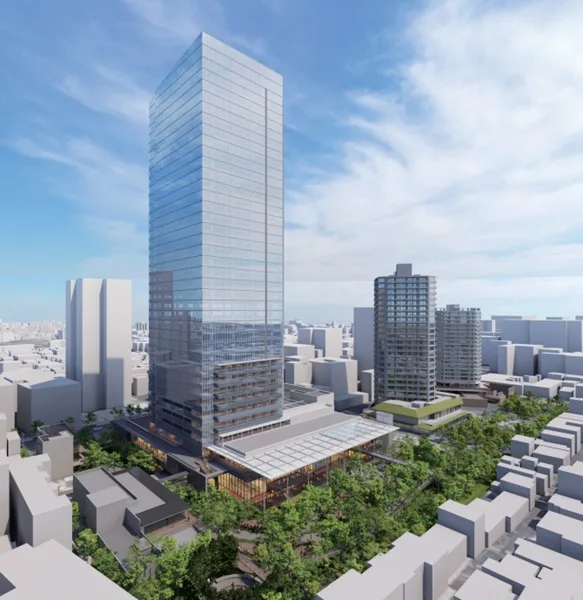
"Station Hill Hirakata" in Phase 3 is a mixed-use facility that includes approximately 23,500㎡ of commercial space (floors 1 to 4), approximately 6,800㎡ of office space, a 139-room hotel (Candeo Hotels Osaka Hirakata), and 202 rental housing units. The north station plaza has a planned area of approximately 12,400㎡ (of which approximately 10,000㎡ will be developed as one integrated space), and completion is expected by the end of February 2026.
Why is the redevelopment of Hirakata-shi Station important?
In short, redevelopment that changes how the station-front area functions affects both the "size" and the "quality" of rental demand. Even in the trends we see on the ground, areas where station-front circulation has improved tend to see better viewing numbers and higher closing rates even at comparable rent levels. Hirakata-shi Station has now entered exactly this phase, in which both that "size and quality" move at the same time, due to the completion of Phase 3 and the development of the north station plaza.
What is the impact on owners' practical operations?
The first assumption owners should make is that the axis of competition will shift from "lower rent" to "compatibility with daily living routes." That is because not only walking minutes to the station matter; the perceived distance also changes when a new plaza and pedestrian network are put in place. More importantly, this is where operations that make the most of human capital matter. Properties supported by management teams with stronger proposal capabilities tend to show clearer differences in evaluation during redevelopment phases.
- The tenant composition of "Station Hill Hirakata" (commercial, hotel, office, and housing) will become a benchmark for surrounding demand by use.
- Once the circulation pattern of the north station plaza is fixed, the "easiest direction to walk" from the ticket gates will change, and the criteria for visibility and accessibility will be updated.
- The retail and housing mix in Phases 1 and 2 will directly affect pricing expectations and tenant needs in nearby areas.
Preparations owners should make now
First, review the priority order of repairs and renovations starting with items that improve the viewing route for prospective tenants. Second, update listing photos and promotional copy so they reflect the post-redevelopment lifestyle image of the station-front area (the station plaza and mixed-use complex). Third, structure your exit strategy on multiple tracks in three-year units. Choosing sustainable growth over short-term judgment will ultimately contribute to asset protection.
INA's view
During a redevelopment phase, results are shaped not only by the building itself but also by the quality of the operating team. That is why I recommend an operating design that prioritizes "investment in human capital" over "cost reduction." Planning with trust and honesty at the center, while disclosing not only the benefits but also the risks, is the strongest management decision over the long term.
Frequently Asked Questions (FAQ)
Q1. Has Phase 3 already been completed?
A. Yes. The core facility of Phase 3, "Station Hill Hirakata," was completed on May 31, 2024. It is a mixed-use facility that includes commercial space, offices, a hotel, and housing.
Q2. When will the north station plaza be completed?
A. According to publicly released information, completion is scheduled for the end of February 2026. The planned plaza area is approximately 12,400㎡, and the pedestrian flow in front of the station will change significantly.
Q3. Will rents rise immediately because of the redevelopment?
A. Not necessarily. Rents may not rise uniformly in the short term, but stronger leasing competitiveness is likely to shorten vacancy periods.
Q4. Can small-scale properties also benefit from the redevelopment?
A. Yes. Improvements to station-front circulation affect how a location is used more than the size of the property, so even small-scale properties can expect improved closing rates.
Cited and reference materials