An inherited family home sits empty. Should it be renovated and rented out? How much would that actually cost? Is renovating worth it at all? This article is written for two audiences at once: Japanese owners of a vacant house (akiya, 空き家) who are weighing exactly that decision, and international investors evaluating older detached houses in Japan's regional and suburban markets as an asset class. Everything here is built from actual cost figures and a decision sequence, drawn entirely from public Japanese government data — not contractor sales estimates, and not the round numbers common in marketing copy.
One thing is worth stating plainly at the outset, because it is the single biggest adjustment for a foreign investor approaching this topic: unlike the United States, the United Kingdom, or Australia, Japan has no MLS-style database of disclosed, comparable transaction prices for renovation deals or resold properties. There is no single commercial platform where you can pull "comps" for what a similar akiya cost to renovate and what it later sold or leased for. Cost benchmarks, subsidy programs, and building-code thresholds are scattered across ministry PDFs, National Tax Agency bulletins, and municipal websites rather than aggregated into one searchable feed. This article exists because assembling that picture from primary sources is, in Japan, something every serious buyer has to do for themselves — and it walks through exactly how.
According to the Ministry of Land, Infrastructure, Transport and Tourism (MLIT, 国土交通省) — Japan's ministry responsible for housing and construction policy, roughly equivalent to a combined national department of housing, transport, and public works — households that actually completed a renovation project spent an average of ¥1,700,000 (approx. USD 11,300) and a median of ¥700,000 (approx. USD 4,700). All currency conversions in this article use an approximate rate of ¥150 = USD 1, as of 2026-08; treat them as an order-of-magnitude guide rather than a live exchange rate. Multi-million-yen, whole-house gut renovations are the exception, not the rule — the amount most owners actually spend sits at this much lower level. The first step in any akiya decision is working out which of these two very different worlds your own house is closer to.
Key takeaways
- Vacant-house renovation costs average ¥1,700,000 (approx. USD 11,300) with a median of ¥700,000 (approx. USD 4,700) in national statistics. For detached houses specifically, the average is ¥1,720,000 (approx. USD 11,500) and the median ¥850,000 (approx. USD 5,700).
- Japan's government publishes official unit-cost notices (告示単価) for seismic retrofitting and thermal-insulation work. Multiply the published rate by your house's floor area and you can produce a self-service construction-cost estimate before ever calling a contractor.
- In 2026, both a subsidy program (the four schemes under the "Housing Energy Conservation 2026 Campaign," 住宅省エネ2026キャンペーン) and a tax reduction (the renovation promotion tax system) are available — but the income-tax deduction is restricted to a house the owner actually lives in, not a rental investment property.
- Following the April 1, 2025 revision to the Building Standards Act (建築基準法), large-scale renovation of a two-story wooden house now requires a formal building confirmation (建築確認) procedure — a change many owners planning a full renovation in 2026 have not yet accounted for.
- Repairing-and-renting, renting as-is, selling, and demolishing are taxed in entirely different ways. Sell, and the ¥30,000,000 (approx. USD 200,000) special exemption for inherited vacant houses is decisive. Demolish, and losing the residential land tax special exception changes the arithmetic.
Start from the national baseline: ¥1,700,000 average, ¥700,000 median (approx. USD 11,300 / USD 4,700)
When you want to know what renovating a vacant house actually costs, the right first stop is not a contractor's rate card — it is government statistics. According to the "FY2025 Housing Market Trend Survey Report" (令和7年度 住宅市場動向調査報告書), published by MLIT in July 2026 (Reiwa 8), the renovation funds spent by households that completed a renovation project averaged ¥1,700,000 (approx. USD 11,300), with a median of ¥700,000 (approx. USD 4,700). The wide gap between the average and the median is the story: a handful of large-scale renovations pull the average upward, while half of all households finish their project for ¥700,000 or less.
This is a useful early comparison point for investors used to US or UK renovation cost guides, which typically quote a per-square-foot range for a full gut renovation. The Japanese figures above are not per-unit-area rates at all — they are what households in aggregate actually spent, regardless of house size or scope, which is itself informative: it tells you that the "typical" Japanese renovation is a modest, targeted project, not a wall-to-wall rebuild.
What the MLIT survey shows about actual renovation funding
Looking at the breakdown of funding sources, self-funded capital (自己資金) accounted for ¥1,430,000 (approx. USD 9,500), a self-funding ratio of 84.2%. In other words, most households pay for renovation out of pocket rather than borrowing — this is not, in the majority of cases, a project financed with a renovation loan. The year-by-year trend below reinforces the same point: this is not a category of spending that Japanese households routinely go into debt for.
| Fiscal year | Total renovation funds | Of which self-funded | Self-funding ratio |
|---|---|---|---|
| FY2021 (Reiwa 3) | ¥2,010,000 (approx. USD 13,400) | ¥1,610,000 (approx. USD 10,700) | 80.3% |
| FY2022 (Reiwa 4) | ¥2,060,000 (approx. USD 13,700) | ¥1,530,000 (approx. USD 10,200) | 74.1% |
| FY2023 (Reiwa 5) | ¥1,370,000 (approx. USD 9,100) | ¥1,120,000 (approx. USD 7,500) | 81.9% |
| FY2024 (Reiwa 6) | ¥1,540,000 (approx. USD 10,300) | ¥1,320,000 (approx. USD 8,800) | 85.5% |
| FY2025 (Reiwa 7) | ¥1,700,000 (approx. USD 11,300) | ¥1,430,000 (approx. USD 9,500) | 84.2% |
Source: MLIT, "FY2025 Housing Market Trend Survey Report" (令和7年度 住宅市場動向調査報告書) (published July 2026). The survey of newly built condominiums, existing (used) homes, and renovated homes covers Japan's three major metropolitan areas (Greater Tokyo, Greater Nagoya, and Greater Osaka).
Broken down by building type, detached houses (一戸建て) had FY2025 renovation funds averaging ¥1,720,000 (approx. USD 11,500) with a median of ¥850,000 (approx. USD 5,700). Multi-unit housing averaged ¥1,660,000 (approx. USD 11,100) with a median of ¥400,000 (approx. USD 2,700). For a vacant detached house, the realistic starting benchmark is the high hundreds of thousands of yen — roughly USD 11,000–12,000 on average — not the multi-million-yen figure that dominates renovation marketing.
Add the acquisition cost, and the whole picture changes
The same survey shows that households who acquired an existing (used) detached house paid an average purchase price of ¥29,660,000 (approx. USD 197,700), with a median of ¥26,500,000 (approx. USD 176,700) and a self-funding ratio of 38.1%. And critically, 71.8% of households who acquired a used detached house carried out renovation work before or after the purchase. Acquiring a used house in Japan is standard practice built around a combined budget for purchase plus renovation, not a purchase decision made in isolation.
This is a meaningful contrast with US or UK buy-to-let norms, where a renovation budget is frequently treated as a separate, optional line item layered onto the purchase decision after the fact. In Japan's used-house market, the two are budgeted together from the start — a structural reason why Japanese real-estate agents and lenders routinely ask about renovation plans at the time of purchase, not afterward.
| Item | Average | Median | Self-funding ratio |
|---|---|---|---|
| Purchase price, existing (used) detached house | ¥29,660,000 (approx. USD 197,700) | ¥26,500,000 (approx. USD 176,700) | 38.1% |
| Purchase price, existing (used) multi-unit housing | ¥33,210,000 (approx. USD 221,400) | ¥27,500,000 (approx. USD 183,300) | 40.0% |
| Renovation funds (all housing types) | ¥1,700,000 (approx. USD 11,300) | ¥700,000 (approx. USD 4,700) | 84.2% |
| Renovation funds (detached houses) | ¥1,720,000 (approx. USD 11,500) | ¥850,000 (approx. USD 5,700) | 83.2% |
Actual renovation work concentrates on plumbing/kitchen/bath, interior finishes, and roofing
According to MLIT's "FY2024 Survey of Vacant House Owners" (令和6年空き家所有者実態調査結果) (published August 2025), only 21.5% of vacant-house-owning households had carried out any renovation in the preceding five years. And the work that was actually done skews heavily toward a specific set of categories:
| Type of work | Share of respondents (multiple answers allowed) |
|---|---|
| Kitchen, toilet, bath, and washroom renovation | 43.6% |
| Interior finishes (ceiling, walls, flooring) | 39.4% |
| Roof re-covering / waterproofing work | 32.6% |
| Exterior wall renovation | 31.1% |
| Water heater renovation / replacement | 29.5% |
| Barrier-free (accessibility) modification | 8.0% |
| Extension or floor-plan change | 7.6% |
| Window thermal insulation retrofit | 6.8% |
| Seismic retrofit | 3.4% |
Insulation at 6.8% and seismic retrofit at 3.4% tell a clear story: almost no vacant houses actually receive a performance upgrade. Flip that around, and it means the decision of whether to go beyond cosmetic work into seismic and thermal performance is exactly the fork in the road between a renovation that stays in the hundreds-of-thousands-of-yen range and one that jumps past ¥5,000,000 (approx. USD 33,300). For the specific methods and cost range of separating a shared bath-and-toilet room — a very common Japanese plumbing configuration with no direct Western equivalent — see Methods and Cost Guide for Separating a Bath and Toilet.
Estimate by unit-cost table: Japan's official "standard construction cost equivalent"
If you want to produce your own estimate before soliciting quotes, Japan's government publishes something most foreign investors have never encountered: a "standard construction cost equivalent" (標準的な工事費用相当額) — a government-notified unit price, set by ministerial notice, that determines allowable tax-deduction amounts. It is not what a project actually costs; it is a government-defined rate that you multiply by the relevant floor area, wall area, or fixture count to arrive at a number. It exists to calculate tax deductions, but it doubles as a useful ruler for sizing up the scale of a project before a contractor gets involved.
This is worth pausing on as a distinctly Japanese feature of the system. In most Western jurisdictions, renovation-related tax credits (where they exist at all) are typically calculated as a percentage of actual, receipted spend. Japan instead publishes a fixed government rate per square meter or per fixture, independent of what you actually paid — which means the deduction calculation and the cost-estimation exercise use exactly the same public numbers.
Seismic retrofit unit costs (MLIT Notice No. 383 of 2009 / Heisei 21)
| Type of retrofit work | Rate per unit | Unit |
|---|---|---|
| Seismic retrofit of a wooden house's foundation | ¥15,400 (approx. USD 105) | Building footprint area (m²) |
| Seismic retrofit of a wooden house's walls | ¥22,500 (approx. USD 150) | Floor area (m²) |
| Seismic retrofit of a wooden house's roof | ¥19,300 (approx. USD 130) | Construction area (m²) |
| Seismic retrofit of a wooden house, other than foundation/walls/roof | ¥33,000 (approx. USD 220) | Floor area (m²) |
| Seismic retrofit of a non-wooden house's walls | ¥75,500 (approx. USD 505) | Floor area (m²) |
| Column-wrapping reinforcement, non-wooden house | ¥1,434,500 (approx. USD 9,600) | Per location |
| Base-isolation work, non-wooden house | ¥591,500 (approx. USD 3,950) | Per location |
Source: MLIT, "Special Income Tax Deduction for Seismic Retrofit" (耐震改修に係る所得税額の特例控除) (deduction available through December 31, 2028 / Reiwa 10).
Thermal insulation / energy-saving retrofit unit costs (Joint METI–MLIT Notice No. 4 of 2009 / Heisei 21)
| Type of retrofit work | Rate per unit | Unit |
|---|---|---|
| Glass replacement (climate zones 1–8) | ¥6,300 (approx. USD 40) | Floor area (m²) × window renovation ratio |
| New secondary (inner) window (zones 4/5/6/7) | ¥8,100 (approx. USD 55) | Floor area (m²) × window renovation ratio |
| New or replacement secondary window (zones 1/2/3) | ¥11,300 (approx. USD 75) | Floor area (m²) × window renovation ratio |
| Sash and glass replacement (zones 5/6/7) | ¥15,000 (approx. USD 100) | Floor area (m²) × window renovation ratio |
| Wall insulation upgrade | ¥19,400 (approx. USD 130) | Relevant floor area (m²) |
| Ceiling insulation upgrade | ¥2,700 (approx. USD 20) | Relevant floor area (m²) |
| Floor insulation upgrade (zones 4–7) | ¥4,600 (approx. USD 30) | Relevant floor area (m²) |
| Latent-heat-recovery water heater installation | ¥49,700 (approx. USD 330) | Per unit |
| Heat-pump electric water heater installation (Eco Cute) | ¥412,200 (approx. USD 2,750) | Per unit |
| Air conditioner installation | ¥134,400 (approx. USD 895) | Per unit |
| Solar power system installation | ¥425,500 (approx. USD 2,840) | Per kW |
Source: MLIT, "Special Income Tax Deduction for Energy-Saving Retrofit" (省エネ改修に係る所得税額の特例控除) (applies where construction is completed and the owner takes up residence on or after January 1, 2025 / Reiwa 7). Climate zones follow MLIT Notice No. 265 of 2016 (Heisei 28), Appendix Table 10.
Building an estimate for a 100 m² floor-area house
Take a two-story wooden house with 100 m² of total floor area (building footprint 50 m²) as a working example, and stack up the official unit costs. Because the insulation rate is applied to "the relevant floor area," the figures below use 100 m² throughout, as an upper-bound case where the whole house is retrofitted. If you limit ceiling or floor work to a single story, the total falls proportionally.
- Wall seismic retrofit: ¥22,500 × 100 m² = ¥2,250,000 (approx. USD 15,000)
- New secondary windows (all windows renovated, ratio = 1.0): ¥8,100 × 100 m² = ¥810,000 (approx. USD 5,400)
- Wall insulation: ¥19,400 × 100 m² = ¥1,940,000 (approx. USD 12,900)
- Ceiling insulation: ¥2,700 × 100 m² = ¥270,000 (approx. USD 1,800)
- Floor insulation: ¥4,600 × 100 m² = ¥460,000 (approx. USD 3,050)
- Insulation subtotal = ¥3,480,000 (approx. USD 23,200)
Applying seismic and insulation retrofits across the entire house comes to roughly ¥5,730,000 (approx. USD 38,200) on an official-unit-cost basis. MLIT's "Seismic Retrofitting for Your Home" (住まいの耐震化) portal publishes a model case for a 50-year-old, two-story wooden house with roughly 100 m² of total floor area, showing seismic retrofit costs of around ¥2,240,000 (approx. USD 14,900) — a close match to the ¥2,250,000 (approx. USD 15,000) wall-retrofit figure calculated above. That convergence is a useful sanity check: the official unit costs are not detached from what retrofits actually cost in practice.
What this ¥5,730,000 figure does not include, however, is plumbing, kitchen, bath, or interior finish work — the official unit costs cover only the seismic and energy-saving categories. A real project layers kitchen, bathroom, toilet, washroom, and interior finishes on top of this base. This is exactly the structural reason why a renovation that starts in the hundreds-of-thousands-of-yen range can suddenly jump past ¥5,000,000 (approx. USD 33,300) the moment structural performance work is added.
[Worked example] Yield on a rebuilt 50-year-old, 100 m² wooden two-story house
Cost is only half the equation — the income side also needs a public-data anchor. According to the Statistics Bureau of the Ministry of Internal Affairs and Communications (総務省統計局)'s "2023 Housing and Land Survey" (令和5年住宅・土地統計調査), the average monthly rent for a privately owned wooden rental house (民営借家・木造) nationwide is ¥54,409 (approx. USD 365) (non-wooden private rentals average ¥68,548 / approx. USD 455; all private rentals combined average ¥59,656 / approx. USD 400). Annualized, that is ¥652,908 (approx. USD 4,350).
How total investment amount drives surface yield and real yield
Holding rent fixed at ¥54,409 (approx. USD 365) per month and varying the total investment amount (acquisition cost + construction cost + incidental expenses) produces the following yield curve. The "real yield" column is a reference figure assuming annual operating costs — management fees, repairs, property tax, and insurance — equal to 20% of gross rental income.
| Total investment | Annual rental income | Surface (gross) yield | Real yield (assuming 20% costs) |
|---|---|---|---|
| ¥5,000,000 (approx. USD 33,300) | ¥652,908 (approx. USD 4,350) | 13.1% | 10.4% |
| ¥8,000,000 (approx. USD 53,300) | ¥652,908 (approx. USD 4,350) | 8.2% | 6.5% |
| ¥10,000,000 (approx. USD 66,700) | ¥652,908 (approx. USD 4,350) | 6.5% | 5.2% |
| ¥15,000,000 (approx. USD 100,000) | ¥652,908 (approx. USD 4,350) | 4.4% | 3.5% |
| ¥20,000,000 (approx. USD 133,300) | ¥652,908 (approx. USD 4,350) | 3.3% | 2.6% |
| ¥30,000,000 (approx. USD 200,000) | ¥652,908 (approx. USD 4,350) | 2.2% | 1.7% |
For investors used to comparing cap rates against, say, US Sun Belt single-family rentals, note the shape of this curve rather than the absolute numbers: it illustrates why keeping total investment low — through a genuinely low acquisition cost rather than through skipping structural work — is the single biggest lever on yield in the vacant-house segment.
A full worked simulation
Assume an acquisition cost of ¥3,000,000 (approx. USD 20,000) (a low-cost acquisition through an akiya bank or similar channel), a construction cost of ¥5,700,000 (approx. USD 38,000) (the seismic-plus-insulation figure from the previous section, on an official-unit-cost basis), and incidental expenses of ¥600,000 (approx. USD 4,000) (a placeholder for brokerage commission, registration costs, and real estate acquisition tax). Total investment: ¥9,300,000 (approx. USD 62,000).
- Annual rental income: ¥54,409 × 12 months = ¥652,908 (approx. USD 4,350)
- Surface yield: ¥652,908 ÷ ¥9,300,000 = 7.0%
- Annual operating costs (assumed at 20% of rent): ¥130,582 (approx. USD 870)
- Real yield: ¥522,326 (approx. USD 3,480) ÷ ¥9,300,000 = 5.6%
- Payback period: ¥9,300,000 ÷ ¥522,326 = approximately 17.8 years
Working backward from this reveals the ceiling on construction spend. If the target is an 8% surface yield, total investment must not exceed ¥652,908 ÷ 0.08 = approximately ¥8,160,000 (approx. USD 54,400). Subtract the ¥3,000,000 acquisition cost and ¥600,000 in incidental expenses, and the construction budget that remains is approximately ¥4,560,000 (approx. USD 30,400). The ¥5,730,000 (approx. USD 38,200) full seismic-and-insulation package from the previous section exceeds that line. Whether to apply the full retrofit package or scope it down to specific elements gets decided right here, at this arithmetic step.
One caveat: ¥54,409 is the nationwide average rent for a private wooden rental house. Apply your own local comparable listings before finalizing this calculation. Rural markets can see monthly rents in the ¥30,000s (approx. USD 200s), while suburbs of major cities can exceed ¥70,000 (approx. USD 465) — a single variable that alone can flip the conclusion.
What's available in 2026: the Housing Energy Conservation 2026 Campaign and the renovation tax system
As of 2026, individual owners have access to two broad categories of direct support: subsidies (the Housing Energy Conservation 2026 Campaign) and tax reductions (the renovation promotion tax system). Start with the subsidy side.
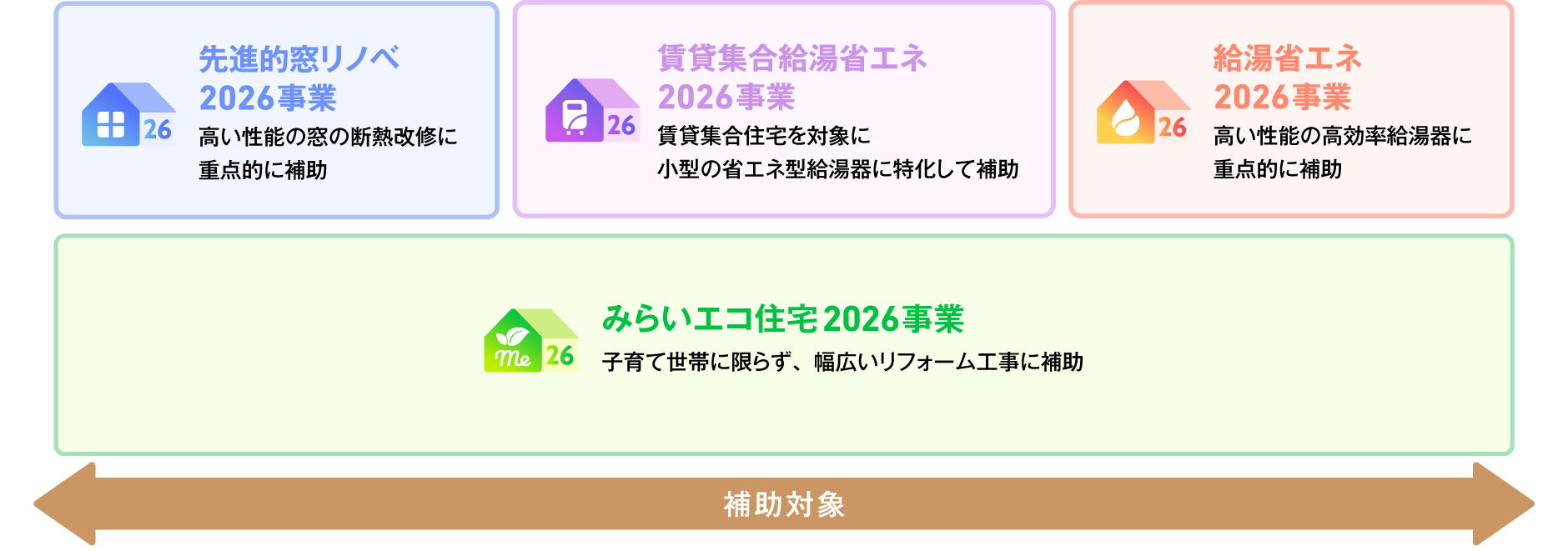
The four programs under the Housing Energy Conservation 2026 Campaign
MLIT, METI (経済産業省, Ministry of Economy, Trade and Industry), and the Ministry of the Environment (環境省) announced a cabinet-approved budget proposal for strengthening housing energy-conservation support on November 28, 2025 (Reiwa 7). The renovation-focused subsidy caps are as follows.
| Program name | Scope / conditions | Subsidy cap |
|---|---|---|
| Mirai Eco House 2026 Project (みらいエコ住宅2026事業) | Below the pre-1992 (Heisei 4) standard → retrofit to the 2016 (Heisei 28) equivalent standard | ¥1,000,000/unit (approx. USD 6,700) |
| Below the pre-1999 (Heisei 11) standard → retrofit to the 2016 (Heisei 28) equivalent standard | ¥800,000/unit (approx. USD 5,300) | |
| Below the pre-1992 (Heisei 4) standard → retrofit to the 1999 (Heisei 11) equivalent standard | ¥500,000/unit (approx. USD 3,300) | |
| Below the pre-1999 (Heisei 11) standard → retrofit to the 1999 (Heisei 11) equivalent standard | ¥400,000/unit (approx. USD 2,700) | |
| Advanced Window Renovation 2026 Project (先進的窓リノベ2026事業) | High-performance thermal window retrofit (run by the Ministry of the Environment; budget ¥112.5 billion / approx. USD 750 million) | ¥1,000,000/unit (approx. USD 6,700) |
| Water Heater Energy Conservation 2026 Project (給湯省エネ2026事業) | Installation of high-efficiency water heaters (run by METI; budget ¥57.0 billion / approx. USD 380 million) | 2 units for detached houses, 1 unit for multi-unit housing |
| Rental Multi-Unit Water Heater Energy Conservation 2026 Project (賃貸集合給湯省エネ2026事業) | Compact energy-saving water heaters for rental multi-unit housing (budget ¥3.5 billion / approx. USD 23.3 million) | ¥50,000/unit without reheating function (approx. USD 335) / ¥70,000/unit with reheating function (approx. USD 465) |
Source: MLIT, "Cabinet Approval of Budget Proposal for Strengthening Support for Housing Energy Conservation" (住宅の省エネ化への支援強化に関する予算案を閣議決定) (November 28, 2025 / Reiwa 7); Housing Energy Conservation 2026 Campaign.
Three application mechanics matter here, and each one is a departure from how tax credits or rebates typically work in the US, UK, or Australia. First, the owner does not apply directly — a registered Housing Energy Conservation Support Business Operator (住宅省エネ支援事業者) applies on the owner's behalf. If the contractor you hire is not a registered operator, you cannot receive the subsidy at all, regardless of the work performed. Second, applications are accepted no later than December 31, 2026, but each program closes the moment its budget is exhausted — there is no guarantee of funding until the stated deadline. The official site publishes daily budget-execution data; as of August 6, 2026, Mirai Eco House 2026 (renovation track) was at 2% of budget consumed, Advanced Window Renovation 2026 at 16%, and Water Heater Energy Conservation 2026 at 35%. Third, confirm the contractor's registration status and eligibility before signing a construction contract, not after.
The "Vacant House Regeneration Promotion Project" is not something individuals apply for directly
Search for akiya subsidies and you will frequently encounter MLIT's "Vacant House Regeneration Promotion Project" (空き家再生等推進事業) and the broader Comprehensive Vacant House Countermeasures Support Project. These, however, operate through a comprehensive infrastructure development grant framework in which the implementing body is a municipality — not a channel through which an owner applies directly to the national government. Under the demolition-type track, up to 8/10 of demolition costs and compensation for losses is eligible for the grant, split 2/5 national government, 2/5 local government, and 1/5 implementing body. Under the utilization-type track, where subsidies flow to private parties or individuals, the property must be used for purposes that support community maintenance and revitalization for at least 10 years. Whether this is usable at all depends entirely on whether your specific municipality has set up the program. The first step is always to check with the local government office where the property is located, not the national ministry.
The renovation promotion tax system (income tax and property tax)
On the tax-reduction side, the FY2026 tax reform extended the program and relaxed its requirements. According to MLIT's "Overview of the FY2026 Tax Reform" (令和8年度税制改正概要) (December 2025 / Reiwa 7), the income-tax special measure was extended three years, from January 1, 2026 to December 31, 2028, and the property-tax special measure was extended five years, from April 1, 2026 to March 31, 2031. The minimum floor-area requirement for eligible housing was also relaxed from 50 m² to 40 m² — a change that specifically brings the smaller detached houses common in the vacant-house segment within scope for the first time.
| Eligible work | Eligible-work cost cap | Maximum deduction (income tax) | Property tax reduction |
|---|---|---|---|
| Seismic retrofit | ¥2,500,000 (approx. USD 16,700) | ¥250,000 (approx. USD 1,700) | 1/2 |
| Barrier-free (accessibility) | ¥2,000,000 (approx. USD 13,300) | ¥200,000 (approx. USD 1,330) | 2/3 |
| Energy-saving | ¥2,500,000 (with solar: ¥3,500,000) (approx. USD 16,700 / USD 23,300) | ¥250,000 (with solar: ¥350,000) (approx. USD 1,700 / USD 2,300) | 2/3 |
| Three-generation cohabitation | ¥2,500,000 (approx. USD 16,700) | ¥250,000 (approx. USD 1,700) | Not eligible |
| Long-life quality housing conversion (seismic + energy-saving + durability) | ¥5,000,000 (¥6,000,000) (approx. USD 33,300 / USD 40,000) | ¥500,000 (¥600,000) (approx. USD 3,300 / USD 4,000) | 1/3 |
| Long-life quality housing conversion (seismic OR energy-saving + durability) | ¥2,500,000 (¥3,500,000) (approx. USD 16,700 / USD 23,300) | ¥250,000 (¥350,000) (approx. USD 1,700 / USD 2,300) | 1/3 |
| Child-rearing | ¥2,500,000 (approx. USD 16,700) | ¥250,000 (approx. USD 1,700) | Not eligible |
The income-tax deduction is unavailable for investment purposes
This is the point most likely to be misunderstood, and it is worth flagging clearly for any investor treating a vacant house as a rental asset. The special income-tax deduction for seismic retrofit requires the house to be "a dwelling primarily used as the taxpayer's own residence"; the special deduction for energy-saving retrofit requires "a dwelling the taxpayer owns and primarily uses as their own residence." A vacant house renovated with the intent of renting it out qualifies for neither deduction. For the energy-saving deduction specifically, additional requirements apply: the standard construction cost equivalent, net of any subsidy received, must exceed ¥500,000 (approx. USD 3,300); the registered floor area must exceed 40 m²; and total income must not exceed ¥20,000,000 (approx. USD 133,300).
Also note that where a subsidy has been received, the deduction applies to the standard construction cost equivalent net of the subsidy amount. Subsidies and tax deductions can be combined, but they do not stack into a double benefit. A lookup table of deduction amounts and the filing procedure are covered in Renovation Tax Deduction Lookup Table and Filing Procedure — worth reviewing while preparing a Japanese income-tax return (kakutei shinkoku, 確定申告).
The April 2025 revised Building Standards Act changed the procedure for full renovations
For anyone considering a whole-house renovation of a vacant property in 2026, this is the change most likely to be missed. Under the revised Building Standards Act (建築基準法), effective April 1, 2025 (Reiwa 7), the scope of the reduced-review system (the so-called "Article 4 exemption," 4号特例) was narrowed to single-story houses of 200 m² or less in total floor area. As a result, two-story wooden detached houses moved from being classified as "former Article 4 buildings" to "new Article 2 buildings" — and large-scale repair or remodeling work on them now requires a formal building confirmation (建築確認) procedure.
This is a genuinely Japan-specific procedural layer with no precise US or UK equivalent. In many US jurisdictions, a building permit is triggered by the scope and value of work regardless of the structure's classification; in Japan, whether a permit-equivalent confirmation is triggered turns on a specific legal threshold — the proportion of a "major structural component" being replaced — that did not previously apply to most two-story wooden houses at all.
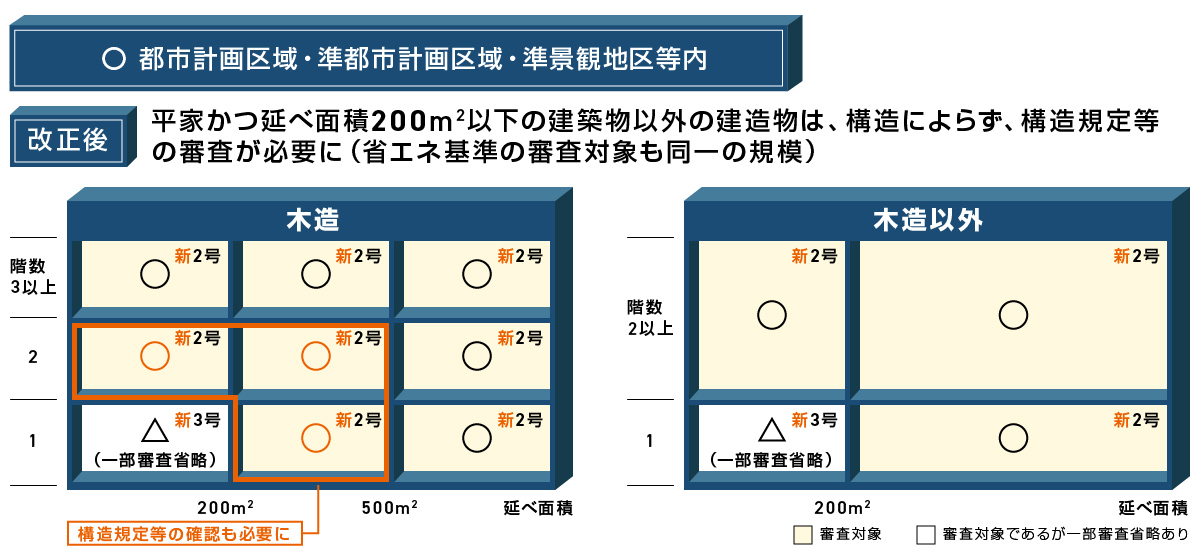
What "large-scale repair or remodeling" actually means
Under the Building Standards Act, "large-scale repair or remodeling" (大規模の修繕・模様替) refers to repair or remodeling work affecting more than half of any one of the major structural components — walls, columns, floors, beams, roof, or stairs. Whether the "more than half" threshold is crossed is judged separately for each component: for walls, by share of total area; for columns and beams, by share of total count; for floors and roof, by share of total horizontal projected area; and for stairs, by share of the total count on that floor.
Work that triggers building confirmation, and work that does not
MLIT's Housing Bureau (国土交通省住宅局) published specific guidance in "Building Confirmation Procedures for Large-Scale Renovation of Wooden Detached Houses," drawing the practical line as follows.
| Area of work | Examples that trigger building confirmation | Examples that do not trigger building confirmation |
|---|---|---|
| Roof | Work extends to the rafters, and the renovated area exceeds half of the total horizontal projected area | Re-covering the roof surface material only / a cover method installing a new roof over the existing one |
| Exterior walls | Work extends to the primary structural wall material, and the renovated area exceeds half of the total area | A cover method applying new finish material over the existing exterior wall |
| Floors (excluding the ground-floor slab) | Work extends to the floor joists, and the renovated area exceeds half of the total horizontal projected area | Applying new finish material over the existing floor |
| Stairs | More than half of the staircase is rebuilt | Renovation of fewer than half the steps / applying new finish material over the existing staircase |
| Plumbing / accessibility | Not applicable | Renovation limited to kitchen, toilet, bath, and similar plumbing fixtures; installation of handrails or ramps |
Source: MLIT Housing Bureau, "Building Confirmation Procedures for Large-Scale Renovation of Wooden Detached Houses" (木造戸建の大規模なリフォームに関する建築確認手続について) (as of February 21, 2025 / Reiwa 7). Where a specific plan is genuinely ambiguous, consultation with the local building control authority (特定行政庁) is required.
What to confirm before requesting a quote
This line matters for both cost and schedule. If you were planning something close to a strip-to-frame renovation, you now need to budget separately for the building-confirmation application documents and the review period. Conversely, if performance can be achieved through a cover method or overlaid finish materials, you may be able to improve the house's condition while avoiding the procedure entirely. The fastest way to control cost uncertainty is to ask the designer directly, up front: "Does this scope of work qualify as large-scale repair or remodeling?" Note also that even where building confirmation is not required, the renovated building still must comply with all Building Standards Act provisions.
Comparing repair-and-rent, rent-as-is, sell, and demolish in a single table
A vacant-house decision is never just about construction cost — each path is taxed in a completely different way. Depreciation applies if you rent it out; the ¥30,000,000 special exemption applies if you sell it; losing the residential land tax special exception applies if you demolish it. The variable that determines the outcome changes depending on which path you choose.
| Option | Initial cost | Expected income | Applicable tax treatment | Main risk |
|---|---|---|---|---|
| Renovate and rent | Construction cost (approx. ¥5,730,000 / USD 38,200 on an official-unit-cost basis for seismic + insulation; hundreds of thousands of yen if plumbing-focused) | Average ¥54,409 (approx. USD 365)/month for a private wooden rental | Depreciation and repair costs are deductible as necessary business expenses. The income-tax renovation deduction does not apply | Failure to find a tenant (the #2 challenge cited for renting/selling is "too few tenants/buyers," 40.3%) |
| Rent as-is, without renovation | Minimal cleaning and disposal of abandoned belongings | Below-market rent | Same as above | Post-occupancy equipment failures, repair burden, disputes with tenants |
| Sell | Demolition costs, survey costs, brokerage commission | One-time sale proceeds | ¥30,000,000 special exemption for inherited vacant houses / ¥1,000,000 special deduction for underused land | Missing even one eligibility requirement significantly changes the tax outcome |
| Demolish and hold vacant land | Demolition cost | Conversion income (e.g. parking lot) or sale proceeds | Loss of the residential land special exception (1/6 valuation reduction) | Higher property tax burden; cannot rebuild if the lot is "unbuildable" (再建築不可) |
Demolition cost benchmarks by structure type are covered in House Demolition Cost Benchmarks and Per-Tsubo Rates.
Selling: the ¥30,000,000 special exemption's requirements and deadline
Per National Tax Agency (国税庁, NTA) Tax Answer No. 3306, the special exemption for selling a decedent's residential property (a vacant house) applies to transfers made between April 1, 2016 (Heisei 28) and December 31, 2027 (Reiwa 9). The main requirements are:
- The house was built on or before May 31, 1981 (Showa 56) — that is, before Japan's current seismic standard took effect
- The sale is completed by December 31 of the year containing the third anniversary of the date of inheritance
- Sale proceeds do not exceed ¥100,000,000 (approx. USD 667,000)
- The property was not used for business, rental, or residential purposes at any point between inheritance and transfer
- Between the transfer date and February 15 of the following year, either the property was brought up to a specified seismic standard, or the building was entirely demolished
- For transfers on or after January 1, 2024 (Reiwa 6), where there are three or more heirs, the deduction amount is reduced to ¥20,000,000 (approx. USD 133,300)
The requirement that the property was not used for rental purposes between inheritance and transfer deserves particular emphasis. Renting the property out even once forfeits this exemption permanently. The decision between "renovate and rent" and "sell" can become irreversible on this single point alone — an investor weighing a rental strategy on an inherited property should model the sale-side numbers first, before signing any lease.
[Worked example] Comparing net proceeds from a sale
The long-term capital gains tax rate is 20.315% (15% income tax, 0.315% special reconstruction income tax, 5% resident tax). Where the acquisition cost is unknown, 5% of the transfer price can be used as a deemed acquisition cost.
Case 1: Using the ¥30,000,000 special exemption (transfer price ¥20,000,000 / approx. USD 133,300; deemed acquisition cost ¥1,000,000 / approx. USD 6,700; transfer costs ¥700,000 / approx. USD 4,700)
- Capital gain: ¥20,000,000 − ¥1,000,000 − ¥700,000 = ¥18,300,000 (approx. USD 122,000)
- Without the exemption: ¥18,300,000 × 20.315% = approx. ¥3,718,000 (approx. USD 24,800) in tax
- With the exemption: the ¥30,000,000 deduction brings taxable gain to ¥0 → tax due: ¥0
- Difference: approximately ¥3,718,000 (approx. USD 24,800)
Case 2: Using the ¥1,000,000 deduction for underused land (transfer price ¥5,000,000 / approx. USD 33,300; deemed acquisition cost ¥250,000 / approx. USD 1,700; transfer costs including demolition ¥800,000 / approx. USD 5,300)
- Capital gain: ¥5,000,000 − ¥250,000 − ¥800,000 = ¥3,950,000 (approx. USD 26,300)
- Without the deduction: ¥3,950,000 × 20.315% = approx. ¥802,000 (approx. USD 5,350)
- With the deduction: (¥3,950,000 − ¥1,000,000) × 20.315% = approx. ¥599,000 (approx. USD 4,000)
- Difference: approximately ¥203,000 (approx. USD 1,350)
The ¥1,000,000 deduction for underused land requires the transfer price to be ¥8,000,000 (approx. USD 53,300) or less within urbanization areas or zoned-use areas, or ¥5,000,000 (approx. USD 33,300) or less elsewhere within a city planning area, plus a holding period exceeding five years, plus municipal confirmation of underuse before the transfer and productive use after it. The FY2026 tax reform extended this deduction's deadline three years, to December 31, 2028 (Reiwa 10).
Demolishing: what happens when the residential land special exception is lost
Property tax on land benefits from the residential land special exception, which reduces the taxable base to 1/6 for small residential land (the portion up to 200 m²) and 1/3 for general residential land (the portion above 200 m²). Demolish the building and hold the land vacant, and this exception no longer applies — the property tax burden on the land rises substantially.
What is easy to miss is that the exception can be lost even without demolition. Land underneath a property designated as a tokutei akiya-tō (特定空家等, "specified vacant house," a legal category for houses recommended for correction by the municipality) or a kanri-fuzen akiya-tō (管理不全空家等, "inadequately managed vacant house") after receiving a formal recommendation from the municipal mayor is excluded from the residential land special exception. According to MLIT data, cumulative measures against specified vacant houses (May 2015 – March 2023) total 3,078 recommendations, 382 orders, and 180 administrative vicarious executions (forced demolitions carried out by the municipality itself). The Act on Special Measures for the Promotion of Vacant House Countermeasures (空家等対策の推進に関する特別措置法) was revised effective December 13, 2023 (Reiwa 5), adding the "inadequately managed vacant house" category. The cost of simply leaving a vacant house untouched has risen measurably in recent years — a point that matters for any investor weighing a long hold on unrenovated inventory.
You cannot read the cost picture without understanding what vacant houses actually look like
Why is vacant-house cost so hard to pin down? The answer lies in the composition of the vacant-house population itself. The numbers from the FY2024 Survey of Vacant House Owners (N = 1,381,000 houses) make the reason clear.
Roughly 60% pre-date 1980, about 66% show decay or damage, and about 58% were acquired through inheritance
| Category | Breakdown |
|---|---|
| Method of acquisition | Inheritance approx. 58% / new build or rebuild approx. 17% / purchased as an existing house approx. 14% |
| Year of construction | Before 1950: 15.1% / 1951–1970: 21.7% / 1971–1980: 26.4% (pre-1980 total: approx. 63%) |
| Structure | Wooden 85.4% / reinforced concrete 7.5% / steel-frame 6.0% |
| Condition (decay/damage) | Structural defects present approx. 20% / partial decay or damage approx. 43% / no decay or damage approx. 34% |
| Renovation in the past 5 years | Yes 21.5% / No approx. 77% |
A construction date before 1980 means most of this housing stock predates June 1, 1981 (Showa 56), when Japan's current seismic standard (shin-taishin kijun, 新耐震基準) took effect — this is precisely the population the seismic-retrofit tax deduction targets when it restricts eligibility to "houses built on or before May 31, 1981." According to MLIT's FY2026 tax reform overview, of Japan's total housing stock of approximately 53,600,000 units, approximately 7,000,000 units (approximately 13%) are estimated to lack adequate seismic performance.
The #1 challenge for renting or selling is "deterioration," at 43.3%
Among households with intent to rent or sell within the next roughly five years (N = 251,000 households), the challenges they cited were as follows.
| Challenge (multiple answers allowed) | Share |
|---|---|
| Deterioration of the house | 43.3% |
| Too few tenants or buyers | 40.3% |
| Disposal of household belongings | 37.4% |
| Aging fixtures and fittings | 34.0% |
| Renovation cost | 21.4% |
| Regional aging population / declining population | 21.4% |
| Seismic performance of the house | 16.0% |
| Thermal insulation of the house | 10.5% |
| Unbuildable lot (poor road access, etc.) | 7.6% |
The #1 answer, "deterioration of the house," is solvable through construction work. But #2, "too few tenants or buyers," and the 7.6% citing "unbuildable lot" status, are not solvable by spending money at all. Separating problems that money can fix from problems money cannot fix is the first task in any vacant-house decision — and it is a distinction that is easy for an overseas investor, evaluating a listing photo and a floor plan remotely, to overlook. "Disposal of household belongings" at 37.4% (the #3 challenge) is also worth flagging: clearing out a deceased owner's belongings is a cost separate from construction, and depending on volume can run into the hundreds of thousands of yen (roughly USD 2,000–6,000).
What to check on site
- Road access (setsudo, 接道): does the lot front at least 2 meters of a Building Standards Act road? If not, the property is "unbuildable" (再建築不可) and your exit options are severely limited
- Foundation: cracking, presence or absence of reinforcing bar, and whether the foundation is unreinforced concrete
- Roof leaks: staining in the attic space, ceiling sag, and displaced roofing material
- Termite damage: damage to the sill plates and columns, and the presence of mud tubes
- Water supply and drainage: connection to the municipal main, septic tank versus sewer, and the material and age of piping
- Abandoned belongings: volume of household goods and an estimate of disposal cost
- Encroachment and boundaries: fences or trees crossing the boundary line, and presence of boundary markers
As a source of listings, MLIT supports a nationwide "akiya bank" (全国版空き家・空き地バンク) — the closest thing Japan has to a centralized listing platform for vacant houses and vacant land, though it is a very different animal from an MLS: it aggregates municipal listings rather than brokered transactions, and it carries no price-history or sold-comp data. As of the end of June 2026 (Reiwa 8), 1,146 municipalities participate, a nationwide participation rate of 65.0% by municipality, with 19,288 listed properties. Update frequency and level of detail vary by municipality, however, which is exactly why an on-site inspection remains essential regardless of how the listing reads.
Don't build the case around tax savings: calculating depreciation on a used wooden building
Vacant-house investment pitches sometimes lean on "tax savings" as a selling point. Run the actual numbers, and the scope of that benefit becomes clear very quickly. Per NTA Tax Answer No. 5404, for a used asset that has already exceeded its full statutory useful life, the useful life for depreciation purposes is calculated as statutory useful life × 20%, rounding down any fraction of a year, with a two-year minimum.
Useful life and annual depreciation under the simplified method
- Statutory useful life for a wooden house: 22 years
- For a house over 22 years old: 22 years × 20% = 4.4 years → rounded down to 4 years
- At a building value of ¥4,000,000 (approx. USD 26,700), the straight-line method (depreciation rate 0.250 for a 4-year useful life) allows ¥1,000,000 (approx. USD 6,700) per year for 4 years
An annual depreciation expense of ¥1,000,000 (approx. USD 6,700) does reduce taxable income for income tax and resident tax purposes. But depreciation runs out after 4 years, and from year 5 onward the depreciation expense drops to zero — taxable income jumps back up. This is a concentrated, front-loaded expense recognition, not a permanent tax reduction. Depreciation rates and useful-life methods by structure type are also covered in Condominium Depreciation Calculation Method and Rate Table.
A full renovation can disqualify you from using the simplified method
This is where the practical trap lies. The NTA states that where a used asset is acquired for business use and the amount of capital expenditure exceeds 50% of the asset's acquisition value, the simplified estimation method cannot be used. Further, where capital expenditure exceeds 50% of the replacement cost (the value of acquiring the same asset new), the statutory useful life applies instead of the shortened one.
Applying this to the earlier example: against a building value of ¥4,000,000 (approx. USD 26,700), a construction cost of ¥5,700,000 (approx. USD 38,000) is well over 50% of the acquisition value. The harder you "buy cheap and renovate big," the more the 4-year depreciation assumption breaks down. Plans built primarily around tax savings are the ones most likely to be thrown off by this point. The correct sequence is: confirm the project works as a business on rent and construction cost alone, first — then check the tax effect afterward. Do not run that order in reverse.
Conclusion: returning cost assumptions to primary sources speeds up the decision
Vacant-house regeneration sits at the intersection of a social challenge and asset utilization — precisely why the first task is not sentiment or good intentions, but building a state where the decision can be made on numbers. Here is what this article has established, organized as a decision sequence.
- Know the real figures: renovation funds average ¥1,700,000 (approx. USD 11,300) with a median of ¥700,000 (approx. USD 4,700); for detached houses, average ¥1,720,000 (approx. USD 11,500), median ¥850,000 (approx. USD 5,700). Multi-million-yen renovations are the exception.
- Produce your own estimate: multiply the government's official standard construction cost equivalent by your floor area, and you can size up seismic and insulation work immediately.
- Check the procedure first: large-scale repair or remodeling of a two-story wooden house has required a building confirmation procedure since April 2025.
- Confirm who each program is for: subsidies are applied for by registered operators, not owners directly, and the income-tax renovation deduction is restricted to owner-occupied housing.
- Identify the problems money can't solve, first: too few tenants and unbuildable-lot status cannot be fixed with construction spending.
- Compare the options side by side: renting forfeits the ¥30,000,000 vacant-house exemption on a future sale; demolishing forfeits the residential land tax special exception.
At INA&Associates, we treat real estate not as "a product to be handled" but as an asset carrying the accumulated time and trust of its owner. That applies to vacant houses too: we do not walk in with a proposal that assumes renovation is the answer. Our work is to lay the numbers out plainly, and work through, together, which of renovate, rent, sell, or demolish an owner can actually stand behind.
Frequently asked questions
How much should I realistically budget for renovating a vacant house in Japan?
If the work is mainly plumbing and interior finishes, budget in the high hundreds of thousands of yen (roughly USD 11,000–12,000). If you go as far as seismic retrofit and thermal insulation, budget over ¥5,000,000 (approx. USD 33,300). MLIT's "FY2025 Housing Market Trend Survey" found that households who completed a renovation spent an average of ¥1,700,000 (approx. USD 11,300) with a median of ¥700,000 (approx. USD 4,700) overall, and an average of ¥1,720,000 (approx. USD 11,500) with a median of ¥850,000 (approx. USD 5,700) for detached houses specifically. By contrast, applying the government's official unit costs to a full seismic (walls) and insulation (windows, walls, ceiling, floor) retrofit of a 100 m² house comes to approximately ¥5,730,000 (approx. USD 38,200). Where your project lands between these two figures is the substance of the decision.
Can an individual apply for the subsidy directly?
No. The four programs under the Housing Energy Conservation 2026 Campaign are structured so that a registered Housing Energy Conservation Support Business Operator applies on the owner's behalf. Owners cannot file the funding application themselves. Confirm before signing a construction contract whether the company you're hiring is a registered operator. Applications are accepted no later than December 31, 2026, but each program closes as soon as its budget is exhausted.
Is building confirmation required for a full renovation?
Yes, for a two-story wooden detached house, where the work involves more than half of any one of walls, columns, floors, beams, roof, or stairs. Following the Building Standards Act revision effective April 1, 2025, two-story wooden houses are classified as "new Article 2 buildings." However, re-covering the roof surface only, an exterior-wall cover method, overlaying floor finish material, or renovation limited to kitchen, toilet, or bath does not trigger the requirement. Where it is unclear, consult the local building control authority (特定行政庁).
What kind of vacant house is better sold than renovated?
An unbuildable lot, a property where achievable rent stays in the ¥30,000s (approx. USD 200s) by local market comparison, or a property with confirmed structural defects. Unbuildable-lot status cannot be resolved through construction spending and severely limits your exit. Also, if you sell an inherited vacant house, you may qualify for the ¥30,000,000 special exemption — but renting the property out even once permanently forfeits that exemption. Calculate the net proceeds from a sale before committing to a rental strategy.
Can a listing on Japan's akiya bank be used as an investment-grade data source?
It's a useful information source, but not something to base an investment decision on directly. The nationwide akiya bank had 1,146 participating municipalities and 19,288 listed properties as of the end of June 2026 — a meaningful scale — but update frequency and level of detail vary by municipality. Decay/damage condition and road-access status in particular cannot be judged from the listing alone; an on-site inspection with a qualified professional is a prerequisite, not an option.
Citations and references
- MLIT, "FY2025 Housing Market Trend Survey Report" (令和7年度 住宅市場動向調査報告書) (published July 2026)
- MLIT, "FY2024 Survey of Vacant House Owners" (令和6年空き家所有者実態調査結果) (published August 2025)
- Statistics Bureau, Ministry of Internal Affairs and Communications, "2023 Housing and Land Survey: Summary of Basic Tabulation Results on Housing and Households" (令和5年住宅・土地統計調査 住宅及び世帯に関する基本集計 結果の概要)
- MLIT, "Special Income Tax Deduction for Seismic Retrofit" (耐震改修に係る所得税額の特例控除) (MLIT Notice No. 383 of 2009 / Heisei 21)
- MLIT, "Special Income Tax Deduction for Energy-Saving Retrofit" (省エネ改修に係る所得税額の特例控除) (Joint METI–MLIT Notice No. 4 of 2009 / Heisei 21)
- MLIT, "Overview of the FY2026 MLIT Tax Reform" (令和8年度 国土交通省税制改正概要) (December 2025 / Reiwa 7)
- MLIT, METI, and the Ministry of the Environment, "Cabinet Approval of Budget Proposal for Strengthening Support for Housing Energy Conservation" (住宅の省エネ化への支援強化に関する予算案を閣議決定) (November 28, 2025 / Reiwa 7)
- Housing Energy Conservation 2026 Campaign (住宅省エネ2026キャンペーン: Mirai Eco House 2026 Project, Advanced Window Renovation 2026 Project, Water Heater Energy Conservation 2026 Project, Rental Multi-Unit Water Heater Energy Conservation 2026 Project)
- MLIT Housing Bureau, "Building Confirmation Procedures for Large-Scale Renovation of Wooden Detached Houses" (木造戸建の大規模なリフォームに関する建築確認手続について) (as of February 21, 2025 / Reiwa 7)
- MLIT, "Review of the Scale of Buildings Subject to Building Confirmation and Inspection" (建築確認・検査の対象となる建築物の規模等の見直し) (effective April 1, 2025 / Reiwa 7)
- MLIT, "Measures Related to the Residential Land Special Exception for Property Tax in the Context of Vacant House Countermeasures" (固定資産税等の住宅用地特例に係る空き家対策上の措置)
- MLIT, "Information Related to the Act on Special Measures for the Promotion of Vacant House Countermeasures" (空家等対策の推進に関する特別措置法関連情報) (revised law effective December 13, 2023 / Reiwa 5)
- MLIT, "Seismic Retrofitting for Your Home: Subsidies and Support Programs" (住まいの耐震化 補助金・支援制度について)
- MLIT, "Nationwide Akiya Bank" (全国版空き家・空き地バンク) (results as of end of June 2026 / Reiwa 8)
- National Tax Agency, Tax Answer No. 3306, "Special Exemption for Selling a Decedent's Residential Property (Vacant House)" (被相続人の居住用財産(空き家)を売ったときの特例)
- National Tax Agency, Tax Answer No. 3226, "Special Long-Term Capital Gains Deduction for Transferring Underused Land" (低未利用土地等を譲渡した場合の長期譲渡所得の特別控除)
- National Tax Agency, Tax Answer No. 5404, "Useful Life of Used Assets" (中古資産の耐用年数)
- MLIT, "Vacant House Regeneration Promotion Project [Demolition Type] [Utilization Type]" (空き家再生等推進事業【除却事業タイプ】【活用事業タイプ】)
If you'd like help thinking through which of renovate, rent, sell, or demolish makes the most sense for a specific property, INA&Associates is glad to talk it through with you. We help clients work from acquisition through construction, rental operations, and exit, checking the numbers at every stage.