This is a Japan-specific system: unlike most US, UK, Australian, or Singaporean home-renovation tax incentives, which tend to be a single national or state-level program, Japan runs four separate renovation tax programs in parallel, each administered under a different legal framework, each with its own eligibility test and its own filing calendar. This guide is written both for anyone weighing a renovation on a home in Japan and for anyone who has already finished the work and wants to know exactly how much comes back. For 2026 (Reiwa 8), Japan's renovation tax relief takes four forms: the housing loan tax reduction for renovation (増改築等住宅ローン減税, zōkaichiku-tō jūtaku rōn genzei — "extension/major-alteration housing loan tax reduction"), the reform promotion tax system (income tax), a fixed asset tax reduction, and a gift-tax exemption for renovation funds received from a parent or grandparent. The mortgage-linked program returns up to ¥140,000 (approx. USD 933) a year from income tax; the promotion program returns ¥600,000–800,000 (approx. USD 4,000–5,333), depending on the type of work, in a single year. This article lays out the caps, the credit rates, the government-set unit prices used to calculate the deduction, a full worked example running from an actual quote to the final refund, and the exact documents you file — all sourced directly from Japan's Ministry of Land, Infrastructure, Transport and Tourism (MLIT, 国土交通省) and National Tax Agency (NTA, 国税庁). For investors who have renovated a Japanese rental property rather than their own home, the closing section explains why none of these four programs apply to you, and what to use instead. (Reference exchange rate used throughout this article: ¥150 = USD 1, approximately as of August 2026 — treat every USD figure as indicative only and confirm current rates before making a financial decision.)
This article's key points
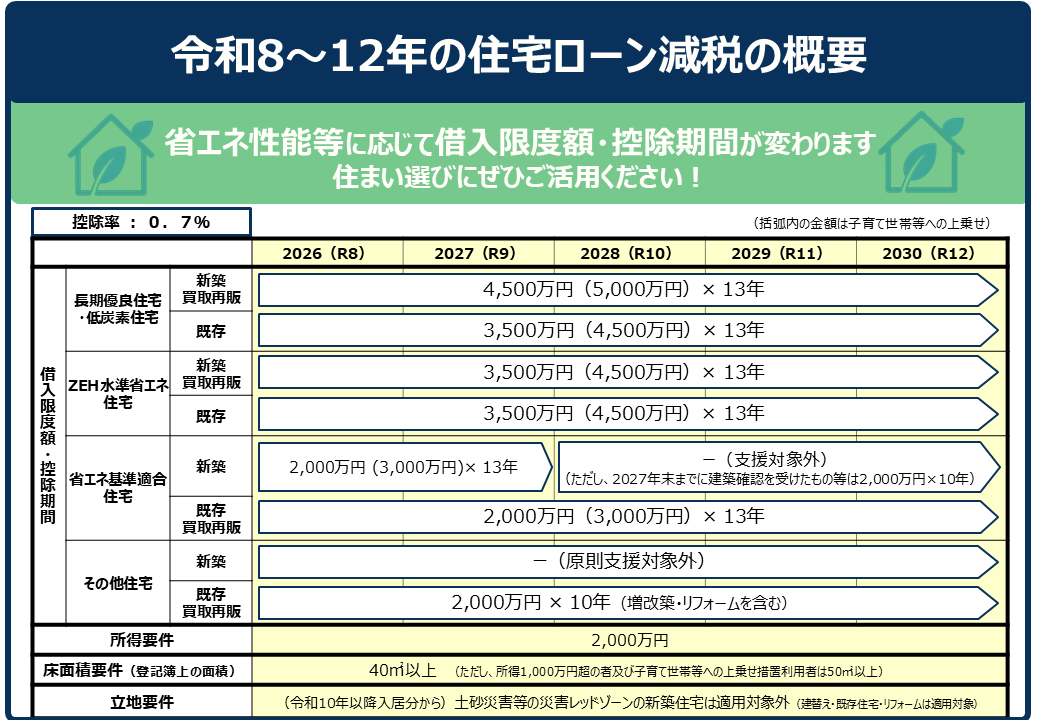
- Under the FY2026 (Reiwa 8) tax reform, the housing loan tax reduction for renovation was extended five years and now covers move-ins through December 31, 2030 (Reiwa 12). The floor-area requirement was also relaxed to 40 m² or more (50 m² or more for households with combined income above ¥10,000,000 / approx. USD 66,667).
- The housing loan tax reduction for renovation caps the eligible loan balance at ¥20,000,000 (approx. USD 133,333), applies a 0.7% credit rate, and runs for 10 years. The annual cap is ¥140,000 (approx. USD 933); any portion that can't be absorbed by income tax carries over to residential (municipal) tax, up to ¥97,500 (approx. USD 650) a year.
- The reform promotion tax system's credit is calculated as (eligible-work cap × 10%) + (other qualifying work × 5%). Crucially, eligibility and the credit amount are not based on the contractor's actual invoice — they are based on a government-published "standard cost equivalent" (標準的な工事費用相当額, hyōjun-teki na kōji hiyō sōtōgaku), a fixed unit-price schedule set by ministerial notice.
- The fixed asset tax (固定資産税, kotei shisan-zei — Japan's annual municipal property tax) reduction applies for one year only, the year following the work: a 1/2 reduction for seismic retrofits, 1/3 for barrier-free work, 1/3 for energy-efficiency work, and 2/3 for long-life quality housing certification.
- All four programs assume the renovated home is the applicant's own residence — none of them apply to a property that is rented out. For rental properties, renovation spending is instead classified as either a repair expense or a capital expenditure. If you hold Japanese rental property, this is the distinction to read most closely, and we cover it in full near the end of this guide.
Bottom line: Japan's 2026 renovation tax relief has four tracks — work out which one applies to you first
Which program applies to you comes down to three questions: did you take out a loan, what kind of work did you do, and how much did you spend? Get the full picture in one table first, then read only the sections that match your situation — that is the fastest path through this guide.
[Quick-reference table] Caps, credit rates, deduction periods, and deadlines for all four programs (as of August 2026)
| Program | Cap | Credit rate / reduction ratio | Deduction period | Maximum credit | Application window |
|---|---|---|---|---|---|
| Housing loan tax reduction (renovation) | Loan balance cap: ¥20,000,000 (approx. USD 133,333) | 0.7% of year-end loan balance | 10 years | ¥140,000/year (approx. USD 933); ¥1,400,000 (approx. USD 9,333) over 10 years | Move-in between Jan 1, 2026 and Dec 31, 2030 (Reiwa 8–12) |
| Reform promotion tax system (income tax) | Eligible-work cap: ¥2,000,000–6,000,000 (approx. USD 13,333–40,000) | 10% on eligible work + 5% on other qualifying work | One year only, the year the work is completed | ¥600,000–800,000 (approx. USD 4,000–5,333) | Move-in between Jan 1, 2026 and Dec 31, 2028 (Reiwa 8–10) |
| Reform promotion tax system (fixed asset tax) | Up to 100 m² or 120 m² of floor area | Reduced by 1/3 to 2/3 | One year, the year following the work | Depends on work type and taxable base value | Work completed between Apr 1, 2026 and Mar 31, 2031 (Reiwa 8–13) |
| Gift-tax exemption for housing acquisition/renovation funds | ¥10,000,000 (approx. USD 66,667) for energy-efficient etc. housing / ¥5,000,000 (approx. USD 33,333) for other housing | Tax-exempt | The year the gift is received | ¥10,000,000 (approx. USD 66,667) | Gifts between Jan 1, 2024 and Dec 31, 2026 (Reiwa 6–8) |
Source: Ministry of Land, Infrastructure, Transport and Tourism (MLIT, 国土交通省), "Tax Reduction Programs Available for Home Renovation" (住宅をリフォームした場合に使える減税制度について) and "Complete Guide to Renovation Support Programs" (リフォーム支援制度まるわかりガイド, revised April 2026); National Tax Agency (NTA, 国税庁), "No. 4508".
Three things that changed for 2026 (Reiwa 8)
- The housing loan tax reduction was extended five years. It now applies to any move-in between January 1, 2026 and December 31, 2030 (Reiwa 8–12). At the same time, the floor-area requirement was relaxed to 40 m² or more for existing homes too (50 m² or more if your combined income exceeds ¥10,000,000 / approx. USD 66,667, or if you're claiming the additional loan cap available to child-rearing households).
- The income-tax side of the promotion tax system was extended three years. The application window is now January 1, 2026 through December 31, 2028 (Reiwa 8–10).
- The fixed-asset-tax side of the promotion tax system was extended five years. The application window is now April 1, 2026 through March 31, 2031 (Reiwa 8–13).
Unlike a permanent statutory credit, most Japanese renovation tax provisions are time-limited and are renewed — or allowed to lapse — through an annual tax reform process (税制改正, zeisei kaisei) debated in the Diet each December. That is worth knowing if you are planning a multi-year renovation: the rules that apply depend on your actual move-in or completion date, not the date you signed a contract. The relaxation of the floor-area requirement to 40 m² matters most for anyone renovating a compact condominium unit to live in: a unit that fell below the old 50 m² line was previously shut out entirely, and from the 2026 move-in year it now qualifies. Source: MLIT press release, "Cabinet Decision to Extend and Expand the Housing Loan Tax Reduction and Related Measures" (住宅ローン減税等の延長・拡充が閣議決定されました!, December 26, 2025 / Reiwa 7; the related tax legislation was enacted March 31, 2026 / Reiwa 8). For the procedure that applies to a newly built home rather than a renovation, see our companion guide, "The First-Year Final Tax Return and Second-Year-Onward Year-End Adjustment for the New-Home Mortgage Tax Deduction."
The baseline rule: all four programs require an owner-occupied home
This is the first fork in the road, and it is the one international investors need to see coming. Both of the income-tax programs require that the person doing the renovation both owns the home and lives in it themselves, and the fixed asset tax reduction for energy-efficiency and long-life-quality-housing work explicitly requires "not a rental dwelling" as a stated condition (a narrower exception exists: if you are claiming only the 10% seismic-retrofit credit, you don't need to be the building's owner). MLIT's own program guidance, discussing renovation carried out by a condominium owners' association, states plainly that units are eligible "if the requirements are met, but a rental unit is excluded." Unlike the US, where a landlord can typically claim capital-improvement costs against rental income through depreciation regardless of who lives in the property, Japan's four renovation tax programs are structured entirely around owner-occupancy — they were never designed with a landlord's balance sheet in mind. If you hold Japanese property as a rental investment, the renovation spending you put into it is handled instead as a necessary expense (必要経費, hitsuyō keihi) against your real-estate income. We put a full comparison table near the end of this guide.
What renovation actually costs in Japan, and where the tax-relief thresholds sit against that reality
Seeing how much most homeowners actually spend tells you, at a glance, whether your own project is likely to clear the qualifying thresholds. MLIT's most recent survey shows something striking: the average and the median are far apart, which says a great deal about who typically qualifies for which program.
[Data table] Renovation spending averages ¥1,700,000, but the median is only ¥700,000
| Category | Average (¥10,000s) | Median (¥10,000s) |
|---|---|---|
| Three major metro areas, overall | 170 (approx. USD 11,333) | 70 (approx. USD 4,667) |
| Greater Tokyo | 162 (approx. USD 10,800) | 60 (approx. USD 4,000) |
| Greater Nagoya (Chukyo) | 145 (approx. USD 9,667) | 60 (approx. USD 4,000) |
| Greater Osaka (Kinki) | 202 (approx. USD 13,467) | 100 (approx. USD 6,667) |
| Detached houses | 172 (approx. USD 11,467) | 85 (approx. USD 5,667) |
| Multi-unit dwellings | 166 (approx. USD 11,067) | 40 (approx. USD 2,667) |
| Child-rearing households | 149 (approx. USD 9,933) | 46 (approx. USD 3,067) |
The funding breakdown was ¥1,430,000 (approx. USD 9,533) from personal savings and ¥270,000 (approx. USD 1,800) borrowed, an 84.2% self-funding rate. Only 5.2% of households had a renovation-specific home loan at all, and among those who did borrow, a repayment term of "10 years or more but under 20 years" was the single most common choice, at 43.5%. Source: MLIT, "FY2025 Housing Market Trend Survey Report" (令和7年度 住宅市場動向調査報告書, published July 2026 / Reiwa 8, three major metro areas).
What a ¥700,000 median means in practice — and why only 4.3% of households actually used the promotion tax system
The promotion tax system's monetary threshold is "standard cost equivalent minus subsidies exceeds ¥500,000 (approx. USD 3,333)," while the housing loan tax reduction's threshold is "actual construction cost minus subsidies exceeds ¥1,000,000 (approx. USD 6,667)." A ¥700,000 (approx. USD 4,667) median tells you that a large share of Japanese homeowners clear the promotion tax system's bar but fall short of the housing loan tax reduction's. And the housing loan tax reduction carries a further condition on top of that — a loan with a repayment term of 10 years or more — so in practice, most renovating households who do qualify for anything are more likely to qualify through the promotion tax system than through the mortgage-linked program.
In the same survey, only 4.3% of households said they had "received" or "plan to receive" the promotion tax system's benefit. Among the reasons they gave (multiple answers allowed): energy efficiency 60.0%, barrier-free 24.0%, child-rearing support 16.0%, seismic retrofit 12.0%, multigenerational cohabitation 12.0%, and long-life quality housing certification 4.0%. Read against the underlying spending data, that gap suggests a meaningful number of households who technically qualified for the credit simply never filed for it. For a breakdown of typical costs by renovation category, see our companion guide, "Renovation Cost Benchmarks and a Quick-Reference Guide to Plumbing and Partial-Work Pricing."
Housing loan tax reduction (renovation): a ¥20,000,000 loan cap, up to ¥140,000 a year
If you finance qualifying renovation or extension work with a loan carrying a term of 10 years or longer, 0.7% of your outstanding year-end loan balance is credited against your income tax, each year, for 10 years. The eligible loan balance is capped at ¥20,000,000 (approx. USD 133,333), which puts the annual credit ceiling at ¥140,000 (approx. USD 933).
Eligibility requirements for a 2026 move-in
| Item | Requirement (move-in between Jan 1, 2026 and Dec 31, 2030) |
|---|---|
| Loan cap | ¥20,000,000 (approx. USD 133,333) — any amount above this is excluded. On a ¥30,000,000 (approx. USD 200,000) loan, only the first ¥20,000,000 counts. |
| Credit rate / period | 0.7% / 10 years |
| Floor area | 40 m² or more per the registered building record (50 m² or more if combined income exceeds ¥10,000,000 / approx. USD 66,667) |
| Income | Combined income of ¥20,000,000 (approx. USD 133,333) or less |
| Construction cost | Cost of qualifying Category 1–6 work, tax included, minus any subsidies, must exceed ¥1,000,000 (approx. USD 6,667) |
| Loan | A housing loan taken out specifically for this renovation, with a repayment term of 10 years or more |
| Occupancy | Must move in within 6 months of handover or work completion, and must continue living there through December 31 of each qualifying year |
| Mixed-use property (with a shop, etc.) | At least half the floor area must be residential, and at least half the construction cost must relate to the residential portion |
Source: MLIT, "Housing Loan Tax Reduction (Renovation)" (住宅ローン減税(増改築)); NTA, "No. 1211-4."
Qualifying work: Category 1 through Category 6
| Category | Description |
|---|---|
| Category 1 | An addition, a rebuild, or major repair/major remodeling as defined under the Building Standards Act |
| Category 2 | For a condominium unit, repair or remodeling covering more than half of any one of: the floor, stairs, partition walls, or a main structural wall |
| Category 3 | Repair or remodeling covering the entire floor or entire walls of any one of: a living room, kitchen, bathroom, toilet, washroom, storage room, entryway, or hallway |
| Category 4 | Repair or remodeling to bring the home up to a specified seismic standard |
| Category 5 | Specified barrier-free renovations (widening a passage or entrance, easing a stairway's gradient, improving a bathroom or toilet, adding handrails, removing level changes/thresholds, improving doors, or replacing flooring with a non-slip material) |
| Category 6 | Thermal-insulation renovation of every window in every room, or floor/wall/ceiling insulation work carried out alongside it |
Category 1 work is where people most often trip up on the fine line. Re-covering only the roofing material, a "cover method" that lays a new roof over the existing one, redoing only the exterior cladding, or interior-only thermal insulation work do not qualify as Category 1 work (an exception applies where exterior cladding work covers the entire exterior wall). On the other hand, incidental costs such as design fees or scaffolding can be included in the construction cost.
[Worked example] How the credit changes with the loan amount
| Year-end loan balance | Balance eligible for the credit | That year's credit |
|---|---|---|
| ¥8,000,000 (approx. USD 53,333) | ¥8,000,000 (approx. USD 53,333) | ¥56,000 (approx. USD 373) |
| ¥15,000,000 (approx. USD 100,000) | ¥15,000,000 (approx. USD 100,000) | ¥105,000 (approx. USD 700) |
| ¥20,000,000 (approx. USD 133,333) | ¥20,000,000 (approx. USD 133,333) | ¥140,000 (approx. USD 933) |
| ¥25,000,000 (approx. USD 166,667) | ¥20,000,000 (approx. USD 133,333) | ¥140,000 (approx. USD 933) |
| ¥30,000,000 (approx. USD 200,000) | ¥20,000,000 (approx. USD 133,333) | ¥140,000 (approx. USD 933) |
Here's the trap: the oft-quoted "¥1,400,000 (approx. USD 9,333) maximum over 10 years" is a theoretical ceiling that only holds if your balance stays at or above ¥20,000,000 the entire decade. Under a standard equal-payment amortization schedule, the balance falls every year, so the real 10-year total is almost always lower than that headline figure.
| Loan amount / term (assumed) | Year-1 credit | Approx. 10-year total |
|---|---|---|
| ¥15,000,000 (approx. USD 100,000) / 15 years | approx. ¥98,000 (approx. USD 653) | approx. ¥680,000 (approx. USD 4,533) |
| ¥20,000,000 (approx. USD 133,333) / 20 years | approx. ¥134,000 (approx. USD 893) | approx. ¥1,040,000 (approx. USD 6,933) |
| ¥30,000,000 (approx. USD 200,000) / 20 years | ¥140,000 (approx. USD 933, capped) | approx. ¥1,340,000 (approx. USD 8,933) |
*These are estimates assuming a 1.0% interest rate, equal-payment amortization, and no early repayment. Your actual credit depends on the figure on your year-end balance certificate and on how much income tax you actually paid that year.
If income tax can't absorb it all: up to ¥97,500 a year from residential (municipal) tax
The housing loan tax reduction is a tax credit, so it can never refund more than the income tax you actually paid that year. However, any unused portion carries over to the following year's residential tax (住民税, jūminzei — Japan's local income-based municipal and prefectural tax), up to a cap of ¥97,500 (approx. USD 650) a year. No separate application is needed on the residential-tax side; you can confirm whether the full credit was used by checking your residential tax assessment notice the following year.
Reform promotion tax system: the credit is "10% on eligible work plus 5% on other work"
If you renovate with cash rather than a loan, the program to look at is the reform promotion tax system (リフォーム促進税制). The credit boils down to a single formula.
Credit = A (standard cost equivalent of eligible work, capped at the eligible-work limit) × 10% + B (any amount over that limit, plus certain other qualifying renovation work; A + B capped at ¥10,000,000 / approx. USD 66,667) × 5%
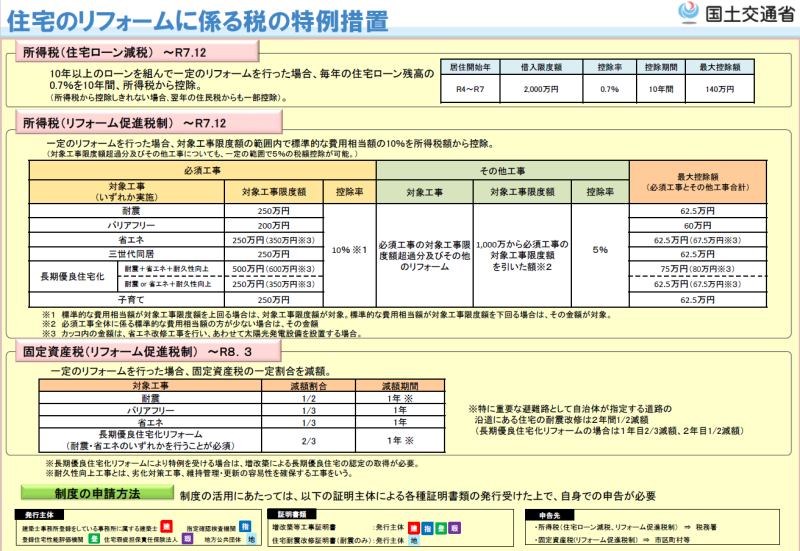
[Data table] Eligible-work cap and credit by work category
| Work category | Eligible-work cap | Cap × 10% | Maximum credit (including the 5% portion) |
|---|---|---|---|
| Seismic retrofit | ¥2,500,000 (approx. USD 16,667) | ¥250,000 (approx. USD 1,667) | ¥625,000 (approx. USD 4,167) |
| Barrier-free | ¥2,000,000 (approx. USD 13,333) | ¥200,000 (approx. USD 1,333) | ¥600,000 (approx. USD 4,000) |
| Energy efficiency | ¥2,500,000 (approx. USD 16,667) | ¥250,000 (approx. USD 1,667) | ¥625,000 (approx. USD 4,167) |
| Energy efficiency (including solar power equipment) | ¥3,500,000 (approx. USD 23,333) | ¥350,000 (approx. USD 2,333) | ¥675,000 (approx. USD 4,500) |
| Three-generation cohabitation | ¥2,500,000 (approx. USD 16,667) | ¥250,000 (approx. USD 1,667) | ¥625,000 (approx. USD 4,167) |
| Child-rearing support | ¥2,500,000 (approx. USD 16,667) | ¥250,000 (approx. USD 1,667) | ¥625,000 (approx. USD 4,167) |
| Long-life quality housing certification (seismic + energy + durability) | ¥5,000,000 (approx. USD 33,333) | ¥500,000 (approx. USD 3,333) | ¥750,000 (approx. USD 5,000) |
| Same, including solar power equipment | ¥6,000,000 (approx. USD 40,000) | ¥600,000 (approx. USD 4,000) | ¥800,000 (approx. USD 5,333) |
| Long-life quality housing certification (seismic OR energy + durability) | ¥2,500,000 (approx. USD 16,667) | ¥250,000 (approx. USD 1,667) | ¥625,000 (approx. USD 4,167) |
| Same, including solar power equipment | ¥3,500,000 (approx. USD 23,333) | ¥350,000 (approx. USD 2,333) | ¥675,000 (approx. USD 4,500) |
The "maximum credit" column is "cap × 10% + (¥10,000,000 − cap) × 5%." For barrier-free work, that's ¥2,000,000 × 10% = ¥200,000, plus the remaining ¥8,000,000 × 5% = ¥400,000, for a total of ¥600,000 (approx. USD 4,000). MLIT's often-quoted "¥600,000–800,000 maximum" figure comes straight out of this calculation. Source: MLIT, "Complete Guide to Renovation Support Programs" (令和8年4月改訂); NTA, No. 1219 (energy efficiency) / No. 1220 (barrier-free) / No. 1222 (seismic) / No. 1224 (multigenerational cohabitation) / No. 1227 (durability improvement) / No. 1228 (child-rearing support).
What "standard cost equivalent" actually means
This is where the promotion tax system trips people up most. The credit is not calculated from the contractor's actual invoice. It's calculated from a "standard cost equivalent" (標準的な工事費用相当額) — a fixed unit price set by government notice for each type of work, multiplied by the area or number of units actually installed. Even if your invoice comes in higher, the lower of the two figures — the amount calculated from the official unit-price schedule — is what governs. This is genuinely unusual by international standards: rather than crediting a percentage of whatever you actually paid (as, for example, the US federal Energy Efficient Home Improvement Credit does, subject to its own dollar caps), Japan substitutes a government-set reference price for the real invoice entirely, which caps the credit's exposure to inflated contractor billing but also means a below-average quote won't reduce your credit either. This standard-cost figure is entered on the "Renovation Work Certificate" (増改築等工事証明書, zōkaichiku-tō kōji shōmeisho) by the certifying architect. MLIT distributes a spreadsheet version of the Renovation Work Certificate with a built-in calculator (計算ツール埋込版の増改築等工事証明書, Excel) that auto-calculates this figure once you enter the work details and subsidy amount, so you can get a realistic estimate at the quotation stage.
[Data table] Sample government unit prices and the quantities they're multiplied by
| Work | Unit price (tax included) | Quantity multiplied |
|---|---|---|
| Window insulation (glass replacement) | ¥6,300 (approx. USD 42) | Home's floor area (m²) × window renovation ratio |
| Window insulation (adding an inner sash, climate zones 4–7) | ¥8,100 (approx. USD 54) | Home's floor area (m²) × window renovation ratio |
| Wall insulation | ¥19,400 (approx. USD 129) | Floor area of the insulated section (m²) |
| Floor insulation, etc. (climate zones 4–7) | ¥4,600 (approx. USD 31) | Floor area of the insulated section (m²) |
| Replacing a bathtub with a low-threshold model | ¥529,100 (approx. USD 3,527) | 1 location |
| Replacing a toilet with a Western-style seated model | ¥359,700 (approx. USD 2,398) | 1 location |
| Converting a hinged door to a sliding door | ¥149,700 (approx. USD 998) | 1 location |
| Installing a fuel-cell cogeneration system | ¥789,800 (approx. USD 5,265) | 1 unit |
Windows are the item people most often get wrong. Window insulation work is calculated as "unit price × home's floor area × window renovation ratio (area of renovated windows ÷ total area of all windows facing the exterior)" — you don't simply multiply the unit price by the renovated window area alone. In the worked example below, this formula produces a standard cost equivalent of ¥393,750 (approx. USD 2,625) for glass replacement (¥6,300 × a 125 m² home × a renovation ratio of 0.5). Wall and floor insulation, by contrast, are multiplied by the floor area of the insulated section directly. Unit prices vary by climate zone and are periodically revised by government notice. Source: MLIT, "Complete Guide to Renovation Support Programs" (令和8年4月改訂), model estimate; MLIT, "Special Income Tax Credit for Energy-Efficiency Renovation" (省エネ改修に係る所得税額の特例控除, unit-price schedule based on Ministry of Economy, Trade and Industry / MLIT Notice No. 4 of Heisei 21).
[Worked example] Five steps from a quote to a ¥423,900 credit
Follow along with the model case MLIT publishes in its own guide: a homeowner does barrier-free and energy-efficiency renovation at the same time, plus Category 3 work (redoing the floor and walls of a kitchen).
- Confirm the monetary threshold. For barrier-free work: standard cost equivalent of ¥1,637,300 (approx. USD 10,915) minus a ¥100,000 (approx. USD 667) subsidy = ¥1,537,300 (approx. USD 10,249). For energy efficiency: ¥2,863,550 (approx. USD 19,090) minus a ¥200,000 (approx. USD 1,333) subsidy = ¥2,663,550 (approx. USD 17,757). Both exceed the ¥500,000 (approx. USD 3,333) threshold, so both qualify.
- Calculate the amount eligible for the 10% credit. For barrier-free: the lesser of the ¥2,000,000 (approx. USD 13,333) cap and ¥1,537,300 (approx. USD 10,249) — so ¥1,537,300. For energy efficiency: the lesser of the ¥2,500,000 (approx. USD 16,667) cap and ¥2,663,550 (approx. USD 17,757) — so ¥2,500,000 (approx. USD 16,667). Combined: ¥4,037,300 (approx. USD 26,915).
- Calculate the candidate amount for the 5% credit. The amount exceeding the cap is ¥0 for barrier-free, and ¥2,663,550 − ¥2,500,000 = ¥163,550 (approx. USD 1,090) for energy efficiency. Add the ¥240,000 (approx. USD 1,600) in other qualifying work, for a total of ¥403,550 (approx. USD 2,690).
- Confirm the amount eligible for the 5% credit. The overall cap is ¥10,000,000 (approx. USD 66,667) minus the ¥4,037,300 already used for the 10% credit, leaving roughly ¥5,962,700 (approx. USD 39,751) of headroom — well above ¥403,550, so the full ¥403,550 counts.
- Add it up. ¥4,037,300 × 10% = ¥403,730 (approx. USD 2,692). ¥403,550 × 5% = ¥20,177 (approx. USD 135). Total: ¥423,907 (approx. USD 2,826), rounded down to the nearest ¥100, giving a final credit of ¥423,900 (approx. USD 2,826).
You can reproduce this exact calculation using MLIT's own renovation tax credit simulator. Swap in the figures from your own quote and you'll get a realistic estimate for your own case. The credit can never exceed the income tax you actually paid that year.
Additional requirements by work category
| Work category | Additional requirement |
|---|---|
| Seismic | Building constructed on or before May 31, 1981 (Showa 56) / the pre-renovation building did not meet the current seismic standard |
| Barrier-free | At least one of: ① age 50 or older ② certified as requiring long-term care or support ③ has a disability ④ lives with a relative who meets ② or ③, or who is 65 or older |
| Child-rearing support | At least one of: ① has a dependent under age 19 ② the applicant or their spouse is under age 40 |
| Long-life quality housing certification | Has received long-life quality housing certification through the renovation |
| Common to all | Combined income of ¥20,000,000 (approx. USD 133,333) or less / post-renovation floor area of 40 m² or more (50 m² or more if income exceeds ¥10,000,000 / approx. USD 66,667) / for mixed-use properties, at least half the floor area must be residential / must move in within 6 months of work completion |
The certification standards for long-life quality housing are covered in our companion guide, "Long-Life Quality Housing Certification Standards, Tax Benefits, and Drawbacks." One more thing to know: if a single piece of work satisfies the requirements of more than one category — a window replacement, say, that qualifies as both energy-efficiency work and child-rearing-support work — you may only apply under one category. Double-claiming the same work under two categories is not allowed.
Fixed asset tax reduction: one year only, cut by 1/3 to 2/3
Separately from income tax, applying to your municipality can get you a reduction on next year's fixed asset tax (固定資産税, kotei shisan-zei) — Japan's annual property tax, assessed and collected by the municipality where the property sits, roughly analogous to a US county property tax or a UK council tax bill, though calculated very differently (see below). The income-tax relief and the fixed-asset-tax relief can be claimed together.
[Data table] Reduction ratio, period, and floor-area cap by work category
| Work category | Reduction ratio | Reduction period | Floor-area cap for the reduction | Construction cost (actual cost minus subsidies) |
|---|---|---|---|---|
| Seismic | 1/2 | One year, the following fiscal year | 120 m² | Exceeds ¥500,000 (approx. USD 3,333) |
| Barrier-free | 1/3 | One year, the following fiscal year | 100 m² | Exceeds ¥500,000 (approx. USD 3,333) |
| Energy efficiency | 1/3 | One year, the following fiscal year | 120 m² | Exceeds ¥600,000 (approx. USD 4,000) |
| Long-life quality housing certification | 2/3 | One year, the following fiscal year | 120 m² | Seismic: exceeds ¥500,000 (approx. USD 3,333) / Energy: exceeds ¥600,000 (approx. USD 4,000) |
On the property side, the home's post-renovation floor area must be between 40 m² and 240 m², and for mixed-use properties, at least half the floor area must be residential. On top of that, each category carries its own building-age condition: seismic requires the building to have existed on or before January 1, 1982 (Showa 57); barrier-free requires a non-rental building that is at least 10 years old; energy efficiency requires a non-rental building that existed on or before April 1, 2014 (Heisei 26). Long-life quality housing certification carries the matching age condition for whichever of seismic or energy-efficiency work is paired with it. Barrier-free work has an additional occupancy condition — the household must include someone aged 65 or older, certified as requiring long-term care or support, living with a disability, or living with a relative who falls into one of those categories — a threshold that differs from the income-tax program's own barrier-free test (which starts at age 50). One more distinction worth flagging: the income-tax programs judge eligibility using the "standard cost equivalent," while the fixed asset tax program judges eligibility using "actual construction cost" minus subsidies. Source: MLIT, "Fixed Asset Tax Reduction for Energy-Efficiency Renovation" (省エネ改修に係る固定資産税の減額措置); MLIT, "Complete Guide to Renovation Support Programs" (令和8年4月改訂).
[Worked example] ¥4,000,000 taxable base, 125 m² home, ¥32,800 in savings
- Confirm eligibility. Barrier-free construction cost of ¥1,754,500 (approx. USD 11,697) exceeds ¥500,000 (approx. USD 3,333). Energy-efficiency construction cost of ¥3,300,000 (approx. USD 22,000) exceeds ¥600,000 (approx. USD 4,000). Both qualify.
- Calculate the reduced taxable base. For barrier-free: the 100 m² cap ÷ the home's 125 m² = 0.8; ¥4,000,000 (approx. USD 26,667) × 0.8 = ¥3,200,000 (approx. USD 21,333). For energy efficiency: 120 m² ÷ 125 m² = 0.96; ¥4,000,000 × 0.96 = ¥3,840,000 (approx. USD 25,600).
- Calculate the savings. ¥3,200,000 × 1.4% × 1/3 = ¥14,900 (approx. USD 99). ¥3,840,000 × 1.4% × 1/3 = ¥17,900 (approx. USD 119). Combined: ¥32,800 (approx. USD 219).
Where the income-tax credit can run into the hundreds of thousands of yen, fixed asset tax relief tends to be a few tens of thousands of yen — a single-year, single-digit-thousand-dollar figure. The application deadline is tight: within 3 months of the work's completion date, at which point you submit a fixed-asset-tax reduction certificate, the renovation work certificate, and documentation of any subsidy amount to your municipal office. It's worth confirming the counter and paperwork with your municipality while you're still at the planning stage with your contractor. The underlying mechanism of Japan's fixed asset tax is covered in our companion guide, "Fixed Asset Tax Reduction Measures, How the Amount Is Calculated, and How It Differs from City Planning Tax."
Housing loan tax reduction vs. the promotion tax system: which one should you use?
[Comparison table] From the figure used for eligibility to whether year-end adjustment is possible
| Item | Housing loan tax reduction (renovation) | Reform promotion tax system (income tax) |
|---|---|---|
| Figure used for eligibility | Actual construction cost (tax included) | Standard cost equivalent |
| Monetary threshold | Exceeds ¥1,000,000 (approx. USD 6,667) after subsidies | Exceeds ¥500,000 (approx. USD 3,333) after subsidies |
| Floor area | Both require 40 m² or more (50 m² or more if combined income exceeds ¥10,000,000 / approx. USD 66,667) | |
| Deduction period | 10 years | One year only, the year work is completed |
| Loan required? | Yes — a loan with a repayment term of 10 years or more | No (self-funding is fine) |
| How the credit is set | Year-end balance × 0.7% (capped at ¥140,000 / approx. USD 933 per year) | Cap × 10% + other work × 5% |
| Year-end adjustment | From year 2 onward, can be processed through year-end payroll adjustment | Not available. A final tax return is required |
| Qualifying work | Category 1 through Category 6 work | Seismic, barrier-free, energy efficiency, three-generation cohabitation, long-life quality housing certification, child-rearing support |
As a rule of thumb: if you're financing a large project over a long loan term, the housing loan tax reduction tends to make more sense; if you're paying cash for a focused performance upgrade, the promotion tax system tends to make more sense. Either way, the actual credit you realize depends on how much income tax you owe that year, so the right choice depends on your own tax position.
[Combination matrix ①] The six income-tax categories and the housing loan tax reduction
| Seismic | Barrier-free | Energy efficiency | Three-gen. cohabitation | Long-life quality | Child-rearing | Loan tax reduction | |
|---|---|---|---|---|---|---|---|
| Seismic | — | Yes | Yes | Yes | No | Yes | Yes |
| Barrier-free | Yes | — | Yes | Yes | Yes | Yes | No |
| Energy efficiency | Yes | Yes | — | Yes | No | Yes | No |
| Three-gen. cohabitation | Yes | Yes | Yes | — | Yes | Yes | No |
| Long-life quality housing certification | No | Yes | No | Yes | — | Yes | No |
| Child-rearing | Yes | Yes | Yes | Yes | Yes | — | No |
| Housing loan tax reduction | Yes | No | No | No | No | No | — |
Two things stand out here. The only category you can combine with the housing loan tax reduction is seismic retrofit, and long-life quality housing certification cannot be combined with seismic or energy-efficiency categories on their own — because the certification's own cap already folds in the seismic and energy-efficiency work, so you can't claim the same spending twice. One more wrinkle worth knowing: if you apply the seismic-retrofit credit and the housing loan tax reduction to the very same renovation project, the NTA's guidance is that the seismic side can only use the 10% portion of the credit, not the full formula.
[Combination matrix ②] The four fixed-asset-tax categories
| Seismic | Barrier-free | Energy efficiency | Long-life quality housing certification | |
|---|---|---|---|---|
| Seismic | — | No | No | No |
| Barrier-free | No | — | Yes | No |
| Energy efficiency | No | Yes | — | No |
| Long-life quality housing certification | No | No | No | — |
On the fixed-asset-tax side, the only combination allowed is barrier-free plus energy efficiency. That's exactly why the ¥32,800 (approx. USD 219) figure in the worked example above was possible — it's the only pairing the rules permit. Source: MLIT, "Complete Guide to Renovation Support Programs" (令和8年4月改訂).
Subsidies come off first: how the 2026 Home Energy Efficiency Campaign interacts with the tax credit
Here's a rule that catches people off guard: both the monetary eligibility threshold and the credit amount itself are calculated after subtracting any subsidy you received. Applying for a subsidy and estimating your renovation tax credit are not two separate calculations — they sit on the same spreadsheet.
[Data table] Maximum subsidy amounts under the 2026 Home Energy Efficiency Campaign
| Program | Covers | Subsidy amount |
|---|---|---|
| Advanced Window Renovation 2026 Project | Installing high-performance insulated windows | Amount set by work type, up to ¥1,000,000 (approx. USD 6,667) per unit |
| Energy-Efficient Water Heater 2026 Project | Installing a high-efficiency water heater | Heat-pump water heater ¥100,000 (approx. USD 667)/unit; hybrid water heater ¥120,000 (approx. USD 800)/unit; home fuel cell ¥170,000 (approx. USD 1,133)/unit |
| Rental Multi-Family Energy-Efficient Water Heater 2026 Project | Replacing an existing rental multi-family building's water heater with an "eco-jozu" high-efficiency model, etc. | Without reheat function: ¥50,000 or ¥80,000 (approx. USD 333–533)/unit; with reheat function: ¥70,000 or ¥100,000 (approx. USD 467–667)/unit |
| Mirai Eco Housing 2026 Project | Energy-efficiency renovation of openings, the building envelope, etc. | For homes below the Heisei 4 standard: renovation to the Heisei 28-equivalent standard, up to ¥1,000,000 (approx. USD 6,667)/unit; to the Heisei 11-equivalent standard, up to ¥500,000 (approx. USD 3,333)/unit. For homes below the Heisei 11 standard: to the Heisei 28-equivalent standard, up to ¥800,000 (approx. USD 5,333)/unit; to the Heisei 11-equivalent standard, up to ¥400,000 (approx. USD 2,667)/unit |
Source: MLIT, "Complete Guide to Renovation Support Programs" (令和8年4月改訂); 2026 Home Energy Efficiency Campaign (住宅省エネ2026キャンペーン). Application windows and current acceptance status are posted on the campaign's official site.
A subsidy lowers your credit, but taking it still leaves you further ahead
Accepting a subsidy shrinks the amount eligible for the credit, which shrinks the credit itself. But the credit only returns 5–10% of the eligible amount (0.7% under the housing loan tax reduction), while a subsidy returns 100% in cash. In the model case above, accepting a ¥300,000 (approx. USD 2,000) subsidy reduced the credit by ¥20,000 (approx. USD 133) — from ¥443,900 (approx. USD 2,959) without the subsidy down to ¥423,900 (approx. USD 2,826) with it — but the household still came out ¥280,000 (approx. USD 1,867) ahead overall. Applying for a subsidy generally requires the contractor to be registered with the program before work begins, so it's worth confirming eligibility while you're still selecting a contractor. Some subsidies can be layered with a municipality's own local program (see our companion guide, "Renovation Subsidy Programs and How to Plan a Project That Keeps Costs Down").
Renovating with gifted funds: up to ¥10,000,000 tax-exempt for energy-efficient etc. housing
If you receive renovation funds as a gift from a parent or grandparent, gifts made between January 1, 2024 and December 31, 2026 (Reiwa 6–8) are exempt from gift tax up to ¥10,000,000 (approx. USD 66,667) for energy-efficient etc. housing, or ¥5,000,000 (approx. USD 33,333) for other housing. Unlike the US, where a lifetime gift-and-estate-tax exemption applies broadly across gift types (over $13 million per person as of recent years), Japan's exemption here is narrow and purpose-specific: it applies only to gifts used for a qualifying home purchase or renovation, from a specific category of relative, within a fixed calendar window. The main requirements for using it toward a renovation are as follows.
- Post-renovation registered floor area of 40 m² to 240 m², with at least half of it used as the recipient's residence
- Renovation cost of ¥1,000,000 (approx. USD 6,667) or more, with at least half relating to the recipient's own residential portion
- The recipient must be 18 or older as of January 1 of the year the gift is received
- The donor must be a lineal ascendant (a parent, grandparent, etc.)
Source: NTA, "No. 4508: Tax Exemption for Gifts of Housing Acquisition Funds from a Lineal Ascendant" (直系尊属から住宅取得等資金の贈与を受けた場合の非課税). If you're also using the housing loan tax reduction, its own final tax return requires you to attach a gift-tax return and related documentation when you're claiming this exemption at the same time — so if you're combining a gift with a renovation credit, plan to assemble both sets of paperwork together.
Filing and year-end adjustment: what to submit, and when
Eight documents, and how to obtain the Renovation Work Certificate
For the housing loan tax reduction (renovation), the documents required with your final tax return are as follows.
- Final income tax return
- Calculation statement for the (specified renovation) housing loan special credit
- Year-end balance certificate for the housing acquisition loan
- Certificate of registered matters (property registry extract)
- Renovation Work Certificate
- Copy of the construction contract
- If you received a subsidy: documentation showing the subsidy amount (a grant decision notice, etc.)
- If you're also claiming the gift-tax exemption: a copy of your gift tax return or similar documentation proving the amount of housing acquisition funds
The document that needs the most lead time is the Renovation Work Certificate. It can only be issued by: an architect belonging to an architectural firm registered under the Architects Act, a designated confirmation and inspection body, a registered housing performance evaluation body, or a housing defect liability insurance corporation. It's issued after the work is complete, and requires the property registry extract, the construction contract or receipts, design documents, and an itemized cost breakdown. Some certifications require an on-site inspection both before and after the work, so confirming — before you break ground — whether a certificate can be issued and whether an inspection will be required saves you from having to backtrack later. The fixed asset tax reduction application, separately, must reach the municipality within 3 months of work completion. Where the income-tax filing happens during the following year's tax season, this one comes due right after the work itself — an easy deadline to lose track of.
Housing loan tax reduction: year-end adjustment from year 2. The promotion tax system: never
- Housing loan tax reduction (renovation): A final tax return is required in year 1, but salaried employees can process year 2 onward through payroll year-end adjustment (年末調整, nenmatsu chōsei) — the mechanism through which most Japanese salaried employees settle their annual income tax through their employer and never file an individual return at all, a system with no direct equivalent in the US, where every taxpayer files with the IRS regardless of employment type. You submit the "Employee's (Specified Renovation) Housing Loan Special Credit Application" and the year-end balance certificate from your lender to your employer.
- Reform promotion tax system: Cannot be processed through year-end adjustment at all. A final tax return is required for the year you claim the credit. Since the credit period is only one year, that's a single filing.
Source: NTA, "Understanding Year-End Adjustment" (年末調整がよくわかるページ); "No. 1220."
If the work year and the move-in year don't line up, file under the year you actually moved in
This is a common point of confusion when a project spans a calendar-year boundary. MLIT describes the rule as claiming the credit for the income tax year in which you actually began living there, and gives these examples:
- Work completed in 2025, moved in January 2026 → file with your 2026 final tax return.
- Already living in the home, work started in 2025 and completed in 2026 → file with your 2026 final tax return.
Forgot to file? A refund claim can be made for up to 5 years after the fact
A refund claim (還付申告, kanpu shinkoku) can be filed any time within 5 years of January 1 of the year following the relevant tax year — it isn't tied to the standard filing season. The NTA itself cites "having done certain renovation work" as a textbook example of a refund claim (No. 2030: Refund Claims). That said, the Renovation Work Certificate can only be issued after the work is complete, and the longer you wait, the harder it becomes to reassemble the underlying paperwork — so if this applies to you, it's worth contacting your contractor sooner rather than later.
Renovating a rental property: this is an expense question, not a tax-credit question
This is the fork in the road for investors. As covered above, all four programs require owner-occupancy, so none of them are available for a property you rent out. Instead, renovation spending on a rental property is treated as a necessary expense (必要経費, hitsuyō keihi) against your real-estate income. The NTA allows spending to be treated as a repair expense (修繕費, shūzenhi) — fully deductible in the year you spend it — if either of the following applies:
- The repair or improvement recurs on a roughly 3-year-or-shorter cycle, or a single repair/improvement costs less than ¥200,000 (approx. USD 1,333); or
- Where it isn't clear whether an amount is a capital expenditure or a repair expense, that amount is under ¥600,000 (approx. USD 4,000), or is no more than roughly 10% of the asset's acquisition cost as of the end of the prior year.
Source: NTA, "No. 1379: Determining What Does Not Qualify as a Repair Expense" (修繕費とならないものの判定). If the spending falls outside those thresholds, it's treated instead as a capital expenditure (資本的支出, shihonteki shishutsu) and depreciated over the relevant useful life rather than expensed all at once — a repair-versus-capital-improvement distinction that will feel familiar to any US landlord who has had to apply the IRS's own de minimis safe harbor and routine-maintenance-safe-harbor tests under the Section 263(a) capital improvement regulations, or to a UK landlord weighing "repairs" against "improvements" for Income Tax purposes. The mechanics of how to run that calculation for a Japanese rental property are covered in our companion guide, "Capital Expenditure vs. Repair Expenses in Rental Property Renovation."
[Comparison table] How a renovation is treated on your own home vs. on a rental property
| Item | Renovating your own home | Renovating a rental property |
|---|---|---|
| Mechanism used | The four renovation tax programs (tax credit, fixed asset tax reduction, gift-tax exemption) | Necessary expense against real-estate income (repair expense) or capital expenditure |
| How it helps | Subtracted directly from your tax bill | Subtracted from your taxable income (the tax saved equals the expense × your marginal rate) |
| Timing | The year you move in (10 years for the housing loan tax reduction) | Repair expenses: fully deductible in the year spent. Capital expenditure: spread over the depreciation schedule |
| Test applied | Standard cost equivalent, or actual construction cost | Under ¥200,000 (approx. USD 1,333); a roughly 3-year-or-shorter repair cycle; under ¥600,000 (approx. USD 4,000); or no more than approx. 10% of acquisition cost |
| Documentation needed | Renovation Work Certificate, etc. | An itemized quote or invoice showing the work breakdown |
| Filing | Final tax return (year 2 onward of the housing loan tax reduction can go through year-end adjustment) | An annual final tax return (may also qualify for the blue-form filing special deduction) |
In practice, how a single invoice is itemized can shift the same piece of work from a repair expense into a capital expenditure, or the reverse. When we manage a property on an owner's behalf, we work through that line-item breakdown with the contractor before the work is ordered, not after the invoice arrives. Thinking beyond the immediate tax saving to how the same spending will look at resale a few years down the line is what actually maximizes what an owner keeps over the long run.
Summary: five things to keep in mind if you're renovating in 2026
- Work out which program applies to your project first. It comes down to three things: whether you have a loan, what type of work you're doing, and how much you're spending.
- The monetary threshold is judged after subsidies are subtracted. For the promotion tax system, it's the standard cost equivalent minus subsidies, over ¥500,000 (approx. USD 3,333); for the housing loan tax reduction, it's actual construction cost minus subsidies, over ¥1,000,000 (approx. USD 6,667).
- The promotion tax system's credit is "cap × 10% + other work × 5%." Because it's calculated from the government's own unit-price schedule rather than your invoice, running the numbers through the official calculator at the quotation stage keeps your estimate accurate.
- File for the fixed asset tax reduction within 3 months of work completion. That's a separate municipal filing from your income-tax return the following year.
- A rental property is an expense question, not a tax-credit question. All four programs assume the renovated home is where you yourself live.
A tax credit can never return more than the tax you actually paid that year, so your real-world result depends on your income and your tax bill. For any large renovation project, it's worth bringing in a tax accountant, or an architect who can issue a Renovation Work Certificate, early in the process rather than after the fact.
FAQ: frequently asked questions about Japan's renovation tax reductions
Q1. How much does the housing loan tax deduction actually return on a renovation?
0.7% of your year-end loan balance is credited for 10 years, and since the eligible loan balance is capped at ¥20,000,000 (approx. USD 133,333), the annual ceiling is ¥140,000 (approx. USD 933). Whether your balance is ¥25,000,000 (approx. USD 166,667) or ¥30,000,000 (approx. USD 200,000), only the first ¥20,000,000 counts. Any amount income tax can't absorb carries over to the following year's residential tax, up to ¥97,500 (approx. USD 650) a year.
Q2. Can a renovation tax credit be processed through year-end adjustment?
The housing loan tax reduction (renovation) requires a final tax return in year 1, but from year 2 onward, salaried employees can process it through year-end payroll adjustment. The reform promotion tax system, by contrast, can never be processed through year-end adjustment — a final tax return is required for the year you claim it. Since its credit period is only one year, that means a single filing.
Q3. Can I combine the reform promotion tax system with the housing loan tax reduction?
As a rule, no. The one exception is seismic retrofit work, which can be combined with the housing loan tax reduction. But if you claim both for the very same renovation project, the seismic side is limited to just the 10% portion of the credit. Barrier-free, energy efficiency, three-generation cohabitation, long-life quality housing certification, and child-rearing support cannot be combined with it.
Q4. Does receiving a subsidy disqualify me from the tax credit?
No, you can still claim it. But both the monetary threshold and the credit amount are judged on the figure that remains after subtracting the subsidy. Since the credit only returns 5–10% of the eligible amount (0.7% under the housing loan tax reduction), while a subsidy returns the full amount in cash, taking the subsidy first is almost always the better outcome in net terms.
Q5. Can I use these tax credits on a property I rent out to tenants?
No. All four programs in this guide assume the renovated home is where the applicant themselves lives — the two income-tax programs require that the person doing the renovation both owns and personally lives in the home, and the fixed asset tax reduction for energy efficiency and long-life quality housing certification explicitly requires that the property is "not a rental dwelling." MLIT's own guidance on condominium renovation by an owners' association states that rental units are excluded. For a rental property, renovation spending is instead treated as a necessary expense against real-estate income, classified as either a repair expense or a capital expenditure.
Q6. If I missed claiming the credit, can I file retroactively?
Yes. A refund claim can be filed at any point within 5 years of January 1 of the year following the relevant tax year, independent of the normal filing season. The NTA itself lists certain renovation work as a textbook example of a refund claim. That said, the Renovation Work Certificate can only be issued after the work is complete, and the longer you wait, the harder the supporting paperwork becomes to reassemble — so it's most practical to contact your contractor as soon as you realize you missed the filing.
Citations and references
- 国土交通省「リフォーム支援制度まるわかりガイド」(令和8年4月改訂) — MLIT, "Complete Guide to Renovation Support Programs" (revised April 2026)
- 国土交通省「住宅をリフォームした場合に使える減税制度について」 — MLIT, "Tax Reduction Programs Available for Home Renovation"
- 国土交通省「住宅ローン減税(増改築)」 — MLIT, "Housing Loan Tax Reduction (Renovation)"
- 国土交通省「住宅ローン減税」 — MLIT, "Housing Loan Tax Reduction"
- 国土交通省 報道発表「住宅ローン減税等の延長・拡充が閣議決定されました!」(令和7年12月26日) — MLIT press release, "Cabinet Decision to Extend and Expand the Housing Loan Tax Reduction and Related Measures" (December 26, 2025)
- 国土交通省「令和7年度 住宅市場動向調査報告書」(令和8年7月公表) — MLIT, "FY2025 Housing Market Trend Survey Report" (published July 2026)
- 国土交通省「増改築等工事証明書の様式」 — MLIT, "Renovation Work Certificate Template"
- 国土交通省「省エネ改修に係る所得税額の特例控除」(標準的な工事費用相当額の単価表) — MLIT, "Special Income Tax Credit for Energy-Efficiency Renovation" (standard-cost unit-price schedule)
- 国土交通省「省エネ改修に係る固定資産税の減額措置」 — MLIT, "Fixed Asset Tax Reduction for Energy-Efficiency Renovation"
- 国土交通省「リフォーム減税の控除額試算シミュレーション」 — MLIT, "Renovation Tax Credit Simulator"
- 住宅省エネ2026キャンペーン — 2026 Home Energy Efficiency Campaign (program site)
- 国税庁 No.1211-4「増改築等をし、令和4年以降に居住の用に供した場合」 — NTA, No. 1211-4, "Where Renovation Work Was Done and the Home Was Occupied On or After Reiwa 4"
- 国税庁 No.1219「省エネ改修工事をした場合」 — NTA, No. 1219, "Where Energy-Efficiency Renovation Work Was Done"
- 国税庁 No.1220「バリアフリー改修工事をした場合」 — NTA, No. 1220, "Where Barrier-Free Renovation Work Was Done"
- 国税庁 No.1222「耐震改修工事をした場合」 — NTA, No. 1222, "Where Seismic Renovation Work Was Done"
- 国税庁 No.1224「多世帯同居改修工事をした場合」 — NTA, No. 1224, "Where Multigenerational-Cohabitation Renovation Work Was Done"
- 国税庁 No.1227「耐久性向上改修工事をした場合」 — NTA, No. 1227, "Where Durability-Improvement Renovation Work Was Done"
- 国税庁 No.1228「子育て対応改修工事をした場合」 — NTA, No. 1228, "Where Child-Rearing-Support Renovation Work Was Done"
- 国税庁 No.4508「直系尊属から住宅取得等資金の贈与を受けた場合の非課税」 — NTA, No. 4508, "Tax Exemption for Gifts of Housing Acquisition Funds from a Lineal Ascendant"
- 国税庁 No.1379「修繕費とならないものの判定」 — NTA, No. 1379, "Determining What Does Not Qualify as a Repair Expense"
- 国税庁 No.2030「還付申告」 — NTA, No. 2030, "Refund Claims"
- 国税庁「年末調整がよくわかるページ」 — NTA, "Understanding Year-End Adjustment"
