In practice, Japanese demolition contractors price a job per tsubo (坪, tsubo — a traditional Japanese unit of area equal to roughly 3.3 square meters, or about 35.6 sq ft, and still the default pricing unit on construction and demolition quotes across Japan, much as US contractors quote per square foot). Market rates run approximately ¥30,000–50,000 per tsubo (USD 200–333) for a wood-frame house, ¥40,000–60,000 per tsubo (USD 267–400) for light-gauge steel construction, and ¥60,000–80,000 per tsubo (USD 400–533) for reinforced concrete (RC). Set against this market range is a separate, government-defined benchmark: the ceiling removal-cost rate that the national government recognizes when calculating demolition subsidies, fixed at ¥36,000 per square meter for wood construction (approx. ¥119,000/tsubo, or USD 793/tsubo) and ¥51,000 per square meter for non-wood construction (approx. ¥169,000/tsubo, or USD 1,127/tsubo), under the Vice-Minister of Land, Infrastructure, Transport and Tourism's notice "Standard Construction Costs for FY2026 Housing Bureau Projects" (令和8年度における住宅局所管事業に係る標準建設費等について, dated April 7, 2026). Your building's actual total cost sits somewhere between these two figures — and this guide exists to help you find where. (All USD conversions in this article use an approximate rate of USD 1 = JPY 150, as of August 2026, and are for orientation only.)
Demolition cost in Japan is a distinctly Japan-specific calculation. There is no equivalent, in the US, UK, Australian, or Singaporean markets, to a national ministry publishing a per-square-meter subsidy ceiling that effectively anchors what local governments will reimburse, or to a body of tenant-protection statute — the Act on Land and Building Leases (借地借家法, Shakuchi Shakuya Hō) — that can make evicting occupants more expensive than knocking the building down. This article is written for three kinds of international readers: an heir deciding whether to demolish an inherited family home in Japan; the owner of an aging wood-frame rental apartment building weighing an exit strategy; and a board member of a condominium management association (管理組合, kanri kumiai) considering the redevelopment of a strata-titled building. Knowing "the price per tsubo" alone will not let you make that decision. For a rental apartment building, the cost of clearing out tenants can exceed the demolition contract itself. A single condominium unit owner cannot demolish their own unit unilaterally — Japan's Act on Unit Ownership of Buildings (区分所有法, Kubun Shoyū Hō) treats the building as one indivisible structure requiring a collective vote. And once land is cleared to a vacant lot, Japan's residential-land property-tax exception disappears, and the annual tax bill can rise sharply. One more contrast is worth flagging up front for readers used to US-style closed-sale-price databases: Japan has no MLS-equivalent public registry of recorded transaction or contract prices, for real estate or for demolition contracts. Every figure below is therefore triangulated from primary sources — ministry notices, municipal subsidy tables, and market quotes — rather than looked up in a single database. What follows assembles those figures: full-cost tables by floor area, comparisons by property type, an itemized cost-breakdown example, the required legal procedures, actual subsidy amounts, and the taxes that apply after demolition.
Key takeaways
- Market-rate pricing for wood-frame demolition runs ¥30,000–50,000 per tsubo (approx. USD 200–333). The government's subsidy-calculation ceiling is set higher — ¥36,000/m² (approx. USD 240/m²) for wood construction and ¥51,000/m² (approx. USD 340/m²) for non-wood construction — and actual market quotes typically come in at less than half of that ceiling.
- For a 70-tsubo (about 231 m², roughly 2,490 sq ft) wood-frame house, the core demolition contract runs approximately ¥2.1–3.5 million (USD 14,000–23,333). Leftover-item disposal, exterior structures, site grading, scaffolding, and administrative fees push the all-in total meaningfully higher still.
- For rental apartment buildings, the single biggest cost and timeline variable is negotiating tenant departures and clearing the building of occupants — governed by Articles 26 through 28 of the Act on Land and Building Leases (借地借家法).
- A single unit in a Japanese condominium cannot be demolished on its own. Under the revised Act on Unit Ownership of Buildings (区分所有法), effective April 1, 2026, a demolition resolution now requires approval from four-fifths of unit owners as a general rule — reduced to three-fourths where specific, objectively defined conditions (such as insufficient earthquake resistance) are met.
- Clearing land to bare ground removes Japan's residential-land property-tax exception. For a 200 m² lot with an assessed value of ¥30 million (approx. USD 200,000), annual property tax can rise from ¥70,000 (USD 467) to as much as ¥294,000 (USD 1,960) at the statutory ceiling — a 4.2x increase, phased in gradually under a statutory burden-adjustment measure, not the informally cited "6x" figure.
How Much Does Demolition Cost Per Tsubo? (As of August 2026)
Demolition cost is built in two layers: the core contract price, calculated as "per-tsubo rate × total floor area," with incidental work and administrative fees layered on top to reach the all-in total. Start with the benchmark rate.
The Official Ceiling Rate: ¥36,000/m² for Wood, ¥51,000/m² for Non-Wood
Private-sector market data in Japan is often quoted without a stated source, but the official ceiling rate the government uses to calculate subsidies is a matter of published record. Section 9, "Removal Costs for Substandard Housing" (不良住宅等除却費), of the Vice-Minister of Land, Infrastructure, Transport and Tourism's notice "Standard Construction Costs for FY2026 Housing Bureau Projects" (令和8年度における住宅局所管事業に係る標準建設費等について, Notice No. Kokujūbi-768, Kokujūsei-201, and Kokujūshi-177, dated April 7, 2026) sets the per-square-meter removal-cost ceiling at ¥36,000 (approx. USD 240) for wood-frame housing and wood-frame buildings, and ¥51,000 (approx. USD 340) for non-wood housing and non-wood buildings, where the applicable rate exceeds those figures.
| Category | Official Ceiling Rate (per m²) | Per-Tsubo Equivalent | Typical Market Rate (per tsubo) |
|---|---|---|---|
| Wood-frame | ¥36,000/m² (approx. USD 240/m²) | approx. ¥119,000/tsubo (approx. USD 793/tsubo) | ¥30,000–50,000/tsubo (approx. USD 200–333) |
| Non-wood (steel-frame) | ¥51,000/m² (approx. USD 340/m²) | approx. ¥169,000/tsubo (approx. USD 1,127/tsubo) | ¥40,000–60,000/tsubo (approx. USD 267–400) |
| Non-wood (reinforced concrete) | ¥51,000/m² (approx. USD 340/m²) | approx. ¥169,000/tsubo (approx. USD 1,127/tsubo) | ¥60,000–80,000/tsubo (approx. USD 400–533) |
The left two columns are the official ceiling, drawn from the Vice-Minister of Land, Infrastructure, Transport and Tourism's notice of April 7, 2026 (国土交通省, Ministry of Land, Infrastructure, Transport and Tourism, MLIT). The right column is the level most often quoted in actual private-sector demolition work. Because the right-hand figures are not official statistics, treat them only as a ruler for reading a contractor's estimate against — not as a guaranteed price. Unlike a US permit-cost database that publishes filed demolition-permit values by jurisdiction, Japan does not publish actual contract prices; the market range shown here is assembled from industry-reported figures rather than a public register.
Why Market Rates Run Below the Official Ceiling — and When They Approach It
The official ceiling is deliberately set high, so that subsidies can reach even difficult properties — dangerous vacant houses in dense urban districts, for example. By contrast, a wood-frame house in a suburban area with a road at least 4 meters wide for heavy equipment access can often be demolished for as little as ¥30,000-something per tsubo (roughly USD 200 or a little more).
The opposite happens — rates climbing toward the ceiling — when several difficult conditions stack up: a narrow access road that heavy machinery cannot enter, forcing more work to be done by hand (手壊し, tekowashi, manual demolition); only a few dozen centimeters of clearance from a neighboring building, which adds protective sheeting and slows the work; a basement or unusually deep foundation; or a long haul distance to an industrial-waste disposal site. Any one of these can push the per-tsubo rate up by 50% or more, and several together compound quickly — a dynamic that will feel familiar to investors used to US urban infill demolition costs, where site access is likewise the dominant cost driver, but that plays out on a far denser and narrower Japanese street grid.
2026 Cost Trends: Construction Labor Rates Have Risen for 14 Straight Years
Demolition cost is built primarily from labor, transport, and disposal fees, so movements in Japan's construction labor market flow straight through to your quote. According to the Ministry of Land, Infrastructure, Transport and Tourism's "Public Works Construction Labor Unit Prices Applicable from March 2026" (令和8年3月から適用する公共工事設計労務単価について, published February 17, 2026), this revision raised the nationwide simple average across all trades by 4.5% year on year, and the nationwide weighted average reached ¥25,834 per day (approx. USD 172/day) — the 14th consecutive annual increase since the FY2013 revision, and the first time the weighted average has exceeded ¥25,000 (approx. USD 167).
In practical terms, applying an estimate from a few years ago, or a figure from an older market-rate article, will understate today's real cost. The realistic assumption for financial planning is that Japanese demolition pricing is on a persistent upward trajectory, not a flat one.
Demolition Cost by Floor Area: A 20–70 Tsubo Simulation
Once floor area and structural type are known, the core-contract range can be calculated on the spot. The table below multiplies the typical market rate per tsubo by total floor area; it does not include incidental work or administrative fees, which are covered separately below.
| Total Floor Area | Wood-frame (¥30,000–50,000/tsubo, approx. USD 200–333) | Steel-frame (¥40,000–60,000/tsubo, approx. USD 267–400) | RC (¥60,000–80,000/tsubo, approx. USD 400–533) |
|---|---|---|---|
| 20 tsubo (approx. 66 m² / 710 sq ft) | ¥600,000–1,000,000 (approx. USD 4,000–6,667) | ¥800,000–1,200,000 (approx. USD 5,333–8,000) | ¥1,200,000–1,600,000 (approx. USD 8,000–10,667) |
| 30 tsubo (approx. 99 m² / 1,066 sq ft) | ¥900,000–1,500,000 (approx. USD 6,000–10,000) | ¥1,200,000–1,800,000 (approx. USD 8,000–12,000) | ¥1,800,000–2,400,000 (approx. USD 12,000–16,000) |
| 40 tsubo (approx. 132 m² / 1,421 sq ft) | ¥1,200,000–2,000,000 (approx. USD 8,000–13,333) | ¥1,600,000–2,400,000 (approx. USD 10,667–16,000) | ¥2,400,000–3,200,000 (approx. USD 16,000–21,333) |
| 50 tsubo (approx. 165 m² / 1,776 sq ft) | ¥1,500,000–2,500,000 (approx. USD 10,000–16,667) | ¥2,000,000–3,000,000 (approx. USD 13,333–20,000) | ¥3,000,000–4,000,000 (approx. USD 20,000–26,667) |
| 70 tsubo (approx. 231 m² / 2,486 sq ft) | ¥2,100,000–3,500,000 (approx. USD 14,000–23,333) | ¥2,800,000–4,200,000 (approx. USD 18,667–28,000) | ¥4,200,000–5,600,000 (approx. USD 28,000–37,333) |
What Does It Cost to Demolish a 70-Tsubo House?
A 70-tsubo home is 231.4 m². For a wood-frame structure, the core contract price is approximately ¥2.1–3.5 million (approx. USD 14,000–23,333). For reference, applying the government's official ceiling rate to this same floor area gives 231.4 m² × ¥36,000 = approximately ¥8.33 million (approx. USD 55,533) — meaning real-world market pricing typically lands at roughly one-quarter to one-half of the official ceiling.
That said, a house of this size typically sits on a larger lot and comes with more incidental structures — block-wall fencing, a carport, garden trees, a storage shed, a septic tank (浄化槽, jōkasō, an on-site wastewater treatment tank still common outside Japan's sewer-connected urban core). Budgeting for incidental work and administrative fees adding 20–40% on top of the core contract, so that a 70-tsubo wood-frame demolition lands around ¥2.5–5 million (approx. USD 16,667–33,333) all-in, will make estimate comparisons far less likely to mislead you.
By Property Type: Comparing Detached Houses, Apartments, and Condominiums
Search terms like "apartment demolition cost" and "condominium demolition cost" raise issues that a single-family house does not. That is not only about the construction price — it is also about the procedural steps required before a crew can legally start work at all. This is where Japanese property investors most often underestimate timeline, and where international investors, used to a landlord being able to end most leases with notice, find the contrast sharpest.
| Property Type | Typical Floor Area | Typical Per-Tsubo Rate | Typical Timeline | Type-Specific Extra Costs | Decisions Required Before Work Starts |
|---|---|---|---|---|---|
| Wood-frame detached house | 25–50 tsubo | ¥30,000–50,000 (approx. USD 200–333) | 1–2 weeks | Block-wall fencing, garden trees, septic tank, storage shed | Consent of the owner (all co-owners, if jointly owned) |
| Wood-frame apartment building (single building) | 50–100 tsubo | ¥30,000–50,000 (approx. USD 200–333) | 2–4 weeks | Disposal of leftover belongings per unit, exterior stairwells and shared corridors, parking-lot paving | Every unit vacated. Requires tenant-eviction negotiation and compensation up front |
| Light-gauge steel apartment building (single building) | 50–120 tsubo | ¥40,000–60,000 (approx. USD 267–400) | 3–5 weeks | Cutting and hauling steel framing, additional excavation for deeper foundations | Same as above |
| RC condominium building (single building) | 150+ tsubo | ¥60,000–80,000 (approx. USD 400–533) | 2–4 months | Larger crushing equipment, noise and vibration mitigation, volume of concrete debris hauled | For strata-titled buildings, a demolition-type resolution (generally requiring 4/5 approval) |
Line-Item Example: A Two-Story, 8-Unit Wood-Frame Apartment Building, 200 m²
Looking only at the per-tsubo rate leaves you unable to explain the gap once an actual estimate arrives. Take a two-story, 8-unit wood-frame apartment building with 200 m² (approx. 60.5 tsubo) of total floor area, and build the estimate up item by item.
| Line Item | Basis | Estimated Cost |
|---|---|---|
| Core demolition work | 60.5 tsubo × ¥40,000/tsubo | ¥2,420,000 (approx. USD 16,133) |
| Leftover-item disposal | Furniture, bedding, and appliances across 8 units (approx. ¥100,000 / USD 667 per unit) | ¥800,000 (approx. USD 5,333) |
| Exterior structure demolition | Approx. 30 m of block-wall fencing, asphalt parking lot, exterior stairwell foundation, trash enclosure | ¥600,000 (approx. USD 4,000) |
| Site grading | Rough grading and compaction of an approx. 350 m² lot | ¥350,000 (approx. USD 2,333) |
| Temporary scaffolding and protection | Perimeter scaffolding, soundproof sheeting, dust-suppression watering equipment | ¥400,000 (approx. USD 2,667) |
| Administrative fees | Regulatory filings, road-use permits, neighbor notifications, waste manifest management, site management costs | ¥450,000 (approx. USD 3,000) |
| Total | – | ¥5,020,000 (approx. USD 33,467) |
In this estimate, incidental work and administrative fees add up to ¥2.6 million (approx. USD 17,333) — almost as much as the ¥2.42 million (approx. USD 16,133) core demolition contract itself. An owner who budgets only "around ¥2.42 million (USD 16,133)" based on the per-tsubo rate alone will find their financing plan off by nearly double. Note that this figure is a market-rate estimate, not an official statistic; calculated at the government's official ceiling rate instead, the core-work component alone caps out at 200 m² × ¥36,000 = ¥7.2 million (approx. USD 48,000).
At the stage of deciding an apartment building's exit strategy, the required capital differs sharply depending on whether you plan to demolish and sell the cleared land or rebuild on it. If a rebuild is on the table, our companion guide on apartment rebuilding costs and how to model the resulting cash flow lets you compare the full investment, demolition included, across both scenarios.
Why RC Condominium Demolition Costs Jump So Much Higher
RC construction running nearly double the wood-frame per-tsubo rate is not simply a matter of concrete being harder to break up. The crushing equipment required is larger, which means the access road and site must be able to accommodate it. In dense urban districts, noise and vibration regulations are strict, often requiring low-noise machinery and additional water spraying and soundproof paneling. And the single biggest cost driver is the sheer volume of concrete debris: an RC building produces several times the debris weight of a wood-frame building on the same floor area, and that weight converts directly into more truck trips and higher disposal fees.
The structural frame is also cut apart section by section while the reinforcing steel is severed, which stretches the timeline — and every extra week of a 2–4 month project adds to scaffolding costs, site-management fees, financing interest, and the opportunity cost of capital tied up in an unusable building.
Rental Apartment Buildings: When "Clearing the Building" Costs More Than the Demolition Itself
Before requesting a demolition estimate for an apartment building, there is a step that must be resolved first: getting the tenants out. If even a single unit remains occupied, the demolition crew cannot legally begin work.
Eviction and "Legitimate Grounds" Under the Act on Land and Building Leases
For a fixed-term building lease, a landlord who fails to serve notice declining renewal between one year and six months before the lease expires is deemed, by law, to have renewed the lease on the same terms (借地借家法, Act on Land and Building Leases, Article 26, Paragraph 1). For a lease with no fixed term, the lease ends six months after a notice of cancellation is served (same Act, Article 27, Paragraph 1).
Critically, that notice or cancellation is only valid if it is backed by "legitimate grounds" (正当の事由, seitō no jiyū). Article 28 of the same Act provides that such notice may not be given unless legitimate grounds are found to exist, taking into account: the circumstances under which the landlord and tenant each need to use the building; the history of the lease relationship; the building's condition and how it is being used; and, where the landlord has offered a financial payment as a condition of, or in exchange for, vacating the property, that offer. This stands in sharp contrast to jurisdictions many international investors know well — several US states permit a landlord to simply decline to renew a lease at term end without cause, and until recently England's Assured Shorthold Tenancy regime allowed "no-fault" Section 21 eviction with notice alone. In Japan, ending even a fixed-term tenancy at its natural expiry date requires an affirmative showing of legitimate grounds; termination is never automatic.
In practice, that "financial payment" — known as tachinokiryō (立退料, vacating compensation paid to a tenant to secure an early or non-renewed departure) — becomes the center of the negotiation. There is no fixed market rate, since the amount depends heavily on the building's age and condition, how the tenant is using the unit, and whether comparable replacement housing is available; but moving costs, brokerage fees, security and key money on a new unit, and any rent differential typically form the starting point of the calculation. Across all 8 units of an apartment building, the total can easily exceed the ¥2.42 million (approx. USD 16,133) core demolition contract itself. The mechanics of drafting a notice letter and running this negotiation are laid out in detail in our companion guide on legitimate grounds and negotiation process for requesting a tenant vacate.
The Time Cost of Waiting for Natural Attrition
An alternative to paying tachinokiryō is to simply stop advertising vacated units and let the building empty out naturally as leases end. This lowers cost but extends the timeline substantially: for an 8-unit building with two units turning over per year, full vacancy can take several years to reach.
During that stretch, occupied-unit count keeps declining while fixed costs — property tax, insurance, and shared-area maintenance — stay constant. The longer the holding period runs past the building's break-even point, the smaller the gap becomes between waiting it out and simply paying to vacate everyone at once. Which approach comes out ahead is a number you can actually calculate: lay the estimated total tachinokiryō against the lost rental income over the expected wait-out period, and compare.
Condominium Units Cannot Be Demolished by a Single Owner
If you are researching "condominium demolition cost" because you own one unit in a strata-titled building, the key point to understand up front is that you cannot demolish just your own exclusive-use portion of the building. The structure is legally treated as a single, indivisible whole, and any decision to tear it down requires a collective decision by all unit owners together — a structure with no real analog to a US or UK freehold or leasehold flat, where an individual owner's rights and a building-wide teardown decision are governed by entirely separate legal frameworks.
Three New Resolutions Under the Revised Act on Unit Ownership of Buildings (Effective April 1, 2026)
Historically, selling a building and its site together, or demolishing the building outright, required the unanimous consent of every unit owner — a bar that was effectively impossible to clear in a building of any size. According to the Ministry of Land, Infrastructure, Transport and Tourism Housing Bureau's "FY2025 Condominium-Related Law Reform and the Future of Condominium Management" (令和7年マンション関係法改正とこれからのマンション管理), the revised Act on Unit Ownership of Buildings (区分所有法, Kubun Shoyū Hō) creates a new system allowing three additional resolutions, at the same majority-vote threshold as a rebuild resolution, effective from April 1, 2026.
| Resolution Type | Content | Majority-Vote Requirement |
|---|---|---|
| Rebuild resolution | Demolish the condominium and construct a new one | Generally 4/5. Reduced to 3/4 where specific, objectively defined conditions apply (2/3 in the case of damage from a government-designated disaster) |
| Building-and-site sale resolution | Sell the condominium and its site together | |
| Demolition-and-site-sale resolution | Demolish the condominium, then sell the site | |
| Demolition resolution | Demolish the condominium |
The "specific, objectively defined conditions" that lower the majority-vote threshold to three-fourths fall into five categories: (1) insufficient earthquake resistance; (2) insufficient fire safety; (3) risk of harm to the surrounding area from spalling exterior walls or finishes; (4) risk of serious sanitary harm from corrosion of water-supply or drainage piping; and (5) non-conformance with barrier-free accessibility standards. The detailed technical criteria for each category are set by Ministry of Justice ordinance.
Alongside these resolutions, the reform also created a new system allowing leases on individual units to be terminated, on a compensation basis, once a rebuild-type resolution has passed. A unit owner who has been renting their unit out to a tenant is now obligated to pay that tenant compensation for the losses ordinarily arising from the lease's termination — and the tenant, for their part, may refuse to vacate the unit until that compensation is actually paid.
Cost Breakdown: What Else Costs Money Beyond the Core Demolition Work
Estimate comparisons often go wrong because the level of detail in this breakdown differs from one contractor to the next. Knowing what belongs in each line item lets you compare apples to apples.
Leftover-Item Disposal, Exterior Structures, Buried Obstacles, Site Grading, Temporary Works, and Administrative Fees
- Leftover-item disposal: Furniture, appliances, bedding, clothing, and similar contents. Japan's Construction Recycling Act Q&A Compendium (建設リサイクル法質疑応答集) states that furniture and household appliances are the responsibility of the party ordering the work — as the "waste generator" — to clear out beforehand, and that if items are left behind, the contractor must ask the client to remove them in advance. Leaving this to the demolition contractor instead means the items get billed as general or industrial waste, at a materially higher rate.
- Exterior structure demolition: Block-wall fencing, gates, parking-lot paving, garden stones, trees, storage sheds, septic tanks. This work is not normally folded into the per-tsubo rate, and typically adds several hundred thousand yen (several thousand USD) to the total.
- Buried obstacles: A previous building's foundation, an old septic tank, buried waste, a disused well. These cannot be known until the ground is actually excavated, so estimates typically list this as "to be discussed separately upon discovery." Whether the contract explicitly defines this as a trigger condition for additional charges — and at what rate — determines how much friction arises later.
- Site grading: Cost varies with the finished condition specified after demolition — simple compaction to level ground, a layer of crushed stone, or a more finished grade intended to improve resale appeal. Our companion guide on Japan Land Grading Costs 2026: Calculate With Tax Tables makes it easier to judge whether a grading line item is reasonably priced.
- Temporary scaffolding and protection: Scaffolding, soundproof sheeting, and dust-suppression watering. The closer the site sits to neighboring buildings, the more labor this requires.
- Administrative fees: Regulatory filings, road-use permits, neighbor notifications, waste-manifest management, and site-management costs. A rough rule of thumb is about 10% of the total contract value.
Asbestos Survey and Removal Cost Guide
Buildings constructed before 2006 may contain asbestos-containing building materials. The Ministry of Land, Infrastructure, Transport and Tourism's "Asbestos Countermeasures Q&A" (アスベスト対策Q&A) publishes a cost guide for removing sprayed asbestos-containing material, broken down by treatment area:
| Asbestos Treatment Area | Removal Cost Guide |
|---|---|
| 300 m² or less | ¥20,000–85,000/m² (approx. USD 133–567/m²) |
| 300 m²–1,000 m² | ¥15,000–45,000/m² (approx. USD 100–300/m²) |
| 1,000 m² or more | ¥10,000–30,000/m² (approx. USD 67–200/m²) |
The same Q&A notes that these unit prices were calculated from actual construction performance data collected between January and December 2007; that the actual removal cost can vary widely depending on conditions such as room shape, ceiling height, and the presence of fixed equipment; and that the range is especially wide for areas of 300 m² or less. Treat these figures purely as a way to gauge the order of magnitude, not as a quote.
Legal Procedures and Contractor Qualifications to Confirm Before Demolition
Demolition in Japan requires pre-construction filings mandated by law — and some of those filing obligations fall on the client (the property owner commissioning the work), not the contractor. Proceeding without knowing this can bring a project to a halt.
| Procedure | Applicable Scale | Who Is Obligated | Deadline / Timing |
|---|---|---|---|
| Construction Recycling Act filing | Demolition of a building with 80 m² or more of floor area (new construction/extension: 500 m² or more; repair/renovation: contract value of ¥100 million / approx. USD 666,667 or more; non-building structures: ¥5 million / approx. USD 33,333 or more) | The client (property owner) or a self-performing contractor | To the prefectural governor, at least 7 days before work begins |
| Sorted demolition and recycling implementation | Same as above | The contracted demolition company | Throughout the construction period |
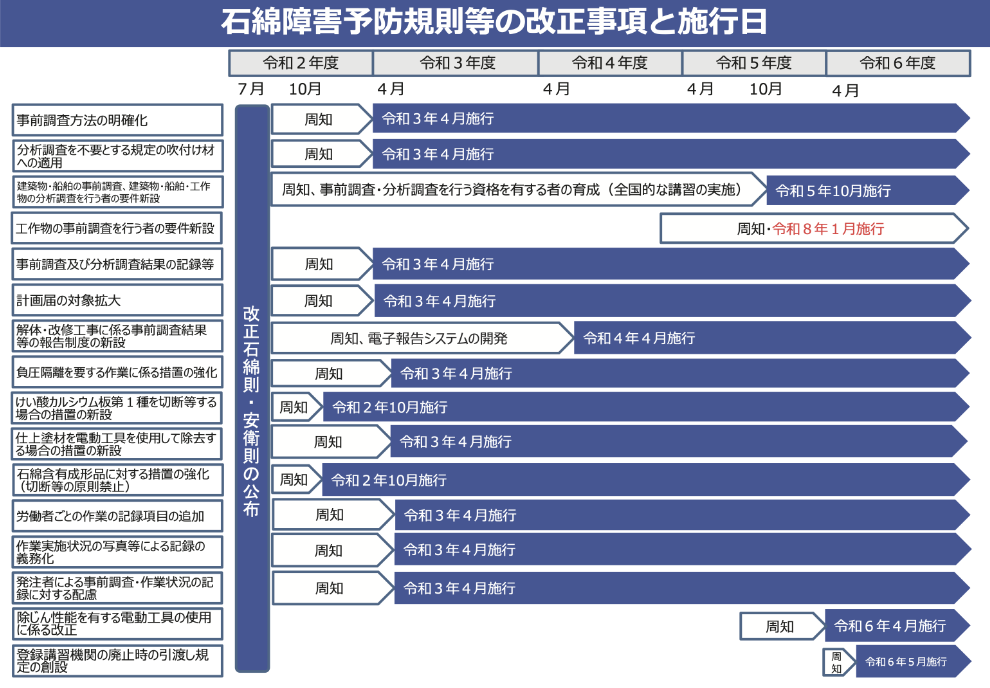
| Reporting of pre-work asbestos survey results | Demolition: 80 m² or more of total floor area; renovation: contract value of ¥1 million (approx. USD 6,667) or more, tax included; certain structures: ¥1 million (approx. USD 6,667) or more, tax included; vessels: steel ships of 20 gross tons or more | The prime contractor | Reported via the electronic system before work begins |
| Pre-work survey by a qualified structure-asbestos surveyor | Demolition and related work on specified structures | The person conducting the survey | For all work commencing on or after January 1, 2026 |
| Building-extinguishment registration (滅失登記, mekkyū tōki) | When a building ceases to exist | The registered title holder listed on the property register | Within one month of the date of extinguishment |
It is easy to overlook that the filing obligation falls on the client. The Ministry of Land, Infrastructure, Transport and Tourism's Construction Recycling Act Q&A Compendium (建設リサイクル法質疑応答集) states that even where a developer commissions the work on the property owner's behalf, "the property owner must file the notification as the client." In practice, the contractor often handles this filing as an administrative convenience — but legal responsibility for it rests with the client.
Demolition Contractor Registration vs. Construction Business License
The first thing to verify when selecting a contractor is their qualification. According to guidance from the Tokyo Metropolitan Bureau of Urban Development (東京都都市整備局), a house-demolition contract valued at ¥5 million (approx. USD 33,333) or more requires the contractor to hold a Construction Business License (解体工事業, demolition-work category); below that threshold, registration as a demolition contractor is sufficient. That registration remains valid for five years, and renewal must be filed between two months and 30 days before the registration's expiration date. Registration requirements include appointing a technical manager who meets the qualification standards set by the relevant ministerial ordinance.
Check whether the quote you receive lists a Construction Business License number or a demolition-contractor registration number, and confirm the contractor is actually registered in the prefecture where the work will take place. It is not uncommon for the lowest-priced bidder to be the one that fails to meet these requirements.
Practical Ways to Reduce Demolition Cost
Municipal Subsidies Come in Two Designs: Percentage-Rate and Per-Unit-Price Cap
Many Japanese municipalities offer subsidy programs for demolishing dangerous, aging vacant houses. There are two different design philosophies, however, and which one a given program uses determines how much you can actually receive: some are set as a percentage of the construction cost, while others cap the subsidy at total floor area multiplied by a per-square-meter unit rate.
| Municipality / Program | Subsidy Rate | Cap Amount | Key Requirements |
|---|---|---|---|
| Matsuyama City (松山市) — Dangerous Aging Vacant House Removal Program (FY2026) | 4/5 of eligible costs (excl. tax) | ¥1,000,000 (approx. USD 6,667); ¥1,600,000 (approx. USD 10,667) for remote islands | Substandard-housing score of 100 points or higher; unoccupied for at least the past year |
| Koto City, Tokyo (江東区) — Wood-Frame House Removal Subsidy (FY2026) | 1/2 of removal work cost | ¥1,000,000 (approx. USD 6,667) | Wood-frame or similar building constructed on or before May 31, 1981 with inadequate seismic resistance; applications accepted April 1, 2026 – January 29, 2027 |
| Utsunomiya City (宇都宮市) — Dangerous Aging Vacant House Removal Subsidy (FY2026) | 2/3 of eligible amount | ¥700,000 (approx. USD 4,667); eligible amount is the lower of (floor area × ¥11,000/m², approx. USD 73/m²) or actual cost | Built on or before May 31, 1981, etc.; household aggregate income of ¥8.18 million (approx. USD 54,533) or less |
| Kaizuka City (貝塚市) — Wood-Frame Vacant House Removal Subsidy | 8/10 of removal costs, etc. | ¥500,000 (approx. USD 3,333); lower of (floor area × ¥20,000/m², approx. USD 133/m²) or ¥500,000 (approx. USD 3,333) | Substandard-housing score of 100 points or higher; vacant for approximately one year or more |
| Shinagawa City, Tokyo (品川区) — Fire-Resistance Priority Zone Support Program | Per-m² unit-rate method | Wood-frame: ¥36,000/m², cap ¥18,000,000 (approx. USD 120,000); light-gauge steel: ¥51,000/m², cap ¥25,500,000 (approx. USD 170,000) (cap raised July 1, 2026) | Aging buildings within a designated fire-resistance priority zone |
The size of the gap between programs traces back to differences in how the funding itself is structured. Under the Ministry of Land, Infrastructure, Transport and Tourism's "Vacant House Regeneration Promotion Project [Removal Type]" (空き家再生等推進事業【除却事業タイプ】), the eligible subsidy amount equals (removal work cost + ordinary compensation for losses arising from removal) × 8/10, with a per-square-meter cap applied to the removal-cost component. The funding is shared: where the local government is the implementing body, national government 2/5, local government 2/5, and the remaining 1/5 also from the local government; where a private party is the implementing body, national government 2/5, local government 2/5, and the private party 1/5. In short, how much a local government is willing to fund beyond the national share is exactly what determines how much a homeowner actually receives.
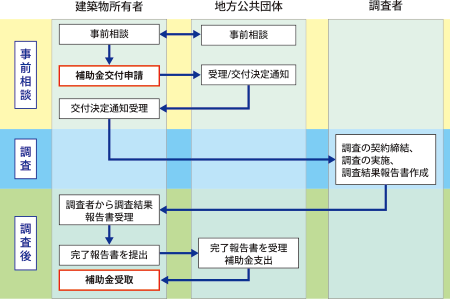
Some municipalities also subsidize the asbestos survey itself. The approval process generally follows the flow below, and in every case, signing a contract or beginning work before the subsidy is formally approved disqualifies the project from funding.
Ten Line Items to Compare Across Competing Quotes
Simply "getting quotes from multiple companies" does not, by itself, explain why the numbers differ. Because Japan has no public database of recorded demolition-contract prices to check a quote against, lining up these ten specific line items across every bid is the practical substitute — it is how you tell whether the cheapest quote is genuinely cheap or simply missing scope.
| Item to Check | Where to Look on the Quote |
|---|---|
| 1. Basis for the total floor area figure | The "m²" or "tsubo" field in the quantity column. Does it match the property register? |
| 2. Whether leftover-item disposal is included, and at what volume | The "leftover-item disposal" line. Is it broken out by quantity and unit price, rather than listed as a lump sum? |
| 3. Exterior structures, block walls, trees | The incidental-work section. Is the wall length in meters and the tree count spelled out? |
| 4. Treatment of buried obstacles | The remarks or special-notes section. What is the process, and the rough unit price, if something is found? |
| 5. Asbestos pre-survey and removal costs | Is the survey fee itemized separately or folded into the core price? Is removal "billed separately if found" or already included? |
| 6. Temporary scaffolding and protection | The temporary-works section. Perimeter length in m² and the soundproof-sheeting specification. |
| 7. Waste manifest management | The administrative-fees section or special notes. Will copies of the manifest be provided? |
| 8. Site-grading finish level | The grading section. Rough grading, compaction, or a crushed-stone finish? |
| 9. Neighbor notifications and road-use permits | The administrative-fees section. Who files for the permit, and who pays for it? |
| 10. Conditions and payment terms for additional charges | The contract terms or special-notes section. What share of the deposit is due, and when? |
Separate Out What You Can Handle Yourself
Disposing of leftover items yourself is often meaningfully cheaper than routing them through the contractor. Using municipal bulk-waste collection and appliance-recycling tickets to empty the interior before the contractor's start date is a legitimate, common approach — and as noted above, the Construction Recycling Act Q&A Compendium itself treats pre-disposal of household items as the client's role, not the contractor's.
Beyond that, avoiding the busy season (Japan's fiscal year-end, January through March) and giving the contractor scheduling flexibility can also move the unit price. That said, if a price negotiation ends up cutting corners on filings, protective work, or waste-manifest management, it has defeated its own purpose. What you can legitimately trim is how labor is allocated and scheduled — never the legally mandated procedures.
Taxes After Demolition, and the Tax Treatment of Demolition Cost
How Much Does Property Tax Rise After Clearing Land? (Up to 4.2x — Not the Rumored "6x")
Land with a house standing on it qualifies for Japan's residential-land tax exception: for small-scale residential land of 200 m² or less, the property-tax assessment base is reduced to one-sixth of the land's assessed value, and the city-planning-tax base to one-third (Ministry of Internal Affairs and Communications, "Overview of Property Tax"; Tokyo Metropolitan Bureau of Taxation). Demolish the house and clear the land, and this exception disappears — a mechanic with no equivalent in most US or European property-tax systems, where the tax treatment of a residential lot does not typically hinge on whether a structure is currently standing on it.
The figure "it becomes 6x" circulates informally, but it is not accurate. Ministry of Internal Affairs and Communications materials show that non-residential land (commercial land, etc.) is subject to a statutory cap: the assessment base cannot exceed 70% of the assessed value. Nor does the tax base jump straight to that cap in a single year. Working through an example with an assessed value of ¥30 million (approx. USD 200,000) on a 200 m² lot:
| Category | Before Demolition (Small-Scale Residential Land) | After Clearing, at the Statutory Cap (70% of Value) | After Clearing, at the Burden-Adjustment Ceiling (60% of Value) |
|---|---|---|---|
| Property tax | ¥30M × 1/6 × 1.4% = ¥70,000 (approx. USD 467) | ¥30M × 70% × 1.4% = ¥294,000 (approx. USD 1,960) | ¥30M × 60% × 1.4% = ¥252,000 (approx. USD 1,680) |
| City planning tax | ¥30M × 1/3 × 0.3% = ¥30,000 (approx. USD 200) | ¥30M × 70% × 0.3% = ¥63,000 (approx. USD 420) | ¥30M × 60% × 0.3% = ¥54,000 (approx. USD 360) |
| Total (annual) | ¥100,000 (approx. USD 667) | ¥357,000 (approx. USD 2,380) | ¥306,000 (approx. USD 2,040) |
Looking at property tax alone, ¥70,000 (approx. USD 467) rising to as much as ¥294,000 (approx. USD 1,960) is a 4.2x increase; including city planning tax, the combined total rises from ¥100,000 (approx. USD 667) to as much as ¥357,000 (approx. USD 2,380), or roughly 3.6x. But this is the figure once the assessment reaches its ceiling — it does not necessarily arrive at that level in the very first year after the land is cleared.
What softens the blow is a statutory burden-adjustment measure (負担調整措置, futan chōsei sochi). According to Tokyo Metropolitan Bureau of Taxation materials, for commercial-type land, where the "burden level" (負担水準, futan suijun — the ratio of the previous year's assessment base to the current assessed value) is below 60%, the assessment base is raised gradually each year, by an amount equal to 5% of the current value added to the prior year's base, with that phase-in stopping once it reaches 60% of value. Where the burden level sits between 60% and 70%, the base is frozen at its current level; above 70%, it is reduced down to the statutory cap of 70%. This measure is confirmed to continue through FY2026. In practice, for land with a low starting burden level, the right-hand column of the table above — not the middle column — is the real destination, and the assessment climbs toward it gradually over several years rather than in one jump.
Tokyo's 23 special wards apply a further reduction under metropolitan tax ordinance, capping the commercial-land burden level (課税限度額, kazei gendogaku) at 65%, and halving the city-planning tax on small-scale residential land. Exactly how many years it takes to reach the applicable ceiling depends on the relationship between the prior year's assessment base and current value, so confirm the actual figure with the municipal property-tax division where the land is located (in Tokyo's 23 wards, the metropolitan tax office, 都税事務所).
Demolishing the building also eliminates the building's separate property-tax liability. But because an older building's assessed value has typically already been reduced substantially through age-based depreciation, that reduction frequently does not offset the increase on the land side. For a deeper look at post-demolition tax exposure and land-use options, see our companion guide on property tax on vacant land and land-utilization strategy.
Is Demolition Cost a Deductible Expense, or Added to the Land's Acquisition Cost?
The tax treatment of demolition cost in Japan depends on why the building is being torn down. Under National Tax Agency Tax Answer No. 5401, where a corporation acquires land together with a building and begins demolishing the building within roughly one year of that acquisition — making it clear the building was always intended to be demolished so the land could be used — the building's book value plus the demolition cost (net of any proceeds from selling salvaged materials) is added to the acquisition cost of the land, rather than expensed.
By contrast, where the building was originally acquired for use in the corporation's business, but that use was abandoned due to unavoidable circumstances, the combined amount may be treated as a deductible loss at the time of demolition, even if demolition occurs within a year of acquisition. Because this determination depends heavily on the individual facts, we recommend confirming the treatment with a qualified tax accountant (税理士, zeirishi) before proceeding.
The ¥30 Million Special Deduction for Selling an Inherited, Demolished Vacant Home
Where an heir demolishes an inherited family home and sells the land, meeting the applicable requirements allows a deduction of up to ¥30 million (approx. USD 200,000) from the resulting capital gain (National Tax Agency Tax Answer No. 3306, "Special Exception for Selling a Decedent's Residential Property [Vacant House]").
| Requirement | Detail |
|---|---|
| Deduction amount | Up to ¥30,000,000 (approx. USD 200,000). For transfers on or after January 1, 2024, where three or more heirs acquired the property through inheritance or bequest, the deduction is ¥20,000,000 (approx. USD 133,333) per heir |
| Application window | Transfers between April 1, 2016 and December 31, 2027 |
| Construction date | The house must have been built on or before May 31, 1981 |
| Sale price | ¥100,000,000 (approx. USD 666,667) or less |
| Transfer deadline | By December 31 of the year containing the date three years after the inheritance began |
| Demolition deadline | Also satisfied if the entire house is demolished between the date of transfer and February 15 of the year following the year of transfer |
The last row deserves attention. Because the deduction can still apply if demolition happens after a buyer is secured but before handover, there are cases where you do not need to clear the land first and absorb a full year of higher property tax while it sits vacant and unsold. The timing of demolition is a decision that should weigh both the tax outcome and the sale strategy together.
Should You Sell as Bare Land, or Sell With the Building Still Standing?
| Decision Factor | Sell as Bare Land | Sell With the Building Standing ("Old House on Land") |
|---|---|---|
| Upfront cost | Seller bears the demolition cost | No demolition cost for the seller |
| Property tax | Taxed as non-residential land until the property sells | Residential-land tax exception continues |
| Buyer pool | Opens to both owner-occupiers and developers/investors | Limited to buyers willing to factor in demolition themselves |
| Price | Easier to target a price close to market comparables | Buyers often negotiate a discount equal to or beyond the demolition cost |
| Post-demolition surprises | Seller must handle any buried obstacles that surface | Risk transfers to the buyer |
| Best suited for | Regular-shaped, well-accessed, rebuildable lots that attract buyers easily | Lots that cannot legally be rebuilt on, or that carry retaining-wall or buried-obstacle concerns |
"Clear the land and it will sell" is only half right as a decision rule. Pay the demolition cost up front, carry the higher tax burden that follows, and then watch the selling period drag on, and you can end up worse off than if you had simply accepted a discount from a buyer willing to take on the old building. When we advise property owners on this decision, we recommend laying out three numbers side by side — the demolition cost, the increased tax burden, and the expected time to sell — and calculating the net proceeds under both scenarios before deciding. Judging on the total return through to exit, rather than which option looks cheaper in isolation, is what actually protects the value of the asset.
Frequently Asked Questions (FAQ)
Q. How long does a demolition project take?
As a guide: 1–2 weeks for a wood-frame detached house, 2–4 weeks for a single wood-frame apartment building, 3–5 weeks for a light-gauge steel apartment building, and 2–4 months for an RC condominium building. On top of the physical work, you also need to allow time before construction begins for the Construction Recycling Act filing (due at least 7 days before work starts), the pre-work asbestos survey and its results reporting, and neighbor notifications. Building-extinguishment registration must follow within one month after demolition. Budgeting 2–3 months overall, from selecting a contractor through to completed registration, for a wood-frame detached house keeps the schedule from slipping.
Q. How long does it take to get tenants out before demolishing an apartment building?
For a fixed-term lease, the landlord must serve a notice declining renewal between one year and six months before the lease term ends (Act on Land and Building Leases, Article 26, Paragraph 1); for a lease with no fixed term, the lease ends six months after a notice of cancellation is served (same Act, Article 27, Paragraph 1). For that notice to actually take effect, it must be backed by "legitimate grounds" under Article 28 — and an offer of financial compensation, such as tachinokiryō (vacating compensation), factors into that determination. Even where negotiations go smoothly, plan realistically for six months to a year; for a building with many units, one to two years is a realistic planning horizon.
Q. Can I demolish just my own unit in a condominium?
No. The building is treated as a single, indivisible structure, and demolition requires a majority-vote resolution among all unit owners. Under the revised Act on Unit Ownership of Buildings, effective April 1, 2026, three new resolution types were created — a demolition resolution, a demolition-and-site-sale resolution, and a building-and-site sale resolution — each achievable by a general four-fifths majority vote. Where specific, objectively defined conditions exist, such as insufficient earthquake resistance, that threshold drops to three-fourths. The starting point is to consult your condominium management association about whether the building can be certified as requiring removal.
Q. Can I combine a municipal subsidy with getting competitive quotes?
Yes, and in fact most subsidy applications require an attached quote as part of the paperwork. What matters is the order of operations: most municipalities specify that signing a construction contract or beginning work before formal approval disqualifies the project from the subsidy (Koto City's program states this explicitly, for example). The typical sequence is to narrow down contractors through competitive quotes, submit the subsidy application, receive formal approval, and only then sign the contract. Because application windows and budget allocations run on a fiscal-year basis, contact the relevant municipal office early, working backward from your intended start date.
Q. When does property tax actually change after demolition?
The property-tax assessment date is January 1 of the relevant fiscal year (Local Tax Act, Article 359). So if a house is still standing on January 1, the residential-land exception applies for that entire fiscal year, and the increased tax does not take effect until the following fiscal year. Conversely, if demolition is completed within the calendar year and the land is bare by January 1, it is taxed as non-residential land starting the following fiscal year. If your sale timeline is uncertain, simply shifting a planned December demolition start into the new year can avoid an entire extra year of the higher tax.
Citations and Sources
- Ministry of Land, Infrastructure, Transport and Tourism (国土交通省, MLIT), Vice-Minister's Notice "Standard Construction Costs for FY2026 Housing Bureau Projects" (令和8年度における住宅局所管事業に係る標準建設費等について, April 7, 2026, Notice No. Kokujūbi-768 et al.)
- MLIT, "Public Works Construction Labor Unit Prices Applicable from March 2026" (令和8年3月から適用する公共工事設計労務単価について, February 17, 2026)
- MLIT, "Asbestos Countermeasures Q&A" (アスベスト対策Q&A)
- MLIT, "Vacant House Regeneration Promotion Project [Removal Type]" (空き家再生等推進事業【除却事業タイプ】)
- Ministry of the Environment (環境省), "Overview of the Construction Recycling Act" (建設リサイクル法の概要)
- MLIT, "Construction Recycling Act Q&A Compendium" (建設リサイクル法質疑応答集)
- Ministry of Health, Labour and Welfare (厚生労働省, MHLW) Asbestos General Information Portal, "Pre-work Asbestos Survey Results Reporting System" (石綿事前調査結果報告システム)
- MHLW Asbestos General Information Portal, "Key Points of the Revised Asbestos Hazard Prevention Ordinance" (改正石綿則のポイント)
- MLIT Housing Bureau, "FY2025 Condominium-Related Law Reform and the Future of Condominium Management" (令和7年マンション関係法改正とこれからのマンション管理, October 26, 2025)
- Ministry of Internal Affairs and Communications (総務省, MIC), "Overview of Property Tax" (固定資産税の概要)
- MIC, "How the Burden-Adjustment Measure for Residential and Commercial Land Works" (宅地に係る負担調整措置の仕組み)
- Tokyo Metropolitan Bureau of Taxation (東京都主税局), "Property Tax and City Planning Tax (Land and Buildings)" (固定資産税・都市計画税(土地・家屋))
- Tokyo Metropolitan Bureau of Taxation, "Burden-Adjustment Measures for Property Tax and City Planning Tax on Commercial and Other Non-Residential Land Continue" (商業地等(住宅用地以外の宅地等)の固定資産税・都市計画税の負担調整措置が継続されます)
- e-Gov Japanese Law Search, Real Property Registration Act (不動産登記法, Article 57, Registration of Building Extinguishment)
- National Tax Agency (国税庁, NTA), Tax Answer No. 5401, "Acquisition Cost of Land Where a Building Acquired Together With It Is Demolished" (土地とともに取得した建物を取り壊した場合の土地の取得価額)
- NTA, Tax Answer No. 3306, "Special Exception for Selling a Decedent's Residential Property (Vacant House)" (被相続人の居住用財産(空き家)を売ったときの特例)
- e-Gov Japanese Law Search, Act on Land and Building Leases (借地借家法, Articles 26–28)
- Tokyo Metropolitan Bureau of Urban Development (東京都都市整備局), "Construction Recycling Act: Information for Demolition Contractors" (建設リサイクル法:解体工事業者のみなさんへ)
- Matsuyama City (松山市), "FY2026 Dangerous Aging Vacant House Removal Program" (令和8年度 老朽危険空家除却事業)
- Koto City, Tokyo (江東区), "Seismic Retrofitting of Wood-Frame Housing (Removal Subsidy)" (木造住宅の耐震化(除却の助成))
- Utsunomiya City (宇都宮市), "Dangerous Aging Vacant House Removal Subsidy" (老朽危険空き家除却費補助金)
- Kaizuka City (貝塚市), "Wood-Frame Vacant House Removal Subsidy Program" (木造空き家除却補助制度)
- Shinagawa City, Tokyo (品川区), "Fire-Resistance Priority Zone Support Program" (不燃化特区支援事業)
