A note for international readers before we start: Japan has no equivalent of the US MLS (Multiple Listing Service), the UK Land Registry's price-paid data, or Australia's CoreLogic — there is no single public database where a buyer can look up what a specific unit actually sold for. The closest thing is REINS (Real Estate Information Network System), a members-only system used by licensed agents, which periodically publishes aggregated statistics but not individual transaction prices. This is one of the most disorienting differences for foreign investors evaluating Japanese property: you cannot simply pull "comps" the way you would in New York, London, or Sydney. This article exists to close part of that gap, using the aggregated data that Japanese industry bodies do publish.
In the first half of 2026, the average per-square-meter price of a newly built condominium ("mansion" in Japanese real-estate usage — a mid-rise or high-rise concrete apartment building, not a single-family house) in greater Tokyo was JPY 1,514,000 per square meter (approx. USD 10,100/sqm), according to the Real Estate Economic Institute (Fudōsan Keizai Kenkyūjo), released July 21, 2026. Meanwhile, resale condominiums five years old or newer closed at JPY 1,531,000 per square meter (approx. USD 10,200/sqm), according to the East Japan Real Estate Information Network (Higashi Nihon REINS), published July 17, 2026 — meaning resale units actually traded slightly above new-build pricing on a per-square-meter basis. Whether new or resale is the better buy is not a question of "which is cheaper." It is a question of total cost — the mortgage tax credit, property tax, brokerage commission, and building reserve fund all factor into the real number, and each of those behaves very differently depending on whether you buy new or resale in Japan.
This article is written for readers who have already narrowed their search down to a handful of specific properties and are making a final call between a new-build unit and a resale unit — whether nearly new or several decades old, at a comparable budget. Rather than listing generic pros and cons, we show exactly how many percentage points of new-build premium disappear at each building-age bracket, what the 2026 mortgage tax credit gap between new and resale actually amounts to in yen, and which tax breaks are available to new-build buyers only — all backed by primary-source numbers and citations. Every yen figure in this article is followed by an approximate US dollar conversion at a rate of JPY 150 = USD 1 (an approximation of the rate as of 2026-08-15; treat all USD figures as rounded estimates for orientation, not as exact currency conversions for transaction purposes).
Key takeaways from this article
- The new-build premium can be quantified by building age. Against a new-build price of JPY 1,514,000/sqm (approx. USD 10,100/sqm), resale units up to 10 years old average JPY 1,309,000/sqm (approx. USD 8,700/sqm) — 13.5% lower — resale units up to 20 years old average JPY 977,000/sqm (approx. USD 6,500/sqm) — 35.5% lower — and resale units over 30 years old average JPY 471,000/sqm (approx. USD 3,100/sqm) — 68.9% lower.
- At the same time, resale units five years old or newer average JPY 1,531,000/sqm (approx. USD 10,200/sqm), which is actually above the new-build average. The assumption that "new is automatically the pricier option" does not hold in greater Tokyo in 2026.
- Under Japan's FY2026 (Reiwa 8) tax reform, the mortgage tax credit (jūtaku rōn kōjo) available on existing (resale) homes was expanded. For a resale unit meeting the ZEH-level energy-efficiency standard, the borrowing cap and 13-year credit period are now identical to new-build: JPY 35,000,000 (approx. USD 233,000), or JPY 45,000,000 (approx. USD 300,000) for households raising children, at 0.7% for 13 years.
- However, a resale unit that cannot document its energy-efficiency performance is classified as a "standard home" (sono ta jūtaku) and capped at just JPY 20,000,000 (approx. USD 133,000) over 10 years — a gap in the maximum lifetime credit of up to JPY 2,695,000 (approx. USD 18,000) compared with the top resale tier.
- The 50% property tax (fixed asset tax) reduction lasts five years for a condominium, or seven years for a certified long-life-quality ("nintei chōki yūryō") condominium. This is a new-build-only benefit; resale units do not qualify at all.
- Nationally, 47.1% of condominiums use a "graduated increase" (dankai zōgaku) building reserve fund contribution schedule, and the more recently a building was completed, the more likely it is to use this method. Judging your future carrying costs solely on the monthly figure quoted at move-in can leave you short later.
How Big Is the Actual Price Gap Between New and Resale Condos?
In 2026 greater Tokyo, the price gap between new-build and resale condominiums cannot be described with a single blanket rule like "new is 20–40% more expensive." Measured per square meter, resale units five years old or newer are essentially at parity with new-build, or slightly above it. The gap only opens up clearly once a building passes roughly the ten-year mark. Unlike markets where age-based depreciation curves are widely published by appraisers or portals, Japan requires piecing this together from separate new-build and resale datasets — which is exactly what we do below.
Greater Tokyo New-Build Condos Average JPY 101,350,000 (approx. USD 676,000) at JPY 1,514,000/sqm (approx. USD 10,100/sqm) — First Half 2026
According to the Real Estate Economic Institute's "Greater Tokyo New Condominium Market Trends, First Half 2026 (January–June)," released July 21, 2026, 7,989 new condominium units were released for sale in greater Tokyo (Tokyo, Kanagawa, Saitama, and Chiba prefectures) in the first half of 2026 — down 0.8% year on year. The average price per unit was JPY 101,350,000 (approx. USD 676,000), and the average price per square meter was JPY 1,514,000 (approx. USD 10,100/sqm). This was the first time the average per-unit price has broken the JPY 100 million (approx. USD 667,000) mark in a first-half reporting period. Year on year, the average price rose 13.1% and the per-square-meter price rose 12.1%. The first-month contract rate was 64.8%.
Broken down by area, the average price per square meter was JPY 2,226,000 (approx. USD 14,800/sqm) in Tokyo's 23 special wards (average unit price JPY 142,490,000, approx. USD 950,000); JPY 1,118,000 (approx. USD 7,500/sqm) in the rest of Tokyo (average unit price JPY 75,500,000, approx. USD 503,000); JPY 1,234,000 (approx. USD 8,200/sqm) in Kanagawa Prefecture (average unit price JPY 83,460,000, approx. USD 556,000); JPY 985,000 (approx. USD 6,600/sqm) in Saitama Prefecture (average unit price JPY 64,690,000, approx. USD 431,000); and JPY 1,246,000 (approx. USD 8,300/sqm) in Chiba Prefecture (average unit price JPY 89,970,000, approx. USD 600,000). Because the greater-Tokyo-wide average is pulled sharply upward by the 23 wards' high per-square-meter pricing, if you are evaluating a specific area outside the 23 wards, the area-level figure will feel much closer to reality than the regional headline number.
Resale Condo Prices by Building Age (REINS, April–June 2026)
For resale figures, the benchmark is actual closed-transaction data from the East Japan Real Estate Information Network (Higashi Nihon REINS), published July 17, 2026 as "REINS TOPIC: Greater Tokyo Resale Condominiums and Resale Detached Houses — Closed Transactions by Region and Building Age, April–June 2026." Across greater Tokyo, there were 11,849 closed resale condo transactions, at an average per-square-meter price of JPY 831,000 (approx. USD 5,500/sqm) and an average closing price of JPY 52,020,000 (approx. USD 347,000). Broken down by building-age bracket, the results are shown below. The rightmost column shows the percentage difference from the new-build per-square-meter price of JPY 1,514,000 (approx. USD 10,100/sqm), indexed at 100.
| Building Age | Closed Transactions | Price / sqm | Closing Price | Floor Area | Diff. vs. New-Build Price/sqm |
|---|---|---|---|---|---|
| New-build (reference) | 7,989 units listed | JPY 1,514,000 (approx. USD 10,100) | JPY 101,350,000 (approx. USD 676,000) | — | — |
| Up to 5 years | 706 | JPY 1,531,000 (approx. USD 10,200) | JPY 94,480,000 (approx. USD 630,000) | 61.7 sqm | +1.1% |
| Up to 10 years | 1,197 | JPY 1,309,000 (approx. USD 8,700) | JPY 77,570,000 (approx. USD 517,000) | 59.2 sqm | −13.5% |
| Up to 15 years | 994 | JPY 1,244,000 (approx. USD 8,300) | JPY 79,160,000 (approx. USD 528,000) | 63.6 sqm | −17.8% |
| Up to 20 years | 1,202 | JPY 977,000 (approx. USD 6,500) | JPY 65,360,000 (approx. USD 436,000) | 66.9 sqm | −35.5% |
| Up to 25 years | 1,407 | JPY 931,000 (approx. USD 6,200) | JPY 65,120,000 (approx. USD 434,000) | 69.9 sqm | −38.5% |
| Up to 30 years | 1,327 | JPY 767,000 (approx. USD 5,100) | JPY 52,110,000 (approx. USD 347,000) | 67.9 sqm | −49.3% |
| Over 30 years | 5,016 | JPY 471,000 (approx. USD 3,100) | JPY 27,670,000 (approx. USD 184,000) | 58.7 sqm | −68.9% |
| Total | 11,849 | JPY 831,000 (approx. USD 5,500) | JPY 52,020,000 (approx. USD 347,000) | 62.6 sqm | −45.1% |
Sources: East Japan Real Estate Information Network (Higashi Nihon Fudōsan Ryūtsū Kikō), "REINS TOPIC: Greater Tokyo Resale Condominiums and Resale Detached Houses — Closed Transactions by Region and Building Age, April–June 2026"; Real Estate Economic Institute (Fudōsan Keizai Kenkyūjo), "Greater Tokyo New Condominium Market Trends, First Half 2026." The "Diff. vs. New-Build Price/sqm" column is a reference figure calculated in-house against the new-build baseline of JPY 1,514,000/sqm.
Within the 23 wards alone, resale units up to five years old averaged JPY 2,335,000/sqm (approx. USD 15,600/sqm) and JPY 138,480,000 (approx. USD 923,000) per closing — above the 23-ward new-build average of JPY 2,226,000/sqm (approx. USD 14,800/sqm). In central Tokyo specifically, nearly new resale units are, as a matter of actual market practice, trading at a higher per-square-meter price than new construction.
What Is the "New-Build Premium," in Percentage Terms?
The new-build premium refers to the portion of a new condominium's sale price that reflects selling costs — the cost of building and staffing a show room, advertising, and sales commissions — rather than the value of the housing itself. Because these costs cannot be recovered at resale, a buyer who resells shortly after taking delivery of a brand-new unit will typically find the resale price falls short of the original purchase price. This is a structural feature of how new-build pricing works in Japan, and it is worth understanding on its own terms before assuming it maps cleanly onto "new-construction markup" concepts you may know from other countries.
From the table above: against a new-build price of JPY 1,514,000/sqm (approx. USD 10,100/sqm), the up-to-10-year resale price of JPY 1,309,000/sqm (approx. USD 8,700/sqm) represents a 13.5% decline over ten years. At the 20-year mark it is 35.5%, and past 30 years it is 68.9%. One important caveat: this decline does not represent the disappearance of the new-build premium alone. As a building ages, physical deterioration, equipment obsolescence, generational differences in seismic and energy-efficiency standards, and differences in the original sale-price level all compound to widen the per-square-meter gap. There is no official government statistic that isolates "how much value disappears the moment you take delivery" as a standalone figure — treat this table as a read on how the market currently prices each building-age bracket, not as a precise decay curve for the premium itself.
Why You Should Not Simply Compare the Average Prices Head-On
Lining up the new-build average of JPY 101,350,000 (approx. USD 676,000) against the resale average of JPY 52,020,000 (approx. USD 347,000) and concluding that "new-build costs almost double" would be a mistake. The two figures come from different populations, different aggregation methods, and a different geographic mix of supply.
- The new-build figure is "the average asking price of units released for sale"; the resale figure is "the average price of transactions that actually closed." Asking and closing are not the same thing.
- Tokyo's 23 wards account for 33.6% of new-build units released, and high-priced units there pull the new-build average upward. On the resale side, units over 30 years old account for 5,016 of 11,849 closings — 42% of the total — which pulls the resale average downward.
- Floor area differs. Back-calculating from the published average price and per-square-meter price, the average new-build unit is roughly 67 sqm, versus a resale average of 62.6 sqm.
When comparing new and resale, use price per square meter, within the same area and the same building-age bracket — not the headline total price per unit. That is why the tables in this article are built around per-square-meter pricing rather than sticker price.
What Are the Advantages of Buying a New-Build Condo?
The advantage of new construction has less to do with how fresh the fixtures look and more to do with what is legally guaranteed. Mandatory energy-efficiency compliance, a ten-year statutory defect-liability period under the Housing Quality Assurance Act, mandatory seller solvency measures, and a property tax reduction — none of these are generally available on a resale purchase. For international buyers used to case-by-case builder warranties, the degree to which these protections are baked into Japanese law, rather than left to individual developer discretion, is itself worth understanding.
Since April 2025, Energy-Efficiency Compliance Has Been Mandatory for All New Homes
Following a 2022 amendment to the Building Energy Efficiency Act (Kenchikubutsu Shōene-hō), energy-efficiency standard compliance is now mandatory, in principle, for all newly built residential and non-residential buildings (Ministry of Land, Infrastructure, Transport and Tourism, MLIT, "Building Energy Efficiency Act Article 10: Expansion of the Scope of Mandatory Energy-Efficiency Compliance"). Full mandatory compliance took effect on April 1, 2025 (Reiwa 7), applying to buildings on which construction work commences on or after that date (buildings with a floor area of 10 sqm or less are excluded). Compliance is verified as part of the standard building-confirmation process, alongside structural-safety review.
This is not merely a matter of insulation performance or day-to-day comfort. As explained below, the borrowing cap for the mortgage tax credit is determined by a property's energy-efficiency classification, which means the simple fact that a unit is new construction now guarantees it will at minimum qualify as an "energy-efficiency-compliant home" for tax purposes — a direct, structural tax advantage. Existing (resale) homes are not subject to this mandate, so performance can vary widely even among buildings of the same age.
A 10-Year Warranty Under the Housing Quality Assurance Act and the Housing Defect Warranty Liability Act
For new-build condominiums, the seller is legally obligated to bear defect liability for ten years from the date of delivery, covering the load-bearing structural elements and the parts that prevent water intrusion. This is grounded in the Act for Promotion of Housing Quality Assurance, known as the Housing Quality Assurance Act (Hinkaku-hō). The foundation, columns, walls, and roof are covered; interior finishes and equipment are not, so those fall under whatever individual warranty the developer or manufacturer separately offers — worth confirming directly.
Just as important in practice is the Act on Securing Liability for Specified Residential Defects (Jūtaku Kashi Tanpo Rikō-hō). Sellers and contractors who deliver new homes are required to secure their ability to pay out on defect claims, either through insurance or by depositing a security bond (applicable to deliveries from October 1, 2009 onward). In plain terms: even if the developer goes bankrupt, a mechanism exists for an insurance corporation to pay for repairs. This solvency-assurance requirement applies specifically to sellers and contractors delivering new homes, so it does not apply to resale transactions where the seller is a private individual. Resale contracts sometimes include a special clause shortening the statutory contract-nonconformity liability period, so always check the period and scope in the contract itself.
A Pre-Delivery Walkthrough Lets You Get Defects Fixed Before You Move In
Before delivery, buyers of new-build units attend a pre-delivery walkthrough (shunkō naikenkai) to check for scratches, stains, poorly fitted fixtures, and plumbing function — and any issues found are typically repaired before delivery. Resale condominiums, by contrast, are delivered "as is" (genjō yūshi) in principle, so the mere existence of this walkthrough step is a practical advantage unique to new construction. For guidance on what to check before and after signing a contract when buying resale, see What to Check in the Disclosure Statement and Fixtures List When Signing a Resale Condo Contract.
Property Tax Is Cut in Half for Five Years — A New-Build-Only Reduction
New homes qualify for a measure that cuts the property tax (fixed asset tax) bill in half. The reduction period is three years for a detached house and five years for a condominium; for a certified long-life-quality home, it extends to five years for a house and seven years for a condominium. Under the FY2026 (Reiwa 8) tax reform, this measure was extended for five more years (April 1, 2026 through March 31, 2031), and the minimum eligible floor area was relaxed to 40 sqm, from the previous 50 sqm (homes within certain designated hazard areas are excluded).
According to MLIT estimates, for a newly built home valued at JPY 25,000,000 (approx. USD 167,000), the property tax due through year three would be JPY 182,000/year (approx. USD 1,200/year) without the special reduction, versus JPY 91,000/year (approx. USD 610/year) with it — a savings of roughly JPY 270,000 (approx. USD 1,800) over three years. This estimate assumes a three-year period for a detached house; because a condominium's 50% reduction runs for five years rather than three, the total savings for a condo buyer over the full reduction period would be larger still. Resale condominiums are not eligible for this reduction at all.
What Are the Disadvantages of Buying a New-Build Condo?
New construction's weak points come down less to the price tag itself than to the things you cannot verify at the time you buy. How the value moves after delivery, what future carrying costs will actually be, and whether the finished unit will match the plans — we look at each in turn.
Value Drops by the Amount of the Selling Cost the Moment You Take Delivery
As noted above, the sale price of a new condo bakes in selling costs — show-room construction, advertising, sales commissions. These are not value the buyer can use as housing, so reselling right after delivery makes it hard to recover them. If a near-term move or resale is even a possibility, it is safer to factor this into your purchase decision up front. Conversely, if you plan to live in the unit for ten years or more, the effect of this initial decline is diluted by the value you get from actually living there over time.
The Building Reserve Fund Is Often Set Up on a "Graduated Increase" Schedule
This is a point unique to new construction, and one that is easy to overlook. According to MLIT's "FY2023 (Reiwa 5) Condominium Comprehensive Survey Results," 40.5% of condominiums use a flat, level contribution schedule, while 47.1% use a graduated-increase (dankai zōgaku) schedule — and the more recently a building was completed, the higher the share using the graduated-increase method. A graduated-increase schedule sets a low initial monthly contribution and raises it every few years.
In other words, the reserve-fund figure a new-build buyer is shown at the point of sale is often the "entry price," not the level that will actually be needed down the road. Below, we line up the real average figures against the government guideline benchmark to show how large that gap can be.
| Metric | Amount (per unit / month) | Source |
|---|---|---|
| Management fee (excluding amounts covered by parking-lot usage fees, etc.) | JPY 11,503 (approx. USD 77) | FY2023 (Reiwa 5) Condominium Comprehensive Survey |
| Management fee (total, including covered amounts) | JPY 17,103 (approx. USD 114) | Same as above |
| Building reserve fund (excluding covered amounts) | JPY 13,054 (approx. USD 87) | Same as above |
| Building reserve fund guideline (under 20 floors, total floor area 5,000–10,000 sqm) | JPY 252/sqm/month (approx. USD 1.70/sqm/month; range JPY 170–320, approx. USD 1.10–2.10) For 70 sqm: JPY 17,640/month (approx. USD 118/month; range JPY 11,900–22,400, approx. USD 79–150) | MLIT Guidelines on Condominium Building Reserve Funds |
Applying the guideline average of JPY 252/sqm/month (approx. USD 1.70/sqm/month) to a 70 sqm unit works out to JPY 17,640/month (approx. USD 118/month) — a gap of just over JPY 4,000/month (approx. USD 27/month) above the actual average contribution of JPY 13,054 (approx. USD 87). For tower-type buildings of 20 floors or more, the guideline runs even higher, at JPY 338/sqm/month (approx. USD 2.30/sqm/month; range JPY 240–410, approx. USD 1.60–2.70), and buildings with mechanical parking require an additional separate contribution. This guideline benchmark was calculated from 366 long-term repair plans.
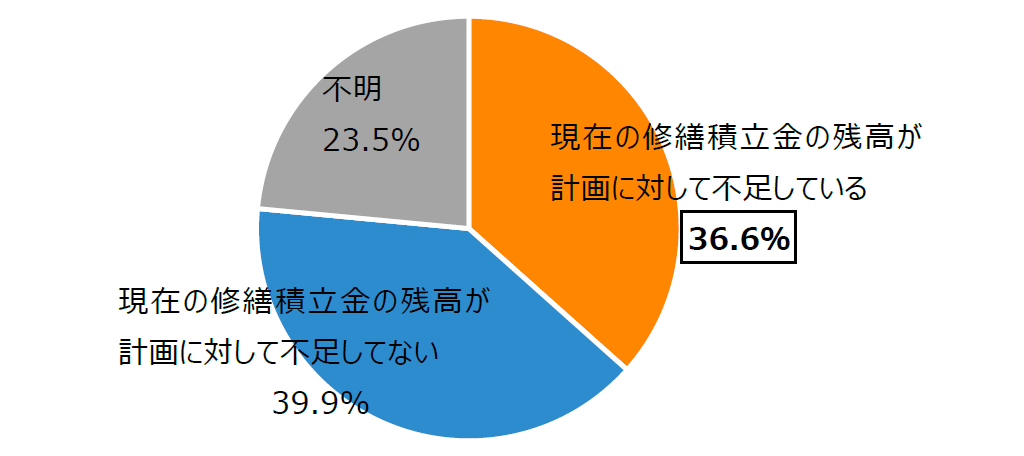
The same survey found that 36.6% of condominiums currently have a building reserve fund balance that falls short of their long-term repair plan, and for 11.7% of those, the shortfall exceeds 20% of the plan. On the other hand, among condominiums built within the past five years, the share whose contribution schedule is based on a long-term repair plan spanning 30 years or more has improved to 75.3% (up from 43.3% previously). When considering a new-build unit, check the "length of the long-term repair plan" and the "contribution method" in the sales materials, and if it uses a graduated-increase schedule, confirm exactly how much the contribution is planned to rise to, and by which year.
With a Pre-Completion Contract, You Have to Decide Without Seeing the Finished Unit
With an off-plan sale (aota-uri, selling before completion), you sign based only on the show room, floor plans, and specification sheets. The view, sunlight, noise from neighboring units, and the relationship to shared corridors cannot really be known until the building is finished. With a resale purchase, by contrast, you can inspect the actual unit, the state of building management, the atmosphere among current residents, and even notices posted in common areas before deciding. For a buyer who places a high priority on "I want to see it in person before I decide," this alone can be reason enough to choose resale.
[2026 Update] How Does the Mortgage Tax Credit Differ Between New-Build and Resale?
For anyone moving in during 2026, the single biggest change to the new-vs-resale calculus is the reform of the mortgage tax credit (jūtaku rōn kōjo, also called jūtaku rōn genzei). Under the FY2026 (Reiwa 8) tax reform, the borrowing cap and credit period for high-quality existing (resale) homes were expanded, and a resale unit meeting the ZEH-level energy-efficiency standard now receives exactly the same terms as new construction. The long-standing assumption that "the credit favors new-build" no longer holds automatically from 2026 onward — it now depends on the property's performance classification.
The FY2026 Tax Reform Expanded the Borrowing Cap and Credit Period for Existing Homes
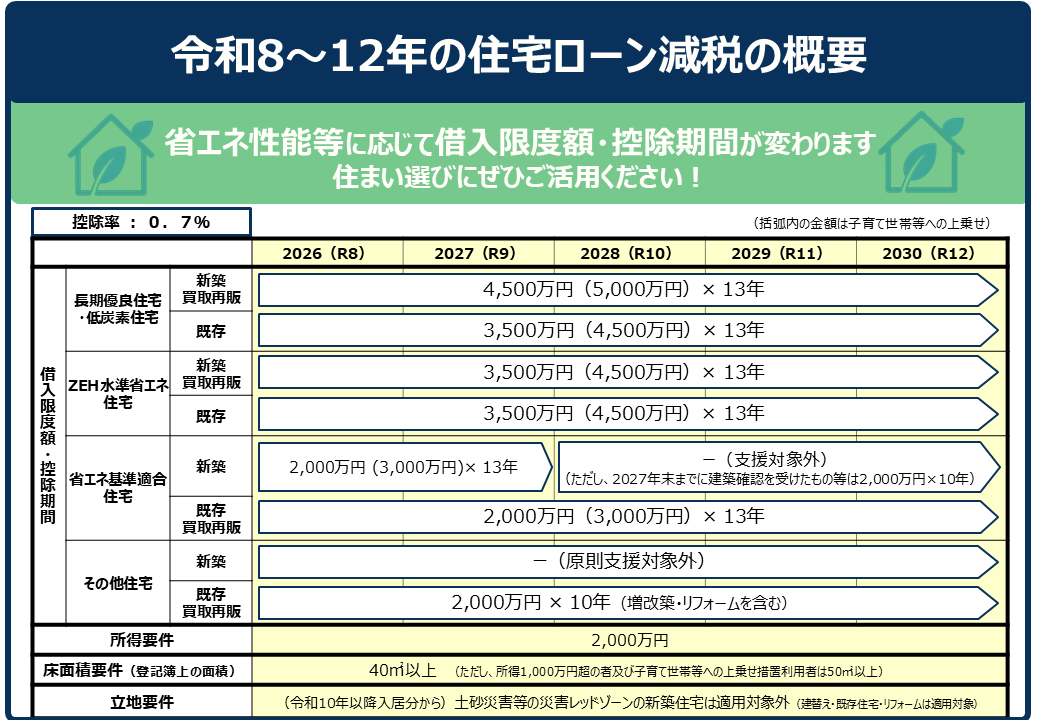
According to MLIT's "FY2026 (Reiwa 8) Tax Reform Overview" (December, Reiwa 7 / 2025), the mortgage tax credit's application period was extended by five years, now covering move-ins from 2026 (Reiwa 8) through 2030 (Reiwa 12). The credit rate remains unchanged at 0.7%. At the same time, for high-energy-efficiency existing homes, the borrowing cap was raised, a top-up was added for child-rearing households, and the credit period was extended to 13 years; the floor-area requirement was also relaxed to 40 sqm or more, in principle.
New-Build vs. Existing-Home Borrowing Caps (For Move-Ins 2026–2030)
| Performance Classification | New-Build | Existing (Resale) |
|---|---|---|
| Certified Long-Life-Quality Home / Low-Carbon Home | JPY 45,000,000 (approx. USD 300,000) [JPY 50,000,000, approx. USD 333,000, for child-rearing households] × 13 years *Includes buy-resell (kaitori saihan) homes | JPY 35,000,000 (approx. USD 233,000) [JPY 45,000,000, approx. USD 300,000] × 13 years |
| ZEH-Level Energy-Efficient Home | JPY 35,000,000 (approx. USD 233,000) [JPY 45,000,000, approx. USD 300,000] × 13 years *Includes buy-resell homes | JPY 35,000,000 (approx. USD 233,000) [JPY 45,000,000, approx. USD 300,000] × 13 years |
| Energy-Efficiency-Standard-Compliant Home | JPY 20,000,000 (approx. USD 133,000) [JPY 30,000,000, approx. USD 200,000] × 13 years *No longer eligible for buyers moving in from 2028 onward; homes that received building confirmation by end of 2027, etc., remain eligible at JPY 20,000,000 × 10 years | JPY 20,000,000 (approx. USD 133,000) [JPY 30,000,000, approx. USD 200,000] × 13 years *Includes buy-resell homes |
| Standard Home (does not meet the energy-efficiency standard) | Not eligible for support, in principle | JPY 20,000,000 (approx. USD 133,000) × 10 years (including extensions/renovations) *Includes buy-resell homes |
Figures in brackets are the borrowing caps that apply to child-rearing households (households with a child under 19, or where either spouse is under 40). The income requirement is JPY 20,000,000 (approx. USD 133,000) or less, and the floor-area requirement is 40 sqm or more (50 sqm or more for buyers with income over JPY 10,000,000, approx. USD 66,700, or those using the child-rearing top-up). From move-ins in 2028 (Reiwa 10) onward, new-build homes located in designated disaster "red zones," such as steep-slope-collapse or landslide special warning areas, will be excluded from the credit (rebuilds, existing homes, and renovations remain eligible). Buy-resell homes (kaitori saihan jūtaku — resale units that a licensed developer has purchased, renovated, and resold) are generally treated at new-build support levels, but for the energy-efficiency-standard-compliant and standard-home classifications, the same caps and periods apply as for existing homes. There are two things to take away from this table: at the ZEH-level tier, new-build and resale are now completely aligned, and the new-build energy-efficiency-standard-compliant tier is dropping to JPY 20,000,000 (approx. USD 133,000) and will be excluded from the credit entirely for buyers moving in from 2028.
Simulating the 13-Year Credit Ceiling
At a 0.7% credit rate, assuming the year-end mortgage balance stays at the full borrowing cap throughout, the maximum lifetime credit works out as follows.
| Case | Borrowing Cap | Annual Credit Cap | Credit Period | Total Cap |
|---|---|---|---|---|
| New-build, Certified Long-Life-Quality Home (child-rearing household) | JPY 50,000,000 (approx. USD 333,000) | JPY 350,000 (approx. USD 2,300) | 13 years | JPY 4,550,000 (approx. USD 30,300) |
| New-build, Certified Long-Life-Quality Home (standard household) | JPY 45,000,000 (approx. USD 300,000) | JPY 315,000 (approx. USD 2,100) | 13 years | JPY 4,095,000 (approx. USD 27,300) |
| Resale, ZEH-Level Energy-Efficient Home (child-rearing household) | JPY 45,000,000 (approx. USD 300,000) | JPY 315,000 (approx. USD 2,100) | 13 years | JPY 4,095,000 (approx. USD 27,300) |
| Resale, Certified Long-Life-Quality Home (standard household) | JPY 35,000,000 (approx. USD 233,000) | JPY 245,000 (approx. USD 1,600) | 13 years | JPY 3,185,000 (approx. USD 21,200) |
| Resale, Standard Home (no proof of energy performance) | JPY 20,000,000 (approx. USD 133,000) | JPY 140,000 (approx. USD 930) | 10 years | JPY 1,400,000 (approx. USD 9,300) |
For the same resale category, whether or not you can document the property's energy-efficiency performance splits the lifetime credit cap between JPY 4,095,000 (approx. USD 27,300) and JPY 1,400,000 (approx. USD 9,300) — a gap of JPY 2,695,000 (approx. USD 18,000). It is not unusual for that gap to exceed what you could realistically negotiate off the purchase price itself — for an international buyer weighing a discounted, undocumented resale unit against a slightly pricier one with energy-performance certification, this is a number worth running before, not after, signing.
Note that this table shows the ceiling only. Per National Tax Agency (NTA, 国税庁) Tax Answers No. 1211-1 and No. 1211-3, the actual annual credit is calculated as that year's year-end mortgage balance (or a similar base) × 0.7%, up to the applicable cap, and is then deducted from that year's income tax liability. If your loan balance does not reach the cap, or if your income tax and resident tax liability is smaller than the calculated credit, you will not be able to use the full amount shown in the table. Check your own planned loan amount and your withholding tax statement (gensen chōshū-hyō) to see where you actually land.
If You Choose Resale, the First Thing to Confirm Is Whether an Energy-Performance Certificate Exists
To claim the expanded mortgage tax credit on a resale condominium, the property's energy-efficiency performance must be documented in writing. Before moving forward with a purchase contract, ask your agent to confirm whether a "Construction Housing Performance Evaluation Report" (kensetsu jūtaku seinō hyōka-sho) or a "Housing Energy-Efficiency Performance Certificate" (jūtaku shō-enerugī seinō shōmei-sho) exists for the unit. Without one of these documents, the unit is classified as a "standard home," capping the credit at JPY 20,000,000 (approx. USD 133,000) over 10 years.
If you are buying with a renovation in mind, it can also pay to design the purchase alongside Japan's separate renovation tax credit, which interacts with the mortgage tax credit. For details, see 2026 Renovation Tax Credit: Quick-Reference Deduction Table and Worked Examples.
How Do Purchase-Time Costs Differ Between New-Build and Resale?
Comparing only the sticker price of the unit hides an asymmetry: certain costs apply only to new-build, and others only to resale. Resale purchases carry a brokerage commission; new-build purchases carry a property tax reduction. Between the two, the swing in total cost can run from several hundred thousand yen to over a million yen.
Resale Purchases Carry a Brokerage Commission (JPY 1,716,000, Approx. USD 11,400, on a JPY 50,000,000 Unit)
The maximum commission a licensed real estate broker may charge for brokering a sale is set by MLIT public notice (Ministry of Construction Notice No. 1552 of Shōwa 45 / 1970, most recently amended June 21, 2026). The cap, inclusive of consumption tax, is 5.5% on the portion of the price up to JPY 2,000,000 (approx. USD 13,300), 4.4% on the portion from JPY 2,000,000 to JPY 4,000,000 (approx. USD 13,300–26,700), and 3.3% on the portion above JPY 4,000,000 (approx. USD 26,700).
For a resale condominium purchased through a broker at JPY 50,000,000 (approx. USD 333,000), the maximum commission works out to: JPY 2,000,000 × 5.5% = JPY 110,000 (approx. USD 730), plus JPY 2,000,000 × 4.4% = JPY 88,000 (approx. USD 590), plus JPY 46,000,000 × 3.3% = JPY 1,518,000 (approx. USD 10,100), for a total of JPY 1,716,000 (approx. USD 11,400), tax included. The commonly used shortcut formula, "(price × 3% + JPY 60,000) × 1.1," gives the same result.
By contrast, when a new-build condominium is purchased directly from the developer (a direct sale, uriushu chokuhan), no brokerage relationship exists at all, so no commission applies. Some new-build transactions do involve a sales agency company, in which case a commission may apply — confirm the sales structure before signing. Separately, a special reduced cap applies to low-value vacant homes priced at JPY 8,000,000 (approx. USD 53,300) or less, where the maximum commission payable by the client is capped at JPY 330,000 (approx. USD 2,200, i.e., 1.1× JPY 300,000, approx. USD 2,000). For the full picture of resale-purchase closing costs, see The Full Picture of Closing Costs When Buying a Resale Condo.
Costs That Apply Only to New-Build, or Only to Resale
| Item | New-Build Condo | Resale Condo |
|---|---|---|
| Brokerage commission | None, if purchased directly from the developer | Capped at 3.3% of the portion over JPY 4,000,000 (approx. USD 26,700) when brokered — JPY 1,716,000 (approx. USD 11,400) on a JPY 50,000,000 (approx. USD 333,000) unit |
| New-build property tax reduction | 50% off the tax bill — 5 years for a condo, 7 years for a certified long-life-quality condo | Not available |
| Real estate acquisition tax deduction (from taxable base) | JPY 12,000,000 (approx. USD 80,000); JPY 13,000,000 (approx. USD 86,700) for certified long-life-quality homes | Deduction amount depends on the building's construction date — older buildings get a smaller deduction |
| Mortgage tax credit borrowing cap (top tier) | JPY 45,000,000 (approx. USD 300,000) [JPY 50,000,000, approx. USD 333,000, for child-rearing households] × 13 years | JPY 35,000,000 (approx. USD 233,000) [JPY 45,000,000, approx. USD 300,000] × 13 years |
| Building reserve fund outlook | Often on a graduated-increase schedule; check the long-term repair plan for future amounts | Current contribution amount, balance, and past increase history can all be checked before you buy |
| Room for price negotiation | Limited, in principle — the developer's list price is the benchmark | Room exists, depending on the seller's circumstances |
New-Build Gets a Real Estate Acquisition Tax Deduction of JPY 12,000,000 (Approx. USD 80,000), or JPY 13,000,000 (Approx. USD 86,700) for Certified Long-Life-Quality Homes
The FY2026 (Reiwa 8) tax reform also extended the special measure for certified long-life-quality homes by five years. The deduction from the real estate acquisition tax's taxable base is JPY 12,000,000 (approx. USD 80,000) for a standard home, versus JPY 13,000,000 (approx. USD 86,700) for a certified long-life-quality home. A deduction is also available for resale homes, but the amount depends on when the building was originally constructed, and shrinks for older properties. Check the exact figure with the prefectural government where the property is located. For how the acquisition tax is calculated on resale purchases and the reduction requirements, see How to Calculate Real Estate Acquisition Tax on a Resale Condo, and the Reduction Requirements.
Who Is Actually Buying New vs. Resale Right Now? The Buyer-Profile Data
Having laid out the rules and prices, it is worth checking who is actually buying. Unlike the transaction-price opacity described earlier, buyer-profile data of this kind is, in fact, one of the more transparent corners of the Japanese housing market: the Japan Housing Finance Agency (JHF, 住宅金融支援機構), a quasi-governmental mortgage institution, publishes it annually — broadly comparable in spirit to the mortgage market surveys Freddie Mac or the Mortgage Bankers Association publish in the US. The primary source here is JHF's "FY2025 Flat 35 User Survey Results," released July 24, 2026, covering 35,553 cases excluding refinancing.
Average Funding Required: JPY 58,820,000 vs. JPY 36,020,000 — Average Household Income: JPY 10,410,000 vs. JPY 7,450,000
| Item | Condo (New-Build) | Resale Condo |
|---|---|---|
| Average funding required | JPY 58,820,000 (approx. USD 392,100) (+JPY 2,900,000, approx. USD 19,300, vs. prior year) | JPY 36,020,000 (approx. USD 240,100) (+JPY 5,690,000, approx. USD 37,900, vs. prior year) |
| Average household income | JPY 10,410,000 (approx. USD 69,400) (+JPY 20,000, approx. USD 130, vs. prior year) | JPY 7,450,000 (approx. USD 49,700) (+JPY 950,000, approx. USD 6,300, vs. prior year) |
| Share of Flat 35 usage | 7.9% (+0.7pt vs. prior year) | 15.4% (+1.1pt vs. prior year) |
| Average building age at purchase | — | 28.7 years (−1.6 years vs. prior year) |
The gap in funding required is JPY 22,800,000 (approx. USD 152,000); the gap in household income is JPY 2,960,000 (approx. USD 19,700). What stands out is that the resale funding requirement grew JPY 5,690,000 (approx. USD 37,900) year on year — outpacing the new-build increase of JPY 2,900,000 (approx. USD 19,300). Resale prices are rising faster than new-build prices, which is consistent with the REINS closing-price data cited earlier. Across all buyers surveyed, the average age was 43.3, and the average total debt-service ratio was 22.8%.
Resale Homes Captured the Largest Usage Share on Record for the First Time (35.9%)
The same survey found that, broken down by building type, resale homes (resale condos plus resale detached houses) accounted for 35.9% of usage (+1.1pt vs. prior year) — the largest share of any category. This is the first time resale has taken the top share since the survey began in 2004. Within that, resale detached houses accounted for 20.5% and resale condos for 15.4%. Newly built for-sale homes accounted for 31.4% (7.9% condos, 23.5% pre-built detached houses), and custom-built detached houses accounted for 32.7%.
Against a backdrop of rising prices, the data shows buyer choice structurally shifting toward resale. That said, this is not simply "resale is the better deal" — it also reflects the fact that new-build supply itself has been shrinking, with first-half 2026 new listings at 7,989 units, down for a fifth consecutive year, and prices rising faster than household income. For how to think about price negotiation on a resale purchase, see Typical Resale Condo Price-Negotiation Discounts, and How to Negotiate.
New or Resale? A Decision Framework by Buyer Objective
Taken together, the numbers above suggest the real decision axis is not "new versus resale" as a category, but three specific questions: which energy-efficiency classification you can secure, how many years you plan to hold or occupy the unit, and how thoroughly you can verify the true future carrying costs.
When New-Build Makes Sense
- You plan to hold or live in the unit for 10 years or more. The initial decline from selling costs gets absorbed over a long holding period.
- You qualify as a child-rearing household and can select a certified long-life-quality home. A borrowing cap of JPY 50,000,000 (approx. USD 333,000) over 13 years brings the maximum mortgage tax credit up to JPY 4,550,000 (approx. USD 30,300).
- You want energy performance and warranty coverage guaranteed in writing. Energy-efficiency compliance is now mandatory, and you get the ten-year Housing Quality Assurance Act warranty plus mandatory seller solvency measures on top.
- You want to make full use of the property tax reduction period. The tax bill is cut in half for five years on a standard condo, or seven years on a certified long-life-quality condo.
When Resale Makes Sense
- Location is your top priority. Resale gives you options even in established areas where no new-build supply exists.
- You want the value-for-money sweet spot of the 10–20-year age bracket. Per-square-meter pricing runs 13.5–35.5% below new-build in that range, while physical wear is still relatively limited.
- You want to inspect the actual unit and building-management quality before deciding. You can review the long-term repair plan, the reserve-fund balance, and even past annual-meeting minutes before signing.
- You can find a unit with energy-performance certification. At the ZEH level, the mortgage tax credit terms are now identical to new-build.
- You are buying with renovation in mind and want to customize the interior yourself. This also opens the door to combining the purchase with Japan's separate renovation tax credit.
Five Things to Verify Before You Decide
- The energy-efficiency classification and whether a certificate exists. The mortgage tax credit's borrowing cap ranges from JPY 20,000,000 to JPY 50,000,000 (approx. USD 133,000–333,000) depending on classification. For resale, whether the paperwork exists is the deciding factor.
- The length of the long-term repair plan. Check whether the reserve-fund contribution is set based on a plan spanning 30 years or more. Among new-build units, 75.3% now meet this standard.
- The building reserve fund's contribution method. If it is a graduated-increase schedule, get the specific numbers: how much it rises to, and in which year.
- Whether the reserve-fund balance is already short of the plan. 36.6% of existing condominiums currently have a shortfall. Cross-check the annual-meeting minutes against the long-term repair plan.
- Construction year and seismic standards. To claim the mortgage tax credit on a resale purchase, the registered construction date must be on or after January 1, 1982 (Shōwa 57). For older buildings, you will need a seismic-standard compliance certificate or similar documentation (National Tax Agency, NTA, Tax Answer No. 1211-3).
When clients come to us for advice on a purchase, we make a point of explaining the downside with the same level of detail as the upside. The building reserve fund shown in a new-build's sales materials is an entry-level number, not a forecast. A resale unit without energy-performance documentation caps the mortgage tax credit at 10 years. We have found that sharing this kind of information up front, even when it complicates the sale, is what actually builds the long-term relationships we care about.
Frequently Asked Questions (FAQ)
Q. How big is the price gap between new-build and resale condominiums?
A. In 2026 greater Tokyo, comparing price per square meter: new-build is JPY 1,514,000 (approx. USD 10,100/sqm), versus JPY 1,531,000 (approx. USD 10,200/sqm) for resale up to 5 years old, JPY 1,309,000 (approx. USD 8,700/sqm) up to 10 years old, JPY 977,000 (approx. USD 6,500/sqm) up to 20 years old, and JPY 471,000 (approx. USD 3,100/sqm) past 30 years old. Nearly new resale units are actually more expensive than new-build, and the gap only becomes clear once a building passes the ten-year mark. Comparing the new-build average price of JPY 101,350,000 (approx. USD 676,000) directly against the resale average closing price of JPY 52,020,000 (approx. USD 347,000) makes the gap look larger than it really is, because the two figures come from different populations, aggregation methods, and area mixes — always compare price per square meter within the same area and building-age bracket instead.
Q. What is the "new-build premium," and by how much does it decline?
A. The new-build premium is the portion of a new condominium's price that reflects selling costs — show-room construction, advertising, sales commissions — rather than the value of the housing itself. Using real 2026 greater Tokyo data, against a new-build price of JPY 1,514,000/sqm (approx. USD 10,100/sqm), resale units up to 10 years old are 13.5% lower at JPY 1,309,000/sqm (approx. USD 8,700/sqm), 35.5% lower at the 20-year mark, and 68.9% lower past 30 years. That decline is not solely the disappearance of the selling-cost premium, however — it also reflects physical deterioration, equipment obsolescence, and generational differences in seismic and energy-efficiency standards. There is no official statistic that isolates the decline rate immediately after delivery on its own.
Q. For a 2026 move-in, is the mortgage tax credit more favorable for new-build or resale?
A. It depends on the performance classification. For a ZEH-level energy-efficient home, new-build and resale receive identical terms: JPY 35,000,000 (approx. USD 233,000) — or JPY 45,000,000 (approx. USD 300,000) for child-rearing households — over 13 years. For a certified long-life-quality home, new-build gets JPY 45,000,000 (approx. USD 300,000, or JPY 50,000,000/approx. USD 333,000 for child-rearing households) versus JPY 35,000,000 (approx. USD 233,000, or JPY 45,000,000/approx. USD 300,000) for resale — new-build has the edge there. Conversely, a resale unit that cannot document its energy performance is classified as a "standard home," capped at JPY 20,000,000 (approx. USD 133,000) over 10 years, with a maximum lifetime credit up to JPY 2,695,000 (approx. USD 18,000) lower. If you are considering resale, confirm before signing whether a housing energy-efficiency performance certificate or similar document exists.
Q. What does the 10-year warranty on a new-build condo actually cover?
A. Under the Act for Promotion of Housing Quality Assurance (Housing Quality Assurance Act), the seller bears defect liability for ten years from delivery on the load-bearing structural elements (foundation, columns, walls, roof, etc.) and the parts that prevent water intrusion. Interior finishes and equipment are not covered, so check the scope of the developer's or manufacturer's individual warranty separately. On top of this, the Housing Defect Warranty Liability Act requires the seller to secure solvency through insurance enrollment or a security-bond deposit, so that repair costs can still be paid out by an insurance corporation even if the seller goes bankrupt.
Q. How high can the building reserve fund on a new-build condo eventually rise?
A. It depends on the individual building's long-term repair plan, but MLIT's guideline benchmark for buildings under 20 floors with a total floor area of 5,000–10,000 sqm is JPY 252/sqm/month (approx. USD 1.70/sqm/month; range JPY 170–320, approx. USD 1.10–2.10). For a 70 sqm unit, that works out to JPY 17,640/month (approx. USD 118/month; range JPY 11,900–22,400, approx. USD 79–150). Tower-type buildings of 20 floors or more run even higher, at JPY 338/sqm/month (approx. USD 2.30/sqm/month; range JPY 240–410, approx. USD 1.60–2.70), with an additional charge if the building has mechanical parking. Since the actual average contribution is JPY 13,054 (approx. USD 87), if a property's quoted contribution is well below the guideline benchmark, assume it is on a graduated-increase schedule with future increases planned, and check the year-by-year figures in the long-term repair plan.
Citations and Sources
- East Japan Real Estate Information Network (Higashi Nihon Fudōsan Ryūtsū Kikō, 東日本不動産流通機構), "REINS TOPIC: Greater Tokyo Resale Condominiums and Resale Detached Houses — Closed Transactions by Region and Building Age [April–June 2026]" (July 17, 2026, PDF) | Closed-transaction counts, price per sqm, closing price, and floor area by building-age bracket
- East Japan Real Estate Information Network, "Statistical Materials" (統計資料) | Source page for the PDF above
- Real Estate Economic Institute (Fudōsan Keizai Kenkyūjo, 不動産経済研究所), "Greater Tokyo New Condominium Market Trends, First Half 2026 (January–June)" (July 21, 2026, PDF) | Units released, average price, price per sqm, first-month contract rate, area breakdown
- Real Estate Economic Institute, "Condominium Market Trends" (マンション市場動向) | Source page for the PDF above
- Ministry of Land, Infrastructure, Transport and Tourism (MLIT, 国土交通省), "FY2026 (Reiwa 8) Tax Reform Overview" (December 2025 / Reiwa 7, PDF) | Mortgage tax credit borrowing caps and credit periods, extension of the 50% new-build property tax reduction, special measures for certified long-life-quality homes
- MLIT, "Mortgage Tax Credit" (住宅ローン減税) | Extension of the application period, expansion for existing homes, floor-area requirement
- National Tax Agency (NTA, 国税庁), "No. 1211-1: Special Deduction for Housing Loans — New Construction, Occupied From 2022 (Reiwa 4) Onward" | How the credit amount is calculated; definition of eligible individuals (child-rearing households, etc.)
- NTA, "No. 1211-3: Special Deduction for Housing Loans — Acquisition of an Existing Home, Occupied From 2022 (Reiwa 4) Onward" | Existing-home construction-date requirement (on or after January 1, 1982), proof of seismic-standard compliance, relationship between the credit amount and income tax liability
- Japan Housing Finance Agency (JHF, 住宅金融支援機構), "FY2025 Flat 35 User Survey Results — Summary" (July 24, 2026 / Reiwa 8, PDF) | Average funding required, average household income, usage share by loan/building category
- JHF, "FY2025 Flat 35 User Survey — Tabulated Results" (PDF) | Average building age at purchase for resale condominiums
- JHF, "FY2025 Flat 35 User Survey" | Source page for the PDFs above
- MLIT, "FY2023 (Reiwa 5) Condominium Comprehensive Survey Results — Overview" (PDF) | Average management fee and building reserve fund, breakdown of contribution methods, reserve-fund surplus/shortfall
- MLIT, "FY2023 (Reiwa 5) Condominium Comprehensive Survey Results (Summary)" (June 21, 2024 / Reiwa 6) | Press release materials and charts
- MLIT, "Guidelines on Condominium Building Reserve Funds" (revised June 2024 / Reiwa 6, PDF) | Benchmark monthly amount and range per sqm of floor area; overview of the 366 sample cases
- MLIT Public Notice, "Maximum Compensation a Real Estate Broker May Receive for Brokering the Sale of Land or Buildings" (most recently amended June 21, 2024 / Reiwa 6, PDF) | Cap on brokerage commission for a sale, special measure for low-value vacant homes
- MLIT, "Building Energy Efficiency Act Article 10: Expansion of the Scope of Mandatory Energy-Efficiency Compliance" | Mandatory energy-efficiency compliance for all new homes
- MLIT, "Full Mandatory Energy-Efficiency Compliance and Revised Structural Regulations Take Effect April 1, 2025 (Reiwa 7)" (April 16, 2024 / Reiwa 6) | Effective date of full mandatory compliance, exclusion for floor area of 10 sqm or less
- MLIT, "Act for Promotion of Housing Quality Assurance (Housing Quality Assurance Act, Hinkaku-hō)" | Ten-year defect-liability period for new homes
- MLIT, "Act on Securing Liability for Specified Residential Defects (Housing Defect Warranty Liability Act, Jūtaku Kashi Tanpo Rikō-hō)" | Solvency-assurance measures via insurance enrollment or security-bond deposit
- MLIT, "Housing Defect Warranty Liability Act and Comprehensive Housing Peace-of-Mind Support Site" | Scope of the ten-year defect-liability period, effective date of the mandatory solvency-assurance requirement (October 1, 2009 / Heisei 21)
