Japan's real estate acquisition tax (fudōsan shutoku-zei, 不動産取得税) on a resale condominium apartment is a tax where, if you buy the unit as your own residence and the building was newly constructed on or after April 1, 1997 (Heisei 9), a ¥12,000,000 (approx. USD 80,000) building deduction plus a discount on the land's taxable value often bring the bill down to ¥0. Buy the exact same unit as an investment or rental property, however, and neither the deduction nor the land discount applies — the full 3% tax rate lands on the taxable base with nothing subtracted. Investors who build their acquisition budget without knowing this distinction are often surprised, months after closing, when a tax notice arrives for several hundred thousand yen more than they expected.
This article is written for two audiences: people buying a resale condo to live in themselves, and investors acquiring a condo unit as a rental asset. Using primary-source tables current as of August 2026, it sets out the tax rates, deduction amounts, and exemption thresholds, then walks through real calculation examples built on actual Tokyo-area contract prices so you can follow, step by step, exactly how much tax a given purchase generates. Beyond the four one-time taxes due at closing, it also covers the fixed asset tax and city planning tax that apply every single year you continue to hold the property — so you can see the full lifetime tax picture, not just the closing-day number.
This is a distinctively Japanese tax with no direct equivalent in the US, UK, Australian, or Singaporean property markets, where transfer taxes or stamp duties are typically a flat percentage of the purchase price regardless of who is buying or why. Japan's real estate acquisition tax instead runs on the property's official Fixed Asset Tax assessed value (kotei shisan-zei hyōka-gaku, 固定資産税評価額) — a government-set value that is almost always lower than the market price — and it applies a completely different set of deductions depending on whether the buyer will live in the unit or rent it out. For a foreign investor comparing Japan against a home-market transfer tax that is a single flat rate for everyone, this owner-occupier-versus-investor split is one of the first structural surprises in Japanese property tax. (All amounts in this article are shown in Japanese yen; USD approximations use a reference rate of $1 = ¥150 as of August 2026 and are rounded for readability — always confirm the current rate before budgeting.)
Key takeaways
- The real estate acquisition tax rate is 3% for both land and residential buildings, and this reduced rate (down from the statutory 4%) applies to acquisitions made through March 31, 2027 (Reiwa 9).
- The deduction amount for a used residential building is set not by the building's age but by its "date of new construction" — a unit newly built on or after April 1, 1997 (Heisei 9) qualifies for a ¥12,000,000 deduction.
- The floor-area requirement for used homes was relaxed for acquisitions on or after April 1, 2026 (Reiwa 8): the minimum dropped from 50 m² to 40 m² (the 240 m² maximum is unchanged).
- A resale condo bought as an investment or rental property gets neither the building deduction nor the residential-land discount — on an identical unit, the gap against an owner-occupier purchase can run to several hundred thousand yen.
- Looking only at the one-time acquisition tax is a mistake. Fixed asset tax and city planning tax are billed every single year you own the property — in this article's Tokyo 23-wards model case, that works out to an estimated ¥136,000 (approx. USD 907) per year.
Total cost of buying a resale condo: the complete 2026 tax table
Buying a resale condo in Japan triggers four taxes that are due only once, at the time of purchase, and two taxes that keep coming every year you own the property. Getting the full picture first, before working through the individual calculations, makes each of the sections below much easier to follow — and it is the first place where the difference between a one-time Japanese "closing tax" and an ongoing annual property tax becomes clear, a distinction that does not map cleanly onto every home market's terminology.
Four taxes due at the time of purchase
| Tax | Taxable base | Rate | Deadline | Source |
|---|---|---|---|---|
| Real estate acquisition tax (fudōsan shutoku-zei) | Fixed Asset Tax assessed value (halved for residential land) | 3% (housing and land) | March 31, 2027 (Reiwa 9) | Tokyo Metropolitan Government Bureau of Taxation |
| Registration and license tax — land ownership transfer (tōroku menkyo-zei) | Fixed Asset Tax assessed value | 1.5% (standard rate 2.0%) | March 31, 2029 (Reiwa 11) | National Tax Agency (NTA) |
| Registration and license tax — residential building ownership transfer | Fixed Asset Tax assessed value | 0.3% (standard rate 2.0%) | March 31, 2027 (Reiwa 9) | National Tax Agency (NTA) |
| Registration and license tax — mortgage registration | Loan amount (secured debt amount) | 0.1% (standard rate 0.4%) | March 31, 2027 (Reiwa 9) | National Tax Agency (NTA) |
| Stamp tax (inshi-zei) | Amount stated on the sale and purchase agreement | Fixed amount by price bracket | March 31, 2027 (Reiwa 9) | National Tax Agency (NTA) |
| Consumption tax | Building sale price, brokerage commission, etc. | 10% (land is exempt) | No expiration | National Tax Agency (NTA) |
An easy detail to miss here is that the reduced-rate deadlines for registration and license tax are not all the same. The 1.5% rate on land was extended three additional years, to March 31, 2029, while the 0.3% rate on residential buildings and the 0.1% rate on mortgage registration both still expire on March 31, 2027. The National Tax Agency's April 2026 (Reiwa 8) pamphlet lays out this exact gap between the two deadlines.
Fixed asset tax and city planning tax: billed every year you own the property
| Tax | Taxable base | Rate | Special reduction for residential land |
|---|---|---|---|
| Fixed asset tax (kotei shisan-zei) | Fixed Asset Tax assessed value (taxable base) | 1.4% (standard rate) | Small-scale residential land: assessed value × 1/6; general residential land: × 1/3 |
| City planning tax (toshi keikaku-zei) | Fixed Asset Tax assessed value (taxable base) | 0.3% (maximum rate) | Small-scale residential land: assessed value × 1/3; general residential land: × 2/3 |
City planning tax applies only to land and buildings inside an "urbanization promotion area" (shigaika kuiki, 市街化区域); it is not levied on property in an urbanization control area. Within Tokyo's 23 wards, the FY2026 (Reiwa 8) city planning tax on small-scale residential land carries an additional 50% reduction. Unlike, say, a US property tax bill that is usually a single combined municipal rate, Japan splits ongoing property taxation into these two separate line items, each with its own rate and its own residential-land discount. It is worth reading how the Fixed Asset Tax assessed value is determined and calculated before working through the examples below, since every number in this article's calculations traces back to that single assessed value.
What resale condo prices in the Tokyo area tell you about your tax bill
Before estimating the tax on your own property, it helps to know where the broader market sits. According to the East Japan Real Estate Information Network System's (Higashi-Nihon REINS, 東日本レインズ) quarterly Market Watch summary report for April–June 2026, contract data for resale condos in the greater Tokyo area breaks down as follows.
| Area | Contract price | Price per m² | Exclusive floor area | Building age |
|---|---|---|---|---|
| Greater Tokyo area (Shutoken) | ¥52,010,000 | ¥831,300/m² | 62.57 m² | 27.70 years |
| Tokyo 23 wards (Tokyo-to Kubu) | ¥75,740,000 | ¥1,362,200/m² | 55.60 m² | 26.43 years |
| Tokyo Tama area | ¥38,820,000 | ¥581,900/m² | 66.71 m² | 27.87 years |
| Kanagawa Prefecture | ¥40,160,000 | ¥612,600/m² | 65.55 m² | 28.05 years |
| Yokohama & Kawasaki cities | ¥43,920,000 | ¥678,400/m² | 64.74 m² | 28.19 years |
| Saitama Prefecture | ¥30,480,000 | ¥454,300/m² | 67.11 m² | 28.68 years |
| Chiba Prefecture | ¥29,880,000 | ¥416,600/m² | 71.72 m² | 30.10 years |
The greater-Tokyo-area average building age of 27.70 years points to a building newly constructed around 1998 — which means the average resale condo already falls into the "newly constructed on or after April 1, 1997 (Heisei 9)" bracket and qualifies for the full ¥12,000,000 building deduction. The 23-wards average exclusive floor area of 55.60 m² also clears the floor-area requirement with room to spare once you add the pro-rated share of common areas. In other words, the closer a unit sits to the market's center, the more likely it is that an owner-occupier purchase brings the real estate acquisition tax to ¥0.
One structural point is worth flagging explicitly for international investors: REINS is not a public database. Unlike the US Multiple Listing Service (MLS) ecosystem, where sites such as Zillow or Redfin let any member of the public look up an individual property's sale-price history, Japan's REINS is a members-only system restricted to licensed real estate brokers, and access to actual, address-level sold-price data is tightly limited even within the industry. What outside investors — and most Japanese buyers — can see is aggregated data of exactly the kind shown in the table above: a quarterly summary report, not a searchable, address-by-address sold-price archive. This is one of the first things that surprises investors coming from MLS-disclosure markets: in Japan, there is no equivalent of typing an address into a website and pulling up what the unit next door actually sold for. Reliable local pricing knowledge, in practice, still runs through a broker with access to REINS and a track record in the specific area.
The calculation formula for the real estate acquisition tax on a resale condo, and the 2026 tax rate
The real estate acquisition tax is calculated by multiplying the tax rate against the assessed value of the property acquired — the Fixed Asset Tax assessed value — not against the actual purchase price or the amount borrowed on a mortgage. That the taxable base is a government-assessed value rather than the transaction price is the first place first-time buyers, especially those used to ad valorem transfer taxes based on sale price, get tripped up.
The rate is 3% for both land and housing (through March 31, 2027)
The standard rate under Japan's Local Tax Act is 4%, but for acquisitions from April 1, 2008 through March 31, 2027, a reduced rate of 3% applies to both land and residential buildings. Non-residential buildings (shops, offices, and the like) remain at 4%. For land, the 3% rate applies regardless of whether a home sits on it — even non-residential land is taxed at 3%.
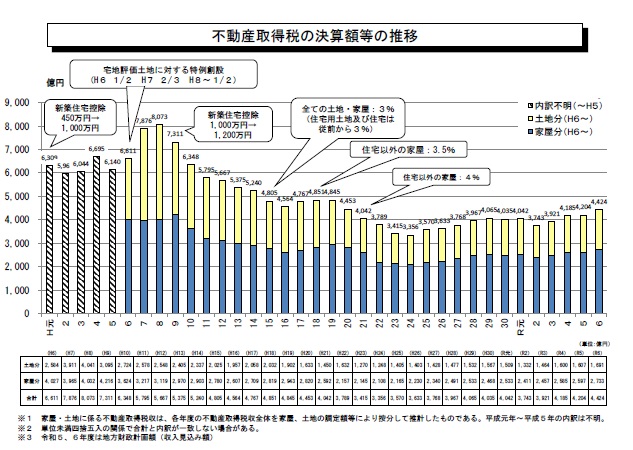
As the chart shows, the 3% rate on land and residential housing is not a one-off tax break — it is a working standard that has now been extended, in increments, for more than twenty years. Legally, though, it remains a time-limited special measure, and because it has been renewed repeatedly in short cycles, some sources online still cite an outdated deadline such as "through March 31, 2024." As of August 2026, the effective deadline is March 31, 2027 (Reiwa 9), and the residential-land taxable-value halving discussed in the next section shares this same deadline. If your contract and handover fall on either side of a fiscal-year boundary, it is worth confirming which period your specific acquisition date lands in.
Residential land's taxable base is halved (through March 31, 2027)
When you acquire residential land (takuchi, 宅地) or land treated as equivalent to residential land, the taxable base is the assessed value multiplied by 1/2. This discount, too, applies only to acquisitions through March 31, 2027. For a resale condo, you take the assessed value of the land corresponding to your site-use right share (shikichiken, 敷地権 — the proportional interest each unit owner holds in the building's underlying land), multiply it by 1/2, and then apply the 3% rate to arrive at the land's "initial tax amount" before any further reduction.
The FY2026 reform raised the tax-exemption thresholds
If the taxable amount falls below the exemption threshold, no real estate acquisition tax is levied at all. Per a notice issued by the Ministry of Internal Affairs and Communications (MIC) on January 21, 2026 regarding the FY2026 (Reiwa 8) local tax reform, together with guidance from the Tokyo Metropolitan Government Bureau of Taxation, these thresholds were raised as follows.
| Category | Acquisitions through March 31, 2026 (Reiwa 8) | Acquisitions from April 1, 2026 (Reiwa 8) onward |
|---|---|---|
| Land | Under ¥100,000 | Under ¥160,000 |
| Building (new construction, extension, or remodeling) | Under ¥230,000 | Under ¥660,000 |
| Building (sale, gift, or other transfer) | Under ¥120,000 | Under ¥340,000 |
The "taxable amount" referred to here is the figure immediately before the tax rate is applied — after any deductions or reductions have already been subtracted. For a property such as an older regional studio unit, where the building's assessed value might be around ¥300,000 and the land's taxable base (after the 1/2 discount) might be around ¥120,000, an acquisition on or after April 1, 2026 (Reiwa 8) would fall below the exemption threshold for both land and building — meaning no tax notice would arrive at all. Under the pre-reform thresholds (¥120,000 for buildings, ¥100,000 for land), the same property would have been taxed. For anyone considering a lower-priced unit, this is a change with real, direct financial impact.
The building deduction: a table of amounts by original construction date
The real estate acquisition tax on the building portion of a used home is calculated as "(the building's assessed value − the deduction amount) × 3%." The deduction amount is split into eight brackets according to the date the building was originally constructed — the newer the building, the larger the deduction.
Eight brackets. Anything built on or after April 1, 1997 (Heisei 9) gets ¥12,000,000
| Date of original construction | Deduction amount |
|---|---|
| April 1, 1997 (Heisei 9) or later | ¥12,000,000 |
| April 1, 1989 (Heisei 1) – March 31, 1997 (Heisei 9) | ¥10,000,000 |
| July 1, 1985 (Showa 60) – March 31, 1989 (Heisei 1) | ¥4,500,000 |
| July 1, 1981 (Showa 56) – June 30, 1985 (Showa 60) | ¥4,200,000 |
| January 1, 1976 (Showa 51) – June 30, 1981 (Showa 56) | ¥3,500,000 |
| January 1, 1973 (Showa 48) – December 31, 1975 (Showa 50) | ¥2,300,000 |
| January 1, 1964 (Showa 39) – December 31, 1972 (Showa 47) | ¥1,500,000 |
| July 1, 1954 (Showa 29) – December 31, 1963 (Showa 38) | ¥1,000,000 |
If the building's assessed value is lower than the deduction amount, the deduction is capped at that value — so the taxable amount can never go negative; it simply stops at ¥0. If you are acquiring only a partial interest in the building, both the assessed value and the deduction amount are multiplied by your ownership share before the calculation. One nuance worth remembering: the "date of original construction" used to determine your bracket is not the construction year listed on the property registry — it is the construction year recorded on the Fixed Asset Taxation Ledger (as shown on the Fixed Asset Assessment Certificate), and the two can occasionally differ.
Acquisitions from April 1, 2026 (Reiwa 8): floor-area requirement relaxed to 40–240 m²
| Timing of acquisition | Floor-area minimum | Maximum |
|---|---|---|
| On or before March 31, 2026 (Reiwa 8) | 50 m² or more | 240 m² or less |
| On or after April 1, 2026 (Reiwa 8) | 40 m² or more | 240 m² or less |
The Tokyo Metropolitan Government Bureau of Taxation's guidance also flags an exception for newly built housing within Tokyo's designated Special Urban Renaissance Emergency Development Areas inside the 23 wards, where the floor-area minimum stays at 50 m² or more even under the relaxed rule. The guidance for used-home relief does not repeat this exception, so if you are considering a compact unit inside one of these designated areas, it is worth confirming directly with the metropolitan tax office (tozei jimusho, 都税事務所) that has jurisdiction.
This floor-area test is not judged on the exclusive private floor area alone. For a condominium, where common areas exist, the test uses the exclusive area plus a pro-rated share of the common areas, allocated according to your exclusive-area ratio. A unit with an exclusive area of 38 m² can, once the common-area allocation is added, come out to 44 m² — which, for an acquisition on or after April 1, 2026 (Reiwa 8), clears the requirement. The test is also based on current, as-built floor area rather than the figure on the property registry, so the two can differ.
The building-age requirement is gone; the seismic-standard requirement is now a simple either/or
An older age-based requirement — "20 years or less for wooden construction, 25 years or less for steel or reinforced-concrete construction" — was already abolished in the FY2022 (Reiwa 4) tax reform. Under the current rule, a building must satisfy one of the following two seismic-standard tests.
- The building was newly constructed on or after January 1, 1982 (Showa 57); or
- The building was newly constructed on or before December 31, 1981 (Showa 56), and a licensed architect or engineer has certified, through a seismic assessment, that it meets the "new seismic standard" (shin-taishin kijun, 新耐震基準) — provided the certifying inspection was completed within two years before the date of acquisition.
Acceptable proof for the second condition is any one of: a seismic-standard compliance certificate, a construction housing performance evaluation report, or documentation confirming that an existing-home sale defect-liability insurance policy has been taken out. One practical note for anyone evaluating a pre-1981 (pre-new-seismic-standard) unit: Tokyo's separate "earthquake-resistance mark" (taishin māku) system cannot itself be used to satisfy this seismic-standard requirement — a distinct certification is required.
The land discount: which is more favorable, the ¥45,000 flat method or the double-floor-area method?
When you acquire residential land, a set amount is subtracted from the land's tax. The reduction is whichever of the following two calculations — (a) or (b) — produces the larger discount. For a resale condo, method (b) is almost always the larger of the two.
How the two reduction amounts are calculated, and how to decide which applies
- (a) A flat ¥45,000
- (b) Land price per m² × twice the building's floor area (capped at 200 m² per unit) × the buyer's acquisition share of the housing × 3%
The "land price per m²" used in method (b) is the Fixed Asset Tax assessed value divided by the land area. For residential land or land treated as equivalent, this uses the value after the 1/2 discount has already been applied. This is where calculation errors most often creep in — forgetting to apply the 1/2 discount here effectively doubles the reduction amount, overstating it.
Also, if the land's initial tax amount is smaller than the reduction amount, the initial tax amount is the cap — there is no refund for the unused portion of the discount; the land tax simply goes to ¥0. Keeping that in mind makes the arithmetic faster.
The requirement when land and building are acquired at different times
To qualify for the used-home land discount, the timing of the land acquisition and the building acquisition must satisfy one of the following conditions. Because a condo unit with an attached site-use right (shikichiken) is acquired simultaneously with its land share, this timing question rarely comes up in practice for condo buyers.
- If the land was acquired first (including simultaneous acquisition): the used home on that land must be acquired within one year of the land acquisition date.
- If the used home was acquired first: the site must be acquired within one year of the home's acquisition date.
In either case, the premise is that the used home on the land satisfies the building-side reduction requirements (owner-occupancy, floor area, and seismic standard). If the building fails any of those requirements, the land discount is lost along with it.
[Worked examples] Calculating the real estate acquisition tax by price bracket
The calculations below are built on REINS' actual contract-price data. Because Fixed Asset Tax assessed values vary property by property, the assessed-value figures used here are illustrative assumptions set at a representative level. Always confirm your own property's actual figures against the Fixed Asset Assessment Certificate or the annual tax statement.
Case 1: Greater-Tokyo average class (contract price ¥52,010,000 / approx. USD 347,000, exclusive area 62.57 m², owner-occupied)
Assumptions: built in 1998 (Heisei 10); floor area including the pro-rated common-area share is 70 m²; the building's assessed value is ¥7,000,000. The building sits on a 1,500 m² lot with a total assessed value of ¥900,000,000; the buyer's site-use-right share is 1/150 (assessed value corresponding to the share: ¥6,000,000). The buyer moves in immediately after acquisition.
| Item | Calculation | Result |
|---|---|---|
| Land's taxable base | ¥900,000,000 × 1/2 × 1/150 | ¥3,000,000 |
| Land's initial tax amount | ¥3,000,000 × 3% | ¥90,000 |
| Land price per m² | (¥900,000,000 × 1/2) ÷ 1,500 m² | ¥300,000/m² |
| Reduction amount (method b) | ¥300,000 × 140 m² (70 m² × 2) × 3% | ¥1,260,000 |
| Land's tax due | ¥90,000 − ¥1,260,000 ≤ 0 | ¥0 |
| Building's taxable base | ¥7,000,000 − ¥12,000,000 ≤ 0 | ¥0 |
| Building's tax due | ¥0 × 3% | ¥0 |
| Total | – | ¥0 |
Because reduction method (b) (¥1,260,000) comfortably beats the flat ¥45,000 method, the flat-rate option never even comes into play here. For an owner-occupier buying a broadly average resale condo in greater Tokyo, the real estate acquisition tax lands at ¥0 in most cases. For an American investor used to a fixed percentage transfer tax on every closing, a ¥52 million (approx. USD 347,000) purchase generating zero transfer-style tax is a genuinely unusual outcome.
Case 2: Tokyo 23-wards average class (contract price ¥75,740,000 / approx. USD 505,000, exclusive area 55.60 m², owner-occupied)
This case applies directly to anyone considering a property in the roughly ¥75 million range. Assumptions: built in 1999 (Heisei 11); floor area including the common-area share is 62 m²; the building's assessed value is ¥9,000,000. The building sits on a 1,200 m² lot with a total assessed value of ¥1,800,000,000; the buyer's site-use-right share is 1/120 (assessed value corresponding to the share: ¥15,000,000).
| Item | Calculation | Result |
|---|---|---|
| Land's taxable base | ¥1,800,000,000 × 1/2 × 1/120 | ¥7,500,000 |
| Land's initial tax amount | ¥7,500,000 × 3% | ¥225,000 |
| Land price per m² | (¥1,800,000,000 × 1/2) ÷ 1,200 m² | ¥750,000/m² |
| Reduction amount (method b) | ¥750,000 × 124 m² (62 m² × 2) × 3% | ¥2,790,000 |
| Land's tax due | ¥225,000 − ¥2,790,000 ≤ 0 | ¥0 |
| Building's tax due | (¥9,000,000 − ¥12,000,000 ≤ 0) × 3% | ¥0 |
| Total | – | ¥0 |
Even at a price in the ¥75 million range, an owner-occupier who meets the requirements still lands at ¥0 real estate acquisition tax. The reason a ¥75 million (approx. USD 505,000) purchase price and the acquisition tax amount are not proportional is that the taxable base is the Fixed Asset Tax assessed value, not the sale price. Confusing the two leads buyers to budget several hundred thousand yen more than they will actually need.
Case 3: A compact 38 m² unit (where the relaxed floor-area rule makes the difference)
Assumptions: built in 2003 (Heisei 15); exclusive area 38 m², floor area including the common-area share 44 m²; the building's assessed value is ¥4,000,000. The building sits on an 800 m² lot with a total assessed value of ¥600,000,000; the buyer's site-use-right share is 1/100 (assessed value corresponding to the share: ¥6,000,000). Owner-occupied.
| Item | Acquisition on or before March 31, 2026 (Reiwa 8) | Acquisition on or after April 1, 2026 (Reiwa 8) |
|---|---|---|
| Floor-area requirement | 50 m² or more → 44 m² does not qualify | 40 m² or more → qualifies |
| Building's tax due | ¥4,000,000 × 3% = ¥120,000 | (¥4,000,000 − ¥12,000,000 ≤ 0) = ¥0 |
| Land's initial tax amount | ¥600,000,000 × 1/2 × 1/100 × 3% = ¥90,000 | Same, ¥90,000 |
| Land's reduction amount | Not applicable | ¥375,000 × 88 m² × 3% = ¥990,000 |
| Land's tax due | ¥90,000 | ¥0 |
| Total | ¥210,000 | ¥0 |
For the exact same property, a ¥210,000 (approx. USD 1,400) difference turns entirely on whether the acquisition date falls before or after April 1, 2026 (Reiwa 8). Anyone considering a compact unit should not simply conclude "under 50 m², so no relief is possible" from the exclusive area alone — ask the management company or the brokerage to confirm the floor area including the pro-rated common-area allocation. In a central-Tokyo studio or one-bedroom unit, that single extra confirmation step can be worth several hundred thousand yen.
Case 4: The same property as Case 1, but acquired as an investment
| Item | Owner-occupied | Investment / rental use |
|---|---|---|
| Building deduction (¥12,000,000) | Applies | Does not apply |
| Building's tax due | ¥0 | ¥7,000,000 × 3% = ¥210,000 |
| Residential land's 1/2 taxable-base discount | Applies | Applies |
| Residential-land reduction | Applies | Does not apply |
| Land's tax due | ¥0 | ¥3,000,000 × 3% = ¥90,000 |
| Total real estate acquisition tax | ¥0 | ¥300,000 |
The same property, the same assessed value — but a ¥300,000 (approx. USD 2,000) gap opens purely based on how the unit will be used. The residential land's 1/2 taxable-base discount applies regardless of use, but the building deduction and the residential-land reduction both sit behind an occupancy test — "a home acquired by an individual for that individual's own residential use" — which an investment purchase, by definition, cannot satisfy.
How different is the tax bill between an owner-occupier purchase and an investment purchase?
Once you add registration and license tax on top of the real estate acquisition tax, the gap widens further. Using the Case 2 property (the roughly ¥75,740,000 / USD 505,000 unit in the 23 wards, with a ¥60,000,000 / USD 400,000 loan) as an example, here is how the closing-time taxes line up side by side.
| Tax | Owner-occupied | Investment / rental use |
|---|---|---|
| Real estate acquisition tax | ¥0 | ¥495,000 |
| Registration and license tax (land, 1.5%) | ¥225,000 | ¥225,000 |
| Registration and license tax (building) | ¥27,000 (0.3%) | ¥180,000 (standard rate 2.0%) |
| Registration and license tax (mortgage) | ¥60,000 (0.1%) | ¥240,000 (standard rate 0.4%) |
| Stamp tax | ¥30,000 | ¥30,000 |
| Total | ¥342,000 | ¥1,170,000 |
The difference comes to ¥828,000 (approx. USD 5,520). What investors most often overlook is registration and license tax: both the reduced rate on residential buildings (0.3%) and the reduced rate on mortgage registration (0.1%) presuppose owner-occupancy, so a rental-use purchase is charged at the full standard rate on both. When you build closing costs into a rental yield calculation, using the standard-rate figures from the start will keep your numbers from being thrown off later.
What to confirm in advance if you plan to rent the unit out eventually
Some buyers acquire a unit as their own residence, claim the reduced rates, and only later — because of a job transfer or other change in circumstances — end up renting it out. The determining factor is whether, at the time of acquisition, you genuinely intended to live in the unit yourself; a purchase that was rental-intended from day one is treated differently from a case where circumstances changed afterward. If you are unsure how your situation would be classified, the safest path is to contact the prefectural tax office (todōfuken zeimu jimusho, 都道府県税事務所) with jurisdiction over the property and describe your actual circumstances. It is also worth reading how to use resale-condo maintenance costs in your investment analysis alongside this article, so you can fold acquisition tax, ongoing property tax, and management costs into a single cash-flow model.
Beyond the real estate acquisition tax: registration and license tax, stamp tax, and consumption tax
Registration and license tax rate table
| Type of registration | Standard rate | Reduced rate | Deadline |
|---|---|---|---|
| Land ownership transfer registration | 2.0% | 1.5% | March 31, 2029 (Reiwa 11) |
| Land ownership trust registration | 0.4% | 0.3% | March 31, 2029 (Reiwa 11) |
| Residential building ownership preservation registration | 0.4% | 0.15% | March 31, 2027 (Reiwa 9) |
| Residential building ownership transfer registration | 2.0% | 0.3% | March 31, 2027 (Reiwa 9) |
| Mortgage registration securing a home-purchase loan | 0.4% | 0.1% | March 31, 2027 (Reiwa 9) |
To claim the reduced rate on residential buildings and on mortgage registration, you must attach a municipal certificate to your registration application (confirming that the property meets certain requirements, including a floor area of 50 m² or more), and the registration must be completed within one year of acquisition. Here is a point worth highlighting: unlike the real estate acquisition tax, the registration and license tax floor-area requirement remains at 50 m² or more — it was never relaxed to 40 m². This creates a possible mismatch where a unit in the low-40s m² range qualifies for real estate acquisition tax relief but must still pay the standard registration and license tax rate.
Stamp tax table (contracts for the transfer of real estate)
| Contract amount stated in the agreement | Standard tax amount | Reduced tax amount |
|---|---|---|
| Over ¥100,000, up to ¥500,000 | ¥400 | ¥200 |
| Over ¥500,000, up to ¥1,000,000 | ¥1,000 | ¥500 |
| Over ¥1,000,000, up to ¥5,000,000 | ¥2,000 | ¥1,000 |
| Over ¥5,000,000, up to ¥10,000,000 | ¥10,000 | ¥5,000 |
| Over ¥10,000,000, up to ¥50,000,000 | ¥20,000 | ¥10,000 |
| Over ¥50,000,000, up to ¥100,000,000 | ¥60,000 | ¥30,000 |
| Over ¥100,000,000, up to ¥500,000,000 | ¥100,000 | ¥60,000 |
| Over ¥500,000,000, up to ¥1,000,000,000 | ¥200,000 | ¥160,000 |
| Over ¥1,000,000,000, up to ¥5,000,000,000 | ¥400,000 | ¥320,000 |
| Over ¥5,000,000,000 | ¥600,000 | ¥480,000 |
This reduction applies to contracts executed between April 1, 2014 (Heisei 26) and March 31, 2027 (Reiwa 9). The greater-Tokyo average of ¥52,010,000 falls into the "over ¥50,000,000, up to ¥100,000,000" bracket, so the stamp tax is ¥30,000 — but if the price were even ¥1 below ¥50,000,000, it would drop to the ¥10,000 bracket, a ¥20,000 step. It is not uncommon for the outcome of a price negotiation to happen to cross one of these thresholds.
Consumption tax depends on who the seller is
| Item | Seller is a licensed real estate broker (business) | Seller is a private individual (non-business) |
|---|---|---|
| Building sale price | Taxable (10%) | Not taxed |
| Land sale price | Exempt | Exempt |
| Brokerage commission | Taxable (10%) | Taxable (10%) |
| Judicial scrivener's fee | Taxable (10%) | Taxable (10%) |
| Registration and license tax / stamp tax / real estate acquisition tax | Outside the scope of consumption tax | Outside the scope of consumption tax |
| Fire insurance premium / loan guarantee fee | Exempt | Exempt |
Under Japan's Consumption Tax Act, the transfer or leasing of land is an exempt transaction. Meanwhile, when a private individual (someone not operating as a business) transfers an asset, no consumption tax is charged at all, and none is embedded in the transfer price. That means a resale condo purchased from a private individual seller carries no consumption tax on the building portion either — a materially different outcome than buying from a licensed broker-seller. For an identical ¥50,000,000 property, whether the seller is a real estate business or a private individual changes the composition of your total payment. How consumption tax works on used homes, and corporate-structure tax strategies covers the seller-type breakdown in more depth.
The cap on brokerage commissions, and how consumption tax factors in
There is a statutory cap on the commission a licensed real estate broker can charge for arranging a sale. Under a Ministry of Land, Infrastructure, Transport and Tourism (MLIT, 国土交通省) public notice (Ministry of Construction Notice No. 1552 of 1970 [Showa 45], most recently amended June 21, 2024), the cap, inclusive of consumption tax, is as follows.
- Portion of the sale price up to ¥2,000,000: 5.5%
- Portion over ¥2,000,000, up to ¥4,000,000: 4.4%
- Portion over ¥4,000,000: 3.3%
- Special cap for low-priced vacant properties (residential land and buildings priced at ¥8,000,000 or less): ¥300,000 × 1.1 = ¥330,000
At the greater-Tokyo average of ¥52,010,000, the cap works out to "¥52,010,000 × 3.3% + ¥66,000 = ¥1,782,330." If you acquired the Case 1 property with a ¥40,000,000 loan, the closing-time taxes would be: real estate acquisition tax ¥0, registration and license tax ¥151,000 (land ¥90,000, building ¥21,000, mortgage ¥40,000), and stamp tax ¥30,000 — a total of ¥181,000. Add the brokerage commission and the figure rises to ¥1,963,330 (approx. USD 13,090), or roughly 3.8% of the contract price. On top of that come the judicial scrivener's fee, fire insurance premium, and the prorated management fee and repair reserve fund at closing. A full breakdown of upfront costs when buying a condo covers the non-tax cost items in more detail.
Consumption tax refunds on investment condo purchases are, as a rule, no longer available
For taxable purchases of a "residential rental building" made on or after October 1, 2020 (Reiwa 2), the input tax is excluded from the purchase-tax-credit calculation. A "residential rental building" here means any building — other than one clearly not intended for residential rental use — that qualifies as a high-value specified asset (a single transaction of inventory or capital assets worth ¥10,000,000 or more before tax). A condo unit rented out as housing almost always meets this definition, which means the consumption tax paid at acquisition generally cannot be refunded. The "consumption tax refund on investment condos" strategy that was once widely promoted is, under the current system, simply not available for residential-use property. Non-residential units — offices, retail space — are treated differently; how the consumption tax refund works for real estate investment, by property use covers that distinction in full.
How to read the fixed asset tax and city planning tax you'll pay every year after purchase
The real estate acquisition tax is a one-time charge, but fixed asset tax and city planning tax apply every year you own the property. Over the long run, this ongoing burden outweighs the one-time acquisition tax — a structural point that is easy to underweight when you are focused on closing-day numbers.
Estimating the annual amount for the Case 1 property
Assumptions: property is within Tokyo's 23 wards; the land share's assessed value is ¥6,000,000 with a share area of 10 m² (small-scale residential land); the building's assessed value is ¥7,000,000. FY2026 (Reiwa 8).
| Item | Calculation | Annual amount |
|---|---|---|
| Fixed asset tax (land) | ¥6,000,000 × 1/6 × 1.4% | ¥14,000 |
| Fixed asset tax (building) | ¥7,000,000 × 1.4% | ¥98,000 |
| City planning tax (land) | ¥6,000,000 × 1/3 × 0.3% × 1/2 (23-wards reduction) | ¥3,000 |
| City planning tax (building) | ¥7,000,000 × 0.3% | ¥21,000 |
| Total | – | ¥136,000 |
For a condo unit, roughly 90% of combined fixed asset tax and city planning tax typically comes from the building portion rather than the land. That is because the land share is small to begin with, and the residential-land special reduction compresses the taxable base down to as little as one-sixth. Even when the one-time real estate acquisition tax comes to ¥0, holding the property still carries an ongoing cost in the ¥136,000 (approx. USD 907) per year range in this model — a recurring line item that any investor's cash-flow projection needs to account for.
Land's taxable base is also subject to a "burden adjustment" mechanism. Depending on the "burden level" — how far the previous year's taxable base sits relative to the full statutory taxable base — increases are phased in gradually rather than applied all at once.
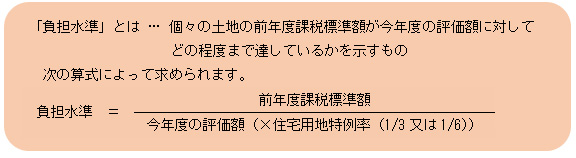
Because of this mechanism, the actual tax billed can diverge from a straight statutory-taxable-base calculation, and rounding also applies — so treat the estimate above as a way to gauge the general level, not an exact figure. Note also that for a resale condo, the temporary fixed-asset-tax reduction available for newly built homes (a 1/2 reduction for three or five fiscal years) has almost always already expired by the time of resale. The difference between fixed asset tax and city planning tax in rental property management is a useful companion reference for organizing your total holding costs.
Reassessment happens every three years; the next one is FY2027
Assessed values for land and buildings are set through a full nationwide reassessment every three years. The most recent base year was FY2024 (Reiwa 6); the second year (FY2025, Reiwa 7) and third year (FY2026, Reiwa 8) generally keep the base-year value in place. The next base year is FY2027 (Reiwa 9). In areas where land prices are rising, land assessed values are likely to step up at that FY2027 reassessment, which could push fixed asset tax and city planning tax higher.
Fixed asset tax is also assessed against whoever owns the property as of the assessment date, January 1. A mid-year sale does not change who is legally liable for the tax. Prorating the tax between buyer and seller at closing is a common market practice, not a requirement under the Local Tax Act — so the exact proration method should always be confirmed in the sale contract's terms.
Fixed asset tax also has its own exemption threshold
If the combined taxable base of all fixed assets owned by the same person within the same municipality falls below ¥300,000 for land or ¥200,000 for buildings, no fixed asset tax is levied. Land or buildings that fall below the fixed asset tax exemption threshold are also exempt from city planning tax. Under the FY2026 (Reiwa 8) local tax reform, the building exemption threshold will be raised to ¥300,000 starting in FY2027 (Reiwa 9).
The home loan tax credit available when buying a resale condo
Per the Ministry of Land, Infrastructure, Transport and Tourism's FY2026 tax reform overview, the home loan tax credit (jūtaku rōn genzei, 住宅ローン減税) has been extended for five more years, with expanded loan-balance caps and credit periods for higher-quality existing homes. The credit rate is 0.7%.
| Category of existing home | Loan-balance cap (households with children, etc.) | Credit period |
|---|---|---|
| Long-life quality housing / low-carbon housing, or ZEH-level energy-efficient housing | ¥35,000,000 (¥45,000,000) | 13 years |
| Energy-efficiency-standard-compliant housing | ¥20,000,000 (¥30,000,000) | 13 years |
| Other housing | ¥20,000,000 | 10 years |
"Households with children, etc." means households with a child under 19, or households where either spouse is under 40. The floor-area requirement is 40 m² or more, rising to 50 m² or more for buyers with income over ¥10,000,000 or for those using the enhanced cap for households with children. The income cap for eligibility is ¥20,000,000 or below. Many resale condos fall under "other housing," but if energy-efficiency compliance can be confirmed, the credit period stretches to 13 years — so it is worth asking the seller or the brokerage whether documentation of the home's energy performance exists.
The procedure and deadlines for claiming these reductions
When the tax notice arrives, and who to file with
The real estate acquisition tax notice is sent by the metropolitan tax office (todōfuken zeimu jimusho / shichō) with jurisdiction over the property. In Tokyo, notices are typically mailed around the 7th of each month, with the payment deadline generally the end of that same month. The gap between acquisition and the notice's arrival can run anywhere from a few months to more than half a year, depending on how quickly the registration and assessment process moves. This is why the tax is sometimes described as one that "arrives just when you've forgotten about it."
If you register the property within 30 days of acquisition, no separate acquisition report is generally required. However, a separate application is required to actually claim any of the reductions described above — you must submit a real estate acquisition tax reduction application, along with the required supporting documents, to the prefectural tax office with jurisdiction over the property. Miss this filing and you may be billed the full, unreduced amount even though you would otherwise have qualified for ¥0.
If you have already paid before filing
Even if you file your reduction application after the tax notice has already arrived, the tax amount will still be reduced if you meet the requirements — and if you have already paid, the difference is refunded to you. If, once your notice arrives, you suspect the reduction has not been applied, contact the prefectural tax office with jurisdiction — whether you have already paid or not. A step-by-step guide to real estate acquisition tax reductions and refund applications covers the filing process in more detail.
Documents to have ready at the time of acquisition
- Copy of the sale and purchase agreement (confirming acquisition date, price, and the parties involved)
- Certificate of registered matters (confirming the transfer of ownership)
- Fixed Asset Assessment Certificate (confirming assessed value and construction year)
- Residence certificate (confirming owner-occupancy)
- For buildings newly constructed on or before December 31, 1981 (Showa 56): one of a seismic-standard compliance certificate, a construction housing performance evaluation report, or proof that existing-home sale defect-liability insurance has been secured
- Documentation showing the condo's floor area (current as-built floor area, including the pro-rated common-area share)
How to work out your own resale condo's acquisition costs, step by step
- Check your property's Fixed Asset Assessment Certificate or annual tax statement for the assessed value of the land (site-use-right share) and the building. Start from the assessed value, not the sale price.
- Check the construction year on the Fixed Asset Assessment Certificate to identify which deduction bracket (¥12,000,000 down to ¥1,000,000) applies.
- Confirm whether the current as-built floor area, including the pro-rated common-area share, falls between 40 m² and 240 m² (acquisitions before March 31, 2026 [Reiwa 8] require 50 m² or more).
- For land, calculate the initial tax amount as "assessed value × 1/2 × 3%," then subtract whichever is larger of (a) "land price per m² [after the 1/2 discount] × twice the floor area × 3%" or (b) ¥45,000.
- For the building, if "assessed value − deduction amount" is negative, the tax is ¥0. If positive, multiply by 3%.
- Add registration and license tax (1.5% for land, 0.3% for the building, 0.1% for the mortgage), stamp tax, and the brokerage commission cap to arrive at your total closing-time cost.
- Finally, estimate the annual fixed asset tax and city planning tax amount and build it into your holding-period cash-flow model.
If the property is located within Tokyo, the Tokyo Metropolitan Government Bureau of Taxation's real estate acquisition tax calculation tool lets you verify your own numbers. Some conditions cannot be handled by the tool, so treat the final confirmation as something to take up with the prefectural tax office with jurisdiction. Working through how to buy a resale condo and the key checkpoints in the purchase process alongside this article lets you build your financing plan and your property due diligence in parallel.
At INA&Associates, our standard practice from the moment a client first consults us on a purchase is to separate out the one-time cost at acquisition from the ongoing fixed costs of holding the property, and to present both clearly, side by side. Whether a property's real estate acquisition tax comes to ¥0 or a unit continues to carry an ongoing cost of roughly ¥136,000 a year, it is only once the numbers are laid out in full that a client can make the decision for themselves. Leading with the advantages and leaving out the costs is how trust breaks down the moment the tax notice actually arrives. We believe that disclosing both the upside and the downside transparently — even when the downside is inconvenient — is what builds a relationship that lasts.
Frequently asked questions
Q. When does the real estate acquisition tax bill for a resale condo arrive?
A. A tax notice arrives from the prefectural tax office with jurisdiction over the property, typically a few months after acquisition. In Tokyo, notices are mailed around the 7th of each month, with the payment deadline generally the end of that same month. Depending on how quickly registration and assessment proceed, it can take more than half a year. Do not assume that no notice within the first few months means no tax is owed.
Q. Can an investment condo also qualify for the reductions?
A. No — neither the building deduction nor the residential-land discount applies, because both require that "an individual acquired the home for their own residential use." The residential land's 1/2 taxable-base discount, however, applies regardless of use. As a result, an investment resale condo's tax is calculated as "land's assessed value × 1/2 × 3% + building's assessed value × 3%," with nothing subtracted.
Q. Does a unit in the low 40 m² range still qualify for the reduction?
A. Yes, for acquisitions on or after April 1, 2026 (Reiwa 8). Before that date, the requirement was 50 m² or more. Because a condo's floor area is judged by adding a pro-rated share of the common areas to the exclusive area, a unit can qualify even if its exclusive area alone is under 40 m². Note that newly built housing within Tokyo's Special Urban Renaissance Emergency Development Areas is a documented exception where the 50 m² minimum still applies — the guidance for used-home relief does not carry the same exception, so confirm with the local metropolitan tax office if your property is in one of these designated areas.
Q. Does consumption tax on a resale condo depend on who I buy it from?
A. Yes. If the seller is a business, such as a licensed real estate broker, the building portion is subject to 10% consumption tax. If the seller is a private individual (not operating as a business), the building is not subject to consumption tax at all. Land is exempt from consumption tax either way. Brokerage commissions and judicial scrivener's fees are taxable regardless of who the seller is.
Q. If my tax comes to ¥0, do I still need to file anything?
A. Yes — if the ¥0 result comes from applying a reduction, you must still file the application to claim that reduction. Without filing, you may be taxed as if the reduction never applied. On the other hand, if your amount falls below the exemption threshold from the start, no notice is generally sent at all. If you are unsure which situation applies to you, the safest step is to confirm directly with the prefectural tax office with jurisdiction.
Sources and references
- Tokyo Metropolitan Government Bureau of Taxation, "Real Estate Acquisition Tax (Frequently Asked Questions)" (used-home deduction amounts, floor-area requirements, seismic-standard requirements, residential-land discount, exemption thresholds, tax-notice mailing schedule)
- Tokyo Metropolitan Government Bureau of Taxation, "Real Estate Acquisition Tax"
- Tokyo Metropolitan Government Bureau of Taxation, "Real Estate Acquisition Tax Calculation Tool"
- Tokyo Metropolitan Government Bureau of Taxation, "Fixed Asset Tax and City Planning Tax (Land and Buildings)" (rates of 1.4% and 0.3%, the residential-land special reduction, the 23-wards small-scale residential land city planning tax reduction, exemption thresholds, reassessment cycle)
- Ministry of Internal Affairs and Communications (MIC, 総務省), "Points of Attention Regarding the FY2026 Local Tax Reform and Local Tax Administration" (Official notice, January 21, 2026) (the relaxation of the real estate acquisition tax floor-area requirement to 40 m² and the raised exemption thresholds; the fixed asset tax building exemption threshold raised to ¥300,000)
- Ministry of Internal Affairs and Communications (MIC), "Local Tax System: Real Estate Acquisition Tax"
- Ministry of Internal Affairs and Communications (MIC), "Local Tax System: Overview of Fixed Asset Tax"
- Ministry of Internal Affairs and Communications (MIC), "Local Tax System: City Planning Tax"
- National Tax Agency (NTA, 国税庁), "Notice Regarding the Reduced Rate for Registration and License Tax on the Sale of Land and the Preservation Registration of Ownership of Residential Buildings" (April 2026 [Reiwa 8])
- National Tax Agency (NTA), Tax Answer No. 7191, "Registration and License Tax Rate Table"
- National Tax Agency (NTA), Tax Answer No. 7108, "Reduced Stamp Tax on Contracts for the Transfer of Real Estate and for Construction Work" (reduced tax amounts and the applicable period)
- National Tax Agency (NTA), Tax Answer No. 7140, "Stamp Tax Amount Table (Part 1): Documents No. 1 through No. 4" (the standard, unreduced tax amount for real estate transfer agreements)
- National Tax Agency (NTA), Tax Answer No. 6201, "Transactions Exempt from Consumption Tax"
- National Tax Agency (NTA), Tax Answer No. 6931, "Consumption Tax and Capital Gains"
- National Tax Agency (NTA), Basic Directive on the Consumption Tax Act, Chapter 11, Section 7, "Residential Rental Buildings"
- National Tax Agency (NTA), "Notice on Amendments to the Consumption Tax Act" (April 2020 [Reiwa 2]) (the restriction on input tax credits for residential rental buildings, the definition of high-value specified assets, and the October 1, 2020 effective date)
- Ministry of Land, Infrastructure, Transport and Tourism (MLIT, 国土交通省), "Overview of the FY2026 MLIT Tax Reform" (December 2025 [Reiwa 7]) (the five-year extension of the home loan tax credit and expanded loan caps and credit periods for existing homes; the three-year extension of the land ownership transfer registration special measure)
- Ministry of Land, Infrastructure, Transport and Tourism (MLIT), "Special Measures Regarding the Preservation Registration of Ownership of Residential Buildings"
- Ministry of Land, Infrastructure, Transport and Tourism (MLIT), "The Maximum Compensation a Licensed Real Estate Broker May Receive for Brokering the Sale of Land or a Building" (Ministry of Construction Notice No. 1552 of 1970 [Showa 45], most recently amended June 21, 2024)
- East Japan Real Estate Information Network System (Higashi-Nihon REINS, 東日本レインズ), "Quarterly Market Watch Summary Report, April–June 2026" (July 17, 2026)
How the tax is actually assessed depends on each property's own assessed value, construction date, floor area, and intended use. The calculation examples in this article are model cases meant to illustrate how the system works, not a substitute for your own figures — the actual tax due is determined by your property's Fixed Asset Assessment Certificate and by the judgment of the prefectural tax office with jurisdiction. Once you are seriously evaluating a specific acquisition, we recommend having your property documents in hand and confirming the details directly with a licensed tax accountant or your prefectural tax office.
