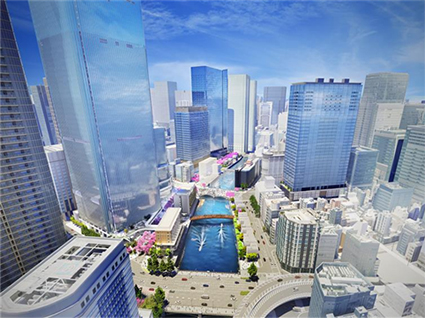
Soaring construction costs are shaking both the completion dates of Tokyo's redevelopment projects and the way public money is spent on them. A survey of 68 districts in Tokyo reported by the Tokyo Shimbun newspaper in July 2026 found that just under 90 percent had seen higher project costs or construction delays, and in individual districts, additional subsidies, phased development plans and greater financial burdens on project operators have come to light. If vacant lots and construction hoardings in front of stations remain for longer, shopping routes, rents and the vitality of the area are all affected. We read this situation not as a question of whether redevelopment is good or bad, but from the perspective of "who waits, who pays, and who benefits."
This is a Japan-specific story in an important way. Much of Tokyo's urban renewal takes place through the urban redevelopment project system (市街地再開発事業, shigaichi saikaihatsu jigyō), in which landowners form a statutory association, swap their old land for floor space in a new building, and receive public subsidies for roads, plazas and other public elements. Unlike a typical private development in the US or UK, where a developer carries cost overruns alone or simply walks away, cost increases in a Japanese redevelopment ripple through landowners, the association, participating developers and taxpayers at the same time. For overseas investors, that makes cost inflation as much a governance and consensus issue as a financial one.
- Redevelopment in Tokyo is becoming harder to deliver as originally planned because of rising construction costs, labor costs and interest rates.
- Subsidies support public elements such as roads, plazas and disaster preparedness, but the larger the total grows, the heavier the burden of accountability becomes.
- The cases of the former Nakano Sunplaza site, Iidabashi Station East and Yaesu show that delays fall into three patterns: "a shift to phased development," "redesign risk" and "post-completion scrutiny of large projects."
- When completion of a district is delayed, the effects spread to residents and businesses as rising rents, the burden of temporary stores, reduced walkability and stalled improvements in daily convenience.
How Soaring Construction Costs Are Shaking Redevelopment
People shopping in front of Nakano Station, companies looking for offices in Iidabashi, visitors transferring to buses in Yaesu. A redevelopment delay is not just a change of schedule on paper. Station passageways stay narrow, the renewal of old buildings is postponed, and tenants waiting to open stores put their decisions on hold. From the point of view of daily life, delays accumulate as everyday inconvenience.
The urban redevelopment project system is not simply a scheme for rebuilding old buildings. The Tokyo Metropolitan Government (東京都, Tōkyō-to) describes it as comprehensive urban development that systematically provides missing public facilities such as roads and parks and renews urban housing and business facilities. That is precisely why subsidies are involved. However, when subsidies are increased because of rising construction costs, the questions "Who is this redevelopment for?" and "How far should taxpayers support it?" become sharper.
The issue here is not whether redevelopment itself is right or wrong. Many districts genuinely need better public facilities, disaster preparedness and station-front routes. The problem is that, now that the original profitability assumptions have collapsed, we have entered a phase in which government, implementing bodies, participating association members, landowners and citizens must reconsider which burdens they will accept, and to what extent. We see this review not as confusion to be avoided but as a process necessary for sound urban development. In many Western markets, a project whose numbers stop working is usually shelved or sold; in Japan's association-based model, the more common response is renegotiation among many parties.
The Weight of "Just Under 90 Percent" in the Survey of 68 Tokyo Districts
What it means when the numbers are no longer exceptions
The Tokyo Shimbun report of July 2026 covered 68 urban redevelopment districts in Tokyo and reported that just under 90 percent of them faced construction delays or higher project costs. Behind this lie rising prices for materials, labor, logistics and interest rates. A newspaper report is not a primary source, but when it is checked against official materials for individual districts, change in the same direction can be confirmed. A ratio of just under 90 percent shows that this is no longer an exceptional problem in a few districts, but that the shared preconditions of Tokyo's redevelopment have changed.
What do subsidies actually support?
The Tokyo Metropolitan Government's Guidelines for Granting Urban Redevelopment Project Subsidies (東京都市街地再開発事業補助金交付要綱) classify eligible costs as surveys, design and planning, land preparation, construction of shared facilities, and contributions to public facility managers, among others. In other words, subsidies are designed to support the elements with a public character, not to directly compensate the profits of private buildings. However, when construction costs rise, the costs of building public and shared facilities also rise. As a result, total subsidies tend to grow.
Reports that subsidies for Tokyo redevelopment are being increased on the order of ¥200 billion (approx. USD 1.29 billion) show the reality of this system. Currency conversions in this article use an approximate rate as of October 2026 of 1 USD ≈ 155 JPY. What is required of government is not simply to "keep redevelopment going." It is to show, in a form that can be compared district by district, the breakdown of increases, the benefits of public facilities, the inconvenience borne by local residents, and future tax revenue and disaster-prevention effects. We believe that explanations which honestly set out both the benefits and the burdens are what support public acceptance. Compared with tax increment financing or public-private partnerships in the US, where the public share is often fixed in advance, Japanese subsidy frameworks can expand as costs rise, which is why transparency matters so much here.
Three Patterns of Delay Seen in Case Studies
The impact of soaring construction costs differs depending on the stage a district has reached. Nakano, Iidabashi and Yaesu each represent a different situation: "plan change," "redesign risk" and "post-completion scrutiny."
Former Nakano Sunplaza site: from all-at-once to phased development
In front of Nakano Station, the review of the plan for the former site of Nakano Sunplaza, once a local landmark concert hall and hotel complex, is symbolic. In March 2024 Nakano City (中野区, Nakano-ku) revised its urban development policy for the Sunplaza district, setting out a policy of developing it together with the Nakano City Office main building site, the Nakano Station North Exit Plaza and the Nakano Station district. However, in response to rising project costs, the original large-scale all-at-once development has become difficult, and discussions continue about changing course toward phased development.
| Item | What can be confirmed from published materials and reports |
|---|---|
| Site | Nakano Sunplaza district and the area around Nakano Station North Exit |
| Main issues | Soaring project costs, change in development policy, integration with the station plaza and the former city office site |
| Impact | Completion pushed back, longer periods of construction hoardings, knock-on effects on nearby retail |
| Undecided matters | Facility composition after phased development, total project cost, final schedule |
From a local, everyday perspective, a delay in completing the station area is a daily inconvenience. Expectations for a large hall and retail functions are postponed, and nearby stores find it harder to count on "future vitality." For owners and investors, not knowing when the station area will be renewed also affects decisions on rent revisions, renovation investment and the timing of sales.
Iidabashi Station East: redesign risk visible in the plan
The Iidabashi Station East district is a mixed-use redevelopment in front of a station in central Tokyo. According to the page of the Tokyo Metropolitan Government Bureau of Urban Development (東京都都市整備局), it covers about 0.7 ha, with a project cost of about ¥36.7 billion (approx. USD 237 million), a total floor area of about 46,565 square meters, and main uses including offices, retail, public-benefit facilities and housing. The city planning decision was made in June 2021 and the association's establishment was approved in October 2022, but the approval of the rights conversion plan, the start of construction and completion are all listed as undecided.
| Item | Details |
|---|---|
| Implementing body | Iidabashi Station East District Urban Redevelopment Association |
| Location | Iidabashi 3-chome, Chiyoda City, Tokyo |
| Area | About 0.7 ha |
| Project cost | About ¥36.7 billion (Tokyo Metropolitan Government page) |
| Total floor area | About 46,565 square meters |
| Main uses | Offices, retail, public-benefit facilities, housing, etc. |
| Schedule | Approval of the rights conversion plan, start of construction and completion are all undecided |
Specialist construction newspapers have also reported that the project cost of the Iidabashi Station East district may rise significantly above the original plan. The figures on the official page are those published at the time of the update and may change in future approval documents or association announcements. The point owners should read is not the amount itself but the fact that if project costs balloon before rights conversion (権利変換, kenri henkan, the step in which old land rights are exchanged for floor space in the new building), consensus becomes harder to reach. The earlier the stage of a district, the more figures should be treated as "estimates."
Yaesu 1-chome East Block B: completion does not end the scrutiny
Yaesu 1-chome East Block B is a large-scale project that has been carried out in front of Tokyo Station, one of the most prominent locations in Japan. The Tokyo Metropolitan Government Bureau of Urban Development has published its area as about 1.3 ha, its project cost as about ¥220.7 billion (approx. USD 1.42 billion), its total floor area as about 225,200 square meters, and its main uses as offices, retail, conference facilities, medical facilities, a bus terminal and parking. Building construction was completed in February 2026, and according to an announcement by Tokyo Tatemono (東京建物), "TOFROM YAESU TOWER," the centerpiece of the block, was completed on February 28, 2026.
| Item | Details |
|---|---|
| Implementing body | Tokyo Station Front Yaesu 1-chome East Block B District Urban Redevelopment Association |
| Location | Yaesu 1-chome, Chuo City, Tokyo |
| Area | About 1.3 ha |
| Project cost | About ¥220.7 billion |
| Total floor area | About 225,200 square meters |
| Main uses | Offices, retail, conference facilities, medical facilities, bus terminal, parking, etc. |
| Completion | February 28, 2026 (TOFROM YAESU TOWER) |
In prime locations like Yaesu, public facilities and private income-producing facilities are closely linked. A bus terminal and pedestrian routes improve convenience for users, but they also push up surrounding rents and land prices. A simple judgment that a project succeeded because it was completed, or failed because it was delayed, is not enough. We need to keep watching how widely the public value supported by subsidies is returned to citizens. For investors from markets where a trophy tower is judged mainly on leasing and exit yield, this added layer of public accountability is a distinctive feature of Japanese station-front projects.
How to Assess Public Facilities and Urban Infrastructure
When thinking about redevelopment subsidies, looking only at how luxurious a building is leads to the wrong conclusions. What readers should check is how far roads, plazas, underground passages, station transport, disaster preparedness and green space will be improved. These are practical yardsticks, close to daily life, for measuring whether subsidies are justified.
| Item | Points to check | Impact on daily life and real estate |
|---|---|---|
| Roads and sidewalks | Road widening, space for pedestrians to linger, delivery routes | Ease of viewings, foot traffic in front of stores, accident risk |
| Station plaza | Separation of buses, taxis and private cars | Commuting convenience, visitor dwell time |
| Underground passages and decks | Routes for rainy days, easing congestion at subway entrances | Material for explaining office and retail rents |
| Disaster preparedness | Accepting people unable to return home after a disaster, emergency stockpiles, seismic upgrades | BCP, tenant attraction, management quality |
| Green space and plazas | Public open space, places to rest, event use | Dwell time, sales opportunities for nearby stores |
In the Iidabashi Station East district, the development of a special ward road and a public plaza has been shown. In Yaesu 1-chome East Block B, in addition to road improvements, the transport hub function in front of Tokyo Station carries great significance. In Nakano, the focus is on integrating the station plaza with the surrounding districts. Whether subsidies are justified should be judged by whether this urban infrastructure remains in a genuinely usable form. In Japan, where most residents commute by rail and walk to the station, these pedestrian-level improvements tend to matter more to rental demand than they would in car-oriented cities.
Effects on Citizens' Lives and Property Owners
The time lag between rents and daily convenience
When redevelopment is delayed, the first to suffer are the people who live and work near the site. Hoardings narrow the passageways, construction vehicles create a psychological distance, and the turnover of shops tends to stall. If only the expectation of post-completion growth is priced in first, a time lag can arise in which surrounding rents rise while daily convenience has not yet improved. Misjudging this time lag can lead to buying overpriced property on expectations alone.
What rental property owners can do
Rental owners do not need to treat redevelopment delays as purely bad news. However, if they set leasing terms too aggressively, tenants will see the real inconvenience. For example, if the station plaza is not yet finished, explain the night-time and shopping routes carefully. If construction is extended, prioritize investments that reduce stress after move-in, such as sound insulation, parcel delivery and cleaning of common areas. Rather than raising rents on the expectation of redevelopment alone, reducing the inconvenience of the people living there now builds long-term trust.
This perspective connects with our earlier articles on how central Tokyo redevelopment affects property values and typical building construction costs per tsubo and their breakdown (a tsubo, 坪, is a Japanese unit of about 3.3 square meters). When a district is changing, it is important to look at expectations and actual operating costs separately.
Soaring construction costs are also a consensus-building challenge
There are points that deserve criticism, but blaming the project operators alone will not solve the problem. A redevelopment is built on consensus formed over a long time among landowners, tenants, government, participating association members, designers, contractors and financial institutions. If construction costs move by 20 or 30 percent, the sale price of reserved floor space (保留床, horyū-yuka, the extra floor area sold to fund the project), rent assumptions, borrowing terms, subsidies and the burden on rights holders all change in a chain reaction.
Especially in districts that have not yet reached rights conversion, the question of who bears the increase hits consensus building directly. Asking contractors alone to absorb it leads to failed tenders or lower quality. If government subsidizes everything, it will not win public acceptance. If the burden on landowners increases, problems arise in rebuilding their lives and continuing their businesses. Soaring construction costs are not just a cost problem but a problem of building consensus for urban renewal. That is why it is necessary to share both good prospects and harsh burdens honestly and to rebuild consensus over time. This multi-stakeholder structure is quite different from the single-sponsor model familiar to many international investors, and it is one reason Japanese redevelopment timelines are long but rarely abandoned outright.
Five Practical Points Owners Should Check
Owners of property in redevelopment areas should check the following five points rather than the artist's impressions of the finished project. Each can be backed up by published materials and site visits.
- Check in the latest city planning and project plans whether the start and completion of construction are "scheduled" or "undecided."
- See where the reasons for increased subsidies lie: public facilities, shared facilities or building costs.
- Check the routes tenants use every day, such as station plazas, underground passages and road widening.
- Factor in not only post-completion rent increases but also vacancies, noise and worse access during construction.
- Compare with Tokyo's once-in-a-century redevelopment rush and avoid overestimating your own area alone.
In a period of soaring construction costs, districts that are completed sooner are not necessarily stronger. Rather, districts where the content of public facilities, the explanation of project costs and the realism of phased development are visible are more likely to win long-term trust. For a broader view, please also see our list of articles on real estate market conditions and investment.
INA's Perspective and Summary
The problem of soaring construction costs undermining redevelopment is a theme that requires thinking at the same time about not only project operators' profitability but also the use of tax money, delays in completing districts and inconvenience in citizens' lives. If just under 90 percent of 68 districts in Tokyo are seeing higher project costs or construction delays, this is no longer an exceptional problem. The former Nakano Sunplaza site shows the gap between station-front expectations and the reality of phased development; Iidabashi Station East shows how hard it is when a plan that has not reached rights conversion is shaken by rising costs; and Yaesu shows that even large projects that have been completed still need scrutiny of their public value and burdens.
At INA&Associates, we value a long-term perspective and honest disclosure of information. We believe that presenting disadvantages and uncertainties as well is what protects the trust of owners, tenants and the community. The right way to look at redevelopment from now on is not the glamour of the finished renderings, but who is made to wait, who bears the burden, and who benefits after completion. The more construction costs rise, the more we need urban development that does not avoid these questions. For overseas investors, this is a reminder that in Japan the timing of a redevelopment can matter as much as its scale.
Frequently Asked Questions
How do redevelopment delays affect nearby rents?
In the short term, real demand in the surrounding area may weaken slightly because of construction noise and worse access. On the other hand, expectations of better convenience after completion may be priced into rents first, creating a time lag between improved convenience and rising rents. When marketing, honestly explaining the current living environment rather than expectations helps avoid problems after move-in.
Does an increase in subsidies mean tax money is being wasted?
It is impossible to generalize. In principle, subsidies are designed to support public elements such as roads, plazas and disaster preparedness, and they do not directly compensate the profits of private buildings. The key points are the breakdown of the increase and whether the public facilities will be used by a broad range of citizens. What is needed is not just a focus on the size of the amount, but a willingness to compare benefits and burdens side by side.
Should I buy property in a redevelopment area now?
Individual investment decisions depend on the property and the financing plan, and we refrain from giving definitive advice. As a general point, however, when the start or completion of construction is "undecided," the total project cost and schedule are prone to change, and yields that assume completion should not be taken at face value. We recommend confirming the stage of progress in published materials and considering the decision with costs during construction factored in.
How definitive are the figures in this article?
Figures such as area, project cost and total floor area in this article are given as guides based on materials published by the Tokyo Metropolitan Government Bureau of Urban Development and each city, and on figures at the time of reporting. Project costs and schedules may change in future approval documents or association announcements, and they are not definitive values. Please check the latest situation via the primary source links at the end of this article.
Sources and References
- Tokyo Shimbun (東京新聞), "Redevelopment in 68 Tokyo districts: 90 percent face 'construction delays' or 'higher project costs'" (都内68地区の再開発、9割で『工期遅れ』『事業費増』), July 2026
- Tokyo Metropolitan Government Bureau of Urban Development (東京都都市整備局), "About Urban Redevelopment Projects" (市街地再開発事業について)
- Tokyo Metropolitan Government (東京都), "Guidelines for Granting Tokyo Urban Redevelopment Project Subsidies" (東京都市街地再開発事業補助金交付要綱)
- Nakano City (中野区), "About the Nakano Sunplaza Acquisition and Operation Project"
- Tokyo Metropolitan Government Bureau of Urban Development (東京都都市整備局), "Iidabashi Station East District Category 1 Urban Redevelopment Project" (飯田橋駅東地区第一種市街地再開発事業)
- Tokyo Metropolitan Government Bureau of Urban Development (東京都都市整備局), "Tokyo Station Front Yaesu 1-chome East Block B District Category 1 Urban Redevelopment Project" (東京駅前八重洲一丁目東B地区第一種市街地再開発事業)
- Tokyo Tatemono (東京建物), "Tokyo Station Front Yaesu 1-chome East District block name decided as TOFROM YAESU" (東京駅前八重洲一丁目東地区 街区名称をTOFROM YAESUに決定), March 3, 2025