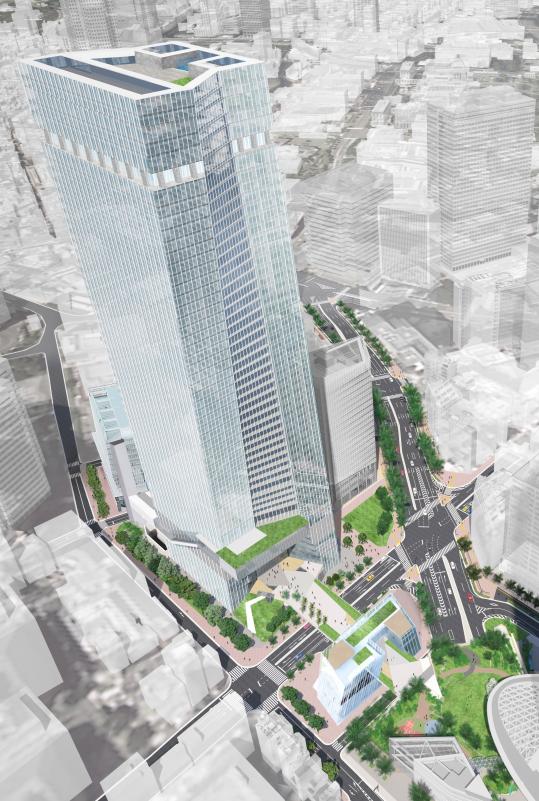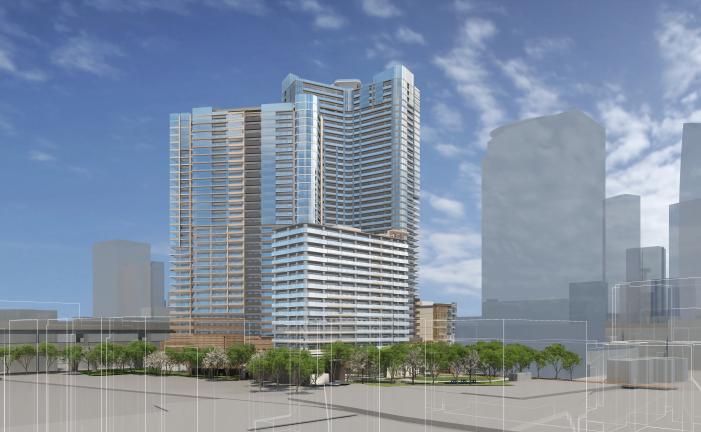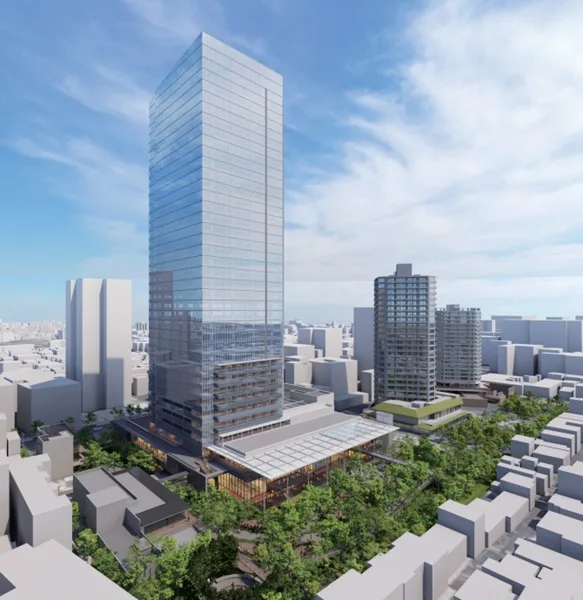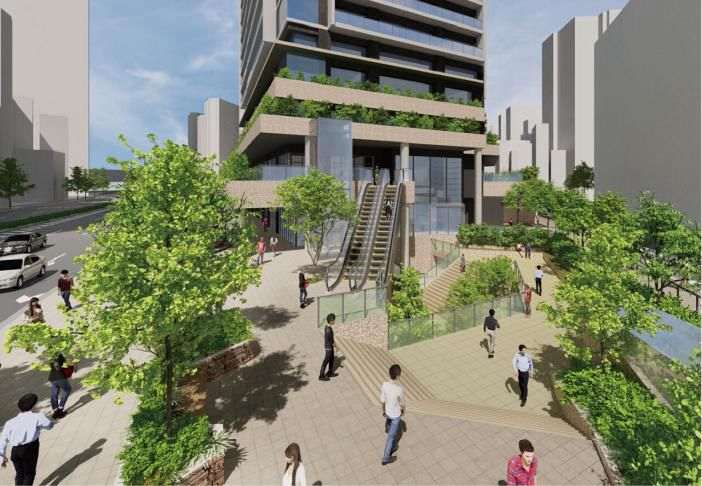
The Shirokane-Takanawa Station East District redevelopment is a Type 1 urban redevelopment project that will create a new station-front mixed-use hub on the east side of Shirokane-Takanawa Station. In addition to a mixed-use complex with 42 above-ground floors, 3 basement floors, and a height of about 160 m, including housing, shops, bicycle parking, and more, the essence of the plan lies in integrating a station-front pedestrian plaza, an underground pedestrian connection, and disaster stockpiling functions.
This article is based on information published as of April 2026.
Shirokane-Takanawa is already an area where several redevelopments have advanced, but the Station East District is a plan to directly upgrade the station's ease of use. That is why it should be read not as a simple tower condominium project, but as urban infrastructure development that includes station-front circulation, public space, disaster preparedness, bicycle parking, and commercial functions.
Key Points
- The redevelopment centers on a mixed-use complex with a site area of about 4,350㎡, a total floor area of about 68,000㎡, and a maximum height of about 160 m.
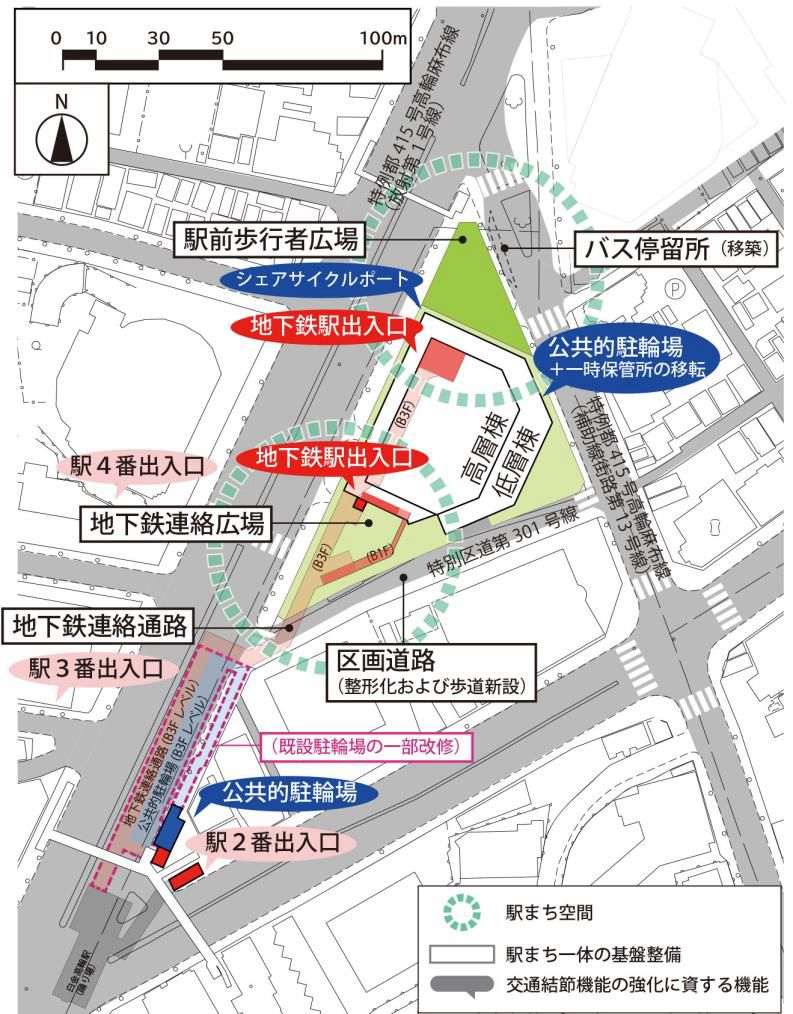
- The Minato City Council materials show a station-front pedestrian plaza, underground pedestrian passageways, an underground pedestrian plaza, and the relocation and expansion of public bicycle parking.
- The plan calls for an urban planning decision in fiscal 2026, association establishment approval in fiscal 2027, construction start in fiscal 2029, and completion in fiscal 2034.
- Its impact on real estate value appears not only in condominium sale prices, but also in rental demand, walkability, disaster resilience, and management quality.
- Nearby owners should review not only the completion timing, but also the link between their buildings and the new station-front circulation, leasing conditions, and renovation priorities.
What Is the Shirokane-Takanawa Station East District Redevelopment?
The Shirokane-Takanawa Station East District redevelopment is a Type 1 urban redevelopment project being considered around 1-1 and 1-2 Takanawa, Minato City. The Minato City Council materials organize it as a plan to form a new station-front mixed-use hub on the east side of Shirokane-Takanawa Station.
The project site is close to Shirokane-Takanawa Station on the Tokyo Metro Namboku Line and Toei Mita Line. The area currently mixes housing, shops, and offices, while challenges include pedestrian circulation around station entrances, the usability of public bicycle parking, seismic strengthening along emergency transport roads, and a shortage of consolidated greenery and open space.
What must not be overlooked in this project is not only the building scale. The Minato City Council materials include the construction of new subway station entrances, underground pedestrian passageways, a station-front pedestrian plaza, relocation and expansion of public bicycle parking, relocation and expansion of a temporary impound lot for abandoned bicycles, creation of shared-cycle ports, relocation of bus stops, and removal of overhead utility poles.
In other words, it is a plan to remake not just the station-front building, but the very infrastructure that connects the station and the town. When evaluating redevelopment in Shirokane-Takanawa, it is necessary to read not only the height and number of units in the tower, but also the quality of the underground and above-ground circulation and public space.
Organizing the Project Outline from Official Materials
In Minato City Council 'Document No. 1: About the Urban Development of the Shirokane-Takanawa Station East District,' the outline of the building and the public facility improvements are presented in concrete terms. First, the framework of the project is organized in a table.
| Item | Plan Details |
|---|---|
| Location | Around 1-1 and 1-2 Takanawa, Minato City |
| Project Name | (Tentative Name) Shirokane-Takanawa Station East District Type 1 Urban Redevelopment Project |
| Main Uses | Housing, shops, bicycle parking, and more |
| Site Area | about 4,350㎡ |
| Total Floor Area | about 68,000㎡ |
| Maximum Height | about 160 m |
| Number of Floors | 42 above-ground floors, 3 basement floors |
| Maximum Floor-Area Ratio | about 990% |
| Planned Schedule | Urban planning decision in fiscal 2026, association establishment approval in fiscal 2027, construction start in fiscal 2029, and completion in fiscal 2034 |
This table shows that the Shirokane-Takanawa Station East District redevelopment is a residential-oriented high-rise mixed-use project that is also strongly tied to station-front infrastructure development. Articles on redevelopment in the Shirokane-Takanawa area often focus on building scale, but in this plan the underground pedestrian passageways and plazas are at the center of the project's value.
What Will Change in Public Facility Development?
The main point to watch in the Shirokane-Takanawa Station East District redevelopment is the public facility development. The Minato City Council materials show a station-front pedestrian plaza, underground pedestrian passageways, an underground pedestrian plaza, block roads, sidewalk-like open spaces, and public bicycle parking.
| Facility | Scale and Content | Meaning of the Improvement |
|---|---|---|
| Station-Front Pedestrian Plaza | about 640㎡, newly built | Space to absorb lingering, meeting, and pedestrian flows in front of the station |
| Underground Pedestrian Passage No. 1 | Width 3.0 m, length about 120 m, underground level | Connects the station and the block underground and improves movement in rainy or crowded conditions |
| Underground Pedestrian Plaza | about 580㎡, above-ground and underground levels, including elevators | Creates a junction between ground and underground and improves station users' circulation |
| Underground Pedestrian Passage No. 2 | Width 3.0 m, length about 90 m, underground level, including elevators | Supplementary access to the station from multiple directions |
| Block Road | Width 8.0 m, length about 120 m, partially widened | Reorganization of the block and improvement of the pedestrian environment |
| Public Bicycle Parking | about 310 bicycle spaces, relocation and expansion | Organizes bicycle use in front of the station and measures against abandoned bicycles |
| Temporary Storage Site for Abandoned Bicycles | capacity about 330 bicycles, relocation and expansion | Operational base that protects pedestrian space around the station |
Seeing this content, one can understand that this is a station-and-town integrated plan. By layering not only the ground plaza but also underground passages, elevators, bicycle parking, and road reconfiguration, it is designed to change how the station front is used.
What Is Planned for Disaster Prevention, Greening, and Everyday Convenience?
In the redevelopment plan, disaster prevention functions and everyday convenience functions are also important. The Minato City Council materials set out temporary stay facilities, disaster stockpile warehouses, disaster stockpile warehouses for the community, and the development of manhole toilets.
Shirokane-Takanawa is both a central urban residential area and a place passed through by station users and nearby workers. In a disaster, how the area accommodates not only residents but also stranded commuters and nearby users affects the city's reputation. Disaster stockpile warehouses and temporary stay facilities are not conspicuous in normal times, but they are urban functions that support long-term asset value.
The materials also include development of greenery and open space that the community can feel familiar with. In a high-density urban area like Shirokane-Takanawa, the quality of open spaces and pedestrian areas affects the impression of housing and the stay value of commercial uses. Planting, plazas, and sidewalk-like open spaces are not merely landscape elements; they are infrastructure that supports daily walkability.
Why Is the Shirokane-Takanawa Station East District Redevelopment Important?
It is important because it directly changes the public space and transport hub function in front of the station. Shirokane-Takanawa has seen multiple redevelopments, but the station east district focuses on access to the station and public facility development.
Shirokane-Takanawa is an area that balances the calm of a residential district and access to central Tokyo within Minato City. At the same time, high-rise housing supply continues around the station, increasing pressure on nearby pedestrian routes, bicycle parking, and pedestrian space. Whether the station-front circulation is improved affects not only livability but also how clearly the property can be explained when leasing it.
When we look at this in rental management practice, even if the walking time to the station is the same, impressions after a viewing change depending on the clarity of the route to the station, the sense of safety at night, the circulation on rainy days, and the usability of bicycle parking. In an area like Shirokane-Takanawa, where rents are high, these small differences become reasons to choose one property over another.
For that reason, this redevelopment is not as simple as 'a new tower will be built.' For owners of nearby properties, it becomes an opportunity to check how their own buildings connect to the new station-front environment.
How Should We See the Relationship With Surrounding Redevelopments?
Around Shirokane-Takanawa Station, multiple redevelopments such as Shirokane The Sky, Shirokane 1-chome West Central District, and Mita 5-chome West District overlap. The current Station East District is positioned as a project that handles station connectivity and public space within that flow.
Related background can also be found in How Shirokane The Sky Changed Real Estate Value in Shirokane-Takanawaas well. Also, as a nearby individual project, Shirokane 1-Chome West Central District Redevelopmentshould also be considered.
As surrounding redevelopments increase, recognition of the entire area rises. However, at the same time, comparison targets for new and recently built properties also increase. Older properties benefit from the location, but differences become more pronounced in equipment standards and the appearance of common areas.
Before raising rent, it is practical to review photos, lighting, parcel lockers, entrances, and management condition. To benefit from the tailwind of redevelopment, the property itself must be in a state that can withstand the expectations of the new town.
How Will It Affect Real Estate Value in Shirokane-Takanawa?
The impact should not be judged only by short-term price increases. Rather, we look at the possibility that mid- to long-term preference will rise as station-front convenience, disaster resilience, commercial functions, and nearby circulation improve.
In the rental market in particular, improved station-front circulation affects impressions at viewings. A route from the station exit to the property that is easy to understand, movement that is easy even on rainy days, and nearby plazas and everyday convenience functions for lingering all matter. These elements do not appear directly in the rent chart, but they affect closing rates and vacancy periods.
On the other hand, it is dangerous to rush investment decisions based only on redevelopment expectations. Market views change at each stage: urban planning decision, association establishment approval, rights conversion, demolition, construction start, and completion. This project should be observed as a long-term one, with completion scheduled for fiscal 2034.
Practical Points Owners Should Check
The first thing owners should check is the relationship between their property and the new station-front circulation. Whether their building becomes closer or merely gets passed by when viewed from the new station entrances and plazas changes how it should be positioned.
Next is updating marketing materials. Simply inserting the phrase 'Shirokane-Takanawa redevelopment' will not communicate much to tenants. It is necessary to translate it into words closer to everyday life, such as station-front pedestrian plaza, underground pedestrian passageway, commercial functions, and disaster stockpile functions, and explain it that way.
The third point is the priority order of repairs and renovations. In redevelopment areas, new supply attracts attention, but not all residents choose only new construction. Existing properties that are well managed and can skillfully absorb changes in the station-front environment still have room to compete.
Finally, there is the human capital perspective. Even if the town changes through redevelopment, it is people who handle tenant support, leasing improvements, and repair decisions. Whether the management company and front-line staff can anticipate change and make proposals has a major impact on the owner's results.
INA's View
INA sees the Shirokane-Takanawa Station East District redevelopment not as additional supply in a luxury residential area, but as a redesign of a station-front mixed-use hub. When reading asset value, the combination of public space, transport connectivity, disaster resilience, and commercial functions matters, not just building height and number of units.
To be frank, redevelopment news tends to draw the eye to glamorous renderings. However, to protect assets over the long term, it is important to find your property's weak points before completion and raise management quality. This is not a matter of simply spending more. It means investing in people and systems to build sustainable rental management.
This redevelopment is one of the Minato City redevelopment projects that has the practical meaning of upgrading station-front circulation. If you own property nearby, review your leasing strategy, renovation plan, and exit strategy early, together with the progress of the urban planning process.
Frequently Asked Questions (FAQ)
Q1. When is the Shirokane-Takanawa Station East District redevelopment scheduled to be completed?
A. According to Minato City Council materials, completion is scheduled for fiscal 2034. However, this may change depending on urban planning procedures and project progress.
Q2. Will rents in Shirokane-Takanawa rise immediately?
A. They may not rise uniformly right away. Improvements in station-front circulation and commercial functions may show up first in vacancy periods and leasing responses.
Q3. Do older nearby properties also benefit?
A. Yes. However, because common areas and equipment are more likely to be compared with new buildings, improving management condition is a prerequisite.
Q4. What should be checked in an investment decision?
A. It is important to check the project's progress, the property's position relative to station entrances, surrounding supply, repair history, and rental demand together.
References
- Minato City Council 'Construction Standing Committee, April 27, 2026'
- Minato City Council 'Document No. 1: About the Urban Development of the Shirokane-Takanawa Station East District'
- Minato City 'Environmental Impact Assessment Plan for the (tentative) Shirokane-Takanawa Station East District Type 1 Urban Redevelopment Project' (March 2026)
- Minato City 'Type 1 Urban Redevelopment Project'