In Japan, the cost of building a rental property swings from ¥721,000 to ¥1,160,000 per tsubo (approx. US$4,810–$7,730; a tsubo, 坪, is a traditional Japanese unit of floor area equal to about 3.31 square meters, or roughly 35.6 square feet, and it is still the default pricing unit the Japanese construction industry quotes in) depending on structure and construction method. Even within the same wood-frame category, prefabricated construction runs about 40% above the all-methods average. That is why the question worth answering first is not the corporate identity of "house maker vs. builder" — it is which structural type, which construction method, what the per-tsubo price is, and what rent that structure can command. Comparing company names only becomes meaningful after those three numbers are on the table.
This is a Japan-specific investment topic: unlike the United States, United Kingdom, or Australia, Japan has no MLS-style public database of sold prices or verified construction costs that any buyer can query. There is no direct equivalent to a Comparative Market Analysis pulled from a multiple listing service. What Japan has instead is a small set of government statistical releases — and for anyone evaluating a Japanese rental-property build, those releases are the closest thing to ground truth available. This article is written for landowners and prospective investors who are about to start, or are already comparing bids for, an apartment or condominium-scale rental building in Japan, and it exists to arm you with numbers before you narrow down a builder. It draws exclusively from primary sources: the Ministry of Land, Infrastructure, Transport and Tourism's (国土交通省, MLIT) "Statistics on Construction Starts" (建築着工統計調査) for the full 2025 calendar year (published January 30, 2026), the Statistics Bureau of Japan's (総務省統計局) Housing and Land Survey, the National Tax Agency (国税庁, NTA), and the Japan Housing Finance Agency (住宅金融支援機構, JHF). It organizes construction cost per tsubo by structural type, the five-year rise in build costs, regional variation, yield modeling, loan repayment figures, and a concrete process for vetting a builder. All figures are current as of the published data available in August 2026. Yen amounts throughout this article are converted to US dollars at an approximate rate of ¥150 = US$1, based on rates prevailing around 2026-08; treat the dollar figures as rounded estimates for orientation, not exact conversions.
Key takeaways
- The construction unit price for Japanese rental housing is ¥721,000 per tsubo for wood-frame (approx. $4,810), ¥1,124,000 for steel-frame (approx. $7,490), and ¥1,160,000 for reinforced concrete, or RC (approx. $7,730) — nationwide, per MLIT's "Statistics on Construction Starts," full-year 2025.
- Comparing the same structural type, prefabricated construction from major "house makers" runs 40.8% higher for wood-frame builds, but only 2.4% higher for steel-frame. The overall average gap across all structures is 18.4%.
- The per-square-meter construction cost for rental housing rose from ¥214,000 in 2020 (approx. $1,430) to ¥293,000 in 2025 (approx. $1,950) — a 36.9% increase in five years. A quote you obtained a few years ago is no longer a reliable benchmark.
- For a 200 m² wood-frame apartment building, conventional construction produces a gross yield of 11.98%, while prefab produces 8.51%. A ¥17,800,000 (approx. $118,670) difference in construction cost translates into a 3.5-percentage-point gap in yield.
- Choosing a builder is not just about price per tsubo — whether the builder can secure Long-Life Quality Housing certification (長期優良住宅, a Japanese government housing-quality accreditation) matters just as much, since certified properties receive a 0.3-percentage-point interest-rate discount for the first 15 years of a Japan Housing Finance Agency loan.
How much does it cost to build rental housing in Japan in 2026? Construction cost per tsubo by structural type
Let's start with the conclusion. For rental housing (貸家, newly built, owner-occupied-excluded rental dwellings — the statistical category Japan uses for investment rental buildings) that broke ground in Japan in 2025, the planned construction cost averaged ¥293,000 per square meter (approx. $1,950) across all structural types, which works out to ¥969,000 per tsubo (approx. $6,460). By structural type, wood-frame is the cheapest at ¥721,000 per tsubo (approx. $4,810), and reinforced concrete (RC) is the most expensive at ¥1,160,000 per tsubo (approx. $7,730). This gap flows directly through to total project cost and to yield.
Unlike US or UK residential construction, where "wood-frame," "steel," and "concrete" builders often compete in overlapping price bands, Japan's structural cost gap is wide and highly predictable — a direct consequence of a national building code that treats fire resistance, seismic performance, and statutory depreciable life very differently by structure, which we'll return to below.
Rental-housing construction cost: ¥218,000/m² for wood-frame, ¥340,000/m² for steel-frame, ¥351,000/m² for RC
The following table extracts the per-tsubo unit price and per-unit construction cost by structural type from MLIT's "Statistics on Construction Starts, Housing Starts Statistics," Table 34 (full-year 2025, nationwide, rental housing). Conversions from square meters to tsubo use 1 tsubo = 3.30578 m².
| Structure | Units started | Cost per m² | Cost per tsubo (converted) | Cost per unit |
|---|---|---|---|---|
| Rental housing, total | 300,793 units | ¥293,000 (approx. $1,950) | ¥969,000 (approx. $6,460) | ¥13,857,000 (approx. $92,380) |
| Wood-frame | 133,938 units | ¥218,000 (approx. $1,450) | ¥721,000 (approx. $4,810) | ¥9,570,000 (approx. $63,800) |
| Steel-frame | 65,924 units | ¥340,000 (approx. $2,270) | ¥1,124,000 (approx. $7,490) | ¥18,825,000 (approx. $125,500) |
| Reinforced concrete (RC) | 98,543 units | ¥351,000 (approx. $2,340) | ¥1,160,000 (approx. $7,730) | ¥16,335,000 (approx. $108,900) |
| Steel-reinforced concrete (SRC) | 2,240 units | ¥322,000 (approx. $2,150) | ¥1,064,000 (approx. $7,090) | ¥14,742,000 (approx. $98,280) |
Source: MLIT (国土交通省), "Statistics on Construction Starts, Housing Starts Statistics," 2025 annual, Table 34 (published January 30, 2026)
There is one detail here that is easy to miss. The highest per-square-meter unit price belongs to RC, but the highest per-unit total construction cost belongs to steel-frame, at ¥18,825,000 (approx. $125,500). Steel-frame rental units tend to be built with more floor area per unit, so unit price and total cost do not necessarily rank in the same order. When you compare bids, lining up per-tsubo prices alone can mislead you. You need to normalize for total floor area and unit count before comparing total project cost.
For context, total new housing starts across Japan in 2025 came to 740,667 units (down 6.5% year-on-year), of which rental housing accounted for 324,991 units (down 5.0% year-on-year) — the third consecutive year of decline for both figures. Construction starts are falling while per-unit cost keeps rising: that is the current state of the market. If you want the fuller picture of costs before ground even breaks, we've broken those down separately in Apartment Management Initial Costs: A Breakdown and Guide to Your Own-Fund Requirement.
Construction costs have risen 36.9% in five years
Plenty of investors reason, "I got a quote a few years ago, so I have a rough sense of the going rate." That assumption no longer holds. The planned per-square-meter construction cost for rental housing rose 36.9% over the five years from 2020 to 2025.
| Year | Rental housing, total (¥ thousand/m²) | Wood-frame | Steel-frame | RC | Cost per unit |
|---|---|---|---|---|---|
| 2020 | ¥214,000 (approx. $1,430) | ¥166,000 (approx. $1,110) | ¥238,000 (approx. $1,590) | ¥249,000 (approx. $1,660) | ¥9,851,000 (approx. $65,670) |
| 2022 | ¥230,000 (approx. $1,530) | ¥169,000 (approx. $1,130) | ¥255,000 (approx. $1,700) | ¥266,000 (approx. $1,770) | ¥10,771,000 (approx. $71,810) |
| 2024 | ¥270,000 (approx. $1,800) | ¥203,000 (approx. $1,350) | ¥312,000 (approx. $2,080) | ¥315,000 (approx. $2,100) | ¥12,616,000 (approx. $84,110) |
| 2025 | ¥293,000 (approx. $1,950) | ¥218,000 (approx. $1,450) | ¥340,000 (approx. $2,270) | ¥351,000 (approx. $2,340) | ¥13,857,000 (approx. $92,380) |
| 5-year change | +36.9% | +31.3% | +42.9% | +41.0% | +40.7% |
Source: same as above (Table 34, full-year 2020, 2022, 2024, and 2025)
The increase has been steepest for steel-frame (+42.9%) and RC (+41.0%), pulling further ahead of wood-frame (+31.3%). That pattern is consistent with rising steel and cement prices flowing disproportionately into non-wood structural costs. The National Tax Agency's (国税庁) own "Standard Construction Cost Table for Buildings" (建物の標準的な建築価額表, used to calculate capital gains) shows the same direction of travel: nationwide across all housing, wood-frame rose from ¥170,100/m² to ¥204,100/m² (approx. $1,130 to $1,360, +20.0%) between 2019 and 2023, and steel-frame rose from ¥228,800 to ¥281,100 (approx. $1,530 to $1,870, +22.9%) over the same period.
The practical implication is straightforward. A budget built on 2022 figures may be understating today's construction cost by more than 20%. Between 2022 and 2025, the all-structures average rose from ¥230,000/m² to ¥293,000/m² (approx. $1,530 to $1,950), a 27.4% increase. If you're collecting multiple bids, insist that they all be dated the same month and specify identical floor area and specification — otherwise you are not comparing like with like.
Even for the same structure, cost varies roughly 2x by region
The national average is only a starting point. For the identical RC structural category, Tokyo runs ¥445,000/m² (approx. $2,970) while Hokkaido runs ¥225,000/m² (approx. $1,500) — roughly double. Here is the breakdown by prefecture:
| Prefecture | Rental housing, total (¥ thousand/m²) | Wood-frame | Steel-frame | RC | RC cost per tsubo |
|---|---|---|---|---|---|
| National average | ¥293,000 (approx. $1,950) | ¥218,000 (approx. $1,450) | ¥340,000 (approx. $2,270) | ¥351,000 (approx. $2,340) | ¥1,160,000 (approx. $7,730) |
| Tokyo | ¥399,000 (approx. $2,660) | ¥281,000 (approx. $1,870) | ¥402,000 (approx. $2,680) | ¥445,000 (approx. $2,970) | ¥1,471,000 (approx. $9,810) |
| Osaka | ¥279,000 (approx. $1,860) | ¥191,000 (approx. $1,270) | ¥307,000 (approx. $2,050) | ¥334,000 (approx. $2,230) | ¥1,104,000 (approx. $7,360) |
| Aichi | ¥262,000 (approx. $1,750) | ¥200,000 (approx. $1,330) | ¥331,000 (approx. $2,210) | ¥308,000 (approx. $2,050) | ¥1,018,000 (approx. $6,790) |
| Fukuoka | ¥243,000 (approx. $1,620) | ¥189,000 (approx. $1,260) | ¥312,000 (approx. $2,080) | ¥268,000 (approx. $1,790) | ¥886,000 (approx. $5,910) |
| Hokkaido | ¥226,000 (approx. $1,510) | ¥227,000 (approx. $1,510) | ¥271,000 (approx. $1,810) | ¥225,000 (approx. $1,500) | ¥744,000 (approx. $4,960) |
Source: same as above (Table 34, full-year 2025, by prefecture, rental housing)
Wood-frame in Tokyo runs ¥281,000/m² (approx. $1,870), 29% above the national wood-frame average of ¥218,000/m² (approx. $1,450). That premium likely reflects Tokyo's abundance of small and irregularly shaped lots and the tighter conditions for scaffolding, staging, and material delivery in a dense urban core. Interestingly, Aichi prefecture shows steel-frame (¥331,000/m²) costing more than RC (¥308,000/m²) — the reverse of the national ranking. Do not judge a builder as "expensive" or "cheap" against the national average; benchmark first against your own prefecture's average, then compare bids.
What actually distinguishes a "house maker" from a construction company? The real dividing line is construction method
This is itself a distinctively Japanese question. The industry category "house maker" (ハウスメーカー) has no exact equivalent in the US, UK, or Australian housing markets: it refers to a small number of large, nationally branded manufacturers — companies like Sekisui House or Daiwa House — that mass-produce standardized housing components in factories and sell them through a nationwide dealer network, in contrast to the far more fragmented, regionally organized custom-home-builder and general-contractor market that dominates residential construction in most Western countries. A local "construction company" or "kōmuten" (工務店, a small or mid-sized regional building contractor) is closer to what an American or British reader would picture as a general contractor or local builder.
The answer to what actually separates the two is neither their sales organization nor their company size. It is construction method. Most house makers use either prefabricated construction (プレハブ, factory-manufactured structural components assembled on site) or the two-by-four platform-frame method (ツーバイフォー工法, closer to standard North American wood-frame construction), while regional construction companies and kōmuten mainly build using the conventional post-and-beam method (在来工法, 木造軸組工法, a traditional Japanese wood post-and-beam framing system). This distinction in construction method is what governs price per tsubo, build time, and design flexibility — not the size of the company's logo on a billboard.
Prefab accounts for 18.9% of rental housing, two-by-four for 18.2%
First, the market composition. Of the 300,793 rental-housing units that broke ground in 2025, the breakdown by construction method is as follows:
| Method | Units started (rental) | Share | Cost per m² | Cost per tsubo | Cost per unit |
|---|---|---|---|---|---|
| Prefabricated | 56,834 units | 18.9% | ¥347,000 (approx. $2,310) | ¥1,147,000 (approx. $7,650) | ¥20,495,000 (approx. $136,630) |
| Two-by-four (wood-frame) | 54,664 units | 18.2% | ¥213,000 (approx. $1,420) | ¥704,000 (approx. $4,690) | ¥10,591,000 (approx. $70,610) |
| Other (mainly conventional method) | approx. 189,295 units | 62.9% | — | — | — |
Source: same as above (Tables 34 and 36, "Prefabricated New Housing Starts"; Table 45, "Two-by-Four New Housing Starts," full-year 2025)
Two things stand out. First, prefab — the specialty of the major house makers — accounts for less than a fifth of the rental market. The remaining 60%-plus is built by construction companies using the conventional method. The assumption that "going with a major house maker is the standard choice" does not match the statistics.
Second, two-by-four rental construction runs ¥704,000 per tsubo (approx. $4,690), below the ¥721,000 (approx. $4,810) all-wood-frame average. Two-by-four also uses factory-manufactured components, yet its price barely differs from conventional wood-frame. The accurate framing is not "factory-made means expensive" — it is "prefab specifically means expensive."
How much more expensive is prefab, controlling for structure?
This is the crux of the matter. Comparing construction methods only means something when you hold structural type constant. Cross-referencing Table 34 (all methods) against Table 36 (prefab only) produces this:
| Structure | All methods (¥ thousand/m²) | Prefab (¥ thousand/m²) | Difference | Per-tsubo difference |
|---|---|---|---|---|
| Wood-frame | ¥218,000 (approx. $1,450) | ¥307,000 (approx. $2,050) | +40.8% | ¥721,000 → ¥1,015,000 (approx. $4,810 → $6,770) |
| Steel-frame | ¥340,000 (approx. $2,270) | ¥348,000 (approx. $2,320) | +2.4% | ¥1,124,000 → ¥1,150,000 (approx. $7,490 → $7,670) |
| RC | ¥351,000 (approx. $2,340) | ¥381,000 (approx. $2,540) | +8.5% | ¥1,160,000 → ¥1,260,000 (approx. $7,730 → $8,400) |
| All structures | ¥293,000 (approx. $1,950) | ¥347,000 (approx. $2,310) | +18.4% | ¥969,000 → ¥1,147,000 (approx. $6,460 → $7,650) |
Source: same as above (Tables 34 and 36, full-year 2025, nationwide, rental housing)
You will sometimes see the generalization that "house makers run 10% to 30% more expensive than local builders." The primary data tells a more nuanced story. Wood-frame shows a 40.8% gap, while steel-frame shows only 2.4%. If you're building in steel-frame or RC, a prefab house maker's pricing is nearly on par with the broader market. Conversely, if you want to minimize per-tsubo cost for a wood-frame apartment building, it's worth broadening your comparison beyond prefab house makers. We think the fact that this gap varies so sharply by structural type is the single most practically useful finding in this whole analysis — and it's a nuance that a simple "house makers cost more" rule of thumb, the kind a Western investor might assume applies here the way it roughly does for custom vs. production-home builders in the US, completely misses.
That said, we'll be candid about the caveat behind this 40.8% figure. Of the rental units that broke ground in 2025, prefab wood-frame accounted for just 3,648 units — only 2.7% of the 133,938 total wood-frame rental units. With such a small sample, the figure can swing from year to year. If you instead use the 130,290 wood-frame rental units that are not prefab, their actual average is ¥214,000/m² (¥709,000 per tsubo, approx. $4,730), which would put the prefab premium at +43.4%. This article uses the more conservative "gap vs. the all-methods average" framing (+40.8%) throughout.
What's actually behind the price gap?
A 40.8% gap for wood-frame isn't just a difference in profit margin. Here is an honest accounting of what prefab construction offers, and what you give up for it.
| Factor | Prefab (house maker) | Conventional method (construction company / kōmuten) |
|---|---|---|
| Cost per tsubo (wood-frame, rental) | ¥1,015,000 (approx. $6,770) — actual figure from the 3,648 prefab wood-frame units | ¥709,000 (approx. $4,730) — actual figure from the 130,290 non-prefab wood-frame rental units |
| Quality variance | Factory production tends to yield more consistent component precision | Depends on individual craftsman skill and on-site management |
| Construction time | Less on-site labor, so timelines are easier to compress | Tends to run comparatively longer |
| Design flexibility | Constrained to a standardized product line | Easier to adapt to irregular or narrow lots |
| After-sales support | Nationwide organization with structured long-term warranty and inspection programs | Varies significantly by company; confirm details in advance |
| Tenant sourcing | Some maintain in-house brokerage networks | Typically requires a separate arrangement with a property manager or leasing agent |
A shorter build time is also a monetary question for a rental-property investor, not just a convenience. If completion arrives three months sooner, rental income starts three months sooner and interest carrying costs during construction drop accordingly. Using the yield model further below (8 units, ¥5,223,000/year in rent, approx. $34,820), three months of earlier income is worth roughly ¥1,300,000 (approx. $8,670). Dismissing the per-tsubo gap as simply "too expensive" without running this calculation leaves real money on the table in either direction.
Major house makers that typically come up as candidates include Daito Trust Construction, Tokyu Livable, Panasonic Homes, Sumitomo Forestry, Mitsui Home, and Sekisui House. Even within the "house maker" label, primary construction methods differ — Mitsui Home, for instance, primarily uses the two-by-four method. As shown above, since price level tracks construction method rather than brand name, confirm the actual method being proposed rather than relying on the company name. That said, in practice, exact master-lease terms and rent-revision conditions are often not spelled out in numeric detail on any house maker's public website. Sekisui House's master-lease system, for example, publicizes its network of roughly 3,000 "Sha Maison" leasing shops and reports that its Sha Maison property-management affiliates collectively manage 723,808 rental units as of January 2026 — but its own materials describe the lease term and rent-revision frequency only as "may be subject to reduction through periodic review (renewal)." Confirm the actual term length and guarantee level in the individual written proposal you receive. Not taking an online summary at face value is the first line of defense.
Apartment ownership vs. condominium-scale ownership call for different builders
"The right builder for a wood-frame apartment building" and "the right builder for an RC condominium building" are not the same competition. A two- to three-story wood-frame apartment building and a four-story-plus RC condominium building differ in per-tsubo cost, statutory useful life, and the capabilities you need from a builder — they are, in effect, different asset classes.
Wood-frame apartment buildings (2–3 stories)
¥721,000 per tsubo (approx. $4,810), 22-year statutory useful life. Those two numbers define the basic parameters of a wood-frame apartment project. This is also the segment where the price gap between prefab and conventional construction is widest, so this is precisely where collecting bids across multiple construction methods is worth the most.
Beyond price per tsubo, evaluate a builder on three additional dimensions. First, can it propose a unit layout that matches actual local rental demand? Second, is soundproofing and insulation specification laid out concretely (noise complaints consistently rank among the top reasons tenants give notice in wood-frame apartments)? Third, can it navigate the Long-Life Quality Housing certification process? Certification changes both the financing interest rate and the duration of fixed-asset-tax relief, and that effect can outweigh a per-tsubo difference of a few tens of thousands of yen.
RC and SRC condominium buildings (4 stories and up)
¥1,064,000 to ¥1,160,000 per tsubo (approx. $7,090–$7,730), 47-year statutory useful life. Total project cost reaches nine or ten figures in yen, which changes what you should demand of a builder: structural-calculation capability, a track record with soil surveys and pile foundations, experience managing neighbor relations during construction, and a balance sheet strong enough to absorb a delayed completion date.
For condominium-scale construction, the price gap versus a prefab house maker narrows to 8.5% (¥351,000/m² vs. ¥381,000/m², approx. $2,340 vs. $2,540). In other words, for mid-rise and high-rise condominium ownership, the "house maker vs. construction company" axis itself carries much less weight than it does for wood-frame. Asking how many buildings of a similar scale and structure the company has actually completed is a far sharper diagnostic. It's also worth confirming the specific characteristics of RC construction itself — fire resistance, sound insulation, and the weight-bearing impact on soil — alongside that completed-project track record.
Ownership economics by structural type, at a glance
Putting per-tsubo price, useful life, depreciation, and rent level side by side shows exactly where structural choice hits your P&L. Depreciation is a rough estimate calculated on the straight-line method over the statutory useful life, for a 200 m² building (wood-frame/steel-frame) or a 600 m² building (RC/SRC).
| Item | Wood-frame | Steel-frame (frame thickness >4mm) | RC / SRC |
|---|---|---|---|
| Cost per tsubo (rental, nationwide) | ¥721,000 (approx. $4,810) | ¥1,124,000 (approx. $7,490) | ¥1,064,000–1,160,000 (approx. $7,090–$7,730) |
| Statutory useful life (residential) | 22 years | 34 years | 47 years |
| Example construction cost | 200 m² = ¥43,600,000 (approx. $290,670) | 200 m² = ¥68,000,000 (approx. $453,330) | 600 m² = ¥210,600,000 (approx. $1,404,000) |
| Annual depreciation (estimate) | ¥1,982,000 (approx. $13,210) | ¥2,000,000 (approx. $13,330) | ¥4,481,000 (approx. $29,870) |
| Typical financing term | Shorter useful life tends to mean a shorter available loan term | Between wood-frame and RC | Longer useful life makes longer-term financing easier to arrange |
| Rent level (private rental housing, national average) | ¥54,409/month (approx. $363) | ¥68,548/month (approx. $457) — non-wood structures | |
Sources: per-tsubo prices from the Construction Starts statistics cited above; useful life from National Tax Agency (国税庁), "Useful Life of Major Depreciable Assets (Buildings / Building Attachments)"; rent from Statistics Bureau of Japan (総務省統計局), "2023 Housing and Land Survey: Basic Tabulation Results" (published September 25, 2024)
This is a meaningful contrast for a US investor used to the IRS's flat 27.5-year straight-line schedule for all residential rental property regardless of construction material: Japan instead ties statutory useful life directly to structural type, which is precisely why the structure you choose reshapes your depreciation schedule and your financeable loan term, not just your construction bill. Steel-frame (鉄骨造)'s useful life itself varies by the thickness of the frame material: 34 years for frames thicker than 4mm, 27 years for 3–4mm, and 19 years for 3mm or thinner. If you're considering a light-gauge steel apartment building, this thickness figure directly affects both your depreciation schedule and your financing term. If a proposal doesn't state the frame thickness, that's worth asking about directly. We've laid out the broader distinction between statutory, physical, and economic useful life — three different ways to think about a building's lifespan — in Statutory, Physical, and Economic Useful Life: What's the Difference?
Running the numbers: how much does builder choice actually move your yield?
Now let's put everything above into an actual profit-and-loss picture. Every figure below assumes the land is already owned outright and the building is fully occupied — these are gross (surface) yields, not net yields.
Model 1: wood-frame apartment building (200 m² total floor area, 8 units)
Building eight units of 25 m² each, we compare conventional construction against prefab. Rent uses the national average for private wood-frame rental housing, ¥54,409/month (approx. $363).
| Item | Conventional (all-methods average) | Prefab |
|---|---|---|
| Construction unit price | ¥218,000/m² (approx. $1,450) | ¥307,000/m² (approx. $2,050) |
| Construction cost (200 m²) | ¥43,600,000 (approx. $290,670) | ¥61,400,000 (approx. $409,330) |
| Annual rental income | ¥54,409 × 8 units × 12 months = ¥5,223,000/year (approx. $34,820) | |
| Gross yield | 11.98% | 8.51% |
| Depreciation (22 years, straight-line) | ¥1,982,000/year (approx. $13,210) | ¥2,791,000/year (approx. $18,610) |
The construction-cost gap is ¥17,800,000 (approx. $118,670). That translates into a 3.47-percentage-point gap in gross yield. The per-tsubo difference only becomes a real decision input once you translate it into a yield difference like this. Gross yield and net yield mean very different things, though, so before treating any of these numbers as comparable across proposals, it's worth reviewing Gross Yield vs. Net Yield: The Difference and What to Expect — it will change how you read a sales proposal.
Model 2: RC condominium building (600 m² total floor area, 20 units)
Building twenty units of 30 m² each in RC. Rent uses the national average for private non-wood rental housing, ¥68,548/month (approx. $457).
- Construction cost: ¥351,000/m² × 600 m² = ¥210,600,000 (approx. $1,404,000)
- Annual rental income: ¥68,548 × 20 units × 12 months = ¥16,452,000/year (approx. $109,680)
- Gross yield: ¥16,452,000 ÷ ¥210,600,000 = 7.81%
- Depreciation (47 years, straight-line): ¥4,481,000/year (approx. $29,870)
Against the wood-frame apartment's 11.98%, the RC condominium comes in at 7.81%. On gross yield alone, wood-frame wins. But annual depreciation of ¥4,481,000 is 2.3 times wood-frame's ¥1,982,000, and a 47-year useful life opens up room to negotiate a longer loan term. Wood-frame wins on yield; RC wins on term and financing leverage. Treating "higher yield is always better" as the whole decision, without understanding this structural trade-off, is how investors end up with a debt-service ratio they can't sustain.
Model 3: adding in loan repayment
Assuming the full construction cost is financed, here is the repayment amount under the Japan Housing Finance Agency's (住宅金融支援機構, JHF) August 2026 reference rate for its "Rental Housing Loan" (35-year fixed, 3.94%, with prepayment-restriction terms applied), calculated as an equal-principal-and-interest repayment.
| Case | Loan amount | Monthly payment | Annual payment | Annual rental income | Annual margin |
|---|---|---|---|---|---|
| Wood-frame apartment (conventional) | ¥43,600,000 (approx. $290,670) | ¥191,000 (approx. $1,270) | ¥2,298,000 (approx. $15,320) | ¥5,223,000 (approx. $34,820) | +¥2,925,000 (approx. $19,500) |
| Wood-frame apartment (prefab) | ¥61,400,000 (approx. $409,330) | ¥270,000 (approx. $1,800) | ¥3,236,000 (approx. $21,570) | ¥5,223,000 (approx. $34,820) | +¥1,987,000 (approx. $13,250) |
| RC condominium | ¥210,600,000 (approx. $1,404,000) | ¥925,000 (approx. $6,170) | ¥11,099,000 (approx. $73,990) | ¥16,452,000 (approx. $109,680) | +¥5,353,000 (approx. $35,690) |
Source: interest rate from Japan Housing Finance Agency (住宅金融支援機構), "Rental Housing Loan Interest Rates" (updated July 30, 2026), August 2026 reference rate
For the same eight-unit apartment building, construction method alone shifts the annual margin by ¥938,000 (approx. $6,250) — ¥32,830,000 (approx. $218,870) over 35 years. There is, however, a rate-discount program that can offset part of this. A rental property that qualifies as Long-Life Quality Housing receives a 0.3-percentage-point rate discount for the first 15 years. Moving from 3.94% to 3.64% saves roughly ¥7,700/month (approx. $51) and ¥93,000/year (approx. $620) on a ¥43,600,000 loan (approx. $290,670). There are three separate discount programs: Long-Life Quality Housing certification is worth 0.2 percentage points annually, meeting JHF's Zero Energy House (ZEH) standard is worth 0.2 points annually, and meeting JHF's child-rearing-friendly rental housing standard is worth 0.2 points annually (all for the first 15 years). The maximum combined discount is 0.5 points when stacking Long-Life Quality Housing with the child-rearing standard, or 0.4 points when stacking ZEH with the child-rearing standard. The child-rearing discount, however, applies only to JHF's Sumai Loan child-rearing/energy-efficiency and community-development product lines. Whether a builder can actually deliver the certification is worth weighing as heavily as its per-tsubo price.
What these models assume, and where they fall short
Everything above is a starting point for your own analysis, not a conclusion. Adjust these three factors for your own situation:
- Full occupancy is assumed. Vacancy and non-payment risk are not built in. Model your rental income at a 5–15% discount to reflect local conditions, and compare both scenarios side by side.
- Costs beyond construction are excluded. Design fees, ground improvement, exterior work, registration fees, real-estate acquisition tax, fire insurance, property-management fees, and reserve-fund contributions to a repair fund are all additional and not included here.
- Rent uses the national average. Actual achievable rent moves substantially with proximity to a station, building age, and unit specification. Replace the national figure with local listing data for your specific area.
Even so, this model has real value: it lets you place competing builder proposals on the same footing. Every builder's financial projection arrives with different underlying assumptions baked in, which makes them impossible to compare as-is. Fix five variables on your own side — price per tsubo, total floor area, unit count, rent, and interest rate — and then plug each builder's own numbers into that fixed framework. We think this is the single most reliable way to evaluate a sales proposal without being carried along by it.
Seven checkpoints for comparing construction companies
Once you have your per-tsubo numbers and yield estimates in hand, the next step is vetting the builder itself. These seven checkpoints focus on things you, as a reader, can verify directly using Japan's public regulatory systems — no insider access required.
1. Compare bids only after aligning floor area and specification / 2. Can the builder deliver Long-Life Quality Housing or ZEH certification?
1. Lining up per-tsubo prices side by side is not a real comparison. Before comparing totals, confirm five things are aligned across every bid: total floor area, unit count, exclusive floor area per unit, whether exterior work and ground improvement are included, and whether design fees are bundled into the headline price. It genuinely happens that a builder's low per-tsubo number turns out to be low only because exterior work and ground improvement are billed separately.
2. Long-Life Quality Housing certification affects three things simultaneously: the financing rate (a 0.3-percentage-point discount for the first 15 years), the real-estate acquisition tax deduction, and the duration of fixed-asset-tax relief. Ask specifically how many certification applications the builder has actually completed, and whether the application fee is included in the bid. "We can handle that" as a verbal answer and a concrete number of completed applications are very different levels of assurance.
3. Verify construction-business licensing and any disciplinary history on MLIT's two databases / 4. Is the company registered as a rental-housing management business?
3. There are two separate lookup systems. Whether a company holds a construction-business license, its license number, and its licensed trade categories can be checked by anyone, by company name, on MLIT's Construction and Real Estate Business Information Search System. Disciplinary and administrative-sanction history is a separate lookup, on MLIT's Negative Information Search Site. That second site lets you search by category — construction contractors, real-estate brokers, and rental-housing management businesses — and for real-estate brokers it publishes the past five years of administrative-sanction records. Neither database has a US or UK equivalent that's this granular and free to search, and running both checks takes about five minutes, well before you request competing bids. It's also worth noting the license type (national-level vs. prefectural-governor-level license, and general vs. specific-category license) and which trade categories the license actually covers — that tells you what the company builds in-house versus what it subcontracts out.
4. If you're being offered a package that bundles construction with ongoing management, check whether the company is registered as a rental-housing management business. Under Japan's Act on Management of Rental Housing (賃貸住宅管理業法), any operator managing 200 or more rental units is legally required to register with the Minister of Land, Infrastructure, Transport and Tourism (registration is optional below 200 units). Registered operators are required to appoint a qualified business manager and to provide owners with a formal explanation of key matters before signing, so registration status is itself a proxy for the level of disclosure you can expect. You can check registration status through the same company-information search system referenced above.
5. If you're offered a sublease arrangement: what Articles 28–31 of the Rental Housing Management Business Act require
This is a Japan-specific regulatory framework with no exact Western counterpart, and it's worth understanding on its own terms before assuming a "guaranteed rent" offer works the way a rent-guarantee product might in your home market. A "master lease" or "guaranteed rent" arrangement (一括借り上げ, sometimes called サブリース) — where an operator leases the entire building from the owner and re-lets individual units to tenants — is tightly regulated under the Act on Management of Rental Housing (賃貸住宅管理業法). This is not an area where "I didn't know" is an acceptable excuse, so it's worth understanding article by article.
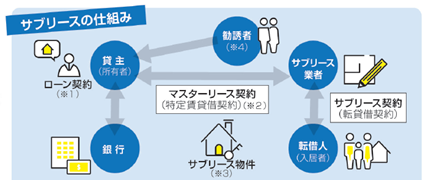
The owner's direct contract is the master lease; the party to the actual tenancy agreement with the occupant is the sublease operator, not the owner. In other words, the peace of mind that "rent keeps coming in even during vacancy" rests entirely on the operator's ability to pay and on the specific terms of your contract — it is a corporate credit exposure to your master-lease counterparty, not a guarantee backed by any regulator. Unlike a standard fixed-term US or UK residential lease, where the landlord contracts directly with the occupying tenant, a Japanese sublease structure interposes a corporate counterparty between you and every unit's actual resident. Four articles are essential reading:
| Article | What it regulates | Penalty for violation |
|---|---|---|
| Article 28: Prohibition of misleading advertising | Bans materially false or misleading representations about rent amount, payment dates and revision terms, how maintenance is performed and costs shared, and conditions for contract termination | Fine up to ¥300,000 (approx. $2,000) |
| Article 29: Prohibition of improper solicitation | Bans deliberately withholding or misrepresenting material facts, such as the risk of a rent reduction. Unsolicited phone or in-person solicitation between 9:00 PM and 8:00 AM can also fall under this provision | Up to 6 months' imprisonment or a fine up to ¥500,000 (approx. $3,330) |
| Article 30: Pre-contract explanation of key matters | Requires a written explanation of 14 specified items before signing; a roughly one-week gap between the explanation and the signing is considered good practice | Fine up to ¥500,000 (approx. $3,330) |
| Article 31: Written disclosure at signing | Requires a written document covering 13 items, including contract term, rent and other conditions, how maintenance is performed and costs shared, reporting obligations, liquidated damages, exemptions, renewal/termination terms, and how rights and obligations transfer at contract end | Fine up to ¥500,000 (approx. $3,330) |

In practice, do three things. First, make sure at least a week separates the date you received the Article 30 explanation from the date you sign. Second, have the operator read aloud, from the Article 31 document, exactly how and when rent revisions happen and exactly what triggers contract termination, and ask them to restate both in plain language on the spot. Third, request to inspect the sublease operator's business status report and balance sheet, which Article 32 requires every sublease operator to keep on file at its office. These are prepared within three months after each fiscal year-end and must be made available for inspection for three years from the date they are filed. There is no good reason to hand a company a 35-year master lease if it is reluctant to let you see these documents. For a deeper look at how the sublease structure itself works and where the risk sits, see Sublease (Master Lease) Contract Structure and Risk.
6. Can construction and management be decoupled? / 7. Is the structure and specification designed with an exit in mind?
6. Handing ongoing property management to the same company that built your property is never mandatory. Confirm, in writing, before you sign, whether construction and management can be separated, and how warranty coverage and after-sales inspection change if they are. If a bundled contract locks you into inseparability, the number of years that lock-in lasts is your real term of obligation — read it as such.
7. The exit begins the moment construction finishes. Whether a future buyer can obtain financing depends on structural type, remaining useful life, and whether a completion inspection certificate (検査済証) exists. Confirm you'll receive the full building-confirmation and completion-inspection paperwork at handover, and how design drawings and structural calculations will be archived. Leave this vague for twenty years and, when you go to sell, the transaction can stall at the buyer's bank.
Tax and financing: the numbers to know as of 2026
Builder selection connects directly to how much tax relief you can actually capture. Here is what's confirmed as of August 2026.
The 50% fixed-asset-tax reduction for new housing is extended through March 31, 2031
The measure that halves the fixed-asset tax on new housing (three years for a detached house, five years for a condominium building) has been extended five years, running from April 1, 2026 through March 31, 2031. Two changes come with the extension:
- The minimum floor-area requirement to qualify has been relaxed to 40 m² (down from 50 m²) in most cases — a change with real practical impact for studio-centric rental housing.
- Housing located within certain designated hazard zones is now excluded from eligibility. Check your project site against your municipality's hazard map before breaking ground to confirm which zone it falls in.
MLIT's own estimate: for a newly built ¥25,000,000 home (approx. $166,670), the fixed-asset tax would run ¥182,000/year (approx. $1,210) without the exemption versus ¥91,000/year (approx. $610) with it — roughly ¥270,000 (approx. $1,800) in savings over three years. It's also worth modeling the tax difference against simply holding the land vacant, to sharpen your own decision.
Certified Long-Life Quality Housing carries a ¥1,300,000 real-estate acquisition tax deduction
The special tax treatment for certified Long-Life Quality Housing has likewise been extended five years, through March 31, 2031. Here's how it compares to standard housing:
| Tax item | Standard housing | Certified Long-Life Quality Housing |
|---|---|---|
| Real-estate acquisition tax deduction from taxable base | ¥12,000,000 (approx. $80,000) | ¥13,000,000 (approx. $86,670) |
| Fixed-asset-tax relief period (detached house) | 3 years | 5 years |
| Fixed-asset-tax relief period (condominium) | 5 years | 7 years |
| Rental-housing loan rate discount | None | Year 1–15: 0.3 points/year |
Source: MLIT (国土交通省), "Overview of FY2026 Tax Reform" (December 2025); interest rate from the Japan Housing Finance Agency source cited above
Certification requires meeting standards across deterioration countermeasures, seismic performance, energy efficiency, ease of maintenance and renovation, disaster resilience, and living-environment quality. Whether a builder can design toward certification from the outset determines whether you capture all three benefits — tax, interest rate, and exit value — at once. A per-tsubo price that's a few tens of thousands of yen higher can end up the better deal once certification is factored in. Ask each candidate builder how many certifications it has actually obtained, and how long the process took from application to approval.
What we believe actually matters in choosing a builder
We've walked through a great deal of data. What we want to leave you with, in closing, is something different.
After all the numbers, what matters most is whether this is someone you can work with for the long haul
Owning rental property doesn't end at handover. A wood-frame building carries a 22-year statutory life; an RC building, 47 years. Over that span, tenants will turn over many times, the water heater will need replacing, and the exterior will eventually need repainting. Whether the company across the table is someone you can walk that long stretch of time with is not a line item that shows up on any per-tsubo comparison chart.
At INA&Associates, we believe our people are our single greatest asset. A building goes up according to its blueprints, but how a company responds to whatever happens after completion depends entirely on the judgment and integrity of the individual staff member handling it. That's exactly why it's worth meeting, before you sign anything, not just the sales representative but the actual person who will be your point of contact after completion. A single question — "how long have you personally been with this company?" — changes the tone of the answer you get back.
The other thing we hold to is telling clients the uncomfortable numbers too. The fact that prefab construction runs 40.8% more expensive for wood-frame is not a convenient statistic for a house maker to publish. But if that price difference buys a genuinely shorter build time and a genuinely stronger after-sales program, that should be laid out on the same page, with the same rigor. A company willing to volunteer the numbers that don't flatter it is a company worth trusting.
The single highest-value thing you can do once you've received a proposal is to have someone with no financial stake in the deal review it. Whether the vacancy rate, rent-decline assumption, and repair-cost estimate in a builder's own financial projection are realistic is much easier to judge from outside that company than from within it. That is precisely the role we play when we're brought in to provide a second opinion on a real-estate investment.
Summary: compare price per tsubo, yield, and long-term support — not company names
When comparing builders for an apartment or condominium rental project, these are the five numbers worth keeping close at hand:
- Price per tsubo is set by structural type. ¥721,000 for wood-frame, ¥1,124,000 for steel-frame, ¥1,160,000 for RC (approx. $4,810 / $7,490 / $7,730) is the 2026 nationwide benchmark. Decide your structural type first, then start comparing builders.
- The prefab premium isn't constant — it depends on structure. +40.8% for wood-frame, +2.4% for steel-frame, +8.5% for RC. It's specifically for wood-frame apartment buildings that comparing across construction methods pays off the most.
- Construction costs have risen 36.9% in five years. A financial model built on older figures needs to be rebuilt from current data.
- Wood-frame wins on yield; RC wins on term. 11.98% versus 7.81% isn't a verdict on which is "better" — it's the trade-off between a 22-year and a 47-year useful life.
- Long-Life Quality Housing certification changes your rate, your tax, and your exit value all at once. That can outweigh a per-tsubo gap of a few tens of thousands of yen.
And finally: checking a builder's construction-business license and rental-housing-management registration on MLIT's company-information search system, checking its disciplinary history on the Negative Information Search Site, and reviewing any sublease proposal against Articles 28–31 of the Rental Housing Management Business Act — all three are free, available to anyone, and doable before you sign anything. For both apartment ownership and condominium ownership, the quality of your decision is a direct function of the quality of the information behind it.
Frequently asked questions
Q. How much more expensive is a house maker than a local construction company?
Comparing the same structural type, wood-frame shows roughly a 40% gap (+40.8%), and the all-structures average shows 18.4%. Steel-frame, however, comes in at only +2.4%, and RC at +8.5%. Using MLIT's "Statistics on Construction Starts" for full-year 2025 rental housing: wood-frame runs ¥218,000/m² for all methods versus ¥307,000/m² for prefab; steel-frame runs ¥340,000 versus ¥348,000; RC runs ¥351,000 versus ¥381,000 (approx. $1,450/$2,050; $2,270/$2,320; $2,340/$2,540). The variation by structural type matters more in practice than the general rule of thumb that "house makers cost 10–30% more."
Q. Which yields higher returns: an apartment building or a condominium building?
Gross yield is higher for a wood-frame apartment building. Our model shows 11.98% for a 200 m², 8-unit wood-frame building versus 7.81% for a 600 m², 20-unit RC condominium building (both using the national average construction cost and national average private-rental rent, assuming the land is already owned and the building is fully occupied). However, statutory useful life is 22 years for wood-frame versus 47 years for RC, which changes both your annual depreciation and the loan term you can arrange. Higher yield and longer holding horizon are effectively a choice between two different strategies, not a simple ranking.
Q. How many companies should I get bids from?
Around three is realistic. What matters more than the number of bidders is holding the assumptions constant: specify total floor area, unit count, exclusive floor area per unit, how exterior work and ground improvement are treated, and a breakdown of the design fee, identically across every request. Since construction costs have risen 36.9% in five years, also make sure every bid is dated within the same short window. Before you even request bids, checking each candidate's license number on MLIT's Construction and Real Estate Business Information Search System and its disciplinary history on the Negative Information Search Site puts every bid on the same footing.
Q. Should I avoid sublease (master-lease) contracts altogether?
Not as a blanket rule, but the terms to verify are specific and non-negotiable. Under the Act on Management of Rental Housing, misleading advertising (Article 28) and improper solicitation (Article 29) are prohibited, and the operator is legally required to explain 14 key items in writing before you sign (Article 30) and to hand you a written document covering 13 items at signing (Article 31). Confirm, specifically and in writing, the timing and method of rent revisions and the conditions for contract termination, and insist on at least a week between the pre-contract explanation and the signing. Build your financial model on the assumption that your guaranteed rent can be reduced through periodic review — because under a standard Japanese master lease, it can.
Q. Construction costs are rising — should I wait to break ground?
There's no reliable basis for assuming prices will fall if you wait, so weigh two facts instead. First, the per-square-meter construction cost for rental housing has risen consistently: ¥214,000 in 2020, ¥230,000 in 2022, ¥270,000 in 2024, and ¥293,000 in 2025 (approx. $1,430 → $1,530 → $1,800 → $1,950). Second, rental-housing starts fell to 324,991 units in 2025, the third consecutive annual decline. The combination of falling starts and rising unit cost suggests the price pressure is coming from materials and labor costs, not from demand. The reference rate as of August 2026 is 3.94% (35-year fixed, JHF). If you do decide to wait, factor in both the rental income you forgo while waiting and the risk that interest rates move against you in the meantime.
Q. Does my property manager after construction have to be the same company that built the property?
No. It's entirely possible to have a house maker handle construction while a separate specialist property-management company handles ongoing management. That said, if your contract bundles a master lease or a long-term warranty with construction, switching management providers can alter your guarantee terms. Confirm, in writing before you sign, whether the two can be separated and what changes if they are.
Citations and references
- MLIT (国土交通省), "Statistics on Construction Starts, Housing Starts Statistics," 2025 annual (full-year 2025), Tables 34, 36, and 45 (published January 30, 2026)
- MLIT (国土交通省), "Report on the Statistics on Construction Starts (Full-Year 2025)" (published January 30, 2026)
- Statistics Bureau of Japan (総務省統計局), "2023 Housing and Land Survey: Basic Tabulation Results Concerning Housing and Households (Detailed Tabulation)" (published September 25, 2024)
- National Tax Agency (国税庁), "Useful Life of Major Depreciable Assets (Buildings / Building Attachments)"
- National Tax Agency (国税庁), "Standard Construction Cost Table for Buildings"
- Japan Housing Finance Agency (住宅金融支援機構), "Rental Housing Loan Interest Rates" (updated July 30, 2026 / August 2026 reference rate)
- MLIT (国土交通省), "Overview of FY2026 Tax Reform" (December 2025)
- MLIT (国土交通省) Rental Housing Management Business Act Portal, "Sublease Fairness Measures"
- MLIT (国土交通省) Rental Housing Management Business Act Portal, "System Overview"
- MLIT (国土交通省), "Construction and Real Estate Business Information Search System"
- MLIT (国土交通省), "Negative Information Search Site"
- Sekisui House, "Master Lease System" (一括借上システム)
The calculations in this article are estimates based on public data. For tax and financing decisions specific to your own land conditions and income situation, please consult a licensed tax professional and your financial institution. All USD conversions are approximate, rounded, and provided for orientation only; they are not a substitute for checking a live exchange rate at the time of your own decision-making.