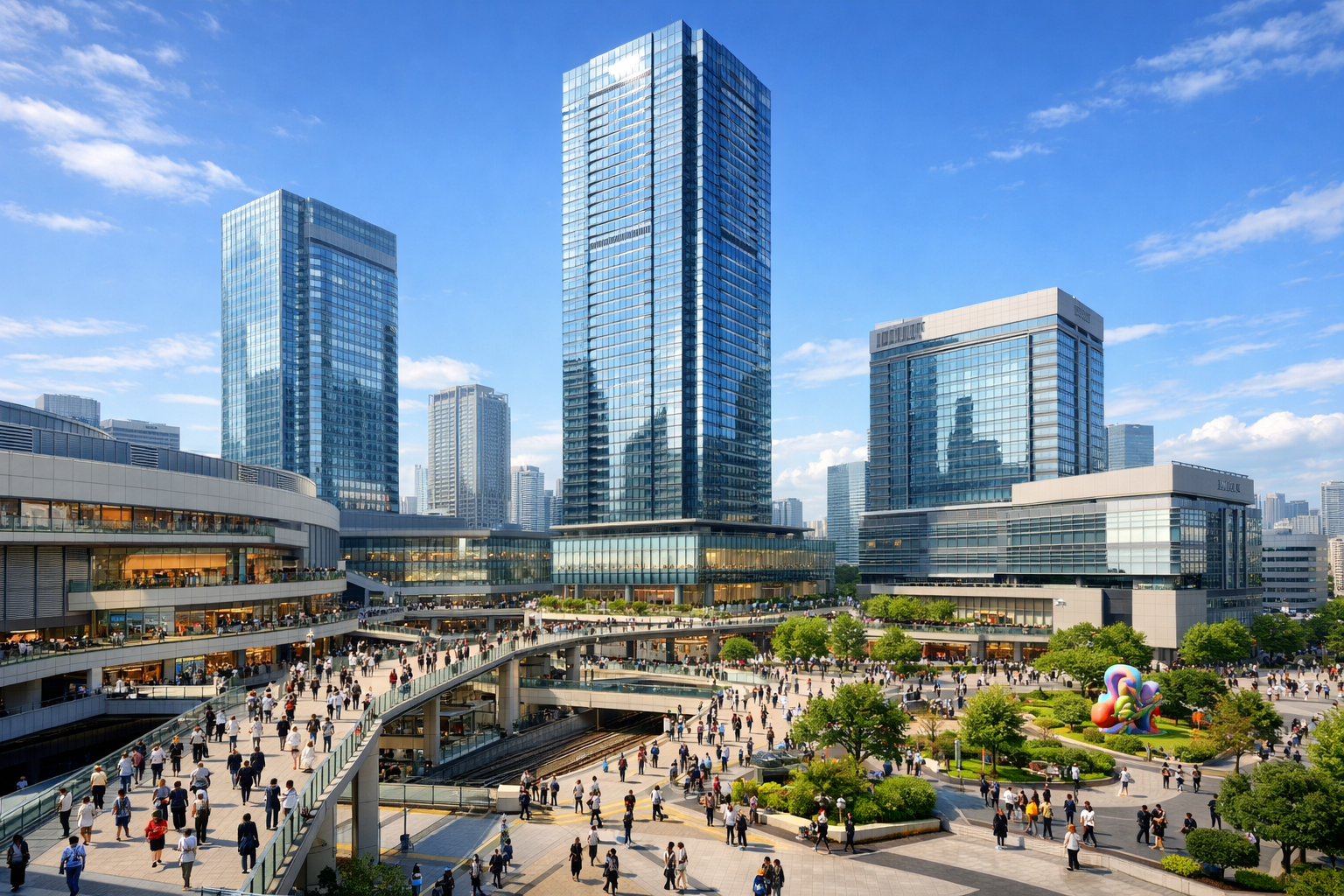
Yokohama Station is a major transportation hub in the Tokyo metropolitan area, used by millions of people daily. Large-scale redevelopment projects have been ongoing for years to transform it into a more attractive and convenient gateway to an international city.
Major Redevelopment Projects
THE YOKOHAMA FRONT (Tsuruyacho District) — A 43-story mixed-use complex completed in March 2024, with commercial, hotel, residential, and co-creation facilities. The commercial area opened in June 2024, connected to Yokohama Station via a pedestrian deck for rain-free access.
JR Yokohama Tower and JR Yokohama Tsuruyacho Building — Opened June 2020, these connected buildings house retail, offices, hotels, and sports facilities, boosting the convenience of the West Exit area.
Linkage Terrace Project (MM60/61 Project) — This project is not in front of Yokohama Station but in Blocks 60 and 61 of the Minato Mirai 21 Central District, the same blocks as the "Music Terrace" (K-Arena Yokohama, Hilton Yokohama, K Tower Yokohama) that opened in September 2023. It will include offices, hotel, museum, retail, and vocational school facilities. According to materials published by the City of Yokohama, construction started in January 2026, with the West Building scheduled for completion in July 2028 and the East Building in February 2029, and it is expected to improve circulation from Yokohama Station toward Minato Mirai.
South East Exit District Redevelopment — Centered on the Yokohama Central Post Office site (~1.41 ha), an urban redevelopment preparation association was established in June 2024. The environmental impact assessment scoping document submitted to the City of Yokohama in October 2025 sets out a high-rise building with 3 basement levels and 45 floors above ground, a height of approximately 231 m and a total floor area of approximately 215,000 m2, with a landing pad for flying cars and helicopters on its roof. Construction is to start in FY2028, with service scheduled to begin in FY2037. High-density land use and a three-dimensional pedestrian network aim to improve circulation around the station.
"Excite Yokohama 22" Vision — Established in 2009 by Yokohama City, this urban planning vision aims to make the Yokohama Station area a fitting gateway for an international city, focusing on internationalization, environmental measures, station appeal, and disaster safety.
Future Development Plans
Sotetsu Group's "Yokohama Station West Exit Major Renovation Plan" — Targeting completion by the 2040s, this plan envisions a multifunctional district for working, living, playing, and learning, with Sotetsu Movie Theater replacement scheduled to begin in the late 2020s.
South East Exit Area — The redevelopment committee is working on detailed plans for high-density land use, commercial and business concentration, and a three-dimensional pedestrian network.
Impact and Outlook
Transportation: Expanded pedestrian decks and underground passages improve circulation. Better public transit convenience and distributed taxi stands are expected to ease traffic congestion.
Commerce: New commercial facilities diversify shopping experiences and stimulate the local economy. Integration with existing retail further boosts foot traffic.
Residential: Station-connected tower condominiums meet demand for urban living. Medical and childcare facilities are being developed, though concerns about building height impact on scenery and radio interference must be addressed.
Conclusion
Multiple simultaneous redevelopment projects around Yokohama Station are strengthening its role as a transport hub while forming new commercial, cultural, and residential zones. Close collaboration among all stakeholders and region-sensitive planning are essential as Yokohama Station evolves into the true face of an international city.
