If you are an international investor weighing whether to bid on a Japanese foreclosure property (kyōbai bukken, 競売物件 — a property sold at judicial auction to satisfy a defaulted loan), here is the conclusion up front: the "cheapness" of a foreclosure property is not a market discount. It is a legally fixed price floor bundled together with the procedures, costs, and time that the winning bidder must personally absorb. This is a distinctly Japanese mechanism with no exact equivalent in a US sheriff's sale, a UK repossession auction, or an Australian mortgagee sale — the price floor, the eviction procedure, and the deadlines are all set by statute, and missing a deadline by even one day can strip you of your legal remedy. If the previous owner refuses to vacate, Japanese law does give the winning bidder a tool to force them out — a court order called a hikiwatashi meirei (引渡命令, "writ of possession") — but it can only be filed within six months of paying the purchase price. Wait too long while you try to negotiate, and that tool disappears entirely. This article lays out, using nothing but the text of the statutes and figures published by the Japanese courts and the National Tax Agency, the difference between a judicial foreclosure auction (kyōbai), a tax-delinquency public auction (kōbai), a private workout sale (nin'i baikyaku), and an ordinary brokered sale; the real yen amounts and real number of days involved when a holdout occupant won't leave; and the taxes due once you actually take title.
Key takeaways
- The floor price you are legally allowed to bid is the "minimum purchase price" (baiukebeshi kagaku, 買受可能価額) — 80% of the court's "sale-standard price" (baikyaku kijun kagaku, 売却基準価額) — and that 80% figure is set directly by statute (Civil Execution Act, Article 60, Paragraph 3). The commonly repeated claim that foreclosure properties sell "20–30% below market" is not a legal figure at all; it is a rule of thumb, and it is frequently wrong.
- Your ultimate weapon against a holdout occupant, the writ of possession, can only be petitioned for within six months of the date you pay the purchase price (nine months if the occupant is a tenant protected by the statutory vacate-grace-period rule). Miss that window and the remedy is gone (Civil Execution Act, Article 83, Paragraph 2).
- Forced eviction starts with a mandatory advance deposit of ¥65,000 (approx. USD 433 at ¥150/USD, as of 2026-08) paid to the court execution officer (the standard amount at the Tokyo District Court) — and that figure does not include mover's day wages, the cost of hauling away abandoned belongings, or warehouse storage fees, all of which are billed separately.
- "The court bears absolutely no responsibility" is not an accurate description of Japanese law. The court's immunity under Civil Code Article 568 applies only to defects in the kind or quality of the physical property — it does not extend to defects in legal title, where cancellation, a price reduction, or damages may still be available.
- A tax-delinquency public auction (kōbai, sometimes marketed to foreign buyers as a "government property auction") is an even harsher instrument than a judicial foreclosure: for real estate, the government owes the winning bidder no obligation to deliver possession at all, and there is no equivalent of the writ-of-possession procedure available to a foreclosure buyer.
This is a distinctly Japanese system: should you avoid foreclosure properties altogether?
Before going further, it is worth stating clearly what makes this a "Japan-specific" investment problem rather than a generic auction-property caveat. In many common-law jurisdictions, an occupant who won't leave a foreclosed property triggers an unlawful-detainer or eviction lawsuit that the new owner files from scratch, often taking many months with an uncertain outcome. Japan's Civil Execution Act instead gives the winning bidder a purpose-built, comparatively fast administrative order — the writ of possession — precisely because the legislature anticipated that foreclosure buyers would routinely face holdout occupants. The tradeoff is that this remedy is wrapped in strict, unforgiving deadlines that do not exist in an ordinary real estate purchase anywhere.
My honest answer, after walking through the numbers below: I do not recommend foreclosure properties to first-time Japanese real estate buyers, to anyone without meaningful spare capital, or to anyone who cannot tolerate a lag of six months or more between winning the auction and actually taking possession. On the other hand, if you can settle in cash, if your financial plan already assumes several months and several thousand dollars of eviction cost, and if you (or an advisor you trust) can actually read the court's disclosure documents — the so-called "three-document set" described later in this article — then a foreclosure property is worth evaluating. The decisive factor is not whether the property itself is good or bad. It is one single question: can you personally absorb the time and cost of the legal process?
The price floor is fixed by statute: the minimum bid equals 80% of the court's sale-standard price
The oft-repeated marketing claim that foreclosure properties sell "20–30% below market" has no legal basis whatsoever. What the law actually fixes is only the floor — the lowest amount a bid is even allowed to be.
The execution court appoints a court-approved appraiser and sets a "sale-standard price" (baikyaku kijun kagaku) based on that appraisal. A bid must be at or above the "minimum purchase price" (baiukebeshi kagaku), defined as the sale-standard price minus one-fifth (i.e., 80% of it) (Civil Execution Act, Article 60, Paragraph 3). If the sale-standard price is ¥20,000,000 (approx. USD 133,300), the floor is ¥16,000,000 (approx. USD 106,700). In other words, that "20% discount" is merely the floor at which the court will accept a bid — it is neither the winning bid price nor the discount to market value. Popular properties routinely sell for more than the sale-standard price, sometimes well above it, in a competitive bidding process not unlike a US foreclosure auction where multiple investors drive the price up from the opening bid.
What "cheap" really means: it is the price of the risk the buyer is taking on
The court appraiser prices in every foreclosure-specific handicap: an occupant may still be living there, you generally cannot inspect the interior before bidding, and there is no cooperative seller walking you through the property's history or condition. The structural reason the price looks "cheap" is that all of the work and risk that a seller or a real estate agent would normally carry in an ordinary transaction has simply been shifted onto the buyer.
That is why judging whether a foreclosure deal is actually a good deal cannot be done by looking at the winning bid alone. You need to add up the winning bid + registration and license tax + real estate acquisition tax + the actual out-of-pocket cost of eviction + any inherited unpaid fees you must assume + restoration costs, and only then compare that total against comparable sales in the neighborhood. Later in this article we walk through that full calculation using real statutory tax rates and real court deposit amounts.
Statutory Costs and Deadlines for a Japanese Foreclosure Property [Reference Table]
In a Japanese foreclosure sale, most of the dates and amounts are dictated by statute and by the operating rules of the execution court, not by negotiation. Here is the overall picture in numbers, based on the published procedure of the Tokyo District Court's Civil Enforcement Center (Civil Division 21).
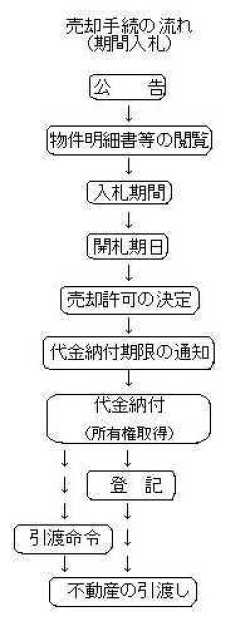
As the chart shows, everything from the public notice through payment of the purchase price runs along a single continuous track — but the writ of possession is a separate, later petition that only begins after that track ends. This is exactly the branch point where "I won the auction but I still can't move in" happens, and it is the single most important structural fact for a foreign buyer to understand before bidding.
Numbers table: from bidding to payment of the purchase price
| Item | Amount / Deadline | Legal basis |
|---|---|---|
| Minimum bid amount | Minimum purchase price = 80% of the sale-standard price (sale-standard price minus one-fifth) | Civil Execution Act, Art. 60, Para. 3 |
| Bid deposit (guarantee) | Normally 20% of the sale-standard price; can be higher — always confirm in the public notice | Same Act, Art. 66 / Tokyo District Court operating rule |
| Bidding period | Normally 8 days at the Civil Enforcement Center | Tokyo District Court, "Procedures for Purchasing a Foreclosure Property" |
| Posting of the public notice and availability of the "three-document set" | Normally 15 days before the bidding period begins | Same source |
| Sworn statement of non-affiliation with organized crime | Required with every bid submission; failure to submit voids the bid, with no opportunity to cure | Civil Execution Act, Art. 65-2 |
| Deadline to pay the purchase price | Normally within about one month of the sale-permission decision becoming final | Same Act, Art. 78, Para. 1 / Tokyo District Court operating rule |
| Treatment of the deposit | The deposit the winning bidder submitted is applied to the purchase price | Same Act, Art. 78, Para. 2 |
| Failure to pay by the deadline | The bidder forfeits the right to purchase and does not get the deposit back | Tokyo District Court, "Procedures for Purchasing a Foreclosure Property" |
In practical terms, the last two rows are what matter most. On a property with a ¥20,000,000 (approx. USD 133,300) sale-standard price, you would need to have ¥4,000,000 (approx. USD 26,700) ready at bidding time, and then pay the remaining balance in cash roughly one month after winning. If your bank's loan underwriting cannot close within that window, your ¥4,000,000 (approx. USD 26,700) deposit is gone — non-refundable. Unlike a conventional home purchase where financing contingencies are standard, a foreclosure sale gives you essentially no such cushion. If you have not already built a banking relationship well before bidding, I have to be candid: the foreclosure timeline is unforgiving. Our related guide on building a relationship with lenders to secure financing covers what that groundwork looks like in practice.
Numbers table: deadlines that start running after you win the auction
| Item | Deadline | Legal basis |
|---|---|---|
| Petition for a writ of possession (general rule) | Within 6 months of the date the purchase price is paid | Civil Execution Act, Art. 83, Para. 2 |
| Petition for a writ of possession (against an occupant of a mortgaged building entitled to the statutory vacate-grace period) | Within 9 months of the date the purchase price is paid | Same |
| When a petition becomes available against an occupant entitled to the vacate-grace period | After the 6-month grace period from the date of payment has elapsed (with exceptions) | Civil Code Art. 395, Para. 1 / Tokyo District Court |
| Period to file an objection (execution appeal) against a writ of possession | One week, counted from the day after service of the certified copy | Tokyo District Court, "Procedural Flow from Petitioning for a Writ of Possession to Petitioning for Enforcement" |
| Start date of forced eviction enforcement | A date normally within 2 weeks of the petition, set in consultation with the execution officer | The Courts, "Real Estate Delivery (Eviction) Enforcement" |
| From the eviction notice to the final vacate deadline | The date that is one month after the date the notice was issued | Civil Execution Act, Art. 168-2, Para. 2 |
Numbers table: out-of-pocket costs
| Cost item | Amount | Source |
|---|---|---|
| Filing fee for the writ-of-possession petition | ¥500 (approx. USD 3.3) in revenue stamps per named respondent | Tokyo District Court, "On Petitioning for a Real Estate Writ of Possession" |
| Advance postage for the writ-of-possession petition | (¥110 [approx. USD 0.7] × number of petitioners) + (¥1,220 [approx. USD 8.1] × number of respondents) | Same |
| Advance deposit for eviction enforcement (base amount) | ¥65,000 (approx. USD 433) for a real-estate delivery/eviction case | Tokyo District Court Execution Officers' Office, "Standard Advance Deposit Table" (revised April 1, 2021) |
| Additional amount | +¥40,000 (approx. USD 267) for each additional debtor or each additional property | Same |
| Not included in the advance deposit | Movers' day wages, cost of hauling away abandoned belongings, warehouse storage fees, etc. — all billed separately | Same (footnote) |
| When a corporation is a party | A certificate of corporate status issued within the prior 3 months is required | Tokyo District Court, "On Petitioning for a Real Estate Writ of Possession" |
The footnote to the Standard Advance Deposit Table explicitly states that movers' day wages, the cost of hauling away abandoned belongings, and warehouse storage fees are not included in the deposit. ¥65,000 (approx. USD 433) is not a ceiling — it is only the entry price. If the unit is left full of furniture and personal effects, the actual hauling and storage costs stack on top of it.
If the Former Owner Won't Leave: The Path and Cost from Writ of Possession to Forced Eviction
This section is for anyone specifically researching what happens when the previous owner of a Japanese foreclosure property refuses to move out. If the occupant will not leave voluntarily, the only tool available to the winning bidder is a court order called the writ of possession (hikiwatashi meirei) — once obtained, the bidder then petitions the execution officer for forced eviction. Informal negotiation or a friendly buyout offer is not part of this two-step legal process; it is, at best, something that happens alongside it.
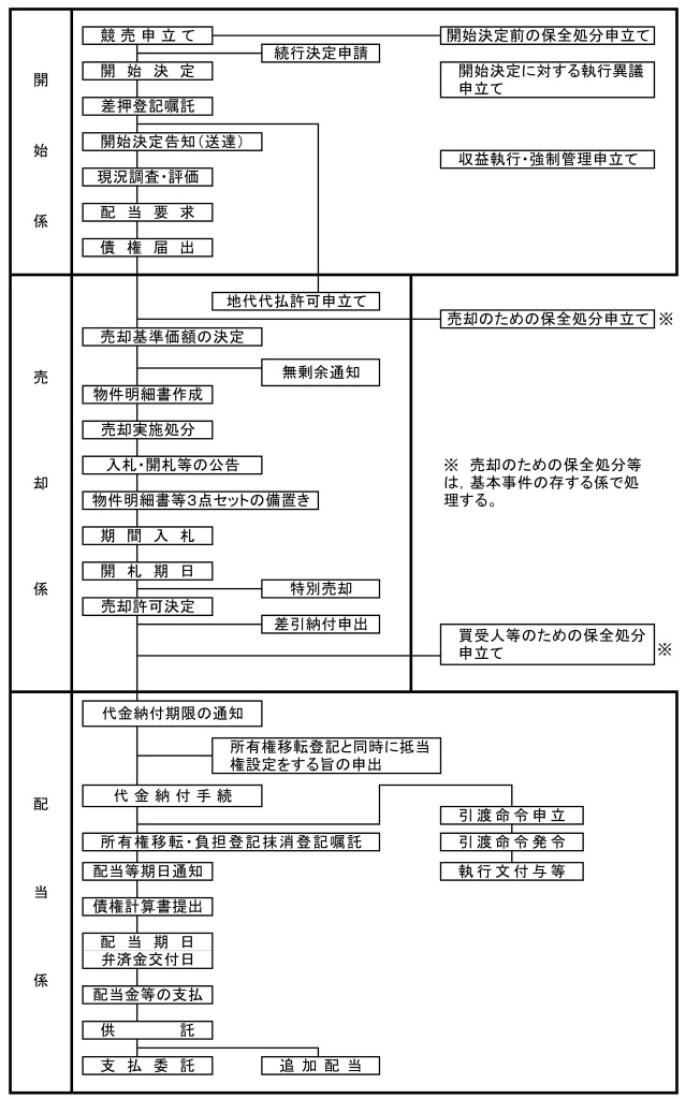
In the lower right of the chart, in the distribution division's column, you can see "writ-of-possession petition → writ of possession issued → enforcement clause granted, etc." laid out in sequence. The structure is clear: paying the purchase price is not the end of the process — it is the point at which an entirely separate procedure begins.
Timeline table: from payment of the purchase price to physical eviction
| Stage | What you file | What you pay | Deadline / timeframe |
|---|---|---|---|
| 1. Payment of the purchase price | Documents accompanying the deposit-receipt procedure | Winning bid amount minus the deposit | Within about 1 month of the sale-permission decision becoming final. This date is the day the 6-month / 9-month clock starts. |
| 2. Petition for a writ of possession | Petition, list of parties, property list (a certificate of corporate status within 3 months if a corporation), receipt | ¥500 (approx. USD 3.3) stamp + postage (¥110 [approx. USD 0.7] × petitioners + ¥1,220 [approx. USD 8.1] × respondents) | Within 6 months of the date the purchase price is paid (9 months for a tenant entitled to the vacate-grace period) |
| 3. Hearing | — (the court serves a hearing document on the respondent) | — | Respondent normally instructed to reply within 7 days |
| 4. Order issued and served | — | — | The judge reviews the record and the response, then issues the order |
| 5. Order becomes final | — | — | The 1-week execution-appeal period, from the day after service, must elapse |
| 6. Enforcement clause and certificate of service granted | Petition for the clause; application for a certificate of service | Stamp fees, etc. | After finality |
| 7. Petition for eviction enforcement | Petition, certified writ with enforcement clause, certificate of service, certificate of corporate status, sketch map of the site | Advance deposit of ¥65,000 (approx. USD 433) (+¥40,000 [approx. USD 267] per additional debtor/property) | Filed with the Execution Officers' Office; stamps and postage generally not required |
| 8. Vacate notice | The creditor (or agent) attends on site | — | Normally carried out within 2 weeks of the petition date |
| 9. Final vacate deadline | — | — | The date one month after the notice date |
| 10. Physical eviction | The creditor (or agent) attends | Movers' day wages, hauling costs, storage costs (actual amounts) | Any convenient date up to the final vacate deadline |
The procedure itself is well organized, and if everything runs smoothly, physical possession can be achieved within several months of paying the purchase price. The problem is that at every stage, the winning bidder has to prepare the paperwork and track the calendar personally — there is no listing agent or property manager doing it for you. If you have already gone through the full eviction process for a delinquent tenant in Japan, you already have a sense of the workload involved; for a first-timer, it is more than most expect.
Civil Code Article 395: the 6-month vacate grace period, and how a demand notice under Paragraph 2 can cut it short
Treatment differs depending on who the occupant is. A "mortgaged-building occupant" — someone occupying under a lease that cannot be asserted against the mortgage holder — does not have to hand the building over to the winning bidder until six months have passed from the date of purchase (Civil Code, Article 395, Paragraph 1). The typical example is a tenant who was already living there under a lease that predates the foreclosure filing.
This grace period is not unconditional, however. If the winning bidder sets a reasonable deadline and formally demands at least one month's worth of use-value payment for the period after purchase, and the occupant fails to pay within that deadline, the grace-period rule no longer applies (Paragraph 2). In practice, this demand is sent by certified mail with proof of delivery (Japan's equivalent of certified mail with a delivery certificate), and a copy of that proof is attached to the writ-of-possession petition. If you neglect to demand fair-market rent from the occupant, you are the one closing off this option.
Adding it up: a real cost example for one holdout eviction case
Using the Tokyo District Court's standard amounts, here is a worked estimate for a single condominium unit (one property) occupied solely by one debtor.
| Item | Amount |
|---|---|
| Writ-of-possession filing fee (1 respondent) | ¥500 (approx. USD 3.3) |
| Advance postage (1 petitioner, 1 respondent) | ¥1,330 (approx. USD 8.9) (¥110 [approx. USD 0.7] + ¥1,220 [approx. USD 8.1]) |
| Eviction enforcement advance deposit (base amount) | ¥65,000 (approx. USD 433) |
| Subtotal (the part fixed by published figures) | ¥66,830 (approx. USD 445.5) |
| Movers' day wages / hauling / warehouse storage | Actual cost, separate (varies with the volume of belongings left behind) |
| Attorney's fee, if you retain one | Separate (varies by firm) |
| Lost rent during the vacancy period before possession | Estimated market rent × number of months |
The published figures only lock in ¥66,830 (approx. USD 445.5); everything else depends on the property's condition and how you handle the work. Here, the bigger issue is not the uncertainty in these fees — it is lost rent. On a unit that could rent for ¥100,000/month (approx. USD 667/month), if eviction takes eight months, you have already lost ¥800,000 (approx. USD 5,300) in income. Whether the auction's "20% discount" was actually worth it comes down to whether you can absorb this time cost.
Miss the deadline by even one day and the writ of possession is gone
Once six months have passed since the purchase price was paid (nine months for an occupant of a mortgaged building entitled to the vacate-grace period), the winning bidder can no longer petition for a writ of possession at all (Civil Execution Act, Article 83, Paragraph 2). This is a hard deadline — there is no extension mechanism.
If you keep negotiating on the assumption that "they'll probably leave if I just talk to them a little longer" and the six months slip by, your only remaining option is an ordinary lawsuit demanding possession of the building — and both the time and the cost jump sharply from there. The standard practice, as a matter of course, is to file the writ-of-possession petition in parallel with any negotiation, not instead of it.
Rights That Disappear vs. Rights You Inherit When You Buy at a Japanese Foreclosure Auction [Reference Table]
The rights attached to a foreclosure property are not simply "wiped clean" by the sale. The statute draws a clear line between what disappears and what the buyer takes on.
| Right / obligation | What happens after the sale | Legal basis |
|---|---|---|
| Statutory liens, pledges without a right of use/enjoyment, mortgages | Extinguished by the sale | Civil Execution Act, Art. 59, Para. 1 |
| Rights acquired but unenforceable against the extinguished right holder, an attaching creditor, or a provisional-attachment creditor | Lose their effect upon sale | Same, Para. 2 |
| Attachments, provisional-attachment enforcement, and unenforceable provisional dispositions | Lose their effect upon sale | Same, Para. 3 |
| Possessory liens, and pledges that do carry a right of use/enjoyment | The winning bidder becomes liable to pay off the secured debt | Same, Para. 4 |
| Occupancy by a mortgaged-building occupant under a lease unenforceable against the mortgage holder | No obligation to vacate for 6 months from the date of purchase | Civil Code, Art. 395, Para. 1 |
| Occupancy under a title enforceable against the winning bidder | Falls outside the scope of a writ of possession (the buyer simply inherits it) | Civil Execution Act, Art. 83, Para. 1, proviso |
| Unpaid condominium management fees / reserve-for-repair fund contributions | The management association can bill the winning bidder as the "specific successor" | Act on Building Unit Ownership, Art. 7, Para. 1 / Art. 8 |
For readers coming from a US condo or UK leasehold background: this is meaningfully different from many Western jurisdictions, where a foreclosing lender's title typically wipes out most junior liens and a buyer at a US foreclosure sale rarely inherits the prior owner's HOA arrears in full. Japan's condominium law works the other way — the unpaid dues survive the change of ownership and travel with the unit, not the person.
What you inherit: possessory liens, and the secured debt behind a pledge with a right of use
One of the most commonly overlooked provisions is Civil Execution Act Article 59, Paragraph 4. If a possessory lien exists on the property, the winning bidder is responsible for paying off the debt secured by that lien. A classic scenario is a contractor who has not been paid for construction work and is physically occupying the building as leverage — in a case like that, the buyer may have to pay off that unpaid debt, on top of the winning bid, before ever gaining possession. This is exactly why it matters to check the property description document — one of the "three-document set" discussed below — for any such inherited right before you bid.
What you inherit: unpaid management fees pass by operation of law, not because of the condo bylaws
When the previous owner of a condominium unit left management fees or reserve-for-repair contributions unpaid, that debt can be pursued against the "specific successor" of the debtor-unit-owner (Act on Building Unit Ownership, Article 8; the underlying receivable is defined in Article 7, Paragraph 1). The winning bidder is a specific successor, so the management association will come to you for it.
You will sometimes see this explained as "you inherit it because the bylaws say so" — that is not accurate. You inherit it as a matter of statute, regardless of what the bylaws do or don't say. If you are bidding on a condominium unit, contact the management association or management company promptly after paying the purchase price to ask for the outstanding balance, and build it into your budget. Our guide on what condominium management fees cover and how they're structured is a useful primer before that call.
"The Court Bears No Responsibility Whatsoever" Is Not Accurate: How to Read Civil Code Article 568
The single most common misconception about Japanese foreclosure sales is the blanket claim that "no matter what goes wrong, you have no recourse at all." Civil Code Article 568 does not grant immunity that broad.
Defects in kind or quality — a leaking roof, termite damage — are carved out under Paragraph 4
Paragraph 4 of that article states that the preceding three paragraphs "do not apply to a nonconformity in the kind or quality of the object of the auction." In plain terms, for purely physical defects, the winning bidder cannot seek cancellation, a price reduction, or damages. A leaking roof, termite damage, deteriorated plumbing, insufficient earthquake resistance — all of it falls into this carve-out. Given that you are bidding without being able to inspect the interior, this remains the single largest source of downside risk in a Japanese foreclosure purchase, full stop.
This is exactly why the ability to estimate repair costs from the exterior and from the photographs in the three-document set is such a critical skill. Where an ordinary secondary-market purchase lets you commission a full pre-purchase due diligence inspection, in a foreclosure sale you are doing that work alone, usually without ever setting foot inside the unit.
Defects in legal title or quantity shortfall — cancellation, price reduction, and damages remain available under Paragraphs 1–3
Defects in legal title, by contrast, are treated differently. Under Civil Code Article 568, Paragraph 1, the winning bidder can demand that the debtor cancel the sale or reduce the price. Paragraph 2 provides that, if the debtor is insolvent, the bidder can demand a refund — in whole or in part — from the creditors who received a share of the distributed proceeds. Paragraph 3 goes further: if the debtor knew about the missing property or right and failed to disclose it, or if the creditor knew about it and requested the auction anyway, the winning bidder can claim damages from them.
In practice, disputes over defective title are relatively rare. But "you bear all the risk yourself" and "you bear the risk of physical defects yourself" are two very different statements, and a meaningful number of bidders give up on legitimate claims simply because they never learned where that line actually sits.
Comparing Foreclosure Auctions, Public Auctions, Private Workout Sales, and Ordinary Brokered Sales in Japan [Comparison Table]
What gets marketed in English as an "unclaimed property auction" or "government property auction" in Japan is actually kōbai (公売), a tax-delinquency enforcement procedure carried out under the National Tax Collection Act — a completely different legal regime from the Civil Execution Act that governs judicial foreclosure (kyōbai). If you confuse the two and bid without realizing which one you are in, you can find yourself completely stuck at the delivery stage.
| Point of comparison | Foreclosure auction (kyōbai) | Public auction (kōbai) | Private workout sale (nin'i baikyaku) | Ordinary brokered sale |
|---|---|---|---|---|
| Governing law | Civil Execution Act | National Tax Collection Act | Civil Code (ordinary sale) + creditor consent | Civil Code / Building Lots and Buildings Transaction Business Act |
| Price floor | Minimum purchase price = 80% of sale-standard price (Art. 60, Para. 3) | At or above the estimated (minimum bid) price | Whatever price the creditor consents to | Whatever price the seller asks |
| Deposit / guarantee | Normally 20% of the sale-standard price | At least 10% of the estimated price (National Tax Collection Act, Art. 100, Para. 1) | Earnest money (set between the parties) | Earnest money (set between the parties) |
| From notice to bidding | Public notice posted / three-document set available 15 days before bidding opens | Public auction notice posted at least 10 days before the auction date (same Act, Art. 95, Para. 1) | — | — |
| Pre-purchase viewing | A viewing system exists if the attaching creditor petitions for it (Civil Execution Act, Art. 64-2) | No formal viewing system | Possible (requires the seller's cooperation) | Possible |
| Liability for kind/quality defects | Excluded (Civil Code Art. 568, Para. 4) | Excluded (Civil Code Art. 568, Para. 4) | Set by contract (an "as-is" waiver is common) | Statutory nonconformity liability applies |
| Public tool to remove an occupant | Writ of possession + eviction enforcement (Civil Execution Act, Art. 83) | The government owes no obligation to deliver possession | Vacating and delivery by the seller is the norm | Vacating and delivery by the seller is the norm |
| Sworn statement of non-affiliation with organized crime | Required (Civil Execution Act, Art. 65-2); false statement: up to 6 months' imprisonment or a fine up to ¥500,000 [approx. USD 3,333] (same Act, Art. 213) | Required for real estate (National Tax Collection Act, Art. 99-2); false statement: up to 6 months' imprisonment or a fine up to ¥500,000 (approx. USD 3,333) (same Act, Art. 189) | Not required | Not required |
| Financing in practice | Payment deadline is roughly 1 month — cash purchase is the norm | Payment deadline stated in the public auction notice — cash purchase is the norm | Ordinary mortgage / investment loans generally usable | Generally usable |
Public auctions are even harsher: the government owes no obligation to hand over the property
The National Tax Agency's own "Guide to Public Auctions" states explicitly that where the auctioned asset is real estate, "the government bears no obligation to deliver the property. Please also negotiate directly with the neighboring landowner regarding the land's boundary." There is no equivalent of the foreclosure writ of possession in a public auction at all. If there is an occupant, the winning bidder starts from square one — filing an ordinary civil lawsuit to obtain an enforceable judgment before any eviction procedure can even begin.
The boundary-line language deserves attention too: the government takes no responsibility for the land's boundaries, and negotiating with the neighboring owner is left entirely to the buyer. On top of that, once the full purchase price has been paid, any damage, theft, or fire loss that occurs afterward is the buyer's responsibility, and the registration and license tax and postage needed to transfer title are also on the buyer. The breezy marketing language of a "property auction" and the actual legal substance of the system are separated by a considerable gap.
What separates a private workout sale and an ordinary brokered sale is "pre-purchase inspection" and "guaranteed delivery"
A private workout sale (nin'i baikyaku) is a sale by agreement between debtor and creditor, arranged before the property ever reaches foreclosure. Because the seller cooperates, an interior viewing is possible, and delivery terms can be negotiated into the contract. From a buyer's perspective, the biggest difference from a foreclosure auction is not the price — it is being able to see inside before you buy, and being able to lock in delivery of the property by contract. Pricing for a private workout sale is set case by case, so it cannot be described in a blanket way as "some fixed percentage below market."
What You Can and Cannot Confirm in Advance: Property Viewings and the Three-Document Set
A viewing system does exist (Civil Execution Act, Article 64-2)
The claim that "you cannot view a foreclosure property before buying" is not entirely accurate. Civil Execution Act Article 64-2 states that if the attaching creditor petitions for it, the execution court must order the execution officer to carry out a viewing — a system that lets prospective bidders enter and inspect the property.
That said, the viewing will not be carried out if the property is occupied by someone whose possessory title is enforceable against the attaching creditors and that occupant does not consent (Paragraph 1, proviso). Also, only the attaching creditor can petition for a viewing — a prospective bidder cannot request one directly. It is true that viewings are not held often in practice, but the correct understanding is not "there is no such system," but "the system exists and simply depends on the creditor filing the petition." Check the property information site BIT (the official Japanese foreclosure-property database) or the property description document for whether a viewing was actually conducted.
A checklist for reading the three-document set
The "three-document set" (santen setto, 三点セット) is the trio of court-produced disclosure documents that stand in for the due-diligence package a buyer would normally receive from a seller or agent: the property description document, the on-site survey report, and the appraisal report. Here is what to check before bidding.
- Who is the current occupant? (The on-site survey report lists the occupant's name.)
- Does that occupant hold an enforceable possessory title? (Same document — this is what determines whether a writ of possession is even available to you.)
- Are there any leases or other rights that will survive your purchase and that you will inherit as-is? (Property description document.)
- If you are buying only the land or only the building, will a statutory superficies right (a right to keep a building on someone else's land) arise? (Property description document.)
- Is a possessory lien, or a pledge carrying a right of use, noted anywhere? (This ties directly into the payoff obligation under Civil Execution Act, Article 59, Paragraph 4.)
- The building's type and structure, the land's actual use category, and the degree of deterioration visible in the attached photos (on-site survey report).
- The basis for the appraised value, the surrounding environment, applicable public-law restrictions, and the attached diagrams (appraisal report).
- For a condominium unit: the description of the land-use right (敷地権) and the possibility of unpaid management fees.
The courts themselves caution that these documents are "reference materials of a limited nature, collected in the course of the foreclosure procedure." The underlying assumption is that you will go see the property in person and independently verify the rights registered at the Legal Affairs Bureau (Japan's land registry office). If the building's legal compliance is a concern, our related guide on the risks and remedies for a property missing its inspection certificate is worth reading alongside this one.
The sworn anti-organized-crime statement and the police background inquiry
Under a 2020 legal reform effective April of that year, anyone submitting a bid to purchase real estate must include a sworn statement that they (and anyone acting on their behalf) do not fall under the statutory definition of a member of an organized crime group (Civil Execution Act, Article 65-2). Tokyo District Court guidance states that this statement is required with every single bid, that a bid submitted without it is void, and that there is no opportunity to cure the omission after the fact. Even a defective or incomplete statement can void the bid.
On top of that, the execution court is required to formally request the prefectural police with jurisdiction to investigate whether the highest bidder falls under the organized-crime definition (Civil Execution Act, Article 68-4). A parallel requirement exists in public auctions (National Tax Collection Act, Articles 99-2 and 106-2), and a false statement in either a foreclosure auction or a public auction carries a penalty of up to six months' imprisonment or a fine of up to ¥500,000 (approx. USD 3,333) (Civil Execution Act, Article 213; National Tax Collection Act, Article 189).
Total Acquisition Cost on an ¥18,000,000 (Approx. USD 120,000) Winning Bid [Worked Example]
The model case assumptions
Assume a condominium unit with a ¥20,000,000 (approx. USD 133,300) sale-standard price and a ¥16,000,000 (approx. USD 106,700) minimum purchase price, requiring a ¥4,000,000 (approx. USD 26,700) deposit, that you win for ¥18,000,000 (approx. USD 120,000). Assume the property-tax-roll registered value is ¥4,000,000 (approx. USD 26,700) for the building and ¥6,000,000 (approx. USD 40,000) for the land (the unit's proportional land-use interest). Assume you could rent it out for ¥100,000/month (approx. USD 667/month, or ¥1,200,000 / approx. USD 8,000 per year).
Registration and license tax; real estate acquisition tax
The registration and license tax base is not the winning bid price — it is, as a general rule, the value registered on the fixed-asset tax roll. A transfer of ownership of a building by ordinary sale or by foreclosure is taxed at 2.0% (20 per 1,000) (National Tax Agency Tax Answer No. 7191).
There is exactly one exception. If an individual acquires residential housing at a foreclosure auction and uses it as their own primary residence, the registration for that transfer is reduced to 0.3% (3 per 1,000) (Act on Special Taxation Measures, Article 73; the reduction is currently scheduled to run through March 31, 2027). The requirements are that the floor area be at least 50 square meters (about 538 sq. ft.), that registration occur within one year of acquisition, and that a certificate from the municipality be attached to the registration application. If you are buying to rent the unit out — as most international investors do — this reduction is not available to you.
Land requires separate attention. An ordinary sale of land carries a reduced 1.5% rate for the registration of the ownership transfer (versus the standard 2.0%), and Japan's fiscal-year-2026 tax reform extended that reduced rate through March 31, 2029 (Act on Special Taxation Measures, Article 72, Paragraph 1). But the National Tax Agency's own tax-rate table classifies a transfer of land by foreclosure under the category "other (gift, exchange, expropriation, foreclosure, etc.)," which is taxed at the full 2.0% (20 per 1,000). When you acquire land through a foreclosure auction, you cannot assume this reduction applies.
| Tax | Taxable base | Rate | Amount |
|---|---|---|---|
| Registration and license tax (building) | ¥4,000,000 (approx. USD 26,700) | 2.0% (transfer by sale or foreclosure) | ¥80,000 (approx. USD 533) |
| Registration and license tax (land) | ¥6,000,000 (approx. USD 40,000) | 2.0% (foreclosure falls under "other") | ¥120,000 (approx. USD 800) |
| Real estate acquisition tax (building, residential) | ¥4,000,000 (approx. USD 26,700) | 3% (standard rate 4%; reduction runs through March 31, 2027) | ¥120,000 (approx. USD 800) |
| Real estate acquisition tax (land) | ¥3,000,000 (approx. USD 20,000) (residential land value is halved for tax purposes) | 3% (reduction through March 31, 2027) | ¥90,000 (approx. USD 600) |
| Subtotal | — | — | ¥410,000 (approx. USD 2,733) |
The land line is lower than the building line because two separate reductions stack on top of each other. First, for residential land (and land assessed as such) acquired by March 31, 2027, the taxable base is halved to 50% of the assessed value. Second, for acquisitions between April 1, 2008 and March 31, 2027, the rate itself is reduced to 3% for both land and residential buildings, with only non-residential buildings taxed at the standard 4% (Tokyo Metropolitan Government Bureau of Taxation). The table above is calculated on this basis.
The real estate acquisition tax also carries two further reliefs: a deduction of ¥12,000,000 (approx. USD 80,000) from the taxable base for newly built housing, and an equivalent deduction for a purchased pre-owned home (National Land and Infrastructure agency guidance). However, the pre-owned-home deduction applies only when an individual occupies the home as their own primary residence — it does not apply if you are buying to rent it out. Because the exact tax amount can vary by municipality and by the specific property's qualifying conditions, confirm the details with your prefectural tax office before you bid. Our related guide on real estate acquisition tax reductions and how to claim a refund covers the procedure in more depth.
Recalculating the final total cost and the yield
Now add in the cost of dealing with a holdout occupant, the inherited unpaid debts, and restoration. Assume unpaid management fees of ¥25,000/month (approx. USD 167/month) for 24 months, totaling ¥600,000 (approx. USD 4,000), and restoration costs of ¥800,000 (approx. USD 5,333) — both of these two figures are illustrative assumptions that will vary property by property.
| Item | Amount | Nature of the figure |
|---|---|---|
| Winning bid price | ¥18,000,000 (approx. USD 120,000) | Fixed (the ¥4,000,000 [approx. USD 26,700] deposit is applied against it) |
| Registration and license tax | ¥200,000 (approx. USD 1,333) | Calculated from published rates |
| Real estate acquisition tax | ¥210,000 (approx. USD 1,400) | Calculated from published rates (using the 50%-of-value taxable base for residential land) |
| Writ-of-possession stamp fee and postage | ¥2,000 (approx. USD 13) | Published amount |
| Eviction enforcement advance deposit | ¥65,000 (approx. USD 433) | Published amount (movers' day wages, etc. are separate) |
| Inherited unpaid management fees / reserve fund | ¥600,000 (approx. USD 4,000) | Assumed value (inherited under Act on Building Unit Ownership, Art. 8) |
| Restoration and repairs | ¥800,000 (approx. USD 5,333) | Assumed value |
| Total acquisition cost | ¥19,877,000 (approx. USD 132,513) | — |
At ¥1,200,000 (approx. USD 8,000) in annual rent, the gross yield calculated on the winning bid alone looks like 6.67%, but on the total acquisition cost, it drops to 6.04%. And if eviction takes eight months, first-year rental income is only ¥400,000 (approx. USD 2,667), pulling the first-year yield down to about 2.0%. Even when you were able to bid at 20% below the sale-standard price, running the full arithmetic through this table frequently turns what looked like "a cheap deal" into something far less attractive. The real economics of a foreclosure purchase are decided by this table, not by the headline winning-bid number.
The risk that your entire preparation goes to waste: cancellation for insufficient surplus
One more time-cost issue deserves mention. If there is no creditor senior to the attaching creditor and the minimum purchase price does not exceed the estimated procedural costs — or if there is a senior creditor and the minimum purchase price does not cover the combined total of procedural costs and that senior creditor's expected claim — the sale is deemed to have "insufficient surplus" (muzō-yo), and the execution court notifies the attaching creditor (Civil Execution Act, Article 63, Paragraph 1).
If the notified attaching creditor does not take specified action within one week, the entire foreclosure procedure itself is cancelled (Paragraph 2). In other words, a prospective bidder can read through the entire three-document set, visit the site, and have the financing lined up — and still see the whole procedure vanish before a sale ever happens. This is a foreclosure-specific dead-end cost with no equivalent in an ordinary brokered transaction.
If Your Own Home Is Facing Foreclosure: The Seller's-Side View of Foreclosure and Private Workout Sales
Everything above has been written from the winning bidder's perspective. But some readers researching this topic are in the opposite position — their own property in Japan is at risk of being sold at foreclosure. From the seller's side, the meaning of this system is completely different.
In a foreclosure sale, the price floor is the minimum purchase price (80% of the sale-standard price), and the property can, and often does, sell right around that level. The sale-standard price itself is set by the execution court based on the court-appointed appraiser's valuation — the owner has no seat at that table and no ability to negotiate it. The timing of the sale, its terms, and how possession is handed over all proceed independently of what the owner wants. The Japanese courts themselves describe a foreclosure property as one that is "sold compulsorily, regardless of the owner's intent."
A private workout sale (nin'i baikyaku), by contrast, is a sale on the open market conducted as an ordinary transaction, with the lender's consent. Buyers can view the interior, and can use conventional home-loan financing, which widens the pool of potential buyers considerably. The timing of delivery can also be negotiated into the contract. For the seller, the difference is not really about price — it's about whether you get to choose your buyer in an open market.
That said, a private workout sale requires the lender's agreement, and the window in which it remains a realistic option is limited. In practice, the decisive factor is contacting your lender early, as soon as you receive a payment demand or notice that foreclosure proceedings have begun. Our guide on what to do — and the risks of delay — when you can no longer make your mortgage payments covers that earlier decision point, and if the property in question is a rental unit subject to mortgage enforcement, our guide on the risks a tenanted property faces when a mortgage is enforced is the relevant companion piece.
Conclusion: Who Should Actually Consider a Japanese Foreclosure Property?
A foreclosure property is not inherently a bad asset. The procedure is well-structured, and both the statutes and the courts' operating practices are fully public. The real issue is that the work an ordinary transaction divides among a seller, a real estate agent, and a lender is, in a foreclosure sale, carried entirely by one person: the winning bidder.
If you can answer "yes" to every item below, a foreclosure property is worth your consideration.
- You can pay the full winning-bid amount in cash within about one month of the sale-permission decision becoming final.
- Beyond the winning bid, you can absorb several thousand dollars in additional cost for eviction, taxes, inherited unpaid fees, and restoration.
- You (or someone you trust) can personally read the property description document, the on-site survey report, and the appraisal report, and judge which rights you would be inheriting.
- You can personally track and manage the deadline to petition for a writ of possession within six months of paying the purchase price.
- Your cash flow can survive several months with zero rental income while eviction plays out.
- You can accept that, if a physical defect turns up after purchase, you have no one to bill for it.
At INA&Associates, we believe that disclosing the downside up front — before you commit — is what builds long-term trust. A foreclosure property is not "a way to buy cheap." It is more accurately described as "a transaction where the price floor is legally protected, in exchange for the buyer personally absorbing the effort and the time." The clearest way to decide is simply whether you are the kind of buyer who can take that burden on.
Frequently Asked Questions
Q1. How much cheaper are Japanese foreclosure properties, really?
The law fixes only a floor — there is no legal standard for "how many percent below market." The minimum bid is the minimum purchase price, 80% of the sale-standard price (Civil Execution Act, Article 60, Paragraph 3). The actual winning bid is determined by competitive bidding and can exceed the sale-standard price. To judge whether a deal is actually good, compare the total acquisition cost — winning bid plus registration and license tax, real estate acquisition tax, eviction costs, inherited unpaid fees, and restoration costs — not the winning bid figure alone.
Q2. If the previous owner won't leave, how much does eviction cost and how long does it take?
The portion fixed by published figures starts at ¥66,830 (approx. USD 445.5) — the ¥500 (approx. USD 3.3) writ-of-possession filing fee, ¥1,330 (approx. USD 8.9) in advance postage, and the ¥65,000 (approx. USD 433) eviction-enforcement advance deposit, using the Tokyo District Court's standard amounts for one debtor and one property. Movers' day wages, hauling costs, and warehouse storage fees are billed separately, on top of that. As for timing: after the eviction-enforcement petition, notice is normally given within about two weeks, and the final vacate deadline falls one month after that notice date. Counting the writ-of-possession hearing and the execution-appeal period, it is realistic to plan for several months from the date you pay the purchase price to actual possession.
Q3. Is it true that you cannot view a Japanese foreclosure property before bidding?
No — a viewing system does exist. If the attaching creditor petitions for it, the execution court must order the execution officer to carry out a viewing (Civil Execution Act, Article 64-2). It will not be carried out, however, if an occupant with an enforceable possessory right refuses to consent. A prospective bidder cannot request a viewing directly — only the attaching creditor can petition for one — so check the public notice or the property description document to see whether a viewing actually took place.
Q4. If I find a leaking roof or termite damage after buying, can I really claim nothing at all?
For nonconformities in kind or quality, Civil Code Article 568, Paragraph 4 excludes the application of Paragraphs 1 through 3, meaning you cannot seek cancellation, a price reduction, or damages. A leaking roof and termite damage both fall into this category. Defects in legal title are different: Paragraph 1 allows cancellation or a price reduction; Paragraph 2 allows a refund claim against creditors if the debtor is insolvent; and Paragraph 3 allows a damages claim against a debtor or creditor who knowingly concealed the defect. The blanket claim that "you have absolutely no recourse" is not accurate.
Q5. How is a public auction (kōbai) different from a foreclosure auction (kyōbai)?
The biggest differences are the governing law — the National Tax Collection Act, rather than the Civil Execution Act — and how delivery of possession is handled. The National Tax Agency's own "Guide to Public Auctions" states plainly that the government owes no obligation to deliver real estate it auctions, and there is no equivalent of the foreclosure writ of possession available in a public auction. Land boundaries are also left to direct negotiation with the neighboring owner. The public-auction deposit is at least 10% of the estimated price, and the public notice must be posted at least 10 days before the auction date.
Q6. If I win a condominium unit, do I have to pay off the previous owner's unpaid management fees?
Yes. This is not a matter of what the condominium's bylaws say — it passes to you as a matter of statute. Act on Building Unit Ownership, Article 7, Paragraph 1 defines the underlying debt, and Article 8 states that "the debt prescribed in the preceding article, Paragraph 1, may also be pursued against a specific successor of the debtor unit-owner." The winning bidder is a specific successor, so the management association will bill you directly. Contact the management association or management company as soon as you pay the purchase price to confirm the outstanding balance.
Citations and References
- Tokyo District Court, "Procedures for Purchasing a Foreclosure Property" (8-day bidding period, three-document set posted 15 days in advance, guarantee equal to 20% of the sale-standard price, purchase-price deadline about 1 month after the sale-permission decision becomes final, writ of possession within 6 or 9 months)
- Tokyo District Court, "On Petitioning for a Real Estate Writ of Possession" (¥500 [approx. USD 3.3] filing fee, ¥110 [approx. USD 0.7] + ¥1,220 [approx. USD 8.1] advance postage, certificate of corporate status within 3 months)
- Tokyo District Court, "Procedural Flow from Petitioning for a Writ of Possession to Petitioning for Enforcement" (hearing reply normally within 7 days; execution appeal within 1 week of the day after service)
- Tokyo District Court, "Real Estate Enforcement Procedure" (procedural flowchart)
- Tokyo District Court Execution Officers' Office, "Standard Advance Deposit Table (revised April 1, 2021)" (real-estate delivery/eviction case base amount ¥65,000 [approx. USD 433], +¥40,000 [approx. USD 267] per additional unit; movers' day wages, hauling, and storage costs not included)
- The Courts, "Real Estate Delivery (Eviction) Enforcement" (enforcement start date normally set within 2 weeks of the petition; vacate deadline one month after the notice)
- Tokyo District Court, "How to Avoid Cancellation for Insufficient Surplus"
- BIT (the official real-estate foreclosure property information site), glossary: "Minimum Purchase Price" / "Sale-Standard Price" / "Three-Document Set"
- Civil Execution Act (e-Gov Japanese Law Search) (Articles 59, 60, 63, 64-2, 65-2, 68-4, 78, 83, 168-2, 213)
- Civil Code (e-Gov Japanese Law Search) (Articles 395, 568)
- Act on Building Unit Ownership (e-Gov Japanese Law Search) (Article 7, Paragraph 1; Article 8)
- National Tax Collection Act (e-Gov Japanese Law Search) (Article 95, Paragraph 1; Article 99-2; Article 100, Paragraph 1; Article 106-2; Article 189)
- National Tax Agency Public Auction Information, "Guide to Public Auctions" (the government owes no obligation to deliver real estate; land boundaries are negotiated with the neighboring owner; registration and license tax etc. are borne by the winning bidder)
- National Tax Agency Tax Answer No. 7191, "Registration and License Tax Rate Table" (ownership transfer of a building by sale or foreclosure: 2.0%; land transfer classified as "other [gift, exchange, expropriation, foreclosure, etc.]": 2.0%; an individual's foreclosure purchase of residential housing for their own primary residence: 0.3% under Act on Special Taxation Measures Article 73)
- National Tax Agency, "Notice on the Reduced Registration and License Tax Rate for the Sale of Land and Preservation Registration of Residential Housing Ownership" (April 2026)
- Ministry of Land, Infrastructure, Transport and Tourism (MLIT, 国土交通省), "Special Measures for Real Estate Acquisition Tax" (residential rate 3% versus the standard 4%, in effect through March 31, 2027; ¥12,000,000 [approx. USD 80,000] deduction for new construction; pre-owned-home deduction)
- Tokyo Metropolitan Government Bureau of Taxation, "Real Estate Acquisition Tax" (residential land acquired through March 31, 2027: taxable base halved; rates of 3% for land, 3% for residential buildings, 4% for non-residential buildings; the pre-owned-home reduction applies only where an individual occupies it as their own primary residence)
This article is a general explanation of the applicable legal framework. For any specific property, tax, or legal question, please consult a licensed attorney, tax accountant, or judicial scrivener in Japan, and the relevant prefectural tax office.
