When a washing machine drain in Japan starts to smell, the first thing to check is whether there is still a "trap seal" (封水, fūsui) — the small reservoir of water that blocks sewer gas from entering the room. This is a distinctively Japanese plumbing detail: Japanese drain traps are regulated down to the centimeter by national building law, and the standard troubleshooting sequence — checking the trap seal first, before assuming a clog or calling a plumber — reflects that regulatory precision. Remove the drain cover and strainer basket; if there is no visible water underneath, sewer odor is rising straight up through an empty trap. If water is present and it still smells, the cause is either a cracked trap bowl or built-up grime. Diagnosing which is which takes about 30 seconds.
This guide is written for two audiences at once: tenants and homeowners in Japan dealing with a smelly washing machine drain right now, and — because this is also a landlord-tenant cost-allocation guide — international investors who own or are considering buying Japanese rental property and have received an odor complaint from a tenant. We cover what you can fix yourself, what a professional visit costs in Japan, and — this is the part with no easy Western equivalent — exactly how Japan's national restoration guidelines divide the repair bill between landlord and tenant, backed by the actual statute numbers and published price sheets.
If you are reading this from outside Japan, the single biggest surprise in this article is likely to be the section on rental cost allocation below. Japan's Ministry of Land, Infrastructure, Transport and Tourism (国土交通省, MLIT) publishes a detailed, government-issued cost-allocation guideline that assigns plumbing maintenance costs to landlord or tenant based on documented negligence — not a blanket "landlord always pays" or "tenant always pays" rule, and not something typically litigated case by case as it might be in a common-law jurisdiction. For a portfolio investor used to opaque, lease-by-lease cost allocation in markets like the US or UK, this level of codified, government-published guidance is unusual and, once you understand it, makes cost budgeting considerably more predictable.
Key points in this article
- Odor has two root causes — "trap seal loss" and "accumulated grime" — and a simple visual check of the trap seal tells you which one you are dealing with.
- Japan's Building Standards Act (建築基準法, Kenchiku Kijun Hō) enforcement order sets the legal depth of a drain trap's water seal at 5cm to 10cm, and it explicitly bans "double trapping" — two traps in series.
- There are five distinct mechanisms by which a trap seal can be lost. "Capillary action" — where a stray thread or hair siphons the water out over hours — is the cause most specific to washing machine drains.
- Professional cleaning runs from ¥15,400 to ¥22,000 (approx. USD 103–147) for a full washing-machine clean, and ¥3,300–¥4,000 (approx. USD 22–27) per unit for building-wide wastewater pipe cleaning in an apartment block.
- In a rental property, MLIT's national restoration guideline puts routine odor cleaning on the landlord if the tenant maintained the unit normally, and shifts the cost to the tenant only where neglect caused the damage.
First, 30 seconds: whether the trap seal is present splits the cause into two categories
Broadly speaking, a smelly washing machine drain in Japan comes down to one of two mechanisms: "trap seal loss" (封水切れ, fūsui-gire) — where sewer odor is rising up an empty trap — or "accumulated grime" — where the drain opening or the washing machine's own tub is the odor source. Cleaning the drain or pouring in detergent will not stop the smell unless you have first determined which of the two you are actually dealing with.
How to check the trap seal
A drain trap (排水トラップ, haisui torappu) is a section of pipe engineered to hold a small reservoir of water partway along the drain line, so that sewer gas and pests on the municipal-drain side cannot travel back up into the room. That reservoir of water is the trap seal. Unlike a US or UK home, where a P-trap under a sink is largely an "install and forget" fixture, Japanese washing machine drains are built around a removable trap that residents are expected to inspect and clean themselves — the Tokyo Metropolitan Bureau of Health and Public Hygiene's "Guidelines for a Healthy and Comfortable Living Environment" (健康・快適居住環境の指針, Kenkō Kaiteki Kyojū Kankyō no Shishin) sets out the standard inspection method for ordinary residents:
- Disconnect the washing machine's drain hose from the drain socket (if it will not come free, shift the washing machine slightly forward).
- Remove, in order, the strainer plate, the strainer basket, and the trap bowl ("わん", wan).
- Look inside and check whether you can see a water surface. If it is too dark to tell, a flashlight will make the water surface visible as a reflection.
If you cannot see a water surface, the trap seal is gone. Slowly pouring in one to two cups of water will stop the sewer smell immediately. If it does not stop, suspect one of the two causes below.
If it still smells with the trap seal present: a cracked trap bowl, or grime
If sewer odor persists even though the trap seal is intact, the same guideline points to a cracked or chipped trap bowl. A crack or chip means the trap can no longer hold water properly, so the bowl requires repair or replacement. If the bowl is undamaged, the cause is on the grime side: lint, hair, and detergent residue accumulate behind the strainer plate, inside the basket, and in the gaps of the trap, where bacteria multiply and produce a smell resembling a dirty dishrag. Mold on the back of the washing machine's own drum can also be the true source.
| Character of the smell | Likely cause | First step |
|---|---|---|
| Sewer- or gutter-like odor | Trap seal loss, or the trap bowl dislodged/cracked | Visually check the trap seal; pour in water |
| Musty, damp-laundry odor | Mold behind the washing tub; grime in the drain opening | Disassemble and clean the drain; clean the washing tub |
| Detergent or soap-like odor | Undissolved detergent residue; slime in the drain | Adjust the detergent dose; clean the drain |
| Odor plus overflowing wastewater | A blocked drain pipe; a building-side fault | Stop using the machine and contact the management company or a plumber |
There are five reasons a trap seal disappears — some you can fix yourself, some you cannot
It is tempting to assume the trap simply "evaporated because the machine sat unused for a while," but that assumption alone will lead you to misdiagnose the problem. The same Tokyo guideline lists five distinct mechanisms by which a trap seal is lost: evaporation, capillary action, self-siphonage, induced siphonage, and back-pressure ejection. For a washing machine drain specifically, evaporation and capillary action are the two most common.
Capillary action deserves particular attention for an overseas reader, because it has no obvious equivalent in most Western plumbing discussions: a stray thread or hair snags on the rim of the trap's overflow lip and hangs down into the water below, and over hours the fiber slowly wicks — siphons — the entire trap seal out through capillary action, even while the machine is in regular use. A homeowner from a market where drain traps are sealed, non-serviceable units under a sink may never have encountered this failure mode at all.
| Cause | When it typically occurs | Symptom | Can you fix it yourself? | Who typically bears the cost in a rental |
|---|---|---|---|---|
| Evaporation | Extended absence, a vacant unit, an unused waterproof pan | A strong sewer smell the first time the machine is used again | Yes (pour in water) | Tenant while occupied; landlord while the unit is vacant |
| Capillary action | Lint or hair snags on the trap's overflow lip and hangs down | The trap seal keeps dropping even during normal use | Yes (remove the snagged fiber) | Tenant, if the cause was neglected cleaning |
| Self-siphonage | A large volume of water drains all at once | The trap seal is pulled out immediately after draining | Partially (review drainage habits and pipe geometry) | Landlord, if the piping design is the cause |
| Induced siphonage | A large discharge from an upper floor creates negative pressure in a branch pipe | Odor appears exactly when someone else uses water | No (a building ventilation issue) | Landlord / building management association |
| Back-pressure ejection | Air in a vertical stack is compressed and pushes back; mainly affects lower floors of high-rise buildings | The trap seal is blown out and wastewater can spray into the room | No | Landlord / building management association |
The important takeaway is that the bottom three causes in that table are building-side problems, not something a resident's cleaning habits can fix. Back-pressure ejection in particular occurs when a large volume of wastewater drops from an upper floor all at once, compressing the air partway up a vertical stack until it blows the trap seal and forces sewage back into the room — a phenomenon concentrated on the lower floors of high-rise buildings. No amount of tenant cleaning resolves it. This falls squarely within the scope of the vent-stack and drain-stack design and blockage issues that the owner and management company are responsible for investigating. If odor complaints are coming in from multiple units in the same building, the diagnosis needs to move from unit-level to building-level. For separating out common-area odor issues, our related guide on diagnosing and resolving unpleasant odors in apartment buildings is a useful next step.
The drain trap's dimensions are not a matter of taste — they are set by law
Bolting an aftermarket "odor-stopping" accessory onto a drain simply because it smells can sometimes make things worse. That is because the physical structure of a Japanese drain trap is not a manufacturer convention — it is specified down to the centimeter in a public notice issued under the Order for Enforcement of the Building Standards Act (建築基準法施行令, Kenchiku Kijun Hō Shikōrei). This is a level of prescriptive plumbing regulation that will be unfamiliar to investors from jurisdictions where trap dimensions are set by a voluntary industry plumbing code rather than binding national law.
| Item | Standard | Legal basis |
|---|---|---|
| Trap seal depth | 5cm to 10cm (5cm minimum if the trap also functions as a grease/solids interceptor) | Ministry of Construction Notice No. 1597, Article 2-3-2 |
| Double trapping | Must be installed so as not to form a double trap | Same notice, Article 2-3-1 |
| Cleaning access | Must provide for easy cleaning | Same notice, Article 2-3-5 |
| Vent piping | Must be effectively installed so pressure differentials in the drain pipe do not break the trap seal | Same notice, Article 2-5-1 |
| Recommended household cleaning frequency | Approximately once a month | Tokyo Metropolitan Guideline No. 14, "Management of Drain Traps" |
| Mandatory drainage-equipment cleaning for designated buildings | At least once every 6 months, on a regular schedule | Building Sanitation Act Enforcement Regulations, Article 4-3 |
The source for these figures is the Ministry of Land, Infrastructure, Transport and Tourism's (国土交通省, MLIT) published notice, "Structural Methods for Water Supply and Drainage Piping Systems Installed in Buildings" (Ministry of Construction Notice No. 1597 of 1975, as last amended by MLIT Notice No. 243 of 2010). The notice sets both a floor and a ceiling on trap depth: too shallow, and the seal cannot reliably block odor and pests; too deep, and flow velocity drops enough that solids and grime settle out and accumulate. Understanding that the upper bound is also meaningful — not just a minimum to clear — keeps you from over-correcting when choosing replacement parts.
The vicious cycle a double trap creates: poor flow and worse odor
A "double trap" is where two traps sit in series along a single drain run. The air in the section of pipe trapped between the two traps has nowhere to escape, which impairs drainage flow — and the resulting stagnation is exactly what lets grime accumulate and the odor intensify. This matters directly if you are considering adding an off-the-shelf odor-blocking cap or hose adapter to a drain opening that already has a trap: check first, because a part installed specifically to stop a smell can end up causing both the clog and the smell it was meant to fix.
"About once a month" is the official cleaning benchmark
For an individual household, the Tokyo guideline's benchmark is about once a month. When you clean the trap, use the same visit to confirm the trap bowl has not been left off and is not cracked. By contrast, larger designated buildings — office buildings with 3,000 square meters or more of total floor area, for example — are legally required under Article 4-3 of the Enforcement Regulations of the Act on Maintenance of Sanitation in Buildings (建築物における衛生的環境の確保に関する法律施行規則) to clean drainage-related equipment at least once every 6 months, on a regular schedule. Ordinary residential apartment buildings do not technically fall under "designated buildings," but that six-month figure is a realistic benchmark for an owner assembling an annual cleaning plan.
The DIY procedure — and a safety warning you should read first
If the problem is trap seal loss, pouring in water solves it outright. If grime is the cause, the fix is to disassemble and clean the drain opening. Before you get to the steps, though, read the warning below: mixing cleaning chemicals in a confined bathroom or utility space carries a real accident risk in Japan, and Japanese consumer-safety data on exactly this hazard is recent and specific.
Warning: never combine a chlorine-based cleaner with an acidic cleaner
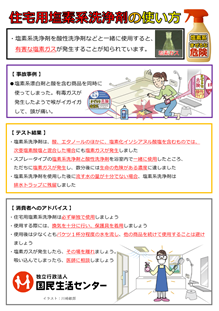
On March 18, 2026, Japan's National Consumer Affairs Center (国民生活センター, Kokumin Seikatsu Center — an independent administrative agency roughly analogous to a national consumer-safety regulator) published a specific warning about household chlorine-based cleaners. In its own testing, spraying a chlorine-based cleaner and an acidic cleaner together inside a bathroom caused the chlorine gas concentration in the room to exceed 16 ppm within a few minutes. The same publication cites reference data on chlorine concentration and acute poisoning symptoms showing that at 14–28 ppm, exposure causes "immediate throat irritation and coughing, with life-threatening risk within 30 minutes to an hour."
Just as important is a second finding: chlorine-based cleaner can be left behind in the trap seal itself. The Center confirmed that if an insufficient volume of water is used to flush a chlorine-based cleaner after use, residue can remain in the standing water of the trap. If a different cleaning product is then used later, the reaction between the residue and the new product can generate chlorine gas with a time delay — meaning the danger is not confined to the moment you are actively cleaning. Japan's PIO-NET (a nationwide consumer-complaint database that aggregates reports submitted to local consumer-affairs centers across the country) logged 40 separate injury or near-injury consultations tied to chlorine gas from household chlorine-based cleaners over the roughly six years from April 2020 to January 15, 2026.
Use cleaning products one at a time, never in combination. Flush thoroughly with water after use, and ventilate the room while you work.
Steps to disassemble and clean the drain opening
- Turn off the washing machine, close the water tap, and disconnect the ground wire and the drain hose.
- Shift the washing machine forward so you can reach the drain opening. Japanese washing machines are heavy — do not attempt this alone; work with a second person.
- Remove the strainer plate, the strainer basket, the trap bowl, and the trap seal cylinder in that order, and photograph the order as you go so reassembly is straightforward.
- Use a brush and neutral detergent to remove lint, hair, and slime. Pay particular attention to whether hair is hanging down from the trap's overflow lip — this is where capillary action originates.
- If you use a cleaning product, use only one type at a time and follow the label's specified contact time. Keep the room ventilated throughout.
- Flush with a generous volume of water — this step is specifically to avoid leaving cleaner residue in the trap seal.
- Reassemble the parts in reverse order, checking the trap bowl for cracks as you go.
- Run water until the trap seal refills, visually confirm the water surface, and only then move the washing machine back into place.
Cleaning the washing tub: roughly 2 hours with lukewarm water, about once every two months
If mold on the back of the washing tub is the source, use a tub-specific cleaning product. Kao Corporation's official product Q&A for its powdered oxygen-based "Sentaku-so Haiter" (洗たく槽ハイター) tub cleaner recommends filling the machine to its highest water level with lukewarm water (or plain water), adding the full packet, running the machine for 2–3 minutes to dissolve the powder, then leaving it to soak for about 2 hours before running a standard wash cycle. On frequency, Kao recommends using the product about once every two months to keep the tub clean. The product label also notes that if you use two packets at once, the water should be lukewarm (around 40°C / 104°F) — cooler water can leave undissolved residue.
Alongside that, the manufacturer's official prevention advice is to leave the lid open between washes so moisture does not get trapped inside, and to remove finished laundry as promptly as possible. Leftover bathwater can be reused for the wash cycle itself, but the official guidance is to use fresh tap water for the rinse cycle rather than reused bathwater.
Top-load and drum-type washing machines differ in both where you clean and how often
If you searched for this because you specifically have a drum-type washer, the first thing to check is not the floor drain at all — it is the drain filter built into the machine itself. Top-load and drum-type machines trap lint in physically different places, and that difference matters for anyone maintaining a rental unit remotely or through a property manager.

| Item | Top-load | Drum-type |
|---|---|---|
| Where lint accumulates | Lint filter (inside the tub) | Drain filter (lower front of the unit) |
| Manufacturer-recommended cleaning frequency | Per the product's instruction manual | Roughly once a week (Panasonic's official FAQ) |
| Can you use a tub-cleaning product? | Yes (fully automatic stainless-steel or plastic-tub top-loaders) | "Sentaku-so Haiter" tub cleaner cannot be used (per Kao) |
| Why not, for drum-type | — | The full tub cannot be submerged in solution, so an effective soak is not possible |
| Symptoms if neglected | Black residue buildup, a musty damp-laundry smell | Drain filter clogging, weakened water flow, drainage error codes |
Kao's official Q&A explains that "Sentaku-so Haiter" cannot be used in drum-type or twin-tub machines because neither design allows the tub to be adequately submerged for a soak, and recommends drum-type owners instead follow the maintenance routine specified in their own instruction manual. Before buying an aftermarket tub cleaner, check the manual first for a manufacturer-designated cleaning cycle and a manufacturer-specific cleaner.
For a drum-type machine that still smells: the order to check
- The drain filter. Is lint built up? Panasonic's official guidance is that forgetting to maintain it causes clogging and weakened water flow.
- The dryer filter and dryer air path. A buildup of fiber lint here extends drying time and can itself become an odor source.
- The inside of the door gasket. Water and lint linger here easily, making it a breeding ground for black mold.
- The floor drain and its trap seal. If you have reached this point without resolving the smell, return to the diagnostic split-test at the top of this article.
- If none of the above resolves it, consider a professional cleaning targeting grime on the back of the drum itself.
What does it cost to call in a professional?
Cost varies sharply depending on whether you are cleaning the washing machine itself or the building's drain piping. Both sets of figures below are rates the service providers publish directly on their own websites — not third-party estimates.
Standard washing-machine cleaning rates
| Service | Standard rate (tax included) | Before tax |
|---|---|---|
| Top-load fully automatic washer, sanitizing clean (includes air-drying) | ¥15,400 (approx. USD 103) | ¥14,000 (approx. USD 93) |
| Top-load washer-dryer combo, sanitizing clean | ¥18,700 (approx. USD 125) | ¥17,000 (approx. USD 113) |
| Drum-type washer-dryer, sanitizing clean | ¥22,000 (approx. USD 147) | ¥20,000 (approx. USD 133) |
These figures come from Duskin's published rates for "Fully Automatic Washing Machine Sanitizing Cleaning" (Duskin is one of Japan's largest home-services franchises). The method does not disassemble the tub: a motorized drill brush scrubs grime from the outer, accessible surfaces, and the tub is then soaked in a cleaning solution. For top-load machines, brushing through adding the cleaning solution takes about an hour, followed by a required soak of 12 hours or more. The final rinse cycle is left to the customer to run — worth factoring in when you schedule the visit around a tenant's or your own availability. Weekend, holiday, and evening appointments may be unavailable, and additional charges can apply on top of the standard rate.
Drain-pipe cleaning rates
| Property type | Unit price | Notes |
|---|---|---|
| Detached house (high-pressure cleaning of all on-site drain piping, plus drain-basin cleaning) | from ¥30,250 (approx. USD 202), tax included | 2–3 hours total working time |
| Apartment building, 100+ units | ¥3,300 per unit (approx. USD 22), before tax | Private-unit scope covers 4 fixtures: kitchen sink, bathroom, washing-machine pan, and washbasin |
| Apartment building, 60–99 units | ¥3,500 per unit (approx. USD 23), before tax | |
| Apartment building, 35–59 units | ¥3,600 per unit (approx. USD 24), before tax | |
| Apartment building, 20–34 units | ¥3,800 per unit (approx. USD 25), before tax | |
| Apartment building, 11–19 units | ¥4,000 per unit (approx. USD 27), before tax | |
| Apartment building, up to 10 units | flat ¥50,000 (approx. USD 333), before tax | Private units only |
The detached-house rate is from Qracian's "Drain Pipe Cleaning Service"; the multi-unit per-unit pricing is from Koei Techno Service's "Wastewater Pipe Cleaning" price sheet. Note that the multi-unit private-scope cleaning explicitly lists the "washing-machine pan" as one of the four fixtures covered — meaning a washing machine's drain opening is treated, structurally, as part of the building's regular scheduled maintenance, not purely a tenant's personal-appliance concern.
It is also worth noting that Qracian directs individual residents of apartment buildings who contact them to go through their building's management company instead, because apartment drain-pipe cleaning is normally carried out building-wide, in one coordinated pass, according to the management company's maintenance plan. This is not a job an individual tenant can arrange unilaterally — a detail that matters directly for how the cost-allocation question below actually plays out in practice. For the operational side of running that kind of building-wide cleaning, see our related guide on the case for regular apartment drain-pipe cleaning and how to run it.
The order to check before you spend any money
Before calling a professional, work through the diagnosis in order of cost, cheapest first: trap seal (¥0) → disassemble and clean the trap (detergent cost only) → clean the washing tub (a few hundred yen, a few dollars) → professional washing-machine cleaning (from ¥15,400 / approx. USD 103) → drain-pipe cleaning (from ¥30,250 / approx. USD 202). The overwhelming majority of cases resolve at the upstream, low-cost end of that list — jumping straight to high-pressure pipe cleaning will not fix a simple trap seal loss. Conversely, if wastewater is overflowing, or several units in the same building smell at once, skip the first three steps and contact the management company directly.
In a rental property, who pays — the landlord or the tenant?
This is where Japan's rental market diverges most sharply from what an investor from the US, UK, Australia, or Singapore will be used to. Rather than leaving cost allocation to whatever is negotiated into an individual lease, or to case-by-case dispute resolution, Japan's Ministry of Land, Infrastructure, Transport and Tourism (国土交通省, MLIT) Housing Bureau publishes a detailed, standardized national guideline — the "Guidelines on Disputes Concerning Restoration to Original Condition" (原状回復をめぐるトラブルとガイドライン, Genjō Kaifuku wo Meguru Trouble to Guideline, revised edition, August 2011) — that landlords, tenants, and property managers across the country reference to resolve exactly this kind of dispute. It functions as a quasi-official reference point even though it is not itself binding law, in a way that has no precise equivalent in a common-law lease dispute.
The short answer under that guideline is: if the tenant has been performing routine cleaning, the landlord bears the cost; if the damage results from the tenant neglecting cleaning and upkeep, the tenant bears the cost. Attachment Table 1 of the guideline, under "Fixtures and Other Equipment," lays out the relevant items as follows:
| Who bears the cost | Corresponding item in Attachment Table 1 | As applied to a washing machine drain |
|---|---|---|
| Landlord (賃貸人, chintainin) | Whole-unit professional house cleaning by a specialist contractor (where the tenant has been performing routine cleaning) | End-of-tenancy cleaning, where the tenant cleaned the drain opening periodically during the tenancy |
| Landlord | Equipment failure or unusability caused by the equipment reaching the end of its service life | Cracking or degradation of trap components from ordinary age-related wear |
| Tenant (賃借人, chinshakunin) | Limescale, mold, etc. in the bath, toilet, or washbasin, where the tenant's own neglect of cleaning and upkeep caused the soiling | A state where slime and mold have hardened onto the drain after a long period with no cleaning at all |
| Tenant | Damage to equipment from improper day-to-day handling or a breach of the terms of use | Using the machine with the trap bowl removed, or damage caused by flushing foreign objects down the drain |
The point most likely to catch an overseas landlord off guard is how the guideline treats depreciation. Attachment Table 2's unit-of-burden schedule states explicitly that, for routine cleaning items, "the number of years elapsed is not taken into account." This is a meaningfully different mechanic from how the same guideline treats something like wallpaper, where the tenant's financial responsibility is discounted year by year the longer they have lived there — a depreciation-style approach roughly analogous to how normal wear-and-tear is treated in many US security-deposit statutes. Odor and cleaning-related items are excluded from that discount: if the tenant is liable at all, it is for the full cost of cleaning that fixture or, in more serious cases, the unit as a whole — with no reduction for tenancy length. For the guideline's full framework, our related guide on practical application of the MLIT restoration guideline lays it out in more detail.
Rent reduction if drainage stays unusable
If the odor escalates into an actual drainage failure — where the washbasin or washing machine drain becomes genuinely unusable for a period — the conversation shifts to rent reduction. The Japan Rental Housing Management Association (公益財団法人日本賃貸住宅管理協会, Japan Rental Housing Management Association, JPM), a public-interest incorporated foundation, publishes the "Guideline for Rent Reduction Due to Defects in Rented Rooms and Equipment" (貸室・設備等の不具合による賃料減額ガイドライン, revised October 4, 2024), which sets out the following formula:
Monthly rent × rent-reduction rate × (number of days the defect lasted − number of exempt days) ÷ 30 days
The guideline's own worked example: if gas service was unavailable for 6 days, monthly rent of ¥100,000 (approx. USD 667) × a 10% reduction rate × (6 days − 3 exempt days) ÷ 30 days works out to a ¥1,000 (approx. USD 7) rent reduction — roughly ¥333 (approx. USD 2.20) per day. The guideline's "Group A" category, for a complete loss of running water, applies a 30% reduction rate with 2 exempt days. That category is written primarily for a water-supply outage, but in practice, parties will often apply the same reasoning by analogy to a drainage failure that leaves a unit's water fixtures unusable. Applying it to a hypothetical case — a unit renting for ¥80,000 (approx. USD 533) per month, unusable for 5 days — produces: ¥80,000 × 30% × (5 days − 2 days) ÷ 30 days = ¥2,400 (approx. USD 16).
That said, the guideline carries no legal force of its own; the reduction rate and exempt-day count are explicitly adjustable to the facts of a given situation, and it does not apply where the defect stems from the tenant's own breach of their duty of reasonable care. For the source document itself, see the Japan Rental Housing Management Association's revision announcement.
Odor alone does not trigger a reduction — but that is not a reason to ignore it
Notably, "odor" itself does not appear anywhere in the Group A or Group B item lists in that guideline. A smell on its own, without an accompanying functional failure, is not something this particular rent-reduction framework covers. That does not mean it is safe to leave unaddressed, however: odor is a direct driver of tenant satisfaction, and dissatisfied tenants decline to renew. Converted into dollar terms, as the next section shows, the gap between the cost of preventive cleaning and the cost of a vacancy is not a close call.
[Worked example] What should an owner actually spend on preventive cleaning?
Whether an odor complaint gets handled as a one-off "please clean it" request, or is instead built into the building's scheduled maintenance, comes down to a question of dollars. Here is the math for a hypothetical 20-unit building.
Annual cost of wastewater-pipe cleaning
The per-unit rate for the 20–34-unit band is ¥3,800 (approx. USD 25), before tax.
- ¥3,800 × 20 units = ¥76,000 per year (approx. USD 507), before tax
- Per unit, per month: ¥76,000 ÷ 20 units ÷ 12 months = approx. ¥317 (approx. USD 2.10) per unit, per month
If a complaint goes unaddressed and a tenant moves out
Assume a unit renting at ¥80,000 (approx. USD 533) per month declines to renew and moves out, citing odor.
- Two months of vacancy = ¥80,000 × 2 = ¥160,000 (approx. USD 1,067) in lost rent
- On top of that come restoration costs and the cost of re-marketing the unit.
The lost rent from two months of vacancy alone — ¥160,000 (approx. USD 1,067) — already exceeds twice the entire building's annual cleaning budget of ¥76,000 (approx. USD 507). Put differently: a single unit sitting vacant for one month costs roughly as much as an entire year of cleaning for the whole building. Annual wastewater-pipe cleaning, at roughly ¥317 (approx. USD 2.10) per unit per month, functions as an investment that removes a structural source of odor complaints before they start. For the broader equipment-replacement decision framework, see our related guide on planning equipment replacement in Japanese rental properties.
The raised waterproof pan: a capital-expenditure option
For a more structural, capital-expenditure fix, consider upgrading the specification of the washing-machine's waterproof floor pan. Technotech, a manufacturer specializing in washing-machine waterproof pans and drain traps, markets a raised-pedestal design that it describes as making it possible to "clean the trap and flush the drain pipe without having to move the large, heavy washing machine at all." Removing the need to physically shift the washer for every cleaning both makes scheduled maintenance easier to actually execute and lowers the bar for tenants to do routine cleaning themselves. Whenever restoration work or a major renovation already has the waterproof pan exposed, that is the natural moment to reconsider its specification.
What owners and management companies should build into standard practice
Odor complaints tend to generate tenant dissatisfaction faster than a landlord can respond if the response only starts once the complaint arrives. Building the following four items into an annual management routine keeps a landlord ahead of the problem rather than reacting to it.
- Written guidance at move-in: Include, with diagrams, in the move-in handbook: never run the machine with the trap bowl removed, do not let lint accumulate, and pour water down the drain before any extended absence. This documentation also becomes the evidentiary basis for holding a tenant responsible for damage caused by improper use.
- Topping up the trap seal during vacancy: For any unit vacant more than a month, pour water into each drain opening during viewings or routine walkthroughs. A sewer smell from evaporation can badly damage a prospective tenant's first impression during a viewing.
- Trap inspection at move-out: Add a check for the presence and condition of the trap bowl to the restoration checklist. Photographing its condition at this stage makes it much easier later to determine whether any damage was ordinary wear or tenant misuse.
- An annual cleaning plan: Budget for wastewater-pipe cleaning once a year, on a fixed month. Use the statutory 6-month interval for designated buildings as a rough upper-bound benchmark, adjusting frequency to the building's size and complaint history.
On the properties we manage, our own practice is never to close out an odor complaint as simply "the tenant isn't cleaning enough." We start by checking the trap seal and ruling out building-side causes first. Asking a tenant to clean without first isolating the actual cause both damages trust and fails to solve the underlying problem. Our experience has been that being straightforward about the cause of an equipment issue, and showing the tenant the actual basis for how the cost is allocated, is what keeps tenants in a property for the long term.
Frequently asked questions
Q. For a drum-type washer, what should I check first if the drain smells?
Start with the drain filter on the lower front of the unit itself. Panasonic's official FAQ recommends cleaning the drain filter about once a week, and warns that neglecting it causes clogging and weakened water flow. From there, check the inside of the door gasket next, and the floor drain's trap seal last — working in that order avoids wasted effort. Note that some off-the-shelf washing-tub cleaners cannot be used in drum-type machines at all, because the design does not allow for an adequate soak; check your instruction manual for the manufacturer-specified method.
Q. In a Japanese rental, who pays for drain cleaning?
Under MLIT's national restoration guideline, if the tenant has been performing routine cleaning, professional cleaning by a specialist is the landlord's cost; damage resulting from the tenant's own neglect of cleaning and upkeep is the tenant's cost. Because routine cleaning items are explicitly excluded from the guideline's depreciation schedule, a longer tenancy does not reduce a tenant's liability on this item the way it would for something like wallpaper. Apartment-building drain-pipe cleaning is normally carried out building-wide, in a single coordinated pass, under the management company's maintenance plan — it is not something an individual tenant arranges on their own.
Q. Is there anything I should do before leaving a unit vacant for an extended period?
Pour one to two cups of water down each drain opening before you leave — it delays trap-seal evaporation. The Tokyo guideline cites a documented case from the 2003 SARS outbreak, in which a drain trap's water seal evaporated in a Hong Kong high-rise residential building, and the virus was drawn back up through the empty trap into the building's air, contributing to a cluster infection. A trap seal is not purely a matter of comfort — it is a public-health control. If you are managing units that sit vacant for extended stretches, building water top-ups into your routine walkthrough checklist is worth the minor added effort.
Q. A drain cleaner isn't fixing it — what now?
If the cause is trap seal loss or a damaged trap, no cleaning product will resolve it. Check the trap seal and the trap bowl for cracks first. If the smell persists, or wastewater is overflowing, suspect a blockage or ventilation problem on the drain-pipe side itself. For a detached house, high-pressure drain-pipe cleaning starts at ¥30,250 (approx. USD 202) including tax; for an apartment building, the management company is the point of contact. Also avoid repeated use of cleaning products in sequence: chlorine-based cleaner can remain in the trap seal if flushed with insufficient water, and reacting with a different product later can generate chlorine gas.
Sources and references
- Ministry of Land, Infrastructure, Transport and Tourism (国土交通省, MLIT), "Structural Methods for Water Supply and Drainage Piping Systems Installed in Buildings" (Ministry of Construction Notice No. 1597, December 20, 1975, as last amended by MLIT Notice No. 243, March 29, 2010)
- Tokyo Metropolitan Bureau of Health and Public Hygiene, "Guidelines for a Healthy and Comfortable Living Environment," Field 5: Drainage Management / Guideline No. 14: Management of Drain Traps (full guideline index)
- Ministry of Health, Labour and Welfare (厚生労働省), Enforcement Regulations of the Act on Maintenance of Sanitation in Buildings (Ministry of Health and Welfare Ordinance No. 2, 1971), Article 4-3
- MLIT Housing Bureau, "Guidelines on Disputes Concerning Restoration to Original Condition" (revised edition, August 2011)
- Japan Rental Housing Management Association, "Guideline for Rent Reduction Due to Defects in Rented Rooms and Equipment" (revised October 4, 2024)
- National Consumer Affairs Center of Japan, "How to Use Household Chlorine-Based Cleaners — Never Mix! Accidents Are Occurring in Bathrooms and Similar Spaces" (published March 18, 2026)
- Duskin, standard rates for "Fully Automatic Washing Machine Sanitizing Cleaning"
- Koei Techno Service, "Wastewater Pipe Cleaning" price sheet
- Qracian, "Drain Pipe Cleaning Service"
- Panasonic, "[Drum-Type Washing Machine] Caring for the Drain Filter"
- Kao Corporation, Product Q&A, "Can 'Sentaku-so Haiter' Be Used in a Drum-Type Washing Machine?"
- Kao Corporation, Product Q&A, "How Do I Prevent Mold in a Fully Automatic Washing Machine?"
- Kao Corporation, Product Q&A, "Can Leftover Bathwater Be Used for Laundry?"
- Kao Corporation, "Sentaku-so Haiter" product information (usage and ingredients)
- Technotech, "Raised Waterproof Pan" product information
