This is a Japan-specific cost question that has no equivalent public database to check against. If you are used to a US-style MLS or a UK comparables service where contractor pricing is at least partially disclosed, Japan's security camera market will feel opaque at first: there is no central registry of "what an apartment building actually paid" for a camera installation. What official sources do publish is narrower but still useful — government subsidy ceilings and manufacturer list prices. Based on those public figures, hardware for a small installation runs ¥93,500 (approx. USD 623) — an outdoor camera at ¥29,700, an indoor camera at ¥50,600, and a PoE hub at ¥13,200 — plus cloud recording at ¥2,200 per camera per month (approx. USD 15, 30-day retention, tax included). Installation labor is the one line item with no published price at all; it is always a site-specific quote. This article puts together National Police Agency crime statistics, the joint design guideline from Japan's Ministry of Land, Infrastructure, Transport and Tourism (MLIT, 国土交通省) and the National Police Agency (NPA, 警察庁), the Personal Information Protection Commission's (PPC, 個人情報保護委員会) guidance, and official vendor pricing, so that an owner of Japanese rental property — whether resident in Japan or investing from overseas — can work out cost, legal obligations, and tax treatment without guessing. A comparison table later in the article also covers a question unique to Japan's rental structure: whether a tenant is allowed to install their own camera at their unit's entrance.
Key takeaways from this article
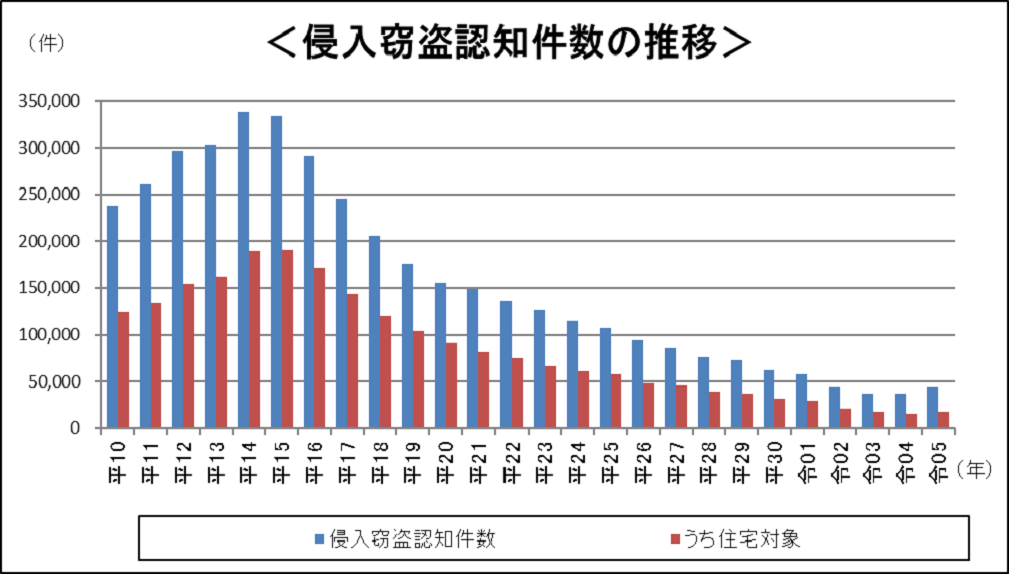
- Housebreaking (侵入窃盗, shinnyū settō, burglary of an occupied or vacant structure) reported in Reiwa 7 (2025) totaled 47,233 cases, up 9.8% year on year. The long-run trend has been a steep decline since the early 2000s, but the last few years show a renewed upswing that landlords should not ignore.
- Wooden-frame apartment buildings of three stories or fewer — Japan's dominant "apāto" (アパート) rental housing type, distinct from taller reinforced-concrete "mansion" condominiums — see 18.2 burglaries per 100,000 households, about 2.3 times the 7.9 rate for buildings of four stories or more.
- Of 2,175 apartment burglaries with a known entry point, 1,042 involved an unlocked door or window and only 1 involved lock-picking, against 279 that used a duplicated key. The statistics point priority squarely at the entrance side and at unlocked doors — not at defeating sophisticated locks.
- A cloud-based system runs ¥93,500 (approx. USD 623) in hardware plus ¥2,200/month per camera (approx. USD 15). Because installation labor has no published price, a 6-unit building with 2 cameras lands in a five-year total of roughly ¥380,000–860,000 (approx. USD 2,500–5,700), or about ¥1,053–2,377 (approx. USD 7–16) per unit per month.
- Assets costing under ¥100,000 (approx. USD 667) can be expensed in full in the year of purchase; those under ¥200,000 (approx. USD 1,333) are depreciated evenly over three years. Japan's tax reform outline for fiscal year 2026 proposes raising the ceiling for the small-asset depreciation exception to under ¥400,000 (approx. USD 2,667).
How much does one security camera cost for a Japanese apartment building?
Let's start with the conclusion. As a public benchmark, the Tokyo Metropolitan Government's crime-prevention equipment subsidy for municipalities (防犯設備区市町村補助金) sets a subsidy ceiling of ¥285,000 (approx. USD 1,900) per camera (Tokyo Metropolitan Government, "Crime Prevention Equipment Subsidy for Municipalities to Secure Regional Safety"). This figure is what the Tokyo government treats as the all-in ceiling — hardware plus installation labor combined — for a single camera installed by a municipality along a public street. It is a useful anchor precisely because it is one of the only all-in figures published by any public body in Japan.
On the private-sector side, hardware pricing is published directly by vendors. Safie Inc. (セーフィー株式会社), one of Japan's leading cloud video platforms, lists an entry-level outdoor bullet camera at ¥29,700, its indoor "Safie One" model at ¥50,600, and a 4-port PoE hub at ¥13,200 on its official online store — all tax included. Cloud recording plans run from ¥1,320/month (approx. USD 9) for 7-day retention up to ¥7,700/month (approx. USD 51) for 365-day retention, with the commonly chosen 30-day plan priced at ¥2,200/month (approx. USD 15) per camera.
Here is the part we want to be upfront about: installation labor has no published price anywhere. Safie's official process states that an on-site survey is free, but that "if installation work is required, a separate charge will apply," with the amount left to site conditions. That means no single vendor, and no government agency, will tell you "your total setup will cost X." What this article does instead is bracket the range using two publicly verifiable endpoints: the hardware cost you can look up on a vendor's price list, and the all-in subsidy ceiling a public body has set for the same kind of work. For a reader used to a market where contractor day-rates are searchable, this bracketing approach is the practical workaround for a market that simply does not publish installation pricing.
The numbers behind why Japanese apartments get targeted
"Is my building actually at risk?" deserves a numbers-based answer, not a gut feeling. The short version: wood-frame apartment buildings are meaningfully more exposed than condominium-style "mansion" buildings, and break-ins cluster overwhelmingly around the entrance side of the property.
Housebreaking rose to 47,233 cases in 2025, up 9.8% year on year
According to the National Police Agency's (NPA, 警察庁) Crime Situation in Reiwa 7 report, reported housebreaking (侵入窃盗) in 2025 (Reiwa 7) reached 47,233 cases, an increase of 4,197 cases (9.8%) over the prior year. Housebreaking crime overall — theft plus other break-in offenses — totaled 58,492 cases, of which roughly 80% was theft-motivated housebreaking.
It would be a mistake to read this single figure as "crime is rising" without context. Housebreaking theft peaked at over 330,000 cases in 2002 (Heisei 14) and fell steadily for two decades, bottoming out at 36,588 cases in 2022 (Reiwa 4). From there it climbed to 44,228 in 2023 (Reiwa 5), eased slightly to 43,036 in 2024 (Reiwa 6), and rose again to 47,233 in 2025 (Reiwa 7). The accurate way to read this data is to hold both facts at once: a decades-long structural decline in burglary, and a recent, multi-year plateau with an uptick layered on top of it.
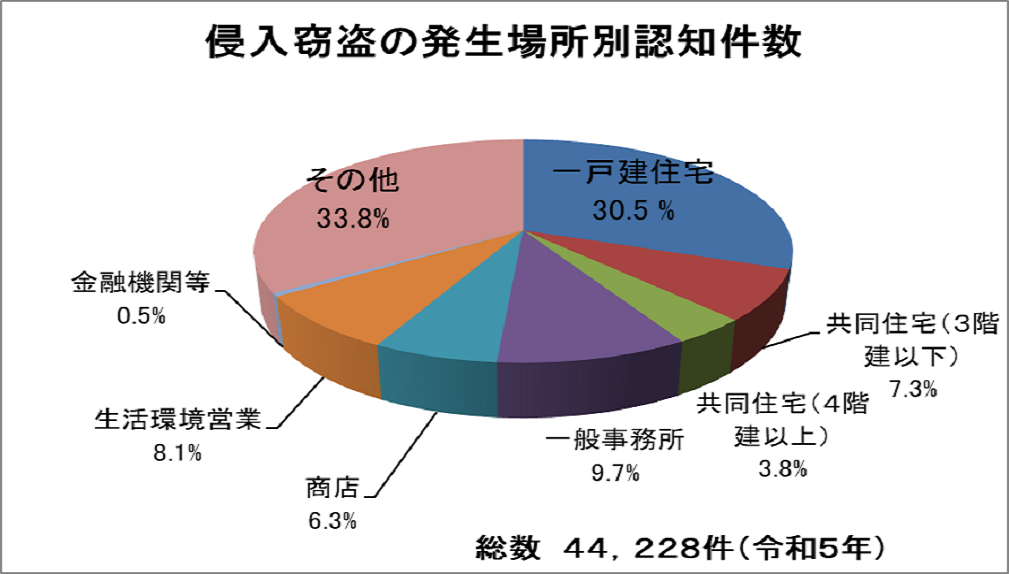
Breaking down where these break-ins happened: of the 47,233 housebreaking-theft cases in 2025, single-family detached houses accounted for 29.1%, apartment buildings of three stories or fewer for 5.7%, and buildings of four stories or more for 3.4%. In raw case counts, detached houses dominate — but for a rental-property owner, the number that matters for decision-making is not the raw count. It is the per-household incidence rate covered next, because Japan has far more detached houses than low-rise apartment buildings in absolute terms, which distorts a simple case-count comparison.
[Data table] Burglary victimization by housing type, per 100,000 households
The breakdown by housing type comes from the NPA's Statistical Materials on Penal Code Offenses in Reiwa 6. In 2024 (Reiwa 6), residential burglary (空き巣, akisu — daytime or unattended-home break-ins, as distinct from break-ins while occupants are present) totaled 10,968 cases nationwide.
| Housing type | Reported burglary cases (2024) | Cases per 100,000 households |
|---|---|---|
| Single-family detached house | 7,588 cases | 25.0 |
| Apartment building (3 stories or fewer) | 2,175 cases | 18.2 |
| Apartment building (4 stories or more) | 1,205 cases | 7.9 |
| All housing types | 10,968 cases | 19.0 |
Source: National Police Agency, "Statistical Materials on Penal Code Offenses in Reiwa 6," Charts 2-2-1-2 and 2-2-1-3. The per-100,000-household rate is calculated using primary-household counts from the Ministry of Internal Affairs and Communications' 2023 (Reiwa 5) Housing and Land Survey, and is limited to cases where the victim's age was identifiable.
Here is the point that matters most for an owner deciding where to spend: low-rise apartment buildings of three stories or fewer — the wood-frame "apāto" type that makes up much of Japan's private rental stock — run 18.2 cases per 100,000 households, about 2.3 times the 7.9 rate for buildings of four stories or more. In other words, the label "apartment building" hides a large gap in real risk. A mid- or high-rise condominium with an autolock entry and an on-site building manager is a different risk category from a low-rise wood-frame building with exterior stairwells and open-air corridors, even though both get filed under the same "multi-unit residential" statistic.
Broken down further by household composition, single-occupant households under age 30 living in low-rise apartment buildings show a rate of 35.1 cases per 100,000 households — the highest of any segment in the data. For owners whose tenant base skews toward students and young single renters, common-area security moves from a nice-to-have into something closer to a leasing requirement.
[Data table] Where and how apartment burglars actually get in
This is the single most operationally useful table for deciding camera count and orientation. It breaks down the 2,175 low-rise apartment burglaries recorded in 2024 (Reiwa 6) by entry point and method.
| Category | Cases | Share of 2,175 cases |
|---|---|---|
| Entry point: front door / main entrance | 1,000 cases | 46.0% |
| Entry point: window | 884 cases | 40.6% |
| Entry point: other opening | 41 cases | 1.9% |
| Method: unlocked (door or window left open) | 1,042 cases | 47.9% |
| Method: breaking glass | 432 cases | 19.9% |
| Method: defeating the lock (subtotal) | 373 cases | 17.1% |
| — of which, duplicated key | 279 cases | 12.8% |
| — of which, thumb-turn manipulation | 18 cases | 0.8% |
| — of which, lock-picking | 1 case | 0.05% |
Source: National Police Agency, "Statistical Materials on Penal Code Offenses in Reiwa 6," Chart 2-2-1-5
Three things stand out. First, 46.0% of entries happen through the front door. A single camera angled to sweep the shared corridor and each unit's entrance delivers the best return on investment of any single placement. Second, 47.9% of break-ins involved a door or window that was simply left unlocked. Before adding more cameras, reminding tenants to lock up and installing supplementary door locks does more for security than another lens. Third, and this is worth sitting with if you are weighing lock upgrades: duplicated keys accounted for 279 cases against a single case of lock-picking. Unlike the "master criminal picks the lock" image that security marketing sometimes leans on, the Japanese data says the far larger risk is an old key still in circulation — which points toward rigorously re-keying every unit at move-out, not toward buying a more pick-resistant lock.
Break-ins at vacant units up 28.4% year on year — a risk specific to owners carrying vacancy
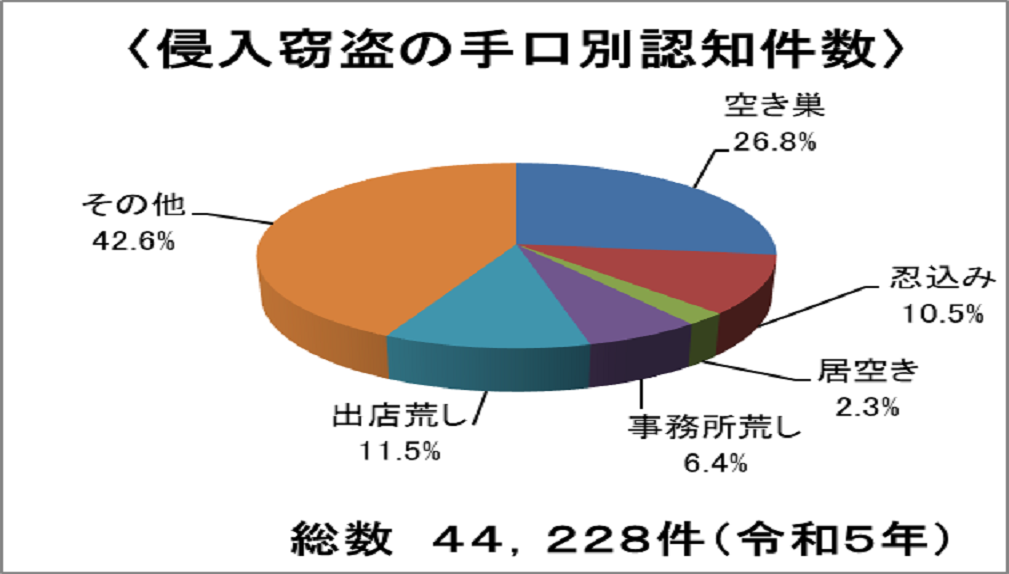
There is one more number owners tend to overlook. Theft with a "vacant house" as the reported location reached 13,971 cases in 2025 (Reiwa 7), a 307.9% increase from 2020 (Reiwa 2), the year this category began being tracked. Of that, housebreaking theft accounted for 11,958 cases, up 2,644 cases (28.4%) year on year, while non-entry theft — items taken from the grounds without entering the structure — reached 1,934 cases, up 494 cases (34.3%).
The pattern of what gets stolen is telling. In non-entry theft from vacant houses, outdoor AC compressor units were involved in 702 cases, and metal materials in 227 cases (up 57.6% year on year). The NPA's own analysis attributes this to a run-up in scrap metal prices — copper wiring and compressor components are being stripped and sold as scrap. In practical terms, the outdoor AC unit or hot-water heater sitting outside a vacant unit is itself a target asset, independent of anything inside the apartment.
Vacancy management is therefore not only a revenue question — it is also a security question. Two related pieces may help connect the two: concrete ideas for reducing vacancy and four essentials of vacant-property management.
What does camera installation actually cost? [A sourced line-item breakdown]
Cost breaks into four buckets: hardware, installation, monthly service, and maintenance. Rather than estimate, this section uses only two kinds of numbers: subsidy ceilings that a government body has published, and prices a vendor discloses on its own official site. Where a figure — installation labor — simply is not published, we say so rather than invent one.
[Data table] Actual prices for hardware, installation, and monthly service
| Item | Amount | Source |
|---|---|---|
| Subsidy ceiling per camera (public benchmark for hardware + installation combined) | ¥285,000 (approx. USD 1,900) | Tokyo Metropolitan Government, Crime Prevention Equipment Subsidy for Municipalities |
| Outdoor camera body (bullet-type entry model, DXAntenna CNE3CBF1S) | ¥29,700 (approx. USD 198), tax included | Safie Store |
| Outdoor camera body (compact dome-type, i-PRO WV-S35302-F2L) | ¥67,870 (approx. USD 452), tax included | Safie Store |
| Indoor camera body (Safie One) | ¥50,600 (approx. USD 337), tax included | Safie Store |
| 4-port PoE hub (VIVOTEK AW-FET-060P-060) | ¥13,200 (approx. USD 88), tax included | Safie Store |
| PoE injector (for connecting a single camera, VIVOTEK AP-GIC-011A-030) | ¥7,700 (approx. USD 51), tax included | Safie Store |
| Installation labor | No published price (on-site survey is free; installation is quoted individually) | Safie, "Pricing and Steps to Get Started" |
| Cloud recording, 7-day retention | ¥1,320/month per camera (approx. USD 9), tax included | Safie official pricing |
| Cloud recording, 14-day retention | ¥1,815/month per camera (approx. USD 12), tax included | Safie official pricing |
| Cloud recording, 30-day retention | ¥2,200/month per camera (approx. USD 15), tax included | Safie official pricing |
| Cloud recording, 60-day retention | ¥2,750/month per camera (approx. USD 18), tax included | Safie official pricing |
| Cloud recording, 90-day retention | ¥3,300/month per camera (approx. USD 22), tax included | Safie official pricing |
| Cloud recording, 180-day retention | ¥4,950/month per camera (approx. USD 33), tax included | Safie official pricing |
| Cloud recording, 365-day retention | ¥7,700/month per camera (approx. USD 51), tax included | Safie official pricing |
Sources: Safie Inc., pricing plans, Safie Store, product list, Safie Store, "Pricing and Steps to Get Started", Tokyo Metropolitan Government, Crime Prevention Equipment Subsidy for Municipalities (all as of August 2026; JPY-to-USD figures are approximate at ¥150/$1). Safie's pricing is used here as a representative example; comparable cloud recording services exist from other vendors. Treat these figures as a benchmark for evaluating quotes, not as a fixed price.
[Data table] Running costs and the electricity-cost formula
Running costs are not just the monthly subscription fee. Maintenance, repairs, and electricity all add up. Tokyo sets the following subsidy ceilings for ongoing maintenance expenses, which are a useful reference point for what upkeep typically costs even though the subsidy itself is narrowly scoped (see below).
| Expense item | Ceiling per camera | Note |
|---|---|---|
| Annual maintenance inspection | ¥10,000 (approx. USD 67) | Public benchmark for an annual check-up |
| Repair cost | ¥200,000 (approx. USD 1,333) | Ceiling in the event of a malfunction |
| Relocation cost | ¥200,000 (approx. USD 1,333) | If the mounting position is changed |
Source: Tokyo Metropolitan Government, "Crime Prevention Equipment Maintenance Cost Subsidy Program". Note that this particular subsidy is restricted to cameras installed by neighborhood associations (町会・自治会, chōkai/jichikai — Japan's local, largely volunteer-run residents' associations, which have no direct US or UK equivalent) or shopping-district associations using a Tokyo or municipal subsidy; a camera a private landlord installs and pays for out of pocket is not eligible. The figures are cited here purely as the government's own working assumption for what maintenance costs, not as money a landlord can claim.
Electricity cost is something you can calculate yourself. The National Household Electrical Appliance Fair Trade Council (全国家庭電気製品公正取引協議会) publishes a benchmark electricity rate of ¥31/kWh (tax included, revised July 22, 2022). Running an 8-watt camera continuously, 24 hours a day for 365 days, works out as follows:
- 8W × 24 hours × 365 days ÷ 1,000 = 70.08 kWh
- 70.08 kWh × ¥31 = approx. ¥2,172/year per camera (approx. USD 14)
- Two cameras: approx. ¥4,345/year (approx. USD 29)
Source: National Household Electrical Appliance Fair Trade Council. This rate is an industry-wide benchmark; your actual electricity cost depends on your specific utility contract. Power draw varies by camera model, so substitute the manufacturer's catalog figure for a more precise estimate.
[Worked example] First-year and five-year total cost for a 6-unit apartment building with 2 cameras
Let's put this into a concrete scenario: a 6-unit wood-frame apartment building installing one outdoor camera at the shared entrance and one indoor camera at the bicycle parking area — two cameras total — with 30-day cloud retention.
| Expense item | Amount | Basis |
|---|---|---|
| Outdoor camera ×1 (bullet-type entry model) | ¥29,700 (approx. USD 198) | Safie Store official price |
| Indoor camera ×1 (Safie One) | ¥50,600 (approx. USD 337) | Safie Store official price |
| 4-port PoE hub | ¥13,200 (approx. USD 88) | Safie Store official price |
| Hardware subtotal | ¥93,500 (approx. USD 623) | Sum of official prices |
| Installation labor | Individual quote required | No published price; on-site survey is free |
| Reference: public benchmark for hardware + installation combined (¥285,000 × 2 cameras) | ¥570,000 (approx. USD 3,800) | Tokyo subsidy ceiling |
| Cloud recording (¥2,200 × 2 cameras × 12 months) | ¥52,800/year (approx. USD 352) | 30-day retention plan |
| Electricity (assuming 8W, 2 cameras) | Approx. ¥4,345/year (approx. USD 29) | Benchmark rate of ¥31/kWh |
| Running-cost subtotal | Approx. ¥57,145/year (approx. USD 381) | Cloud recording + electricity |
Because installation labor is never a fixed number, the total cost cannot be reduced to a single figure. Instead we show it as a range with two defensible endpoints: a floor built from hardware cost alone, and a ceiling built from the government's all-in installation benchmark.
| Scenario | Year 1 | 5-year total | Per unit, per month (6 units) |
|---|---|---|---|
| Floor: hardware only (self-installed) | Approx. ¥150,645 (approx. USD 1,004) | Approx. ¥379,225 (approx. USD 2,528) | Approx. ¥1,053 (approx. USD 7) |
| Ceiling: hardware + installation at the ¥285,000-per-camera public benchmark | Approx. ¥627,145 (approx. USD 4,181) | Approx. ¥855,725 (approx. USD 5,705) | Approx. ¥2,377 (approx. USD 16) |
In other words, installing 2 cameras in a 6-unit apartment building lands in a range of roughly USD 7 to just under USD 16 per unit per month. When a contractor's quote comes in, check how close the installation-labor line sits to that ¥285,000-per-camera (approx. USD 1,900) ceiling — that comparison is the first useful yardstick for judging whether a quote is reasonable, given that no other public price check exists.
From here, it becomes a business decision: do you pass this cost through in rent, or absorb it as a competitive amenity in your listing? One month of vacancy on a ¥60,000-a-month unit (approx. USD 400) already costs ¥60,000 in lost rent. Whether you view a ¥380,000–860,000 five-year total (approx. USD 2,500–5,700) as "the equivalent of six to fourteen months of vacancy on one unit" or as "a USD 7–16-a-month piece of capital equipment" is a framing choice — but putting it in numbers at least makes the framing explicit. Because the actual effect on rent and occupancy depends heavily on location and competing properties, weigh this against a broader look at apartment operating expenses and cash flow using your own building's numbers.
[Comparison table] Outright purchase, cloud recording, or a security-company lease — which fits?
The choice between formats is best made not on which is cheapest per month, but on a more practical question: who holds the footage, and who is responsible for fixing it when it breaks? Here is how the three common formats in the Japanese market compare.
| Comparison point | A: Outright purchase + self-managed NVR | B: Cloud recording service | C: Security-company lease/rental |
|---|---|---|---|
| Initial cost | Hardware + installation. Higher due to the network video recorder (NVR) unit | Hardware + installation. No recorder unit needed | Low; some contracts have no upfront cost |
| Monthly fee | None in principle (electricity + maintenance only) | ¥1,320–7,700 per camera depending on retention (approx. USD 9–51) | Monthly fee amortized over the contract term |
| Recording retention | Depends on hard-drive capacity and video quality; footage is overwritten | Fixed by the plan (7–365 days) | Depends on contract specifications |
| Hardware ownership | Owner | Owner (if hardware is purchased) | Leasing company / security company |
| Burden if something breaks | Owner. The hard drive is a consumable that needs periodic replacement | Handled within the maintenance contract | Often included in the contract |
| Accounting treatment | Capitalized as an asset or expensed, depending on acquisition cost | Hardware is capitalized; the monthly fee is expensed | Lease/rental payments are generally expensed |
| At cancellation/removal | Hardware remains with the owner | Recording stops once the service is cancelled | Equipment is returned; early-termination fees may apply |
For a building with few units, where to physically house a recorder and who manages it becomes a real burden in itself. If you outsource management to a property manager and there is no on-site staff, Format B (cloud) tends to be the easiest to operate. Conversely, if you self-manage multiple buildings and are comfortable handling hardware, Format A (outright purchase) tends to work out cheaper over a horizon of five years or more.
You may come across general rules of thumb about leasing versus renting — "if you'll use it more than X months, buying wins" — but because the actual break-even point depends entirely on contract terms, this article does not make that call for you. What we recommend instead: check whether the quote states the total amount payable over the full term and whether an early-termination clause exists.
How to decide camera count: shared entrance, corridors, bike parking, or the trash area?
When budget is limited, the statistics above point to a clear priority order.
- Shared entrance and corridors: 46.0% of burglary entry points are the front door. A position that captures each unit's entrance at an angle is the first candidate.
- Bicycle and motorcycle parking: In 2025 (Reiwa 7), bicycle theft totaled 172,654 cases and motorcycle theft 14,552 cases (up 25.0% year on year) — both large categories of street-level crime (National Police Agency, Crime Situation in Reiwa 7). These also translate directly into tenant complaints.
- Trash collection area: Illegal dumping and improper sorting are areas where a camera's deterrent effect shows up quickly, with a side benefit of lower cleaning costs.
- Parking area and around vacant units: Given the rise in theft of outdoor AC units and metal materials, buildings carrying ongoing vacancy should move this up the priority list.
The most common mistake is trying to make one camera serve multiple purposes and ending up with footage too vague to identify anything. Assigning each camera a single, specific purpose produces more value per camera than spreading coverage thin.
Camera count and placement are actually decided by lighting — MLIT and NPA's design guideline
Before locking in camera specifications, there is one document worth checking first: the joint Design Guideline for Crime-Prevention-Conscious Multi-Unit Housing (防犯に配慮した共同住宅に係る設計指針), issued by MLIT and the NPA. This guideline is a Japan-specific document with no direct US or UK counterpart — it sets out concrete lighting-level targets, measured in lux, for every part of a multi-unit residential building, and treats cameras as a secondary measure layered on top of adequate lighting rather than a first-line solution.
[Data table] Illuminance standards for shared areas
| Location | Minimum average horizontal illuminance |
|---|---|
| Shared entrance (interior floor) | Approx. 50 lux or more |
| Shared entrance (exterior floor) | Approx. 20 lux or more |
| Shared entry/exit points other than the main entrance | Approx. 20 lux or more |
| Shared mail area | Approx. 50 lux or more |
| Elevator hall on the shared-entrance floor | Approx. 50 lux or more |
| Elevator hall on other floors | Approx. 20 lux or more |
| Elevator cab interior | Approx. 50 lux or more |
| Shared corridors and stairwells | Approx. 20 lux or more |
| Bicycle / motorcycle parking area | Approx. 3 lux or more |
| Parking area | Approx. 3 lux or more |
| Pathways | Approx. 3 lux or more |
| Children's play area, plaza, green space, etc. | Approx. 3 lux or more |
Source: MLIT and NPA, "Design Guideline for Crime-Prevention-Conscious Multi-Unit Housing"
For a reader coming from a market where lighting is typically governed by building code minimums rather than a dedicated crime-prevention lux table, this level of specificity is itself a Japan-specific feature — it reflects Japan's long-standing policy emphasis on "defensible space" design (natural surveillance and adequate lighting) as the first line of crime prevention, with technology layered on afterward.
The principle: put a camera where sightlines fail
The guideline's positioning of cameras is unambiguous. For the shared entrance, it states that "where visibility from the street or other public areas cannot be secured, measures such as installing a security camera should be implemented to supplement that visibility." For shared corridors, stairwells, and elevator halls, it similarly states that "for areas that become blind spots, it is desirable to implement measures such as installing a security camera to supplement visibility."
In short, a camera is meant to substitute for a clear sightline — adding one to a spot that already has good visibility does little. The guideline extends the same logic to renovations of existing buildings: "where securing necessary crime-prevention visibility is difficult during renovation of the shared entrance, shared mail area, elevator hall, indoor shared stairwells, bicycle/motorcycle parking, parking areas, and similar spaces, it is desirable to install a security camera." The correct sequence, then, is to walk the property first, identify the blind spots, and place cameras only there.
On placement, the guideline also states that "the effective position and number of cameras should be considered and appropriately arranged from the standpoint of supplementing visibility and deterring criminal intent," and recommends that a recording device be installed alongside. A camera that only displays a live feed without recording is of limited use after an incident has already occurred.
Why fixing the lighting is often cheaper than buying a higher-resolution camera
The guideline contains one line that is easy to overlook: "the lighting fixtures in the area where a security camera is installed shall secure the illuminance necessary for that camera to function effectively."
A high-resolution camera pointed at a dark space still will not resolve a face. If your shared corridor is falling short of the 20-lux benchmark, replacing the light fixture is a cheaper fix than upgrading the camera. Switching to LED lighting also lowers your electricity bill, and brighter common areas directly shape a prospective tenant's first impression during a viewing — which makes better lighting a leasing investment as much as a security one.
A sensible sequence is: (1) walk the property and map the blind spots, (2) fix the lighting, (3) place the cameras, (4) design the recording and operating rules. A companion article laying out multi-unit building security measures systematically is also worth reading alongside this one.
Are security cameras on a rental property legal in Japan? The answer differs for owner and tenant
The short answer: it is not illegal for a rental-property owner to install a camera in common areas they own, for crime-prevention purposes. What the owner does need to follow is a set of procedural obligations under Japan's Act on the Protection of Personal Information (APPI, 個人情報保護法) as a "personal information handling business operator" (個人情報取扱事業者). A tenant installing a camera at their own unit, on the other hand, sits under a different framework entirely. Because these two situations are frequently conflated in general commentary, we separate them here.
This is a useful point to frame against your home market's privacy law, because the mechanics differ in an important way. Under the EU's GDPR or many US state privacy statutes, CCTV notice requirements tend to center on a documented legal basis and a formal privacy notice. Japan's APPI takes a lighter, more practical approach for a case like this: if the crime-prevention purpose is self-evident from how the camera is installed, formal notice of the purpose of use is not required at all — what the law actually requires is simply making sure people can tell they are being recorded, typically through visible signage. That is a materially different compliance bar than what a GDPR- or CCPA-oriented owner might expect walking in.
[Comparison table] Owner installing in common areas vs. tenant installing in their own unit
| Issue | Owner (landlord) installs | Tenant installs |
|---|---|---|
| Typical location | Shared entrance, shared corridors, bicycle parking, trash area, parking lot | Inside the unit's own entrance, interior, balcony (areas of exclusive tenant use) |
| Is permission required? | No (it is the owner's own property). Tenants should still be notified | Yes. Because it touches lease-related alterations and restoration-to-original-condition obligations, landlord consent is required |
| Standing under the Act on the Protection of Personal Information | Because rental management is a business activity, the general view is that the obligations of a "personal information handling business operator" apply | If the purpose is purely private/personal use, business-operator obligations do not automatically apply |
| Signage required | Signage such as "Security camera in operation" at the entrance or installation point | No legal signage obligation is generally assumed, though it is good practice as a courtesy to neighbors |
| Who bears the cost | Owner. Eligible as a business expense / depreciation | Tenant. A personal household expense |
| At move-out / restoration to original condition | Remains as building equipment | Screw holes and wiring marks can be treated as items subject to restoration-to-original-condition (原状回復, genjō-kaifuku — Japan's tenant-liability framework for returning a unit to its pre-tenancy condition); this should be agreed at lease signing |
| Limits on what can be filmed | Adjusted so that neighboring land, public roads, and the interior of individual units are not excessively captured | Should not continuously film another unit's entrance, the shared corridor, or a neighboring balcony |
| Requests to view footage | Where footage qualifies as "retained personal data," handled through the statutory disclosure procedure | Managed personally by the tenant; sharing with third parties should be handled cautiously |
When a tenant uses a camera on the inside of their own entrance, or an intercom-integrated unit, it rarely becomes a real dispute. The friction case is a camera mounted on the outside of the unit's door that continuously captures the shared corridor or a neighboring unit's entrance. That configuration risks being treated as an invasion of another tenant's privacy, with removal or damages potentially sought. Under a Japanese lease, any installation involving drilling into the building also requires landlord consent as a baseline matter.
On the owner's side, the practical fix is to not leave this ambiguous: stating in your leasing terms or key disclosure documents that "installation inside the unit requires prior landlord approval, and cameras may not be oriented to capture shared areas" heads off later disputes. A related piece on tenant-installed security equipment and restoration-to-original-condition treatment is a useful reference when drafting that lease language.
Four points landlords need to cover under the Act on the Protection of Personal Information
Following guidance from the Personal Information Protection Commission (PPC, 個人情報保護委員会), the four requirements to cover are as follows.
- Notification or publication of the purpose of use: Where the crime-prevention purpose is evident from how the camera is installed, this falls under "cases where the purpose of use is clearly evident from the circumstances of acquisition" (Article 21, Paragraph 4, Item 4 of the Act), meaning notification or publication is generally understood to be unnecessary.
- A measure that lets a person recognize they are being filmed: Where a person cannot easily recognize the filming, Article 20, Paragraph 1 requires a measure — such as signage at the entrance or installation point — that lets them recognize they are being recorded.
- Setting and deleting after a retention period: Under Article 22, owners should set a retention period based on how long the footage is genuinely needed, and make efforts to delete it promptly once that need has passed.
- Security control measures: Under Article 23, this includes organizational measures (limiting who can access footage and designating a responsible party), physical measures (preventing theft or loss of recording media), and technical measures (access controls and password protection for network cameras).
Sources: Personal Information Protection Commission, Guideline Q&A, Q1-13, Personal Information Protection Commission, "Q&A on Cameras"
One correction worth making explicitly here: you will sometimes see the claim that "the Act on the Protection of Personal Information means installing a camera without consent is illegal." That is not accurate. Where the crime-prevention purpose is evident, notification or publication of the purpose of use is not required — what the law asks for is making sure the person being filmed can recognize that they are being filmed. This is a procedural requirement, not a prohibition, and it is considerably lighter-touch than what a landlord used to Western-style consent-based privacy regimes might expect.
Why a "security camera in operation" sign carries actual legal weight
The signage requirement is not just a courtesy. Article 20, Paragraph 1 of the Act prohibits acquiring personal information through deception or other improper means, and signage exists specifically to avoid a situation where images are captured without the subject being able to recognize that filming is occurring. Even where a camera is visually obvious, the Personal Information Protection Commission's own guidance states that it is still desirable to make recognition even easier through signage.
Good wording states who is filming and why — something like "Security camera in operation (Manager: [name] / Purpose: crime prevention and facility management)." Beyond the compliance function, signage is also a deterrent that costs nothing.
When a tenant requests footage, or the police make an inquiry
Once a camera system is running, both of these situations will eventually come up. Deciding your response in advance keeps things from stalling in the moment.
- A disclosure request from a tenant: Where footage qualifies as retained personal data, it can be subject to a statutory disclosure request. Decide in advance who handles the request, how identity is verified, and how footage showing other tenants is treated.
- A police inquiry: A formal inquiry made under legal authority — such as an investigative records request — can qualify as an exception to the third-party provision restriction. Keep a record of the date, scope, and recipient of any footage provided in response to a written inquiry.
- A tenant asking you to "film the neighbor": Operating the system to monitor a specific individual falls outside the original stated purpose. Writing your refusal rationale into your operating policy in advance keeps your response consistent.
- Posting footage online: Publishing footage on the internet at a manager's discretion can create exposure to defamation or privacy-invasion claims. Where a crime is suspected, consult the police instead.
Operating rules to set before installation, and how to notify tenants
A camera starts functioning not on the day it is installed, but on the day its operating rules are decided. This is the part that most often gets left half-finished.
Seven items to put in your management policy
- Responsible manager: Is it the owner personally, or the property management company? Specify by name or by department.
- Purpose of installation: State the purpose explicitly as crime prevention and facility management. Monitoring a specific individual is not included in that purpose.
- Installation location and field of view: Map out the camera count, orientation, and the area actually captured, ideally on a site diagram.
- Retention period: For a cloud service, this is your contracted plan; for a local recorder, note the actual overwrite cycle.
- Who can view footage, and under what conditions: Limit who may view footage, under what circumstances, and through what process.
- Third-party disclosure procedure: Decide in advance how to respond to a police inquiry and how that response is documented.
- Disposal and equipment-replacement handling: Decide how hard drives and SD cards are disposed of, and how data is wiped when leased equipment is returned.
These seven items double as ready-made answers when a tenant or their family later asks a question about the system. If management is outsourced, we recommend agreeing in advance with your property manager on who decides what. A piece on building a low-friction property management system is a useful foundation for thinking through this structure.
What to include in the tenant notice, and where to post signage
Notify all units in writing one to two weeks before installation. The notice should cover five elements:
- The purpose of installation and the installation date
- The installation location and the area that will be captured (confirming that unit interiors are not filmed)
- How long footage is retained, and that it is deleted after that period
- Who can view the footage, and under what conditions
- A contact point for questions
Post signage just before the area actually captured — at the shared entrance, bicycle parking, trash area, and parking-lot entrance. Notice and signage are simultaneously a legal requirement and a way of showing tenants they are looked after. Installing quietly and letting tenants find out later lands very differently than the same equipment introduced with advance explanation.
Adjusting the field of view: keeping neighboring land, other units' entrances, and public roads out of frame
Decide the final camera angle on installation day, while watching the live feed. Practical points to check:
- If neighboring land or a neighbor's window falls within the frame, use the camera's privacy-mask function to black out that area
- There is no need to capture a wide stretch of public road; limit the frame to the property's own entry point
- Frame each unit's entrance loosely enough to confirm comings and goings, but avoid an angle that captures the interior when a door is opened
- Check the footage at night and during backlit conditions as well — a system approved only in daylight may not perform when it is actually needed
Can security camera costs be expensed? [Tax treatment by acquisition cost]
For a rental-property owner, this is probably the section you actually opened the article for. The answer branches on acquisition cost. What follows is a general summary; actual treatment depends on individual circumstances, so confirm the specifics with your own tax accountant (税理士, zeirishi) before filing.
If you are used to a flat depreciation schedule or a single Section 179-style expensing threshold, Japan's system will look more granular: it uses several discrete cost bands, each with its own treatment, rather than one simple cutoff.
[Data table] Four tax treatment tiers by acquisition cost
| Acquisition cost | Treatment | Basis / notes |
|---|---|---|
| Under ¥100,000 (approx. USD 667) | Fully deductible as a necessary expense in the year of acquisition | Applies where useful life is under one year, or acquisition cost is under ¥100,000 |
| ¥100,000–under ¥200,000 (approx. USD 667–1,333) | Depreciated evenly over 3 years as a "lump-sum depreciable asset" (一括償却資産) | One-third of the combined acquisition cost is deducted as a necessary expense in each of the 3 years following the year the asset is put into business use |
| ¥200,000–under ¥300,000 (approx. USD 1,333–2,000) | Under the small-value depreciable asset exception for small and medium-size enterprises (中小企業者等の少額減価償却資産の特例), fully deductible as a loss/necessary expense in the year of acquisition, conditional on filing as a blue-return taxpayer (青色申告, ao-iro shinkoku — Japan's preferential tax-filing status requiring proper bookkeeping) (capped at a combined ¥3,000,000/year, approx. USD 20,000) | The exception itself applies to assets costing ¥100,000–under ¥300,000; assets in the ¥100,000–200,000 band can instead choose the lump-sum depreciation route above. For a company, eligibility requires 500 or fewer regular employees (300 or fewer for certain specified corporations). The exception is currently set to expire March 31, 2026 |
| ¥300,000 or more (¥400,000 or more after the pending reform) | Depreciated over the statutory useful life | Classified under the "tools, furniture and fixtures" (器具備品) category |
Sources: National Tax Agency (NTA, 国税庁), Tax Answer No. 2100, "Overview of Depreciation", National Tax Agency, Tax Answer No. 5408, "Special Exception for Deducting the Acquisition Cost of Small-Value Depreciable Assets for Small and Medium-Size Enterprises"
On statutory useful life (耐用年数, taiyō nensū — the government-set depreciation schedule length by asset category, distinct from a US MACRS class life but serving a similar function): under the National Tax Agency's useful-life table for tools, furniture and fixtures, the "office and communication equipment" category lists both "intercoms and broadcasting equipment" and "other office equipment" at 5 years. In practice, security cameras are commonly depreciated on a 5-year schedule (National Tax Agency, Useful-Life Table (Tools, Furniture and Fixtures)).
Japan's FY2026 tax reform proposes raising the small-asset exception to under ¥400,000
This is current as of 2026. Japan's Ministry of Finance's "Outline of the FY2026 Tax Reform" (令和8年度税制改正の大綱) proposes the following changes to the small-value depreciable asset exception for small and medium-size enterprises:
- Raise the eligible acquisition cost ceiling to under ¥400,000 (approx. USD 2,667), from the current under ¥300,000
- Extend the exception's expiration by three years
- Exclude corporations with more than 400 regular employees from eligibility (a narrower carve-out than the current threshold)
If this reform takes effect, a complete camera setup — hardware plus installation — landing in the low ¥300,000s could newly fall within the exception's scope. In practical terms, the awkward zone where treatment hinged on whether a single camera's acquisition cost was just above or just below ¥300,000 gets meaningfully wider. Note that as of this writing, National Tax Agency Tax Answer No. 5408 still shows the current rules (under ¥300,000; expiring March 31, 2026; 500 or fewer employees) — confirm the effective date and final requirements with the National Tax Agency's latest guidance and your own tax accountant before relying on the new threshold.
Can installation labor be separated from the camera itself? Watch for "building-attached facility" treatment
This is where owners most often trip up in practice. It is tempting to separate the camera body from the installation labor and treat only the body as a small-value asset, but as a general rule, acquisition cost includes costs directly incurred to put the asset into business use, such as freight and installation charges. If a ¥29,700 camera body has installation labor added to it, the combined total is generally what gets tested against the ¥100,000 / ¥200,000 / ¥300,000 thresholds — not the camera body in isolation.
There is a further wrinkle: where wiring is run through the building and the installation involves electrical work that fixes the camera in place semi-permanently, it may be treated not as "tools, furniture and fixtures" but as a "building-attached facility" (建物附属設備, tatemono fuzoku setsubi — a Japanese tax category for building-integrated systems such as wiring, electrical, and fixed equipment, which carries its own, typically longer, useful-life schedule). If that reclassification applies, the useful-life category changes accordingly. The reliable approach is to have your quote itemize hardware cost, wiring labor, and electrical work separately, and hand that breakdown to your tax accountant for a judgment call. A companion article on how depreciation and useful life are calculated covers this in more depth.
Available subsidies, and how to check whether a rental-property owner qualifies
Security-camera subsidy programs exist across Japan, but a subsidy for cameras a landlord installs in their own property's common areas is frequently excluded from eligibility. Most programs are designed around neighborhood associations (町会・自治会, chōkai/jichikai) or individual owner-occupied households, not commercial rental operators. This is a structural difference worth flagging for a reader used to a US-style HOA or a landlord-facing municipal grant: in Japan, the default assumption behind most crime-prevention subsidies is a volunteer residents' association acting collectively, not a private rental-property owner acting alone. Let's look at the actual programs to see exactly where that line falls.
[Data table] Three Tokyo Metropolitan Government programs
| Program | Eligible applicant | Subsidy ceiling | Cost-sharing ratio |
|---|---|---|---|
| Crime Prevention Equipment Subsidy for Municipalities to Secure Regional Safety | Municipal costs for installing security cameras (Tokyo subsidizes the municipality) | ¥285,000 per camera (approx. USD 1,900) | Tokyo 3/4, municipality 1/4 |
| Crime Prevention Equipment Maintenance Cost Subsidy Program | Maintenance, repair, and relocation of cameras installed under the program above or under a watch-activity support program | ¥10,000/camera for maintenance inspection, ¥200,000/camera for repairs, ¥200,000/camera for relocation (approx. USD 67 / 1,333 / 1,333) | Depending on the underlying program: Tokyo 1/2 and municipality 1/3, or Tokyo 1/3 and municipality 1/3 |
| FY2026 Tokyo Metropolitan Emergency Subsidy for Crime Prevention Equipment Purchases | Household heads registered as residents at, and living at, an address within Tokyo | ¥10,000 per household (approx. USD 67) | Tokyo 1/2, resident 1/2 (may vary by municipality) |
Sources: Tokyo Metropolitan Government, Crime Prevention Equipment Subsidy for Municipalities, Tokyo Metropolitan Government, Crime Prevention Equipment Maintenance Cost Subsidy Program, FY2026 Tokyo Metropolitan Emergency Subsidy for Crime Prevention Equipment Purchases
The third program, the emergency subsidy, covers security cameras, camera-equipped intercoms, anti-break-in window film, and similar equipment useful for preventing housebreaking, capped at ¥10,000 per household. Eligibility is limited to "a household head or equivalent who is registered as a resident at, and actually lives at, that address" — which means a landlord's own common areas in a property they do not personally occupy generally will not qualify as-is. This program fits more naturally as something to point tenants toward for their own unit's security equipment, rather than something an owner applies for directly.
Five questions to ask your local municipality
Programs vary significantly by municipality. Narrowed down to what a single phone call can typically confirm, the five questions are:
- Can a rental-property owner (individual or corporate entity) apply directly, or must the application go through a neighborhood or residents' association?
- Does a camera installed in the shared area of a multi-unit residential building fall within eligible equipment?
- What is the subsidy rate and ceiling — is it per camera, or per application?
- What is the application timing (is pre-construction application required, or is a post-installation application accepted), and what is this fiscal year's application window?
- What obligations apply after installation (signage, submitting an operating policy, activity reporting, a minimum retention period for the equipment, etc.)?
The fourth question deserves particular attention. Most programs require an approved application before construction begins; starting work first typically disqualifies the project entirely. Confirming this before you request a contractor quote is the correct order of operations.
Cameras alone aren't the answer — the design guideline's other conclusion
Everything up to this point has covered cost and legal compliance, but a security camera is only one piece of a larger picture. Even the MLIT/NPA design guideline treats cameras as a supplement to good sightlines, not a substitute for them.
The sequence: lighting, key management, entrance cameras, then autolocks and delivery boxes
Where a limited budget should go first follows directly from the statistics already covered.
- Fix the lighting: An LED upgrade costing a few tens of thousands of yen improves the effective performance of cameras you already have. This is the cheapest lever available.
- Rigorous re-keying at every move-out: Duplicated-key entries outnumber lock-picking entries 279 to 1. Upgrading lock hardware matters less than making re-keying a non-negotiable part of your turnover process.
- Entrance-side security cameras: With 46.0% of break-ins entering through the front door, this remains a high priority.
- Window security film and supplementary locks: 40.6% of entries are through windows, and 19.9% of methods involve breaking glass. Prioritize ground-floor units first.
- Autolock entry systems and delivery boxes: These are investments that also strengthen your property's competitiveness in the leasing market. a piece weighing the pros and cons of autolock entry systems and a guide to installing delivery boxes in an apartment building can help you weigh these.
- Mailbox security: Mail theft creates both real financial loss and a sense of unease for tenants (security risks and countermeasures for shared mailboxes).
Basic security habits worth communicating to tenants
Of 2,175 apartment burglaries, 1,042 — 47.9% — involved an unlocked entry point. Communicating this single fact to tenants, on its own, meaningfully reduces losses. Consider including the following in move-in paperwork or an annual reminder:
- Lock the door even for a short absence — including taking out the trash or hanging laundry
- Even above the ground floor, lock any unbarred window or a small window facing the shared corridor
- Never hand a duplicated key to a third party, and report a lost key to the management company immediately
- If you notice someone suspicious, contact the management company or the police rather than approaching them directly
Before spending on equipment, check whether this four-line reminder has actually reached your tenants. That alone reveals security improvements that cost nothing to implement.
What we think about, day to day, in property management
When we get a security camera inquiry, the first thing we ask is: "what actually happened?" Was a bicycle stolen? Is trash sorting repeatedly being violated? Have tenants raised concerns? The answer changes where a camera should go, how many are needed, and whether a camera is even the right answer at all.
More cameras do not automatically mean more peace of mind. What tends to become a problem later is less often the hardware and more often the operational gaps: nobody has been designated to review footage, no one tracks how long footage is retained, or a sign has fallen down and stayed down. Equipment starts degrading the moment you buy it; operational design, by contrast, compounds in value over time.
And security, ultimately, is inseparable from a tenant's quality of life. A shared corridor that is well lit at night. A mailbox that has not been tampered with. Someone to call when something goes wrong. Each of these, individually, is what keeps a tenant from deciding to move out — and what brings in the next one. We think about property management not as "managing a building" but as "managing the relationship with the people who live there," and that is exactly why we ask owners to think of security equipment as an investment in a building people want to keep living in, not simply a short-term cost to minimize.
Summary | Apartment security cameras are decided by lighting and operations, not camera count
Here is a consolidated version of the decision-making inputs covered in this article.
- Risk: Burglary at low-rise apartment buildings (3 stories or fewer) runs 18.2 cases per 100,000 households — about 2.3 times the 7.9 rate for buildings of 4 stories or more, and reaching 35.1 for single-occupant households under age 30.
- Orientation: 46.0% of entry points are the front door; 47.9% of methods involve an unlocked door or window. Duplicated keys account for 279 cases against a single case of lock-picking. Film the entrance side first, and get locking habits and key re-keying right before adding more hardware.
- Cost: Cloud-system hardware for 2 cameras runs ¥93,500 (approx. USD 623), plus ¥2,200/month per camera (approx. USD 15). Because installation labor has no published price, a 6-unit building with 2 cameras lands at a 5-year total of roughly ¥380,000–860,000 (approx. USD 2,500–5,700), or about ¥1,053–2,377 (approx. USD 7–16) per unit per month.
- Design: A camera supplements a sightline, not the other way around. Confirm your property meets the illuminance benchmarks — 20 lux for shared corridors, 3 lux for bicycle parking — before deciding camera count.
- Legal compliance: Where the crime-prevention purpose is evident, notification or publication of the purpose of use is unnecessary. What is required is a recognizable-filming measure such as signage, a defined retention period, and security control measures.
- Tax treatment: Assets under ¥100,000 (approx. USD 667) are fully expensed; those under ¥200,000 (approx. USD 1,333) are depreciated evenly over 3 years. Japan's FY2026 tax reform outline proposes raising the small-value depreciable asset exception threshold to under ¥400,000 (approx. USD 2,667).
- Subsidies: Most programs target neighborhood associations or individual households. Whether a rental-property owner qualifies varies by municipality, making a pre-construction inquiry essential.
If you are weighing a security camera installation, or are working through the design and operating rules for common-area security more broadly, INA&Associates is available to discuss your specific property. We review the property's actual conditions and put together a proposal with a clear, numbers-based view of cost versus benefit.
Frequently Asked Questions (FAQ)
Q. What does one security camera typically cost for a Japanese apartment building?
Only hardware pricing is publicly available. For a cloud-recording setup, an outdoor camera body starts at ¥29,700 (approx. USD 198), an indoor camera body at ¥50,600 (approx. USD 337), and a 4-port PoE hub at ¥13,200 (approx. USD 88), all tax included. The monthly cloud fee runs ¥2,200 per camera (approx. USD 15) for 30-day retention. Installation labor has no published price and requires an individual quote. The public benchmark ceiling is Tokyo's subsidy figure of ¥285,000 per camera (approx. USD 1,900), covering hardware and installation combined. For 2 cameras in a 6-unit building, the 5-year total runs roughly ¥380,000 (approx. USD 2,528) at the hardware-only floor, or roughly ¥860,000 (approx. USD 5,705) if installation is priced at the ceiling — about ¥1,053–2,377 (approx. USD 7–16) per unit per month.
Q. Is it illegal for a landlord to install a security camera in a shared corridor?
No, it is not illegal. Where the crime-prevention purpose is evident from how the camera is installed, notification or publication of the purpose of use under Japan's Act on the Protection of Personal Information is not required. What is required is a measure — such as signage at the entrance — that lets people recognize they are being filmed, setting a retention period and deleting footage once it is no longer needed, and security control measures such as limiting who can access the footage.
Q. Can a tenant install their own camera at their unit's entrance?
Landlord consent is a prerequisite. A camera on the inside of the unit, or an intercom-integrated model, is unlikely to be a problem. But a camera mounted on the outside of the door that continuously captures the shared corridor or a neighboring unit's entrance risks being treated as an invasion of privacy, with removal potentially requested. Because screw holes and wiring marks can be treated as items subject to restoration-to-original-condition obligations, confirm the terms in writing before installation.
Q. Can security camera costs be expensed in full?
If the acquisition cost is under ¥100,000 (approx. USD 667), it can be fully deducted as a necessary expense in that tax year. From ¥100,000 to under ¥200,000 (approx. USD 667–1,333), it is depreciated evenly over 3 years as a lump-sum depreciable asset. Above that, it either qualifies for the small-value depreciable asset exception (available to blue-return filers, capped at a combined ¥3,000,000/year, approx. USD 20,000) or is depreciated over its statutory useful life. Note that installation labor is generally included in the acquisition cost, so the threshold cannot be judged on the camera body's price alone. Because actual treatment depends on individual circumstances, confirm with your tax accountant.
Sources and references
- National Police Agency, "Crime Situation in Reiwa 7" (February 2026)
- National Police Agency, "Statistical Materials on Penal Code Offenses in Reiwa 6" (August 2025)
- National Police Agency, "Sumairu Bōhan 110-ban," housebreaking-theft occurrence data
- MLIT and NPA, "Design Guideline for Crime-Prevention-Conscious Multi-Unit Housing"
- Personal Information Protection Commission, Guideline Q&A Q1-13 (conventional security cameras)
- Personal Information Protection Commission, "Q&A on Cameras"
- Personal Information Protection Commission, "Cameras and the Act on the Protection of Personal Information (for private-sector businesses)" (December 2023)
- Tokyo Metropolitan Government, "Crime Prevention Equipment Subsidy for Municipalities to Secure Regional Safety"
- Tokyo Metropolitan Government, "Crime Prevention Equipment Maintenance Cost Subsidy Program"
- "FY2026 Tokyo Metropolitan Emergency Subsidy for Crime Prevention Equipment Purchases"
- Safie Inc., pricing plans
- Safie Store, full product list (tax-included pricing for cameras and accessories)
- Safie Store, "Pricing and Steps to Get Started"
- National Household Electrical Appliance Fair Trade Council, FAQ (benchmark electricity rate)
- National Tax Agency, Tax Answer No. 2100, "Overview of Depreciation"
- National Tax Agency, Tax Answer No. 5408, "Special Exception for Deducting the Acquisition Cost of Small-Value Depreciable Assets for Small and Medium-Size Enterprises"
- National Tax Agency, Useful-Life Table (Tools, Furniture and Fixtures), Office Equipment and Communication Equipment
- Ministry of Finance, "Outline of the FY2026 Tax Reform"
