This is a distinctly Japanese process: when you sign a lease with a foreign tenant in Japan, the documents you collect are not something a landlord invents case by case. They are formally defined by Japan's Ministry of Land, Infrastructure, Transport and Tourism (MLIT, 国土交通省) in a published checklist covering 14 items across 3 categories. There is no equivalent central-government checklist in the United States, United Kingdom, or Australia, where document requirements are typically left to the individual landlord, the letting agent, or a private screening company to decide. What actually differs from a lease with a Japanese tenant is narrower than most overseas landlords assume: just four documents — the residence card (在留カード, zairyū kādo), the permit for activities outside the scope of the residence status (資格外活動許可書), the certificate of eligibility for the applicant's current work (勤労資格証明書), and a bank remittance certificate (銀行の送金証明書) — plus the "period of stay" (在留期限, zairyū kigen) information read from them.
This guide is written for property owners and management-company staff who have just received a lease application from a foreign national, and it answers three practical questions: what to collect, what to check, and how many years to set the lease term for. Timing matters here: the residence card format changed on June 14, 2026, and the "period of stay" (在留期間, zairyū kikan — the length, such as 3 years or 5 years) was removed from the card's printed face. Any verification procedure written before that date is now out of date, and staff following an old process will not know how to read the card being presented today. Every figure and procedure in this article is drawn directly from primary-source publications by MLIT and Japan's Immigration Services Agency (出入国在留管理庁, ISA) — not from secondary summaries. Throughout this article, JPY amounts are converted to USD at an indicative reference rate of ¥150/USD (2026-08) for context only; treat the JPY figures as the authoritative numbers.
Key Takeaways
- Required documents are organized into 14 items across 3 categories (identity / work or school / income) on MLIT's official checklist, which is available ready-to-use in 14 languages.
- Checking a residence card by sight alone is not enough — verification requires two separate government tools: the revocation-status lookup and the card-reading app. Under the new format issued from June 14, 2026 onward, the "period of stay" no longer appears on the card's printed face.
- Lease term is worked backward from the period of stay tied to each visa category, and the range is wide: Permanent Residents (永住者) face no time limit at all, Student visa holders (留学) are capped at 4 years and 3 months, and Specified Skilled Worker (i) status (特定技能1号) is capped at no more than 3 years.
- Rent-guarantee (家賃債務保証) providers form a three-tier structure — 123 registered companies, 52 of which offer multilingual support, and 12 that hold a separate government certification. For accepting foreign tenants in practice, the 52 multilingual-support companies are the ones landlords should actually approach.
- For a studio renting at ¥80,000/month (approx. USD 533/month), move-in costs run to roughly ¥372,837–396,837 (approx. USD 2,486–2,646), and the guarantee limit an owner can receive tops out at ¥3.84 million (approx. USD 25,600) — 48 months of monthly rent.
- Refusing a tenant based on nationality alone risks being ruled unlawful discrimination — Japanese courts have previously ordered landlords to pay damages in cases decided on that basis.
The 14 Required Documents for Renting to Foreign Tenants in Japan: MLIT's Official Checklist
The answer to "what documents do we need" is set out in MLIT's Checklist of Required Documents for Tenant Screening, published as part of the resource appendix to the Guidelines for Facilitating Foreign Nationals' Access to Private Rental Housing (外国人の民間賃貸住宅入居円滑化ガイドライン). The form sorts documents into three categories according to what each one is meant to confirm, for a total of 14 items. Japanese and English appear side by side on the same page, with furigana readings included. Owners and staff do not need to build their own list — checking the applicable boxes on this single official sheet and handing it to the applicant is, by itself, a complete explanation of what's required.
What's easy to miss is that landlords are not meant to collect all 14 items every time. The form is designed so that only the applicable boxes get checked: a salaried employee does not need a certificate of school enrollment, and a student will not have a withholding-tax statement to provide. For a US or UK landlord accustomed to a single-page rental application plus a private credit check, the existence of a centrally issued, multi-language, government-published form for tenant document collection is itself the distinctive feature — it exists because MLIT treats housing access for foreign residents as a policy priority, not simply as a matter left to individual landlords' discretion.
Table: The 14-Item Required Document Checklist
| Category | No. / Document Name | What It Verifies | Difference from a Japanese Tenant's Application |
|---|---|---|---|
| Verifies identity | ① Passport | Name, date of birth, nationality, and Japan entry record | Equivalent to a Japanese tenant's driver's license or health insurance card |
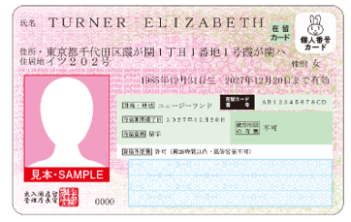
| ② Residence Card (在留カード) | Residence status, expiration date of period of stay, whether work is restricted, whether permission for activities outside status has been granted | Unique to foreign-tenant applications. This is the basis for setting the lease term | |
| Verifies your work or school | ③ Certificate of Employment | Employer and confirmation of current employment | Japanese tenants may also be asked for this |
| ④ Certificate of School Enrollment | School and confirmation of current enrollment | Same as for a Japanese student | |
| ⑤ Certificate of Eligibility for the applicant's current work | Confirms the current residence status permits this job | Unique to foreign-tenant applications. Matters especially right after a job change | |
| ⑥ Permit for Activities Outside the Scope of the Residence Status | Confirms a student or dependent may legally earn part-time income | Unique to foreign-tenant applications. Needed to evaluate a student's income | |
| Verifies income and salary | ⑦ Statement of Withholding Tax | Previous year's annual income | Same as for Japanese tenants |
| ⑧ Pay Slip | Most recent monthly income | Same as for Japanese tenants | |
| ⑨ Certificate of Tax Payment | Income and tax-payment record | Same as for Japanese tenants | |
| ⑩ Copy of Previous Year's Final Tax Return | Income for sole proprietors and business owners | Same as for Japanese tenants | |
| ⑪ Certificate of (Expected) Salary Payment *For those about to start work | Expected income even before starting the job | Used for applications made right after arriving in Japan | |
| ⑫ Bank Remittance Certificate | Money sent from family or others in the home country | Unique to foreign-tenant applications. Serves as a funding source for students | |
| ⑬ Scholarship Payment Certificate | Scholarship as a recurring income source | Serves as a funding source for students | |
| ⑭ Proof of Savings (bankbook copy) | Balance of funds on hand | Supporting material when income alone looks thin |
Source: MLIT (国土交通省, Ministry of Land, Infrastructure, Transport and Tourism), "Checklist of Required Documents for Tenant Screening" (入居審査必要書類チェックシート), part of the resource appendix to the Guidelines for Facilitating Foreign Nationals' Access to Private Rental Housing (外国人の民間賃貸住宅入居円滑化ガイドライン). The same checklist is published in 14 languages: Japanese, English, Chinese, Korean, Spanish, Portuguese, Vietnamese, Nepali, Thai, Indonesian, Burmese, Khmer, Tagalog, and Mongolian.
The 4 Documents That Truly Differ from a Japanese Tenant's Application
Of the 14 items, only four do not appear at all when screening a Japanese applicant: ② the residence card, ⑤ the certificate of eligibility for the applicant's current work, ⑥ the permit for activities outside the scope of the residence status, and ⑫ the bank remittance certificate. The remaining ten play the same role they play in a Japanese tenant's screening. The common assumption that "foreign tenants mean twice the paperwork" does not hold up in practice — what actually increases is four specific items.
These four items answer four distinct questions. The residence card answers "how long can this person legally remain in Japan?" The certificate of work eligibility answers "is this person permitted to do this job under their current residence status?" The permit for outside-status activities answers "can we count part-time income as income at all?" And the bank remittance certificate answers "is there a source of funds beyond a Japanese salary?" Framed this way, these are not extra hurdles designed to make screening stricter — they fill in information gaps that, for a Japanese applicant, are already implicitly answered by citizenship and residency. Seen that way, the purpose of the added checks becomes much clearer.
The item most often overlooked is ⑥, the permit for activities outside the scope of the residence status. Student and Dependent visa holders face restrictions on paid work, and part-time income only becomes legitimate once this permit has been granted. Whether the permit has been granted is also noted on the residence card itself, so it is worth cross-checking that the part-time income declared on the application matches what the card records.
Alternatives When a Document Is Missing
In practice, three situations come up again and again. For each one, there is a defined substitute.
- No withholding-tax statement because the applicant just arrived in Japan: in place of ⑦, request ⑪ the certificate of (expected) salary payment. The checklist itself carries a note for "those about to start work," anticipating exactly this kind of pre-employment application. Combine this with ⑭ proof of savings to assess near-term ability to pay.
- No pay slip because employment hasn't started yet: alongside ⑪, secure ③ a certificate of employment or an employment contract to confirm the employer and the terms of employment. If the residence status is "Engineer/Specialist in Humanities/International Services" and you want to confirm the job duties actually match that status, add ⑤ the certificate of work eligibility.
- A student whose only regular income is a scholarship: combine ⑬ the scholarship payment certificate with ⑫ the bank remittance certificate. This lets you assess whether the scholarship plus remittances together can cover the rent — and in this scenario, using a rent-guarantee service does a great deal to support the decision.
Stopping an application because a single document is missing risks turning away applicants who could have used a valid substitute. Keeping the purpose-based structure in mind — identity, employment, income — and knowing which substitutes are available for each, gives screening real flexibility without lowering the bar. The underlying logic of tenant screening is covered in more depth in our guide to rental screening criteria and the reasons applications get rejected.
How to Verify a Residence Card: What Changed on the Card's Face in June 2026
Visually inspecting a residence card is not sufficient verification. Japan's Immigration Services Agency (出入国在留管理庁, ISA) has explicitly stated that cases of counterfeit or altered cards built on valid residence-card numbers have occurred, and forgeries that cannot be detected by appearance alone genuinely exist in circulation. On top of that, the information printed on the card's face changed on June 14, 2026, so the verification procedure itself needs updating. For a landlord used to a UK right-to-rent check or a US tenant-screening service, this two-step, government-run verification is a distinctly Japanese layer: there is no equivalent free, national ID-authenticity lookup tool built into tenant screening in most English-speaking rental markets.
Why a Visual Check Isn't Enough: The Two-Step Verification Process
The Immigration Services Agency publishes two free tools to counter forgery and alteration. Because they serve different purposes, running a card through both is the standard practice.
- Residence Card Reader Application (在留カード等読取アプリケーション): reads the name, date of birth, and photo stored on the card's IC chip and cross-checks them against what is printed on the card's face. This confirms whether the printed information has been tampered with. It is distributed for Windows, macOS, Android, and iOS; using it on a PC requires a contactless IC card reader/writer.
- Residence Card Number Revocation-Status Lookup (在留カード等番号失効情報照会): checks the card number and validity period to determine whether the card has been revoked. This confirms whether the card is still currently valid. Since November 14, 2025, the revocation lookup has been accessible directly from within the reader app.
These two tools are not substitutes for each other. The reader app alone cannot catch a card that is genuine but has since been revoked, and the revocation lookup alone cannot catch a forged card that reuses a valid card number. The Immigration Services Agency itself advises that anyone using the reader app should also run the revocation-status lookup. Both tools are linked from the ISA's "Residence Card Reader Application / Revocation-Status Lookup Support Page". As with any other identity document, using the reader app presupposes that the cardholder's consent has been obtained before the card is presented for scanning.
The New Format and the Specified Residence Card, Introduced June 14, 2026
From June 14, 2026, Japan began issuing the "Specified Residence Card" (特定在留カード), which combines the functions of the residence card with those of the My Number Card (マイナンバーカード, Japan's national ID card), and standard residence cards not upgraded to Specified status switched to the new format at the same time. What matters most for owners and management companies is that less information is now printed on the card's face.
| Item | Cards issued through June 13, 2026 | Cards issued from June 14, 2026 onward |
|---|---|---|
| Residence status | Printed on card | Printed on card (unchanged) |
| Expiration date of period of stay | Printed on card | Printed on card (unchanged) |
| Whether work is restricted | Printed on card | Printed on card (unchanged) |
| Whether permission for activities outside status has been granted | Printed on card | Printed on card (unchanged) |
| Period of stay (length, e.g. 3 years or 5 years) | Printed on card | Removed from card face. Recorded only on the IC chip |
| Type of permission, date of permission, date of issuance | Printed on card | Removed from card face. Recorded only on the IC chip |
| Photo for holders under 16 | Not shown | Now shown for ages 1 through 15 |
| Card validity period for Permanent Resident / Highly Skilled Professional (ii) status | 7 years after issuance | Until the holder's 10th birthday after issuance (5th birthday if under 18) |
Source: Immigration Services Agency of Japan (出入国在留管理庁, ISA), "About Applying for a Specified Residence Card" (特定在留カード交付申請について) and "Q&A on the Integration of the Residence Card and the My Number Card" (在留カードとマイナンバーカードの一体化Q&A)
The practical conclusion is simple. The "expiration date of period of stay," the figure you actually need to design the lease term, is still printed on the card face under the new format. So the information required for lease design is still readable from the card exactly as before. What disappeared is the notation of whether the period of stay is "3 years" or "5 years" — supplementary information useful for gauging how often the tenant is likely to renew, not for setting the lease term itself.
One caveat: the "period of stay," "type of permission," and "date of permission" that were removed from the card's face are, as of now, also not displayed by the reader app. The Immigration Services Agency has indicated it plans to release an updated version capable of showing these items by around September 2026. Until then, it is more realistic to build lease terms around the expiration date than to spend effort trying to confirm the exact length of the period of stay.
One more shift worth flagging: the number of card formats a landlord may see has grown to three. The old-format residence card, the new-format residence card, and the Specified Residence Card are all equally valid; the old format remains usable through its own expiration date, so there is no need to demand a switch. Obtaining a Specified Residence Card is optional, and a tenant may continue holding a separate residence card and My Number Card instead. At the front desk, the correct posture is not "which is the right card format" but "is the card presented currently valid" — and for an owner running screening across a multi-unit portfolio, that is a training point, not just a piece of trivia: staff should be taught to check validity procedurally, rather than to expect a single "correct" card to appear.
Table: Period of Stay by Visa Category, and How to Set the Lease Term
The lease term is set from two inputs: the residence card's expiration date and the nature of the residence status itself. A Permanent Resident, whose period of stay is unlimited, and a Student, whose period of stay is individually set and capped at 4 years and 3 months, mean something entirely different even under an identical 2-year lease. This is a sharper distinction than most Western leasing markets draw: a US or UK landlord signing a 12-month lease applies the same term regardless of the tenant's immigration status, whereas in Japan the tenant's residence status is itself an input into the lease-term calculation, because it determines how long that person is legally permitted to remain in the country at all. The table below sets out the periods of stay defined in the Immigration Control Act's status table, and the lease-design logic that follows from each.
| Residence Status | Period of Stay (per the Immigration Control Act) | How to Think About the Lease Term | Documents to Re-check at Renewal |
|---|---|---|---|
| Permanent Resident | No time limit | No need to weigh a time constraint at all — design the lease the same way as for a Japanese tenant | Residence card (note: the card itself carries a validity period) |
| Spouse or Child of a Japanese National | 5 years, 3 years, 1 year, or 6 months | A standard 2-year lease works without difficulty | Residence card |
| Long-Term Resident | 5 years, 3 years, 1 year, 6 months, or individually designated up to 5 years | A standard 2-year lease works without difficulty | Residence card |
| Engineer / Specialist in Humanities / International Services | 5 years, 3 years, 1 year, or 3 months | A 2-year lease is standard. If the expiration date falls within a year, explain up front that the tenancy is conditional on renewal | Residence card, and a certificate of employment or certificate of work eligibility |
| Business Manager | 5 years, 3 years, 1 year, 6 months, 4 months, or 3 months | A 2-year lease is standard. Also assess the continuity of the tenant's business | Residence card, copy of tax return |
| Specified Skilled Worker (ii) | 3 years, 2 years, 1 year, or 6 months | A 2-year lease is standard. Because family members may accompany this status, clearly define the number of occupants | Residence card, certificate of employment |
| Specified Skilled Worker (i) | Individually designated, not exceeding 3 years. A cap also applies to the cumulative total period of stay | Build the lease from the expiration date, and confirm the likelihood of renewal with the employer before deciding | Residence card, certificate of employment |
| Dependent | Individually designated, not exceeding 5 years | Linked to the supporting family member's period of stay, so check that person's expiration date too | Residence card for both the applicant and the supporting family member, and the permit for activities outside the scope of status |
| Student | Individually designated, not exceeding 4 years and 3 months | Match whichever is shorter: the enrollment period or the card's expiration date. Plan for move-out around graduation | Residence card, certificate of school enrollment, permit for activities outside the scope of status |
Source: Immigration Services Agency of Japan (出入国在留管理庁, ISA), "Table of Residence Statuses" (在留資格一覧表); for the cumulative total period of stay under Specified Skilled Worker (i), see the same agency's "Cumulative Total Period of Stay" (通算在留期間)
As of the end of 2025, the largest single residence-status category was Permanent Resident, at 947,125 people — the group with no time limit on their stay at all. Engineer/Specialist in Humanities/International Services followed at 475,790, and Student at 464,784. In other words, a substantial share of foreign applicants belongs to a group that requires almost no thought about lease-term constraints. Treating every foreign applicant as a uniformly "short-stay risk" is simply not supported by the data — and for an owner evaluating occupancy strategy, that means the addressable pool of low-risk foreign tenants is considerably larger than a cautious first impression would suggest.
In Practice: When the Period of Stay Is Shorter Than the Lease Term
When the card's expiration date falls in the middle of the lease term, owners have two options.
The first, and generally preferable, option is to keep a standard lease (普通借家契約, futsū shakuya keiyaku) in place and have the tenant re-present their residence card at renewal. Renewing the period of stay is a procedure the tenant handles on their own with immigration authorities, and a new residence card is issued once renewal is approved. Writing "the tenant will submit a copy of their residence card at renewal" into the lease or a supplementary memorandum turns this check into a routine step rather than an awkward one-off conversation. There is no need to raise the subject of termination while the expiration date is still well in the future.
The second option is a fixed-term lease (定期借家契約, teiki shakuya keiyaku — a lease structure unique to Japanese law, created by the 2000 revision of the Act on Land and Building Leases, that terminates automatically and definitively at the end of its stated term, with no statutory right of renewal for the tenant; this stands in contrast to a standard lease, where courts apply a strong "legitimate reason" standard that makes landlord-initiated non-renewal difficult) timed to the card's expiration date — but we recommend weighing this carefully. Because a fixed-term lease ends definitively when its term expires, even a tenant whose period of stay has been renewed and who wants to keep living there will be asked to move out unless the parties agree to a fresh contract. If cutting the lease off becomes an end in itself, an owner risks losing a good tenant over a short-term technicality. Our own view is that pairing a standard lease with a disciplined renewal-check process does more for occupancy over the long run than defaulting to a fixed-term lease.
Choosing a Rent-Guarantee Company: The Three-Tier System of 123 Registered, 52 Multilingual, and 12 Certified Providers
The issue of "the applicant has no joint guarantor (連帯保証人, rentai hoshōnin) resident in Japan" can be solved in practice through a rent-guarantee company (家賃債務保証会社). The role of a rentai hoshōnin runs deeper than a typical US or UK guarantor or co-signer: under Japanese civil law, a joint guarantor is jointly and severally liable for the tenant's obligations, meaning a landlord can pursue the guarantor directly without first having to exhaust efforts against the tenant — which is exactly why Japanese leasing has historically leaned so heavily on finding one. For a foreign applicant with no personal or family network in Japan, a commercial guarantee company fills that structural gap. But saying "we'll use a guarantee company" means different things depending on which tier that company sits in. MLIT's published list of providers is organized into three distinct tiers.
Table: The Three Tiers of Rent-Guarantee Providers
| Tier | Number of Providers | Government Involvement | What It Means for Accepting Foreign Tenants |
|---|---|---|---|
| Registered Rent-Guarantee Providers | 123 providers (as of March 31, 2026) | Providers registered under a system established by MLIT public notice | The base population — providers meeting requirements for financial standing and scope of business |
| Registered Providers Offering Foreign-Language Support | 52 providers (as of December 31, 2025) | Among registered providers, MLIT separately publishes a list of those confirmed to offer language support | The tier landlords should actually approach. Roughly 40% of all registered providers |
| Certified Rent-Guarantee Providers | 12 providers (as of July 31, 2026) | Certified by the Minister of Land, Infrastructure, Transport and Tourism as providers accessible to those who need extra support securing housing | Providers proactively oriented toward accepting tenants who need extra support. Still a small number |
Source: MLIT (国土交通省), "List of Registered Rent-Guarantee Providers", "List of Registered Rent-Guarantee Providers Offering Foreign-Language Support", "List of Certified Rent-Guarantee Providers"
In practice, the middle tier — the 52 providers — is the one worth focusing on. The simple fact that this many companies are publicly documented as offering multilingual support at signing and throughout the tenancy should put to rest the assumption that "foreign tenants can't get a guarantee company." Look up company names and head-office locations on the published list, and shortlist a handful that actually operate in your management area — that is the realistic amount of preparation needed. The mechanics of how a guarantee company works are covered in our explainer on what a rent-guarantee company is.
What Changed With the Certified Rent-Guarantee Provider System, Effective October 2025
The Certified Rent-Guarantee Provider system is a framework under which the Minister of Land, Infrastructure, Transport and Tourism certifies rent-guarantee providers as accessible to housing-vulnerable persons (住宅確保要配慮者, jūtaku kakuho yō-hairyosha — a legal category under Japan's Housing Safety Net Act covering groups who face structural difficulty securing rental housing, including low-income households, elderly people living alone, single-parent households, and foreign nationals). It was created through an amendment to the Housing Safety Net Act (Act No. 43 of Reiwa 6 / 2024) and took effect October 1, 2025. Foreign nationals are included within this housing-vulnerable category.
The same amendment also introduced a certification system for residential support housing, promoted the use of lifetime building leases, and encouraged the removal of a deceased or absent tenant's abandoned belongings. From an owner's perspective, this amounts to institutional backing for the underlying anxiety of "if something happens after I rent to this person, who deals with it?" Some guarantee products now include the cost of removing, storing, and disposing of a tenant's abandoned belongings within their coverage, which has meaningfully lightened the practical burden on owners when a tenant suddenly returns to their home country.
Worked Example: Move-In Costs and Guarantee Fees for an ¥80,000/Month Studio
Saying "we'll explain the costs carefully" is not actually an explanation unless you can name the number. Using real figures from the FY2025 Housing Market Trend Survey, here is a full build-up for a studio renting at ¥80,000/month (approx. USD 533/month). This is worth walking through in detail, because the assumption most international tenants and investors carry in — one refundable deposit, one month's rent, done — does not match how Japanese move-in costs are actually structured.
According to the survey, households that moved into private rental housing paid a monthly rent of ¥83,381 on average and ¥74,000 at the median (approx. USD 556 and USD 493 respectively), with an average common-area fee of ¥4,837/month (approx. USD 32). Among households that paid a security deposit, 51.9% did so, and of those, 64.4% paid exactly one month's rent. Among households that paid key money, 43.1% did so, and of those, 73.4% paid exactly one month's rent. Among households that paid a brokerage fee, 48.0% did so, and of those, 69.7% paid exactly one month's rent.
Breakdown of Move-In Costs
| Item | Amount | Basis |
|---|---|---|
| Advance rent (1 month) | ¥80,000 (approx. USD 533) | Assumed rent |
| Common-area fee (1 month) | ¥4,837 (approx. USD 32) | Survey average monthly amount |
| Security deposit (敷金, shikikin) (1 month) | ¥80,000 (approx. USD 533) | Among households with a deposit, 64.4% paid exactly 1 month's rent |
| Key money (礼金, reikin) (1 month) | ¥80,000 (approx. USD 533) | Among households with key money, 73.4% paid exactly 1 month's rent |
| Brokerage fee (1 month + 10% consumption tax) | ¥88,000 (approx. USD 587) | Among households with a brokerage fee, 69.7% paid exactly 1 month's rent |
| Guarantee fee (if the initial rate is 50%) | ¥40,000 (approx. USD 267) | Company D's example, as published in MLIT's guide |
| Guarantee fee (if the initial rate is 80%) | ¥64,000 (approx. USD 427) | Company E's example, from the same guide |
| Total move-in cost | ¥372,837–396,837 (approx. USD 2,486–2,646) | Range reflects a guarantee fee of 50%–80% |
Source: MLIT (国土交通省), "FY2025 Housing Market Trend Survey Report" (令和7年度 住宅市場動向調査報告書, July 2026); MLIT and the Japan Property Management Association (国土交通省・日本賃貸住宅管理協会), "Guide to Accepting Foreign Tenants, for Landlords and Real Estate Professionals" (《大家さん、不動産事業者のための》外国人の受入れガイド)
Renting this ¥80,000 room means having roughly 4.7 months of rent ready before move-in. This is one of the sharpest points of difference for an overseas investor or tenant: in the United States, the United Kingdom, and Australia, a landlord typically collects a single refundable security deposit — commonly capped by law or convention at somewhere between three and five weeks', or one to two months', rent — and nothing more. Japan layers on a second, non-refundable payment with no direct Western equivalent: reikin (礼金, "key money" or "gratitude money"), a one-time payment to the landlord that is not held as security and is never returned, regardless of how or when the tenancy ends. Historically, reikin was a gesture of gratitude to the landlord for the opportunity to rent, dating back to a housing-scarce postwar market; today it persists mainly as market custom, and both its prevalence and its size vary by region and by how competitive the local rental market is. Showing this number up front — roughly 4.7 months of rent — sets more accurate expectations for an international applicant than any amount of verbal explanation of what "key money" means. Note also that the basis for calculating the guarantee fee varies by provider: some calculate it on rent alone, others on the full monthly charge including common-area fees.
Guarantee Fees and the Coverage Limit an Owner Can Receive
MLIT's guide publishes service examples, with actual figures, from two real guarantee companies. The guarantee fee the tenant pays and the coverage ceiling the owner can receive line up as follows.
| Item | Company D's Example | Company E's Example |
|---|---|---|
| Initial guarantee fee | 50%–75% of monthly rent (¥40,000–60,000, approx. USD 267–400, for an ¥80,000 rent) | 80% of monthly rent (¥64,000, approx. USD 427, for an ¥80,000 rent) |
| Renewal (annual) guarantee fee | ¥10,000/year (approx. USD 67) | ¥10,000/year (approx. USD 67) |
| Guarantee coverage limit | 48 months of monthly rent (¥3.84 million, approx. USD 25,600, for an ¥80,000 rent) | 24 months of monthly rent (¥1.92 million, approx. USD 12,800, for an ¥80,000 rent) |
| Coverage scope | Monthly rent charges (rent, management fee, common-area fee, parking, etc.), electricity/gas/water charges, costs of removing, storing, and disposing of abandoned belongings, litigation costs, and more | |
| Support services | Multilingual support at signing and during the tenancy, daily-living support during the tenancy, removal/storage/disposal of abandoned belongings | Multilingual support at signing and during the tenancy, trouble-related consultation during the tenancy, removal/storage/disposal of abandoned belongings |
| Tenant's total cost over 4 years | ¥70,000 (initial 50% + ¥10,000/year renewal × 3 years; approx. USD 467) | ¥94,000 (initial 80% + ¥10,000/year renewal × 3 years; approx. USD 627) |
The point worth pausing on is that the guarantee coverage limit differs by a factor of two between the 48-month and 24-month options — for an ¥80,000 rent, that's a difference between ¥3.84 million and ¥1.92 million. If non-payment drags on and litigation costs or belongings-removal costs stack on top, this gap flows straight through to what the owner is left holding. A lower guarantee fee is attractive to the tenant, but the coverage limit and scope of coverage are what the owner needs to be evaluating. For a broader sense of typical pricing, see our guide to rent-guarantee fee structures and pricing.
One more data point: in the FY2025 Housing Market Trend Survey, "securing a joint guarantor" ranked second among difficulties experienced at signing. In the Immigration Services Agency's Basic Survey of Foreign Residents, 19.3% of respondents cited "finding a guarantor when renting a home" as a difficulty in daily life. Using a guarantee company is simultaneously a risk-management tool for the owner and a solution to one of the biggest headaches tenants themselves report.
The Line Screening Must Not Cross: Refusing a Tenant Based on Nationality Alone Risks Unlawful Discrimination
The "Guide to Accepting Foreign Tenants," produced jointly by MLIT and the Japan Property Management Association, states the following explicitly in Q&A format: refusing to rent to someone because they are a foreign national risks constituting unlawful discrimination. There have been past cases in which a landlord who refused a tenancy based on nationality alone was ordered by a court to pay damages.
This is not only an ethical point — it is a business-risk point. Quietly continuing a blanket "no foreigners" policy means carrying real legal exposure while also voluntarily shrinking the pool of applicants available to fill a vacancy. For a US reader, the closest parallel is the Fair Housing Act, which prohibits rental discrimination based on national origin among other protected classes; UK readers will recognize the same underlying principle in the Equality Act 2010, which lists race — including nationality — as a protected characteristic. Japan does not yet have a fair-housing statute as broad or as heavily litigated as either of those, but Japanese courts have reached materially the same outcome by applying general tort law (Article 709 of the Civil Code, the general unlawful-act provision): a blanket "no foreigners" policy is legally exposed, not merely impolite.
The #1 Setting for Discrimination: "Searching for Housing"
In the Immigration Services Agency's FY2025 "Basic Survey of Foreign Residents" (8,874 valid responses, a 45.5% response rate, fielded October 17–November 9, 2025), "searching for housing" ranked highest among settings where respondents experienced discrimination, at 19.4%. Among the parties respondents identified as the source of that discrimination, "real estate and housing-industry professionals" ranked third at 23.8%. Consistent with the previous year's survey, housing search remains the single setting where the most friction occurs.
Read the other way, this number also points to real opportunity for any company or owner able to handle this moment well. Free-text responses in the same survey included accounts of foreign residents who, even after living in Japan for many years, are repeatedly asked to produce a Japanese guarantor at every lease renewal — and for whom the process of finding housing at all has become a significant, recurring source of stress.
The Line Between What Screening May Consider and What It May Not
| Item Under Review | Permitted? | Reason |
|---|---|---|
| Expiration date of period of stay | Permitted | Because it is an objective fact needed to design the lease term |
| Income and ability to pay (withholding statement, remittance certificate, savings) | Permitted | Because the same standard applied to Japanese applicants applies here too |
| Whether the applicant passes rent-guarantee screening | Permitted | Because there is a rational basis: preparing for the risk of non-payment |
| Planned number of occupants and their relationship to the applicant | Permitted | Because it is a contractual element tied to the conditions of use for the property |
| Whether work is restricted / whether permission for outside-status activities has been granted | Permitted | Because it is necessary to confirm the income is lawfully earned |
| Nationality itself | Not to be used as a factor | Because it risks constituting unlawful discrimination and has no bearing on ability to pay |
The underlying principle is simple to state. Facts tied to ability to pay and to fulfilling the contract may be considered; the attribute itself may not. "A two-year lease is difficult because the period of stay expires in three months" is a judgment grounded in fact; "not acceptable because of X nationality" is exclusion based on an attribute. Putting this distinction into explicit, written-down language internally means front-line staff no longer have to guess where the line is.
Before, During, and After the Tenancy: Which Multilingual Tools to Use When
MLIT's "Guide to Accepting Foreign Tenants" organizes the root causes of trouble with foreign tenants into three categories: not understanding daily living rules or how to use the property, not fully understanding the contract terms, and communication that simply didn't work. Examples of in-tenancy trouble cited include violations of garbage-disposal rules, noise complaints from neighbors, unpaid rent, and unauthorized additional occupants.
All three root causes boil down to the same thing: information that never actually got across. If the cause is a communication gap rather than bad intent, providing the right tool closes that gap. And that tool already exists, published free of charge in 14 languages.
Before the Contract: Share Preferences and Required Documents on Paper
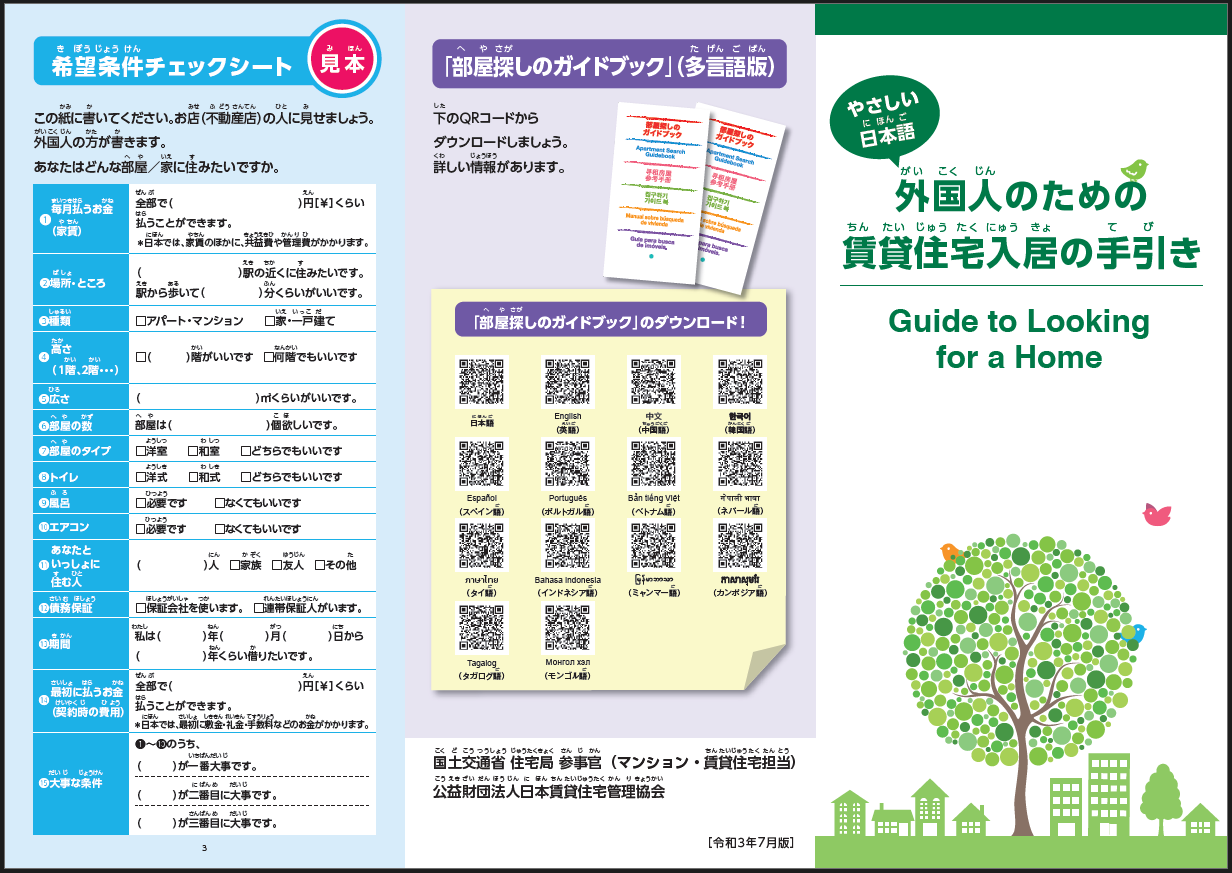
- Preferred Conditions Checklist (希望条件チェックシート): a form for the prospective tenant to fill in rent, location, floor area, number of rooms, whether a Japanese-style room (washitsu, 和室) or Western-style room (yōshitsu, 洋室) is preferred, the number of co-residents, whether a personal guarantor or a guarantee company will be used, desired move-in timing, and an upper limit on contract-related costs. Having applicants complete this before a property viewing reduces wasted showings caused by mismatched expectations.
- Checklist of Required Documents for Tenant Screening (入居審査必要書類チェックシート): the same 14-item form covered at the top of this article. Check the relevant boxes and hand it to the applicant.
- Important Matters Explanation and the Lease Agreement: the Guidelines include multilingual sample versions of the Standard Lease Agreement (賃貸住宅標準契約書) and the Standard Fixed-Term Lease Agreement (定期賃貸住宅標準契約書) (both dated March 2018), a sample rental application, and a sample Important Matters Explanation (重要事項説明, jūyō jikō setsumei — a legally mandated disclosure that a licensed real-estate agent must walk the tenant through before signing, with no direct one-to-one equivalent in most Western leasing, where pre-signing disclosure obligations tend to be narrower and less formally staged). Keeping the applicant's native-language sample alongside the Japanese original during the explanation measurably improves comprehension.
As a baseline for communication, the Guide recommends "speaking slowly and clearly in Plain Japanese, using as little technical vocabulary as possible," and also suggests inviting a friend who can interpret to accompany the applicant, or using a portable translation device. A fully built-out multilingual operation is not a prerequisite for starting — there is plenty that can begin today.
During the Tenancy: Post Rules With Illustrations
- Move-In Agreement Checklist (入居の約束チェックシート): a multilingual form covering house rules such as garbage disposal, noise, and prohibited activities. Read it through together at signing and give the tenant a copy.
- Guidebook for Finding a Room (部屋探しのガイドブック): a booklet explaining how to search for housing, everyday living rules, and real-estate terminology in Plain Japanese and multiple other languages. Hand it to tenants once their application is approved.
- Use illustrations on notices: because text-only notices are hard to follow, the Guide recommends illustrated signage instead. Showing "burnable trash: Mondays and Thursdays" with a picture and the days of the week communicates the same information to tenants of any nationality.
- Secure emergency contacts in advance: the Guide lists confirming the contact information of people the applicant regularly interacts with — family in their home country, Japanese friends, their employer, or their school — as an important precaution to put in place before move-in.
Beyond these MLIT resources, the Japan Property Management Association (公益財団法人日本賃貸住宅管理協会) publishes a "Guide to Foreign Residents' Way of Living" video on its own foreign-tenant support page. For tenants who absorb information better from video than from paper, this is a useful option to point them toward.
At Move-Out: Explain Restoration-to-Original-Condition Rules at Move-In
Move-out disputes are decided at the moment of signing, not at the moment of move-out. This is where genjō-kaifuku (原状回復, "restoration to original condition") — MLIT's guideline-based framework for dividing repair and cleaning costs between landlord and tenant based on normal wear-and-tear versus tenant-caused damage — needs to be explained clearly, not left implicit. The Guide states that "it is important to carefully explain the restoration obligation at the time of contract signing so the tenant genuinely understands it," and recommends that, where possible, landlord and tenant jointly inspect the property's condition together at move-in. The Guidelines also include a multilingual Move-In/Move-Out Condition and Restoration Confirmation checklist.
In the FY2025 Housing Market Trend Survey, the top difficulty tenants reported at move-out was "unclear billing for repair costs," followed by "settling rent and the security deposit." These are problems that arise with Japanese tenants too — the sensible sequencing is to resolve them more carefully, and earlier, when a language barrier is also in play. The division of restoration costs is covered in detail in our guide to genjō-kaifuku practices and how to avoid disputes.
Why Accept Foreign Tenants: A Vacancy Strategy for the Era of 4.12 Million Foreign Residents
The reason it's worth getting these procedures right comes down to the scale of the market. As of the end of 2025, Japan's foreign resident population stood at 4,125,395, up 356,418 people, or 9.5%, from the previous year-end — the first time the total has crossed 4 million. That breaks down into 3,858,499 mid- to long-term residents and 266,896 special permanent residents.
Table: The Scale and Composition of Japan's Foreign Resident Population (as of Year-End 2025)
| Category | Top Entries | Number |
|---|---|---|
| Total | Foreign resident population | 4,125,395 (up 356,418, +9.5% year-on-year) |
| By residence status | Permanent Resident | 947,125 |
| Engineer / Specialist in Humanities / International Services | 475,790 | |
| Student | 464,784 | |
| Technical Intern Training | 456,618 | |
| Specified Skilled Worker | 390,296 | |
| By nationality / region | China | 930,428 |
| Vietnam | 681,100 | |
| South Korea | 407,341 | |
| Philippines | 356,579 | |
| Nepal | 300,992 | |
| By prefecture | Tokyo | 801,438 (19.4% of the national total) |
| Osaka | 375,319 | |
| Aichi | 357,800 | |
| Kanagawa | 317,353 | |
| Saitama | 290,937 |
Source: Immigration Services Agency of Japan (出入国在留管理庁, ISA), "On the Number of Foreign Residents as of the End of 2025" (令和7年末現在における在留外国人数について)
The fact that Permanent Resident is the single largest residence-status category has a direct bearing on how owners should approach acceptance decisions. More than 940,000 people are living in Japan with no time limit on their stay whatsoever, and for this group, "worried about their period of stay expiring" simply does not apply as a concern. Amid Japan's shrinking overall population, continuing to exclude a demand segment that is growing 9.5% a year from your applicant pool is difficult to justify as a rational vacancy strategy. For a broader treatment of turning acceptance into an occupancy lever, see our practical guide to reducing vacancy by welcoming foreign tenants.
The Housing Safety Net System: Institutional Support for Accepting Foreign Tenants
Foreign nationals are included among the housing-vulnerable persons covered by the Housing Safety Net System (住宅セーフティネット制度, jūtaku sēfutī netto seido — Japan's statutory framework, distinct from anything in most Western housing-benefit programs, that registers private rental units as dedicated safety-net housing and channels support toward both landlords and tenants who use them). The system provides support for renovating dedicated safety-net housing and for reducing the financial burden on tenants, and the October 2025 amendment newly created a certification system for residential support housing. Registration and search are available through the Residential Support Housing Information System. The full shape of the system is explained in our guide to using the Housing Safety Net System as a vacancy strategy.
We see accepting housing-vulnerable tenants — whether elderly residents or foreign nationals — not as a concession, but as an expansion of the options available in rental management. Let the system absorb the risk the system is designed to absorb, and let owners spend their time building the relationship with the tenant instead. In our view, that is what supports both occupancy and asset value over the long term.
Summary: The Order of Checks Before Signing
Once the procedure is defined, leasing to a foreign tenant looks almost identical to leasing to a Japanese one. Here, in order, is that procedure.
- Hand over the Preferred Conditions Checklist: share rent, area, number of occupants, and a cost ceiling on paper, and resolve mismatched expectations before a viewing.
- Verify the residence card in two steps: read the residence status and the expiration date of the period of stay from the card face, then confirm the card's authenticity and current validity using the reader app and the revocation-status lookup.
- Select from the 14-item Required Document Checklist: across the three categories of identity, work or school, and income, request only the items that apply to that specific applicant.
- Work the lease term backward from the expiration date: for a permanent resident, design it the same way as for a Japanese tenant; for a student, match whichever is shorter — the enrollment period or the card's expiration date.
- Choose a guarantee company from the 52 multilingual-support providers: compare on the guarantee limit, the scope of coverage, and the availability of multilingual support — not on how low the fee is.
- State the cost in real numbers: for an ¥80,000 rent, explain that move-in costs run to roughly ¥372,837–396,837 (approx. USD 2,486–2,646) using concrete figures, and explain the relationship between the security deposit and restoration obligations at move-in.
- Read through the Move-In Agreement Checklist together: share garbage-disposal and noise rules in multiple languages, and prepare illustrated signage.
Of these seven steps, only steps 2 and 4, and part of step 5, are actually specific to foreign-tenant contracts. Everything else is a step worth doing well for a Japanese tenant's contract too. Getting foreign-tenant acceptance right is, in that sense, the same project as getting rental management itself right.
If you have questions about building an acceptance framework, selecting a guarantee company, or handling multilingual contract logistics, please reach out to INA&Associates Inc. We tailor our recommendations to your specific managed properties in a form you can put into practice directly.
Frequently Asked Questions
What's actually different between the documents required for a foreign tenant and a Japanese tenant?
Of the 14 items on MLIT's checklist, only 4 do not appear at all in a Japanese applicant's screening: the residence card, the certificate of work eligibility, the permit for activities outside the scope of the residence status, and the bank remittance certificate. The remaining 10 items — passport, certificate of employment, certificate of school enrollment, statement of withholding tax, pay slip, certificate of tax payment, copy of a final tax return, certificate of expected salary payment, scholarship payment certificate, and proof of savings — play the same role they play in a Japanese tenant's screening. The number of documents does not increase dramatically.
What if the applicant doesn't have a joint guarantor resident in Japan?
A rent-guarantee company solves this in practice. MLIT publishes a list of 52 registered rent-guarantee providers (as of December 31, 2025) that offer foreign-language support — roughly 40% of the 123 total registered providers. Some products even cover multilingual support at signing and during the tenancy, plus removal, storage, and disposal of any belongings left behind. Securing a joint guarantor ranks as the second most common difficulty reported at signing in the Housing Market Trend Survey — it is a genuinely difficult step for Japanese tenants too. Using a guarantee company is not a special accommodation reserved for foreign tenants.
How should the lease be structured if the tenant's period of stay is shorter than the intended lease term?
The standard approach is to keep a regular (non-fixed-term) lease in place and have the tenant submit a copy of their renewed residence card at renewal time. Once the period of stay is renewed, a new residence card is issued, so it's worth writing a re-confirmation step into the lease or a supplementary memorandum at the renewal date. A fixed-term lease timed to the expiration date is also possible, but it ends definitively when its term is up — meaning even a tenant whose stay has since been renewed and who wants to remain will be asked to leave unless both parties agree to a new contract. This risks losing a good tenant over a short-term technicality, so we recommend weighing it carefully.
Can a landlord refuse a tenant simply for being a foreign national?
No. The "Guide to Accepting Foreign Tenants," from MLIT and the Japan Property Management Association, states explicitly that refusing a tenancy because the applicant is a foreign national risks constituting unlawful discrimination, and that Japanese courts have previously ordered landlords to pay damages in cases where a tenancy was refused based on nationality alone. At the same time, decisions grounded in facts tied to ability to pay and to fulfilling the contract — the expiration date of the period of stay, income and ability to pay, and whether the applicant passes rent-guarantee screening — remain permitted. The operative distinction is: judge on facts, not on the attribute itself.
What should landlords check on the residence card format that changed in June 2026?
The "residence status" and "expiration date of period of stay" needed to design a lease term are still printed on the card's face under the new format. What was removed from the printed face is the "period of stay" itself (the length, such as 3 or 5 years), the "type of permission," the "date of permission," and the "date of issuance" — these are now recorded only on the card's IC chip. As of this writing, the reader app also cannot yet display these fields, so building the lease term around the expiration date is the realistic operating approach for now. Cards issued under the old format remain fully valid through their own expiration dates, and no switch to the new format is required.
Citations and References
- MLIT (国土交通省), "Checklist of Required Documents for Tenant Screening" (入居審査必要書類チェックシート), Resource Appendix to the Guidelines for Facilitating Foreign Nationals' Access to Private Rental Housing
- MLIT (国土交通省), "Preferred Conditions Checklist" (希望条件チェックシート)
- MLIT (国土交通省), "Move-In Agreement Checklist" (入居の約束チェックシート)
- MLIT (国土交通省), "Guidebook for Finding a Room" (部屋探しのガイドブック)
- MLIT (国土交通省), "On Facilitating Foreign Nationals' Smooth Access to Private Rental Housing" (外国人の民間賃貸住宅への円滑な入居について)
- MLIT and the Japan Property Management Association (国土交通省・日本賃貸住宅管理協会), "Guide to Accepting Foreign Tenants, for Landlords and Real Estate Professionals" (《大家さん、不動産事業者のための》外国人の受入れガイド)
- MLIT (国土交通省), "List of Registered Rent-Guarantee Providers" (登録家賃債務保証業者一覧) (123 providers, as of March 31, 2026)
- MLIT (国土交通省), "List of Registered Rent-Guarantee Providers Offering Foreign-Language Support" (外国人の言語対応サポートを行っている登録家賃債務保証業者一覧) (52 providers, as of December 31, 2025)
- MLIT (国土交通省), "List of Certified Rent-Guarantee Providers" (認定家賃債務保証業者一覧) (12 providers, as of July 31, 2026)
- MLIT (国土交通省), "Certified Rent-Guarantee Provider System" (認定家賃債務保証業者制度)
- MLIT (国土交通省), "FY2025 Housing Market Trend Survey Report" (令和7年度 住宅市場動向調査報告書, July 2026)
- MLIT (国土交通省), "Housing Safety Net System" (住宅セーフティネット制度)
- MLIT (国土交通省), "On the Act Partially Amending the Housing Safety Net Act and Related Laws" (住宅セーフティネット法等の一部を改正する法律について) (effective October 1, 2025)
- MLIT (国土交通省), "Residential Support Housing Information System" (居住サポート住宅 情報提供システム)
- Immigration Services Agency of Japan (出入国在留管理庁, ISA), "On the Number of Foreign Residents as of the End of 2025" (令和7年末現在における在留外国人数について)
- ISA (出入国在留管理庁), "Table of Residence Statuses" (在留資格一覧表)
- ISA (出入国在留管理庁), "Cumulative Total Period of Stay" (通算在留期間)
- ISA (出入国在留管理庁), "Residence Card Reader Application / Revocation-Status Lookup Support Page" (在留カード等読取アプリケーション/失効情報照会 サポートページ)
- ISA (出入国在留管理庁), "About Applying for a Specified Residence Card" (特定在留カード交付申請について)
- ISA (出入国在留管理庁), "Q&A on the Integration of the Residence Card and the My Number Card" (在留カードとマイナンバーカードの一体化Q&A)
- ISA (出入国在留管理庁), "FY2025 Basic Survey of Foreign Residents (Key Results)" (令和7年度 在留外国人に対する基礎調査(主な結果))
- ISA (出入国在留管理庁), "Basic Survey of Foreign Residents" (在留外国人に対する基礎調査)
- Japan Property Management Association (公益財団法人日本賃貸住宅管理協会), "Support for Facilitating Foreign Tenant Move-In" (外国人入居円滑化支援)
