This is a distinctly Japanese data point: wood-frame ("mokuzō," 木造) construction in Japan costs approximately ¥233,000 per square meter (about USD 1,553 at a reference rate of ¥150/USD, roughly USD 144 per square foot) — around 76.9万円 per tsubo (a traditional Japanese area unit equal to 3.30578 square meters, still the standard unit for pricing construction and real estate in Japan; about ¥769,000, or USD 5,127, per tsubo) — against roughly ¥410,000 per square meter (about USD 2,733) for reinforced-concrete (RC) construction, a gap of roughly 40%. These are not marketing estimates. They come directly from the Ministry of Land, Infrastructure, Transport and Tourism's (国土交通省, MLIT) "Annual Report on Construction Starts Statistics" (建築着工統計調査報告, full-year Reiwa 7 / 2025 data), calculated by dividing total planned construction cost by total floor area started, by structural type.
For readers outside Japan, one thing about this market is worth stating plainly up front: unlike the United States, where a Multiple Listing Service (MLS) publishes searchable sold-price histories for virtually every closed transaction, Japan has no equivalent centralized, publicly searchable database of realized sale prices for existing homes. Comparable-sales data is fragmented, often proprietary to brokerages, and rarely reaches the granularity international buyers expect. What Japan does publish — and what this article draws on — is something most foreign investors do not expect from a market with weak price transparency: detailed, government-verified per-unit construction cost data by structural type, updated annually and cross-checked against actual mortgage-disbursement records. If you are building new, this is some of the most reliable underwriting data available in the Japanese market, even where resale comparables fall short.
"Wood is cheap" and "wood is environmentally friendly" are claims repeated constantly in Japan's construction industry, but few articles actually show how much cheaper wood construction is, using primary-source numbers. This article is written for two audiences: individuals planning to build a home in Japan, and business investors planning wood-frame rental or non-residential buildings. It lays out cost-per-tsubo by structural type, the differences in tax treatment and insurance cost, the building-code amendments that took effect in April 2025, and the subsidies available in fiscal 2026 — all sourced from Japanese government data, in yen with USD reference conversions throughout. This is written for readers who want to decide based on numbers and regulation, not impressions.
Key points in this article
- Wood-frame construction costs approximately ¥233,000 (about USD 1,553) per square meter; RC construction costs approximately ¥410,000 (about USD 2,733). Wood-frame is about 57% of the RC cost — a gap of roughly 43% (calculated from the FY2025 Annual Report on Construction Starts Statistics).
- Of the 740,667 new housing starts in FY2025 (Reiwa 7), 433,974 (58.6%) were wood-frame, and wood-frame accounts for 66.4% of total floor area started.
- By contrast, the wood-frame share of non-residential buildings is only 9.6%, and for mid-rise and high-rise non-residential buildings (four stories or more) it is 0.1% or less — wood-frame commercial buildings remain an early-stage market.
- The legal (tax) depreciation life is 22 years for wood-frame and 47 years for RC. A used wood-frame property older than 22 years can be depreciated over just 4 years under the simplified method, producing an annual depreciation deduction roughly 2.7 times larger than a newly built wood-frame property.
- In fiscal 2026, the "Mirai Eco Housing 2026" ("みらいエコ住宅2026事業") program offers subsidies of up to ¥1.10 million (about USD 7,333) for GX-oriented ("GX志向型," carbon-transition-oriented) housing — ¥1.25 million (about USD 8,333) in cold-climate regions — with an additional ¥200,000 (about USD 1,333) for Long-Life Quality Housing and ZEH-level housing when an old structure is demolished on the site.
How Much Does Wood-Frame Construction Cost in Japan? Comparing Cost per Tsubo by Structural Type, Using Primary Data
The headline figure: wood-frame construction in Japan costs approximately ¥233,000 per square meter — about ¥769,000 (roughly USD 5,127) per tsubo. Reinforced-concrete (RC) construction, calculated the same way, comes to approximately ¥410,000 per square meter, or about ¥1,355,000 (roughly USD 9,033) per tsubo. The gap is about ¥177,000 per square meter (about USD 1,180), or roughly 43%.
For investors used to US, UK, Australian, or Singaporean markets — where wood-frame construction (in the US, "stick framing") is often the default for single-family homes and reinforced concrete is reserved for mid-rise and high-rise, so the cost gap between the two structural types is rarely discussed as a distinct line item — Japan's construction market treats structural type as a first-order cost decision at every building scale, from a single-family home to a mid-rise apartment building. That is precisely why MLIT publishes this data broken out by structure every year.
Unit Cost per Square Meter and per Tsubo, by Structural Type [Data Table 1]
MLIT's Annual Report on Construction Starts Statistics (建築着工統計調査報告, full-year Reiwa 7 / 2025 data) publishes a summary table of floor area started and planned construction cost, broken out by structural type. Dividing one by the other produces the average unit cost of buildings actually started construction that year. This is not a modeled estimate — it is derived from aggregated permit-application figures.
| Structure | Floor Area Started (thousand m²) | Planned Construction Cost (¥100 million) | Cost per m² | Cost per Tsubo | Wood = 100 |
|---|---|---|---|---|---|
| Wood-frame (mokuzō, 木造) | 41,562 | 96,648 | approx. ¥233,000 (≈USD 1,553) | approx. ¥769,000 (≈USD 5,127) | 100 |
| Steel-frame (tekkotsu-zō, 鉄骨造) | 33,834 | 125,643 | approx. ¥371,000 (≈USD 2,473) | approx. ¥1,228,000 (≈USD 8,187) | 160 |
| Reinforced concrete (tekkin konkurīto-zō / RC, 鉄筋コンクリート造) | 18,437 | 75,550 | approx. ¥410,000 (≈USD 2,733) | approx. ¥1,355,000 (≈USD 9,033) | 176 |
| Steel-reinforced concrete (tekkotsu-tekkin konkurīto-zō / SRC, 鉄骨鉄筋コンクリート造) | 1,076 | 5,160 | approx. ¥480,000 (≈USD 3,200) | approx. ¥1,586,000 (≈USD 10,573) | 206 |
| Total non-wood | 54,291 | 208,171 | approx. ¥383,000 (≈USD 2,553) | approx. ¥1,268,000 (≈USD 8,453) | 165 |
| Total, all buildings | 95,853 | 304,818 | approx. ¥318,000 (≈USD 2,120) | approx. ¥1,051,000 (≈USD 7,007) | 137 |
Source: calculated from the summary table in the Ministry of Land, Infrastructure, Transport and Tourism's (国土交通省, MLIT) "Annual Report on Construction Starts Statistics (建築着工統計調査報告), full-year Reiwa 7 / 2025 data" (planned construction cost ÷ floor area started; 1 tsubo = 3.30578 m²). USD figures in this article use a reference rate of ¥150 = USD 1 (as of 2026-08) and are provided for orientation only — treat the yen figures as authoritative.
How to Read This Unit Cost, and What It Assumes
The unit costs in Data Table 1 are aggregated from the planned construction cost declared at the time of building-confirmation application. They therefore exclude land acquisition cost, exterior/landscaping work, design and supervision fees, registration costs, and mortgage-related fees. The total amount an owner or investor actually pays will be higher than the figure implied by this unit cost alone.
A second point worth flagging for readers unfamiliar with how this statistic is compiled: it is not a residential-only figure. Low-cost-per-unit uses such as warehouses and factories, and high-cost-per-unit uses such as hospitals and commercial facilities, are folded into the same aggregate. Wood-frame construction skews heavily toward housing, while RC and SRC construction skew toward offices and multi-unit residential buildings, so part of the cost gap between structural types reflects differences in building-use mix, not structural cost alone. The honest way to use this table is as a market-level cost signal, not a laboratory-controlled comparison of "the same building in two different structures."
It's also worth noting that hybrid wood-and-steel structures are classified in this statistic according to their primary structural component — the data does not let you isolate "just the wood-frame portion is cheaper" within a hybrid building. If you want to go deeper into how to choose between structural types for a specific project, our companion article comparing wood-frame, steel-frame, and RC construction in practice covers that decision in more detail.
Construction-Cost Simulation for a Custom-Built Home [Calculation Example 2]
A number closer to what an actual homebuyer pays comes from the Japan Housing Finance Agency's (住宅金融支援機構, JHF) "FY2025 Flat 35 User Survey" (フラット35利用者調査). Flat 35 is Japan's dominant long-term, fixed-rate mortgage product, and because this survey aggregates the actual disbursed loan amounts behind completed transactions, it tracks closer to real-world spending than the construction-starts statistics above.
| Region | Home Floor Area | Construction Cost | Cost per m² | Cost per Tsubo |
|---|---|---|---|---|
| Nationwide | 118.4 m² (approx. 35.8 tsubo) | ¥42.598 million (≈USD 284,000) | approx. ¥360,000 (≈USD 2,400) | approx. ¥1,189,000 (≈USD 7,927) |
| Greater Tokyo | 121.6 m² (approx. 36.8 tsubo) | ¥47.615 million (≈USD 317,433) | approx. ¥392,000 (≈USD 2,613) | approx. ¥1,294,000 (≈USD 8,627) |
| Kinki (Osaka/Kyoto area) | 117.5 m² (approx. 35.5 tsubo) | ¥42.698 million (≈USD 284,653) | approx. ¥363,000 (≈USD 2,420) | approx. ¥1,201,000 (≈USD 8,007) |
| Tōkai (Nagoya area) | 121.0 m² (approx. 36.6 tsubo) | ¥43.488 million (≈USD 289,920) | approx. ¥359,000 (≈USD 2,393) | approx. ¥1,188,000 (≈USD 7,920) |
| Other regions | 116.5 m² (approx. 35.2 tsubo) | ¥40.126 million (≈USD 267,507) | approx. ¥344,000 (≈USD 2,293) | approx. ¥1,139,000 (≈USD 7,593) |
| Hokkaido | 129.8 m² (approx. 39.3 tsubo) | ¥46.130 million (≈USD 307,533) | approx. ¥355,000 (≈USD 2,367) | approx. ¥1,175,000 (≈USD 7,833) |
Source: calculated from the Japan Housing Finance Agency's (住宅金融支援機構, JHF) "FY2025 Flat 35 User Survey (フラット35利用者調査)," custom-built home Table 1 (nationwide sample of 3,889 cases, published July 24, 2026). At the reference rate of ¥150/USD, the nationwide construction cost of ¥42.598 million converts to approximately USD 284,000; the nationwide cost per square meter of approximately ¥360,000 converts to approximately USD 2,400.
Against the construction-starts figure of ¥233,000 (about USD 1,553) per square meter for wood-frame, the Flat 35 custom-home figure is ¥360,000 (about USD 2,400) per square meter. This is not padding — the gap reflects exterior work, ancillary construction, equipment-grade selections, and design/supervision fees that the construction-starts statistic excludes. When budgeting, it is more reliable to anchor your plan on this real-world figure of roughly ¥360,000 per square meter (about USD 2,400) than on a promotional per-tsubo number from a builder's brochure. For a more granular breakdown of how per-tsubo pricing is actually calculated, see how custom-home cost per tsubo is calculated and what to compare.
The Cost Difference Versus Building the Same Home in RC
Applying the nationwide average of 118.4 m² directly to the structural unit costs in Data Table 1 produces the following:
- Wood-frame: ¥233,000/m² × 118.4 m² = approx. ¥27.59 million (about USD 183,900)
- Steel-frame: ¥371,000/m² × 118.4 m² = approx. ¥43.93 million (about USD 292,900) — approx. ¥16.34 million (about USD 108,900) more than wood-frame
- RC: ¥410,000/m² × 118.4 m² = approx. ¥48.54 million (about USD 323,600) — approx. ¥20.95 million (about USD 139,700) more than wood-frame
Using the Flat 35 real-world figure of ¥42.598 million (about USD 284,000) as the baseline instead, and applying the RC-to-wood cost ratio from Data Table 1 (41.0 ÷ 23.3 ≈ 1.76×), the equivalent RC build comes to roughly ¥75 million (about USD 500,000) — a gap of roughly ¥32 million (about USD 213,300). The construction-starts figure is based on declared planned cost; the Flat 35 figure includes ancillary costs at real-world levels. The true difference for any individual project will fall somewhere between these two estimates. Based on primary data alone, it is realistic to expect a gap in the range of roughly ¥20 million to ¥30 million (about USD 133,000 to USD 200,000) between an otherwise-comparable wood-frame and RC home of the same size.
This gap converts directly into land budget, equipment-grade upgrades, or preserved liquidity elsewhere in an investor's capital stack. For many buyers and investors, that reallocation is the real economic case for choosing wood-frame construction in Japan — not sentiment about the material itself.
How Widely Is Wood-Frame Construction Actually Used in Japan? [Data Table 2]
Of the 740,667 new housing units started construction in FY2025 (Reiwa 7), 433,974 — 58.6% — were wood-frame. Measured by floor area, the wood-frame share rises further, to 66.4%. Nearly two out of every three new homes built in Japan today are still built of wood.
For readers from markets where wood-frame housing is already the norm — the US, Canada, and Australia in particular — this may look unremarkable at first glance. The distinction is in what "wood-frame" means structurally and administratively in Japan, and in how deliberately the government tracks and reports this figure as a policy metric (see the building-code and subsidy sections below) rather than treating it as a background statistic, the way US Census construction data might.
| Category | Units | Share |
|---|---|---|
| New housing starts, total | 740,667 units | 100% |
| Wood-frame | 433,974 units | 58.6% |
| Reinforced concrete | 204,927 units | 27.7% |
| Steel-frame | 94,482 units | 12.8% |
| (By method) Platform-frame / "two-by-four" (2×4) | 91,512 units | — |
| (By method) Prefabricated | 88,877 units | — |
Source: Ministry of Land, Infrastructure, Transport and Tourism (国土交通省, MLIT), "Annual Report on Construction Starts Statistics (建築着工統計調査報告), full-year Reiwa 7 / 2025 data." Wood-frame floor area started was 37,788,977 m², or 66.4% of total new-housing floor area (56,885 thousand m²). New housing starts nationwide fell 6.5% year-on-year in FY2025 — the third consecutive annual decline.
By construction method, platform-frame ("two-by-four," known in Japan as mokuzō-wakugumi-kabe-kōhō, 木造枠組壁工法) accounted for 91,512 units, and prefabricated construction for 88,877 units. Platform-frame construction assembles walls, floors, and roof as integrated panels, which tends to produce reliable seismic performance and airtightness, and — because components and installation sequences are standardized — less quality variance between builders. Japan's traditional post-and-beam method (zairai-jikugumi-kōhō, 在来軸組工法, the dominant wood-frame method not captured under the "two-by-four" label above) is comparatively easier to reconfigure for floor-plan changes and future renovation. Neither method is objectively superior — the right choice depends on whether an owner prioritizes standardized performance or long-term renovation flexibility, similar to how a US buyer might weigh stick-built platform framing against a more custom post-and-beam design.
How Far Has Wood-Frame Construction Progressed for Commercial and Non-Residential Buildings? [Data Table 3]
The question investors evaluating wood-frame commercial development in Japan actually need answered is: does a wood-frame office, retail, or mixed-use building pencil out as a business proposition? The current answer, based on the data: for low-rise non-residential buildings, yes, it is already a viable and increasingly common option; for buildings of four stories or more, it remains exceptional. Here are the numbers.
| Category (FY2025 / Reiwa 7 starts) | Wood-Frame Share |
|---|---|
| Low-rise (3 stories or fewer) housing | 83.5% |
| Low-rise (3 stories or fewer) non-residential | 16.2% |
| All buildings excluding low-rise housing | 6.6% |
| Mid/high-rise (4 stories or more) housing | 0.2% |
| Mid/high-rise (4 stories or more) non-residential | 0.1% or less |
| Non-residential buildings, overall | 9.6% (wood-frame floor area approx. 2,660 thousand m²) |
| Public buildings (FY2024 / Reiwa 6) | 15.9% (of which low-rise: 33.4%) |
Source: Headquarters for the Promotion of Wood Utilization in Public and Private Buildings (木材利用促進本部), "Summary of Implementation Status for Measures to Promote the Use of Wood in Buildings, FY2025 (令和7年度 建築物における木材の利用の促進に向けた措置の実施状況の取りまとめ)" (published March 27, 2026).
Against 83.5% for low-rise housing, low-rise non-residential buildings sit at just 16.2%. Shops, offices, welfare facilities, and warehouses are still more than 80% non-wood. Read the other way, this is precisely the segment with the most room to grow. Mid/high-rise wood-frame floor area started totals only about 31,000 m² — a rounding error against the market as a whole — but this is a segment that was effectively zero a decade ago and is now, however slowly, moving.
On the technical frontier: "Port Plus," an 11-story, 44-meter fire-resistant wood building, was completed in 2022, with every above-ground structural member — columns, beams, floors, and walls — built entirely from wood (source: Obayashi Corporation, announced May 20, 2022). It is proof of concept that mid/high-rise wood buildings are structurally achievable in Japan, not yet a standard playbook. For investors underwriting an actual project today, a 3-story-or-fewer non-residential building remains the pragmatic entry point. For a deeper look at one specific, code-defined category that unlocks 3-story wood-frame apartment buildings, see our guide to the "moku-sankyō" (木三共, 3-story wood-frame joint housing) framework, its qualifying conditions, and its cost advantages.
Programs Available to Developers: Wood Utilization Promotion Agreements and Subsidy Schemes
Non-residential wood-frame construction also comes with dedicated incentives on the developer side. The Building Wood Utilization Promotion Agreement (建築物木材利用促進協定) is a framework under which a private business enters into an agreement with the national government or a local government, sharing a wood-utilization policy and coordinating a stable supply chain. As of the end of December 2025, 28 such agreements had been signed with the national government, with three more concluded by March 16, 2026.
In parallel, Japan's Forestry Agency (林野庁) publishes a list of subsidy programs and schemes available for wood construction and wood-finishing of buildings, currently covering the FY2026 budget and the FY2025 supplementary budget, alongside a dedicated advisory service — the "Building Wood/Timber Utilization Support Concierge" (建築物の木造化・木質化支援事業コンシェルジュ) — for developers navigating the application process. Which programs are available changes year to year, so checking the current version at the planning stage materially widens what a project can access.
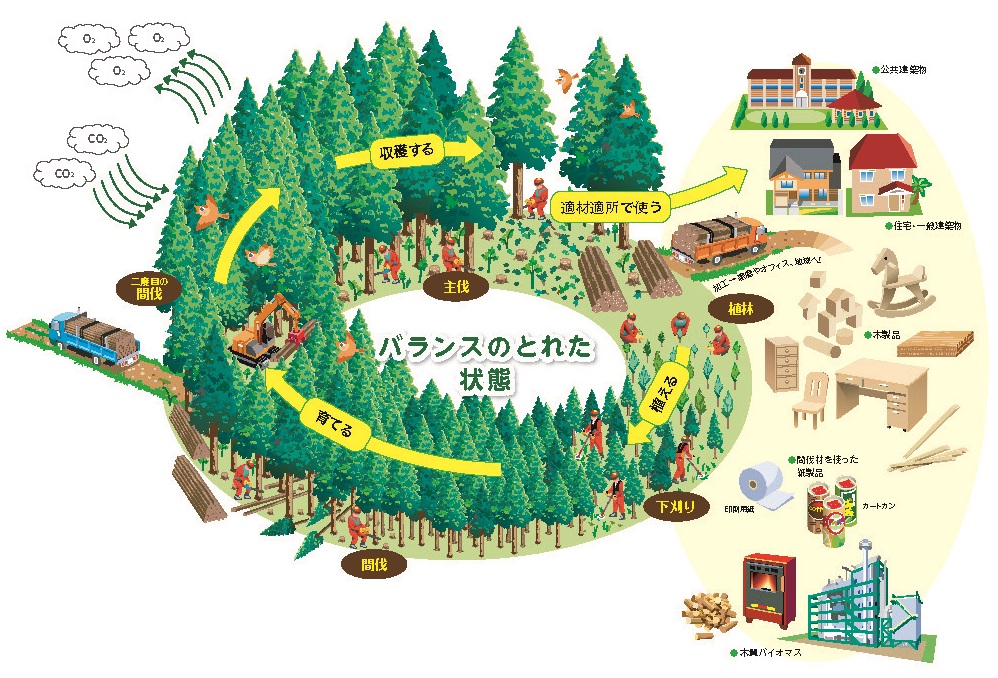
How Did the April 2025 Legal Reform Change Wood-Frame Home Construction in Japan?
For anyone building a wood-frame home in Japan today, the single most consequential development is the amended Building Standards Act (建築基準法) and amended Building Energy Efficiency Act (建築物省エネ法), both of which took effect in April 2025. The documentation required at building-confirmation application expanded, and compliance with energy-efficiency standards became mandatory for every new building. A transitional grace period for the new wall-quantity (structural) standard ended on March 31, 2026, meaning any building that broke ground from April 2026 onward is fully subject to the new standard with no exceptions.
The End of the "Category 4" Exemption, and Reclassification into New Category 2 and New Category 3 Buildings
| Item | Before Reform (Category 4 Building) | After Reform — New Category 2 Building | After Reform — New Category 3 Building |
|---|---|---|---|
| Scope | Wood-frame, 2 stories or fewer, total floor area 500 m² or less, etc. | Wood-frame, 2 stories; or wood-frame single-story with total floor area over 200 m² | Wood-frame single-story with total floor area 200 m² or less |
| Structural documentation | Review waived | Submission and review required | Review waived (designer must still self-certify compliance) |
| Energy-efficiency documentation | Not required | Submission and review required | Review waived (energy-standard compliance still mandatory) |
| Energy-standard compliance | Best-efforts obligation | Mandatory | Mandatory |
Source: Ministry of Land, Infrastructure, Transport and Tourism (国土交通省, MLIT), "Three Key Points of the Category 4 Exemption Reform (4号特例見直し 3つのポイント)" and "Rules Change Starting April 2025! Energy-Standard Compliance Now Mandatory for All New Construction."
The practical impact is unambiguous. A two-story wood-frame home is now classified as a "New Category 2" building, and structural documentation and energy-efficiency documentation that used to skip review entirely must now be submitted and reviewed. Design-side workload has increased accordingly, and the time required for building-confirmation approval, along with design and supervision fees, tend to run higher than before the reform. If you obtained a quote or timeline before April 2025, it is worth confirming the schedule and pricing have been rebuilt around the post-reform process — not carried over from an earlier, pre-reform assumption.
Mandatory Energy-Efficiency Compliance, and Why Buildings Are Getting Heavier
Every new building that broke ground from April 2025 onward is now required to meet Japan's energy-efficiency standard. More insulation, higher-performance window sashes, and rooftop solar installations all add weight to the structure. A heavier building experiences greater seismic force in an earthquake, which is why the required quantity of load-bearing (shear) walls was revisited alongside the energy-efficiency mandate — in Japan's current code framework, energy performance and structural design are no longer separable line items. For readers who want to understand how Japan's energy-efficiency housing grades and labeling actually work, our companion guide on how ZEH (net-zero energy house) standards and subsidies work covers that system in detail.
The Revised Wall-Quantity Calculation, and the Transitional Grace Period That Ended March 31, 2026
Japan's previous wall-quantity standard sorted roofs into two categories — "heavy roof" and "light roof" — and assigned a single required wall quantity to each category. Under the revised standard, required wall quantity is instead calculated based on the actual specifications of the building in question. Buildings with rooftop solar panels or thick insulation now require correspondingly more shear wall.
A transitional grace period for this new standard was in place, but it ended on March 31, 2026 (Reiwa 8). Every wood-frame building that broke ground from April 2026 onward is designed under the new wall-quantity standard, with no exceptions (source: Ministry of Land, Infrastructure, Transport and Tourism, "Standards for Required Wall Quantity to Address Increased Building Weight from Energy-Efficiency Measures in Wood-Frame Buildings"). If you are working from a quote or floor plan drawn up before this transition, confirming with your designer that it has been recalculated under the new standard is a reasonable and inexpensive precaution.
Quantifying the Downsides of Wood-Frame Construction [Comparison Table 1]
The genuine downsides of wood-frame construction are not well captured by a vague sense of unease. They show up in two concrete, monetary places: the legal depreciation life, and the fire-insurance structural rating. We want to be direct about both.
| Item | Wood-Frame | Steel-Frame (frame thickness over 4mm) | Reinforced Concrete |
|---|---|---|---|
| Legal (tax) depreciation life, residential use | 22 years | 34 years | 47 years |
| Straight-line depreciation rate | 0.046 | 0.030 | 0.022 |
| Cost per m² (construction-starts statistics) | approx. ¥233,000 (≈USD 1,553) | approx. ¥371,000 (≈USD 2,473) | approx. ¥410,000 (≈USD 2,733) |
| Fire-insurance structural class | Class H in principle (Class T if built to Ministerial-Ordinance quasi-fire-resistant standard) | Class T in principle | Multi-unit: Class M; single-family: Class T |
| Annual depreciation (¥30 million building) | ¥1.38 million (≈USD 9,200) | ¥0.90 million (≈USD 6,000) | ¥0.66 million (≈USD 4,400) |
Source: National Tax Agency (国税庁, NTA), "Useful Life Table for Major Depreciable Assets" and "Tax Answer No. 2100, Outline of Depreciation"; Japan Housing Finance Agency (住宅金融支援機構, JHF), "What Is a Ministerial-Ordinance Quasi-Fire-Resistant Home"; General Insurance Rating Organization of Japan (損害保険料率算出機構, GIROJ), "Overview of Fire and Earthquake Insurance, FY2025 (based on FY2024 statistics)." At ¥150/USD, a ¥30 million building converts to approximately USD 200,000; the wood-frame annual depreciation figure of ¥1.38 million converts to approximately USD 9,200, versus approximately USD 4,400 for RC.
What a 22-Year Legal Depreciation Life Actually Means — and How It Differs from Real-World Building Lifespan
The 22-year legal depreciation life is a tax-accounting figure — it defines the period over which a building's acquisition cost is expensed for tax purposes. It does not mean a wood-frame building becomes unusable after 22 years. A wood-frame home that is well-designed, well-built, and properly maintained routinely remains in use for many decades, in many cases a century or more, which is a useful contrast for readers from markets where "wood-frame" and "short-lived" are sometimes assumed to go together.
What the 22-year figure does affect is lender behavior and resale valuation. Japanese financial institutions frequently size mortgage terms around this legal life, and as a wood-frame building ages, its assessed structural value trends toward zero, leaving land value as the dominant component of resale price. Investors planning to hold a wood-frame asset long-term should build their financing and exit plan around this valuation pattern from day one, not discover it at resale. For more detail on how legal depreciation life interacts with actual investment returns, see how legal useful life and depreciation affect returns on wood-frame investment property.
A Worked Depreciation Example [Calculation Example 1]
For a newly built rental property with a building value of ¥30 million (about USD 200,000, building structure only, excluding land), straight-line depreciation works out as follows:
- New wood-frame: 22-year life, 0.046 rate. ¥30 million × 0.046 = ¥1.38 million per year (about USD 9,200/year) for 22 years
- New RC: 47-year life, 0.022 rate. ¥30 million × 0.022 = ¥660,000 per year (about USD 4,400/year) for 47 years
The annual depreciation deduction for wood-frame is roughly 2.1 times that of RC. The total depreciable amount is identical either way, but wood-frame lets an owner expense that same total faster — compressing taxable income earlier in the holding period, which matters for investors weighing after-tax cash flow in the first several years of ownership.
The effect is larger still for a used wood-frame property. Once a wood-frame asset has fully exhausted its 22-year legal life, Japanese tax rules allow a simplified method: legal life × 20%. For wood-frame, 22 years × 0.2 = 4.4 years, rounded down to 4 years, giving a depreciation rate of 0.250. For a used wood-frame property purchased for ¥15 million (about USD 100,000, older than 22 years), that works out to ¥15 million × 0.250 = ¥3.75 million per year (about USD 25,000/year), depreciated over just 4 years (source: National Tax Agency, "Tax Answer No. 5404, Useful Life of Used Assets").
¥3.75 million (about USD 25,000) per year is roughly 2.7 times the ¥1.38 million (about USD 9,200) annual figure for a new ¥30 million (about USD 200,000) wood-frame build. The catch: depreciation ends after year 4, and expenses fall off a cliff — taxable income jumps sharply in year 5. This structure needs to be underwritten with the exit timing and capital-gains tax on eventual sale built in from the start, not treated as a short-term tax play in isolation. Making a decision based on the front-loaded tax shelter alone, without planning the year-5 income spike, is the most common way investors get this wrong.
Fire-Insurance Structural Class, and the Ministerial-Ordinance Quasi-Fire-Resistant Alternative
Fire-insurance premiums in Japan are set by a building's structural class. There are three classes — Class M (concrete multi-unit buildings and similar), Class T (fire-resistant and quasi-fire-resistant buildings and similar), and Class H (everything else) — and a standard wood-frame single-family home falls into Class H by default, the most expensive of the three. According to the General Insurance Rating Organization of Japan's (損害保険料率算出機構, GIROJ) reference pure premium rates, the spread between the highest- and lowest-rated structural classes runs from roughly 2.84× to 5.92× (the spread varies by location).
There is a legitimate way around this. A home built to the Ministerial-Ordinance quasi-fire-resistant standard (省令準耐火構造, defined by the Japan Housing Finance Agency) is treated as Class T for insurance purposes even though it is wood-frame. This is a fire-performance standard modeled on — though not identical to — the Building Standards Act's quasi-fire-resistant structure, built around three pillars: preventing fire spread from outside the building, containing fire within individual rooms, and delaying fire spread to adjacent rooms. It's achievable using JHF-specified wood post-and-beam or platform-frame construction, as well as prefabricated homes and methods JHF has separately approved.
There is an incremental construction cost to building this way, but insurance is a bill paid for 30 or 40 years. Compared over the full holding period, opting into the Ministerial-Ordinance quasi-fire-resistant standard is very often the more economical choice on a total-cost-of-ownership basis. Asking "can you build to the Ministerial-Ordinance quasi-fire-resistant standard?" at the quoting stage, rather than adding it later, keeps the incremental cost lower. For more on how to structure insurance for a rental property specifically, see our fire insurance guide for rental property owners.
Where Wood-Frame Construction Carries Unpredictable Add-On Costs: Soundproofing, Fire Resistance, and Termite Protection
The three cost areas that are hardest to predict up front in wood-frame construction are sound insulation, fire resistance, and termite protection. Sound insulation may require double-layered partition walls or vibration-damping material; fire resistance may require fire-protective cladding or "char-layer" design (sizing structural timber so a burned outer layer still leaves adequate structural capacity); termite protection requires chemical treatment and periodic reapplication. All three become significantly more expensive if added after the fact rather than designed in from the start.
For wood-frame apartment buildings specifically, our guide to noise mitigation and soundproofing renovation costs for wood-frame apartments walks through specific methods and pricing. It is true that wood-frame structures are flexible and can absorb seismic energy across the whole building during an earthquake — but that behavior depends entirely on correct structural engineering and correctly executed connection details. We would caution against the blanket claim that "wood-frame is earthquake-resistant" without first confirming the structural calculations behind a specific building.
2026 Subsidies for Wood-Frame Housing, and What They Actually Save You [Calculation Example 3]
Japan's fiscal 2026 subsidy program for new housing construction is "Mirai Eco Housing 2026" (みらいエコ住宅2026事業, "Future Eco-Housing 2026"). The subsidy amount depends on a home's performance category and climate-zone classification, with an additional bonus available when an existing structure is demolished on the same site before construction.
| Housing Category | Cold Regions (Zones 1–4) | General Regions (Zones 5–8) | Old-House Demolition Bonus |
|---|---|---|---|
| GX-oriented housing | ¥1.25 million (≈USD 8,333) | ¥1.10 million (≈USD 7,333) | — |
| Long-Life Quality Housing | ¥800,000 (≈USD 5,333) | ¥750,000 (≈USD 5,000) | +¥200,000 (≈USD 1,333) |
| ZEH-level housing | ¥400,000 (≈USD 2,667) | ¥350,000 (≈USD 2,333) | +¥200,000 (≈USD 1,333) |
Source: Ministry of Land, Infrastructure, Transport and Tourism (国土交通省, MLIT), "Mirai Eco Housing 2026 Program (new construction)." Long-Life Quality Housing and ZEH-level housing subsidies are limited to households raising children and young married couples. At ¥150/USD: ¥1.25 million ≈ USD 8,333; ¥1.10 million ≈ USD 7,333; ¥800,000 ≈ USD 5,333; ¥750,000 ≈ USD 5,000; ¥400,000 ≈ USD 2,667; ¥350,000 ≈ USD 2,333; ¥200,000 ≈ USD 1,333.
Using the nationwide average construction cost of ¥42.598 million (about USD 284,000) as a baseline, the effective net cost after subsidy works out as follows:
- GX-oriented housing (general region): ¥42.598 million − ¥1.10 million = approx. ¥41.498 million (about USD 276,700)
- GX-oriented housing (cold region): ¥42.598 million − ¥1.25 million = approx. ¥41.348 million (about USD 275,700)
- Long-Life Quality Housing (general region) + old-house demolition: ¥42.598 million − ¥950,000 = approx. ¥41.648 million (about USD 277,700)
- ZEH-level housing (general region) + old-house demolition: ¥42.598 million − ¥550,000 = approx. ¥42.048 million (about USD 280,300)
Will You Actually Make the Deadline? Start Date, Application Window, and Budget Burn Rate
With a subsidy program like this, eligibility and timing requirements are everything. Four conditions matter:
- Groundbreaking date: only projects that began foundation work on or after November 28, 2025 are eligible.
- Application window: Period 1 runs March 31 – May 12, 2026; Period 2 runs May 13 – December 31, 2026. Note that for custom-built ZEH-level homes specifically, the deadline is earlier — September 30, 2026.
- Completion deadline for progress-based work: January 31, 2027.
- Total budget: ¥75 billion for GX-oriented housing (about USD 500 million; ¥20 billion / about USD 133 million in Period 1), and ¥145 billion for Long-Life Quality/ZEH-level housing (about USD 967 million; ¥40 billion / about USD 267 million in Period 1).
As of August 6, 2026, the published budget burn rate was 47% for GX-oriented housing and 21% for Long-Life Quality/ZEH-level housing (source: Ministry of Land, Infrastructure, Transport and Tourism, "Mirai Eco Housing 2026 Program"). The GX-oriented budget is already nearly half committed; if you are planning to break ground in the second half of the fiscal year, checking the remaining budget on a monthly basis is not optional. The program stops accepting applications the moment its budget is exhausted, regardless of the published deadline — this should factor directly into how you sequence your groundbreaking date.
Five Checkpoints for Deciding Whether to Build in Wood
- Make sure you're comparing costs on the same basis: confirm whether a quoted per-tsubo figure covers the main structure only, or also includes ancillary construction, exterior work, and design/supervision fees. Comparing quotes built on different assumptions is not a real comparison, no matter how close the headline numbers look.
- Confirm the design uses the post-April-2026 wall-quantity standard: the transitional grace period has ended. A plan or quote produced before the reform may understate the required shear-wall quantity.
- Ask about Ministerial-Ordinance quasi-fire-resistant construction at the earliest possible stage: this shifts a building's fire-insurance structural class from H to T, with a direct, compounding effect on total insurance cost over the holding period.
- Map the subsidy's groundbreaking-date and application-deadline requirements onto your actual construction schedule: a project that broke ground before November 28, 2025 does not qualify at all. A schedule slip of even a few weeks can take a subsidy from full amount to zero.
- Look all the way through to exit-time building valuation: wood-frame construction carries a 22-year legal depreciation life. Before purchasing, confirm with your lender how that valuation curve will be treated at resale or refinance — this affects loan-to-value assumptions on both the way in and the way out.
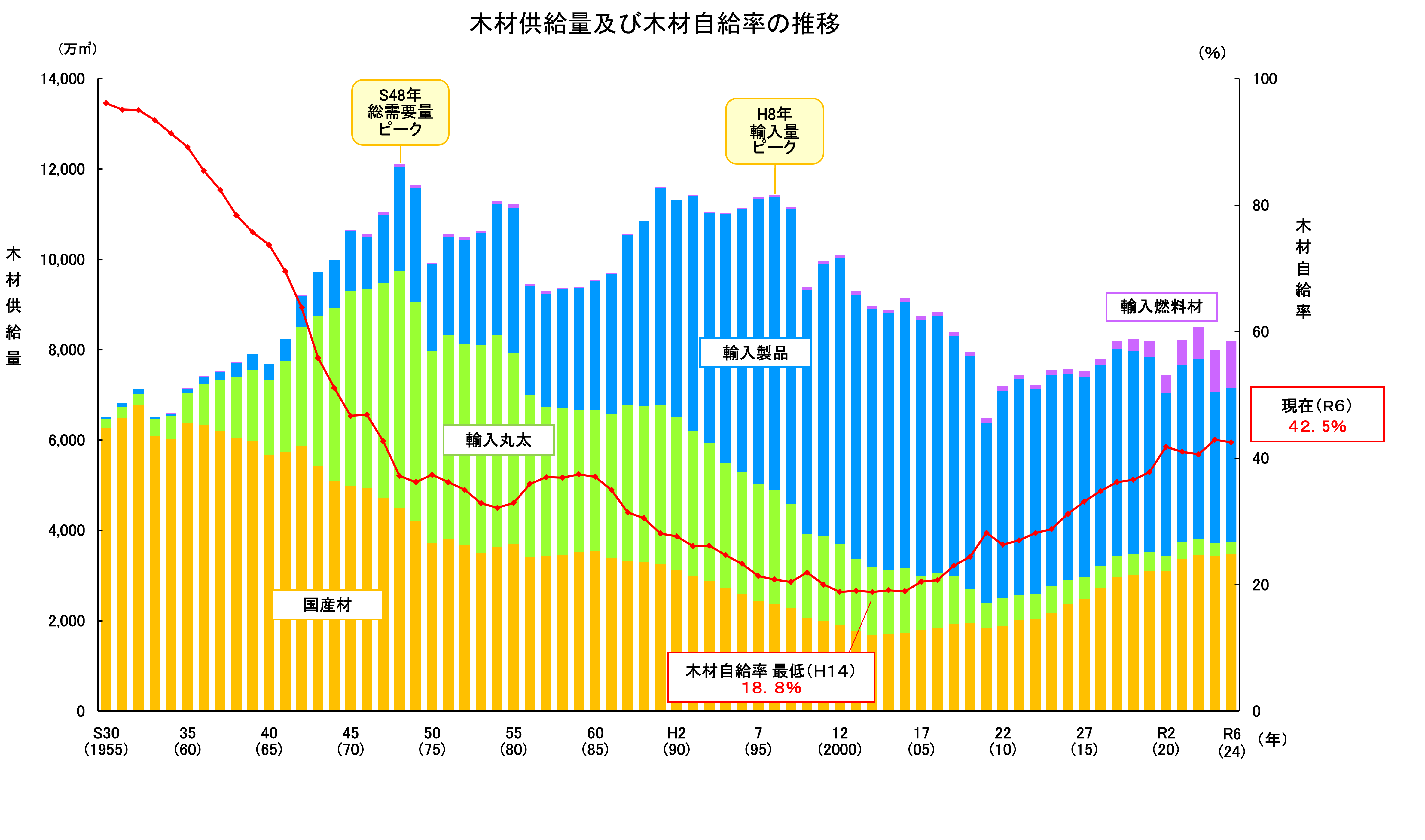
Even the environmental argument for wood construction can be checked against numbers rather than taken on faith. Japan's FY2024 (Reiwa 6) wood self-sufficiency rate was 42.5% (down 0.4 points year-on-year); narrowed to construction-grade timber specifically, it was 52.9% (down 2.4 points). Using wood only reduces environmental impact to the extent the full cycle — harvest, use, replant, grow — is actually maintained end to end. Asking a designer where their timber is sourced from, and whether it is verifiably part of that cycle, is what makes the environmental claim substantive rather than marketing.
Summary: The Value of Wood-Frame Construction Can Be Verified in Numbers
Wood-frame construction costs approximately ¥233,000 (about USD 1,553) per square meter, against approximately ¥410,000 (about USD 2,733) for RC — a gap of roughly 43%. Wood-frame accounts for 58.6% of new housing starts, yet only 9.6% of non-residential buildings and 0.1% or less of buildings four stories or taller. The legal depreciation life is 22 years, and a used wood-frame property can access a 4-year depreciation window. Fire insurance shifts from Class H to Class T when a home is built to the Ministerial-Ordinance quasi-fire-resistant standard. In fiscal 2026, GX-oriented housing qualifies for subsidies of ¥1.10 million to ¥1.25 million (about USD 7,300 to USD 8,300).
Every figure in this article is verifiable against publicly available primary-source data. Whether to build in wood is not a decision that needs to rest on the tactile appeal of the material or a general environmental sentiment. Our view is that verifying the numbers and the regulatory framework first — and enjoying the qualities of wood second — produces decisions investors are less likely to regret.
At INA&Associates, we believe that sharing information even when it works against us is what builds long-term trust with clients. If you are weighing whether to build in wood-frame or another structural type — for a personal home, a rental property, or a commercial development in Japan — bring us your existing quotes and plans, and we will work through the underlying numbers with you from first principles.
Frequently Asked Questions
Q1. What does wood-frame construction cost per tsubo in Japan?
On a construction-starts basis, approximately ¥769,000 per tsubo (about USD 5,127; approximately ¥233,000, or about USD 1,553, per square meter). This is calculated from the Ministry of Land, Infrastructure, Transport and Tourism's Annual Report on Construction Starts Statistics (full-year Reiwa 7 / 2025 data), dividing total wood-frame planned construction cost (¥9,664.8 billion, about USD 64.4 billion) by total wood-frame floor area started (41,562 thousand m²). This figure reflects only the construction cost declared at building-confirmation application — it excludes exterior work and other ancillary costs. The real-world figure for people who have actually built a custom home, from the FY2025 Flat 35 User Survey nationwide average, is approximately ¥1,189,000 (about USD 7,927) per tsubo (¥42.598 million ÷ 118.4 m²).
Q2. How much more expensive is RC construction than wood-frame construction in Japan?
On a cost-per-square-meter basis, wood-frame is approximately ¥233,000 against approximately ¥410,000 for RC — wood-frame is about 57% of RC cost, a gap of roughly 43%. Applied to the nationwide average of 118.4 m², the construction-starts-based figures come to approximately ¥27.59 million (about USD 183,900) for wood-frame versus approximately ¥48.54 million (about USD 323,600) for RC, a difference of approximately ¥20.95 million (about USD 139,700). Estimated on a real-world, all-costs-included basis, that gap widens to approximately ¥32 million (about USD 213,300). A realistic planning range, based on primary data, is a gap of roughly ¥20 million to ¥30 million (about USD 133,000 to USD 200,000).
Q3. Did the April 2025 legal reform increase construction time or cost?
Yes, in both directions. The former "Category 4" building classification was reorganized into the "New Category 2" classification, and even a two-story wood-frame home must now submit structural documentation and energy-efficiency documentation for review — previously waived entirely. Building-confirmation review time and design/supervision fees both trend higher than before the reform. In addition, the transitional grace period for the wall-quantity standard ended on March 31, 2026, so any building that broke ground from April 2026 onward requires more shear wall, which tends to increase structural-material costs as well.
Q4. Does a wood-frame commercial building work as a viable business proposition in Japan?
Yes, if it is low-rise. Non-residential wood-frame construction of 3 stories or fewer already has a 16.2% market share — a meaningful, established track record. Non-residential wood-frame construction of 4 stories or more, by contrast, sits at 0.1% or less, with total mid/high-rise wood-frame floor area started of only about 31,000 m² — still an early-stage, leading-edge segment. If you are structuring this as a business proposition, start by evaluating a 3-story-or-fewer non-residential building, and check the Building Wood Utilization Promotion Agreement and Forestry Agency subsidy programs at the planning stage.
Q5. How does depreciation work if I buy a used wood-frame property in Japan?
A wood-frame home older than 22 years has fully exhausted its legal depreciation life, which makes it eligible for the simplified method: 22 years × 20% = 4.4 years, rounded down to 4 years, giving a depreciation rate of 0.250. For a building valued at ¥15 million (about USD 100,000), that allows ¥3.75 million (about USD 25,000) to be expensed annually over 4 years — roughly 2.7 times the pace of the ¥1.38 million annual figure for a newly built ¥30 million wood-frame property. The catch is that depreciation ends after year 4 and taxable income rises sharply in year 5, so this needs to be planned together with your intended exit timing and the capital-gains tax due on eventual sale.
Citations and Sources
- Ministry of Land, Infrastructure, Transport and Tourism (国土交通省, MLIT), "Annual Report on Construction Starts Statistics (建築着工統計調査報告), full-year Reiwa 7 / 2025 data" (published January 30, 2026)
- Same report, summary table (floor area started and planned construction cost by structural type)
- Same report, press release materials (breakdown by use and construction method)
- Japan Housing Finance Agency (住宅金融支援機構, JHF), "FY2025 Flat 35 User Survey (フラット35利用者調査)" (published July 24, 2026)
- Headquarters for the Promotion of Wood Utilization in Public and Private Buildings (木材利用促進本部), "Summary of Implementation Status for Measures to Promote the Use of Wood in Buildings, FY2025" (published March 27, 2026)
- Ministry of Land, Infrastructure, Transport and Tourism (国土交通省, MLIT), "Standards for Required Wall Quantity to Address Increased Building Weight from Energy-Efficiency Measures in Wood-Frame Buildings"
- Ministry of Land, Infrastructure, Transport and Tourism (国土交通省, MLIT), "Three Key Points of the Category 4 Exemption Reform"
- Ministry of Land, Infrastructure, Transport and Tourism (国土交通省, MLIT), "Rules Change Starting April 2025! Energy-Standard Compliance Now Mandatory for All New Construction"
- Ministry of Land, Infrastructure, Transport and Tourism (国土交通省, MLIT), "Mirai Eco Housing 2026 Program," new-construction subsidy amounts
- Ministry of Land, Infrastructure, Transport and Tourism (国土交通省, MLIT), "Mirai Eco Housing 2026 Program," official site (budget, application windows, burn rate)
- National Tax Agency (国税庁, NTA), "Useful Life Table for Major Depreciable Assets"
- National Tax Agency (国税庁, NTA) Tax Answer No. 2100, "Outline of Depreciation"
- National Tax Agency (国税庁, NTA) Tax Answer No. 5404, "Useful Life of Used Assets"
- Japan Housing Finance Agency (住宅金融支援機構, JHF), "On Ministerial-Ordinance Quasi-Fire-Resistant Housing"
- Japan Housing Finance Agency (住宅金融支援機構, JHF), "What Is a Ministerial-Ordinance Quasi-Fire-Resistant Home" (Flat 35 site)
- General Insurance Rating Organization of Japan (損害保険料率算出機構, GIROJ), "Fire Insurance Reference Pure Premium Rates"
- General Insurance Rating Organization of Japan (損害保険料率算出機構, GIROJ), "Overview of Fire and Earthquake Insurance, FY2025 (based on FY2024 statistics)" (structural classes M/T/H)
- Forestry Agency (林野庁), "Publication of the FY2024 (2024) Wood Supply and Demand Table"
- Forestry Agency (林野庁), "Building Wood Utilization Promotion Agreement"
- Forestry Agency (林野庁), "List of Subsidy Programs and Schemes Available for Wood Construction and Wood-Finishing of Buildings"
- Obayashi Corporation (大林組), "Japan's First High-Rise, Pure-Wood, Fire-Resistant Building, 'Port Plus'" (announced May 20, 2022)
