In Japan, a chintai-heiyō jūtaku (賃貸併用住宅, literally "rental-combined residence") — the closest Japanese equivalent to what American investors call house hacking — hinges on a single number: whether the owner-occupied portion is at least half of the total floor area. That one threshold simultaneously decides which mortgage products you can use, how much of the mortgage interest tax credit you can claim, and how much of the capital-gains exemption survives when you eventually sell. Every other calculation in this guide flows from that single ratio.
This guide is written for international investors who are deciding whether to build a house-hacking duplex in Japan, and it draws entirely on primary-source data as of 2026 so that you can run the numbers for your own case. One thing tends to surprise English-speaking investors researching Japan for the first time: unlike the United States, Japan has no MLS-equivalent public database of actual closed sale prices or asking rents. There is no Zillow-style "comps" tool to check what a similar unit down the street actually rented for last month. Instead, this article works from the two datasets that Japanese professionals actually use in its place — the National Tax Agency's (国税庁, NTA) per-square-meter construction-cost tables, broken down by structure type and region, and the Ministry of Internal Affairs and Communications' (総務省, MIC) nationwide rent survey — combined with worked calculation examples for the area-apportionment rules that trip up almost everyone. The goal is to replace a gut-feel sense of "market rate" with numbers you can trace back to their source.
Key takeaways
- If the owner-occupied share falls below half of the total floor area, you lose access to ordinary home-mortgage products altogether — the loan is reclassified as an investment-property loan — and the mortgage tax credit no longer applies at all.
- The fixed-asset tax (固定資産税, property tax) discount for residential land, however, is judged by occupancy ratio, not owner-occupied ratio. Because a rented unit still counts as residential space, each additional rental unit widens the small-residential-land allowance (200 sqm per unit).
- Flat 35 (【フラット35】, Japan's flagship long-term fixed-rate mortgage) cannot be used for any part of a property let to a third party, and non-residential floor area is excluded from the loan amount entirely. For a house-hacking duplex you will need either a conventional bank mortgage or a lender's dedicated hybrid product.
- For funds disbursed in August 2026, Flat 35's most common rate (21- to 35-year terms) is 3.290% per year. Any cash-flow model still assuming 1% interest is no longer realistic.
- Per the NTA's construction-cost tables, reinforced-concrete construction in Tokyo runs ¥431,000 per sqm — approximately USD 2,873/sqm at an assumed rate of ¥150 = USD 1 (all JPY-to-USD conversions in this article use this rate, as of August 2026, for reference only) — or roughly ¥1.425 million per tsubo (坪, a traditional Japanese area unit equal to 3.30578 sqm that is still the everyday unit in Japanese construction quotes; approx. USD 9,500/tsubo). Construction cost varies nearly two-fold by region and structure type.
- Under Japan's FY2026 (Reiwa 8) tax reform, the mortgage interest tax credit was extended five years — but newly built homes in the low-energy-efficiency "other housing" category are, in principle, no longer eligible at all.
What Is a House-Hacking Duplex (賃貸併用住宅)? Why the "50% Owner-Occupied" Line Decides Everything
A chintai-heiyō jūtaku is a single building in which the owner's own residence and one or more units rented out to third parties coexist under the same roof. Because the structure carries two identities at once — a home and an income property — nearly every tax and lending rule that touches it has to be split between the owner-occupied portion and the rental portion.
Readers from the US, UK, Australia, or Singapore will likely recognize the underlying idea immediately: this is Japan's take on house hacking — living in part of a multi-unit property while renting out the rest to offset your mortgage payment, the strategy popularized among US FIRE-movement investors who buy a duplex or triplex under an owner-occupant loan. But the mechanics diverge sharply from what a Western investor might expect. Where a US house hacker mainly has to satisfy a one-year owner-occupancy clause to qualify for favorable financing, a Japanese chintai-heiyō jūtaku owner is bound by a strict floor-area ratio test that follows the property for the entire life of the mortgage tax credit, the annual property-tax assessment, and even the eventual sale decades later.
Five Things That Change With the Owner-Occupied Ratio
The first thing to decide when considering a house-hacking duplex in Japan is not the floor plan or the structural system — it is the share of total floor area occupied by the owner's own residence. That single number touches the five systems below. As explained further down, however, fixed-asset (property) tax is judged on a different basis, so it is important not to lump all five together as though one ratio governs everything.
- Mortgage type: Suruga Bank's (スルガ銀行) house-hacking duplex loan, for example, is marketed as a standard home-mortgage product when the owner-occupied portion is 50% or more of floor area, and as an investment real-estate loan product when it falls below 50% (source: Suruga Bank, "House-Hacking Duplex Loan" (賃貸併用住宅ローン)).
- Mortgage interest tax credit: the eligibility rule requires that at least half of the total floor area be used exclusively as the owner's own residence. Fall short of that line and the credit drops to zero — not a reduced amount, zero.
- Fixed-asset (property) tax: this is the one exception. The residential-land special exemption is judged by occupancy ratio (which includes rented units), not owner-occupied ratio, and the small-residential-land allowance widens with the number of dwelling units.
- Inheritance tax: the owner-occupied portion and the rental portion draw on separate allowances under the small-scale residential land special exemption (小規模宅地等の特例), and — critically — the two allowances cannot be stacked in full.
- Sale: the ¥30 million special capital-gains exemption for a primary residence applies only to the portion that was actually used as the owner's own home.
In other words, the owner-occupied ratio is not a design preference — it is the fork in the road for both tax treatment and financing. When clients bring us a house-hacking duplex plan, this is the very first number we check.
How This Differs from a Custom-Built Home or a Full Rental Building
Sorted by function, the difference is clear. A standard custom-built house (注文住宅) is a building you live in; it generates no income. A full rental building (一棟アパート) is an income-generating building; the owner typically does not live there at all. A house-hacking duplex sits in between — it is built on the design philosophy of holding an asset while diluting your own housing cost with rental income, not maximizing yield.
That is precisely why expecting the same yield as a dedicated rental building leads to disappointment. Once you have allocated more than half of your investment to a portion of the building that generates no income at all, competing with a pure rental building on investment efficiency is structurally out of reach. The question worth asking is not "is the yield high?" but "is this more favorable than the rent I would otherwise have paid?"
How Much Does a House-Hacking Duplex Cost to Build? 2026 Construction Costs by Structure and Region
Rather than starting from an industry rule-of-thumb "price per tsubo," we recommend starting from public statistical data. Because Japan has no comparable-sales database that lets you sanity-check a contractor's quote against actual recent transactions, the tables below are the closest thing available to an independent benchmark.
NTA Construction-Cost Tables: Per-Square-Meter Costs by Structure and Region
The construction-cost table published by the National Tax Agency — originally designed to calculate casualty-loss deductions after a disaster destroys a home — shows the per-square-meter construction cost by region and structural type, and it doubles as a benchmark line for sanity-checking a builder's estimate. The table below extracts the major regions from the "Regional/Structural Construction Cost Table (Per 1 sqm) for Reiwa 7" and converts the figures into price per tsubo (1 tsubo = 3.30578 sqm) as well as approximate USD per square meter.
| Region | Wood-frame | Steel-frame | Steel-reinforced concrete (SRC) | Reinforced concrete (RC) |
|---|---|---|---|---|
| National average | ¥217,000/sqm ≈ USD 1,447/sqm (≈¥717,000/tsubo) | ¥314,000/sqm ≈ USD 2,093/sqm (≈¥1.038M/tsubo) | ¥334,000/sqm ≈ USD 2,227/sqm (≈¥1.104M/tsubo) | ¥338,000/sqm ≈ USD 2,253/sqm (≈¥1.117M/tsubo) |
| Tokyo | ¥230,000/sqm ≈ USD 1,533/sqm (≈¥760,000/tsubo) | ¥384,000/sqm ≈ USD 2,560/sqm (≈¥1.269M/tsubo) | ¥404,000/sqm ≈ USD 2,693/sqm (≈¥1.336M/tsubo) | ¥431,000/sqm ≈ USD 2,873/sqm (≈¥1.425M/tsubo) |
| Kanagawa | ¥217,000/sqm ≈ USD 1,447/sqm (≈¥717,000/tsubo) | ¥355,000/sqm ≈ USD 2,367/sqm (≈¥1.174M/tsubo) | ¥378,000/sqm ≈ USD 2,520/sqm (≈¥1.250M/tsubo) | ¥361,000/sqm ≈ USD 2,407/sqm (≈¥1.193M/tsubo) |
| Chiba | ¥217,000/sqm ≈ USD 1,447/sqm (≈¥717,000/tsubo) | ¥321,000/sqm ≈ USD 2,140/sqm (≈¥1.061M/tsubo) | ¥335,000/sqm ≈ USD 2,233/sqm (≈¥1.107M/tsubo) | ¥359,000/sqm ≈ USD 2,393/sqm (≈¥1.187M/tsubo) |
| Saitama | ¥217,000/sqm ≈ USD 1,447/sqm (≈¥717,000/tsubo) | ¥314,000/sqm ≈ USD 2,093/sqm (≈¥1.038M/tsubo) | ¥334,000/sqm ≈ USD 2,227/sqm (≈¥1.104M/tsubo) | ¥354,000/sqm ≈ USD 2,360/sqm (≈¥1.170M/tsubo) |
| Osaka | ¥217,000/sqm ≈ USD 1,447/sqm (≈¥717,000/tsubo) | ¥314,000/sqm ≈ USD 2,093/sqm (≈¥1.038M/tsubo) | ¥334,000/sqm ≈ USD 2,227/sqm (≈¥1.104M/tsubo) | ¥338,000/sqm ≈ USD 2,253/sqm (≈¥1.117M/tsubo) |
The tsubo conversions are our own calculation. What stands out is the regional gap. Wood-frame construction barely differs between the national average and Tokyo, but reinforced-concrete construction runs about 1.3x higher in Tokyo (¥1.425M/tsubo, ≈USD 9,500) than the national average (¥1.117M/tsubo, ≈USD 7,447) — a gap of roughly USD 620 per sqm. If you choose reinforced concrete in an urban center for its soundproofing, that gap alone can add tens of thousands of dollars to total project cost (source: National Tax Agency (国税庁, NTA)).
Construction Costs Have Risen Roughly 20% in Five Years
The other trend worth tracking is the trajectory of construction costs over time. The NTA's "Standard Construction Value Table for Buildings" (建物の標準的な建築価額表) divides the projected construction-cost figures from Japan's housing-start statistics by floor area to produce a per-square-meter unit price, year by year.
| Construction year | Wood-frame / wood-and-mortar | Steel-frame | Reinforced concrete (RC) | Steel-reinforced concrete (SRC) |
|---|---|---|---|---|
| 2019 (Reiwa 1) | ¥170,100/sqm (≈USD 1,134) | ¥228,800/sqm (≈USD 1,525) | ¥285,600/sqm (≈USD 1,904) | ¥363,300/sqm (≈USD 2,422) |
| 2020 (Reiwa 2) | ¥172,000/sqm (≈USD 1,147) | ¥230,200/sqm (≈USD 1,535) | ¥276,900/sqm (≈USD 1,846) | ¥279,200/sqm (≈USD 1,861) |
| 2021 (Reiwa 3) | ¥172,200/sqm (≈USD 1,148) | ¥227,300/sqm (≈USD 1,515) | ¥288,200/sqm (≈USD 1,921) | ¥338,400/sqm (≈USD 2,256) |
| 2022 (Reiwa 4) | ¥176,200/sqm (≈USD 1,175) | ¥241,500/sqm (≈USD 1,610) | ¥277,500/sqm (≈USD 1,850) | ¥434,400/sqm (≈USD 2,896) |
| 2023 (Reiwa 5) | ¥204,100/sqm (≈USD 1,361) | ¥281,100/sqm (≈USD 1,874) | ¥314,300/sqm (≈USD 2,095) | ¥366,700/sqm (≈USD 2,445) |
From 2019 to 2023, wood-frame costs rose approximately 20.0%, steel-frame rose approximately 22.9%, and reinforced-concrete rose approximately 10.0% (National Tax Agency, "Standard Construction Value Table for Buildings"). If you plug a quote you obtained a few years ago straight into today's financing plan, you can expect a shortfall of several million yen (tens of thousands of dollars) by the time construction actually starts. For more on the forces behind rising Japanese construction costs, see our related article on how surging construction costs are reshaping investment decisions.
Building the Total Project Cost: A 180 sqm Model
From here on, this article uses one common reference model throughout: a 200 sqm site, 180 sqm total floor area (100 sqm owner's residence + two rental units totaling 80 sqm), for an owner-occupied ratio of 55.6%. The land is assumed to be either already owned or acquired for ¥24 million (≈USD 160,000).
| Item | Wood-frame (national average unit price) | Steel-frame (national average unit price) | Reinforced concrete (Tokyo unit price) |
|---|---|---|---|
| Construction cost (180 sqm) | ¥39.06M (≈USD 260,400) | ¥56.52M (≈USD 376,800) | ¥77.58M (≈USD 517,200) |
| Incidental costs (assumed at 10% of construction cost) | ≈¥3.91M (≈USD 26,067) | ≈¥5.65M (≈USD 37,667) | ≈¥7.76M (≈USD 51,733) |
| Land | ¥24M (≈USD 160,000) | ¥24M (≈USD 160,000) | ¥24M (≈USD 160,000) |
| Total project cost | ≈¥67M (≈USD 446,667) | ≈¥86.2M (≈USD 574,667) | ≈¥109.3M (≈USD 728,667) |
Construction cost is simply the unit price from the tables above multiplied by 180 sqm. Incidental costs — design fees, registration costs, fire insurance, exterior work, ground improvement, and similar items — are assumed here at 10% of construction cost; replace this assumption with your actual quote. Skip that step and every yield calculation that follows will be off.
How Much More Does This Cost Than a Standalone House?
According to the Japan Housing Finance Agency's (JHF, 住宅金融支援機構) "FY2025 Flat 35 User Survey Results" (published July 24, 2026; 35,553 cases, excluding refinancing), the average funds required were ¥42.62 million (≈USD 284,133) for a custom-built house (up ¥3.26M / ≈USD 21,733 year over year) and ¥53.13 million (≈USD 354,200) for a custom-built house with land (up ¥3.06M / ≈USD 20,400), with average household income at ¥7.19 million (≈USD 47,933) and ¥7.42 million (≈USD 49,467) respectively (Japan Housing Finance Agency (JHF)). Our wood-frame model above, at roughly ¥67 million (≈USD 446,667), runs about ¥14 million (≈USD 93,333) above the average custom-built house with land. Whether rental income can recover that gap is what determines whether the house-hacking duplex pays off.
What Yield Should You Expect? Calculating With Government Rent Data
The short answer: run the numbers using average rents from public statistics, and the gross yield on the rental portion alone lands in the low 4% range, while yield on total project cost lands around 2%. If you go into this expecting the 8–10% often quoted for a dedicated rental building, the gap between expectation and reality will come as a shock.
This is worth pausing on for readers used to US or UK multifamily underwriting. In most Western markets, a duplex or fourplex purchased purely as an income property is expected to clear a cap rate comparable to — or better than — a larger apartment building, because the whole point is investment return. A Japanese house-hacking duplex is not competing on that basis at all: more than half of the capital is tied up in a unit that produces no rent whatsoever, so a 2% return on total cost is not a sign the deal is bad — it is the deal working as designed, once you understand what it is actually designed to do.
Defining Gross Yield and Net Yield
- Gross yield = annual rental income ÷ investment amount × 100
- Net yield = (annual rental income − annual operating expenses) ÷ (investment amount + acquisition costs) × 100
In a house-hacking duplex, the number swings dramatically depending on how you define "investment amount." Divide by the full total project cost and the yield looks low; divide only by the amount apportioned to the rental portion and it looks much higher. A pitch deck that shows you only one of these two numbers is not giving you what you need to decide. Operating expenses to subtract include property-management fees, fixed-asset and city-planning tax, fire insurance, reserve funds for repairs, vacancy losses, and accounting fees.
Running the Numbers With Ministry of Internal Affairs Rent Data
According to the Ministry of Internal Affairs and Communications Statistics Bureau's (総務省統計局) "2023 (Reiwa 5) Housing and Land Survey," the average monthly rent for privately rented housing nationwide is ¥54,409 (≈USD 363) for wood-frame units and ¥68,548 (≈USD 457) for non-wood-frame units. The average across all rented housing is ¥59,656 (≈USD 398), up 7.1% from the 2018 survey (Statistics Bureau of Japan, Ministry of Internal Affairs and Communications (MIC)). Applying these figures to the reference model above:
| Item | Wood-frame model | Steel-frame model |
|---|---|---|
| Assumed rent (per unit, monthly) | ¥54,409 (≈USD 363) | ¥68,548 (≈USD 457) |
| Annual rental income (2 rental units) | ≈¥1.306M (≈USD 8,707) | ≈¥1.645M (≈USD 10,967) |
| Total project cost | ≈¥67M (≈USD 446,667) | ≈¥86.2M (≈USD 574,667) |
| Investment apportioned to rental portion (80/180) | ≈¥29.8M (≈USD 198,667) | ≈¥38.3M (≈USD 255,333) |
| Gross yield on rental portion | ≈4.4% | ≈4.3% |
| Yield on total project cost | ≈1.9% | ≈1.9% |
Let's also work out net yield for the steel-frame model. Assume a property-management fee at 5% of rent (≈¥82,000, ≈USD 547), fixed-asset and city-planning tax of ¥150,000 (≈USD 1,000), fire insurance of ¥30,000 (≈USD 200), a repair reserve of ¥160,000 (≈USD 1,067), and vacancy loss at 10% of rent (≈¥165,000, ≈USD 1,100) — total annual operating expenses of roughly ¥587,000 (≈USD 3,913). That leaves net income of roughly ¥1.058 million (≈USD 7,053), for a net yield on the rental portion of approximately 2.8%.
Note that this calculation is a conservative one built on the nationwide average rent. For your own case, substitute the actual asking rents in your specific construction location and recalculate.
Benchmarking Against What Professional Investors Expect
Whether that low-4% figure is high or low only means something once you compare it to what professional institutional investors demand. The Japan Real Estate Institute's (日本不動産研究所) "54th Real Estate Investor Survey" (as of April 2026, published May 27, 2026) reports the following expected yields for a whole rental building:
| Survey area | Studio/1R type | Family type |
|---|---|---|
| Tokyo, Jōnan (城南) area | 3.6% | 3.7% |
| Osaka | 4.2% | 4.3% |
| Fukuoka | 4.5% | 4.5% |
| Sapporo | 4.9% | 5.0% |
| (Reference) This article's house-hacking duplex model | Rental-portion gross yield ≈4.3–4.4% / total-project-cost basis ≈1.9% | |
Source: Japan Real Estate Institute (日本不動産研究所), "54th Real Estate Investor Survey". Per the same survey, the expected yield in Tokyo's Jōnan area fell 0.1 points from the previous survey for both studio and family types, to 3.6% and 3.7% respectively.
Looked at in isolation, the rental portion's yield sits roughly in line with what institutional investors expect from regional cities — but measured against total project cost, it falls under 2%. That gap is exactly why a house-hacking duplex functions as a "housing-cost reduction vehicle" rather than an "investment product." We go into the relationship between yield calculations and common failure patterns in more depth in Japan Apartment Investing: 7 Failures & How to Vet a Manager.
The Structural Problem: One Vacancy Cuts Income in Half
Vacancy risk in a house-hacking duplex is fundamentally different in character from vacancy risk in a full rental building. With only one or two rental units, losing a single tenant cuts your rental income by half, and there is no portfolio of other units to diversify the loss.
Compare this to underwriting a 20-unit US apartment building, where a single vacant unit costs you roughly 5% of gross rental income and the remaining 19 units keep cash flow largely intact. A Japanese house-hacking duplex with two rental units offers none of that cushion — the entire structure behaves more like a single-tenant net lease than a diversified rental portfolio, except that the "landlord" is also living on-site.
Market conditions are also tightening. The 2023 Housing and Land Survey found 9.002 million vacant homes nationwide, a vacancy rate of 13.8% — both record highs. Of those, 4.436 million vacant units were specifically rental vacancies, and rental vacancies accounted for 78.5% (3.947 million units) of all vacant units in multi-unit residential buildings.
Applying this to the steel-frame model above: if one of the two units sits vacant for three months, lost rent comes to ¥68,548 × 3 ≈ ¥206,000 (≈USD 1,373), plus roughly ¥170,000 (≈USD 1,133) combined for restoration costs and advertising, for a total annual impact of about ¥376,000 (≈USD 2,507) — around 23% of the ¥1.645 million (≈USD 10,967) in annual rental income. Whether your household budget can absorb that swing is a question worth answering before you break ground.
Area Apportionment, Fully Explained: Every System Splits the Building Differently
Area apportionment (面積按分, menseki-anbun) is where most confusion about house-hacking duplexes comes from — and it's the single biggest structural difference from house hacking as US or UK investors know it. Each government system apportions the building on its own basis, and each has its own threshold ratio, so what qualifies you for one benefit can simultaneously disqualify you from another. Start with the full picture in one table before diving into any single rule.
Area-Apportionment Quick Reference (7 Systems)
| System | Apportionment basis | What changes at the 1/2 owner-ratio threshold | Legal basis |
|---|---|---|---|
| Mortgage interest tax credit | Floor area of the owner-occupied portion ÷ total floor area of the building. Land is apportioned at the same ratio. | If less than half of floor area is used exclusively as the owner's own residence, the credit is not available at all. | Act on Special Measures Concerning Taxation, Order for Enforcement Art. 26(7); Related Directive 41-27 |
| Fixed-asset tax residential-land exemption | Site area × residential-land ratio (determined by occupancy ratio). Occupancy ratio = floor area of residential portion ÷ total floor area, and rental units count as residential. | Does not change with owner-occupied ratio. It drops to a 0.5 ratio only if a shop or office is added and occupancy ratio falls below 1/2. | Local Tax Act (municipal residential-land exemption) |
| New-build fixed-asset tax reduction | Judged per dwelling unit by floor area (up to 120 sqm per unit). | Judged by each unit's floor-area requirement (generally 40 sqm or more), not by owner-occupied ratio. | Local Tax Act (extended and eased under the FY2026 tax reform) |
| Real-estate acquisition tax standard-value deduction | Per dwelling unit: ¥12M (≈USD 80,000) per unit (¥13M / ≈USD 86,667 for certified long-life quality housing). | Driven by unit count, not owner-occupied ratio. Each unit must be 40–240 sqm. | Ministry of Land, Infrastructure, Transport and Tourism (国土交通省, MLIT) / each prefecture |
| Necessary expenses / depreciation | Generally the rental portion's floor-area ratio; other reasonable methods are allowed. | Expenses attributable to the owner-occupied portion are not deductible as necessary expenses. | Income tax calculation for real-estate income |
| Small-scale residential land special exemption | Owner-occupied residential land: 330 sqm / 80% reduction. Rental-business land: 200 sqm / 50% reduction. A combined formula caps the total qualifying area. | The larger the owner-occupied floor area, the more it crowds out the rental-business allowance, so full stacking is not possible. | National Tax Agency (国税庁, NTA) No. 4124 |
| ¥30M special capital-gains exemption on sale | Building and site apportioned by the residential portion's floor-area ratio. | If the residential portion is roughly 90% or more of the whole, the entire property can be treated as residential. | National Tax Agency (国税庁, NTA) No. 3452 |
Even this table alone makes clear that if you design around area apportionment as though it were "one rule," you will fall through the cracks somewhere.
Working the Mortgage Tax-Credit Apportionment
The NTA illustrates apportionment with a worked example in its FAQ, "When a Newly Built House Combines a Shop and a Residence" (店舗併用住宅を新築した場合). In that example: land of 300 sqm (of which 120 sqm is a rented parking lot) is purchased for ¥60 million (≈USD 400,000) with a year-end loan balance of ¥40 million (≈USD 266,667); a building with 180 sqm total floor area (90 sqm ground-floor shop, 90 sqm second-floor residence) is newly built for ¥30 million (≈USD 200,000) with a year-end loan balance of ¥20 million (≈USD 133,333). In this case, the housing loan eligible for the credit is calculated as ¥10 million for the building portion + ¥12 million for the land portion = ¥22 million (≈USD 66,667 + USD 80,000 = USD 146,667) (National Tax Agency (国税庁, NTA), FAQ examples; based on law in effect as of August 1, 2025).
Now apply the same method to our house-hacking duplex model: 180 sqm total floor area (100 sqm owner's residence), occupancy ratio 55.6%, building-loan year-end balance ¥40 million (≈USD 266,667), land-loan year-end balance ¥20 million (≈USD 133,333).
- Calculate occupancy ratio: 100 sqm ÷ 180 sqm = 55.6%
- Apportion the building loan: ¥40M × 55.6% ≈ ¥22.22M (≈USD 148,133)
- Apportion the land loan: ¥20M × 55.6% ≈ ¥11.11M (≈USD 74,067)
- Sum the credit base: ¥22.22M + ¥11.11M ≈ ¥33.33M (≈USD 222,200)
- Calculate the credit: ¥33.33M × 0.7% ≈ ¥233,000/year (≈USD 1,553/year)
Over the 13-year credit period, that totals roughly ¥3.03 million (≈USD 20,200). The credit is capped by your income-tax liability (plus a portion of unused credit against resident tax), though, so whether you can use the full amount depends on your income.
The Exception That Skips Apportionment: the "Roughly 90%" Rule
Related Directive 41-29 under the Act on Special Measures Concerning Taxation provides that when the residential floor area or land area calculated under Directive 41-27 amounts to roughly 90% or more of the building's or land's total area, the entire property can be treated as residential for the mortgage tax credit — no apportionment required (National Tax Agency (国税庁, NTA), Related Directives Concerning Article 41).
If you are attaching just a single small rental unit, you may fall within this exception. But design past 90% owner-occupied and rental income becomes negligible, which defeats much of the point of building a house-hacking duplex in the first place. In practice, it is safer to assume apportionment is the default rule and the 90% exception is the rare case.
Fixed-Asset Tax Runs on the "Residential-Land Ratio" — Not the Owner-Occupied Ratio
The fixed-asset tax residential-land exemption is determined by occupancy ratio, not owner-occupied ratio. For a mixed-use building's site, only the portion of site area obtained by multiplying total site area by a "residential-land ratio" — itself set according to occupancy ratio — actually qualifies as residential land.
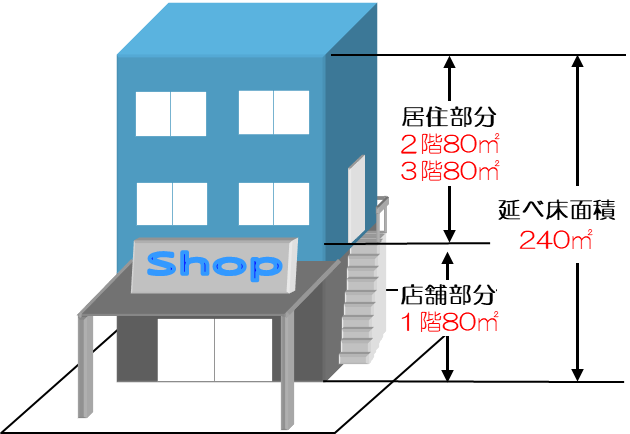
Here is the point worth underlining: the numerator in "occupancy ratio" is not "owner-occupied floor area" — it is "residential floor area." A rented unit is space people live in, so it counts as residential too. That means a house-hacking duplex with no attached shop or office has an occupancy ratio of 100% and a residential-land ratio of 1.0, whether the owner-occupied share is 40%, 30%, or anything else. You may see claims online that "unless your own home is at least half the building, your fixed-asset tax break gets cut in half" — that statement only applies when there is a non-residential portion, such as a ground-floor shop, dragging occupancy ratio down.
| Building category | Occupancy ratio | Residential-land ratio |
|---|---|---|
| Residential-only building | All | 1.0 |
| Mixed-use building (4 stories or fewer above ground) | 1/4 to under 1/2 | 0.5 |
| 1/2 or more | 1.0 | |
| Mixed-use building (5 stories or more above ground) | 1/4 to under 1/2 | 0.5 |
| 1/2 to under 3/4 | 0.75 | |
| 3/4 or more | 1.0 |
If a mixed-use building's occupancy ratio falls below 1/4, none of the site qualifies as residential land, regardless of story count. For the portion of the site that does qualify, the following exemption rates then apply.
| Residential-land category | Fixed-asset tax | City-planning tax |
|---|---|---|
| Small residential land (up to 200 sqm per dwelling unit) | Taxable value reduced to 1/6 | Taxable value reduced to 1/3 |
| General residential land (portion beyond 200 sqm) | Taxable value reduced to 1/3 | Taxable value reduced to 2/3 |
The exemption rate is set per dwelling unit. That means a building with one owner-occupied unit plus two rental units — three units total — extends the small-residential-land allowance to 200 sqm × 3 = 600 sqm. This is a frequently overlooked advantage of building a house-hacking duplex rather than a single-family home (City of Osaka (大阪市), "Special Measures for the Taxable Standard of Residential Land").
How Much Does Unit Count Change the Land Tax Bill?
Because it is unit count — not owner-occupied ratio — that drives this exemption, it's worth calculating the actual difference. Take a 300 sqm site with a land value (assessed value) of ¥45 million (≈USD 300,000, or ¥150,000/≈USD 1,000 per sqm), two stories above ground, and compare a standalone single-family home (1 unit) against a house-hacking duplex (1 owner unit + 2 rental units = 3 units). This simplified calculation uses a fixed-asset tax rate of 1.4% and a city-planning tax rate of 0.3%, and does not account for burden-adjustment transition measures.
| Item | Single-family home (1 unit) | House-hacking duplex (1 owner unit + 2 rental units) |
|---|---|---|
| Small-residential-land allowance | 200 sqm × 1 unit = 200 sqm | 200 sqm × 3 units = 600 sqm |
| Breakdown of the 300 sqm site | 200 sqm small + 100 sqm general | All 300 sqm classified as small |
| Fixed-asset tax taxable base | ¥30M×1/6 + ¥15M×1/3 = ¥10M (≈USD 66,667) | ¥45M×1/6 = ¥7.5M (≈USD 50,000) |
| Fixed-asset tax (1.4%) | ≈¥140,000 (≈USD 933) | ≈¥105,000 (≈USD 700) |
| City-planning tax taxable base | ¥30M×1/3 + ¥15M×2/3 = ¥20M (≈USD 133,333) | ¥45M×1/3 = ¥15M (≈USD 100,000) |
| City-planning tax (0.3%) | ≈¥60,000 (≈USD 400) | ≈¥45,000 (≈USD 300) |
| Annual total | ≈¥200,000 (≈USD 1,333) | ≈¥150,000 (≈USD 1,000) |
Adding just two rental units lowers the annual fixed-asset and city-planning tax on the land by about ¥50,000 (≈USD 333) a year. Over 35 years, that's a ¥1.75 million (≈USD 11,667) difference. The larger the site and the more dwelling units, the bigger this effect becomes. Actual tax amounts depend on your municipality's assessment and burden-adjustment measures, so confirm the specifics with your local tax office at the design stage.
Apportioning Necessary Expenses and Depreciation
In calculating real-estate income, depreciation on the building, repair costs, fire insurance premiums, fixed-asset tax, and loan interest are apportioned, with only the amount attributable to the rental portion treated as a deductible necessary expense. Floor-area ratio is the standard apportionment basis; other reasonable methods are permitted, but once you choose a method, you must apply it consistently — you cannot switch to whichever method is more favorable each year.
Electing blue-form tax filing (青色申告) unlocks an additional special deduction, but a house-hacking duplex, with its small number of rental units, often falls short of the "business scale" threshold (roughly 5 buildings or 10 units) that unlocks the largest deduction amount. Confirm this point with a tax accountant.
House-Hacking Duplexes and Mortgages: The Reality at August 2026 Interest Rates
Can Flat 35 Be Used for a House-Hacking Duplex?
The short answer is: not for the portion intended as rental. The Japan Housing Finance Agency (住宅金融支援機構) explicitly states in its usage conditions that "Flat 35 cannot be used to finance the acquisition of investment properties, including properties intended to be leased to third parties." On top of that, "construction or purchase costs attributable to non-residential portions, such as shops or offices, are excluded from the loan amount."
The agency periodically verifies actual occupancy — for example, by mailing balance certificates via non-forwardable mail — and states that if third-party rental is discovered, the borrower is required to repay the entire outstanding loan in a lump sum (Japan Housing Finance Agency (JHF), "Flat 35 Usage Conditions", as of April 1, 2026). You cannot plan a house-hacking duplex's financing around Flat 35.
Comparing the Loan Products You Can Actually Use
| Loan type | How it applies to a house-hacking duplex | Area/ratio requirements | Caveats |
|---|---|---|---|
| Flat 35 | Cannot be used for the rental-purpose portion | Detached houses etc.: 50 sqm+ floor area; multi-unit: 30 sqm+. For mixed-use buildings, the residential portion's floor area must be at least equal to the non-residential portion's. | Cannot be used to fund an investment property. Non-residential floor area is excluded from the loan amount. |
| Conventional private-bank mortgage | Covers the owner-occupied portion; some lenders will finance the rental portion together with it | Typically requires the owner-occupied portion to be at least 1/2 of total floor area | Whether a lender will handle a house-hacking duplex at all varies bank by bank — confirm in advance |
| Dedicated house-hacking duplex loan | Finances the owner-occupied and rental portions together as one loan | Treated as a home-mortgage product if owner-occupied share is 50%+, an investment real-estate loan product if under 50% | Repayment continues even during vacancy. Loan ceiling varies by product |
| Apartment loan (investment property loan) | Covers the rental portion | Underwritten on the deal's business viability, not floor-area requirements | Interest rates tend to run higher than home mortgages |
Suruga Bank's (スルガ銀行) "House-Hacking Duplex Loan" treats the loan as a home-mortgage product when the owner-occupied portion is 50% or more and as an investment real-estate loan product below 50%, with a maximum loan amount of ¥600 million (≈USD 4,000,000). Here again, the "50% owner-occupied" line functions as the practical fork in the road. For more on typical apartment-loan interest rates, see our guide to current apartment loan interest rates and lending conditions.
Calculating Repayments at August 2026 Interest Rates
A cash-flow table built on outdated interest-rate assumptions is the single most dangerous document you can bring into this decision. For funds disbursed in August 2026, Flat 35 (21–35 year terms, loan-to-value 90% or below) carries a most-common rate of 3.290% per year, with a range of 3.290%–5.570%. Flat 20 (terms of 20 years or less) carries a most-common rate of 2.970% (Japan Housing Finance Agency (JHF), "Flat 35 Latest Interest Rate Information"). As a proxy for prevailing full-term fixed-rate levels, here is the repayment on a ¥50 million (≈USD 333,333) loan over 35 years, level payments, at that rate:
| Assumed rate | Monthly payment | Annual payment | Total repaid over 35 years |
|---|---|---|---|
| 3.290%/year | ≈¥200,600 (≈USD 1,337) | ≈¥2.407M (≈USD 16,047) | ≈¥84.26M (≈USD 561,733) |
| 1.000%/year (reference — a past low-rate environment) | ≈¥141,100 (≈USD 941) | ≈¥1.694M (≈USD 11,293) | ≈¥59.28M (≈USD 395,200) |
The gap is about ¥710,000 (≈USD 4,733) a year, or ¥25 million (≈USD 166,667) over 35 years. Set against the steel-frame model's annual rental income of ¥1.645 million (≈USD 10,967), even directing every yen of rent toward repayment falls short of the ≈¥2.407 million (≈USD 16,047) in annual payments due at 3.290%. Out-of-pocket cash comes to roughly ¥760,000 a year (≈USD 5,067), or about ¥63,000 a month (≈USD 420). Whether you read that as "the house-hacking duplex runs at a loss" or as "I get to own my home for ¥63,000 a month" is exactly where the judgment call lies.
Choosing a Rate Type
The Japan Housing Finance Agency's (JHF) "Survey on Mortgage Borrower Conditions" (January 2026 survey, 1,237 respondents) found rate-type choices of: variable-rate 75.0% (down 4.0 points from the April 2025 survey), fixed-period-select 14.9% (up 2.7 points), and full-period fixed-rate 10.1% (up 1.3 points) (Japan Housing Finance Agency (JHF)). Variable-rate loans dominate the market, though their share has begun to slip.
This is a meaningful contrast for readers used to the US market, where the 30-year fixed-rate mortgage is the default and variable-rate products are the minority, niche choice. In Japan the opposite is true: the vast majority of borrowers — including many buying house-hacking duplexes — take on variable-rate exposure by default, often without a full appreciation of how it interacts with a building designed to be held for 35 years.
A house-hacking duplex is a building built on the premise of long-term ownership, typically around 35 years. Rent is not easy to raise on short notice, while a variable interest rate can rise. Given that scheduled repayments already exceed rental income by design, there is no realistic way to absorb a rate increase by raising the rent further. We explore related considerations in why using a home loan for investment purposes is risky in Japan.
Tax Rules for Building in 2026 (Reiwa 8): Fully Updated for the Latest Reform
The Mortgage Tax Credit for Move-Ins in 2026
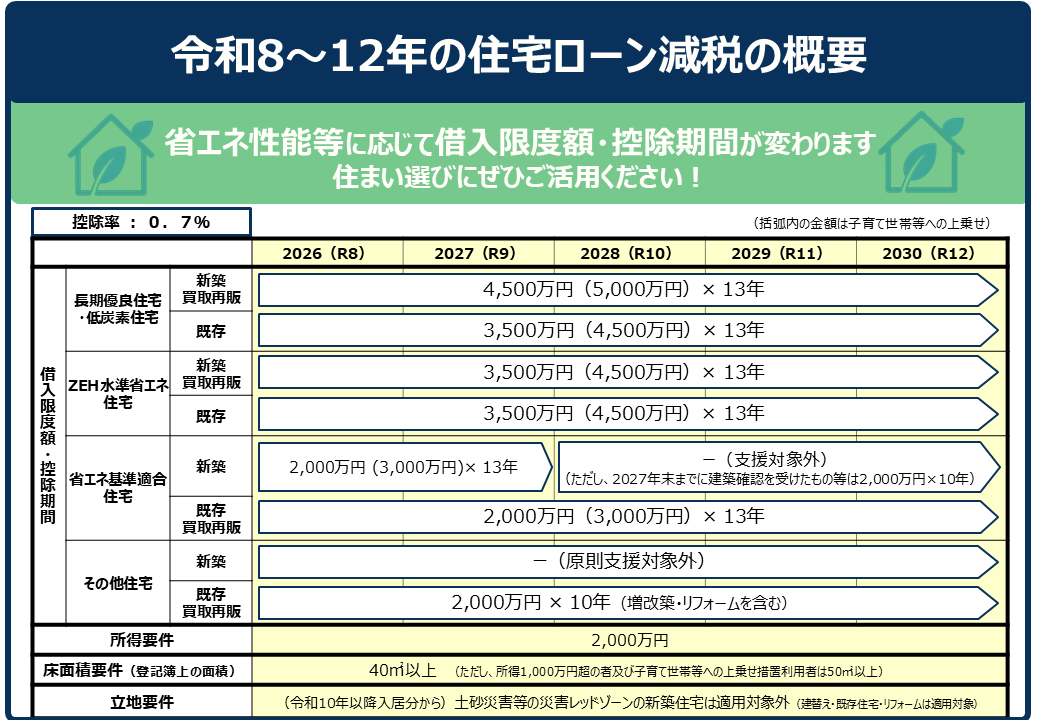
Under the FY2026 (Reiwa 8) tax reform, Japan's mortgage interest tax credit was extended five years, through move-ins completed by 2030 (Reiwa 12). The credit rate stays at 0.7%, but the loan-limit tiers and eligibility requirements have changed.
| Housing category | New build / qualified resale | Existing housing |
|---|---|---|
| Long-life quality housing / low-carbon housing | ¥45M (¥50M) (≈USD 300,000 / USD 333,333) × 13 years | ¥35M (¥45M) (≈USD 233,333 / USD 300,000) × 13 years |
| ZEH-level energy-efficient housing | ¥35M (¥45M) (≈USD 233,333 / USD 300,000) × 13 years | ¥35M (¥45M) (≈USD 233,333 / USD 300,000) × 13 years |
| Energy-code-compliant housing | 2026 move-ins only: ¥20M (¥30M) (≈USD 133,333 / USD 200,000) × 13 years. Not eligible from 2027 onward (properties with building confirmation obtained by end of 2027 etc. get ¥20M (≈USD 133,333) × 10 years) | ¥20M (¥30M) (≈USD 133,333 / USD 200,000) × 13 years |
| "Other housing" (below energy code) | Not eligible, in principle | ¥20M (≈USD 133,333) × 10 years (including additions/renovations) |
Figures in parentheses are the higher loan limits available to child-rearing households (households with a child under 19, or where either spouse is under 40). The income requirement is total income of ¥20 million (≈USD 133,333) or less, and the floor-area requirement is 40 sqm or more (50 sqm or more if your income exceeds ¥10 million / ≈USD 66,667, or if you are using the child-rearing-household loan-limit uplift). Starting with move-ins from 2028 (Reiwa 10) onward, newly built homes located in landslide-risk "disaster red zones" are excluded entirely (Ministry of Land, Infrastructure, Transport and Tourism (国土交通省, MLIT), "Overview of the FY2026 MLIT Tax Reform").
One point worth emphasizing for anyone considering a house-hacking duplex: a newly built home in the low-energy-efficiency "other housing" category is, in principle, no longer eligible for the credit at all. If securing the credit matters to your numbers, targeting ZEH level or above from the design stage becomes a practical requirement, not an optional upgrade. You must also still satisfy the underlying rule covered earlier — at least half of floor area used exclusively as the owner's own residence — together with the ¥20 million (≈USD 133,333) total-income cap (National Tax Agency (国税庁, NTA) No. 1211-1). Floor area is judged on the whole building, including any shop or office portions.
The New-Build Fixed-Asset Tax Reduction Is Extended Through March 2031
The special measure that halves fixed-asset tax for three years (five years for condominium-type buildings) on a newly built home has been extended five years, from April 1, 2026 through March 31, 2031. Alongside the extension, the minimum qualifying floor area was eased to 40 sqm (from 50 sqm), while homes in certain hazard-designated areas are now excluded. MLIT's own estimate: for a newly built home valued at ¥25 million (≈USD 166,667), fixed-asset tax through year three would be ¥182,000/year (≈USD 1,213) without the exemption versus ¥91,000/year (≈USD 607) with it — a savings of roughly ¥270,000 (≈USD 1,800) over three years (Ministry of Land, Infrastructure, Transport and Tourism (国土交通省, MLIT), "Overview of the FY2026 MLIT Tax Reform").
Real-Estate Acquisition Tax Applies "Per Dwelling Unit"
The real-estate acquisition tax is one of the most commonly overlooked line items. The rate on acquiring housing is reduced to 3% (from a base rate of 4%), and building a new home entitles you to a ¥12 million (≈USD 80,000) deduction from the taxable standard value. The reduced-rate special measure is in effect through March 31, 2027 (Ministry of Land, Infrastructure, Transport and Tourism (国土交通省, MLIT), "Special Measures for Real-Estate Acquisition Tax").
The critical detail is that this deduction applies per dwelling unit. Hokkaido Prefecture's guidance, for example, explains that as long as each unit's floor area is between 40 and 240 sqm, the deduction of up to ¥12 million (≈USD 80,000) per unit applies against the assessed value. Certified long-life quality housing acquired by March 31, 2031 (Reiwa 13) qualifies for a higher cap of ¥13 million (≈USD 86,667) (Hokkaido Prefecture (北海道), "Real-Estate Acquisition Tax Reduction for New Housing").
For a house-hacking duplex configured as one owner unit plus two rental units, with each unit at 40 sqm or more, the simple math works out to a total deduction allowance of ¥12M × 3 units = ¥36 million (≈USD 240,000). Subdivide the rental units below 40 sqm each and you forfeit this allowance entirely — a point worth confirming before you finalize the floor plan. Requirements and administration vary by prefecture, so confirm the specifics with the prefectural tax office covering your construction site.
Inheritance and Exit: The Three Most Overlooked Issues With a House-Hacking Duplex
Estate planning around a house-hacking duplex works very differently from the step-up-in-basis and revocable-trust playbook familiar to US investors, and the eventual sale draws on an exemption structure with no direct US or UK equivalent. Both deserve careful attention well before the building is designed.
The "Rented Land" Valuation Discount Is Not a Flat 20%
The valuation discount for land under a rented building (貸家建付地, kashiya-tsukechi) is often cited as an inheritance-tax planning tool, but the commonly repeated claim that it "knocks about 20% off the value across the board" is not accurate. The National Tax Agency's formula is:
Value of rented-building land = Value as owner-occupied land − (Value as owner-occupied land × leasehold ratio × tenancy ratio × rental ratio)
The leasehold ratio (借地権割合) varies by area and is looked up from the local rosenka (路線価, roadside land-value) map or valuation-multiple table. The rental ratio (賃貸割合) is the floor area of units actually rented out at the valuation date, divided by the building's total floor area of independently rentable units (National Tax Agency (国税庁, NTA) No. 4614, "Valuation of Rented-Building Land"). With a tenancy ratio of 30% and a rental ratio of 1.0, the discount comes to 12% at a 40% leasehold ratio, 15% at 50%, 18% at 60%, and 21% at 70%. In other words, "roughly 20%" only holds true in areas where the leasehold ratio happens to be 60–70%.
There is a further constraint specific to house-hacking duplexes: the site area corresponding to the owner-occupied portion does not qualify for the rented-land discount at all. Take a model where owner-occupied valuation is ¥50 million (≈USD 333,333), leasehold ratio is 60%, and the rental portion is 44.4% of total floor area: the portion of site valued as rented-building land is ¥50M × 44.4% ≈ ¥22.22 million (≈USD 148,133), and the discount on that portion is ¥22.22M × 0.6 × 0.3 ≈ ¥4 million (≈USD 26,667). Measured against the entire site, that is a discount of only about 8% — compared with roughly ¥9 million (18%, ≈USD 60,000) for an equivalent fully rented apartment building. We cover inheritance-tax valuation in more depth in how rental management interacts with inheritance tax planning.
The Small-Scale Residential Land Exemption Cannot Be Fully Stacked
The small-scale residential land special exemption comes in two flavors: the owner-occupied residential land exemption (特定居住用宅地等, capped at 330 sqm with an 80% reduction) and the rental-business land exemption (貸付事業用宅地等, capped at 200 sqm with a 50% reduction). A house-hacking duplex can potentially qualify for both, but electing the rental-business exemption requires the combined area to fit within the following adjustment formula:
(Specific business-use land ① + ②) × 200/400 + Owner-occupied residential land ⑥ × 200/330 + (Rental-business land ③ + ④ + ⑤) ≤ 200 sqm
Take a 200 sqm site split 50/50 between owner-occupied and rental use: 100 sqm owner-occupied × 200/330 ≈ 60.6 sqm, plus 100 sqm rental-business land, for a combined 160.6 sqm — within the 200 sqm cap, so both exemptions apply in full.
Now take a 330 sqm site with owner-occupied space at 2/3 (220 sqm) and rental space at 1/3 (110 sqm): 220 sqm × 200/330 ≈ 133.3 sqm + 110 sqm = 243.3 sqm, which exceeds the 200 sqm cap. In this case the estate must choose which exemption to prioritize, and the portion left out gets no reduction at all. The larger the site and the higher the owner-occupied ratio, the tighter this cap becomes (National Tax Agency (国税庁, NTA) No. 4124).
The ¥30M Capital-Gains Exemption on Sale Covers Only the Owner-Occupied Portion
The exit is governed by apportionment too. The special ¥30 million (≈USD 200,000) exemption available when selling a primary residence applies only to the portion actually used as the owner's own home — this is Japan's rough analog to the US Section 121 home-sale exclusion, though far narrower in both amount and scope, since it excludes any portion let to tenants. If the residential portion is roughly 90% or more of the whole, however, the entire property can be treated as residential for purposes of the exemption (National Tax Agency (国税庁, NTA) No. 3452, "Special Treatment When Selling a Mixed-Use Shop-and-Residence Property"). In our 55.6%-owner-occupied model, only about 55.6% of the capital gain qualifies for the exemption; the remainder is taxed as ordinary capital gain on investment property.
A Structurally Limited Buyer Pool at Exit
A house-hacking duplex faces two categories of buyer at resale, each applying a different — and unflattering — valuation lens. A buyer looking for a home to live in is put off by the idea of a stranger living in the same building; an investor discounts the deal because "the portion the owner lived in generates no yield." Neither buyer type is likely to give the property full marks. At inheritance, the same physical indivisibility tends to push heirs into co-ownership, since the building cannot be split, and any future sale or major renovation then requires unanimous agreement among all co-owners. Deciding who inherits the building — and how — is a conversation worth having before you break ground, not after.
The Friction of Sharing a Building With Your Tenants
We have covered a lot of numbers; the lived-in reality deserves equal attention. Some friction can be designed away. Some cannot — and that distinction matters more for a house-hacking duplex than it would for a landlord who never sets foot in the building.
- Noise: footsteps, television volume, children's voices. This is especially pronounced in wood-frame construction, and sound-insulating materials or double floors/ceilings can add several tens of thousands of yen (several hundred dollars) per tsubo to construction cost. Good design substantially reduces this.
- Shared-space rules: which day trash goes out, how parking or garden space gets used. Separating entrances, stairwells, and traffic flow reduces day-to-day contact between owner and tenants, which in turn reduces friction.
- Complaints land directly on you / rent arrears: without a property manager in between, a late-night equipment failure call and a rent-arrears reminder both come straight to you, the owner-occupant, rather than to a management company. Design cannot solve this one. Property-management fees run around 5% of rent, but weighed against the emotional cost of being your tenant's first call at 11pm, it is money well spent.
Most of the people who struggle with a house-hacking duplex are worn down not by the numbers but by the interpersonal friction. We generally recommend building your cash-flow plan around outsourcing management from day one, rather than treating it as an optional add-on you might skip to save the fee.
Who a House-Hacking Duplex Suits — and Who It Doesn't
A Three-Axis Checklist
Here is everything above distilled into yes/no questions.
Money axis
- Could you keep making the monthly loan payment out of household income even if rental income dropped to zero?
- Could you keep making payments if interest rates rose two percentage points?
- Have you modeled cash flow for the years after the mortgage tax credit ends at year 13?
- Can you separately set aside funds for major repairs 10 years out?
Location axis
- Have you checked asking rents for your intended floor plan at three or more comparable listings near the build site?
- Have you checked local vacancy conditions via listing counts on rental portals?
- Do you have a reasoned basis for expecting rental demand to persist at this location 20 years from now?
- Given the site area and zoning, can the building still pencil out financially while keeping the owner-occupied portion at 1/2 or more?
Lifestyle axis
- Is every member of your household genuinely comfortable with strangers living in the same building?
- Does your cash-flow plan assume outsourcing to a property manager?
- Do you have a realistic expectation of still living in this home in 10 or 20 years?
- Have you started the conversation about who inherits this building?
Wherever you answer "no" more than once on a given axis, that is the area to address first.
Five Numbers to Confirm Before You Build
- Owner-occupied ratio: the owner-occupied share of total floor area. Drop below 1/2 and both financing and tax treatment change entirely.
- Assumed rent: not the nationwide average, but actual asking rents at your specific build site, confirmed against three or more real listings.
- Applicable interest rate: the actual rate quoted by your lender. As of August 2026, full-term fixed rates run in the 3% range.
- Repayment-to-income ratio: annual loan payments as a share of household income. Flat 35's total debt-service ratio standard is 30% or below for incomes under ¥4 million (≈USD 26,667) and 35% or below for incomes at or above that level.
- Cash left after a three-month vacancy: how much comes out of household savings if one rental unit sits empty for three months.
Bottom Line: The Shortest Path to a Numbers-Based Decision
As an investment product, a house-hacking duplex underperforms a dedicated rental building. Yield on total project cost sits around 2% — well below the 3.6–3.7% expected yield the Japan Real Estate Institute reports for a whole rental building in Tokyo's Jōnan area. If there is a single reason it is still worth choosing, it is this: it lets you hold an asset while diluting your own housing cost with rental income.
The order of decision-making is straightforward. First, lock in an owner-occupied ratio of 1/2 or more. Next, use the NTA's construction-cost tables to get a rough sense of build cost, and set your rent assumption using actual local asking rents, not a national average. Then obtain a real quoted interest rate from a lender, and calculate how much would come out of household cash if a unit sat vacant for three months. Fit all of that onto a single sheet of paper, and the decision to build — or not — tends to make itself.
What we care about most is giving you transparent information, downsides included. A house-hacking duplex is not a product built for short-term profit. We believe it is worth considering specifically for people building their family's home and their family's assets around a long time horizon.
Frequently Asked Questions
Q1. What percentage of total floor area should the owner-occupied portion be?
We recommend securing 50% or more of total floor area. Fall below 50% and you lose access to home-mortgage products (the loan is reclassified as an investment real-estate loan), the mortgage tax credit no longer applies, and the scope of the ¥30 million (≈USD 200,000) special exemption on sale shrinks as well. In this article's reference model, the mortgage tax credit alone is worth roughly ¥3.03 million (≈USD 20,200) over 13 years. In most cases, securing 50% and then optimizing unit count and floor plan within that constraint works out better than prioritizing yield by dropping to 49%.
Q2. Can Flat 35 be used for a house-hacking duplex?
Not for the portion intended as rental. The Japan Housing Finance Agency (JHF) explicitly states that "Flat 35 cannot be used to finance the acquisition of investment properties, including properties intended to be leased to third parties," and construction or purchase costs attributable to non-residential portions such as shops or offices are excluded from the loan amount as well. The agency periodically verifies actual occupancy, and if third-party rental is discovered, it can demand full repayment. For a house-hacking duplex, you'll need to look at a conventional private-bank mortgage, a lender's dedicated house-hacking duplex product, or an apartment loan.
Q3. How large is the mortgage tax credit?
It equals 0.7% of the year-end loan balance multiplied by occupancy ratio. In our model — 180 sqm total floor area, 100 sqm owner-occupied (occupancy ratio 55.6%), a building-loan balance of ¥40 million (≈USD 266,667), and a land-loan balance of ¥20 million (≈USD 133,333) — the credit base comes to roughly ¥33.33 million (≈USD 222,200), for an annual credit of about ¥233,000 (≈USD 1,553), or roughly ¥3.03 million (≈USD 20,200) over 13 years. Note that the land-loan portion is apportioned too — a detail that is easy to miss. If the residential portion is roughly 90% or more, apportionment can be skipped and the whole property treated as residential. The credit is capped by your income-tax liability, so depending on your income you may not be able to use the full amount.
Q4. How much does the owner-occupied ratio affect fixed-asset tax?
The land's fixed-asset tax does not change with owner-occupied ratio at all. The residential-land exemption is judged by occupancy ratio (residential floor area ÷ total floor area), and rented units count as residential too. For a house-hacking duplex made up only of dwelling units — no attached shop or office — occupancy ratio is 100% and the residential-land ratio is 1.0, regardless of the owner-occupied share. What actually matters is unit count: the small-residential-land allowance (1/6 taxable base) applies at up to 200 sqm per dwelling unit, so one owner unit plus two rental units extends the allowance to 600 sqm. In our 300 sqm site / ¥45 million (≈USD 300,000) assessed-value model, that worked out to roughly ¥50,000 (≈USD 333) less per year than a standalone single-family home.
Q5. Can both the owner-occupied and rental portions use the small-scale residential land exemption at inheritance?
Only within the limits of the adjustment formula. Combining the owner-occupied residential land exemption (330 sqm, 80% reduction) and the rental-business land exemption (200 sqm, 50% reduction) requires satisfying "owner-occupied land × 200/330 + rental-business land ≤ 200 sqm." At a 200 sqm site with a 50/50 split, that comes to 60.6 sqm + 100 sqm = 160.6 sqm, so both apply. At a 330 sqm site with owner-occupied space at 2/3, it comes to 243.3 sqm, which exceeds the cap. The larger the site and the higher the owner-occupied ratio, the worse the outcome — so it is worth running these numbers while the estate is still being planned, not after.
Q6. What's a reasonable benchmark for construction cost?
The most reliable approach is to use the NTA's per-square-meter unit prices from its construction-cost tables (Reiwa 7 edition). For 180 sqm of total floor area, national-average unit prices come to ¥39.06M (≈USD 260,400) for wood-frame, ¥56.52M (≈USD 376,800) for steel-frame, and ¥60.84M (≈USD 405,600) for reinforced concrete; Tokyo unit prices come to ¥41.4M (≈USD 276,000) for wood-frame, ¥69.12M (≈USD 460,800) for steel-frame, and ¥77.58M (≈USD 517,200) for reinforced concrete. Land cost and incidental costs (design fees, registration, insurance, exterior work, and similar) come on top of these figures. Checking a builder's quote against these public unit prices is a quick way to see whether it is in a reasonable range.
Sources and References
- National Tax Agency (国税庁, NTA), "Regional/Structural Construction Cost Table (Per 1 sqm) for Reiwa 7"
- National Tax Agency (国税庁, NTA), "Standard Construction Value Table for Buildings"
- National Tax Agency (国税庁, NTA), FAQ Example: "When a Newly Built House Combines a Shop and a Residence"
- Related Directives Concerning Article 41 of the Act on Special Measures Concerning Taxation (Directives 41-27 and 41-29)
- National Tax Agency (国税庁, NTA) No. 1211-1, "Newly Building or Otherwise Acquiring a Home and Moving In From 2022 Onward (Mortgage Interest Special Tax Credit)"
- National Tax Agency (国税庁, NTA) No. 4614, "Valuation of Rented-Building Land"
- National Tax Agency (国税庁, NTA) No. 4124, "Special Valuation for Small-Scale Residential or Business-Use Land Inherited (Small-Scale Residential Land Special Exemption)"
- National Tax Agency (国税庁, NTA) No. 3452, "Special Treatment When Selling a Mixed-Use Shop-and-Residence Property"
- Ministry of Land, Infrastructure, Transport and Tourism (国土交通省, MLIT), "Overview of the FY2026 MLIT Tax Reform"
- Ministry of Land, Infrastructure, Transport and Tourism (国土交通省, MLIT), "Mortgage Interest Tax Credit"
- Ministry of Land, Infrastructure, Transport and Tourism (国土交通省, MLIT), "Special Measures for Real-Estate Acquisition Tax"
- Statistics Bureau of Japan, Ministry of Internal Affairs and Communications (総務省統計局, MIC), "2023 Housing and Land Survey: Basic Tabulation Results on Housing and Households"
- Japan Housing Finance Agency (住宅金融支援機構, JHF), "Flat 35 Usage Conditions"
- Japan Housing Finance Agency (住宅金融支援機構, JHF), "Flat 35 Latest Interest Rate Information"
- Japan Housing Finance Agency (住宅金融支援機構, JHF), "FY2025 Flat 35 User Survey Results" (July 24, 2026)
- Japan Housing Finance Agency (住宅金融支援機構, JHF), "Survey on Mortgage Borrower Conditions (January 2026 Survey)"
- Japan Real Estate Institute (日本不動産研究所), "54th Real Estate Investor Survey" (as of April 2026)
- City of Osaka (大阪市), "Special Measures for the Taxable Standard of Residential Land"
- Hokkaido Prefecture (北海道), "Real-Estate Acquisition Tax Reduction for New Housing"
- Suruga Bank (スルガ銀行), "House-Hacking Duplex Loan"
