Manufacturer list prices for a Japanese apartment-building delivery locker — called a takuhai bokkusu (宅配ボックス, literally "delivery box," the standard term for a parcel locker bank in Japan) — start at ¥89,200 (approx. USD 595), tax excluded, for a small multi-unit model, and at ¥375,100 (approx. USD 2,501), tax included, for a large locker bank serving 10 to 100 households. On top of that comes installation work, but a national government subsidy can cover up to ¥500,000 (approx. USD 3,333) per building, and in Tokyo's Itabashi Ward (板橋区) an apartment building can claim up to ¥250,000 (approx. USD 1,667) more. Starting from these official list prices, this guide works through the full installed cost and the payback period for a 6-unit apartment building. (Reference exchange rate used throughout: ¥150 = USD 1, as of August 2026; treat all USD figures as approximate.)
This is a Japan-specific piece of building infrastructure with no exact Western counterpart, and the market around it is unusually codified. In many English-speaking markets, a parcel locker is either a shared Amazon Hub unit bolted on by a third-party logistics company, or a courier simply leaves a package on the porch. In Japan, by contrast, delivery lockers are typically owned outright by the landlord, priced from a public manufacturer catalogue, partly funded through layered national-and-municipal subsidy programs, and — for tenants who want to add one themselves — subject to an explicit written-consent clause buried in the government's own model lease. None of that infrastructure exists in the same form in the US, UK, Australian, or Singaporean rental markets, which is exactly why the topic deserves a guide of its own for an overseas owner.
This article is written for owners of apartment and small multi-family buildings, and for the management companies who run them, who need to answer three questions in hard numbers: "how much would this cost on my specific building," "how far does a subsidy actually bring that number down," and "how many years does it take to pay for itself." We also devote a separate section to a question we hear constantly from tenants: "can I install a delivery locker myself, and do I need my landlord's permission." Every price in this article is a manufacturer's official suggested retail price; every regulation and statistic is drawn from a ministry or municipal government publication.
Key takeaways
- Manufacturer list prices for multi-unit locker banks run ¥89,200 to ¥157,900 (approx. USD 595–1,053), tax excluded, for Panasonic's "Combo-Maison" line, and ¥79,200 to ¥1,049,400 (approx. USD 528–6,996), tax included, for Nasta Corporation's "Nasta Box" line. Both are official manufacturer suggested retail prices and exclude installation labor.
- For fiscal year 2026, Japan's national Child-Rearing Support Multi-Family Housing Promotion Project (子育て支援型共同住宅推進事業) subsidizes one-third of eligible project cost, multiplied by the child-rearing-household occupancy rate, capped at ¥500,000 (approx. USD 3,333) per building. Tokyo's Itabashi Ward caps its own program at ¥250,000 (approx. USD 1,667), and Tokyo's Koto Ward (江東区) caps its program at 20% of eligible cost, up to ¥100,000 (approx. USD 667). All three require the application to be approved before construction begins.
- Installing lockers in a 6-unit apartment building at official list prices, with an assumed ¥80,000 (approx. USD 533) installation cost, comes to roughly ¥292,800 (approx. USD 1,952), tax included. If the owner can raise rent by ¥1,000 (approx. USD 7) per unit per month, that pays back in about 4.1 years unsubsidized, or about 3.0 years after the Itabashi Ward subsidy.
- Japan's redelivery rate for parcels — the share of delivery attempts that fail on the first try and must be re-attempted — stood at approximately 7.6% in the government's April 2026 survey, and the share of households using some form of contactless receiving method (parcel lockers, convenience-store pickup, and similar) was approximately 31.0%, both figures published by 国土交通省 (Ministry of Land, Infrastructure, Transport and Tourism, MLIT). Tokyo's national government has set a policy target of raising that contactless-receiving rate to roughly 50% by fiscal year 2030.
- Only 57.4% of Japan's owner-occupied condominium buildings (分譲マンション) have a delivery locker at all (49.2% installed at construction, plus 8.2% retrofitted later) — and among small buildings of 20 units or fewer, that figure drops to just 41.2% (国土交通省, FY2023 Comprehensive Condominium Survey). Smaller buildings are precisely where a locker still functions as a genuine point of differentiation rather than table stakes.
How much does a delivery locker cost to install? (Official manufacturer price list)
Locker costs break into three components: the unit itself, the mounting hardware, and installation labor. The first two are published by the manufacturers as suggested retail prices, so you can size up the cost before ever requesting a quote. We start with those official numbers, then turn to the installation-labor question that only a site quote can answer.
Panasonic "Combo-Maison" suggested retail prices (all 8 models, tax excluded)
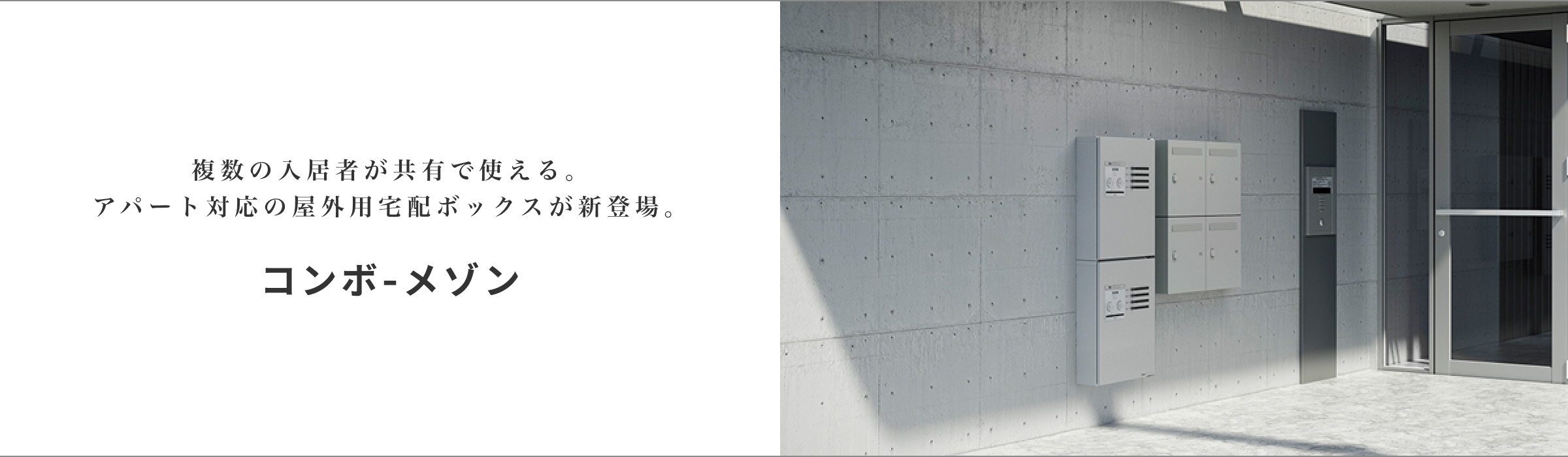
For apartment-sized buildings, the product owners look at first is usually Panasonic's "Combo-Maison" (コンボ-メゾン) line. It comes in a single-lock "private use" configuration, one unit per household, and shared 4-, 6-, and 8-lock configurations serving multiple households from one bank. Panasonic publishes suggested retail prices for every model on its official site.
| Usage | Type | Model number | Suggested retail price (tax excluded) |
|---|---|---|---|
| Private use (1 lock) | Compact | CTNR4140R(L)□ | ¥89,200 (approx. USD 595) |
| Half | CTNR4130R(L)□ | ¥98,100 (approx. USD 654) | |
| Middle | CTNR4120R(L)□ | ¥113,000 (approx. USD 753) | |
| Shared use (4 locks) | Half | CTNR4430R(L)□ | ¥127,700 (approx. USD 851) |
| Middle | CTNR4420R(L)□ | ¥142,600 (approx. USD 951) | |
| Shared use (6 locks) | Half | CTNR4630R(L)□ | ¥135,300 (approx. USD 902) |
| Middle | CTNR4620R(L)□ | ¥150,300 (approx. USD 1,002) | |
| Shared use (8 locks) | Half | CTNR4830R(L)□ | ¥143,000 (approx. USD 953) |
| Middle | CTNR4820R(L)□ | ¥157,900 (approx. USD 1,053) |
Source: Panasonic, "Multi-Family Delivery Locker Combo-Maison" (集合住宅用宅配ボックス コンボ-メゾン). Listed prices are suggested retail prices; consumption tax and installation labor are not included. The Compact type is marked on Panasonic's official site as scheduled for discontinuation at the end of March 2026.
Two things are worth pulling out of this table. First, even the 8-lock Middle type — the largest configuration in the line — is only ¥157,900 (approx. USD 1,053) tax excluded, which is a smaller purchase than most overseas readers would assume for shared building infrastructure. Second, Panasonic's own product page states explicitly that "no electrical work is required, so retrofit installation is also possible." Where a unit needs no power connection, retrofitting it into an existing, already-tenanted apartment building becomes a far simpler project than most Western readers would expect from "adding a piece of shared infrastructure" to an occupied building.
Nasta Corporation "Nasta Box" price range and household capacity (¥79,200 to ¥1,049,400, tax included)
If you are shopping by the scale implied by "delivery locker bank" rather than a single small unit, the line to look at is Nasta Corporation's (株式会社ナスタ) "Nasta Box" series. Nasta's official comparison table publishes household capacity, receiving method, and whether electrical work is required, alongside price, all in one place — a level of upfront, self-serve pricing transparency that is unusual for shared building equipment in most Western markets, where a comparable purchase typically starts with a vendor quote rather than a public price list.
| Product | Key type / receiving method | Household capacity | Electrical work | Price (tax included) |
|---|---|---|---|---|
| Petit-Taku | Analog key / front-load, front-unload | 1 household and up | Not required | ¥79,200 (approx. USD 528) and up |
| Petit-Taku unit | Analog key / front-load, front-unload | 2–20 households | Not required | ¥149,600 (approx. USD 997) and up |
| Petit-Taku unit | Digital key / front-load, front-unload | 2–12 households | Not required | ¥314,600 (approx. USD 2,097) and up |
| Petit-Taku / Petit-Taku unit | Digital key / front-load, rear-unload | 2–12 households | Not required | ¥421,300 (approx. USD 2,809) and up |
| STANDARD | Analog key / front-load, front-unload | 10–100 households | Not required | ¥375,100 (approx. USD 2,501) and up |
| STANDARD | Smart key / front-load, front-unload | 8–50 households | Required | ¥715,000 (approx. USD 4,767) and up |
| STANDARD | Smart key / front-load, rear-unload | 10–50 households | Required | ¥1,049,400 (approx. USD 6,996) and up |
Source: Nasta Corporation, "How to Choose a Nasta Box Multi-Family Delivery Locker: Comparison Table" (Nasta Box 集合住宅向け宅配ボックスの選び方・比較表). All models are rated to the IPX4 water-resistance standard.
An apartment building with fewer than 10 units can start looking at ¥79,200 (approx. USD 528), while covering a 50-household building with a smart-key system pushes the price past ¥1 million (approx. USD 6,667). The same generic phrase — "delivery locker" — spans more than a tenfold price range, and understanding that up front makes it much easier to judge whether a quote you receive is reasonable.
Costs beyond the unit itself, and how to request a quote
Two costs beyond the locker unit itself are essentially unavoidable: mounting hardware and installation labor. Mounting hardware, at least, has a published manufacturer price.
| Mounting hardware (Panasonic) | Suggested retail price (tax excluded) |
|---|---|
| Embedded-installation pole, TSU-1 / TSU-3 type | ¥35,800 (approx. USD 239) |
| Post-installation pole, TSA-1 / TSA-3 type | ¥64,000 (approx. USD 427) |
| Embedded-only pole (1–2 unit / 4 unit installation) | ¥46,000 (approx. USD 307) |
| Post-installation pole set (pole + mounting bracket) | ¥86,900 (approx. USD 579) |
| Freestanding base, TSB-1 type | ¥28,800 (approx. USD 192) |
| Freestanding base (for Middle type) | ¥30,100 (approx. USD 201) |
| Plug anchor bolt set, CTP17306 | ¥5,800 (approx. USD 39) |
Source: Panasonic, "Multi-Family Delivery Locker Combo-Maison" (集合住宅用宅配ボックス コンボ-メゾン), installation hardware.
Installation labor, by contrast, has no published price at all, because it is set entirely by site conditions — whether a foundation is needed, how the locker interfaces with the existing mailbox bank, the access route for delivery, and whether an old unit has to be removed first. The installation-labor figure this article uses from this point forward is an assumed value, chosen purely to make the arithmetic work, and it is not presented as a market rate you should expect to pay. Ask any contractor to itemize the unit, mounting hardware, installation labor, and removal cost as separate line items on the quote. Without that breakdown, you cannot isolate which costs actually qualify for a subsidy. Itabashi Ward's own program, for instance, explicitly requires "an itemized statement of the delivery locker purchase and installation cost, in addition to the receipt for the exterior works as a whole" — the ward will not accept a single bundled invoice.
Total-cost model cases by unit count (6, 12, and 30 units)
Adding an assumed installation-labor figure to the official unit prices gives a rough picture of total cost by building size. Remember that every installation-labor figure here is an assumption, not a quote.
| Building size | Assumed model (official price) | Unit + hardware (tax excluded) | Installation labor (assumed) | Total (tax included, with assumption) |
|---|---|---|---|---|
| 6-unit apartment building | Combo-Maison, shared 6-lock Middle ¥150,300 + freestanding base ¥30,100 + anchor bolts ¥5,800 | ¥186,200 (approx. USD 1,241) | ¥80,000 (approx. USD 533) | approx. ¥292,800 (approx. USD 1,952) |
| 12-unit apartment building | Combo-Maison, shared 8-lock Middle ¥157,900 × 2 units + post-installation pole ¥64,000 × 2 | ¥443,800 (approx. USD 2,959) | ¥150,000 (approx. USD 1,000) | approx. ¥653,200 (approx. USD 4,355) |
| 30-unit condominium | Nasta Box STANDARD, analog key (10–100 households) ¥375,100 (tax included) and up | approx. ¥341,000 (approx. USD 2,273), tax-excluded equivalent | ¥250,000 (approx. USD 1,667) | approx. ¥650,100 (approx. USD 4,334) and up |
Unit prices here are official; installation-labor figures are assumptions. The 30-unit case has the widest range of possible configurations, so read that row as a practical floor, not a ceiling — the final amount moves considerably depending on exactly which combination of units you choose.
What actually differs between locker types? (Comparison by mechanism)
The real choice is not a simple binary between "mechanical" and "electronic." It maps much more cleanly onto the actual product lineups if you think in four categories: analog key, digital key, smart key, and freestanding/simple-mount. The decisive split between them is not price — it is whether electrical work is required, and whether the unit supports front-load, rear-unload (through-type) operation.
| Mechanism | Approximate household capacity | Unit price range (official) | Electrical work | App / smartphone integration | Receiving method | Best suited to |
|---|---|---|---|---|---|---|
| Analog key (dial / mechanical) | 1–100 households | ¥79,200 (approx. USD 528) and up, tax included / Panasonic ¥89,200 (approx. USD 595) and up, tax excluded | Not required | None | Front-load, front-unload | Any size; the default first choice for buildings under 10 units |
| Digital key | 2–12 households | ¥314,600–421,300 (approx. USD 2,097–2,809), tax included | Not required (battery-powered) | Available on some models | Front-load, front-unload or front-load, rear-unload | Small auto-locked buildings |
| Smart key | 8–50 households | ¥715,000–1,049,400 (approx. USD 4,767–6,996), tax included | Required | Yes | Front-load, front-unload or front-load, rear-unload | Medium to large condominium buildings |
| Freestanding / simple-mount | 1–20 households | ¥149,600 (approx. USD 997) and up, tax included / freestanding base ¥28,800 (approx. USD 192) and up, tax excluded | Not required | None | Front-load, front-unload | No-wall sites, townhouse-style buildings |
Source: Nasta Corporation, "Nasta Box Comparison Table"; Panasonic, "Combo-Maison". Unlike the US market, where a shared parcel locker installation almost always means bolting on a third-party service such as an Amazon Hub or a courier-operated locker bank under a separate commercial agreement, every one of these four Japanese categories is a piece of equipment the landlord purchases outright and owns.
Front-load/front-unload versus front-load/rear-unload: what drives placement and price
In the front-load, front-unload configuration, both the courier and the resident open and close the same door, from the same side. In the front-load, rear-unload configuration — sometimes called a "through-type" unit — the courier deposits the parcel from outside the secured entrance, and the resident retrieves it from inside. Because the parcel passes to the resident on the secure side of the building's auto-lock (オートロック, the Japanese term for a keycard- or intercom-controlled secured entrance, roughly equivalent to a US doorman building's controlled-access lobby, but far more common in ordinary rental apartments in Japan than in comparable Western rental stock), the front-load, rear-unload design is the only option that preserves the security value of the auto-lock system while still allowing package delivery.
The trade-off is that front-load, rear-unload units require the locker to be built into the wall, which means construction work that penetrates the wall itself, and the price jumps accordingly. On Nasta's own official pricing, the analog-key, front-load/front-unload Petit-Taku starts at ¥79,200 (approx. USD 528) tax included, while the digital-key, front-load/rear-unload version starts at ¥421,300 (approx. USD 2,809) tax included — more than five times the price for the through-type mechanism alone. For an ordinary apartment building without an auto-lock entrance, a front-load, front-unload unit fully serves the purpose at a fraction of the cost.
How to think about it by building size (under 10 units / 10–30 units / over 30 units)
- Under 10 units: an analog-key shared 4- to 6-lock unit is the realistic choice. No electrical work is required, and the total is easy to keep in the neighborhood of ¥300,000 (approx. USD 2,000).
- 10–30 units: you move into either multiple locker banks or a modular unit system to secure enough lockers. Nasta's STANDARD analog-key line (serving 10–100 households, from ¥375,100, approx. USD 2,501) sits squarely in this range.
- Over 30 units: a smart key's usage-history logging and remote-unlock capability starts to meaningfully reduce the management company's workload. But because electrical work becomes mandatory at this tier, confirming the wiring route has to happen before anything else.
If a delivery locker alone does not settle the decision, our guide to replacement timing and cost benchmarks for rental-property equipment lays this investment side by side with other equipment upgrades, such as water heaters and air conditioners, so you can rank priorities across the whole building.
What subsidies are available in FY2026, and how do you apply? (Subsidy comparison table)
Delivery lockers are eligible for subsidies at both the national and municipal level in Japan — a genuinely Japan-specific, two-tier structure. Where a US or UK property tax credit or rebate program is typically a single federal or state-level scheme claimed after the fact, Japan runs national ministries and individual wards (city sub-governments, roughly analogous to a New York City borough or a London borough, each with its own budget and application process) as two separate, stackable-in-principle subsidy layers, and every one of them shares the same rule: construction may not begin before the subsidy is formally approved. Start researching subsidies only after you have already placed the order, and whatever subsidy you might have qualified for is simply gone.
| Program | Subsidy rate / cap | Main eligibility | Application window / deadline |
|---|---|---|---|
| National: Child-Rearing Support Multi-Family Housing Promotion Project (子育て支援型共同住宅推進事業) | 1/3 of eligible project cost × child-rearing-household occupancy rate Cap: ¥500,000 (approx. USD 3,333) per building | Existing multi-family or row housing. Child-rearing-household occupancy of 30% or more; average unit floor area of 40 m² or more; compliant with the post-1981 seismic standard. One installation per building, in a shared area only | Pre-consultation and application both run 7 April 2026 – 29 January 2027 Construction must start by 31 January 2027 |
| Itabashi Ward, Tokyo (板橋区): Delivery Locker Installation Subsidy Program | Multi-family building, IoT-capable: 1/2 of eligible cost, cap ¥250,000 (approx. USD 1,667) Multi-family building, non-IoT: 3/10, cap ¥100,000 (approx. USD 667) | Owners or management associations of multi-family buildings within the ward. Installation must be performed by a contractor based in the ward | 1 April 2026 – 15 February 2027 Installation-completion report due by 31 March 2027 |
| Koto Ward, Tokyo (江東区): Subsidy for Delivery Locker Installation in Condominium Common Areas | 20% of eligible cost, cap ¥100,000 (approx. USD 667) Cap raised to ¥200,000 (approx. USD 1,333) for a management-plan-certified condominium | Buildings of 3 stories or more (excluding basement) and 10 or more total units. Owners of rental condominium buildings are also eligible. Number of lockers installed must be at least 10% of total units | Applications open 8 January 2026, closing once budget is exhausted Installation must be completed within the application fiscal year |
The national Child-Rearing Support program has narrow, detailed eligibility rules
The national program offers the largest cap, but the eligibility rules are correspondingly tight. According to the program administrator's published guidance, eligibility is limited to existing multi-family or row housing — new construction does not qualify — and requires a child-rearing-household occupancy rate (households raising at least one child under 18 as of 1 April 2026) of 30% or more, an average unit floor area of 40 m² or more, and compliance with Japan's post-1981 seismic standard, known as the shin-taishin kijun (新耐震基準, new seismic standard).
Placement is also restricted. The subsidy applies only to lockers installed in a shared area such as a building entrance — a unit placed in front of each individual door does not qualify. Only one installation per building is eligible, and the product itself must be a registered item under the "Mirai Eco Housing (formerly Child-Rearing Green Housing) 2026 Project" (みらいエコ住宅(旧子育てグリーン住宅)2026事業). Replacing an existing unit can also be claimed, provided the new unit is a genuine performance upgrade over the old one; removal and disposal costs are not eligible.
Municipal subsidies: the "local contractor" condition matters more than the amount
Itabashi Ward offers a genuinely generous rate for a municipal program — half of eligible cost, up to ¥250,000 (approx. USD 1,667), for an IoT-capable multi-family unit. The catch is that the installation work must be performed by a contractor based within Itabashi Ward itself; placing a single bundled order with an out-of-ward contractor disqualifies the project entirely. Eligible cost covers the unit and installation labor only — nameplates, lighting, consumption tax, and removal costs are all excluded. There are also product requirements: at least one locker compartment must accept a parcel whose three dimensions sum to 75 cm or more, and units secured only with a padlock are excluded. The ward's total FY2026 budget was ¥11,520,000 (approx. USD 76,800), and as of 31 July 2026 the cumulative value of applications received stood at ¥1,434,000 (approx. USD 9,560).
Koto Ward's rate is more modest — 20%, capped at ¥100,000 (approx. USD 667) — but in practice, one detail matters a great deal: owners of rental condominium units are explicitly eligible to apply, not just owner-occupiers. For an ordinary owner-occupied condominium, the installation and its budget must first be approved by a resolution of the building's kanri kumiai (管理組合, the condominium's legally mandatory owners' association — every unit owner in a Japanese condominium is automatically a member, unlike a US or UK homeowners' association, which some jurisdictions allow buildings to opt out of forming) at a general meeting. Because eligibility requires 3 or more stories and 10 or more units, a small two-story wood-frame apartment building does not qualify for this particular program.
Applications run into essentially three problems
- Placing the order or starting construction before approval is granted. Itabashi Ward states explicitly: "Purchase, contracting, and installation must take place only after the subsidy approval decision." Approval typically takes about four weeks from application.
- Missing the fiscal-year completion deadline. The national program's completion-report deadline is 3 February 2027; Itabashi Ward's installation-completion report is due by 31 March 2027. Miss either deadline and the subsidy is not paid, regardless of how sound the original application was.
- The budget runs out and the program closes early. Koto Ward states outright that applications close "once the budget is exhausted." The later in the fiscal year you move, the worse your odds.
Whether a national subsidy can be combined with a municipal one depends on the specific pair of programs — there is no blanket rule either way. Itabashi Ward's condition is that the applicant must not already be "receiving any other subsidy from the ward for the eligible cost." Always confirm combinability with both the national program office and the municipal counter before you apply, rather than assuming either way.
How many years does it take to pay back the installation cost? (Simulation)
A capital-equipment decision is usually easier to make on payback period than on the raw price tag alone. Here we work through a 6-unit apartment building as an example, stating every assumption explicitly. The unit and hardware costs are official manufacturer prices; the installation-labor cost and the rent increase are both assumptions.
Setting the assumptions
- Unit: Combo-Maison, shared 6-lock Middle type, ¥150,300 (approx. USD 1,002), tax excluded, official price
- Mounting hardware: freestanding base ¥30,100 (approx. USD 201) + anchor bolt set ¥5,800 (approx. USD 39), tax excluded, official price
- Installation labor: ¥80,000 (approx. USD 533) (assumed; varies with site conditions)
- Total: ¥266,200 (approx. USD 1,775), tax excluded = approx. ¥292,800 (approx. USD 1,952), with 10% consumption tax
Payback period if rent rises ¥1,000 / ¥2,000 per unit per month
| Case | Annual additional income | Without subsidy (approx. ¥292,800 / USD 1,952) | After Itabashi Ward subsidy (approx. ¥213,800 / USD 1,425) |
|---|---|---|---|
| +¥1,000 (approx. USD 7) per unit per month | ¥72,000 (approx. USD 480) (6 units × ¥1,000 × 12 months) | approx. 4.1 years | approx. 3.0 years |
| +¥2,000 (approx. USD 13) per unit per month | ¥144,000 (approx. USD 960) (6 units × ¥2,000 × 12 months) | approx. 2.0 years | approx. 1.5 years |
The post-subsidy figure applies Itabashi Ward's non-IoT tier (3/10 of eligible cost, capped at ¥100,000, approx. USD 667): eligible cost of ¥266,200 × 3/10 = ¥79,860, rounded down to the nearest thousand yen to ¥79,000 (approx. USD 527), giving a net cost of ¥292,800 minus ¥79,000 = ¥213,800 (approx. USD 1,425) tax included. Itabashi Ward's eligible cost excludes consumption tax, so the subsidy amount is calculated on the tax-excluded figure. If you select an IoT-capable product and qualify for the 1/2, ¥250,000 (approx. USD 1,667) cap tier instead, the net cost falls further still. The rent increase itself is only an assumption — whether you can actually raise rent by that amount depends entirely on how it compares with the surrounding market. Our article on setting rent by working backward from target investment yield, and vacancy countermeasures lays out how to think about the right size of rent increase.
The effect of a shorter vacancy period
Even in a location where you cannot raise rent at all, there is still a path to payback through a shorter vacancy period between tenants. Assume a ¥60,000 (approx. USD 400) unit with two tenant turnovers a year, and assume each turnover's vacancy period shrinks by one month.
- Lost rent avoided: ¥60,000 × 2 units = ¥120,000 (approx. USD 800) per year
- Payback period without subsidy: ¥292,800 ÷ ¥120,000 = approx. 2.4 years
- Payback period after the Itabashi Ward subsidy: ¥213,800 ÷ ¥120,000 = approx. 1.8 years
Both the number of turnovers and the size of the vacancy-period reduction are assumptions here too. Even so, the underlying picture is clear: this is an investment that can pay for itself in roughly two years without raising rent by a single yen. Read this alongside our cost-effectiveness comparison of vacancy-reduction ideas to rank it against your other options.
Tax treatment: the FY2026 tax reform raises the small-asset depreciation threshold to under ¥400,000
There is a genuinely useful change to know about for 2026. According to guidance the 中小企業庁 (Small and Medium Enterprise Agency, SMEA) published in May 2026, the special provision for immediate expensing of small depreciable assets for small and medium-sized enterprises has had its acquisition-cost ceiling raised from under ¥300,000 (approx. USD 2,000) to under ¥400,000 (approx. USD 2,667). The measure runs through the end of fiscal year 2028 (31 March 2029). It applies to blue-return-filing small and medium enterprises with 400 or fewer regular employees (300 or fewer for partnerships and similar entities with paid-in capital over ¥100 million). 財務省 (Ministry of Finance, MOF), in its published FY2026 tax reform outline, likewise states that the acquisition-cost threshold rises to under ¥400,000, corporations with more than 400 regular employees are excluded, and the measure's term is extended three years (the same treatment applies to individual income tax).
This expanded threshold matters specifically for the higher-priced end of the product range.
- Combo-Maison, shared 6-lock Middle type, ¥150,300 (approx. USD 1,002), tax excluded: this already fell under the old under-¥300,000 threshold, so the expansion changes nothing for this model.
- Nasta Box STANDARD, analog key, ¥375,100 tax included (¥341,000, approx. USD 2,273, tax-excluded equivalent): this did not fit under the old under-¥300,000 threshold, but can now qualify under the new under-¥400,000 threshold. That is the difference between expensing a large locker bank in full in the year of purchase and having to depreciate it over several years instead.
Several conditions still apply, though. The annual aggregate cap of ¥3,000,000 (approx. USD 20,000) is unchanged. And critically, assets held for lease are excluded from the special provision, unless the leasing itself is the taxpayer's principal business. Whether a delivery locker in a rental property falls under this exclusion is a question that can turn on the specific facts of the business, and reasonable positions differ. Note also that 国税庁 (National Tax Agency, NTA) Tax Answer No.5408 is still published on an "as of the law in effect on 1 April 2025" basis and, as of this writing, may still show the old under-¥300,000 figure rather than the new ¥400,000 one.
Whether acquisition cost is judged tax-included or tax-excluded depends on which consumption-tax accounting method your business uses, and the applicable useful life differs depending on whether the locker is classified as a building-attached facility or as furniture and fixtures. This article does not state a specific number of years, because that classification can only be confirmed against 国税庁's official useful-life tables. Please confirm the actual tax treatment with your engaged tax accountant or your local tax office. For the underlying logic of depreciation and offsetting losses, see our companion piece on how depreciation and loss offsetting work.
Why does a delivery locker matter for rental management right now? (Demand data)
"Because tenants like it" is not, by itself, grounds for a capital-spending decision. Here we check the actual level of demand against published government and industry data.
| Metric | Value | As of | Source |
|---|---|---|---|
| Parcel redelivery rate | approx. 7.6% (urban areas 8.5% / suburban areas 7.2% / rural areas 6.0%) | April 2026 survey | 国土交通省 (MLIT) |
| Redelivery-rate trend | 8.4% (April 2025) → 8.3% (October 2025) → 7.6% (April 2026) | Each survey round | 国土交通省 (MLIT) |
| Contactless-receiving usage rate | approx. 31.0% (+1.1 points vs. previous survey) | April 2026 survey | 国土交通省 (MLIT) |
| Government target | Raise contactless-receiving usage to roughly 50% by FY2030 | Comprehensive Logistics Policy Framework (総合物流施策大綱, cabinet-approved 31 March 2026) | 国土交通省 (MLIT) |
| Share of households using online shopping | 55.3% (56.2% the same month a year earlier, −0.9 points) | May 2026, households of two or more people | 総務省統計局 (Statistics Bureau, Ministry of Internal Affairs and Communications) |
| Online shopping expenditure | ¥26,606 (approx. USD 177) (+2.1% year-on-year) / ¥48,102 (approx. USD 321) per shopping household | May 2026 | 総務省統計局 |
| Delivery-locker installation rate, owner-occupied condominiums | 57.4% (49.2% installed at construction + 8.2% retrofitted later) | FY2023 | 国土交通省 (MLIT) |
| Average number of lockers installed | 8.3 units (21.7 units at buildings completed FY2020 or later) | FY2023 | 国土交通省 (MLIT) |
The redelivery rate is falling, but one attempt in roughly thirteen still fails
According to a survey result 国土交通省 published on 10 July 2026, Japan's parcel redelivery rate in April 2026 stood at approximately 7.6%, down 0.7 points from 8.3% in October 2025. The improvement is a genuinely notable, nationally tracked policy trend — Japan is one of relatively few countries where the government runs a standing, government-published survey of failed first-attempt deliveries at all, largely because of the acute courier-driver shortage the industry calls the "2024 problem" (物流の2024年問題). Even so, in urban areas the rate remains 8.5%, meaning roughly one delivery in twelve still requires a second attempt. Flip that statistic around: a building that can complete that one delivery on the first attempt creates value both for its own tenants and for the courier company serving it.
The same survey put the contactless-receiving usage rate at approximately 31.0%. In the Comprehensive Logistics Policy Framework the national government adopted by cabinet decision on 31 March 2026, it set a target of raising that usage rate to roughly 50% by FY2030. A delivery locker is increasingly positioned as equipment that is directly aligned with national policy, not simply a tenant amenity.
Online shopping is no longer a niche behavior
According to 総務省統計局's Family Income and Expenditure Survey, in May 2026 the share of households using online shopping was 55.3%, and average monthly spending across all households of two or more people was ¥26,606 (approx. USD 177). Among households that actually shopped online, that figure was ¥48,102 (approx. USD 321) per household. Compared with the same month a year earlier, the share of households shopping online fell 0.9 points, while spending rose 2.1%. The picture that emerges is not more shoppers, but more volume per shopper. More parcels per household means more missed deliveries when nobody is home to receive them.
Smaller buildings still have real room to differentiate
国土交通省's FY2023 Comprehensive Condominium Survey found that 49.2% of owner-occupied condominiums have a delivery locker installed since construction, plus another 8.2% retrofitted later, for 57.4% combined. But break that down by total unit count, and the picture changes considerably.
| Total units in building | Installed at construction | Retrofitted later | Combined |
|---|---|---|---|
| 20 units or fewer | 31.8% | 9.4% | 41.2% |
| 21–30 units | 43.9% | 9.1% | 53.0% |
| 31–50 units | 54.4% | 9.1% | 63.5% |
| 51–75 units | 52.8% | 7.8% | 60.6% |
Broken down by completion year, buildings completed in or before 1999 show an at-construction installation rate of 40.6% or lower, and buildings completed in or before 1979 fall below 5%. The pattern is that older, smaller buildings have the lowest installation rates of all. And that figure is for owner-occupied condominiums, which as a category tend to have more amenities than rental stock — small wood-frame rental apartment buildings almost certainly sit even lower. That is exactly why, when a prospective tenant compares two buildings of similar size, similar layout and similar location in the same neighborhood, a delivery locker is still a real point of difference rather than an assumed baseline.
Koto Ward mandates delivery lockers in new condominiums by ordinance
Regulation is moving in the same direction. The Koto Ward Condominium Construction Ordinance (江東区マンション等の建設に関する条例) was amended by Ordinance No. 35 of 2023 to add Article 24, which took effect 1 January 2024. The provision reads:
(Installation of Delivery Lockers) Article 24. A developer that intends to construct a family-type condominium, a single-room condominium, or a small-scale condominium shall install delivery lockers in a number not less than the number prescribed by regulation.
Source: Koto Ward Condominium Construction Ordinance (江東区マンション等の建設に関する条例).
The fact that delivery lockers now sit in the same clause group as assembly rooms, community spaces, and mailboxes signals a shift from "a nice amenity to have" toward "a baseline expectation." An ordinance like this — a municipal government legally mandating a specific piece of amenity equipment in new residential construction — has no close parallel in most US, UK, or Australian municipal building codes, which tend to regulate life-safety and structural matters but rarely mandate a specific consumer convenience feature by name. We would suggest weighing this decision with the expectation that what differentiates a building today may simply be assumed, and its absence penalized, within a few years.
Where the plan usually stalls first: placement and building regulation
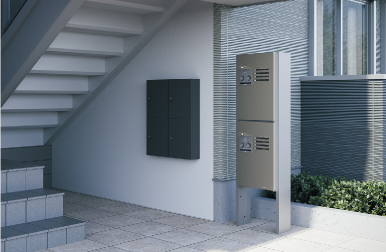
Even once the product and budget are settled, a project can stall entirely over where the unit physically goes. The first thing to check in practice is corridor width and the building's evacuation route.
Shared corridor width is set by Article 119 of the Order for Enforcement of the Building Standards Act
Article 119 of the Order for Enforcement of the Building Standards Act (建築基準法施行令) sets the minimum permissible width of a corridor. For multi-family housing, the rule applies to a shared corridor on any floor where the combined floor area of the dwelling units or rooms it serves exceeds 100 m²: a corridor with rooms on both sides must be at least 1.6 meters wide, and any other corridor must be at least 1.2 meters wide. This is a nationally uniform numerical minimum written directly into a government ordinance — a structural constraint quite different from the case-by-case fire-marshal or building-code review a comparable project would typically go through in many US or UK jurisdictions, where the standard is a functional one ("adequate means of egress") applied by local inspection rather than a single fixed number set at the national level.
A delivery locker is a bulky, deep piece of equipment. If placing it in a shared corridor pushes the remaining clear width below that legal minimum, the building falls out of code compliance. Koto Ward's own subsidy eligibility requirements make this explicit too, stating that the installation must comply "with the Building Standards Act and other relevant laws and regulations, including securing the evacuation route." Judge the placement by the "remaining clear width" — the corridor width shown on your building's drawings, minus the locker's own depth — rather than by the corridor width alone. Dead space beside a building entrance, or an outdoor pole-mounted installation, tend to be the preferred choices precisely because they sidestep this constraint entirely.
The condominium resolution threshold was clarified as an "ordinary resolution" in the June 2024 revision
For a long time, owner-occupied condominiums in Japan faced a genuinely unsettled question: does installing a delivery locker require a tokubetsu ketsugi (特別決議, special resolution — typically a supermajority of roughly three-quarters of both unit owners and voting rights, comparable to a US condo's "material alteration" supermajority vote) or only a futsū ketsugi (普通決議, ordinary resolution — a simple majority)? This was settled through the 7 June 2024 revision of the MLIT Standard Management Regulations for Condominiums (マンション標準管理規約). A newly added sentence in the commentary to Article 47 states:
(d) Regarding delivery-locker installation work, where the degree of modification to the common areas is minor — such as fixing the locker to a wall or floor — this may reasonably be carried out by ordinary resolution.
Source: 国土交通省, "Standard Management Regulations for Condominiums (Single-Building Type), Old-New Comparison Table" (マンション標準管理規約(単棟型)新旧対照表, revised 7 June 2024) (parent page: 国土交通省, "About the Standard Management Regulations for Condominiums").
The same commentary lines up delivery lockers alongside auto-lock security equipment, security cameras, and EV charging equipment, applying the same logic to all of them. Where the work amounts to nothing more than fixing something to a wall or floor, it can proceed by ordinary resolution — that is the position MLIT has now made explicit. Note, though, that the Standard Management Regulations are exactly that: a model template, not binding law. The Japanese national government publishing an official model bylaw template that individual condominium associations across the country then voluntarily adopt — rather than each building drafting its governing document from scratch, as is typical of a US or UK homeowners' association's CC&Rs — is itself a distinctly Japanese approach to condominium governance. Each building's actual resolution requirement still depends on its own management regulations, so confirm the relevant clause in your own building's bylaws before bringing the matter to a general meeting.
For outdoor installation, separate waterproofing, mounting, and anti-theft measures
For an outdoor installation, there are three things to confirm. First, waterproofing — every model in Nasta's Nasta Box lineup is rated to the IPX4 water-resistance standard. Second, the mounting method — Koto Ward's subsidy eligibility requires the unit to be "fixed to the building structure using anchors or similar hardware," and explicitly excludes units secured only by a wire or cable tie. Third, the unit must be built so that stored parcels cannot be seen from outside, and so that only the correct recipient can retrieve them. All three are requirements Koto Ward has written into its subsidy eligibility rules, but they double as a useful quality benchmark even if you are not applying for that subsidy. For the wider question of building and unit security, see our companion article on security measures for shared areas and individual units.
The delivery locker from a tenant's perspective (for renters who want to add one themselves)
From here, we switch to the perspective of the renter. The conclusion up front: in a rented apartment, you cannot install a delivery locker at your own entrance or in a shared corridor purely on your own judgment. Those are common areas, and installation requires the consent of the landlord or the management company.
Why consent is required
MLIT's Standard Form Rental Housing Agreement (賃貸住宅標準契約書) — a government-published model lease that private landlords across Japan widely adopt, wholly or in part, rather than drafting from scratch — states in Article 8, Paragraph 2: "The Tenant shall not carry out any extension, rebuilding, relocation, alteration, or renovation of the Premises, nor install any structure on the grounds of the Premises, without the Landlord's written consent." Because "installation of a structure on the grounds of the Premises" is stated explicitly, the natural reading covers not only a locker fixed to a wall, but also a freestanding unit placed anywhere on the property — neither can be installed without consent. It is worth pausing on this clause itself: the government publishing a standardized model lease that spells out, in this level of specificity, what counts as unauthorized property alteration is a different regulatory approach from the US or UK convention, where lease terms on alterations are set independently by each landlord and vary enormously from one rental agreement to the next.
The process itself is simple. Contact the management company, provide the product name, dimensions, installation location, and mounting method, and request written consent. Because the unit will occupy a shared area, it can also make more sense for the landlord to take it on as a capital investment in the building. From the owner's side, this is a straightforward opportunity to improve the property's competitiveness — there is no reason to assume the answer will automatically be no.
Managing move-out restoration risk
Even once consent is granted, it is worth settling the move-out terms up front. Get two specific points written into the consent document: who pays to repair the wall where mounting screws were driven in, and whether the installed locker stays with the property or is removed at move-out. A "verbal okay" and nothing else is exactly the situation most likely to turn into a dispute at move-out. For how the cost-sharing for restoration is typically worked out, see our detailed article on genjō kaifuku (原状回復, restoration to original condition) scope and how to avoid disputes.
A small freestanding unit placed just inside your own front door sidesteps this problem entirely, since it never touches a shared area and the consent bar is correspondingly lower. The trade-off is that a courier cannot access it, so it does not actually function as a delivery locker in the ordinary sense — accept that limitation going in.
Parcels a delivery locker cannot accept
"If there's a delivery locker, everything can be received without meeting the courier in person" is not quite true. Here is the breakdown, based on Yamato Transport's official FAQ.
| Parcel or condition that cannot be received | Reason / note |
|---|---|
| Cool Takkyubin (refrigerated / frozen) | Cannot be delivered because temperature cannot be maintained |
| Takkyubin Collect (cash on delivery) / freight collect | Parcels requiring payment on receipt |
| Parcels requiring direct hand-to-hand delivery | Items requiring identity verification, heavy items, fragile items, and similar |
| Perishable items such as food | Shelf-stable food such as canned goods may sometimes be accepted |
| Parcels too large to fit in the locker | Oversize |
| Lockers that cannot confirm receipt | Where the unit cannot print a receipt or record a signature |
| When the locker is full | Cannot be used until a prior parcel has been retrieved |
| Parcels the sender has specifically prohibited from locker delivery | Set by the sender |
| When the delivery address cannot be confirmed | No nameplate present, multiple buildings sharing the same street address, and similar |
Source: Yamato Transport (ヤマト運輸), "What parcels cannot be placed in a home delivery locker?", Yamato Transport, "Can Cool Takkyubin be delivered to a home delivery locker?".
That last condition — "no nameplate present" — is genuinely easy to overlook. Even with a delivery locker installed, a parcel will not be placed inside if the courier cannot identify which unit it belongs to. Confirm that unit nameplates or room numbers are clearly displayed at the same time you install the locker.
Three things to check when choosing a "delivery-locker-equipped" property
- The ratio of lockers to units: if the number of lockers is small relative to the number of units, they will already be full by the time you get home. 国土交通省's survey found an average of 8.3 installed lockers per condominium building.
- The mix of locker sizes: check whether large, medium, and small compartments are all represented. All-small compartments will not fit a bulk household-goods order.
- Storage time limits and operating rules: check whether there is a defined policy for parcels left unretrieved for an extended period. Without one, the lockers stay perpetually full.
Pre-installation checklist

- Number of lockers: the one public benchmark you can point to is Koto Ward's subsidy eligibility standard of "at least 10% of total units, rounded up." 国土交通省's survey found an average of 8.3 lockers per condominium building. No official data states an optimal count, so treat these as floor-level guidance and build in extra capacity for buildings with high parcel volume.
- Size mix: combine large, medium, and small compartments. Itabashi Ward's subsidy eligibility rule requires "at least one locker compartment able to accept a parcel whose three dimensions sum to 75 cm or more."
- Installation location: confirm on the building drawings that the shared corridor's remaining clear width does not fall below the Article 119 standard, and that the evacuation route stays clear.
- Whether power is needed: smart-key models require electrical work. Confirm the wiring route before anything else.
- Mounting method: fix the unit to the building structure with anchors or similar hardware. A wire or cable tie alone is not adequate as an anti-theft measure.
- Operating rules: build handling of long-unretrieved parcels, PIN-code management, and lost-key procedures into the documentation you give tenants at move-in.
- Subsidies: confirm both national and municipal programs before placing an order. Construction started before approval is granted is not eligible.
Installing the equipment is only half the job — whether tenant satisfaction actually improves depends on whether you also design the operating rules around it. In our experience running property management day to day, what separates a capital investment that actually reduces vacancy from one that does not is rarely the hardware's own specifications; it is who takes ownership of running it afterward, and how. We make the same point throughout our guide to treating rental property management as a business.
Frequently Asked Questions (FAQ)
Q. I live in a rented apartment. Can I install a delivery locker myself as a retrofit?
The entrance and shared corridors are common areas, so you cannot install one without the landlord's or management company's written consent. Article 8, Paragraph 2 of MLIT's Standard Form Rental Housing Agreement requires the landlord's written consent for "installation of a structure on the grounds of the Premises." Bring the product name, dimensions, installation location, and mounting method to the management company and discuss it with them.
Q. In an owner-occupied condominium, does installation require an ordinary resolution or a special resolution?
The commentary to Article 47 of the MLIT Standard Management Regulations for Condominiums, revised 7 June 2024, states that where the degree of modification to common areas is minor — such as fixing the locker to a wall or floor — this can reasonably proceed by ordinary resolution. That said, the actual resolution requirement depends on each building's own management regulations, so confirm your own building's bylaws before bringing it to a general meeting.
Q. Can I apply for a subsidy after construction has already started?
No. The national Child-Rearing Support Multi-Family Housing Promotion Project requires that "construction has not commenced prior to the approval decision," and Itabashi Ward likewise requires that purchase, contracting, and installation take place only after approval is granted. Approval typically takes about four weeks from application, so build that time into your schedule.
Q. Can I expense the installation cost? What is the useful life for depreciation?
It is a depreciable asset, but the applicable useful life differs depending on whether it is classified as a building-attached facility or as furniture and fixtures. That classification has to be confirmed against 国税庁's official useful-life tables, so this article does not state a specific number of years. Separately, under the FY2026 tax reform, the special provision for immediate expensing of small depreciable assets for small and medium-sized enterprises had its acquisition-cost ceiling raised from under ¥300,000 to under ¥400,000 (approx. USD 2,667), with the measure running through 31 March 2029. Confirm eligibility with a tax accountant or your local tax office.
Q. Can a delivery locker receive refrigerated or frozen parcels?
No. Yamato Transport states officially that "because temperature cannot be maintained, Cool Takkyubin parcels cannot be delivered to a home delivery locker." Cash-on-delivery and freight-collect parcels, and any parcel requiring identity verification, likewise require an in-person handoff.
Sources and references
- 国土交通省「宅配便の多様な受取方法の利用率は約31.0%」(令和8年7月10日) — MLIT, "Usage rate of diverse parcel-receiving methods reaches approximately 31.0%" (10 July 2026)
- 国土交通省「令和7年10月の宅配便の再配達率は約8.3%」 — MLIT, "October 2025 parcel redelivery rate approximately 8.3%"
- 国土交通省「令和7年4月の宅配便の再配達率は約8.4%」 — MLIT, "April 2025 parcel redelivery rate approximately 8.4%"
- 国土交通省「宅配便の再配達率サンプル調査」 — MLIT, "Parcel redelivery-rate sample survey" (survey program page)
- 国土交通省「宅配便の再配達削減に向けて」 — MLIT, "Toward reducing parcel redelivery"
- 総務省統計局「家計消費状況調査 ネットショッピングの状況について(2026年5月分結果)」(令和8年7月7日) — Statistics Bureau, MIC, "Family Income and Expenditure Survey: Online Shopping, May 2026 results" (7 July 2026)
- 国土交通省「令和5年度マンション総合調査結果〔概要編〕」 — MLIT, "FY2023 Comprehensive Condominium Survey Results (Summary Volume)"
- 国土交通省「令和5年度マンション総合調査結果〔データ編〕管理組合向け調査の結果」 — MLIT, "FY2023 Comprehensive Condominium Survey Results (Data Volume): Owners' Association Survey Results"
- パナソニック「集合住宅用宅配ボックス コンボ-メゾン」 — Panasonic, "Multi-Family Delivery Locker Combo-Maison" (official product page)
- 株式会社ナスタ「Nasta Box 集合住宅向け宅配ボックスの選び方・比較表」 — Nasta Corporation, "How to Choose a Nasta Box Multi-Family Delivery Locker: Comparison Table"
- 国土交通省「子育て支援型共同住宅推進事業」 — MLIT, "Child-Rearing Support Multi-Family Housing Promotion Project" (program page)
- 子育て支援型共同住宅サポートセンター「宅配ボックス」 — Child-Rearing Support Multi-Family Housing Support Center, "Delivery Lockers" (program administrator's guidance page)
- 板橋区「板橋区宅配ボックス導入助成事業」 — Itabashi Ward, Tokyo, "Itabashi Ward Delivery Locker Installation Subsidy Program"
- 江東区「マンション共用部分への宅配ボックス設置費用の助成」 — Koto Ward, Tokyo, "Subsidy for Delivery Locker Installation Cost in Condominium Common Areas"
- 江東区マンション等の建設に関する条例 — Koto Ward Condominium Construction Ordinance
- 国土交通省「マンション標準管理規約(単棟型)新旧対照表」(令和6年6月7日改正) — MLIT, "Standard Management Regulations for Condominiums (Single-Building Type), Old-New Comparison Table" (revised 7 June 2024)
- 国土交通省「賃貸住宅標準契約書」 — MLIT, "Standard Form Rental Housing Agreement" (model lease page)
- 財務省「令和8年度税制改正の大綱」(法人課税) — Ministry of Finance, "FY2026 Tax Reform Outline" (corporate taxation)
- 中小企業庁「少額減価償却資産の特例を拡充しました」(令和8年5月作成) — Small and Medium Enterprise Agency, "The special provision for small depreciable assets has been expanded" (issued May 2026)
- 国税庁 タックスアンサー No.5408「中小企業者等の少額減価償却資産の取得価額の損金算入の特例」 — National Tax Agency, Tax Answer No.5408, "Special provision for expensing the acquisition cost of small depreciable assets for small and medium-sized enterprises"
- 国税庁 タックスアンサー No.2100「減価償却のあらまし」 — National Tax Agency, Tax Answer No.2100, "Outline of Depreciation"
- ヤマト運輸「宅配ボックス(自宅)に入れられない荷物を教えてください。」 — Yamato Transport, "What parcels cannot be placed in a home delivery locker?"
- ヤマト運輸「クール宅急便は、宅配ボックス(自宅)に配達してもらえますか?」 — Yamato Transport, "Can Cool Takkyubin be delivered to a home delivery locker?"
