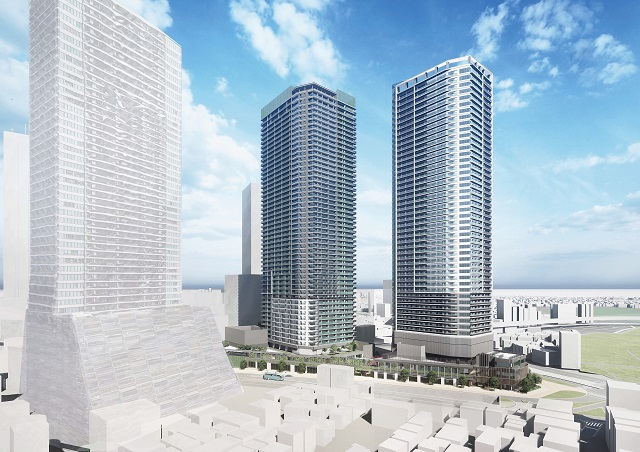
A twin-tower project with a total project cost of roughly ¥128.1 billion and 1,498 residential units is rising in the southeastern part of Ikebukuro. The Minami-Ikebukuro 2-chome District C Type 1 Urban Redevelopment Project sits at the southernmost edge of the Ikebukuro Station Area Specified Urban Renaissance Emergency Development Area, a designation that marks it out for accelerated, government-backed redevelopment. It is a large-scale project involving two of Japan's biggest developers, Sumitomo Realty & Development and Nomura Real Estate. The North Block tower, "Grand City Tower Ikebukuro," received its public notice of construction completion in March 2026, and the retail space on its lower floors has been opening in stages since the summer of that year; together they are set to reshape both the skyline and the property market of the Ikebukuro area. This article walks through the full scope of the project and its expected impact on the surrounding market.
What is the Minami-Ikebukuro 2-chome District C redevelopment?
This article is based on information published as of October 2025.
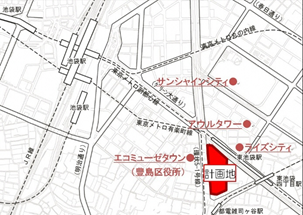
The Minami-Ikebukuro 2-chome District C Type 1 Urban Redevelopment Project covers a project area comprising lots 1, 2, 40, 43, 44 and 46 of Minami-Ikebukuro 2-chome in Toshima Ward, Tokyo. It sits at the southernmost point of the Ikebukuro Station Area Specified Urban Renaissance Emergency Development Area, roughly 700 meters southeast of JR Ikebukuro Station, and connects directly to Higashi-Ikebukuro Station on the Tokyo Metro Yurakucho and Fukutoshin lines. The project area spans about 1.7 hectares, and total project cost runs to roughly ¥128.1 billion. The implementing body is the Minami-Ikebukuro 2-chome District C Urban Redevelopment Association — a legally chartered union of the area's existing landowners, formed specifically to carry out the project. This "association-implemented" (kumiai sekō) model is one of the more distinctive features of Japanese urban redevelopment law for readers used to Western practice: rather than a single private developer or a municipal redevelopment authority driving the project, the law requires the site's existing owners to organize themselves into a cooperative-like union that becomes the formal project operator, with outside developers joining afterward as "participating union members" who bring capital and construction expertise. The participating union members here are Sumitomo Realty & Development (North Block), Nomura Real Estate (South Block), and the Urban Renaissance Agency (UR), an independent administrative agency that functions as a quasi-public redevelopment partner roughly comparable to a state or municipal redevelopment authority in the United States or a development corporation in the United Kingdom.
The project traces back to March 2020, when the redevelopment association was formally approved. In August 2021, the project reached its "rights conversion date" (kenri henkan), a defining feature of Japan's Type 1 redevelopment scheme that has no exact equivalent in most Western planning systems: rather than the government acquiring land by eminent domain or compulsory purchase and paying owners cash, existing landowners' rights to their old land and buildings are converted, on a fixed date, directly into ownership rights to floor space in the new building — a form of in-kind compensation closer in spirit to a land-readjustment or plot-consolidation scheme than to a cash buyout. Construction on the North Block began in October 2022, followed by the South Block in May 2023, with Shimizu Corporation and Maeda Corporation jointly building both blocks as a joint venture. The North Block was completed in March 2026, and the South Block is scheduled for completion between February and May 2027, at which point the full project will be complete.
Overview of the North Block: Grand City Tower Ikebukuro
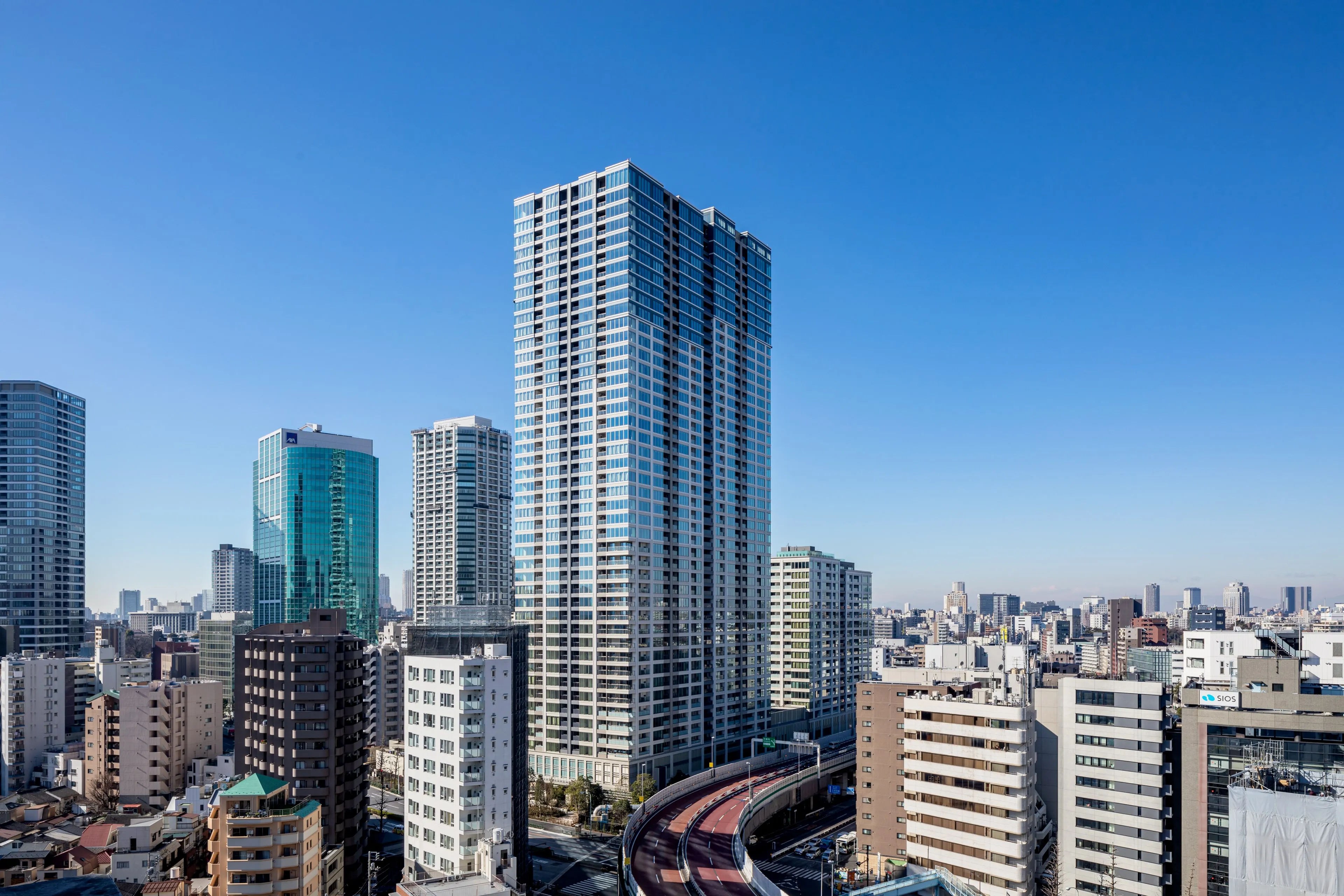
Grand City Tower Ikebukuro rises on the North Block. This is a super-high-rise tower with 52 floors above ground and two below, standing roughly 190 meters tall, with 878 units in total (including 105 units not offered for sale) and a gross floor area of about 112,130 square meters. It is a mixed-use development centered on residential use but combining retail, office space, childcare-support facilities, and public-interest facilities. The participating union member for this block is Sumitomo Realty & Development, and the public notice of construction completion for the North Block was issued in March 2026. According to Sumitomo Realty & Development's property outline, the North Block obtained provisional-use approval in March 2026, and the scheduled completion date covering the North Block, the South Block and the block as a whole is mid-May 2027, with handover to residents scheduled for mid-March 2027.
The commercial component, roughly 1,194 square meters of gross floor area, has been opening in stages since the summer of 2026, starting with the food supermarket "Santoku Toshima-kuyakusho-mae," which opened on the first floor of Grand City Tower Ikebukuro on July 22, 2026. Units are priced at an average of roughly ¥10.6–11.0 million per tsubo (about 3.3 square meters), a level in keeping with premium central-Tokyo high-rise pricing. That is the highest price point yet recorded among major large-scale properties in the Ikebukuro area, and a clear numerical marker of the area's rising value.
Overview of the South Block: Proud Tower Ikebukuro
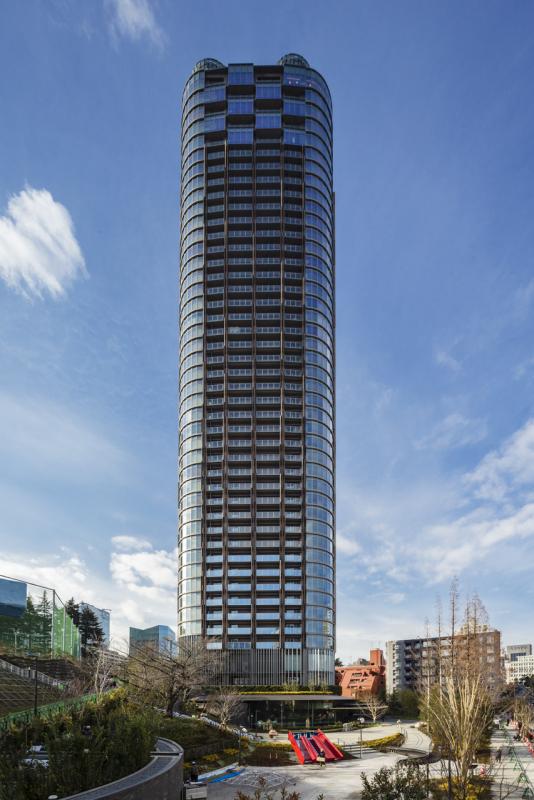
Nomura Real Estate's "Proud Tower Ikebukuro" is being built on the South Block. It has 47 floors above ground and two below, stands roughly 182 meters tall, comprises 620 units in total, and has a gross floor area of about 75,210 square meters. Its distinguishing feature is a genuinely multi-generational mix of uses — residential units alongside a cultural-exchange facility, a childcare-support facility, an elder-support facility, retail, and a school. Completion is scheduled for May 2027, with move-ins expected from late June 2027.
Units are priced at an average of roughly ¥10.0 million per tsubo; the top-floor (47th floor) units are priced at roughly ¥13.27 million per tsubo, and the highest-priced unit reaches as much as ¥490 million. Combined with Grand City Tower Ikebukuro, the North and South Blocks together bring 1,498 units of large-scale supply into a single concentrated area. A supply of this scale is unprecedented for the Ikebukuro area and is expected to have a significant impact on the area's population mix and commercial density.
Impact analysis: land prices and the real estate market
Land-price trends in the Minami-Ikebukuro area show the average 2025 published (kōji chika) land price reaching about ¥4,024,333 per square meter, up 12.33% year over year. Across Toshima Ward as a whole, both residential and commercial land have continued to post solid gains — up 7.8% for residential land and 8.0% for commercial land in 2024 — figures that reflect the progress of the redevelopment. This rate of increase exceeds the average across Tokyo's 23 wards, a sign that the Ikebukuro area is once again drawing investor attention.
A supply of 1,498 units might, at first glance, look like it would put downward pressure on the rental and for-sale markets. But as an analysis of Tokyo's major 2025 redevelopment projects shows, large-scale redevelopment often generates "new demand" rather than simply absorbing existing demand, an effect that can lift commercial and residential demand across the surrounding area more broadly. Because this is a mixed-use, live-near-work-style development, it is likely to draw a wide range of residents — families raising children, dual-income households, and older residents alike — which in turn should lift rental demand across the area as a whole.
The direct connection to Higashi-Ikebukuro Station is also not to be overlooked. Access to the Yurakucho and Fukutoshin lines means direct, transfer-free travel toward Toyosu, Shin-Kiba, and Yokohama in one direction, and toward Shibuya, Shinjuku, and Kotake-Mukaihara in the other. That kind of transit access is closely tied to the depth of rental demand, and is likely to push up rents at surrounding properties once construction is complete.
The bigger picture: redevelopment across the Ikebukuro area
Minami-Ikebukuro 2-chome District C is one piece of a roughly 143-hectare wave of redevelopment moving through the wider Ikebukuro area. Nearby, the Higashi-Ikebukuro 1-chome district (33 floors above ground) is due for completion in fiscal 2027, and the Minami-Ikebukuro 2-chome Block 28 project (about 110 meters tall) is targeting completion in fiscal 2031. Development plans are also moving forward for the areas around Ikebukuro Station's west exit and directly above the station on the west side, with an eye toward better pedestrian links to Sunshine City and Rise City Ikebukuro — the beginning of a transformation across the entire area.
As seen in the case of redevelopment around Shibuya Station, multiple redevelopment projects proceeding at once around a major terminal station tend to lift the area's overall brand value in a mutually reinforcing way. In Ikebukuro too, the chain of projects that includes the Minami-Ikebukuro District C site is starting to make a scenario in which land prices and rents continue rising over a decade or more feel genuinely plausible.
What actions should property owners consider?
Owners who hold existing properties around Minami-Ikebukuro and Higashi-Ikebukuro should review their portfolios with an eye to how the market is likely to shift. The first step is to get an accurate read on the risk of intensified competition from the 1,498 units of new supply. Older existing buildings may find it harder to differentiate themselves from new towers, which can make it necessary to consider renovation to add value or to revisit rent levels.
At the same time, properties well positioned to benefit from the area's broader population growth and commercial revitalization are worth examining closely for whether to hold or to consider the timing of a sale. Identifying the point at which post-completion market prices peak is central to maximizing asset value. As the case of the Shimbashi east-exit redevelopment shows, one option is a strategy of selling or repositioning once the surrounding infrastructure is complete. For anyone considering a new acquisition, it is worth waiting to see actual post-completion leasing results before making a decision.
My take
Looking at the Minami-Ikebukuro 2-chome District C redevelopment, what catches my attention is less the sheer scale of the numbers than the density of mixed uses packed into it. A design that folds childcare support, elder support, a cultural-exchange facility, and a school into the same block is fundamentally different from simply supplying more tower apartments. It amounts to a live-near-work style of neighborhood building where residents can stay in the same place even as their stage of life changes, and I think that is what will underpin stable rental demand over the long run.
A project of this size — a total cost of roughly ¥128.1 billion — is the product of a public-interest decision-making process bringing together government, the private sector, and the Urban Renaissance Agency. An area that concentrates this much resource has, in my view, a real chance of becoming one of the most asset-durable districts in Tokyo over a ten-to-twenty-year horizon. That is exactly why it matters to look past short-term rent adjustments driven by the immediate increase in supply and instead take a long view of the area's structural change in value.
Trust and honesty are indispensable in real estate investment. Around any large redevelopment, properties can appear that are priced on overly optimistic expectations. When making an investment decision, I would encourage readers to carefully cross-check data against conditions on the ground and to base decisions on transparent information.
Summary
Here are the key points of the Minami-Ikebukuro 2-chome District C Type 1 Urban Redevelopment Project.
- Project scale: a project area of about 1.7 hectares, total project cost of roughly ¥128.1 billion, and 1,498 units in total (878 in the North Block plus 620 in the South Block)
- North Block: "Grand City Tower Ikebukuro," 52 floors above ground and about 190 meters tall, public notice of construction completion in March 2026, with handover to residents scheduled for mid-March 2027
- South Block: "Proud Tower Ikebukuro," 47 floors above ground and about 182 meters tall, completion scheduled May 2027 with move-ins from late June 2027
- Land-price trend: Minami-Ikebukuro up an average of 12.33% in 2025; Toshima Ward residential land up 7.8% and commercial land up 8.0% (2024)
- Transit access: direct connection to Higashi-Ikebukuro Station (Yurakucho and Fukutoshin lines) provides strong access across the city
- Area outlook: a core project within a roughly 143-hectare wave of redevelopment across the wider Ikebukuro area
As completion approaches, the area's real estate market is expected to draw even more attention. For anyone weighing a strategic review of an existing holding or a new acquisition, drawing on specialist advice grounded in the latest market trends will be key to maximizing asset value.
Frequently Asked Questions (FAQ)
Q1. When will the Minami-Ikebukuro 2-chome District C redevelopment be completed?
The North Block, "Grand City Tower Ikebukuro," received its public notice of construction completion in March 2026, and handover to residents is scheduled for mid-March 2027. The South Block, "Proud Tower Ikebukuro," is scheduled for completion in May 2027, with move-ins expected from late June 2027. The scheduled completion date published by Sumitomo Realty & Development, covering the North Block, the South Block and the block as a whole, is mid-May 2027.
Q2. What are the main differences between Grand City Tower Ikebukuro and Proud Tower Ikebukuro?
Grand City Tower Ikebukuro is the North Block tower, with Sumitomo Realty & Development as the participating union member: 52 floors above ground, 878 units, and an average price of roughly ¥10.6–11.0 million per tsubo. Proud Tower Ikebukuro is the South Block tower built by Nomura Real Estate: 47 floors above ground, 620 units, and an average price of roughly ¥10.0 million per tsubo (with the highest-priced unit reaching ¥490 million). The South Block has the more multi-functional program, including a cultural-exchange facility, an elder-support facility, and a school.
Q3. Is this redevelopment worth watching from a real estate investment perspective?
Direct access to Higashi-Ikebukuro Station, a mixed-use program that secures diverse residential demand, and synergy with the wider area-wide redevelopment together suggest solid potential for medium- to long-term asset-value growth. That said, investment decisions need to account for the short-term impact of 1,498 units of new supply on the rental market, as well as land and property prices that have already reached a high level.
Q4. What impact will this have on owners of existing rental properties nearby?
Competition from the new towers could create vacancy risk or downward pressure on rents at older existing properties. At the same time, population growth and commercial revitalization across the area as a whole could also lift underlying demand, so the right strategy will depend on a property's age, location, and specifications. Owners should consider consulting a specialist about differentiating through renovation or about the timing of a sale or asset swap.
Sources and references
- Toshima City official site, "Urban Redevelopment Project (Minami-Ikebukuro 2-chome District C)"
- Tokyo Metropolitan Bureau of Urban Development, "Minami-Ikebukuro 2-chome District C Type 1 Urban Redevelopment Project"
- Sumitomo Realty & Development, press release on the start of North Block construction, Minami-Ikebukuro 2-chome District C Urban Redevelopment Project (October 14, 2022)
- Nomura Real Estate, "Proud Tower Ikebukuro" official site — redevelopment page
- Minami-Ikebukuro 2-chome District C Urban Redevelopment Association official site