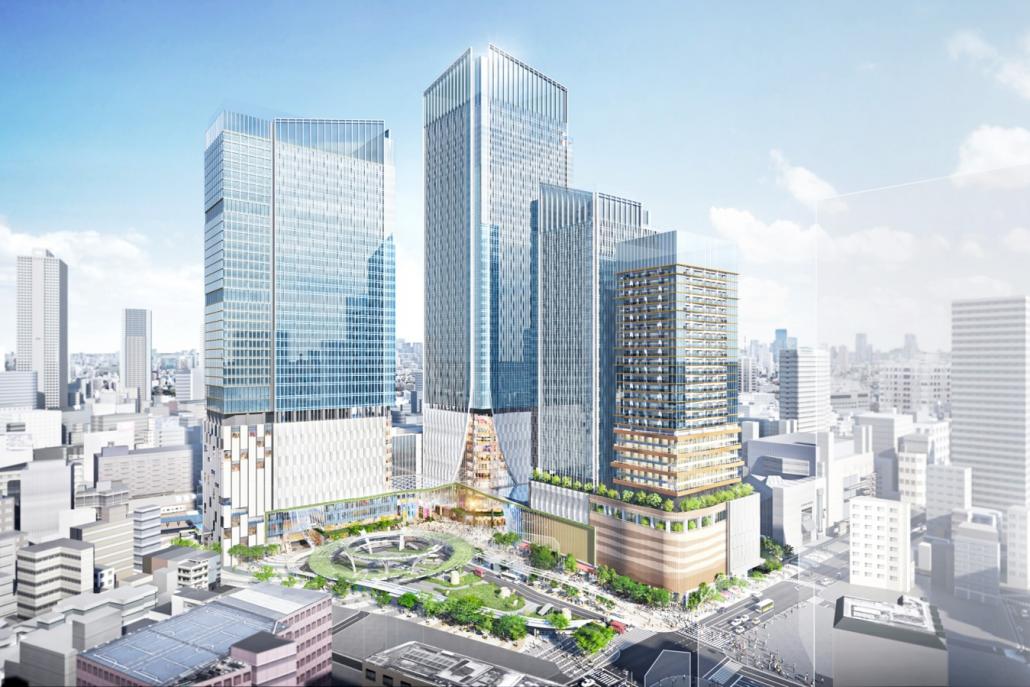
The largest urban redevelopment project among Yamanote Line terminals is getting underway at Ikebukuro's west exit. In September 2024, the Tokyo Metropolitan Urban Planning Council approved changes to the urban plan, confirming the formation of a new district featuring three ultra-high-rise towers headed by a 270m structure, with full completion scheduled for fiscal year 2043. This redevelopment holds the potential to redraw the map of the real estate market in the Ikebukuro area, which has historically maintained land prices lower than Shibuya and Shinjuku.
This article is based on information published as of September 2024. Timelines may change as the project progresses.
Ikebukuro West Side's "20-Year Project" Gets Underway
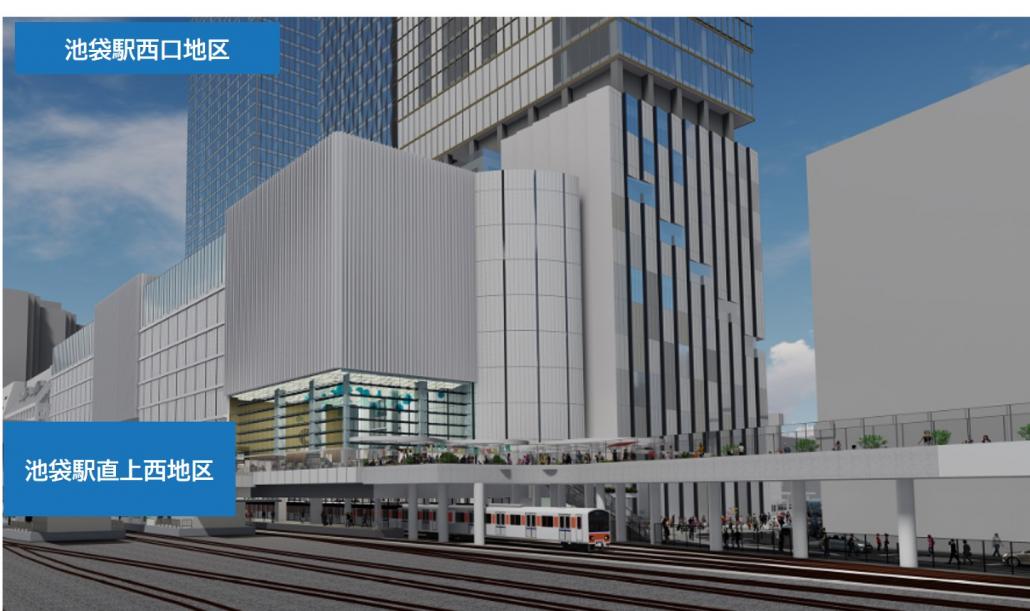
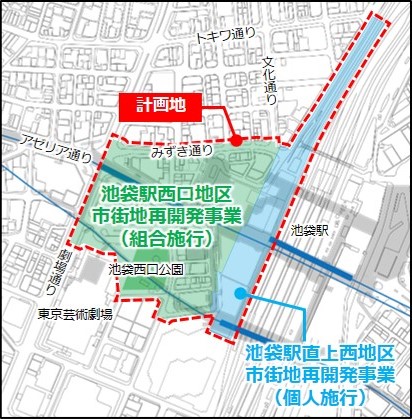
The Ikebukuro Station West Exit District Type 1 Urban Redevelopment Project covers a construction area of approximately 4.5 ha for the West Exit District, approximately 1.6 ha for the Ikebukuro Station Direct West District, totaling approximately 6.1 ha. The project area includes major west exit facilities such as Tobu Department Store Ikebukuro Main Store, Ikebukuro Center Building, and the former bus terminal site, with the area that serves as the face of Ikebukuro undergoing fundamental transformation. The planned implementers are the Ikebukuro Station West Exit District Urban Redevelopment Association (West Exit District) and Tobu Railway Co., Ltd. (Direct West District, individual implementation), with Mitsubishi Estate Co., Ltd. and Mitsubishi Estate Residence Co., Ltd. listed as project cooperators.
In March 2024, Tobu Railway and Mitsubishi Estate announced the urban planning draft, and on September 10 of the same year, the Tokyo Metropolitan Urban Planning Council approved the urban planning amendment. Designation as a Special Urban Renewal District allows for benefits such as relaxed floor area ratios. The project is positioned as the symbolic base of Toshima Ward's long-held "International Art and Culture City" vision, making it a public-private collaboration project with both government and private sector working in unison.
Full Picture of 4 Blocks: Three Ultra-High-Rise Towers Led by 270m Height
The West Exit District and Direct West District together consist of four blocks, each with clearly defined uses and scales.
Block A is a 41-story, 4-basement ultra-high-rise building approximately 220m tall, with commercial and office uses as the main purpose, serving as an art and cultural information dissemination hub. As a cultural symbol embodying Toshima Ward's "International Art and Culture City" vision, it is planned to attract visitors from both domestic and international locations.
Block B is a 50-story, 5-basement building approximately 270m tall, the largest in this project, to be individually implemented by Tobu Railway as the Direct West District. In addition to commercial and office uses, it incorporates an international hotel—the first in the Ikebukuro area—and station facilities, clearly demonstrating responsiveness to international business demand. The recruitment of an international hotel brand is attracting attention as an element that will significantly elevate Ikebukuro's overall brand image.
Block C is a 33-story, 6-basement building approximately 185m tall, featuring an art and culture concept lifestyle hotel in addition to commercial and office uses. The development of accommodation facilities catering to the needs of renowned artists is an important measure to enhance appeal as an art and culture city.
Block D is developed as a park, positioned as the "green core" of the entire redevelopment. A total of 865 parking spaces and 2,206 bicycle parking spaces are secured for the three buildings combined, with transportation infrastructure development proceeding in an integrated manner.
Schedule: From 2027 Demolition Start to 2043 Full Completion
This project is a long-term project targeting full completion in fiscal year 2043, proceeding in phases as follows.
| Phase | Timeline |
|---|---|
| Start of existing building demolition | From fiscal year 2027 |
| New construction start for Blocks B and C | Fiscal year 2030 |
| Block C completion | Fiscal year 2034 |
| New construction start for Block A | Fiscal year 2036 |
| Block B completion | Fiscal year 2040 |
| Block A completion (full completion) | Fiscal year 2043 |
Demolition of existing buildings will begin in fiscal year 2027, with new construction for Blocks B and C starting in fiscal year 2030. Block C will be completed ahead of schedule in fiscal year 2034, followed by Block A starting construction in fiscal year 2036 and Block B completing in fiscal year 2040. Finally, Block A will complete in fiscal year 2043, marking the full completion of the project. As this is an approximately 20-year long-term project, the phased block development is designed to minimize impacts on the surrounding environment during construction.
[Updated June 2026] Demolition Start and Full Completion Schedule Pushed Back
On June 30, 2026, the Tokyo Metropolitan Government Bureau of Environment published the environmental impact assessment report for the "Ikebukuro Station West Exit District and Ikebukuro Station Direct West District Type 1 Urban Redevelopment Project." This revealed that the demolition start for Blocks B and C, originally targeted for fiscal year 2027, is now expected to be pushed back to fiscal year 2030, and full completion (Block A), originally targeted for fiscal year 2043, is now expected to be pushed back to fiscal year 2048. Soaring construction costs and a shortage of engineers and skilled construction workers to handle demolition and construction are cited as the main reasons.
The Tokyo Shimbun had already reported on the delay to the demolition start in an article dated June 30, 2025, explaining that the difficult business environment behind it stems from an inability to find contractors willing to take on the work. Subsequently, in July 2026, the Kentsu Shimbun reported, based on the environmental impact assessment report, that full completion was now expected in fiscal year 2048. At the same time, the total gross floor area for the three blocks combined (approximately 582,700 m²) remains unchanged, meaning the basic scope of the project, including its use composition and number of blocks, has not been scaled back. Because the years listed in the "Schedule" table above reflect the timeline as of the urban planning amendment (2024), refer to the years in this section for the most up-to-date status.
"International Art and Culture City" Vision and Differentiation from the East Exit
At the core of this redevelopment is the establishment of an urban brand around the "International Art and Culture City" concept promoted by Toshima Ward. The ward has long promoted city development centered on art and culture as a differentiation strategy against competing terminals such as Shibuya, Shinjuku, and Akihabara.
While redevelopment is already progressing at the east exit with the completion of "Grand City Tower Ikebukuro" (2023) and the Sunshine 60-centered development, the west exit redevelopment clearly differentiates itself from the east exit with an internationally rich facility composition featuring international hotel recruitment and a lifestyle hotel catering to renowned artists. Also important is that an aerial deck spanning the tracks will form a walkable pedestrian network, dramatically improving east-west connectivity.
In terms of disaster prevention and environmental considerations, reinforcing disaster response capability and working toward carbon neutrality are listed as three pillars of the basic concept. The design philosophy of enhancing overall urban resilience while avoiding over-concentration in ultra-high-rises is a very rational direction from the perspective of maintaining long-term urban value.
Analysis of Impact on Land Prices and Real Estate Market
With the progress of redevelopment, land prices in the Ikebukuro area have already entered a clear upward phase. According to official announcements, the average publicly announced land price in the West Ikebukuro area recorded 3,142,200 yen/m² (year-on-year +15.67%) as of 2026, with the commercial land price change rate for the entire Toshima Ward (2025 standard land prices) also showing a high growth of +12.67%.
Compared to Shibuya (450,000 to over 10 million yen per tsubo) and Shinjuku (approximately 7 million yen per tsubo), the price per tsubo around Ikebukuro Station still remains at a discounted level of 2.5 million to 4 million yen. This price gap is the reason investors are focusing on it as "room for upside growth." Despite transportation convenience equivalent to Shibuya and Shinjuku as a Yamanote Line terminal, a significant land price gap remains, which is expected to gradually close as the redevelopment progresses toward completion.
There are also demand-side growth factors. The number of IT industry workers in Toshima Ward increased by 122% over the five years from 2016 to 2021, and expanding office demand is supporting land prices. As also pointed out in the report providing a bird's-eye view of all Tokyo redevelopment areas, the synergistic effect of redevelopment and industrial agglomeration has been confirmed at multiple Tokyo terminals, and Ikebukuro is likely to follow a similar trajectory.
Who Is the General Contractor?
For the Ikebukuro Station Direct West District (Block B), which Tobu Railway is implementing on its own, the Kensetsu Tsushin Shimbun reported in May 2026 that a prospective contractor had been informally selected. However, as of this article's update (September 2026), the name of the specific contractor has not been officially announced.
Meanwhile, for the association-implemented blocks in which Mitsubishi Estate and Mitsubishi Estate Residence are participating as project cooperators (the West Exit District, including Blocks A and C), a contractor has not yet been selected or announced. In urban redevelopment projects, the public solicitation and selection of a designated business agent responsible for design and construction generally takes place around the time the rights conversion plan is approved, so an official announcement is expected for this district as well in the future.
Actions Owners Should Take
Based on the progress of this long-term redevelopment project, here is a summary of actions that property owners in the Ikebukuro area or those considering investment should take now.
First, accurately understand the property value within the area. Even within the same Ikebukuro area, land price trends vary significantly depending on distance from the redevelopment zone, direction, and land use zone. The west side commercial and quasi-commercial land shows a clear upward trend, but residential land also has short-term negative factors such as noise and construction impacts. Objectively evaluating the current and future value of each property is the starting point for decision-making.
Second, be conscious of the 2027 demolition start as one timing milestone. As construction intensifies, the routes and commercial districts in the surrounding area will change, and rental demand flows may temporarily fluctuate. It is important to consider tenant renewal timing and vacancy countermeasure policies in conjunction with the construction schedule.
Third, capture the phased value increase after the 2034 Block C completion from a medium-to-long-term perspective. Similar to the Shibuya station surroundings redevelopment case, a scenario is anticipated where rental market rates and land prices in the area are progressively pushed up at the completion timing of each block. Owners with a 10 to 20-year holding plan will need to redesign their medium-to-long-term plans, including reviewing exit strategies.
My View
Looking at the Ikebukuro Station West Exit District redevelopment from an investment perspective, what particularly catches my attention is Ikebukuro's current position as an "undervalued terminal." The situation where land prices diverge significantly despite transportation convenience equivalent to Shibuya and Shinjuku means the market has not yet fully priced in Ikebukuro's added value of "culture and internationalism." If an international hotel is born through redevelopment, artists stay there, and world-class offices cluster there, this perception gap will be rapidly corrected.
That is why I believe an approach focused on long-term holding for rental income and compound growth in asset value, rather than short-term capital gains, is effective. The 20-year project period may seem long, but milestones will be reached in phases: Block C completion in 2034 and Block B completion in 2040. As information priced into the market is updated at each phase, the evaluation of surrounding real estate also rises step by step. I see that the key to maximizing value in this type of project is combining long-term perspective with phased information updates in decision-making.
Summary
The Ikebukuro Station West Exit District Type 1 Urban Redevelopment Project is the largest project at a Yamanote Line terminal, promoted in collaboration by Tobu Railway, Mitsubishi Estate, and Toshima Ward. Three ultra-high-rise towers, headed by Block B at approximately 270m, will be completed in fiscal year 2043, aiming to realize an "International Art and Culture City" through international hotel recruitment, artist-friendly facilities, and a walkable pedestrian network.
- Urban planning amendment approved by the Tokyo Metropolitan Urban Planning Council in September 2024, designated as Special Urban Renewal District
- Three ultra-high-rise towers: Block A (approx. 220m, 41F), Block B (approx. 270m, 50F), Block C (approx. 185m, 33F)
- Construction area approx. 6.1 ha, long-term project with demolition starting 2027 and full completion in 2043
- West Ikebukuro publicly announced land price +15.67% year-on-year (2026), still at a discounted level compared to Shibuya and Shinjuku
- Owners are advised to revisit medium-to-long-term plans with awareness of the 2027 demolition start and 2034 Block C completion
Frequently Asked Questions (FAQ)
Q1. When will construction start? When will demolition begin?
Demolition of existing buildings is scheduled to start in fiscal year 2027. New construction for Blocks B and C will begin in fiscal year 2030, and Block A will start in fiscal year 2036. Full completion is expected in fiscal year 2043.
Q2. What will happen to existing facilities at Ikebukuro's west exit (such as Tobu Department Store)?
Tobu Department Store Ikebukuro Main Store, Ikebukuro Center Building, and the former bus terminal site are included in the project zone, with demolition and relocation planned as part of the redevelopment. Tobu Railway, as the individual implementer of Block B (Direct West District), is advancing the project in a form that will carry on station facility functions to the new building.
Q3. Are residential condominiums included in the plan?
The current plans do not include condominiums for sale. The main uses for Blocks A, B, and C are commercial, office, and hotel, with no condominiums included. The project, designated as a Special Urban Renewal District, is designed to prioritize the clustering of business and cultural functions aimed at strengthening international competitiveness.
Q4. How will real estate values change after redevelopment?
The publicly announced land price in West Ikebukuro has already recorded a +15.67% increase year-on-year as of 2026, with the land price upward trend accompanying redevelopment progress already underway. With Ikebukuro at a discounted level compared to Shibuya and Shinjuku, there is significant room for upside, and phased value improvement is expected at each block's completion, compounded by demand-increasing factors such as international hotel recruitment and IT company agglomeration.
Citations and References
-
Toshima Ward "Urban Redevelopment Project (Ikebukuro Station West Exit District and Ikebukuro Station Direct West District)" (Toshima Ward Official Website)
-
Cabinet Office National Strategic Special Zone "Overview of Urban Planning (Draft) for Special Urban Renewal District (Ikebukuro Station West Exit District)" (Cabinet Office National Strategic Special Zone)