You've just been told you're relocating for three months, and you want to rent a normal apartment on a short lease. This article is written for exactly that situation — and for any international investor, relocating employee, or expat trying to understand how short-term housing actually works in Japan. Here is the headline finding, stated up front: this is a uniquely Japanese legal quirk with no direct equivalent in the US, UK, or Australian rental markets. Under Japanese law, a standard residential lease (普通借家, futsū shakuya, an "ordinary" lease) legally cannot be limited to "just one month." Article 29, Paragraph 1 of the Land and Building Lease Act (借地借家法29条1項, Shakuchi Shakuya Hō) automatically treats any building lease with a stated term of less than one year as a lease with no fixed term at all — the clause you both signed simply gets overridden by statute. In practice, that means anyone who wants to rent for a genuinely short period in Japan has only two real options: a fixed-term lease (定期借家契約, teiki shakuya keiyaku) or a furnished "monthly mansion" (マンスリーマンション). Below, we calculate the real total cost of renting for one, three, and six months using official government statistics and published provider rate cards, and show — in yen and in approximate US dollars — exactly where each option becomes the cheaper one.
Key takeaways
- A standard lease cannot legally be written for "just one month" — any stated term under one year is automatically converted by law into a lease with no fixed term (Land and Building Lease Act, Art. 29(1)). Only a fixed-term lease (定期借家契約) can set a term as short as one month, under Article 38, Paragraph 1 of the same law.
- For a one-month stay, the real out-of-pocket cost is about ¥284,957 (approx. USD 1,900) under a standard lease versus about ¥182,930 (approx. USD 1,220) for a furnished monthly apartment (Leopalace21's Rank H unit, 30 days) — the monthly apartment runs roughly ¥100,000 (approx. USD 667) cheaper.
- The crossover point is around four months. Beyond that, a standard lease becomes cheaper even after paying the deposit and key money, and by six months the gap reaches about ¥69,000 (approx. USD 460) in the standard lease's favor.
- Housing rentals for a period of less than one month, and lodging at facilities regulated under the Hotel Business Act, are subject to Japan's 10% consumption tax (National Tax Agency Tax Answer No. 6226) — so the same headline price can carry a materially different tax burden depending on how the contract term is written.
- Minpaku (民泊, Japan's registered home-sharing / short-term rental system) is capped at 180 operating days a year by law, but the average registered property is actually used for only about 107 days a year on an annualized basis (Japan Tourism Agency, April–May 2026 data). It was never designed to be a place to actually live for months at a time.
What Counts as "Short-Term Rental" in Japan? The 4 Ways to Rent for One Month
"Short-term rental" is an umbrella term for securing housing for anything from a few weeks to a few months — it is not itself a legal category of contract in Japan. In practice, anyone renting short-term in Japan is choosing among exactly four arrangements:
- Standard lease (普通借家, futsū shakuya): term of one year or longer. Even if you write a shorter term into the contract, the law reclassifies it as a lease with no fixed term.
- Fixed-term lease (定期借家契約, teiki shakuya keiyaku): if executed in writing, the term can be set as short as one month. It does not renew automatically — it simply ends.
- Monthly mansion (マンスリーマンション): a Japan-specific furnished-apartment format, typically with appliances and utilities bundled into the price. Some are structured as an ordinary lease; others are legally licensed as lodging facilities under the Hotel Business Act (旅館業法) rather than as a rental at all.
- Extended-stay hotel plans: this is a lodging contract, not a lease. You cannot register your resident address (住民票, jūminhyō, Japan's resident registration record) at a hotel, and both consumption tax and, in many municipalities, an accommodation tax apply.
Minpaku (民泊, Japan's home-sharing system) is capped at 180 nights a year by law, so it functions as a lodging facility rather than housing. Unlike the US or UK, where a short-term let, a serviced apartment, and a regular tenancy can often be negotiated on broadly similar legal terms with a landlord, Japan's four options sit on entirely different legal foundations — and which one you can even use is largely determined by how many months you plan to stay. We start with the numbers.
2026 Comparison: Total Cost for 1, 3, and 6 Months
The short answer: for stays of up to three months, a furnished monthly apartment is cheaper; beyond four months, a standard lease wins. The table below is built from Ministry of Land, Infrastructure, Transport and Tourism (国土交通省, MLIT) statistics and Leopalace21's published rate card. All yen figures are also shown in approximate US dollars, converted at roughly ¥150 = US$1 (the approximate rate as of August 2026) — treat the USD figures as directional, not exact.
Data Table 1: Total Cost Simulation by Rental Type
| Rental type | 1 month (30 days) | 3 months (90 days) | 6 months (180 days) |
|---|---|---|---|
| Standard lease (futsū shakuya) Total amount paid | ¥368,338 (≈$2,456) | ¥544,774 (≈$3,632) | ¥809,428 (≈$5,396) |
| Same, net cost assuming full deposit refund | ¥284,957 (≈$1,900) | ¥461,393 (≈$3,076) | ¥726,047 (≈$4,840) |
| Fixed-term lease | Cost structure is the same as a standard lease (deposit, key money, and agent commission can all apply). The differences are that the term can be set in one-month increments, and the contract does not renew. | ||
| Monthly mansion (Leopalace21, Rank H) | ¥182,930 (≈$1,220) | ¥427,790 (≈$2,852) | ¥795,080 (≈$5,301, estimated) |
| Extended-stay hotel (Toyoko Inn Monthly Plan) | The only published figure is a discount condition — "up to 15% off for stays of 30–31 nights" — the per-night rate itself varies by property and season. The total must be checked via the official availability search. Because the discount applies specifically to 30–31 night stays, longer stays require a separate inquiry or rebooking. | ||
Standard-lease figures are built from actual amounts in MLIT's (国土交通省, Ministry of Land, Infrastructure, Transport and Tourism) "Fiscal 2025 Housing Market Trend Survey Report" (published July 2026, covering private rental housing in Japan's three major metropolitan areas). Monthly-apartment figures are from Leopalace21's published "Monthly Contract Short-Term Plan Rate Table" (as published December 1, 2023), plus the key-exchange fee and the monthly adjustment fee. Hotel figures are the discount conditions published in Toyoko Inn's official Monthly Plan (as published in August 2026), reproduced as disclosed.
Worked Example 1: A One-Month Standard Lease Costs About ¥285,000 (≈$1,900)
Here is the full breakdown for a standard lease. In the same survey, households that moved into private rental housing paid an average monthly rent of ¥83,381 (≈$556; median ¥74,000/≈$493) plus an average common-area fee of ¥4,837 (≈$32) per month. Among the households that paid a deposit, key money, or agent commission at all, the single most common amount for each was exactly one month's rent — this Japan-specific convention is what drives the whole cost structure below.
- Rent ¥83,381 (≈$556) + common-area fee ¥4,837 (≈$32)
- Security deposit (敷金, shikikin — refundable) ¥83,381 (≈$556, one month's rent)
- Key money (礼金, reikin — a non-refundable payment to the landlord, with no equivalent in most Western leases) ¥83,381 (≈$556, one month's rent)
- Agent commission (仲介手数料) ¥83,381 (≈$556, one month's rent)
- Other costs ¥29,977 (≈$200)
- Total amount paid: ¥368,338 (≈$2,456). Assuming the full deposit is refunded, the net cost is ¥284,957 (≈$1,900) — plus any separate restoration-to-original-condition (原状回復, genjō kaifuku) charges deducted at move-out.
By contrast, Leopalace21's short-term plan (Rank H, 30 days) totals ¥152,900 (≈$1,019), tax included. Add a ¥16,500 (≈$110) key-exchange fee and a monthly adjustment fee of ¥451/day (≈$3.01/day) × 30 days = ¥13,530 (≈$90), paid in one lump sum at signing, and the total comes to ¥182,930 (≈$1,220). Water, electricity, and gas are generally already included, and you don't need to buy any furniture or appliances. For a one-month stay, the math is clear: the monthly apartment runs roughly ¥100,000 (≈$670) cheaper. Unlike a typical US or UK short-let, where the price gap against a standard tenancy is mostly about flexibility, in Japan that gap is driven specifically by reikin and agent commission — costs a Western renter simply wouldn't budget for at all.
Worked Example 2: The Crossover Point Is About Four Months
The picture changes as the stay gets longer, because a standard lease's deposit, key money, and agent commission are all one-time costs, while a monthly apartment's daily rate keeps accumulating for every additional day. As formulas:
- Standard lease (net cost) = ¥88,218 (≈$588) × number of months + ¥196,739 (≈$1,312)
- Monthly apartment (Rank H) = ¥122,430 (≈$816) × number of months + ¥60,500 (≈$403)
The two lines cross at roughly 3.98 months — in practice, about four months, or around 120 days. At exactly four months, the standard lease comes to ¥549,611 (≈$3,664) against the monthly apartment's ¥550,220 (≈$3,668) — essentially a tie. By six months, it's ¥726,047 (≈$4,840) for the standard lease versus ¥795,080 (≈$5,301) for the monthly apartment, a gap of roughly ¥69,000 (≈$460) in the standard lease's favor. As a rule of thumb: under three months, choose a monthly apartment; five months or more, choose a standard or fixed-term lease; around the four-month mark, the decision comes down to the specific property's terms.
Why You Can't Rent a Normal Apartment for Just One Month
Before we get further into the numbers, it helps to understand why landlords turn down short leases at the door in the first place. The reason lies in the Land and Building Lease Act (借地借家法, Shakuchi Shakuya Hō) — a law with no direct counterpart in most common-law jurisdictions, where lease term length is generally left to freedom of contract between landlord and tenant.
Article 29, Paragraph 1: Anything Under One Year Is Deemed to Have "No Fixed Term"
Article 29, Paragraph 1 states: "A building lease with a stated term of less than one year is deemed to be a building lease with no fixed term." In other words, even if you and the landlord both agree in writing that you'll move out after one month, that agreed term is legally void, and the contract automatically converts into an open-ended lease with no end date at all.
In a lease with no fixed term, the tenant can give notice to terminate at any time — but under Article 617, Paragraph 1, Item 2 of the Civil Code (民法617条1項2号), a building lease only actually ends three months after that notice is given. Contracts often shorten this to a one-month notice period in the tenant's favor, and terms that benefit the tenant are enforceable. But from the landlord's side, none of that changes the core problem: they'd be handing over a unit — often without collecting a deposit or key money up front for a "short stay" — to a tenant whose real move-out date is legally undefined. That mismatch of incentives, not paperwork or prejudice, is the real reason landlords say no to short leases.
A Fixed-Term Lease (Article 38, Paragraph 1) Can Be Written for Just One Month
Article 38, Paragraph 1 allows a lease with no renewal to be agreed, but only if it is executed in writing — for example as a notarized deed — and adds: "In this case, the provision of Article 29, Paragraph 1 does not apply." Because Article 29's override is switched off, the parties can set the term at exactly one month, three months, or any other length they agree on. This single carve-out is the entire legal reason short-term rentals in Japan are structured as fixed-term leases rather than standard ones.
There's a condition attached, though. Before signing, the landlord must hand over and explain a separate written document stating explicitly that the lease will not renew and will end at the stated term (Article 38, Paragraph 3) — and if that explanation is skipped, the no-renewal clause itself becomes void (Article 38, Paragraph 5). MLIT publishes a standard form for this purpose, the "Standard Fixed-Term Residential Lease Contract" (『定期賃貸住宅標準契約書』, March 2018 edition). We cover the full mechanics of this system in How Fixed-Term Leases Work: Pros and Cons for Tenants and Landlords and Standard Lease vs. Fixed-Term Lease: What's the Difference.
According to the same MLIT survey, only 2.0% of households renting private housing actually used a fixed-term lease, and 54.4% said they had never even heard of the system. For anyone wanting a genuinely short lease, that's the practical takeaway: most listings you'll encounter are standard leases by default, so it's worth explicitly asking upfront whether a landlord or agent even offers fixed-term contracts — in our experience, most tenants never think to ask, and simply assume the answer is no.
When a Temporary-Use Lease (Article 40) Applies
Article 40 provides: "The provisions of this chapter do not apply where it is clear that a building lease was entered into for temporary use." The classic examples are temporary housing during renovation work, or an election campaign office, where both the purpose and the timeframe are unambiguous. In exchange for losing the Land and Building Lease Act's tenant protections, the parties gain complete freedom to set whatever term they like. The catch is that whether use is "clearly temporary" is judged from the actual facts and circumstances of the arrangement, not simply by what the landlord and tenant agree to call it on paper — you can't manufacture Article 40 protection just by writing "temporary" into the contract.
Comparison Table 1: Which Contract Type Applies
| Item | Standard lease | Fixed-term lease | Temporary-use lease | Monthly apartment | Minpaku |
|---|---|---|---|---|---|
| Minimum term | Effectively 1 year (under 1 year = no fixed term) | No minimum (as short as 1 month) | No minimum | Set by the provider (e.g., from 30 days) | From 1 night |
| Governing law | Land and Building Lease Act, Art. 29(1) | Same Act, Art. 38(1) | Same Act, Art. 40 | Lease law or the Hotel Business Act | Private Lodging Business Act (Minpaku Act) |
| Early termination | Civil Code, Art. 617(1)(ii) (3 months' notice) | Allowed for unavoidable reasons if under 200㎡, residential (Art. 38(7)) | Per contract | Per provider terms (cancellation fee applies) | Per booking terms |
| Deposit / key money | May apply | May apply | Per contract | Generally none (separate fees instead) | None |
| Resident registration (jūminhyō) | Can be transferred | Can be transferred | Depends on actual use | Depends on actual use | Cannot be transferred |
| Consumption tax | Exempt | Exempt | Exempt (if residential) | Taxable if under 1 month or licensed as lodging | Taxable |
Sources: Land and Building Lease Act (e-Gov Japanese Law Search), Civil Code (same), National Tax Agency Tax Answer No. 6226.
3 Reasons Short Stays Cost More — And By How Much
It's common knowledge that short stays cost more in Japan — what's rarely explained is why, and by exactly how much. Here are the three specific mechanisms, each with real numbers attached.
Reason 1: Upfront Costs Are Charged in Full, Regardless of How Short Your Stay Is
The deposit, key money, and agent commission don't scale down for a shorter stay — you pay a full month's rent for each of them whether you're staying one month or three years. Unlike a US security deposit, which is typically a flat, refundable sum regardless of lease length, Japan's key money in particular is a non-refundable cost that functions as a fixed tax on moving. That means the shorter your stay, the higher these costs become as a share of your total spend.
| Cost item | Share of households that paid it | Typical amount |
|---|---|---|
| Security deposit (shikikin) | 51.9% | "Exactly 1 month's rent" for 64.4% of those who paid it |
| Key money (reikin) | 43.1% | "Exactly 1 month's rent" for 73.4% of those who paid it |
| Agent commission | 48.0% | "Exactly 1 month's rent" for 69.7% of those who paid it |
| Lease-renewal fee | 44.4% | "Exactly 1 month's rent" for 69.7% of those who paid it |
| Other costs | 15.6% | Average ¥29,977 (≈$200) |
Source: MLIT (国土交通省), "Fiscal 2025 Housing Market Trend Survey Report" (July 2026). Responses from households renting private housing in Japan's three major metropolitan areas.
Agent commission is legally capped. Item 3 of Ministry of Construction Notice No. 1552 (建設省告示第1552号) limits the combined commission an agent can collect from both parties in a lease brokerage to one month's rent total — and, specifically for residential buildings, caps what can be collected from either party alone at half a month's rent, unless that party has given advance consent to pay more. In practice: if you're quoted a full month's commission, you have grounds to ask exactly when, and how, you gave that advance consent. We break down the full cost-saving angle in Rental Move-In Costs in Japan: What's Included and How to Save.
Reason 2: Short-Term Plans Charge a 20–25% Higher Daily Rate
Even for the exact same unit, the per-day rate itself changes depending on how long you commit to. Cross-referencing Leopalace21's published rate cards makes the gap explicit.
| Rank | Short-term plan (30–90 days), daily rate | Long-term plan (181+ days), daily rate | Difference |
|---|---|---|---|
| A | ¥2,300 (≈$15.33), excl. tax | ¥1,870 (≈$12.47), excl. tax | ≈23% higher |
| H | ¥3,300 (≈$22), excl. tax | ¥2,640 (≈$17.60), excl. tax | ≈25% higher |
| Z | ¥10,800 (≈$72), excl. tax | ¥9,000 (≈$60), excl. tax | 20% higher |
Source: Leopalace21, "Monthly Contract Short-Term Plan Rate Table" (as published December 1, 2023) and "Monthly Contract Long-Term Plan Rate Table" (as published September 1, 2023, ver. 2).
The easy-to-miss line item is the monthly adjustment fee. It runs ¥451/day (≈$3.01/day, tax included) on a short-term plan versus just ¥149/day (≈$0.99/day, tax included) on a long-term plan — ¥13,530 (≈$90) over 30 days, or ¥81,180 (≈$541) if a 180-day stay were priced at the short-term rate. The lesson: don't just compare the headline daily rate — check every fee that scales with the number of days, or your total estimate will be off.
Reason 3: Stays Under One Month Are Subject to 10% Consumption Tax
As a general rule, residential rentals in Japan are exempt from consumption tax — unlike, say, US sales-tax regimes that can apply broadly to short-term lodging. But the National Tax Agency's (国税庁) Tax Answer No. 6226 carves two exceptions out of that exemption: rentals for a period of less than one month, and rentals of facilities licensed under the Hotel Business Act (旅館業法). The same guidance is explicit that weekly mansions and resort condominiums do not qualify for the tax exemption even when the stay is a month or longer, if the facility itself is licensed as lodging — and that minpaku is likewise excluded from the exemption, because it too is categorized as a hotel-business facility.
| Case | Consumption tax | What ¥300,000 (≈$2,000) actually buys |
|---|---|---|
| Residential rental, 1 month or longer | Exempt | The full ¥300,000 (≈$2,000) goes toward housing |
| Residential rental, under 1 month | Taxable (10%) | About ¥27,000 (≈$180) of the ¥300,000 (≈$2,000) is consumption tax |
| Hotel Business Act facility (hotel, weekly mansion, etc.) | Taxable regardless of length of stay | Same as above — plus an accommodation tax in some municipalities |
Source: National Tax Agency (国税庁) Tax Answer "No. 6226: Rental of Residential Housing" (law and regulations current as of April 1, 2025).
In other words, "29 days" and "31 days" get taxed completely differently. This is a case where a difference of just a couple of days in how the contract term is written has a real, calculable effect on your final bill.
A "Monthly Mansion" May Not Legally Be a Rental at All
The term "monthly mansion" describes a marketing category, not a legal one. Some are structured as an ordinary lease agreement; others are licensed and operated as facilities under the Hotel Business Act (旅館業法) — legally, lodging rather than rental housing. That distinction directly determines two things that matter enormously to any tenant: whether you can register your address there, and whether you pay consumption tax.
The Two Tests Under the Hotel Business Act, and a 1988 Ministry Notice
What counts as "a business of providing lodging to people" under the Hotel Business Act is defined by a March 31, 1986 notice from the Director of the Guidance Division, Environmental Health Bureau, Ministry of Health and Welfare (厚生省生活衛生局指導課長通知, Notice No. Eishi-44 [衛指第44号]), which sets out two conditions:
- Looking at the facility's overall management and operating structure, it is generally understood that the operator — not the guest — bears responsibility for sanitary upkeep of the premises, including the rooms occupied by guests.
- The business operates on the principle that guests do not make the room they are staying in their primary residence (生活の本拠, seikatsu no honkyo).
Tokyo Metropolitan Government asked the ministry whether these two tests applied to "weekly mansions." The ministry's response — Notice "Regarding Questions on the Application of the Hotel Business Act" (旅館業法運用上の疑義について, January 29, 1988, Notice No. Eishi-23 [衛指第23号]) — confirmed that yes, it is acceptable to treat them as facilities subject to the Hotel Business Act. The facility type in question booked in units of one week or more, with most actual stays running one to two weeks, used mainly by short-term business travelers, corporate trainees, and exam candidates. Even where the guest handles their own cleaning during the stay, the ministry held that the operator still bears the core sanitary-management responsibilities — cleaning between guests and managing bedding — meaning the facility is a lodging business, not a straightforward rental, purely by virtue of how it is operated.
Can You Register Your Address There — and Does That Change the Price?
Whether you can register your resident address (住民票, jūminhyō) at a monthly mansion is not up to the discretion of the local ward or city office — it turns entirely on whether the unit is actually your primary residence (生活の本拠). Staying a few weeks for a business trip or training program, while you keep a home elsewhere, doesn't qualify. But a three-month solo relocation for work, where the unit genuinely is where you're living, normally does.
This is also where pricing actually diverges between providers. Leopalace21's short-term plan rate table states explicitly that the published rates apply to non-residential use — a second home, temporary use, and similar purposes — and that anyone renting for residential purposes must confirm pricing in person at a branch. In plain terms: the price you're quoted can depend on whether you intend to register your resident address there. Stating your actual purpose accurately when you apply is the simplest way to avoid a mismatch discovered later.
Can Minpaku Work as Short-Term Housing? The 2026 Reality
The short answer: minpaku (民泊) suits a stay of a few days to about a week, but it isn't built for a multi-month residence. Beyond the statutory 180-day annual cap, real-world usage is running at roughly half of even that limit.
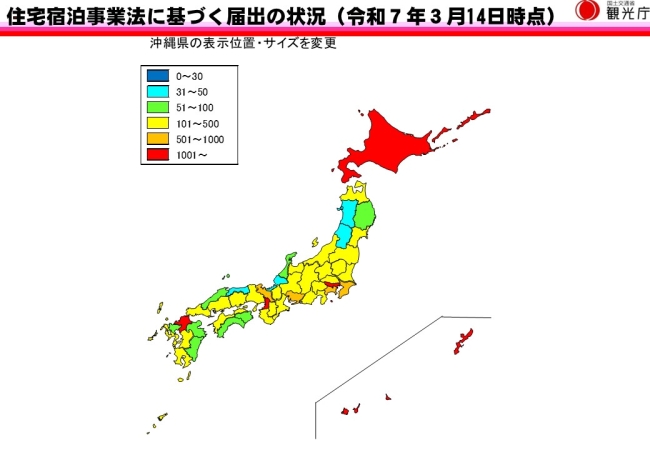
Data Table 2: 42,070 Registered Properties, Averaging About 107 Operating Days a Year
| Metric | Value | As of |
|---|---|---|
| Registrations filed | 65,837 | July 15, 2026 |
| Of which, business discontinued | 23,767 | Same |
| Currently registered properties | 42,070 | Same |
| Total guest-nights | 624,088 nights (138.6% of the same period the prior year) | April–May 2026 |
| Guest-nights per registered property | 17.9 nights (over the 2-month period) | Same |
| Total guest count | 1,745,359 guest-nights | Same |
| Share of foreign guests | 62.4% (391,174 people) | Same |
Source: Japan Tourism Agency (観光庁), "Status of Implementation of the Private Lodging Business Act" (as of July 15, 2026; occupancy figures cover April 1 – May 31, 2026).
17.9 nights over a two-month period annualizes to roughly 107 nights a year — only about 60% of the statutory 180-day cap, and more than a third of all registrations have already been discontinued. With 62.4% of guests being foreign visitors, the system's actual user base is clearly tourists, not residents. Minpaku was never designed as a system for anyone to live in for months at a time, and the usage data bears that out directly.
In many condominium buildings, minpaku is separately prohibited outright by the building's own management bylaws (管理規約), independent of what national law allows. We cover this in detail in Minpaku Restrictions in Condominiums and the Risks for Owners.
Osaka City's National Strategic Special Zone Minpaku Stopped Accepting New Applications on May 29, 2026
One 2026 regulatory change worth flagging is specific to Osaka. Osaka City decided to stop accepting new applications for "special zone minpaku" (特区民泊, a separate scheme under the National Strategic Special Zones Act, distinct from the nationwide Minpaku Act) at its second project team meeting on September 30, 2025, and received the Prime Minister's approval for the corresponding zone-plan amendment on November 28, 2025. As a result, new applications for special zone minpaku in Osaka closed as of May 29, 2026. Facilities already approved before that date may continue operating under the existing rules.
Comparison Table 2: Recommended Option by Purpose and Length of Stay
| Purpose | Recommended option | Estimated total cost | Things to check |
|---|---|---|---|
| Business trip, 1–2 weeks | Hotel or weekly mansion | Per-night rate × nights (Toyoko Inn's Monthly Plan offers up to 15% off for 30–31 night stays) | Consumption tax applies under 1 month; you cannot register your address |
| Business assignment / training, 1–3 months | Monthly mansion | ¥180,000–¥430,000 (≈$1,200–$2,867) | Key-exchange fee and adjustment fee are separate; some providers don't refund the first 30 days even on early termination |
| Exam prep / job hunting | Monthly apartment (30-day units) | From roughly ¥180,000 (≈$1,200) | Assume you can't view the unit beforehand; confirm internet setup and desk availability in advance |
| Temporary housing during renovation, 3–6 months | Fixed-term lease if over 4 months | ¥460,000–¥730,000 (≈$3,067–$4,867) | Article 40 temporary-use leases may apply in some cases; agree on extension terms upfront in case the renovation runs long |
| Accompanying a hospitalized family member | Monthly apartment, if you can estimate the duration | From roughly ¥180,000 (≈$1,200) | Confirm the notice period and cancellation fee in case discharge happens earlier than planned |
Totals are estimates based on Data Table 1 above. Actual amounts vary by region, property, and season.
From Application to Move-In: How Monthly Apartments Work
Short-term properties can go from search to move-in much faster than a standard lease. The tradeoff is that several things you'd take for granted with a standard lease simply aren't available. Here is the process, step by step.
- Search for a property: narrow down by commute time from your workplace or exam venue. Availability changes daily, so it's worth keeping a few backup candidates in mind.
- Apply and sign: have your identity documents ready. Individual applicants are sometimes asked for a joint guarantor (連帯保証人).
- Pay all costs upfront, in one lump sum: room fee, service fees, key-exchange fee, and so on are wired together in a single payment. Installment payment is generally not offered.
- Collect the keys and move in: keys are handed over once payment is confirmed. Electricity, gas, and water are usually already connected, and you won't need to arrange to have them disconnected when you leave either.
The single biggest constraint is that you usually can't view the unit in advance. The previous occupant is often still there until shortly before your move-in date, so you're deciding based on photos and a floor plan alone. This is a real departure from renting in the US or UK, where an in-person or virtual viewing is close to standard practice. Precisely because of that, it's worth asking a staff member the following questions directly before you apply, not after:
- Internet connection type and speed (a make-or-break question if you'll be working from home)
- Whether a washing machine, refrigerator, and microwave are included, and whether cookware and dishware can be rented
- Whether consumables like detergent and toilet paper are provided
- Which floor the unit is on, and whether there's an auto-lock entrance or a parcel locker
- Whether bedding is included in the price or billed separately
Furniture and appliances included, lower upfront costs, and a comparatively easy screening process — that combination of convenience is the whole value proposition of a short-term unit. But that convenience is traded directly against having less information going in, since there's no viewing. Asking everything you can ask, upfront, is the single most effective way to lower your odds of an unpleasant surprise.
7 Things to Confirm Before You Sign
At INA&Associates, we believe that surfacing the downsides upfront ultimately serves both landlord and tenant. These are the seven points that most commonly turn into disputes after the fact in short-term contracts:
- Whether you received the mandatory advance-disclosure document: for a fixed-term lease, if the landlord fails to hand over and explain the written no-renewal disclosure, that no-renewal clause itself becomes legally void (Land and Building Lease Act, Art. 38(5)).
- The termination notice period: exactly how many days' notice ends the contract, and on what date it actually terminates. Get this in days, not vague language.
- The scope of cancellation fees and refunds: precisely which portion of your prepayment is non-refundable. As a general rule, service fees are non-refundable.
- How utilities are handled: a flat rate included in the price, or billed as actual usage? If it's a flat rate, confirm the cap and how any overage is settled.
- Fees that scale with the number of days: adjustment fees, cleaning fees, extra-occupant charges — all of these move the total.
- Move-out cleaning and restoration (原状回復) charges: in standard leases, the single most common move-out dispute is an "unclear or unexplained repair-cost invoice" (16.9% of cases).
- Occupancy count and the unit's stated capacity: exceeding capacity typically triggers an extra charge or is treated as a breach of contract.
For context, the same survey found that 25.1% of households renting in Japan reported having had some kind of problem, and the single most common complaint at contract signing was "the financial burden of the deposit, key money, and similar costs" (48.0%). Getting every financial term nailed down in writing before you sign heads off the great majority of these disputes before they start.
What Happens If You Want to Cancel Partway Through
You'll sometimes hear a blanket claim that "none of your prepayment comes back" if you cancel early. That's not accurate — the actual treatment depends entirely on which of the four contract types you signed.
For a fixed-term lease, Article 38, Paragraph 7 of the Land and Building Lease Act grants the tenant an early-termination right. If the unit is residential with floor space under 200㎡, and the tenant becomes unable to use it as their primary residence due to a job transfer, medical treatment, the need to care for a family member, or other unavoidable circumstances, the tenant can give notice to terminate — and the contract ends one month after that notice is given. Any special clause that tries to override this in the tenant's disfavor is void (Article 38, Paragraph 8). See Can You Terminate a Fixed-Term Lease Early? 4 Methods and How to Handle It for the full picture.
For a monthly apartment, it comes down entirely to the provider's own terms of service. Leopalace21's published short-term plan terms allow early termination effective 10 days after you give notice; if you want to leave sooner than that, you're charged 10 days' worth of room fee and cancellation fee to make up the difference. Critically, though, the first 30 days from the contract's start date are excluded from any refund entirely, and the monthly service fee is non-refundable under any circumstances. On the long-term plan, the notice period stretches to 30 days.
For a standard lease, termination itself is always possible, but the contract may include a special clause imposing a cancellation penalty for terminating within the first year. We explain how those amounts are set, and when they're enforceable versus void, in Typical Cancellation Penalties in Japanese Rental Contracts, and When They're Invalid.
Frequently Asked Questions
Q. Can I rent an apartment in Japan for just one month?
Not under a standard lease. Under Article 29, Paragraph 1 of the Land and Building Lease Act, any stated term under one year is void, and the contract is automatically treated as having no fixed term. To actually set a one-month term, you need either a fixed-term lease or a monthly (furnished) apartment.
Q. For one month, which is cheaper — a standard lease or a monthly apartment?
The monthly apartment. A standard lease's net cost runs about ¥284,957 (≈$1,900), against roughly ¥182,930 (≈$1,220) for a monthly apartment (Leopalace21 Rank H, 30 days) — a gap of about ¥100,000 (≈$670). A standard lease also adds the cost of buying furniture and appliances and setting up utility contracts, which isn't reflected in that figure at all.
Q. After how many months does a standard lease become the better deal?
Around four months. Because the deposit, key money, and agent commission are all one-time costs, the longer you stay, the lower your cost per month becomes. By six months, it's ¥726,047 (≈$4,840) for the standard lease versus ¥795,080 (≈$5,301) for the monthly apartment — a gap of roughly ¥69,000 (≈$460).
Q. Are there legal caps on the deposit, key money, or agent commission for short-term rentals?
The agent commission is capped. Under Ministry of Construction Notice No. 1552, the total commission an agent can collect from both parties combined is limited to one month's rent, and for residential buildings, one party alone can only be charged up to half a month's rent unless they've consented in advance to pay more. There is no statutory cap on the deposit or key money.
Q. Can I terminate a fixed-term lease early? Do I get prepaid rent back?
If the unit is residential with floor space under 200㎡, and you're facing a job transfer, medical treatment, caring for a family member, or another unavoidable circumstance, you can give notice to terminate, and the lease ends one month after that notice (Land and Building Lease Act, Art. 38(7)). In that case, any prepaid rent covering the period after termination is subject to a settlement/refund. Without one of those qualifying circumstances, it comes down to whatever the contract itself specifies.
Q. Can I register my resident address (jūminhyō) at a short-term rental?
You can, if the unit genuinely is your primary residence. The test is the actual facts of where you live, not the discretion of the local government office. A few weeks on a business trip normally wouldn't qualify. Minpaku can never be used for address registration, since it's legally a lodging facility under the Private Lodging Business Act rather than housing. Some providers also price differently depending on whether you intend to register your address there, so it's worth confirming upfront.
Sources and References
- MLIT (国土交通省, Ministry of Land, Infrastructure, Transport and Tourism) — "Fiscal 2025 Housing Market Trend Survey Report" (July 2026)
- Land and Building Lease Act [借地借家法] (e-Gov Japanese Law Search)
- Civil Code [民法] (e-Gov Japanese Law Search)
- National Tax Agency (国税庁, NTA) — Tax Answer "No. 6226: Rental of Residential Housing"
- Ministry of Health and Welfare (厚生省), Environmental Health Bureau Guidance Division Notice — "Regarding Questions on the Application of the Hotel Business Act" (January 29, 1988, Notice No. Eishi-23)
- Japan Tourism Agency (観光庁) Minpaku Portal — "What Is the Private Lodging Business Act (Minpaku Act)?"
- Japan Tourism Agency (観光庁) — "Status of Implementation of the Private Lodging Business Act" (as of July 15, 2026)
- City of Osaka (大阪市) — "On the End of New Applications for the Osaka National Strategic Special Zone Foreign Visitor Accommodation Business"
- Ministry of Construction Notice No. 1552 [建設省告示第1552号] — "Amount of Compensation Real Estate Brokers May Receive in Connection with the Sale, etc., of Land or Buildings"
- MLIT (国土交通省) — "On the 'Standard Fixed-Term Residential Lease Contract'" (March 2018 edition)
- Leopalace21 — "Monthly Contract Short-Term Plan Rate Table" (as published December 1, 2023)
- Leopalace21 — "Monthly Contract Long-Term Plan Rate Table" (as published September 1, 2023, ver. 2)
- Toyoko Inn — "Monthly Plan" (as published as of August 2026)
