"I inherited a plot of land and it's sitting empty. I don't have the capital to build an apartment building, but I hear a parking lot is easy." This is one of the most common questions we hear from property owners — and the follow-up question is always the same: "how much actually comes in each month, and how much goes out?" This article exists to answer that one question with real figures from Japan's official government statistics: monthly and hourly parking rates, the unit cost of paving work, exactly how much property tax rises, and why the commonly quoted "yield of 15–30%" figure is misleading. Every number comes with the calculation shown, so you can substitute your own land size and space count and produce your own estimate. (Reference exchange rate used throughout: ¥150 = USD 1, as of August 2026; treat all USD figures as approximate.)
Before going further, it is worth flagging something international readers often find surprising: this article runs on a uniquely Japanese data landscape. Unlike the United States, the United Kingdom, or Australia, Japan has no MLS-style public database of realized sale prices, rents, or parking fees, searchable by address. Instead, Japan's Ministry of Internal Affairs and Communications (総務省, Sōmu-shō) directly measures monthly parking rates, hourly coin-parking rates, and even paving construction costs through a nationwide price survey, and publishes them city by city, free of charge, every month. For a foreign investor evaluating Japanese property, this survey is often the closest thing to a comparable-sales database available anywhere in the market — which is why this article leans on it so heavily.
Key takeaways
- The nationwide level for monthly ("tsukigime," 月極) parking is around ¥10,000 (approx. USD 67) a month. Across the 81 cities surveyed, the median is ¥10,000 (approx. USD 67), the highest is Tokyo's 23 wards at ¥27,549 (approx. USD 184), and the lowest is Imabari City at ¥4,500 (approx. USD 30) (Ministry of Internal Affairs and Communications, "Retail Price Survey (Trend Report)" [小売物価統計調査(動向編)], June 2026).
- The hourly rate for coin (pay-by-hour) parking has a median of ¥300 (approx. USD 2.00) across 47 cities, and ¥728 (approx. USD 4.85) in Tokyo's 23 wards. On the very same plot of land, monthly parking and hourly parking behave like two entirely different businesses — one like a fixed lease, the other like a small daily-revenue operation.
- The commonly cited "yield of 15–30%" figure leaves the value of the land itself out of the denominator. Once the price of the land is added in, even under Tokyo 23-ward assumptions the gross yield falls to roughly 9%.
- Because parking lots do not qualify for Japan's residential-land property tax discount, fixed asset tax and city planning tax run several times higher than they would if a house stood on the same land. For a lot with an assessed value of ¥30 million (approx. USD 200,000) and 200 m², the difference is ¥250,000–¥410,000 a year (approx. USD 1,667–2,733).
- Nationwide, Japan already has 723.5 parking spaces supplied for every 10,000 registered vehicles, and 47.3% of municipalities report that, area-wide, parking supply already exceeds demand. Site selection has moved past the point where instinct is enough — it needs to start from supply-and-demand data.
How Much Does Parking Lot Income Really Run in Japan? Official Figures as of June 2026
Income from a Japanese parking lot is determined by "rate per space × number of spaces × occupancy rate." Of these three variables, only the rate can be checked against official statistics. The Statistics Bureau of Japan (総務省統計局)'s "Retail Price Survey (Trend Report)" [小売物価統計調査(動向編)] measures monthly and hourly parking fees every month in major cities nationwide, and publishes the actual figures city by city. Starting from this dataset lets you judge for yourself whether the rent assumptions in an operator's proposal are realistic, without needing a Japanese real-estate license or local contacts.
This is a meaningful contrast with markets like the US or UK, where comparable rental and parking-rate benchmarks are typically compiled by private data vendors and can be expensive or incomplete. In Japan, the government itself publishes this data, free, every month.
Monthly (Tsukigime) Parking: The Median Across 81 Cities Is ¥10,000
The table below shows the actual June 2026 figures for item 7342, "garage rental fee" (車庫借料), from the same survey. The surveyed product is defined as one month of monthly parking for a compact car, on an unroofed, asphalt-paved lot — so it can be treated as representative of a flat, open-air monthly parking lot.
| City | Monthly Parking Rate (per month) | City | Monthly Parking Rate (per month) |
|---|---|---|---|
| Tokyo 23 Wards | ¥27,549 (approx. USD 184) | Kyoto City | ¥14,167 (approx. USD 94) |
| Takamatsu City | ¥20,833 (approx. USD 139) | Sendai City | ¥13,500 (approx. USD 90) |
| Kawasaki City | ¥19,000 (approx. USD 127) | Sapporo City | ¥12,433 (approx. USD 83) |
| Naha City | ¥17,733 (approx. USD 118) | Saitama City | ¥12,283 (approx. USD 82) |
| Yokohama City | ¥16,633 (approx. USD 111) | Hiroshima City | ¥12,100 (approx. USD 81) |
| Kobe City | ¥16,220 (approx. USD 108) | Niigata City | ¥10,200 (approx. USD 68) |
| Chiba City | ¥16,157 (approx. USD 108) | Kumamoto City | ¥7,633 (approx. USD 51) |
| Osaka City | ¥15,000 (approx. USD 100) | Nagoya City | ¥6,833 (approx. USD 46) |
| Fukuoka City | ¥14,337 (approx. USD 96) | Imabari City (lowest) | ¥4,500 (approx. USD 30) |
Source: compiled from the Statistics Bureau of Japan, "Retail Price Survey (Trend Report)," June 2026, Table 1, City-Level Retail Prices for Major Items (item 7342, "garage rental fee"). The median across the 81 surveyed cities is ¥10,000 (approx. USD 67).
What stands out is Nagoya City, at ¥6,833 (approx. USD 46) — just a quarter of the Tokyo 23-ward rate. This is not simply a story of "the three major metro areas cost more, rural areas cost less." The per-space price of parking in Japan is set less by a city's overall size than by the structural question of where, in that city, people are expected to keep their car. In cities where a high share of detached houses come with a private parking space built in, demand for monthly rented parking is thin to begin with — a pattern quite different from, for example, dense US or UK cities, where off-street parking is scarcer and street parking is metered or permit-restricted.
Hourly Coin Parking: The Median Across 47 Cities Is ¥300
Hourly rates can be checked in the same survey, under item 7343, "parking fee" (駐車料金). The surveyed product is one hour of weekday, daytime, pay-by-hour parking for a compact car.
| City | Hourly Rate (1 hour) | City | Hourly Rate (1 hour) |
|---|---|---|---|
| Tokyo 23 Wards | ¥728 (approx. USD 4.85) | Saitama City | ¥400 (approx. USD 2.67) |
| Yokohama City | ¥553 (approx. USD 3.69) | Naha City | ¥367 (approx. USD 2.45) |
| Sendai City | ¥500 (approx. USD 3.33) | Niigata City | ¥333 (approx. USD 2.22) |
| Nagoya City | ¥493 (approx. USD 3.29) | Hiroshima City | ¥320 (approx. USD 2.13) |
| Sapporo City | ¥467 (approx. USD 3.11) | Kumamoto City | ¥300 (approx. USD 2.00) |
| Kyoto City | ¥450 (approx. USD 3.00) | Kobe City | ¥233 (approx. USD 1.55) |
| Osaka City | ¥433 (approx. USD 2.89) | Fukuoka City | ¥200 (approx. USD 1.33) |
| Chiba City | ¥400 (approx. USD 2.67) | Yamaguchi City (lowest) | ¥100 (approx. USD 0.67) |
Source: compiled from the same survey (item 7343, "parking fee"). The median across the 47 surveyed cities is ¥300 (approx. USD 2.00).
Nagoya City, which ranked low for monthly parking at ¥6,833 (approx. USD 46), jumps to 4th place nationally for hourly parking at ¥493 (approx. USD 3.29). It is not unusual for a city with weak monthly-parking economics to have strong hourly-parking economics on the very same land. Before concluding "parking doesn't pay in my area," it is worth comparing both rate structures rather than just one.
How to Apply These Benchmarks to Your Own Land
These statistics are city averages, and they will not translate directly into the rent you can charge on your specific plot. When we run estimates for owners, we apply the following adjustment sequence:
- Start from the statistical figure for the target city as a baseline (for example, Osaka City: ¥15,000 monthly (approx. USD 100), ¥433 hourly (approx. USD 2.89)).
- Survey at least three nearby lots (within roughly 300 m) for their actual posted rates, and check how far they deviate from the baseline.
- Adjust up or down for the width of the frontage road and how easy the lot is to enter and exit. Lots narrower than 4 m that require back-and-forth maneuvering to park tend to rent 10–20% below the surrounding area.
- Check how the spaces are arranged. Spaces set back from the road, or squeezed between pillars or walls, are typically the last to fill even within the same lot.
- For hourly parking, the maximum daily rate cap has an outsized effect on actual revenue, so do not judge viability from the hourly rate alone.
Initial Costs: The Official Unit Cost of Paving Runs ¥150,000–¥520,000 per Space
The single largest initial cost is paving work, and here too an official benchmark exists. The same Retail Price Survey, under item 3179, "parking lot construction cost" (駐車場工事費), tracks the per-job cost of paving under a defined specification: concrete-surface work on a 33 m² lot (space for two cars), with subgrade excavation of 20–27 cm, a crushed-stone base layer of 10–15 cm, and a 10–12 cm concrete surface layer reinforced with wire mesh and finished with a broom texture. Because the specification is stated explicitly, you can compare it directly against a contractor's quote.
| City | Construction Cost (2 spaces, 33 m²) | Cost per m² | Cost per Space |
|---|---|---|---|
| Yokohama City | ¥1,031,569 (approx. USD 6,877) | approx. ¥31,260 (USD 208) | approx. ¥515,785 (USD 3,439) |
| Fukuoka City | ¥811,250 (approx. USD 5,408) | approx. ¥24,583 (USD 164) | approx. ¥405,625 (USD 2,704) |
| Hiroshima City | ¥810,085 (approx. USD 5,401) | approx. ¥24,548 (USD 164) | approx. ¥405,043 (USD 2,700) |
| Nagoya City | ¥700,000 (approx. USD 4,667) | approx. ¥21,212 (USD 141) | ¥350,000 (USD 2,333) |
| Sendai City | ¥663,000 (approx. USD 4,420) | approx. ¥20,091 (USD 134) | ¥331,500 (USD 2,210) |
| Sapporo City | ¥622,250 (approx. USD 4,148) | approx. ¥18,856 (USD 126) | ¥311,125 (USD 2,074) |
| Osaka City | ¥517,658 (approx. USD 3,451) | approx. ¥15,687 (USD 105) | approx. ¥258,829 (USD 1,726) |
| Tokyo 23 Wards | ¥498,756 (approx. USD 3,325) | approx. ¥15,114 (USD 101) | approx. ¥249,378 (USD 1,663) |
| Naha City (lowest) | ¥292,413 (approx. USD 1,949) | approx. ¥8,861 (USD 59) | approx. ¥146,207 (USD 975) |
Source: compiled from the Statistics Bureau of Japan, "Retail Price Survey (Trend Report)," June 2026, Table 1 (item 3179, "parking lot construction cost"). Per-m² and per-space figures are editorial conversions dividing the 33 m² / 2-space figure. The median across the 47 surveyed cities is ¥621,500 (approx. USD 4,143), or approximately ¥310,750 per space (approx. USD 2,072).
The key fact to notice here is that construction costs in Yokohama City are 3.5 times higher than in Naha City. Paving costs are not uniform nationwide. It is also worth noting that Tokyo's 23 wards, at ¥498,756 (approx. USD 3,325), actually fall below the national median. Paving cost is driven less by land value than by construction conditions and the competitive landscape among local contractors, so the assumption that "construction must cost more in the city center" does not hold up. This is a useful data point for international investors used to markets where construction costs correlate more tightly with urban land values. For how to choose among paving types, see our companion article, Parking Lot Paving Methods and Cost Criteria.
There Is Also an Option Where the Owner Pays Nothing for Equipment
If you convert the lot to coin parking, you also need a fee machine, wheel locks, signage, lighting, and electrical work. However, contract structures exist in which the owner bears none of this. According to the official explanation from Times 24 Co., Ltd. (タイムズ24株式会社), under its master-lease (一括借上げ, ikkatsu-karige) arrangement, the company bears, in principle, everything from the initial cost of the equipment and signage needed to open the lot and the electrical work, through to ongoing operating costs such as regular maintenance and utilities. The contract itself is a temporary-use land lease for parking (駐車場(用地)一時使用賃貸借契約), and it is explicitly stated that no leasehold interest, superficies right (地上権), or business right arises from it.
This master-lease structure has no precise equivalent in typical US or European parking arrangements, where an owner more commonly either self-operates or enters a straightforward revenue-share or flat-lease deal with an operator. Japan's version is distinctive in explicitly disclaiming any land-related legal right for the operator, which matters for an owner's long-term control over the property.
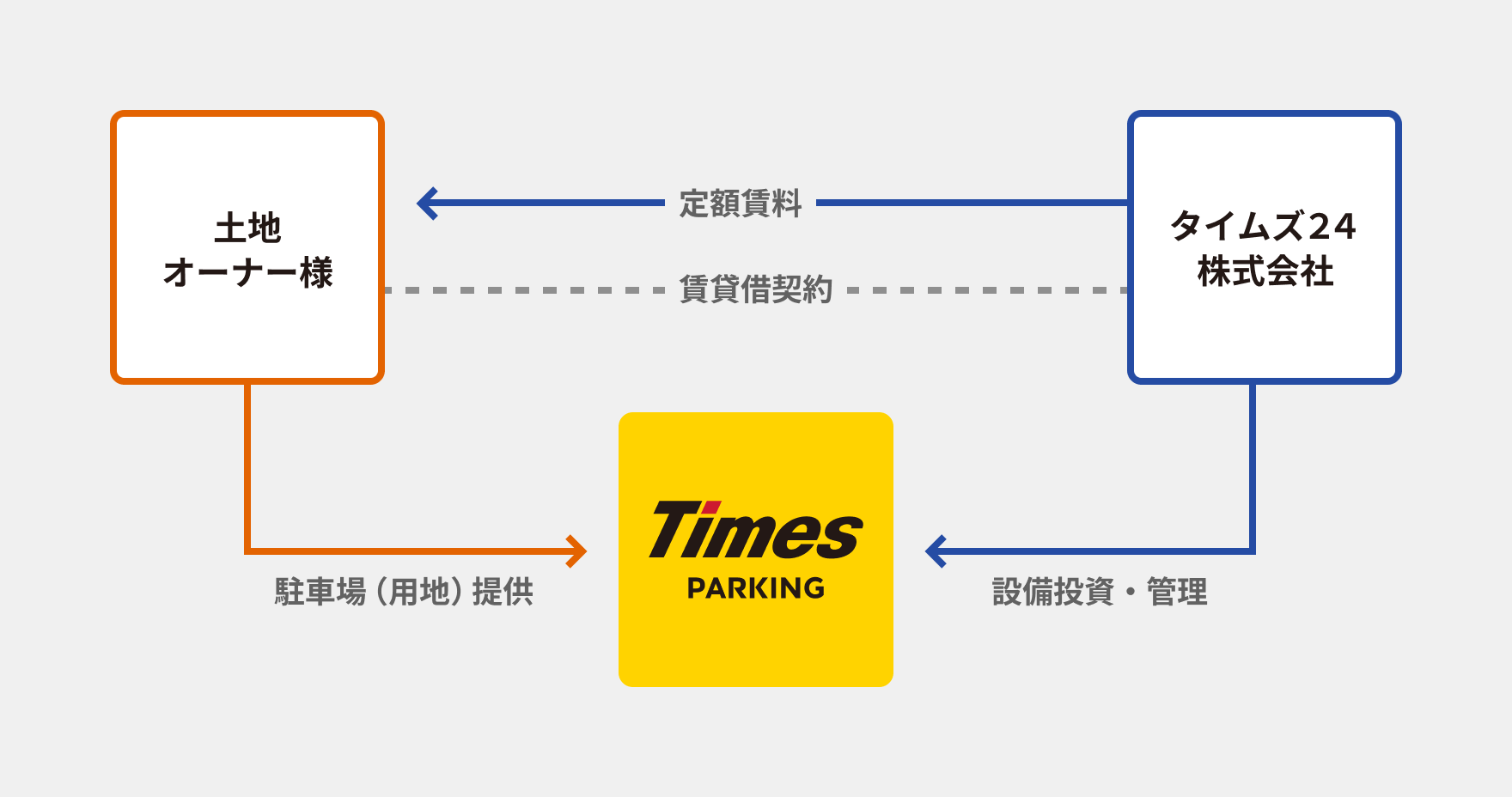
In short, a path exists to start hourly parking without taking on equipment investment yourself. In exchange, revenue belongs to the operator, and what the owner receives is a fixed rent. Note that who bears the paving cost, and who bears restoration costs at contract termination, cannot be determined from public information alone — these need to be confirmed individually in the contract. We compare the economics of this trade-off in table form later, under "How to Choose an Operating Model."
Income and Expense Simulation: What's Left Over on 5 Monthly Spaces on 83 m²
From here we move into actual calculations. The assumption is a lot of 83 m² (about 25 tsubo — a traditional Japanese land-area unit equal to roughly 3.3 m² — a unit you will still see on Japanese land listings) in Tokyo's 23 wards, built out as five monthly parking spaces. Substitute your own land area and space count as you follow along, and this becomes your own estimate.
Calculation Example 1: Annual Income, Expenses, and Net Income
| Item | Formula | Amount |
|---|---|---|
| Annual income at full occupancy | ¥27,549 × 5 spaces × 12 months | ¥1,652,940 (approx. USD 11,020) |
| Annual income at 80% occupancy | ¥1,652,940 × 80% | ¥1,322,352 (approx. USD 8,816) |
| Management fee (10% of income) | ¥1,322,352 × 10% | −¥132,235 (approx. −USD 882) |
| Fixed asset tax + city planning tax | Assessed value ¥11.6 million × (1.4% + 0.3%) | −¥197,200 (approx. −USD 1,315) |
| Net income (pre-tax) | 1,322,352 − 132,235 − 197,200 | ¥992,917/year (approx. USD 6,619) |
| Initial paving cost | ¥15,114/m² × 83 m² | approx. ¥1,254,000 (USD 8,360) |
The land's assessed value for fixed-asset-tax purposes is set here at a round ¥11.6 million (approx. USD 77,333), derived from a published-price benchmark of ¥200,000/m² × 83 m² = ¥16.6 million (approx. USD 110,667), multiplied by the rule of thumb that residential land's assessed value targets roughly 70% of the published land price (Ministry of Internal Affairs and Communications, "Fixed Asset Tax"), giving approximately ¥11.62 million. The tax is calculated here at the statutory base rate without any burden-adjustment relief, so the actual liability may be lower depending on the burden level applied locally. This calculation excludes cleaning costs, insurance, electricity for lighting, income tax, and resident tax.
Three things stand out here. First, the paving cost is recovered in roughly one year and three months of net income — a payback speed that would be hard to imagine with an apartment building. Second, the single largest expense line is not the management fee, but property-related tax. Third, even so, net income is only about ¥992,917 a year (approx. USD 6,619) — not a large return relative to a business built on ¥16.6 million (approx. USD 110,667) worth of land. This is the real shape of parking lot investment economics in Japan. For a more granular, item-by-item estimate, see our Parking Lot Income and Expense Simulation.
Calculation Example 2: Sensitivity When Switching to Hourly Parking
Converting that same space to hourly parking changes the picture of income entirely. We calculate using Tokyo's 23-ward hourly rate of ¥728 (approx. USD 4.85).
| Assumption | Formula | Monthly Income per Space |
|---|---|---|
| Theoretical maximum (24 hours × 30 days, fully booked) | ¥728 × 24 hours × 30 days | ¥524,160 (approx. USD 3,494) |
| 30% occupancy | ¥524,160 × 30% | ¥157,248 (approx. USD 1,048) |
| 15% occupancy | ¥524,160 × 15% | ¥78,624 (approx. USD 524) |
| Monthly parking (for comparison) | ¥27,549 | ¥27,549 (approx. USD 184) |
| Break-even occupancy vs. monthly parking | 27,549 ÷ 524,160 | approx. 5.3% |
On paper, if a car occupies the space for roughly 1 hour and 15 minutes a day, hourly parking matches monthly parking. Looking only at that number, hourly parking appears overwhelmingly more attractive. In practice, however, real coin-parking lots impose a daily maximum-rate cap, so a long-duration parked car earns well under the per-hour rate, and overnight occupancy runs well below daytime levels. The theoretical ceiling of ¥524,160 (approx. USD 3,494) is never actually realized — treat this table as a sensitivity tool for "how far off does actual occupancy have to be before it falls behind monthly parking," not as a revenue forecast. We cover the specifics of hourly-parking design in our Practical Guide to Coin Parking Investment.
The "Yield of 15–30%" Trap: Land Value Is Missing From the Denominator
The "5–15% for monthly parking, 15–30% for coin parking" yield figures commonly cited in parking-lot articles do not include the price of the land in the denominator. This is less an outright error than an omission of the definition. But when the omission goes unexplained and the figure is used for comparison anyway, it leads to serious misjudgment.
This mirrors a trap that catches investors in many countries: a headline "cap rate" or "yield" figure that is quietly computed on operating structure or improvement cost alone, excluding the underlying land or property value. Just as a US investor would ask "yield on what basis — purchase price, replacement cost, or improvements only?", the same scrutiny applies here.
Calculation Example 3: Verifying the Yield With Land Value Included
| Denominator Basis | Denominator | Gross Yield at Full Occupancy | At 80% Occupancy | After Expenses |
|---|---|---|---|---|
| Paving cost only | ¥1,254,000 (approx. USD 8,360) | approx. 131.8% | approx. 105.4% | approx. 79.2% |
| Paving cost + land value | ¥17,854,000 (approx. USD 119,027) | approx. 9.3% | approx. 7.4% | approx. 5.6% |
Calculated on annual income of ¥1,652,940 (approx. USD 11,020, full occupancy), ¥1,322,352 (approx. USD 8,816, 80% occupancy), and ¥992,917 (approx. USD 6,619, after expenses). Land value is assumed at the published-price benchmark of ¥200,000/m² × 83 m² = ¥16.6 million (approx. USD 110,667).
Using paving cost alone as the denominator produces a yield above 100%. When a calculation produces a number that could not exist in reality, that is a sign the denominator does not represent the actual economics of the business. Including the land value brings the yield down to about 9.3%, and after expenses, to about 5.6% — a figure roughly comparable to what a US or European investor would call a "cap rate." That is the true return on using this land as a parking lot.
To verify this on your own land, check the published land price and the prefectural land-price survey for your area using the Ministry of Land, Infrastructure, Transport and Tourism's (国土交通省, MLIT) "Real Estate Information Library" [不動産情報ライブラリ]. Owners who inherited their land tend to skip this step, because there is no felt sense of an "acquisition cost." But the land always retains the option of being sold or converted to another use, and running it as a parking lot consumes that option.
Deciding Whether to Keep the Parking Lot as Land Prices Rise
This point carries particular weight in the 2026 market. According to MLIT's "Overview of the Reiwa 8 Published Land Prices" [令和8年地価公示の概要] (March 2026 [Reiwa 8]), nationwide residential land rose 2.1% year-on-year, residential land in the greater Tokyo area rose 4.5%, and residential land in Japan's three major metropolitan areas rose 3.5% — the fifth consecutive year of increase across all use categories.
This kind of sustained, multi-year land appreciation is not universal — it stands in contrast to markets where residential land values have been flat or declining over the same period, which is part of why global investors have increasingly looked at Japan.
If residential land in greater Tokyo continues appreciating at 4.5% a year, simply holding the land generates the equivalent of a 4.5% annual unrealized gain. That is almost exactly the same level as the 5.6% after-expense yield calculated above. This is why I consider it more accurate to think of a parking lot as a "device for holding onto land" rather than as a standalone investment: it covers the property taxes, preserves the freedom to convert the land later, and buys time. Whether it is fulfilling that role — or not — is really the axis on which to decide whether to continue or exit.
Parking Lot vs. Apartment Building: Which Pays Off Better?
The short answer: an apartment building wins on absolute return, while a parking lot wins on how easily you can reverse the decision. These are not competing options so much as options on different time horizons. Here are the main differences, each backed by its legal basis. This comparison is especially relevant for international investors weighing a ground-up rental development against a lower-commitment holding strategy while they get to know the Japanese market.
| Item | Monthly Parking | Coin Parking | Apartment Building |
|---|---|---|---|
| Initial cost | Paving + space markings + wheel stops. About ¥15,114/m² (approx. USD 101) at the official Tokyo 23-ward unit cost | The above, plus fee machine, wheel locks, signage, electrical work. Under a master lease, borne by the operator | Requires the building's construction cost itself — an order of magnitude larger |
| Time to open | Just weeks for site prep | About one month after contracting with an operator (per Times 24's official information) | Months to about a year, covering design, building-confirmation application, and construction |
| Income volatility | Stable per contract; losing one tenant has an outsized impact | Varies day to day, driven by weather, events, and nearby construction | Long contract terms; volatility is low |
| Consumption tax | Taxable sales (National Tax Agency, No. 6213) | Residential rent is tax-exempt | |
| Residential-land property tax discount | Not applicable (externally rented parking is non-residential land) | Assessed value × 1/6 up to 200 m² of small-scale residential land | |
| Small-scale residential land inheritance tax discount | Not eligible while left as an unpaved, open-air lot; if a structure exists, may qualify as land used for a rental business, with room for a 200 m² / 50% reduction | May qualify, since equipment and paving count as structures | Qualifies as land used for a rental business, 200 m² / 50% reduction |
| Depreciation period | 10 years for asphalt surfacing / 15 years for concrete and similar surfacing | 22 years for wood-frame residential buildings / 47 years for reinforced-concrete residential buildings | |
| Ease of conversion | High. No leasehold or tenancy right arises, and terminating the contract is relatively easy | Low. Japan's Act on Land and Building Leases (借地借家法) requires negotiating tenants' move-out | |
Basis: National Tax Agency No. 6213 / No. 4124; Ministry of Internal Affairs and Communications, "Fixed Asset Tax"; Tokyo Metropolitan Government Bureau of Taxation, "Fixed Asset Tax and City Planning Tax (Land and Buildings)"; Ministerial Ordinance on Useful Life of Depreciable Assets, Appendix Table 1; Times 24 Co., Ltd. official website.
The line that matters most for decision-making is the bottom one: ease of conversion. The moment an apartment building is built, that land becomes tenants' home, and an owner cannot simply reverse the decision unilaterally. This is broadly analogous to residential tenant-protection regimes in the US, UK, or EU, but Japan's Act on Land and Building Leases (借地借家法, Shakuchi Shakka Hō) is notably tenant-protective by international standards — eviction, even for an owner's own use, requires "legitimate reason" (正当事由) and often a lengthy negotiation. For land where a sale within ten years, a future road-widening project, or a change in family circumstances all remain live possibilities, the parking lot's very reversibility carries real value in its own right.
The Tax Bill on a Parking Lot, in Real Numbers
When a parking lot surprises an owner, it is almost always about tax. This is not a place for qualitative description — treat it in real figures.
Calculation Example 4: How Much Higher Is Property Tax Than on Residential Land?
Residential land benefits from a reduced taxable-value rule. Per the Ministry of Internal Affairs and Communications, the taxable value of residential land up to 200 m² is reduced to one-sixth of its assessed value, and the portion beyond 200 m² is reduced to one-third. For city planning tax, small-scale residential land is reduced to one-third, and general residential land to two-thirds. The Tokyo Metropolitan Government Bureau of Taxation (東京都主税局) explicitly lists "externally rented parking (月極駐車場、コインパーキング、カーシェアリングやシェアサイクルの用地など — monthly parking, coin parking, and land used for car-share or bike-share services)" as an example of non-residential land. In other words, parking lots are excluded from the discount.
| Category | Fixed Asset Tax (1.4% rate) | City Planning Tax (0.3% capped rate) | Annual Total |
|---|---|---|---|
| House standing on the land (small-scale residential land) | ¥30 million × 1/6 × 1.4% = ¥70,000 (approx. USD 467) | ¥30 million × 1/3 × 0.3% = ¥30,000 (approx. USD 200) | ¥100,000 (approx. USD 667) |
| Parking lot (statutory base rate) | ¥30 million × 1.4% = ¥420,000 (approx. USD 2,800) | ¥30 million × 0.3% = ¥90,000 (approx. USD 600) | ¥510,000 (approx. USD 3,400) |
| Parking lot (with the 70% statutory burden-adjustment ceiling applied) | ¥21 million × 1.4% = ¥294,000 (approx. USD 1,960) | ¥21 million × 0.3% = ¥63,000 (approx. USD 420) | ¥357,000 (approx. USD 2,380) |
Assumes land with an assessed value of ¥30 million (approx. USD 200,000) and 200 m². For commercial-type (non-residential) land, if the burden level exceeds 70%, the taxable value is capped at 70% of the assessed price (Tokyo Metropolitan Government Bureau of Taxation). Within Tokyo's 23 wards, an additional municipal-ordinance reduction applies: where the burden level exceeds 65%, the tax burden is reduced to match a taxable value of 65% of the assessed price. Actual amounts vary by municipality and burden level.
The difference is ¥250,000–¥410,000 a year (approx. USD 1,667–2,733). Recall that Calculation Example 1 produced net income of about ¥992,917 (approx. USD 6,619) a year — so converting land that previously had a house on it into a parking lot means roughly 30–40% of your net income is going straight to tax. Owners who do not budget for this are often surprised by their year-two tax notice. We cover the tax treatment of vacant and miscellaneous-use land more broadly in Fixed Asset Tax on Vacant Land and Land-Use Decisions, and parking-lot-specific points in our Parking Lot Fixed Asset Tax Guide.
Parking Income Counts as Taxable Sales for Consumption Tax
This point is easy to overlook. Residential rent is exempt from Japan's consumption tax (消費税, the national VAT-equivalent, currently 10%), but parking-lot usage fees are taxable. National Tax Agency Tax Answer No. 6213 explains that consumption tax applies where the operator manages the parked vehicles, or "where the ground is prepared as a parking lot, or a fence, space markings, or a structure is installed to make the land usable as a parking lot" [駐車場としての地面の整備またはフェンス、区画、建物の設置などをして駐車場として利用させる場合]. In practice, once you pave the surface and paint the space lines, treat the income as taxable in principle.
This differs from how many jurisdictions treat small-scale rental income, and is worth flagging explicitly for foreign owners used to a simple "residential landlord = no VAT" rule. In Japan, the distinction runs along residential-vs-non-residential use, not landlord size.
That said, if taxable sales in the base period (two years prior, for individual proprietors) are ¥10 million (approx. USD 66,667) or less, the obligation to pay is exempted in principle (National Tax Agency No. 6501). Two points need attention:
- If you are registered as a Qualified Invoice Issuer (適格請求書発行事業者, part of the "invoicing system," commonly called インボイス制度, the Invoice System) — even if taxable sales are ¥10 million (approx. USD 66,667) or less, you are not exempted. Owners already registered for invoicing through another business will find their parking income becomes taxable as well.
- You are also not exempted if taxable sales in the specified period (January 1 to June 30 of the prior year, for individual proprietors) exceed ¥10 million (approx. USD 66,667).
For owners who hold an apartment building through a corporate entity and are already registered for invoicing, adding a parking lot will reduce net income by the amount of consumption tax owed. Build this into your assumptions before you start.
Depreciation: 10 Years for Asphalt, 15 Years for Concrete
Paving costs cannot be expensed all at once. Appendix Table 1 of the Ministerial Ordinance on Useful Life of Depreciable Assets (減価償却資産の耐用年数等に関する省令 別表第一), under "paved roads and paved surfaces" [舗装道路及び舗装路面] within the structures category, sets 15 years for concrete, block, brick, and stone surfacing, and 10 years for asphalt and wood-brick surfacing, with 3 years for bituminous surfacing. National Tax Agency guidance (質疑応答事例) further clarifies that asphalt-concrete surfacing falls under the 10-year asphalt category.
If the ¥1,254,000 (approx. USD 8,360) paving cost from Calculation Example 1 is depreciated as concrete surfacing over 15 years, the annual depreciation expense is ¥83,600 (approx. USD 557). As asphalt surfacing over 10 years, it becomes ¥125,400 (approx. USD 836). The same construction cost produces a 1.5x difference in the amount expensed each year, depending purely on the paving type. Whether to smooth out income tax over time or front-load the expense is a genuine choice here.
Can a Parking Lot Help With Inheritance Planning? Open-Air vs. Paved Makes All the Difference
When asked "does a parking lot help with inheritance planning," our answer is: "it depends entirely on whether the lot has paving or equipment." The dividing line sits in the requirements for the small-scale residential land inheritance tax discount (小規模宅地等の特例). This is a Japan-specific inheritance-tax mechanism with real financial stakes and no close Western analogue — it is worth understanding even for investors who do not expect to pass Japanese property to heirs, since it directly affects how a Japanese seller may be motivated to price and structure a sale.
National Tax Agency No. 4124 defines the land eligible for this discount as land "used as the site of a building or a structure" [建物または構築物の敷地の用に供されている宅地等]. An open-air lot with nothing more than a rope strung around it therefore does not qualify, because it has no structure on it. A lot paved with asphalt or concrete, on the other hand, may be assessed as the site of a structure, and can potentially qualify as land used for a rental business, eligible for a 200 m² / 50% reduction. That said, this depends on individual circumstances, so confirm with a licensed tax accountant (税理士, zeirishi) before acting.
Two additional constraints matter as well:
- Land newly put into a rental business within three years before the start of inheritance is, in principle, excluded from eligibility. Starting a parking lot in a hurry once inheritance is on the horizon will not be in time. This exclusion does not apply, however, if the specified rental business had already been operated for more than three years by the date inheritance began.
- The heir must take over the rental business by the filing deadline and continue holding the land (the business-succession requirement and the continued-holding requirement).
There is one more commonly misunderstood point about the inheritance-tax valuation itself. Per National Tax Agency No. 4627, land that the owner personally operates as monthly-style rental parking is valued as "owner-occupied land" (自用地), meaning no deduction can be taken for a leasehold interest. This is the opposite of an apartment building's land, which can be valued at a discount as tenanted land (貸家建付地). It is safest to understand that a parking lot is not, generally, a tool for lowering assessed value for inheritance purposes.
Site Selection Should Run on Supply-and-Demand Data, Not Instinct
Judging a site by "it's close to the station, so it should be fine" is becoming harder to sustain. MLIT's City Bureau (国土交通省都市局), in "Recent Trends in Parking Policy" [駐車場政策の最近の動向] (December 20, 2023 [Reiwa 5]), states explicitly that "due to the slowdown in growth of vehicle ownership and other factors, many areas now have a parking supply that exceeds demand, and oversupply has been noted in some areas" [自動車保有台数の伸びの鈍化等により、多くの地域で需要を上回る駐車場の供給が行われているほか、一部では過剰も指摘されている]. In the hourly-parking supply-demand balance survey (2021) cited in the same document, 47.3% of municipalities responded that, area-wide, demand is less than supply.
This kind of nationwide, government-published parking supply-demand survey is itself unusual internationally — many markets leave this analysis to private consultants, or leave investors to infer it from occupancy anecdotes. In Japan, a prospective investor can pull this directly from a public source.
The degree of local saturation can be checked through MLIT's "Annual Report on Motor Vehicle Parking Lots, FY Reiwa 7 Edition" [自動車駐車場年報 令和7年度版] (as of end of March 2025 [Reiwa 7]), which tracks the number of parking spaces per 10,000 vehicles. Nationwide, total available parking spaces are 5,687,740, against 78,619,088 registered vehicles (excluding two-wheelers), giving a national average of 723.5 spaces per 10,000 vehicles.
| Prefecture | Parking Spaces per 10,000 Vehicles | Ratio to National Average (723.5) |
|---|---|---|
| Tokyo | 2,673.0 | 3.69× |
| Kanagawa | 1,607.0 | 2.22× |
| Osaka | 1,567.4 | 2.17× |
| Fukuoka | 991.3 | 1.37× |
| Hokkaido | 946.5 | 1.31× |
| National | 723.5 | 1.00× |
| Ibaraki | 238.6 | 0.33× |
| Yamanashi | 87.2 | 0.12× |
Source: compiled from survey results in MLIT City Bureau, "Annual Report on Motor Vehicle Parking Lots, FY Reiwa 7 Edition" (as of end of March 2025).
This table needs to be read carefully. A high space count does not simply mean "oversupplied," and a low count does not simply mean "opportunity." Yamanashi's figure of 87.2 mainly reflects the fact that the overwhelming majority of cars there park on the owner's own private land, meaning the paid-parking market itself is simply small. Conversely, Tokyo's 2,673.0 reflects a well-established culture of paying for parking. What matters is not comparison against the national average, but a relative judgment: within the same prefecture, is your land's surrounding area thinner or thicker in supply than the local average?
How to Choose an Operating Model: Self-Management, Managed Contract, or Master Lease
At bottom, the choice of operating model comes down to a single question: whose revenue is the parking income? Once that is settled, who bears the initial investment and who bears the vacancy risk both follow automatically.
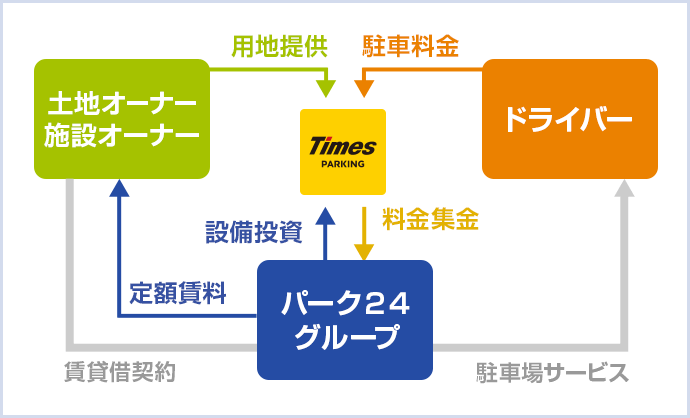
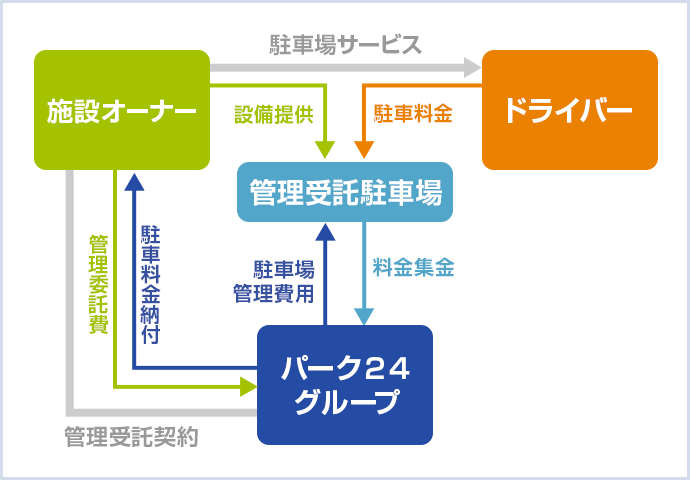
The difference between the two diagrams is just the direction of the arrow. But that arrow determines everything about the owner's take-home income and risk exposure. The main conditions line up as follows.
| Comparison Point | Self-Management | Managed Contract | Master Lease (Sublease) |
|---|---|---|---|
| Who revenue belongs to | Owner | Owner | Operator |
| Who bears the initial investment | Owner (paving and all equipment) | Owner (also prepares equipment and signage) | Equipment, signage, and electrical work cost borne by the operator (as with Times 24); paving cost treatment varies by contract |
| Shape of monthly income | Actual income, as is | Actual income minus management fee | Fixed rent regardless of occupancy |
| Who bears vacancy risk | Owner | Owner | Operator |
| When revenue outperforms | Owner keeps it all | Owner keeps it all | Owner does not participate (rent is fixed) |
| Contract term | Not applicable | Depends on the operator | Two years initially, then automatic annual renewal (as with Times 24) |
| Cancellation process | Not applicable | Depends on the contract | Cancellable with three months' notice after the initial term (as above) |
| Restoration cost at cancellation | Owner | Owner | Varies by contract — confirm in the contract document |
| Legal rights created | Not applicable | Not applicable | Temporary-use land lease for parking. No leasehold, superficies right, or business right arises (as above) |
Source: compiled from publicly disclosed terms in Park24 Co., Ltd., "Parking Business Models," and Times 24 Co., Ltd., "Land Utilization." Conditions vary by operator and by individual deal.
As a rule of thumb: if you are running hourly parking and this is your first time working with land in this way, a master lease is the practical choice — no equipment investment is required, and the operator bears the loss if occupancy comes in below projection. If, on the other hand, you can gauge local rates and occupancy yourself, a managed contract will leave you with a larger take-home. The deciding factor is whether you can forecast the occupancy rate on that specific piece of land yourself. For an international owner unfamiliar with the local Japanese market, the master lease functions much like a net lease to a single credit tenant in a Western market: you trade upside for predictability and zero operating involvement.
Checklist: What to Confirm Before Signing a Contract
Here is everything covered so far, organized as a pre-launch checklist.
- Have you checked the monthly and hourly rate statistics for the target city, and cross-checked them against actual posted rates at lots within roughly 300 m?
- Have you compared the paving contractor's quote against the official per-m² unit cost for parking lot construction in the target city?
- Have you decided on a paving type (10-year useful life for asphalt, 15 years for concrete and similar)?
- Have you confirmed the assessed value with the municipality and calculated exactly how much fixed asset tax and city planning tax will rise from the residential-land level?
- Are you already registered for invoicing (インボイス, the Qualified Invoice Issuer system) through another business? If so, your parking income becomes subject to consumption tax.
- If inheritance is on your horizon, have you confirmed whether a structure exists, and how much time has passed between the start of the rental business and the (eventual) start of inheritance — the three-year new-rental exclusion?
- For a master lease, have you confirmed the contract term, the automatic-renewal conditions, the notice period for cancellation, and who bears removal costs, in the contract document itself?
- Does your future conversion plan (sale, construction, a road project) conflict with the timing at which the contract can actually be cancelled?
Common Problems and Failure Patterns in Parking Lot Management
Even when the numbers check out, operations can still go wrong. The failures we actually hear about from owners fall into a consistent set of patterns.
- Pricing that doesn't match the local market. This happens when an owner adopts the city-wide statistical average as-is, without checking actual nearby rates. A gap of just ¥1,000 (approx. USD 6.67) per space becomes ¥60,000 (approx. USD 400) a year across five spaces.
- Hard-to-enter spaces stay empty. Cramming in the maximum number of spaces can push real occupancy below projections. Giving up the width of one space to make entry and exit easier for the rest often raises year-round occupancy more than the extra space would have earned.
- Unpaid rent and the cost of chasing it down. Making bank-account auto-debit the default, and spelling out how late payment is handled in the contract, prevents most of this.
- Unauthorized parking and complaints from neighbors. Whether you have lighting, a security camera, and a 24-hour contact line makes a large difference to how much of a burden this becomes. When choosing a management company, visit a lot they already manage and check how clean it is kept.
- Underestimating the tax burden. This is the most common failure of all. The increase in fixed asset tax, and whether you will be a taxable business for consumption tax, are numbers you want nailed down before you start — not discovered afterward.
Conclusion
Running a parking lot in Japan is a form of land use with low upfront cost, a fast start, and an exit available at any time. As this article has shown, five monthly spaces on an 83 m² lot in Tokyo's 23 wards works out to roughly ¥1,254,000 (approx. USD 8,360) in paving cost, against roughly ¥992,917 (approx. USD 6,619) a year in pre-tax net income. The paving cost is recovered in about one year and three months.
At the same time, the "yield of 15–30%" figure excludes land value, and once land value is added to the denominator, the after-expense yield drops to about 5.6%. Fixed asset tax runs several times higher than on residential land, parking income counts as taxable sales for consumption tax, and — left as an open-air lot — it does not qualify for the small-scale residential land inheritance tax discount either.
Even so, a parking lot has value, because it lets you keep your options open on the land while covering the property taxes and buying time. In a market where land prices are rising, this ability to "stay in a position to wait" is itself worth almost as much as the cash yield. Running the numbers yourself, on your own land, is the first step toward a land-use decision you can live with for the long term. If you want to compare a wider range of uses for idle land, see also our 10 Ways to Use Idle Land.
Frequently Asked Questions (FAQ)
How much does it cost to start a parking lot in Japan?
The main cost is paving. At the official Tokyo 23-ward unit cost, that runs about ¥15,114 per m² (approx. USD 101), or about ¥249,378 per space (approx. USD 1,663) (Ministry of Internal Affairs and Communications, "Retail Price Survey," June 2026; concrete-surface work, two spaces, 33 m²). The city-to-city range is wide — Yokohama City runs about ¥515,785 per space (approx. USD 3,439), Naha City about ¥146,207 (approx. USD 975). For coin parking, equipment, signage, and electrical work may be borne by the operator under a master-lease contract.
Which is more profitable, monthly parking or coin parking?
On rate alone, hourly (coin) parking is more attractive. At Tokyo's 23-ward hourly rate of ¥728 (approx. USD 4.85), occupancy above 5.3% already outperforms the ¥27,549 (approx. USD 184) monthly rate. In practice, however, a daily maximum-rate cap keeps actual income well below the theoretical calculation. The general rule: monthly parking for dense residential areas, hourly parking for commercial districts, tourist areas, and around hospitals.
How much does fixed asset tax rise if I convert to a parking lot?
For land with an assessed value of ¥30 million (approx. USD 200,000) and 200 m², residential land carries combined fixed asset tax and city planning tax of about ¥100,000 (approx. USD 667) a year, but a parking lot — ineligible for the residential-land discount — runs about ¥510,000 (approx. USD 3,400) a year. Factoring in the statutory 70%-of-price burden-adjustment ceiling, it comes to about ¥357,000 (approx. USD 2,380). The difference is ¥250,000–¥410,000 a year (approx. USD 1,667–2,733); actual figures vary by municipality and burden level.
Is parking income subject to consumption tax?
Yes. Under National Tax Agency No. 6213, income is taxable where the ground is prepared, or fenced, marked, or built out to be used as a parking lot. This differs from residential rent, which is tax-exempt. If taxable sales in the base period are ¥10 million (approx. USD 66,667) or less, you are exempt from payment in principle — but not if you are registered as a Qualified Invoice Issuer (インボイス, the invoicing system).
Can a parking lot help with inheritance tax planning?
Left as an open-air lot, the benefit is limited. The small-scale residential land discount requires land "used as the site of a building or a structure," so an unpaved open-air lot with no structure does not qualify. Once paved, it may qualify as land used for a rental business, with room for a 200 m² / 50% reduction — but land newly put into a rental business within three years of the start of inheritance is, in principle, excluded. This depends on individual circumstances, so consult a licensed tax accountant.
Do I need a license to operate a parking lot in Japan?
No special license is required. A managed-contract or master-lease arrangement lets you start without specialized knowledge. That said, rate setting, tax classification, and reviewing the contract terms remain the owner's judgment call — we recommend working through the eight-item checklist in this article before you begin.
Citations and References
- Statistics Bureau of Japan, Ministry of Internal Affairs and Communications, "Retail Price Survey (Trend Report)" [小売物価統計調査(動向編)], June 2026, Table 1, City-Level Retail Prices for Major Items (item 7342 "garage rental fee," item 7343 "parking fee," item 3179 "parking lot construction cost") | e-Stat, Japan's Official Statistics Portal
- Statistics Bureau of Japan, "Retail Price Survey (Trend Report): Survey Items and Base Brands" [小売物価統計調査(動向編)調査品目及び基本銘柄] | Statistics Bureau, Survey Results
- MLIT City Bureau, "Annual Report on Motor Vehicle Parking Lots, FY Reiwa 7 Edition" [自動車駐車場年報 令和7年度版] (as of end of March 2025) | Table of Contents / Survey Results (PDF)
- MLIT City Bureau, Street and Traffic Facilities Division, "Recent Trends in Parking Policy" [駐車場政策の最近の動向] (December 20, 2023 [Reiwa 5]) | Document (PDF)
- MLIT, "Overview of the Reiwa 8 Published Land Prices" [令和8年地価公示の概要] (March 2026 [Reiwa 8]) | Overview (PDF) / Press Release
- MLIT, "Real Estate Information Library" [不動産情報ライブラリ] (search for published land prices and prefectural land-price survey data) | Site
- Ministry of Internal Affairs and Communications, "Fixed Asset Tax" [固定資産税] (1.4% standard rate; residential-land taxable-value discount) | Local Tax System
- Ministry of Internal Affairs and Communications, "City Planning Tax" [都市計画税] (0.3% capped rate) | Local Tax System
- Tokyo Metropolitan Government Bureau of Taxation, "Fixed Asset Tax and City Planning Tax (Land and Buildings)" [固定資産税・都市計画税(土地・家屋)] (residential-land discount, examples of non-residential land, burden-adjustment measures) | Explanation Page
- National Tax Agency, Tax Answer No. 6213, "Parking Fees and Similar Charges" [駐車場の使用料など] | National Tax Agency
- National Tax Agency, Tax Answer No. 6501, "Exemption From Tax Liability" [納税義務の免除] | National Tax Agency
- National Tax Agency, Tax Answer No. 4124, "The Small-Scale Residential Land Discount" [小規模宅地等の特例] | National Tax Agency
- National Tax Agency, Tax Answer No. 4627, "Valuation of Land Used as Rental Parking" [貸駐車場として利用している土地の評価] | National Tax Agency
- Ministerial Ordinance on Useful Life of Depreciable Assets, Appendix Table 1 [減価償却資産の耐用年数等に関する省令 別表第一] ("paved roads and paved surfaces") | e-Gov Japanese Law Search
- National Tax Agency, Q&A Case Study, "Classification of Asphalt-Concrete Paved Roads" [アスファルトコンクリート敷の舗装道路の細目判定] | National Tax Agency
- Park24 Co., Ltd., "Parking Business Models" [駐車場のビジネスモデル] | Official Site
- Times 24 Co., Ltd., "Land Utilization" [土地活用] | Official Site
The calculations in this article are estimates based on public data. For tax judgments specific to your own property or income situation, please consult a licensed tax accountant (税理士, zeirishi) or other qualified professional.
