If you are researching land in Japan, one fact will surprise most international investors before any number does: Japan has no MLS-style public database of actual, closed sale prices. Unlike the United States, the United Kingdom, Australia, or Singapore, where a buyer can look up what the house next door actually sold for, Japanese jittai kakaku (実勢価格, real transaction prices) are not systematically disclosed to the public. What you can access instead are official appraisal benchmarks and asking prices — useful, but not the same thing as a comparable-sales record you could pull up on a portal in five seconds. This guide works around that structural gap using the most authoritative substitute available: the Japanese government's own annual land-price survey, cross-referenced against national construction-cost data collected from actual mortgage borrowers.
If you are looking at a 50-tsubo (165.29 m², about 1,779 sq ft) plot of land in Japan, what you actually want to know first is simple: how much does the land cost, how large a house can legally be built on it, and what does the whole project add up to. This article is written for two audiences: people who are about to buy a 50-tsubo lot, and people who have inherited or otherwise come to own one and are deciding whether to live on it, build a rental property on it, or hold it as-is. Using only primary-source Japanese government data current as of 2026, we work through a regional price lookup table, the buildable floor area under different building-coverage and floor-area ratios, total cost (land plus construction), the current mortgage tax deduction, how many apartment units the lot supports if rented out, and how many parking spaces it holds — all structured so you can substitute your own lot's dimensions and location into the same math.
Key takeaways
- A 50-tsubo (165.29 m²) residential lot, priced at the average residential-land rate from the Reiwa 8 (2026) Official Land Price Publication, costs approximately ¥141.55 million (approx. USD 943,700) in Tokyo's 23 wards, approximately ¥19.40 million (approx. USD 129,300) in Sapporo, and approximately ¥5.77 million (approx. USD 38,500) in Aomori City.
- The size of house you are legally permitted to build is not decided by the floor area ratio alone. The building coverage ratio and the width of the road fronting the lot typically cap the buildable floor area before the floor area ratio even comes into play — a two-layer restriction most Western zoning codes do not combine in quite this way.
- Building a house with 50 tsubo (165.29 m²) of gross floor area costs approximately ¥59.3 million (approx. USD 395,300), based on the 2025 Flat 35 User Survey's national average construction cost of ¥359,000 per m² (approx. USD 2,393 per m²).
- For homes occupied in 2026, the mortgage tax deduction's loan-balance cap swings by ¥25 million (approx. USD 166,700) — from ¥20 million (approx. USD 133,300) to ¥45 million (approx. USD 300,000) — depending purely on the home's energy performance rating.
- If you rent the 50-tsubo lot out, a three-storey building under a 60% building coverage ratio and 200% floor area ratio yields roughly nine to ten units of about 25 m² each; as a monthly-contract surface parking lot with a single row accessed directly from the front road, the same lot holds about six cars.
How Much Does 50 Tsubo of Land Cost in Japan? 2026 Regional Price Lookup Table
As a benchmark, 50 tsubo of land costs approximately ¥141.55 million (approx. USD 943,700) in Tokyo's 23 wards, approximately ¥49.74 million (approx. USD 331,600) in Osaka City, approximately ¥38.02 million (approx. USD 253,500) in Nagoya City, and approximately ¥19.40 million (approx. USD 129,300) in Sapporo. These figures come from multiplying 165.29 m² (50 tsubo) by the "average" residential-land price for each prefectural-capital city published by 国土交通省 (Ministry of Land, Infrastructure, Transport and Tourism, MLIT) in the Reiwa 8 chika kōji (地価公示, Official Land Price Publication), as of January 1, 2026. The same 50 tsubo of land can cost more than twenty times as much depending purely on which city it sits in.
For an investor used to thinking in terms of a single national price index, this is an early warning worth taking seriously: in Japan, "national average land price" is close to meaningless as an investment metric. The spread between Tokyo and a regional city here is wider than the spread the US National Association of Realtors publishes between its most and least expensive metro markets — and unlike in a market with public sold-price records, you cannot quickly triangulate an individual address against recent comparable closings to sanity-check where it falls in that spread.
The table below is the regional lookup. Actual transaction prices move up or down from these benchmark figures based on distance to the nearest train station, road frontage, and lot shape. Because there is no closed-sale database to check an individual transaction against, treat this table strictly as a benchmark for "buying at the average residential land price for that city," not as a specific-property estimate — and budget for a professional local appraisal before you rely on any number from this table in an actual offer.
Reference Table 1: 50-Tsubo (165.29 m²) Land Price by Region (Reiwa 8 / 2026 Official Land Price Publication)
| City | Average residential-land price (JPY per m², Reiwa 8) | Approx. price for 50 tsubo = 165.29 m² | Reference: Reiwa 7 (2025) average price (JPY per m²) |
|---|---|---|---|
| Tokyo's 23 wards | ¥856,400 (approx. USD 5,709) | approx. ¥141,550,000 (approx. USD 943,700) | ¥771,600 (approx. USD 5,144) |
| Osaka City | ¥300,900 (approx. USD 2,006) | approx. ¥49,740,000 (approx. USD 331,600) | ¥282,800 (approx. USD 1,885) |
| Yokohama City | ¥266,000 (approx. USD 1,773) | approx. ¥43,970,000 (approx. USD 293,100) | ¥257,000 (approx. USD 1,713) |
| Fukuoka City | ¥258,100 (approx. USD 1,721) | approx. ¥42,660,000 (approx. USD 284,400) | ¥239,800 (approx. USD 1,599) |
| Kyoto City | ¥247,700 (approx. USD 1,651) | approx. ¥40,940,000 (approx. USD 272,900) | ¥238,700 (approx. USD 1,591) |
| Saitama City | ¥246,700 (approx. USD 1,645) | approx. ¥40,780,000 (approx. USD 271,900) | ¥238,400 (approx. USD 1,589) |
| Nagoya City | ¥230,000 (approx. USD 1,533) | approx. ¥38,020,000 (approx. USD 253,500) | ¥222,300 (approx. USD 1,482) |
| Kobe City | ¥172,300 (approx. USD 1,149) | approx. ¥28,480,000 (approx. USD 189,900) | ¥165,200 (approx. USD 1,101) |
| Hiroshima City | ¥156,400 (approx. USD 1,043) | approx. ¥25,850,000 (approx. USD 172,300) | ¥151,100 (approx. USD 1,007) |
| Chiba City | ¥149,700 (approx. USD 998) | approx. ¥24,740,000 (approx. USD 164,900) | ¥140,800 (approx. USD 939) |
| Sendai City | ¥135,700 (approx. USD 905) | approx. ¥22,430,000 (approx. USD 149,500) | ¥129,800 (approx. USD 865) |
| Sapporo City | ¥117,400 (approx. USD 783) | approx. ¥19,400,000 (approx. USD 129,300) | ¥115,600 (approx. USD 771) |
| Kumamoto City | ¥82,700 (approx. USD 551) | approx. ¥13,670,000 (approx. USD 91,100) | ¥80,000 (approx. USD 533) |
| Aomori City | ¥34,900 (approx. USD 233) | approx. ¥5,770,000 (approx. USD 38,500) | ¥34,300 (approx. USD 229) |
Source: 国土交通省 (MLIT), Reiwa 8 chika kōji (地価公示, Official Land Price Publication), "Average" Residential Land Prices for Prefectural Capital Cities. The 50-tsubo figures are an approximation obtained by multiplying this per-m² rate by 165.29 m². USD equivalents in this article use an approximate rate of ¥150 = US$1; convert at current spot rates before relying on any figure for an actual transaction.
It also helps to know which direction prices are moving. Under the Reiwa 8 Official Land Price Publication, the year-over-year change in residential land prices averaged +2.1% nationwide, +4.5% in the Greater Tokyo area, +2.5% in the Greater Osaka area, and +1.9% in the Greater Nagoya area, against +0.9% for regional areas on average. Even outside the three major metropolitan areas, the four leading regional cities — Sapporo, Sendai, Hiroshima, and Fukuoka — rose +3.5%, matching the three-major-metro average of +3.5%. Residential land has now risen for five consecutive years, so an investor's assumption of "prices will come down if I wait" does not currently hold up against the data (Source: 国土交通省 (MLIT), Reiwa 8 chika kōji, Table 3, Year-over-Year Average Change Rate by Region and Land Use). For a foreign buyer weighing whether to act now or wait for a pullback, this five-year trend is the single most direct answer the government's own data can give you.
How Big Is 50 Tsubo, Exactly? Converting to m², Tatami Mats, and Familiar References
Tsubo (坪) is a traditional Japanese unit of area with no exact equivalent in the imperial or metric systems most international buyers grew up using, which is precisely why Japanese real estate listings, contractor quotes, and government statistics still default to it. One tsubo equals 400/121 m² (approximately 3.3058 m²), so 50 tsubo equals 165.29 m² (about 1,779 sq ft). Dividing by the 1.62 m² conventionally used for one tatami mat (畳, the traditional Japanese floor-mat unit) in real estate advertising gives roughly 102 jō (畳, mats) — a figure you will see quoted in Japanese listings and that is worth being able to convert on sight.
A few reference points make 165.29 m² easier to picture in the field:
- It is almost exactly the size of one volleyball court (18 m × 9 m = 162 m²).
- It is roughly equivalent to eleven standard car parking spaces (at 6.0 m × 2.5 m = 15.0 m² each, 165.29 ÷ 15.0 ≈ 11 spaces), though this excludes any drive aisle.
- Typical rectangular proportions for a 50-tsubo lot run around 10 m × 16.5 m or 12 m × 13.8 m. A narrow-frontage, deep lot and a wide-frontage, shallow lot of the identical area can support very different house shapes, so the shape of your particular 50 tsubo matters as much as the number itself.
Is 50 Tsubo Actually a "Large" Lot in Japan?
The short answer is no: 50 tsubo is smaller than the national average lot size, and only slightly below the average even in the Greater Tokyo area. Treating "50 tsubo" as automatically synonymous with "a spacious lot" is a mistake that plays out differently depending on which part of Japan you are in — a useful caution for an investor comparing it mentally to, say, a suburban half-acre lot in the US, which is roughly three times as large.
According to the 住宅金融支援機構 (Japan Housing Finance Agency, JHF) 2025 Flat 35 User Survey, the average site area for a custom-built house-with-land purchase was 247.1 m² (about 74.7 tsubo) nationwide. Broken down by region:
Reference Table 2: Site Area for House-with-Land Purchases (2025 Flat 35 User Survey)
| Region | Average site area | Converted to tsubo | Comparison to 50 tsubo |
|---|---|---|---|
| Nationwide | 247.1 m² | approx. 74.7 tsubo | 50 tsubo is approx. 25 tsubo smaller than the average |
| Three major metropolitan areas | 199.8 m² | approx. 60.4 tsubo | 50 tsubo is approx. 10 tsubo smaller than the average |
| Greater Tokyo area | 190.5 m² | approx. 57.6 tsubo | 50 tsubo is approx. 8 tsubo smaller than the average |
| Greater Osaka (Kinki) area | 184.1 m² | approx. 55.7 tsubo | 50 tsubo is approx. 6 tsubo smaller than the average |
| Greater Nagoya (Tōkai) area | 252.6 m² | approx. 76.4 tsubo | 50 tsubo is approx. 26 tsubo smaller than the average |
| Other regions | 298.3 m² | approx. 90.2 tsubo | 50 tsubo is approx. 40 tsubo smaller than the average |
Source: 住宅金融支援機構 (Japan Housing Finance Agency, JHF), 2025 Flat 35 User Survey (house-with-land purchases, Table 1)
At the same time, 50 tsubo is one of the single most common lot sizes actually transacted in Japan. In the same survey's distribution of site areas, 426 of the 7,733 nationwide cases fell in the 160–170 m² band — second in frequency only to lots under 100 m² (588 cases). 50 tsubo, at 165.29 m², sits squarely in the middle of that band. In other words: 50 tsubo is slightly smaller than the national average, but it is also one of the most frequently chosen land sizes in Japan — a sweet spot between "affordable enough to be common" and "large enough for a full-size family house," which is exactly why it is worth a dedicated guide rather than treating it as an arbitrary number.
How Large a House Can You Build on 50 Tsubo? A Floor-Area Simulation by Building Coverage Ratio and Floor Area Ratio
This is where Japanese zoning diverges most sharply from what US, UK, and Australian buyers are used to. In Japan, the size of the house you can build on 50 tsubo is governed by two separate percentages applied simultaneously: kenpeiritsu (建蔽率, building coverage ratio, which caps the footprint) determines how much of the ground floor you can cover, and yōsekiritsu (容積率, floor area ratio) determines the combined floor area across every storey. Article 53 of the 建築基準法 (Building Standards Act) sets the building coverage ratio limit, and Article 52 sets the floor area ratio limit, both fixed per zoning district — so even on your own 50-tsubo lot, you cannot simply build wall-to-wall.
The basic arithmetic: multiplying the lot area by the building coverage ratio gives the maximum building footprint (roughly the area enclosed by the ground-floor exterior walls), and multiplying the lot area by the floor area ratio gives the maximum total floor area across all storeys combined.
Comparison Table 1: Maximum Building Footprint and Total Floor Area for 50 Tsubo (165.29 m²)
| Example zoning district | Building coverage ratio | Max. footprint | Floor area ratio | Max. total floor area | Can storeys use it up? |
|---|---|---|---|---|---|
| Type 1 Low-Rise Exclusive Residential District | 40% | 66.1 m² (20.0 tsubo) | 80% | 132.2 m² (40.0 tsubo) | Exactly used up by 2 storeys |
| Type 1 Low-Rise Exclusive Residential District | 50% | 82.6 m² (25.0 tsubo) | 100% | 165.3 m² (50.0 tsubo) | Exactly used up by 2 storeys |
| Type 1 Medium-High-Rise Exclusive Residential District | 60% | 99.2 m² (30.0 tsubo) | 150% | 247.9 m² (75.0 tsubo) | 2 storeys caps out at 198.4 m²; a 3rd storey is required |
| Type 1 Residential District | 60% | 99.2 m² (30.0 tsubo) | 200% | 330.6 m² (100.0 tsubo) | Even 3 storeys caps out at 297.5 m²; a 4th storey is required |
| Neighborhood Commercial District | 80% | 132.2 m² (40.0 tsubo) | 200% | 330.6 m² (100.0 tsubo) | Fully used up by 3 storeys |
The column that matters most is the last one. A high floor area ratio is worthless if the building coverage ratio is too low to stack it into a reasonable number of storeys — and Type 1 Low-Rise Exclusive Residential Districts additionally carry an absolute height limit (10 m or 12 m) that makes a third storey difficult, so "a 150% floor area ratio" does not automatically mean "a 75-tsubo house" in practice. Unlike a US zoning variance process, where a buyer can sometimes negotiate case-by-case relief, these Japanese ratios are fixed by district and are not something a buyer can petition to change for a single lot. If you want to go one layer deeper on how coverage ratio and floor area ratio interact, see our related guide, How to Calculate Building Coverage Ratio and Floor Area Ratio, and How to Use Them When Buying or Rebuilding Land.
Why the Width of the Road in Front of Your Lot Can Lower Your Floor Area Ratio
The shitei yōsekiritsu (指定容積率, the floor area ratio designated by the city plan for that zone) is not automatically the ratio you get to use. Under Article 52, Paragraph 2 of the Building Standards Act, if the width of the road fronting the lot is less than 12 m, the lower of (a) "road width in meters × a fixed coefficient" and (b) the designated floor area ratio applies — whichever produces the smaller number wins. This is a mechanism with no real analogue in most Western zoning codes, where floor area entitlement is rarely tied to the literal width of the street outside your door. The coefficients are:
- Type 1 and Type 2 Low-Rise Exclusive Residential Districts, Rural Residential Districts: 4/10
- Type 1 and Type 2 Medium-High-Rise Exclusive Residential Districts, Type 1 and Type 2 Residential Districts, Quasi-Residential Districts: 4/10 (6/10 in areas designated by the competent administrative agency)
- All other building types: 6/10 (4/10 or 8/10 in areas designated by the competent administrative agency)
A worked example: for a Type 1 Residential District lot fronting a 4 m road, the cap is 4 × 4/10 = 160%. Even if the designated floor area ratio is 200%, only 160% (equivalent to 264.5 m² on our 50-tsubo lot) is actually usable. If the frontage road were 6 m instead, the cap becomes 6 × 4/10 = 240%, which exceeds the designated 200%, so the full designated 330.6 m² becomes available. The width of the road fronting the property is the single biggest reason a 50-tsubo owner ends up unable to use the full designated floor area ratio — which is precisely why, when you inspect a lot, we recommend measuring the road width before you even discuss the area or the price. For an international buyer accustomed to reading a zoning map and being done with it, this is the point where "check the road width in person" becomes a non-negotiable step, not an optional one.
Two Conditions That Can Add 10–20% to Your Building Coverage Ratio
The building coverage ratio can also be relaxed in your favor. Article 53, Paragraph 3 of the Building Standards Act allows an additional 10 percentage points to be added to the base limit for each of the following two conditions, so a lot that satisfies both gets a combined 20-point uplift:
- A fireproof building (taika kenchikubutsu tō, 耐火建築物等) inside a Fire Prevention District (excluding districts where the building coverage ratio limit is already set at 80%), or a fireproof/quasi-fireproof building inside a Quasi-Fire Prevention District
- A building on a corner lot (kadochi, 角地) or other site designated by the competent administrative agency, positioned at the corner of a city block
A worked example: a lot with a base 60% building coverage ratio that is also designated a corner lot and is built as a fireproof structure in a Quasi-Fire Prevention District gets 60 + 10 + 10 = 80%, expanding the maximum footprint from 99.2 m² to 132.2 m² (40.0 tsubo). That 33 m² difference is large enough to add an entire washitsu (和室, a traditional Japanese-style room with tatami flooring) plus a full closet. Note also that in areas within a Fire Prevention District where the coverage ratio limit is already set at 80%, fireproof buildings are exempted from the coverage-ratio restriction entirely (same Article, Paragraph 6). Whether a given lot actually carries the corner-lot designation varies by municipality, so confirm it with the local building guidance division before you buy, rather than assuming a lot "looks like a corner" qualifies.
What Does It Cost to Build on 50 Tsubo? Land Plus Construction, Total Cost Simulation
At this point it is worth separating two different meanings of "50 tsubo," because the money involved is completely different depending on which one you mean: a lot that is 50 tsubo versus a house whose gross floor area is 50 tsubo.
Case 1: A 50-Tsubo Lot with an Average-Size House Built on It
In the 2025 Flat 35 User Survey's house-with-land category, the nationwide average living area was 110.3 m² and the average construction cost was ¥37.376 million (approx. USD 249,200). Adding this construction cost to the regional land prices above produces the following totals:
| Area | 50-tsubo land (approx.) | Construction cost (regional average) | Total (approx.) |
|---|---|---|---|
| Tokyo's 23 wards | approx. ¥141,550,000 (approx. USD 943,700) | approx. ¥38,140,000 (approx. USD 254,300) — Greater Tokyo average | approx. ¥179,690,000 (approx. USD 1,197,900) |
| Nagoya City | approx. ¥38,020,000 (approx. USD 253,500) | approx. ¥38,710,000 (approx. USD 258,100) — Greater Nagoya average | approx. ¥76,730,000 (approx. USD 511,500) |
| Sapporo City | approx. ¥19,400,000 (approx. USD 129,300) | approx. ¥37,340,000 (approx. USD 248,900) — "other regions" average | approx. ¥56,740,000 (approx. USD 378,300) |
None of these totals include registration fees, agent commission, ground-improvement costs, or exterior works (driveways, fencing, landscaping) — the kind of soft and ancillary costs a US buyer might lump into "closing costs" but that in Japan are itemized separately and can add up meaningfully. When you set an overall budget, adding roughly another 10% on top of these totals brings you closer to what you will actually spend.
Case 2: A House Whose Gross Floor Area Is 50 Tsubo (165.29 m²)
These figures are for readers searching specifically for "a 50-tsubo house" in the sense of building size, not land size. In the 2025 Flat 35 User Survey's custom-built house category, the nationwide average construction cost was ¥359,000 per m² (median ¥346,000 per m²) — approximately ¥1,187,000 (approx. USD 7,913) per tsubo.
Applying that rate to 165.29 m² gives ¥359,000 × 165.29 m² ≈ ¥59.3 million (approx. USD 395,300). Using the median rate of ¥346,000 instead gives approximately ¥57.2 million (approx. USD 381,300). Greater Tokyo runs higher, at an average of ¥387,000 per m² (median ¥370,000), which brings the same 50-tsubo floor area to roughly ¥64.0 million (approx. USD 426,700). A house of this size is genuinely large by Japanese standards, and both utility bills and future renovation costs scale with floor area, so budget for that ongoing cost alongside the upfront construction figure. For the full breakdown of what goes into a whole-project budget, see Cost Breakdown and Financial Planning for Building a House.
What Buyers Actually Spent, Nationwide and by Region
A number closer to lived reality than any of the averages above is what people who actually borrowed to build their house paid. In the 2025 Flat 35 User Survey's house-with-land category, the total funds required (land plus building) had a nationwide median of ¥48.84 million (approx. USD 325,600) and an average of ¥53.129 million (approx. USD 354,200). In Greater Tokyo, the median was ¥57.47 million (approx. USD 383,100) and the average ¥64.044 million (approx. USD 427,000).
Viewed per m² of total funds required, the nationwide average was ¥485,000 (approx. USD 3,233) per m² (median ¥453,000, approx. USD 3,020), rising to ¥532,000 (approx. USD 3,547) in the three major metropolitan areas and ¥591,000 (approx. USD 3,940) in Greater Tokyo. Having this land-inclusive per-m² benchmark on hand lets you judge, on the spot, roughly where a builder's quote falls relative to the going market rate — useful leverage in a negotiation where you, as a foreign buyer, may otherwise have no independent reference point.
Two Regulatory Changes That Matter If You Build in 2026
Houses that break ground or are occupied in 2026 are affected by two rules that took effect just before this window. Both feed directly into construction cost and design.
First, mandatory compliance with energy-efficiency standards. Following the 2022 (Reiwa 4) amendment to the Building Energy Efficiency Act, compliance with the energy-efficiency standard became mandatory in principle for essentially all new residential and non-residential buildings. 国土交通省 (MLIT) guidance materials specify "from April 2025" and "energy-efficiency compliance mandatory for all new construction," applying to work that begins construction from April 2025 onward. Because insulation specifications and window performance are effectively raised across the board, construction costs rise even for the same floor plan you might have built under the old standard — a cost increase every 2026 buyer should assume up front rather than discover mid-project (Source: 国土交通省 (MLIT), "The Rules Change from April 2025!" (guidance for designers and builders)).
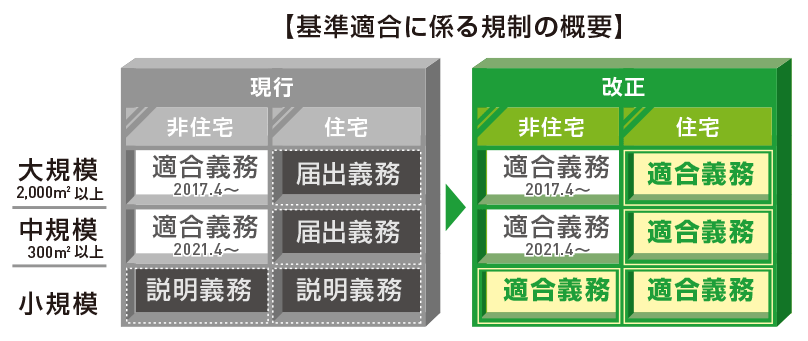
Second, the narrowing of the so-called "Article 4 exemption" and revised wall-quantity standards. Since April 1, 2025, within city planning areas, any building other than a single-storey structure of 200 m² or less in total floor area now requires a structural review regardless of its structural system. At the same time, to account for the added weight that energy-efficiency upgrades add to a building, the standards governing required wall quantity and minimum post cross-section were revised. A one-year transitional measure allowed former "Article 4" buildings of up to 300 m² total floor area that broke ground within one year of the revised law taking effect (by March 31, 2026 / Reiwa 8) to use the pre-revision standard — but that transitional measure ended as of March 2026. 国土交通省 (MLIT) has stated that even a building that received its building confirmation certificate under the transitional measure must, if construction unavoidably begins on or after April 1, 2026, be confirmed as compliant with the post-revision standard at the inspection stage. A two-storey, highly insulated house on a 50-tsubo lot falls squarely into this category. Confirm with your designer, at the earliest design stage, that wall-quantity calculations are being run under the new standard (Source: 国土交通省 (MLIT), Standards for Required Wall Quantity to Address Increased Building Weight from Energy Efficiency in Wooden Buildings, Revision to the Scale of Buildings Subject to Building Confirmation and Inspection).
2026 Mortgage Tax Deduction: The Loan-Balance Cap Can Swing by ¥25 Million (Approx. USD 166,700) Depending on Home Performance
For homes occupied between January 1, 2026 (Reiwa 8) and December 31, 2030 (Reiwa 12), Japan's jūtaku rōn genzei (住宅ローン減税, mortgage tax deduction) applies. This is Japan's closest equivalent to the US mortgage interest deduction, but it works differently: rather than deducting interest paid, Japan applies a flat 0.7% deduction rate to the year-end loan balance (up to a capped amount) and credits that directly against income tax owed. For new construction, both the loan-balance cap and the number of years you can claim the deduction depend on the home's energy-efficiency rating — and the gap between the best-performing and lowest-qualifying category is ¥25 million (approx. USD 166,700) in loan-balance cap alone.
Comparison Table 2: Loan-Balance Cap and Deduction Period for New Homes Occupied From 2026
| Home category | Loan-balance cap (general) | Loan-balance cap (households with children / young couples) | Deduction period | Eligible occupancy years |
|---|---|---|---|---|
| Long-term quality housing (chōki yūryō jūtaku) / low-carbon housing | ¥45,000,000 (approx. USD 300,000) | ¥50,000,000 (approx. USD 333,300) | 13 years | 2026–2030 |
| ZEH-standard energy-efficient housing | ¥35,000,000 (approx. USD 233,300) | ¥45,000,000 (approx. USD 300,000) | 13 years | 2026–2030 |
| Energy-efficiency-standard-compliant housing | ¥20,000,000 (approx. USD 133,300) | ¥30,000,000 (approx. USD 200,000) | 13 years | 2026–2027 only (not eligible from 2028 onward; however, homes that received building confirmation by end of 2027 etc. get ¥20,000,000 / approx. USD 133,300 for 10 years) |
| Other housing (below the energy-efficiency standard) | Not eligible for support, in principle | |||
Income eligibility requires total income of ¥20 million (approx. USD 133,300) or less; the floor-area requirement is 40 m² or more (50 m² or more if your total income exceeds ¥10 million / approx. USD 66,700, or if you are claiming the enhanced cap for households with children). In addition, starting with occupancy from 2028 (Reiwa 10) onward, new homes built in designated "disaster red zones" — areas at high risk of landslide or similar hazards — become ineligible for the deduction entirely, a category most foreign buyers would not think to check for on a Japanese title without local guidance.
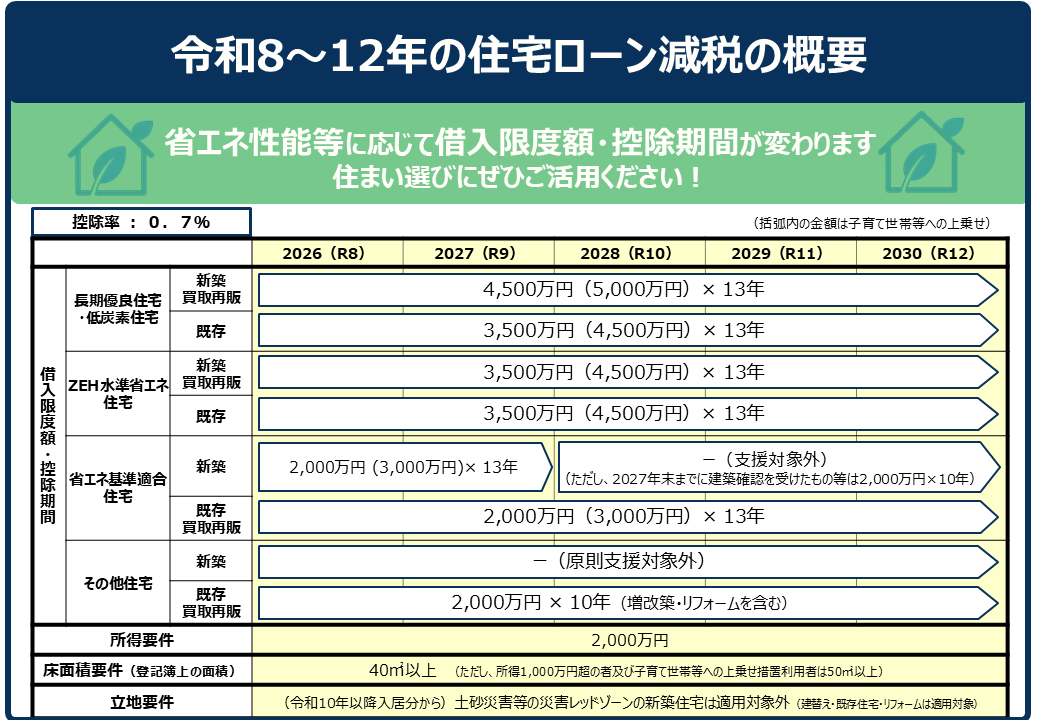
For a house built on a 50-tsubo lot, the floor-area requirement is essentially never the binding constraint — the deciding factor is performance rating. Building to long-term-quality-housing standard raises your design, application, and initial construction costs, but it also lifts your loan-balance cap from ¥20 million to ¥45 million. Run the deduction for the full 13-year period at the 0.7% rate and the two categories generate a total deduction of ¥1.82 million (approx. USD 12,100) versus ¥4.095 million (approx. USD 27,300) — a difference of roughly ¥2.27 million (approx. USD 15,100) in your pocket over the life of the deduction. Separately, there is a property-tax relief measure that halves the assessed tax on new housing for three years, extended to five years for certified long-term-quality housing — worth factoring into the same performance-tier decision (Source: 国土交通省 (MLIT), "Cabinet Decision to Extend and Expand the Mortgage Tax Deduction and Related Measures" (December 26, 2025 / Reiwa 7)).
Floor Plans on 50 Tsubo: Can You Fit a Two-Household House, a Single-Storey House, or a Courtyard House?
Whether a "two-household house is possible" or "a single-storey house is out of the question" on your 50-tsubo lot is not a matter of taste — it is settled by working backward from the required floor area, not from the floor plan you saw in a photo. The table below matches four representative house types to the building footprint and total floor area each one needs, and the building coverage ratio / floor area ratio required to support it.
Comparison Table 3: Feasibility of Different House Plans on 50 Tsubo (165.29 m²)
| Plan | Approx. total floor area | Required footprint | Required building coverage ratio / floor area ratio | Verdict on 50 tsubo |
|---|---|---|---|---|
| Fully separated two-household house (upper/lower split) | 170–200 m² | 85–100 m² | Coverage ratio 52–61% / floor area ratio 103–121% | Realistic with a 60% coverage ratio and 150%+ floor area ratio. At 50% coverage, each household's unit becomes cramped. |
| Single-storey 4LDK (4 bedrooms + living/dining/kitchen) | 105–120 m² | 105–120 m² | Coverage ratio 64–73% | At 60% coverage (99.2 m²), a 3LDK is about the practical ceiling. Achievable if corner-lot or fire-prevention relief lifts you to 70–80%. |
| Two-storey courtyard house (chūniwa, 中庭付き, a house built around an interior open-air courtyard) | 110–130 m² | 70–85 m² | Coverage ratio 43–52% / floor area ratio 67–79% | Works comfortably at 50% coverage / 100% floor area ratio. The best-fitting plan for a 50-tsubo lot. |
| Two-storey house with a built-in garage | 130–150 m² (of which garage is 15–20 m²) | 75–90 m² | Coverage ratio 46–55% / floor area ratio 79–91% | Relatively easy to achieve, since the garage portion is excluded from the floor-area-ratio calculation up to one-fifth of total floor area. |
The pattern to read here is simple: a single-storey house lives or dies by the building coverage ratio; a two-household house lives or dies by the floor area ratio. If a single-storey 4LDK is a serious contender for you, you need either a zoning district with a 60%-or-higher coverage ratio, or a lot that qualifies for the corner-lot or fireproof-building relief discussed above. There is a Japan-specific angle here worth flagging for overseas buyers: the fully separated two-household house is a distinctly Japanese housing product, built to accommodate multi-generational living (for example, aging parents and an adult child's family sharing one property with separate entrances and utilities) — a configuration far less common as a purpose-built housing type in the US, UK, or Australia, where multi-generational households more often retrofit an existing single-family house. For a detailed cost and layout comparison of the different degrees of household separation, see Price Benchmarks for Fully Separated Two-Household Houses, and the Difference Between Side-by-Side and Upper/Lower Separation.
Three Ways to Add Floor Area Within the Rules — and the Exact Conditions Each One Requires
Even within your coverage-ratio and floor-area-ratio limits, there are legitimate ways to expand livable space. Getting the exact statutory conditions wrong, however, is one of the most common ways a design falls apart mid-project. Here are the three most frequently misunderstood provisions:
- Basements (chikashitsu, 地下室): Under Article 52, Paragraph 3 of the Building Standards Act, floor area in a basement level whose ceiling sits no more than 1 m above ground level, and which is used for residential or elderly-care purposes, is excluded from the floor-area-ratio calculation — up to a limit of one-third of the total residential/elderly-care floor area. This is not "one-third of the whole building's floor area"; it is one-third of the residential-use portion specifically, and the ceiling-height condition must also be met. On a lot with a high water table or soft ground, basement construction costs can spike sharply, so wait for your soil survey results before committing to a basement in your budget.
- Balconies and eaves (barukonī / noki): Any portion projecting more than 1 m from the centerline of the exterior wall counts toward the building footprint from a point 1 m back from its outer edge (Building Standards Act Enforcement Order, Article 2, Paragraph 1, Item 2). This is a footprint-calculation rule, and it is a separate question from whether the space counts toward gross floor area. If the Minister of Land, Infrastructure, Transport and Tourism recognizes the structure as having sufficiently high openness, the portion within 1 m of the edge is excluded — so the design of the handrail and the presence or absence of walls change the treatment.
- Attic storage and lofts (kominari mono-oki / rofuto): The common convention is that a space with a ceiling height of 1.4 m or less, and a floor area no more than half that of the storey directly below, is not counted toward storey count or floor area. This is not a statutory provision, however — it is an operating standard applied by the competent administrative agency based on internal technical guidance. Details such as whether a fixed ladder is permitted vary by municipality, so confirm with the local building guidance division for your specific site.
In addition, garage space for cars (jidōsha shako-tō) is excluded from the floor-area-ratio calculation up to one-fifth of the combined floor area of every storey on the lot, under Building Standards Act Enforcement Order Article 2, Paragraph 1, Item 4(a) and Paragraph 3, Item 1. On a 150 m² house, up to 30 m² qualifies — enough to comfortably fit a two-car garage without eating into your floor-area-ratio allowance, a form of "free" bonus space that has no close equivalent in most Western zoning codes.
Live On It or Rent It Out? Comparing Four Uses for 50-Tsubo Land by Yield and Tax
For someone who has inherited (or otherwise come to own) 50 tsubo of land, the biggest fork in the road is whether to live on it, rent it out, or hold it as vacant land. Yield is not the only variable that matters here: whether or not you build a residence on the land changes the property tax on the land itself by up to a factor of six. This single fact — a tax mechanism tied directly to land use rather than to income or transaction value — has no direct parallel in most Western property-tax systems, where the land-use decision and the tax bill are far more loosely connected.
Comparison Table 4: Four Land-Use Options for 50 Tsubo
| Use | Approx. initial investment | Land property tax (assessment base) | Inheritance tax valuation | Exit flexibility |
|---|---|---|---|---|
| Own residence (detached house) | Construction cost from approx. ¥37,000,000 (approx. USD 246,700) | All 165.29 m² qualifies as small-scale residential land: 1/6 of assessed value | If it qualifies as land for a specific residence, an 80% reduction applies up to 330 m² — the full 50-tsubo area is covered | High flexibility for both sale and rebuild |
| Wood-frame apartment building (3 storeys, 9–12 units) | Construction cost for approx. 297.5 m² gross floor area, plus exterior works | Assessed per 200 m² per unit, so the entire lot still qualifies for the 1/6 rate | Valued as land with a rental building attached (reduced valuation); if it qualifies as land for a rental business, a 50% reduction applies up to 200 m² | Constrained by tenancy — selling or repurposing is harder while occupied |
| Monthly-contract surface parking (approx. 6 spaces) | Small — just paving, line-marking, and signage | No small-scale residential land relief; taxed as vacant land | Open-air parking does not qualify for the small-scale residential land tax exception | Easy to repurpose with only notice-of-termination required |
| Hold as vacant land | ¥0 (USD 0) | No small-scale residential land relief | No reduction | Maximum flexibility, but the highest ongoing tax burden |
The second column is the decisive one. Under Japan's property tax relief for residential land, the assessment base is reduced to 1/6 of assessed value for the portion up to 200 m², and to 1/3 for any portion beyond 200 m². Since 50 tsubo (165.29 m²) falls entirely under 200 m², even a single detached house on the lot gets the full 1/6 treatment on the whole area. A rental apartment building is assessed by dividing the lot area by the number of dwelling units, so it too qualifies for the 1/6 rate across the entire lot (Local Tax Act, Article 349-3-2). Parking lots and vacant land get neither relief — meaning whether or not you build a residence literally sixes your land property tax bill. For a full walkthrough of the mechanics and mitigation strategies, see How Property Tax on Vacant Land Can Reach Six Times a Built Lot, and Land-Use Strategies to Reduce It.
From an inheritance-tax standpoint, land with a rental apartment building on it is valued as kashiya-tatetsuke-chi (貸家建付地, "land with a rented building attached"), calculated as: self-use land value − (self-use land value × leasehold ratio × building leasehold ratio × occupancy rate). The leasehold ratio and building leasehold ratio for your specific location are published by 国税庁 (National Tax Agency, NTA) in its rosenka-zu (路線価図, roadside land price maps) and valuation multiplier tables. This inheritance-tax discount from building a rental property — routinely used by Japanese landowners as a deliberate estate-planning tool — is a strategy overseas investors rarely encounter in comparable form; where Western jurisdictions might apply a step-up in cost basis or an estate-tax exemption threshold, Japan instead directly discounts the assessed value of land once it is encumbered by tenancy. For more on using a rental building as an inheritance-tax strategy, see Why Apartment Management Reduces Inheritance Tax, and How the Valuation Mechanism Works.
How Many Units Can You Fit in a 50-Tsubo Apartment Building?
The short answer: on a 50-tsubo lot with a 60% building coverage ratio, a 200% floor area ratio, and a 6 m frontage road, you can expect roughly nine to ten units at approximately 25 m² each, or around twelve units at approximately 20 m² each. The calculation runs as follows:
- Maximum footprint = 165.29 m² × 60% = 99.2 m²
- Maximum floor area ratio = 165.29 m² × 200% = 330.6 m² (with a 6 m frontage road, the road-width cap of 6 × 4/10 = 240% exceeds the designated 200%, so the designated 200% governs)
- With three storeys, actual gross floor area = 99.2 m² × 3 = 297.5 m² (within the floor-area-ratio ceiling)
- Deducting 15–20% for shared common areas (stairwells, corridors) leaves a total leasable area of 238–253 m²
- At 25 m² per unit, that yields 9–10 units; at 20 m² per unit, roughly 12 units
The picture changes on a residential-zoned lot with only a 4 m frontage road. There, the floor area ratio is capped at 4 × 4/10 = 160% (264.5 m²), pulling the unit count down to 8–9 units at 25 m² each and roughly 11 units at 20 m² each. A road that is 2 m narrower can cost you one to two rentable units — and your fully-occupied rent roll drops by exactly that much. When planning an apartment project, check the frontage road before you check the floor area.
How Many Cars Fit If You Turn 50 Tsubo Into a Parking Lot?
If you convert 50 tsubo into monthly-contract surface parking, the theoretical maximum with parking spaces packed edge to edge is 11 cars — but what you can actually fit, once you allow room for vehicles to maneuver, is closer to 6.
Under the Ministry of Construction's Parking Lot Design and Construction Guidelines, a standard parking space measures 6.0 m × 2.5 m (15.0 m²) for a regular passenger car, 5.0 m × 2.3 m (11.5 m²) for a compact car, and 3.6 m × 2.0 m (7.2 m²) for a kei car (軽自動車, Japan's ultra-compact "kei" car class, with no direct Western equivalent). 165.29 m² ÷ 15.0 m² ≈ 11 spaces is the theoretical figure.
In practice, though, cars need room to enter and exit. On a lot with, say, 16.5 m of frontage and 10 m of depth, a single row accessed directly from the front road gives you 16.5 m ÷ 2.5 m = 6 cars. Try to add a second row behind it, and you now need a drive aisle in addition to the 6.0 m of parking-space depth. The same guidelines recommend a drive aisle width of 7.0 m for regular cars where there is no separate pedestrian walkway, or a minimum of 5.5 m where that is not achievable. 6.0 m + 5.5 m + 6.0 m = 17.5 m, which does not fit within a 10 m-deep lot — so two rows are simply not possible here. Mixing in kei-car-only spaces (3.6 m × 2.0 m) can push the count up to 7–8, at the cost of narrowing your pool of prospective tenants. And as noted above, parking lots get none of the small-scale residential land property-tax relief. In practice, the right way to decide is weighing the property tax increase against the rental income you would actually collect. For how the economics work under different operating models, see How Parking Lot Investment Works: Getting Started and Thinking Through Yield.
7 Things to Confirm Before You Buy or Develop 50-Tsubo Land
Here, the steps above are reordered into the sequence you would actually follow on-site and at the local government offices. Once these seven items are filled in, the outline of what you can build and what it will cost is essentially locked in.
- Zoning district, building coverage ratio, and floor area ratio: Confirm with the municipality's city planning information (the online city planning map, or the city planning division in person). This tells you which row of Comparison Table 1 above applies to your lot.
- Frontage road width and length of road frontage: Confirm the officially recognized width with the road management division, and physically measure it on-site as well. Below 12 m, your floor area ratio may be reduced. Below 2 m of road frontage, you cannot legally build at all.
- Fire Prevention District / Quasi-Fire Prevention District designation: Confirm with the city planning division. Fireproof and quasi-fireproof specifications directly affect construction cost, but they can also unlock the 10% building-coverage-ratio relief.
- Whether the lot carries a corner-lot designation: Confirm with the building guidance division. Corner-lot criteria vary by municipality — being physically on a corner does not automatically mean the relief applies.
- District plans, height limits, and setback requirements: Confirm with the city planning division. Low-rise exclusive residential districts sometimes carry a mandatory exterior-wall setback (1 m or 1.5 m), which reduces the actual buildable footprint below what the coverage ratio alone suggests.
- Soil conditions and water table: Commission a geotechnical survey firm. This is especially critical if you are considering a basement, and the results alone can swing your budget by several million yen.
- Post-April-2026 wall-quantity standard: Confirm with your designer that wall-quantity calculations are being run under the new standard. The transitional measure ended for projects breaking ground after March 31, 2026.
Frequently Asked Questions (FAQ)
Q. What is the going market rate for 50 tsubo of land in Japan?
Priced at the Reiwa 8 Official Land Price Publication's average residential-land rate, 50 tsubo costs approximately ¥141.55 million (approx. USD 943,700) in Tokyo's 23 wards, approximately ¥49.74 million (approx. USD 331,600) in Osaka City, approximately ¥38.02 million (approx. USD 253,500) in Nagoya City, approximately ¥19.40 million (approx. USD 129,300) in Sapporo, and approximately ¥5.77 million (approx. USD 38,500) in Aomori City. The same 50 tsubo can cost more than twenty times as much depending on the city. Actual transaction prices move up or down from these figures based on distance to the nearest station, road frontage, and lot shape, so use this only as a benchmark for the average residential land price in that city, not as a specific-property estimate.
Q. How many bedrooms/LDK can I fit on a 50-tsubo lot?
At a 50% building coverage ratio and 100% floor area ratio, you can build up to 165.3 m² of total floor area, making a two-storey 4LDK-to-5LDK house realistic. At a 40% coverage ratio and 80% floor area ratio, total floor area caps at 132.2 m², putting 4LDK at roughly the practical ceiling. If the frontage road is under 12 m, however, the floor area ratio may be reduced, so do not judge feasibility from the designated floor area ratio alone — recalculate from the actual road width.
Q. What does it cost to build a house with 50 tsubo of floor area?
Using the 2025 Flat 35 User Survey's national average construction cost for custom-built houses (¥359,000 per m², approx. USD 2,393 per m²), 165.29 m² × ¥359,000 ≈ ¥59.3 million (approx. USD 395,300). At the Greater Tokyo average of ¥387,000 per m² (approx. USD 2,580 per m²), the same floor area comes to roughly ¥64.0 million (approx. USD 426,700). Neither figure includes the cost of the land itself, registration fees, or exterior works.
Q. How many units can an apartment building on 50 tsubo hold?
On a lot with a 60% building coverage ratio, a 200% floor area ratio, and a 6 m frontage road, a three-storey building gives roughly 297.5 m² of gross floor area; after deducting shared common areas, that works out to about 9–10 units at approximately 25 m² each, or around 12 units at approximately 20 m² each. With only a 4 m frontage road, the floor area ratio drops to 160%, reducing the count to roughly 8–9 units at 25 m² each.
Q. What happens to property tax if I turn 50 tsubo into a parking lot?
Because the small-scale residential land relief no longer applies, the assessment base for the land's property tax reverts from 1/6 of assessed value back to the full assessed value. Since a lot with a residence on it under 200 m² is taxed at 1/6 of assessed value, the simple comparison is up to a six-fold difference. Whether it makes financial sense depends on whether your parking income exceeds that tax increase.
Q. Is a two-household house realistic on 50 tsubo?
With a building coverage ratio of 60% and a floor area ratio of 150% or higher, a fully separated (upper/lower split) two-household house is comfortably realistic. Securing the 170–200 m² of total floor area it requires needs an 85–100 m² footprint; at a 50% coverage ratio (82.6 m²), each household's unit becomes tight. At inheritance, the property may qualify as land for a specific residence, with an 80% reduction in assessed value up to 330 m² — but confirm the exact eligibility requirements with a tax accountant before relying on it.
Citations and References
- 国土交通省 (Ministry of Land, Infrastructure, Transport and Tourism, MLIT), "Reiwa 8 Official Land Price Publication" (as of January 1, 2026)
- 国土交通省 (MLIT), "Reiwa 8 Official Land Price Publication," Average Residential Land Prices for Prefectural Capital Cities (PDF)
- 国土交通省 (MLIT), "Reiwa 8 Official Land Price Publication," Table 3, Year-over-Year Average Change Rate by Region and Land Use (PDF)
- 国土交通省 (MLIT), "Overview of Reiwa 8 Official Land Price Publication Results" (PDF)
- 住宅金融支援機構 (Japan Housing Finance Agency, JHF), "2025 Flat 35 User Survey" Summary Tables
- 建築基準法 (Building Standards Act, via e-Gov Japanese Law Search), Articles 52 and 53
- 建築基準法施行令 (Building Standards Act Enforcement Order, via e-Gov Japanese Law Search), Article 2
- 国土交通省 (MLIT), "Building Energy Efficiency Act Article 10: Expansion of the Scope Subject to Mandatory Energy-Efficiency-Standard Compliance"
- 国土交通省 (MLIT), "The Rules Change from April 2025!" Guidance for Designers and Builders (PDF)
- 国土交通省 (MLIT), "Transitional Measures for Wall-Quantity Standards End as of March 2026" (PDF)
- 国土交通省 (MLIT), "Revision to the Scale of Buildings Subject to Building Confirmation and Inspection"
- 国土交通省 (MLIT), "Standards for Required Wall Quantity to Address Increased Building Weight from Energy Efficiency in Wooden Buildings"
- 国土交通省 (MLIT), "Cabinet Decision to Extend and Expand the Mortgage Tax Deduction and Related Measures" (December 26, 2025 / Reiwa 7)
- 国土交通省 (MLIT), "Necessary Measures Related to Housing-Acquisition Promotion Policies Including the Mortgage Tax Deduction" (PDF)
- 国土交通省 (MLIT), "Mortgage Tax Deduction (住宅ローン減税)"
- 総務省 (Ministry of Internal Affairs and Communications, MIC), "Overview of Property Tax"
- 地方税法 (Local Tax Act, via e-Gov Japanese Law Search), Article 349-3-2, Special Provision for the Property Tax Assessment Base on Residential Land
- 国税庁 (National Tax Agency, NTA), No. 4124, Special Valuation for Small-Scale Residential/Business-Use Land Inherited (Small-Scale Residential Land Tax Exception)
- 国税庁 (NTA), No. 4614, Valuation of Land With a Rental Building Attached
- 建設省 (former Ministry of Construction), "Parking Lot Design and Construction Guidelines" (PDF)
