South-facing is not "the orientation that struggles in summer" — it is the orientation that excels in winter. According to the official orientation coefficients published in a technical manual produced under a subsidized research project of the Ministry of Land, Infrastructure, Transport and Tourism (国土交通省, MLIT), summer solar gain is actually higher on east-facing walls (0.512) and west-facing walls (0.504) than on south-facing walls (0.434) — south is not the hottest orientation, despite what the compass direction suggests. South's real value shows up in winter, where its coefficient of 0.936 is roughly 3.6 times the north-facing value of 0.261. But recovering a rent premium through utility-bill savings alone turns out to be a difficult case to make, and you need to work out for yourself how large a monthly premium is actually rational before you agree to pay it.
This guide is for anyone standing in front of a viewing appointment or a rental application, trying to decide whether insisting on a south-facing unit — and paying an extra few thousand yen a month for it — is genuinely worth it in their own case. Rather than repeating generic orientation folklore, we lay out Japan's official orientation coefficients, sunshine-duration statistics, seasonal air-conditioner electricity consumption, and shadow-regulation rules in a form you can plug directly into your own calculation with a candidate property in front of you. Every figure in this article comes from a primary Japanese government or industry-association source that was current as of 2026.
This is a distinctly Japanese calculation, and it is worth pausing on why. Japanese rental listings display orientation (mukou, 向き) as a headline attribute in a way most Western listing platforms do not, and Japanese landlords routinely price a south-facing unit at a premium over an otherwise identical north-facing unit in the very same building. Just as importantly — and this will likely be the most surprising structural fact in this article for an investor used to the US MLS (Multiple Listing Service) or the UK's Land Registry Price Paid Data — Japan has no equivalent public database of actual signed rents or sale prices that you can search by orientation, floor, or unit number. The Japanese government publishes physics (solar coefficients, daylight-hour records, shadow-regulation formulas) in exhaustive, almost academic detail, but it does not publish a searchable record of what any specific unit actually rented for. That gap is exactly why this guide relies on physics and appliance-consumption data rather than on comparable-transaction statistics: for the orientation question in Japan, the physics is the only public dataset you get. We return to this point, and to the MLS comparison specifically, later in the article.
Key takeaways
- Under Japan's "Zone 6" orientation coefficients — the climate zone covering Tokyo, Osaka, and most of the country's major rental markets — the highest summer solar-gain coefficients belong to east (0.512) and west (0.504). South (0.434) is actually on the low side.
- The winter coefficient for south is 0.936, about 3.6 times north's 0.261. South-facing's economic value comes from winter warmth and daylight, not summer coolness.
- Heating with a Japanese air conditioner (Japan's standard heat-pump unit, used for both heating and cooling year-round) consumes roughly 2.4 times the electricity that cooling does: 607 kWh over a heating season versus 251 kWh over a cooling season, on a representative unit rated at 2.8 kW cooling capacity.
- With a window head height of 2.0 meters, direct sunlight reaches only about 0.44 m into the room at the summer solstice, versus 3.34 m at the winter solstice. A balcony roughly 1.5 m deep turns out to be the tipping point between the two.
- Commercial, industrial, and exclusively-industrial zoning districts (yōto chiiki, 用途地域, Japan's land-use zoning categories) are completely exempt from shadow regulations. Choose a south-facing unit without checking the zoning to its south, and your future sunlight has no legal protection at all.
What Does "South-Facing" Mean in Japan? Defining Orientation and Japan's Solar Conditions
In Japanese rental listings, minami-muki (南向き, "south-facing") means the balcony or the unit's largest window — its primary daylighting face — points south. Because Japan sits in the Northern Hemisphere, the sun tracks across the southern sky, and a south-facing window receives the longest cumulative hours of direct sunlight of any orientation across the year. That single fact accounts for almost the entire rent premium south-facing units command in Japan. The same physics applies across the Northern Hemisphere — the same logic is why UK and US real-estate agents sometimes tout "south-facing gardens" too — but Australian and other Southern-Hemisphere buyers should flip the compass: in Australia, it is the north-facing aspect that carries the premium, for the identical astronomical reason in reverse. Few Western rental markets, however, treat orientation as a standalone, headline listing attribute and price it as explicitly as Japan does.
Orientation Is Defined by the Balcony or Primary Daylighting Face — Not the Whole Unit
The "south-facing" label on a Japanese rental floor plan (madori-zu, 間取り図) usually refers to the balcony's orientation. In a corner unit, though, the living room's floor-to-ceiling sliding glass door (hakidashi-mado, 掃き出し窓, a sliding window that opens directly onto the balcony) may face south while the bedroom windows face east or west. The orientation label describes one primary face of the unit, not the character of every room in it. When you review a floor plan, cross-check the compass marking against the position of each individual window — do not assume the headline orientation applies to the whole unit.
There is a second catch: a unit can be south-facing on paper and still fail to deliver usable sunlight. In a low-floor unit that faces a street to the south, passers-by and cars can make opening the curtains feel too exposed, so residents keep them closed and never actually capture the orientation's benefit. "South-facing" on a listing describes the potential to receive sunlight — it is not a guarantee that you will.
Tokyo's Solar Noon Altitude: 77.7° at the Summer Solstice, 30.9° at the Winter Solstice — a 47° Swing on the Same South-Facing Window
According to the National Astronomical Observatory of Japan (国立天文台, NAOJ), the sun's altitude at solar noon on the summer solstice equals 90° minus latitude plus 23.4°; on the winter solstice it equals 90° minus latitude minus 23.4°; and at the spring and autumn equinoxes, when the sun's declination is 0°, it equals simply 90° minus latitude. Applying Tokyo's latitude of roughly 35.7°N gives a solar-noon altitude of 77.7° at the summer solstice, 54.3° at the equinoxes, and 30.9° at the winter solstice — a difference of 46.8°, roughly 47°, between the two solstices.
That 47° swing is what actually determines how a south-facing unit performs. In summer the sun sits almost directly overhead and strikes a vertical south-facing window pane at a shallow, glancing angle. In winter the sun sits low on the horizon and drives straight through a south-facing window at a much steeper, more direct angle. The same south-facing room behaves like two entirely different rooms depending on the season — readers used to markets where "south-facing" is marketed as one static, year-round attribute should note that in Japan it is really two separate seasonal effects bundled into a single label.
[Data Table] Solar Gain by Orientation: Japan's Official Coefficients Show South Is Not the Peak Summer Exposure
Solar gain by orientation does not have to be a matter of intuition — Japan publishes an official coefficient for it. The "orientation coefficient" (hōi keisū, 方位係数) expresses the solar gain on a vertical wall facing each of eight compass directions as a ratio to the solar gain on a horizontal surface (set to 1.0), with separate values defined for summer and winter within each of Japan's climate zones. The table below reproduces the values for "Zone 6" (chiiki 6, 6地域) — the temperate climate zone that covers Tokyo, Osaka, and most of Japan's major urban rental markets — from a technical manual produced under a fiscal-2023 (Reiwa 5) MLIT-subsidized research project.
Zone 6 Orientation Coefficients, All Eight Compass Directions (Summer and Winter)
| Orientation | Summer coefficient | Winter coefficient |
|---|---|---|
| North | 0.341 | 0.261 |
| Northeast | 0.431 | 0.325 |
| East | 0.512 | 0.579 |
| Southeast | 0.498 | 0.833 |
| South | 0.434 | 0.936 |
| Southwest | 0.491 | 0.763 |
| West | 0.504 | 0.523 |
| Northwest | 0.427 | 0.317 |
Source: 一般社団法人 木を活かす建築推進協議会 (Association for the Promotion of Wood-Utilizing Construction), Energy-Efficient Housing Design and Construction 2023 [Zones 4–7 Edition] (住宅の省エネルギー 設計と施工 2023【4〜7地域版】), Table 3.1.1, "Orientation Coefficients for the Six Climate Zones" (6地域の方位係数), produced under a fiscal-2023 (Reiwa 5) MLIT-subsidized project. Colder climate zones (Zones 1–3, covering Hokkaido and much of Tōhoku) use different coefficients; if you are evaluating a property in those regions, consult the corresponding zone table in the same manual rather than the Zone 6 figures above.
In Winter, South-Facing Receives About 3.6x the Solar Gain of North-Facing (0.936 vs. 0.261)
The winter orientation coefficient for south is 0.936 — the highest of all eight compass directions by a clear margin, and roughly 3.6 times north's 0.261. Southeast (0.833) and southwest (0.763) follow behind it, while east (0.579) and west (0.523) fall to roughly half of south's value. Measured purely by the ability to draw solar heat indoors in winter, south-facing units are in a different class from every other orientation.
The same source manual states directly that "the more southerly the wall, the larger the orientation coefficient in winter, and the greater the effect of solar gain." If there is a rational basis for south-facing units commanding a rent premium in Japan, the accurate reading is that the premium is paid for winter warmth and daylight — not for summer performance. For a reader used to a market where "south-facing" is marketed as one blanket, year-round premium feature, Japan's data makes an unusually precise, disaggregated case: the premium is really a winter-specific premium.
Summer's Highest Solar Gain Belongs to East (0.512) and West (0.504) — South (0.434) Is Actually Smaller
Look at the summer coefficients, though, and the ranking flips. The largest is east at 0.512, followed by west at 0.504, southeast at 0.498, and southwest at 0.491. South, at 0.434, ranks fourth-smallest of the eight — ahead of only north (0.341), northwest (0.427), and northeast (0.431). The same source manual states plainly that "in summer, the east and west orientation coefficients are large, and the south orientation is not particularly notable in solar impact compared with the other directions."
The reason lies in solar-noon altitude. The summer sun sits at a high 77.7°, so it strikes a vertical south-facing pane of glass at a shallow, glancing angle. East- and west-facing walls, by contrast, take the low-altitude morning and evening sun square-on, near-perpendicular to the glass. The popular belief that "south-facing gets hot in summer" feels intuitively correct, but it runs directly against the primary orientation-coefficient data.
Is the Warning Against South-Facing Units Justified? If Summer Heat Is the Concern, West-Facing Is the Bigger Risk
You'll sometimes hear Japanese rental advice along the lines of minami-muki yametoke ("skip the south-facing unit"), usually justified by summer heat and sun-fading of interior finishes. But if you rank orientations purely by summer solar-gain volume, the ones to be more cautious about are actually west (0.504) and east (0.512) — not south. West-facing units are further disadvantaged because their solar gain is concentrated in the late afternoon, exactly when outdoor air temperature also peaks, so the felt heat ends up worse than the raw solar-gain numbers alone would suggest.
If there is a legitimate reason to be cautious about south-facing units, it is cost-effectiveness rather than solar exposure. Because south-facing is popular, it tends to carry an easy rent premium, and in some cases that premium is not recoverable through utility savings or comfort gains. We think that is the real substance behind the folk warning — and whether a given premium is justified is something you can calculate for your own candidate property using the break-even formula later in this article.
Checking the Data Behind the Warning Against Southwest-Facing Units
Southwest's summer coefficient is 0.491 — about 13% higher than south's 0.434. Its winter coefficient is 0.763, the second-highest of all eight directions after south's 0.936. In other words, southwest captures winter benefits close to south's level while carrying a somewhat heavier summer burden than south does.
Southwest's real weakness, though, is less about the coefficient gap itself than about timing. Its strongest solar gain arrives in the late afternoon and early evening, exactly overlapping the daily outdoor-temperature peak. If you are typically home in the late afternoon, you'll likely feel this disadvantage; if you're out during the day and return only in the evening, you may barely notice it. Whether to avoid a southwest-facing unit is really a question about your own daily schedule, not a verdict about the orientation itself.
[Comparison Table] All Eight Orientations at a Glance: Choosing by the Winter-to-Summer Ratio
The single most useful metric for choosing an orientation is the "winter-to-summer ratio" — the winter coefficient divided by the summer coefficient. The higher this ratio, the more an orientation is "strong in winter, not particularly weak in summer." The lower it is, the more the orientation reads as "weak in winter, cool in summer."
Winter-to-Summer Ratio and Best-Suited Daily Schedule, by Orientation
| Orientation | Summer | Winter | Winter-to-summer ratio | Best suited for | Caution |
|---|---|---|---|---|---|
| South | 0.434 | 0.936 | 2.16 | Households home during the day, remote workers, families with young children | Carries the steepest rent premium |
| Southeast | 0.498 | 0.833 | 1.67 | Early risers who are mostly home in the morning | Afternoon sun fades early |
| Southwest | 0.491 | 0.763 | 1.55 | Those who are out during the day and return in the evening | Room temperature climbs fast on summer afternoons |
| East | 0.512 | 0.579 | 1.13 | Early risers who are typically out by the afternoon | Highest summer coefficient of all eight orientations |
| West | 0.504 | 0.523 | 1.04 | Night owls who dislike cold winter mornings | Peak outdoor heat coincides with peak solar gain |
| Northeast | 0.431 | 0.325 | 0.75 | Best suited to bedrooms and studies | Almost no winter solar gain to expect |
| Northwest | 0.427 | 0.317 | 0.74 | Those who are out during the day and prioritize lower rent | Watch for winter chill and condensation |
| North | 0.341 | 0.261 | 0.77 | Rent-conscious households mostly out during the day | Lowest summer solar gain of all eight orientations |
The winter-to-summer ratio is calculated from the orientation coefficients above (rounded to two decimal places). South's ratio of 2.16 makes the point cleanly: south-facing is not "the orientation that basks in strong summer sun," it is "the orientation that concentrates winter solar gain." If you'd like to compare the broader characteristics of each orientation side by side, see our companion guide, How to Choose a Well-Lit Direction, and the Characteristics of Each Orientation.
Rational Reasons to Choose Something Other Than South — North Has the Lowest Summer Solar Gain of Any Orientation
Choosing something other than south-facing is not always a matter of settling for second best. North's summer coefficient of 0.341 is the lowest of all eight directions, making it the single most favorable orientation purely in terms of avoiding summer solar heat load. For storing books or musical instruments, or for a workspace built around a monitor screen, where you want to avoid direct sunlight and rapid temperature swings, north-facing becomes an active, deliberate choice rather than a fallback.
North-facing units also tend to carry lower rent within the same building, freeing up that difference for more square footage or a shorter commute. If your daily schedule keeps you out of the apartment for most of the day, the winter coefficient's weak point (0.261) rarely shows up in lived experience. For a closer look at how to weigh a north-facing or lower-sunlight unit, see The Pros and Cons of a Home with Poor Sunlight.
[Worked Example] How Far Does South-Facing Sunlight Actually Reach Indoors? Sizing the Balcony Depth
"If the balcony is too deep, no sunlight gets in" is common advice, but almost nothing tells you exactly how many meters is too many. Once you know the sun's altitude, that distance is a simple trigonometry problem.
With a 2.0 m Window-Head Height: 0.44 m at the Summer Solstice, 1.44 m at the Equinoxes, 3.34 m at the Winter Solstice
Assume the outer edge of the eave or balcony overhang sits at the same height as the top of the window, and that height is 2.0 m above the floor. The horizontal distance direct sunlight reaches into the room equals "window-head height ÷ tan(solar-noon altitude)." Plugging in Tokyo's solar-noon altitudes gives the following:
| Time of year | Solar-noon altitude | Horizontal reach indoors (2.0 m window head) |
|---|---|---|
| Summer solstice | 77.7° | approx. 0.44 m |
| Spring / autumn equinox | 54.3° | approx. 1.44 m |
| Winter solstice | 30.9° | approx. 3.34 m |
The solar-noon altitudes are calculated by applying Tokyo's latitude of 35.7°N to the National Astronomical Observatory of Japan's formula cited earlier. At higher latitudes the sun sits lower and the reach distance grows correspondingly longer — worth remembering if you're comparing a Tokyo listing against one further north, such as in Sendai or Sapporo.
A Balcony Roughly 1.5 m Deep Is the Tipping Point
The implication of this calculation is straightforward. If the balcony is roughly 1.5 m deep, the summer-solstice direct sunlight (reaching only 0.44 m) is almost entirely caught by the balcony floor itself and never enters the room. The winter-solstice sun, meanwhile, reaches 3.34 m — so even after subtracting the 1.5 m balcony depth, it still penetrates more than 1.8 m into the room.
In other words, a south-facing unit with a balcony roughly 1.5 m deep hits something close to the ideal outcome: it blocks summer sun while still drawing winter sun deep into the room. Push the balcony depth past 2.5 m, though, and winter sunlight starts getting cut too; drop it to around 0.8 m, and summer sun comes straight through into the room unfiltered. The balcony depth printed on a floor plan matters just as much as the orientation label itself.
Schedule Viewings Around Solar Noon (11 a.m.–2 p.m.) to See the Worst Case
The most useful time to schedule a viewing is 11 a.m. to 2 p.m., which brackets solar noon. This is when the sun's altitude is at its daily peak and shadows cast by buildings to the south are at their smallest. If a unit still feels dark, or is still sitting in shadow, during this window, you can reasonably conclude it will struggle to get direct sunlight at any point in the year.
You can look up the exact solar-noon time and solar altitude for any date and location using the National Astronomical Observatory of Japan's Ephemeris Computation Office (暦計算室) online tool. Checking the solar-noon time for your viewing date in advance lets you concentrate your limited viewing time in the single most informative window of the day.
[Worked Example] How Much Does Orientation Actually Change Your Utility Bill? Finding the Rent-Premium Break-Even Point
The short answer up front: realistically, utility-bill savings alone are unlikely to cover a rent premium tied to orientation. Let's work through the published air-conditioner figures step by step. (Reference exchange rate used throughout this section: ¥150 = USD 1, as of August 2026; treat every USD figure as approximate.)
Heating an Air Conditioner Uses About 2.4x the Electricity That Cooling Does
According to the Agency for Natural Resources and Energy's (資源エネルギー庁, ANRE) Energy-Saving Performance Catalog 2025 Edition (Household) (省エネ性能カタログ2025年版(家庭用)), a representative wall-mounted heating-and-cooling air-conditioner model (2024) rated at 2.8 kW cooling capacity consumes 251 kWh of electricity over a full cooling season and 607 kWh over a full heating season — heating uses roughly 2.4 times what cooling does. A larger, 4.0 kW representative model shows the same pattern: 396 kWh cooling versus 944 kWh heating.
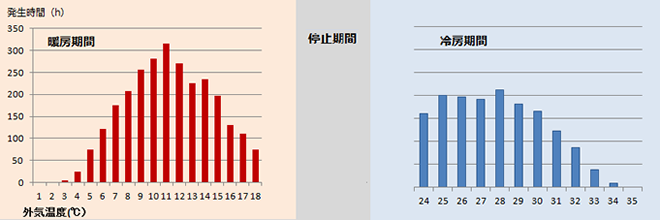
This gap comes partly from how the calculation defines the seasons for the Tokyo reference model — the cooling season runs May 23 to October 4, while the heating season runs November 8 to April 16 — and partly from the simple fact that winter indoor-outdoor temperature differences are larger than summer ones. Orientation discussions tend to fixate on "summer heat," but the real weight of electricity consumption sits on the winter side. If you also want to size cooling capacity against room area, see our companion guide, How to Choose Air Conditioner Capacity by Room Size in Japan.
The Catalog Figures Already Assume a "South-Facing Wood-Frame House"
Here's a detail that's easy to overlook. Japan's seasonal-electricity-consumption calculation is standardized under JIS C 9612:2013 (Japanese Industrial Standard), and the reference building it assumes is explicitly defined as "an average wood-frame house (south-facing)." The assumed indoor set-point temperatures are 27°C for cooling and 20°C for heating, over an 18-hour operating window from 6 a.m. to midnight.
In other words, the electricity-cost figures printed on every air-conditioner catalog already bake in a south-facing assumption. A north-facing unit is likely to run somewhat higher on the heating side than these published numbers, while choosing a south-facing unit will not meaningfully undercut the catalog figures either — they're already the south-facing case. The expectation that "going south-facing will dramatically cut your electricity bill" does not hold up well against the standard's own assumptions.
Estimated Annual Electricity Cost: Heating approx. ¥16,400 (USD 109), Cooling approx. ¥6,800 (USD 45), at ¥27/kWh
The same catalog calculates an estimated electricity cost as "seasonal electricity consumption × ¥27/kWh (approx. USD 0.18/kWh)." Applied to the 2.8 kW representative model, that works out to 251 kWh × ¥27 = approx. ¥6,800 (USD 45) for cooling, 607 kWh × ¥27 = approx. ¥16,400 (USD 109) for heating, for a combined total of approx. ¥23,200 (USD 155).
Now assume that choosing a south-facing unit cuts the heating load by 10%. Ten percent of 607 kWh is about 61 kWh, or roughly ¥1,600 (USD 11). Even under an aggressive 20% reduction assumption, the saving only reaches about ¥3,300 (USD 22). To be clear, "10%" and "20%" here are illustrative assumptions for the purpose of the calculation — no public statistic quantifies the actual relationship between orientation and heating load.
The answer also shifts somewhat depending on which electricity rate you plug in. The Fair Trade Council of the Household Electric Appliance Industry (公益社団法人 全国家庭電気製品公正取引協議会) sets a reference electricity rate of ¥31/kWh (approx. USD 0.21/kWh, tax included, revised July 22, 2022) for these estimates; using that rate instead increases the saving by about 15%, to roughly ¥3,800 (USD 25) even under the 20% reduction assumption. Either way, it doesn't move the number by an order of magnitude.
How Much Rent Difference Is Rational? The Break-Even Formula
The whole decision collapses into a single formula:
- Annual rent difference = monthly rent difference × 12 months
- Estimated annual utility savings = heating-season electricity consumption × assumed reduction rate × electricity unit price
- If the annual rent difference exceeds the estimated annual utility savings, treat the remainder as payment for comfort, brightness, and how easily laundry dries indoors
Take a south-facing unit that costs ¥3,000 (USD 20) more per month, for example: that's an extra ¥36,000 (USD 240) a year. Against that, even an aggressive 20% reduction assumption only yields about ¥3,300 (USD 22) in utility savings. The remaining approx. ¥32,700 (USD 218) is best understood as what you're actually paying for: a brighter, warmer room in winter, laundry that dries faster, and less indoor humidity buildup.
Framed that way, the decision rule becomes: if you're home during the day for long stretches, dry laundry indoors and outdoors frequently, or find winter cold genuinely hard to tolerate, a ¥3,000 (USD 20) difference is well worth paying. If you're typically out during the day and home only in the evening, redirecting that same ¥3,000 (USD 20) toward more floor space or a shorter commute will likely leave you more satisfied.
No Official Statistics Exist on Rent Differences by Orientation — So We Won't Pretend There Are
You may come across claims online that "a south-facing unit rents for so many yen more per month than an equivalent north-facing unit." As of 2026, no public authority in Japan continuously tracks rent differentials by orientation. Within the same building, floor level, corner-unit status, view, and layout typically vary at the same time as orientation, which makes isolating orientation alone as a price variable a genuinely difficult statistical problem — one that, as far as we can determine, no Japanese government agency or major listing portal has published a rigorous answer to.
This is worth pausing on, because for an investor coming from the US, UK, Australia, or Singapore, it will likely be the single most surprising structural fact in this entire article. In the US, the MLS (Multiple Listing Service) and county-level public records make actual closed sale prices — and, through services like Zillow or Redfin, often rent comparables too — searchable in seconds. The UK's HM Land Registry publishes every residential sale price, address by address, as open data. Singapore's URA (Urban Redevelopment Authority) publishes actual transacted private-property rents and prices by project. Japan has no direct equivalent for rents, and even its closest analogue for sale prices — MLIT's Land General Information System (土地総合情報システム), built from the industry's REINS transaction database — publishes only anonymized, area-level transaction data, not searchable address-level records. An overseas investor who tries to "pull the comps" the way they would at home, to price a south-facing unit against a north-facing one, will simply find that the data does not exist in Japan. That is not a data-quality failure on Japan's part; it reflects a real-estate information culture built around a domestic tenant walking into a local leasing office with a paper floor plan, not a remote, data-driven overseas buyer. It is also precisely why this article leans on physics — solar coefficients, sunshine-hour records, appliance energy-consumption ratings — rather than on comparable-transaction statistics: for the orientation question in Japan, physics is the only public dataset you actually get.
Our policy is not to hand you an unfounded rule of thumb just because one is expected. Instead, plug the real rent difference between the two specific units you're actually weighing into the formula above. Whether that difference suits your own daily schedule is something only your own numbers — not a market average that doesn't exist anyway — can answer. We believe being candid about this kind of uncertainty, downsides included, is what builds long-term trust with a client.
[Data Table] Tokyo's Monthly Sunshine-Duration Normals: Rainy-Season June Is 68 Hours Shorter Than January
That south-facing's value concentrates in winter is also confirmed by long-term sunshine-duration averages. Looking at the Japan Meteorological Agency's (気象庁, JMA) 30-year normal values for Tokyo (statistical period 1991–2020), January's sunshine duration is 192.6 hours — 68.4 hours more than June's 124.2 hours, which falls during Japan's June rainy season (tsuyu, 梅雨).
| Month | Sunshine duration (hours) | Global solar radiation (MJ/m²) |
|---|---|---|
| January | 192.6 | 9.4 |
| February | 170.4 | 11.5 |
| March | 175.3 | 13.3 |
| April | 178.8 | 16.1 |
| May | 179.6 | 17.3 |
| June | 124.2 | 14.8 |
| July | 151.4 | 15.6 |
| August | 174.2 | 15.8 |
| September | 126.7 | 11.9 |
| October | 129.4 | 9.8 |
| November | 149.8 | 8.6 |
| December | 174.4 | 8.1 |
| Annual total | 1,926.7 | — |
South-Facing's Value Peaks When Sunshine Duration Is Long and Solar Altitude Is Low: Winter
January and December rank among the longest-sunshine months of the year. Layer on top of that a low solar-noon altitude of 30.9° at the winter solstice. Long hours of sunshine, arriving at a low angle that drives straight through a south-facing window — those two factors compounding together is exactly why winter's south orientation coefficient reaches its standout value of 0.936.
Global solar radiation itself, though, tells a slightly different story: January's 9.4 MJ/m² is barely more than half of May's peak value of 17.3 MJ/m². South-facing's winter advantage comes from "how long the sun is out" and "the angle at which it hits the window," not from the raw total energy the sun is delivering. That distinction is worth keeping straight.
When Does Interior Sun-Fading Actually Happen? Using the UV Index's Seasonal Swing to Time Your Countermeasures
Interior sun-fading, often cited as a downside of south-facing units, doesn't progress at a constant pace year-round. The Japan Meteorological Agency's long-term monthly average of Tokyo's daily maximum UV index shows a seasonal swing of more than threefold.
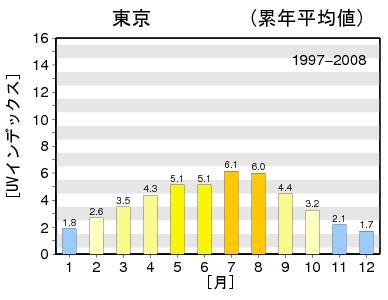
As the chart shows, UV intensity is strongest from May through September, peaking at 6.1 in July and 6.0 in August. December sits at just 1.7, and January at 1.8. If your priority is protecting wallpaper, flooring, or tatami mat color from fading, you don't need year-round countermeasures — concentrating them across May to September covers the exposure efficiently.
Cross-referencing this against the orientation coefficients sharpens the priority further. The orientations that receive the most sunlight during the high-UV summer months are east (0.512) and west (0.504) — south (0.434) is actually on the lower end. Avoiding a south-facing unit specifically to reduce fading risk turns out to have weak numerical support. For guidance on whether blackout curtains or window shutters are an effective countermeasure, see The Role of Window Shutters in Japanese Rental Properties, and What to Check.
Even a South-Facing Unit Can Lose Its Sunlight: Reading the Future Daylight Risk in Zoning Law
Even if you choose south-facing, sunlight disappears the moment a tall building goes up to the south of you. And whether that building can legally be built at all comes down almost entirely to the use-zoning district assigned to the land to your south. This information doesn't appear on any rental listing, but anyone can look it up through their municipality's city-planning information portal.
[Data Table] Height Limits and Shadow Regulations by Use-Zoning District, at a Glance
| Use-zoning district (用途地域) | Absolute height limit (Building Standards Act Art. 55) | Shadow-regulation measurement height | Maximum permitted shadow duration (Appended Table 4) |
|---|---|---|---|
| Category I & II Low-Rise Exclusive Residential Districts; Rural Residential Districts | 10 m or 12 m | 1.5 m | Within 10 m: 3–5 hrs / beyond 10 m: 2–3 hrs |
| Category I & II Mid/High-Rise Exclusive Residential Districts | None | 4 m or 6.5 m | Within 10 m: 3–5 hrs / beyond 10 m: 2–3 hrs |
| Category I & II Residential Districts; Quasi-Residential Districts; Neighborhood Commercial Districts; Quasi-Industrial Districts | None | 4 m or 6.5 m | Within 10 m: 4–5 hrs / beyond 10 m: 2.5–3 hrs |
| Commercial Districts; Industrial Districts; Exclusively Industrial Districts | None | — | Not regulated |
Japan's shadow regulation (nikage kisei, 日影規制), set under Article 56-2 and Appended Table 4 of the Building Standards Act (建築基準法, Kenchiku Kijun-hō), restricts a new building from casting a shadow of more than a specified duration beyond a horizontal distance of 5 m from the site boundary, measured on true solar time on the winter solstice between 8 a.m. and 4 p.m. (9 a.m. to 3 p.m. within Hokkaido). Exactly which zones the rule applies to, and which of the permitted shadow-duration tiers is used, is decided by each municipality's own ordinance. The table above shows the range set by national law; actual figures vary by municipality. Note also that even land with no use-zoning designation at all can still fall under Appended Table 4 and be regulated by local ordinance.
Commercial, Industrial, and Exclusively Industrial Districts Are Exempt from Shadow Regulation — Check the Zoning to Your South
The bottom row of the table is the one to watch most closely. The Building Standards Act's Appended Table 4 simply does not list commercial, industrial, or exclusively industrial districts. That means no shadow regulation applies in those zones at all, and there is no legal mechanism to restrict a high-rise building to your south on daylight grounds, however much shadow it casts on your unit.
Readers familiar with the UK's common-law "right to light" doctrine, or with US zoning setback and height-plane rules, should note that Japan's shadow regulation works quite differently: it is a statutory formula tied to specific zoning categories, decided in advance by law and local ordinance, not a case-by-case nuisance claim you could bring after the fact — and, critically, it simply does not exist at all within commercial, industrial, and exclusively industrial districts, full stop. Conversely, if the land to the south is a Category I Low-Rise Exclusive Residential District, building height there is capped at 10 or 12 m in principle (Building Standards Act Art. 55). Even if that southern lot is currently a parking lot or a two-story house, if it sits within a commercial or quasi-industrial district, it is safest to assume your future sunlight is not guaranteed. Checking the zoning to the south isn't about "how sunny is it today" — it's about "how sunny will it still be in 10 years."
Daylighting Rules Were Relaxed from 1/7 to 1/10 in April 2023 — Why Smaller Windows Are Now Appearing
Article 19, Paragraph 3 of the Enforcement Order of the Building Standards Act (建築基準法施行令) requires that, for a habitable room in a residence, the area of window openings effective for daylighting be at least one-seventh of the room's floor area. Under a revision that took effect April 1, 2023 (Reiwa 5), however, that requirement can now be relaxed down to as little as one-tenth, provided measures such as installing supplemental lighting fixtures meet a standard set by MLIT's Minister.
That standard specifically requires lighting fixtures capable of maintaining at least 50 lux of illuminance at floor level. Because this relaxation applies to newly built housing too, going forward you may encounter units with smaller windows than in the past that are nonetheless fully legal. Checking the actual window dimensions and count on the floor plan — rather than relying on the "south-facing" label alone — now matters more than it used to.
Seven Checkpoints to Verify With Real Numbers During a Viewing
Here's everything above condensed into something you can actually check on-site during a viewing. Recording numbers instead of impressions makes comparing multiple properties dramatically easier.
- Schedule the viewing for 11 a.m.–2 p.m. Shadows are smallest around solar noon; if a unit is still dark during this window, you can reasonably conclude it won't get much direct sunlight at any point in the year.
- Measure the balcony depth yourself. Around 1.5 m blocks summer direct sun while still letting winter sun reach deep into the room. Beyond 2.5 m, winter sunlight starts getting cut too.
- Check the window-head height. Using 2.0 m as the baseline, a taller window head lets winter sunlight reach further into the room.
- Visually record the height and distance of buildings to the south. Confirming true south first with a compass app on your phone improves accuracy.
- Look up the zoning district to the south through your municipality's city-planning information portal. Commercial, industrial, and exclusively industrial districts are exempt from shadow regulation.
- Check the balcony railing material. A tall concrete parapet can block the low winter sun on lower floors; glass or open lattice railings let it through.
- Cross-check each room's window orientation against the compass marking on the floor plan. Corner units have windows facing multiple directions, so losing sunlight on one face doesn't necessarily mean losing it everywhere.
Beyond these seven points, for everything else worth checking during a viewing — fixtures, noise, shared areas, and more — see our full Rental Property Viewing Checklist. Used alongside the orientation checks above, it helps you make the most of a limited viewing slot.
What Do Actual Tenants Prioritize Over Orientation? MLIT's FY2025 Housing Market Trend Survey
Finally, let's widen the lens. MLIT's Fiscal 2025 (Reiwa 7) Housing Market Trend Survey Report (令和7年度 住宅市場動向調査 報告書), published in July 2026 (Reiwa 8), surveyed households that had moved into private rental housing on the reasons behind their choice.
The #1 Reason Rental Tenants Choose a Home: "Price/Rent Was Appropriate" at 45.8% — "Orientation" Isn't Even a Listed Option
| Reason for choosing the home (multiple answers allowed) | Private rental households |
|---|---|
| Price/rent was appropriate | 45.8% |
| Location was favorable | 37.6% |
| Convenient transit access | 34.2% |
| Close to workplace | 27.6% |
| Good design, size, or facilities | 27.3% |
What stands out is that the survey's answer choices don't include "orientation" or "sunlight" as a standalone category at all. Daylighting is folded into "design, size, or facilities" as just one component among several — a very different weighting from rent, location, and transit access, which each stand as their own top-line reason.
The Single Most Common Compromise: "Rent," at 28.6% — Also the Most Common Post-Move Dissatisfaction
In the same survey, among private rental households, the most common answer to "what did you compromise on when choosing your home" was "price/rent (ended up higher than planned)," at 28.6%, followed by unit size at 17.1% and layout/room count at 15.3%. Among concrete items respondents said they were dissatisfied with after moving in, price/rent again topped the list at 17.3%.
On the burden of rent specifically, 8.3% said they feel it is "a significant burden" and 45.6% said "somewhat of a burden," for a combined 53.9% who feel some financial strain from their rent. Paying a premium purely to secure a south-facing orientation means voluntarily walking into the single category respondents most often regret, statistically speaking. That doesn't mean you shouldn't choose south-facing — it means you should convert the premium into an annual figure and actually look at it before you commit.
Bottom Line: Choose by Your Daily Schedule and the Size of the Rent Premium, Not by Orientation Alone
South-facing is a winter-strong orientation. Its winter coefficient of 0.936 is roughly 3.6 times north's — a difference you can verify with official data rather than take on faith. Its summer coefficient of 0.434, meanwhile, is smaller than east's 0.512 and west's 0.504, so the popular judgment "avoid south-facing because it's hot in summer" has no support in the primary data.
In practice, though, recovering that advantage through utility savings alone is difficult. Even a 20% cut to the 607 kWh heating-season electricity consumption saves only about ¥3,300 (USD 22) a year, while a ¥3,000 (USD 20) monthly rent premium adds up to ¥36,000 (USD 240) a year. Think of the premium you pay for orientation not as an electricity-bill offset, but as payment for winter brightness and warmth, faster-drying laundry, and lower indoor humidity.
The decision sequence, then, looks like this. First, be honest with yourself about how much of the day you're actually home. Second, multiply the rent difference between your candidate units by 12 to get an annual figure. Third, check the zoning to the south and the balcony depth to see whether that sunlight is actually protected going forward. Work through those three steps, and the orientation debate stops being a matter of preference and becomes a concrete calculation.
One more note: if your real goal is simply winter warmth, the building's own insulation performance matters more than orientation does. Two south-facing units with different insulation grades can feel — and cost — very differently to live in, so we'd recommend checking insulation performance alongside orientation as part of the same decision.
Frequently Asked Questions (FAQ)
Q. Which is more livable, south-facing or east-facing?
If winter sunlight is your priority, south-facing wins. Comparing Zone 6 winter coefficients, south sits at 0.936 versus east's 0.579 — south receives roughly 1.6 times the solar gain. In summer, though, east's coefficient of 0.512 is the highest of all eight orientations, while south's 0.434 is on the low side. If you're an early riser who's typically out by the afternoon, east-facing's downside is minor; if you're home for long stretches during the day, south-facing will feel more comfortable.
Q. How much more does a south-facing unit typically cost in rent?
No public statistics on rent differences by orientation exist as of 2026 — floor level, corner-unit status, and view all vary simultaneously with orientation even within the same building, making an apples-to-apples comparison difficult to construct. Base your decision on the actual rent figures for the specific units you're comparing. As a rule of thumb, compare "monthly rent difference × 12" against "607 kWh heating-season consumption × assumed reduction rate × ¥27/kWh (approx. USD 0.18/kWh)" — the latter comes out to only about ¥3,300 (USD 22) even at a 20% reduction assumption.
Q. Will I regret a south-facing unit because of summer heat?
In terms of summer solar-gain volume alone, south-facing is not particularly disadvantaged. Zone 6's summer coefficient for south is 0.434, lower than east (0.512), west (0.504), southeast (0.498), and southwest (0.491). At the summer solstice's solar-noon altitude of 77.7°, direct sunlight through a window with a 2.0 m head height reaches only about 0.44 m into the room. A balcony roughly 1.5 m deep is enough to block nearly all of that direct summer sun.
Q. Under what circumstances can a south-facing unit still end up with poor sunlight?
Mainly when a tall building goes up on the land to your south. Three things are worth checking. First, the use-zoning district to the south — commercial, industrial, and exclusively industrial districts aren't listed in the Building Standards Act's Appended Table 4 and are exempt from shadow regulation entirely. Second, the absolute height limit — Category I & II Low-Rise Exclusive Residential Districts and Rural Residential Districts are capped at 10 or 12 m (Building Standards Act Art. 55). Third, balcony depth — beyond roughly 2.5 m, winter sunlight also struggles to reach deep into the room.
Sources & References
- 一般社団法人 木を活かす建築推進協議会 (Association for the Promotion of Wood-Utilizing Construction), Energy-Efficient Housing Design and Construction 2023 [Zones 4–7 Edition] (住宅の省エネルギー 設計と施工 2023【4〜7地域版】), Table 3.1.1, "Orientation Coefficients for the Six Climate Zones" (6地域の方位係数) (October 2023 / Reiwa 5, produced under an MLIT-subsidized project)
- 資源エネルギー庁 (Agency for Natural Resources and Energy, ANRE), Energy-Saving Performance Catalog 2025 Edition (Household) (省エネ性能カタログ2025年版(家庭用)) (seasonal electricity consumption, estimated electricity cost, regional correction coefficients)
- 一般社団法人 日本冷凍空調工業会 (Japan Refrigeration and Air Conditioning Industry Association), "Choose Seasonal Electricity Consumption as Your Guide to Energy Efficiency" (期間消費電力量を省エネ性の目安にお選びください) (JIS C 9612:2013 calculation conditions)
- 公益社団法人 全国家庭電気製品公正取引協議会 (Fair Trade Council of the Household Electric Appliance Industry), "Frequently Asked Questions" (よくある質問Q&A) (reference electricity rate ¥31/kWh, revised July 22, 2022 / Reiwa 4)
- 気象庁 (Japan Meteorological Agency, JMA), "Tokyo Normal Values (Statistical Period 1991–2020), Monthly Sunshine Duration and Global Solar Radiation" (東京の平年値(統計期間1991〜2020年)月別の日照時間・全天日射量)
- 気象庁 (Japan Meteorological Agency, JMA), "Monthly Long-Term Average Graph of Daily Maximum UV Index (Analyzed Values)" (日最大UVインデックス(解析値)の月別累年平均値グラフ)
- 国立天文台 (National Astronomical Observatory of Japan, NAOJ), "How Is the Sun's Solar-Noon Altitude Calculated?" (太陽の南中高度はどうやって計算する?)
- 国立天文台 暦計算室 (National Astronomical Observatory of Japan, Ephemeris Computation Office) (sunrise/sunset, solar-noon time, and solar altitude by location)
- e-Gov Japanese Law Search, Building Standards Act (建築基準法), Articles 55, 56-2, and Appended Table 4
- e-Gov Japanese Law Search, Enforcement Order of the Building Standards Act (建築基準法施行令), Article 19 Paragraph 3 and Article 20
- 国土交通省 (Ministry of Land, Infrastructure, Transport and Tourism, MLIT), "Results of Public Comment on the Partial Revision of the Public Notice Establishing Standards for Lighting Fixture Installation, Effective Daylighting Methods, and Other Equivalent Measures" (照明設備の設置、有効な採光方法の確保その他これらに準ずる措置の基準等を定める件の一部を改正する告示案に関する意見募集の結果について) (February 7, 2023 / Reiwa 5)
- 国土交通省住宅局 (MLIT Housing Bureau), Fiscal 2025 (Reiwa 7) Housing Market Trend Survey Report (令和7年度 住宅市場動向調査 報告書) (July 2026 / Reiwa 8)
- 国土交通省 (MLIT), "Housing Market Trend Survey" statistics top page (住宅市場動向調査)
