Shirokanedai is on the verge of yet another transformation. The "Shirokane 1-Chome Seibu-Naka District Category 1 Urban Redevelopment Project," which broke ground in October 2025, is a large-scale mixed-use development centered on a 39-story tower rising approximately 140 meters, integrating 991 residential units, commercial facilities, and childcare support facilities. Completion is scheduled for fiscal year 2029. Positioned as a "redevelopment that coexists with the community" through its explicit partnership with the Shirokane Shopping Street, the project is drawing growing attention from investors and property owners.
Project Overview | What Kind of Area Is Shirokane 1-Chome Seibu-Naka?
The Shirokane 1-Chome Seibu-Naka District is an area of approximately 1.6 hectares located in Shirokane 1-Chome, Minato City, Tokyo. Situated within walking distance of Shirokane-Takanawa Station on the Tokyo Metro Namboku Line and Toei Mita Line, this district has long been characterized by a mixed landscape of residential and commercial properties. While aging buildings and narrow streets remain, the area has also been valued for its tranquil hilltop setting and excellent access to central Tokyo.
The project is being carried out by the "Shirokane 1-Chome Seibu-Naka District Urban Redevelopment Association." The urban planning decision was made in July 2018, followed by approval for the association's establishment in June 2022, and approval of the rights conversion plan in February 2024. In terms of Minato City's urban planning framework, the project is designated as an initiative to create a mixed-use urban district by introducing high-quality housing with strong residential permanence and commercial functions that connect with the Shirokane Shopping Street as the area's vibrant commercial corridor.
While the "Eastern-North District" of the same Shirokane 1-Chome area saw the completion of Shirokane The Sky in 2023, the Seibu-Naka District is an independent project with a different project area, developer, and concept. Whereas the Eastern-North District pursued an internationally competitive development emphasizing proximity to Takanawa Gateway Station, the Seibu-Naka District takes a distinctly different direction as a "community-rooted, residence-oriented mixed-use development."
Decoding the Development Specs | A 39-Story Tower and Three Blocks
The project comprises three blocks: Block A, Block B-1, and Block B-2.
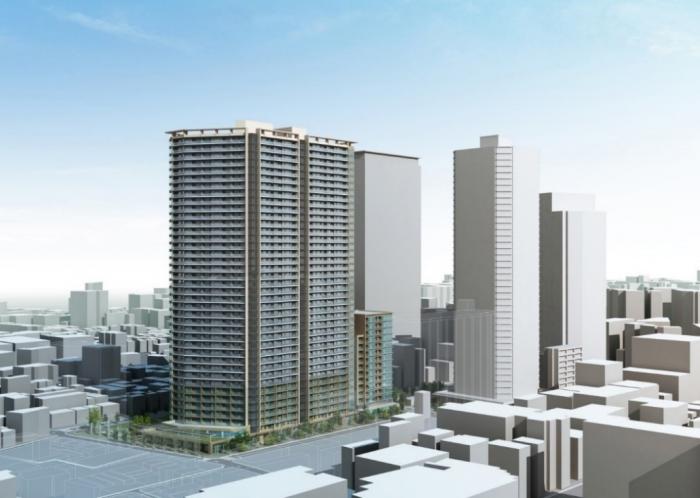
Block A is the core of the project—a supertall tower with 39 above-ground floors and one basement level, standing approximately 140 meters tall with a total floor area of roughly 97,910 square meters. With a building coverage ratio of approximately 43% and a floor area ratio of approximately 649%, it will house 991 residential units along with retail spaces, childcare support facilities, and 263 parking spaces. As a predominantly residential large-scale tower condominium, it will play a significant role in housing supply for the Shirokanedai area.
Blocks B-1 and B-2 are low-rise complementary blocks. Block B-1 is a 4-story structure (approximately 15 meters tall) with a total floor area of roughly 1,000 square meters, while Block B-2 is also 4 stories (approximately 15 meters tall) with a total floor area of roughly 950 square meters. Both are relatively modest in scale, designed with careful consideration for the surrounding streetscape. Rather than concentrating everything in a single high-rise, the multi-block configuration incorporating low-rise buildings reflects a clear design intent to maintain visual continuity with the existing shopping street landscape.
The primary uses designated for the entire project are "residential, retail, childcare support facilities, workshops, parking, and related functions," aiming to create a multifunctional mixed-use district. Notably, the inclusion of workshop use reflects consideration for the continuity of existing rights holders' livelihoods.
Project Timeline | From Groundbreaking to Completion
The project's history and upcoming schedule are summarized below.
| Date | Milestone |
|---|---|
| July 2018 | Urban planning decision |
| June 2022 | Association establishment approval |
| February 2024 | Rights conversion plan approval |
| October 2025 | Construction commencement |
| Fiscal year 2029 | Scheduled completion |
Approximately seven years elapsed from the urban planning decision to the start of construction. This reflects the meticulous process inherent to Category 1 urban redevelopment projects—building consensus among rights holders, completing association establishment procedures, and formulating the rights conversion plan. By the time construction began in October 2025, the rights conversion plan had already been approved, meaning that former land and building rights had been converted into rights in the redeveloped building.
A construction period of approximately four years is anticipated until the planned completion in fiscal year 2029. This timeline is standard for a large-scale mixed-use development centered on a supertall tower (39 stories, approximately 140 meters). Both landowners and investors need to make informed management decisions that account for the prolonged impact on the surrounding area.
Impact Analysis on Shirokanedai Area Real Estate Values
The Shirokanedai and Shirokane-Takanawa area has long been recognized as one of central Tokyo's most prestigious residential neighborhoods. As analyzed in our article on the impact of Shirokane-Takanawa area redevelopment on real estate values, the district has maintained a consistent upward trend in land prices, a trajectory further reinforced by the convergence of multiple redevelopment projects.
The impact of the Seibu-Naka District development on the existing real estate market can be considered from three key perspectives.
First, the increase in housing supply and the bolstering of demand. While the large-scale supply of 991 units could theoretically pose a short-term risk of oversupply, the brand prestige of the Shirokanedai address and superior central Tokyo access suggest that occupancy demand will remain relatively stable. In fact, the completion of a tower condominium is likely to raise the profile of the entire surrounding area, generating an "area branding effect" that boosts rental demand for existing properties.
Second, the enhancement of convenience through strengthened commercial functions. The integration of a partnership with the Shirokane Shopping Street into the project concept is noteworthy as a commercial coexistence model within large-scale redevelopment. The addition of commercial amenities within the mixed-use complex will improve walkable convenience, potentially attracting families and long-term residents.
Third, the promotion of residential permanence through childcare support facilities. Securing childcare and parenting-related facilities has become one of the most critical factors in recent urban living demand. Both the Tokyo Metropolitan Government and Minato City have identified enhanced childcare support as a priority policy initiative, and the incorporation of childcare support facilities into the redevelopment project directly contributes to promoting long-term residency in the area.
Key Points for Property Owners and Investors
During the construction period—from the October 2025 groundbreaking through the anticipated fiscal year 2029 completion—several changes are expected in the surrounding rental market.
Regarding rental demand during construction, temporary demand increases from construction workers and temporarily relocated residents are possible, while some reduction in residential comfort due to construction noise and vibration is unavoidable. Properties located at a certain distance from the construction site may actually experience concentrated demand. Making investment decisions that maintain and enhance property competitiveness from a medium- to long-term perspective is essential.
As for post-completion asset values, positive effects are anticipated based on comparable nearby examples. As demonstrated in our analysis of the Shibuya Station area redevelopment and its impact on property values, large-scale redevelopment tends to lift land prices and rents across the broader surrounding area. For the Shirokane 1-Chome Seibu-Naka District as well, it is worth considering how the area brand enhancement following completion could relatively elevate the values of existing neighboring properties.
Property owners are encouraged to adopt long-term asset management strategies. Rather than reacting to the short-term impacts of the construction period, making decisions that factor in the scenario of rising area value from fiscal year 2029 onward will be a crucial perspective for wealth building.
INA's Perspective | A New Model for Urban Development Emerging from Shirokane 1-Chome Seibu-Naka
What caught my attention most in the Shirokane 1-Chome Seibu-Naka project plan was the phrase "partnership with the Shirokane Shopping Street." Large-scale tower redevelopments often tend to absorb existing local commerce, replacing it with homogenized commercial facilities. This project, however, positions the existing shopping street as the "area's vibrant commercial corridor" and has designed its commercial functions to work in tandem with its revitalization.
This carries meaningful implications from a real estate investment perspective as well. Rather than serving only the residents of the tower condominium as customers, coexisting with the surrounding area's established community allows the entire district's value to appreciate sustainably. This kind of long-term vision for urban development deeply resonates with the core value that we at INA&Associates hold dear: "the happiness of everyone involved."
The introduction of childcare support facilities can be understood in the same context. Enriching the lives of residents raises the area's residential retention rate, which in turn stabilizes local commercial demand—creating a virtuous cycle. The Seibu-Naka District redevelopment, advancing with community coexistence at its core in the rare and prestigious residential area of Shirokanedai. We will be watching closely from a long-term perspective to see what kind of streetscape and market value this area develops after completion in fiscal year 2029 and beyond.
Summary
- The Shirokane 1-Chome Seibu-Naka District Category 1 Urban Redevelopment Project is a mixed-use development spanning approximately 1.6 hectares, anchored by a 39-story, approximately 140-meter tower (991 units, commercial space, and childcare support facilities)
- Construction began in October 2025, with completion targeted for fiscal year 2029
- The project is distinguished by its partnership with the Shirokane Shopping Street and the integration of childcare support facilities, adopting a "residence-oriented" redevelopment concept distinct from the Eastern-North District (Shirokane The Sky)
- Positive impacts on the surrounding real estate market are expected both during and after construction, though decisions grounded in a long-term perspective are essential
- For investors and property owners, now is the time to begin developing asset management strategies that anticipate the area's enhanced brand value following the fiscal year 2029 completion
Frequently Asked Questions (FAQ)
Q1. When will the Shirokane 1-Chome Seibu-Naka redevelopment be completed?
A. Construction began in October 2025, with completion scheduled for fiscal year 2029. Specific details regarding the completion date and move-in timing are expected to be announced by the project developer in due course.
Q2. How does this differ from the Shirokane 1-Chome Eastern-North District (Shirokane The Sky)?
A. These are independent projects with different project areas and developers. The Eastern-North District (Shirokane The Sky) was completed in 2023 as a high-rise branded condominium development emphasizing proximity to Takanawa Gateway Station. The Seibu-Naka District is a "community coexistence" mixed-use development centered on its partnership with the Shirokane Shopping Street and the introduction of childcare support facilities—a fundamentally different concept.
Q3. How will the values of existing condominiums and rental properties in the area change?
A. In the short term (during construction), concerns about construction noise and vibration impacts may arise. However, over the medium to long term, the enhancement of the area's brand through the tower condominium's completion and improvements in daily convenience are likely to boost both rental demand and asset values for existing properties. Since impacts vary depending on a property's location and condition, we recommend consulting with a specialist.
Q4. Are there investment opportunities in the Shirokane 1-Chome Seibu-Naka redevelopment?
A. As this is a Category 1 Urban Redevelopment Project, there is no mechanism for general investors to participate directly. However, involvement through investing in surrounding pre-owned condominiums and rental properties, or purchasing newly built units after completion, is possible. For more details, please contact INA&Associates.
Related Articles
- Impact of Shirokane-Takanawa Area Redevelopment on Real Estate Values (As of April 2025)
- Shibuya Station Area Redevelopment: Full Overview and Impact on Property Values
Citations and References
