Five large-scale redevelopment projects are advancing simultaneously in Chuo Ward's waterfront area. Combining the Kachidoki East, Toyomi, Tsukishima 3-Chome North, Tsukishima 3-Chome South, and Tsukiji districts, the total unit count exceeds 8,000 and combined project costs surpass ¥1 trillion. Between 2026 and the early 2030s, the urban fabric of this area will be fundamentally transformed.
Five Major Redevelopments Underway in Chuo Ward's Waterfront
The Kachidoki, Toyomi, Tsukishima, and Tsukiji areas of Chuo Ward have long served as residential neighborhoods and market hubs, thanks to their prime waterfront location close to central Tokyo. However, aging buildings and growing demand for urban renewal have spurred five large-scale redevelopment projects now progressing in parallel.
The four residential projects alone are set to deliver over 7,300 tower apartment units. On top of that, the former Tsukiji Market site has launched a massive mixed-use development spanning approximately 1.26 million m² of total floor area at an estimated cost of around ¥900 billion. Even within the "once-in-a-century" urban transformation championed by the Tokyo Metropolitan Government, the concentration of development in this area stands out.
Each project is at a different stage of progress—some are nearing completion, while others are targeting a grand opening in the 2030s. This is precisely why understanding the scope and timeline of each project is essential for property owners and investors making informed decisions.
Kachidoki East District Redevelopment — Building B Breaks Ground to Complete the Project
The Kachidoki East redevelopment is a large-scale project led by the Kachidoki East District Urban Redevelopment Association, with Mitsui Fudosan Residential participating as a project partner. It comprises three towers: Building A1 (58 stories, approx. 194 m, 1,665 units), Building A2 (45 stories, approx. 165 m, 1,121 units), and Building B (29 stories, approx. 103 m, 464 units).
Buildings A1 and A2 have already been completed, with residents moving in. The remaining Building B broke ground in April 2026, with completion scheduled for May 2029. Once Building B is finished, the entire project—totaling approximately 3,250 units at a cost of roughly ¥180.6 billion—will be complete.
Population growth around Kachidoki Station is already evident, and commercial and lifestyle amenities continue to expand. After Building B's completion, the area's overall urban functionality is expected to reach new heights.
Toyomi District Redevelopment "THE TOYOMI TOWER MARINE & SKY" — A 2,046-Unit Twin Tower by Six Major Developers
In the Toyomi district, a twin tower is under construction as a joint venture among six major firms: Mitsui Fudosan Residential, Tokyu Land Corporation, Tokyo Tatemono, Nomura Real Estate, Mitsubishi Jisho Residence, and Shimizu Corporation. Officially named "THE TOYOMI TOWER MARINE & SKY," it rises 53 stories to approximately 189 meters.
With 2,046 units, it ranks among the largest residential developments in the waterfront area. Completion is slated for November 2026, with move-ins beginning in August 2027. The project will also include community facilities such as a civic hall, medical clinic, and atrium.
The six-company consortium brings together a wealth of expertise and financial strength, underscoring the project's stability. In fact, it is rare for this many leading developers to collaborate on a single venture—a testament to the market's high expectations for the Toyomi district.
Tsukishima 3-Chome North District "Grand City Tower Tsukishima" — A 58-Story Landmark for Tsukishima
"Grand City Tower Tsukishima" is being developed in the Tsukishima 3-Chome North district by Sumitomo Realty & Development and Penta-Ocean Construction. Standing 58 stories and approximately 200 meters tall, it will be the tallest building in the Tsukishima area.
The tower comprises approximately 1,285 units, with completion set for April 2026 and move-ins from December 2026. As the first of the five projects to reach completion, it is poised to become Tsukishima's new landmark.
Tsukishima sits just 1.5 km from Ginza—a prime central location that still retains its traditional neighborhood charm. The arrival of a 200-meter tower will significantly alter the streetscape, and the resulting impact on property values warrants close attention.
Tsukishima 3-Chome South District "Central Garden Tsukishima The Tower" — A 48-Story Tower Coexisting with Monja Street
"Central Garden Tsukishima The Tower" is under construction in the Tsukishima 3-Chome South district. Developed jointly by Mitsui Fudosan Residential, Nomura Real Estate, and Taisei Corporation, the project will deliver a 48-story tower standing approximately 177 meters tall with 744 units.
Construction began in January 2024, with completion scheduled for September 2028 at a project cost of approximately ¥53.9 billion. The site sits adjacent to Tsukishima's famous Monja Street, making coexistence with the area's history and culture a central theme of the development.
Combined with Grand City Tower in the north district, Tsukishima 3-Chome alone will see over 2,000 new tower apartment units. The residential population of the Tsukishima-Kachidoki area is set to increase substantially, driving greater demand for infrastructure and commercial facilities.
Tsukiji District Urban Development Project — A ¥900 Billion, 1.26 Million m² Mega-Project
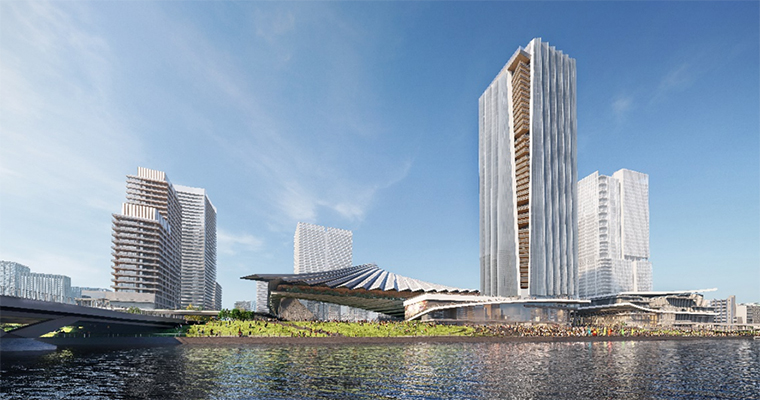
By far the largest of the five projects is the Tsukiji District Urban Development Project. Spanning approximately 19 hectares of the former Tsukiji Market site, it is being advanced by a consortium of 11 companies led by Mitsui Fudosan, including Toyota Fudosan and the Yomiuri Shimbun Group.
The total floor area reaches approximately 1.26 million m² across nine buildings, with project costs estimated at around ¥900 billion. This site—equivalent to roughly 27 Tokyo Domes—will house a mixed-use complex of offices, retail, hotels, residences, and cultural facilities.
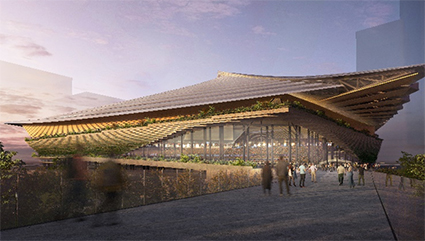
A standout feature is the multi-stadium with a capacity of approximately 50,000. Its flexible design scales from 20,000 to 57,000 seats, accommodating sports, entertainment, MICE events, and more. The plan also includes a life sciences hub and a waterway transportation network.
In terms of timeline, temporary facilities are expected to begin operations in fiscal 2026–27, with the first phase of the "grand opening" planned for the early 2030s. For a deeper look at the Tsukiji project, see our detailed analysis in Overview and Future Prospects of the Tsukiji District Urban Development Project.
Comparison of All Five Projects
| Project | Developer(s) | Stories & Height | Total Units | Completion | Project Cost |
|---|---|---|---|---|---|
| Kachidoki East | Mitsui Fudosan Residential | A1: 58F/194 m, A2: 45F/165 m, B: 29F/103 m | Approx. 3,250 | Bldg. B: May 2029 | Approx. ¥180.6 billion |
| Toyomi | Mitsui Fudosan Residential + 5 partners | 53F / approx. 189 m | 2,046 | Nov. 2026 | — |
| Tsukishima 3-Chome North | Sumitomo Realty & Development / Penta-Ocean Construction | 58F / approx. 200 m | Approx. 1,285 | Apr. 2026 | — |
| Tsukishima 3-Chome South | Mitsui Fudosan Residential / Nomura Real Estate / Taisei Corporation | 48F / approx. 177 m | 744 | Sep. 2028 | Approx. ¥53.9 billion |
| Tsukiji | Mitsui Fudosan + 10 partners | 9 buildings / approx. 1.26M m² total floor area | — (Mixed-use) | Early 2030s | Approx. ¥900 billion |
The four residential projects alone account for approximately 7,325 units, while the combined project cost across all five developments exceeds ¥1 trillion. The fact that development of this magnitude is concentrated within a roughly 2 km radius is extraordinary, even by Tokyo standards.
The Waterfront Subway and the Area's Long-Term Potential
A key factor that could further elevate the Chuo Ward waterfront's prospects is the Waterfront Subway (Rinkai Chikatetsu) planned by the Tokyo Metropolitan Government. Envisioned as a new line connecting Tokyo Station to the waterfront, with anticipated stops at Kachidoki and Tsukiji, it would dramatically improve transportation access in the area.
Currently, rail access is primarily limited to Kachidoki and Tsukishima stations on the Toei Oedo Line. The Waterfront Subway would provide direct connections to Tokyo Station and the Shimbashi area, boosting not only commuting convenience but also property values across the district.
Once Tsukiji's multi-stadium and mixed-use complex are fully operational, the area is expected to attract millions of visitors annually. Coupled with the expansion of rail infrastructure, the entire waterfront zone has the potential to evolve into a comprehensive urban hub where people can live, work, and enjoy world-class amenities.
Implications for Property Owners and Investors
With development of this scale concentrated in a single area, it is essential to assess the impact on the real estate market from multiple angles.
Shifts in rental demand deserve close attention. The supply of over 7,000 tower apartment units may create short-term competition with existing rental properties in the surrounding area. However, as the working population grows and commercial amenities improve, overall housing demand in the area is likely to expand over the medium to long term. Once the Tsukiji mixed-use development reaches full scale in the early 2030s, an additional surge in demand can be anticipated.
For existing property owners, upgrading facilities and enhancing management quality will be key to maintaining competitiveness. Differentiating from newly built tower apartments requires investment decisions made with a long-term perspective.
For those considering selling, it is important to monitor each project's completion timeline and the progress of the Waterfront Subway. An exit strategy timed to coincide with peak market interest in the area will be most effective. In this environment, informed analysis grounded in reliable data is more important than ever.
Frequently Asked Questions (FAQ)
Q1. Which of the five redevelopment projects will be completed first?
A. "Grand City Tower Tsukishima" in the Tsukishima 3-Chome North district is scheduled for completion in April 2026, making it the first to finish. Move-ins are expected to begin in December 2026. Next is "THE TOYOMI TOWER MARINE & SKY" in the Toyomi district, with completion planned for November 2026.
Q2. When will the Tsukiji District Urban Development Project be completed?
A. Temporary facilities are expected to begin operations in fiscal 2026–27, with the first phase of the "grand opening" planned for the early 2030s. Full completion will take additional time, as facilities will be developed in stages.
Q3. When will the Waterfront Subway open?
A. As of March 2026, no specific opening date has been confirmed. The Tokyo Metropolitan Government is currently studying the project for implementation. If realized, it will significantly improve transportation access to the Kachidoki and Tsukiji areas.
Q4. How will these redevelopments affect surrounding property prices?
A. The large-scale housing supply and concentration of urban functions are expected to enhance the overall brand value of the area. However, in the short term, the influx of new units may put pressure on the resale condominium market. A long-term perspective is essential when making investment decisions.
Related Articles
- Overview and Future Prospects of the Tsukiji District Urban Development Project
- Tokyo Redevelopment Plans: A "Once-in-a-Century" Urban Transformation
References
- Tokyo Metropolitan Government Bureau of Urban Development — Kachidoki East District Type 1 Urban Redevelopment Project
- Tokyo Metropolitan Government Bureau of Urban Development — Toyomi District Type 1 Urban Redevelopment Project
- Tokyo Metropolitan Government Bureau of Urban Development — Tsukishima 3-Chome North District Type 1 Urban Redevelopment Project
- Tokyo Metropolitan Government Bureau of Urban Development — Tsukishima 3-Chome South District Type 1 Urban Redevelopment Project
- Mitsui Fudosan Co., Ltd. — Tsukiji District Urban Development Project Master Plan (August 2025)
