When a front-door door closer (the pneumatic arm that controls how a door swings shut) suddenly starts slamming, the first question most owners have is simple: how much will this cost to fix? This is a distinctly Japanese question to ask in a distinctly Japanese way — Japan's major building-materials makers publish official, itemized repair price lists for exactly this kind of fixture, something that has no real equivalent in the US, UK, or Australian markets, where a homeowner would typically just call a local handyman and negotiate a price on the spot. According to LIXIL, one of Japan's largest door and window manufacturers, the official benchmark for replacing a door closer is ¥32,000–¥121,000 (approx. USD 200–760, at ¥159 = USD 1 as of 2026-08-14), and a speed adjustment alone runs ¥19,000–¥33,000 (approx. USD 120–210) (source: LIXIL "Repair Cost Guide," as of June 2025; figures include callout fee, labor, parts, and consumption tax). If oil is seeping from the unit itself, adjustment is no longer an option — replacement is the only path forward.
This guide is written for three groups of readers: owners of rental (chintai, 賃貸) properties, unit owners (kubun shoyūsha, 区分所有者) in condominium buildings called bunjō manshon (分譲マンション, sectional-ownership condominiums — Japan's dominant form of urban multi-unit ownership, structurally closer to a US condo or a UK leasehold flat than to a freehold house), and households whose own front door has started acting up. Using primary-source Japanese material, it works through four decisions: how much repair costs, how long a door closer actually lasts, who you should call, and — critically for anyone buying investment property in Japan — who is legally responsible for paying. A great deal of content circulating online suggests a door closer is something a handy owner can swap out themselves. Japanese manufacturers explicitly say otherwise, and this guide explains why, citing the exact language from their official documentation.
Key Takeaways
- The manufacturer's official benchmark for replacement is ¥32,000–¥121,000 (approx. USD 200–760); for adjustment alone it is ¥19,000–¥33,000 (approx. USD 120–210). The minimum call-out charge is ¥14,300 (approx. USD 90).
- If oil is seeping or dripping from the unit, repair is not possible. No amount of adjustment will fix it — replacement is the only remedy.
- The industry durability standard is 200,000 open-close cycles. At 8 uses a day that works out to roughly 68 years; at 50 uses a day, roughly 11 years — a more than sixfold difference driven purely by how often the door is used.
- Manufacturers state explicitly that "customers cannot replace the unit themselves." An owner's own job stops at documenting the symptoms and identifying the model number.
- In a Japanese condominium (bunjō manshon), only the lock and the interior paint surface of the front door count as your private, exclusively-owned space — the door closer itself is legally a shared, common-area component. A unit owner cannot simply have it replaced on their own authority.
How Much Does a Door Closer Replacement Cost in Japan? The Manufacturer's Official Price Guide
The overall cost picture splits into two bands depending on the symptom: roughly ¥20,000 (approx. USD 125) if adjustment alone will do, and ¥30,000 (approx. USD 190) or more once replacement is required. Some Japanese-language forums and blogs cite a going rate of around ¥15,000 (approx. USD 95), but the official repair pricing published by Japan's building-materials manufacturers does not come in that low. To avoid being surprised the moment a quote lands in your inbox, it's worth anchoring on the manufacturer's own published numbers first — a level of published pricing transparency that is itself unusual by the standards of most Western home-repair markets, where quotes are typically negotiated case by case rather than published as a fixed schedule.
Cost Quick-Reference by Symptom (LIXIL, "Repair Cost Guide," as of June 2025)
| Symptom / Location | Likely Work | Estimated Cost (tax included) |
|---|---|---|
| Front door: opens/closes too fast or too slow | Door closer / hinge closer replacement | ¥32,000–¥121,000 (approx. USD 200–760) |
| Front door: opens/closes too fast or too slow | Door closer / hinge closer adjustment | ¥19,000–¥33,000 (approx. USD 120–210) |
| Front door: won't close fully / feels heavy to open or close | Frame/fit adjustment | ¥19,000–¥33,000 (approx. USD 120–210) |
| Front door: makes noise when opening/closing | Hinge replacement | ¥32,000–¥127,000 (approx. USD 200–800) |
| Front door: makes noise when opening/closing | Cleaning and adjustment | ¥19,000–¥33,000 (approx. USD 120–210) |
| Front sliding door: opens/closes too fast or too slow | Auto-closer replacement | ¥36,000–¥101,000 (approx. USD 225–635) |
| Front sliding door: makes noise when opening/closing | Auto-closer replacement | ¥36,000–¥94,000 (approx. USD 225–590) |
| (Reference) Front door: lock doesn't catch properly | Latch / box-lock replacement | ¥24,000–¥113,000 (approx. USD 150–710) |
Every one of these figures already includes the callout fee, labor, parts, and Japan's consumption tax (source: LIXIL, "Repair Cost Guide"). The wide ranges reflect the fact that the type of door, the closer's model, and parts availability all change what the job actually involves. Even within the single category of "replacement," a standard hinged door that takes an off-the-shelf part is a very different job from a fire-rated door or an electronically locked entrance, where the parts are specialized and the compliance stakes are higher.
The Cost Breaks Into Three Line Items: Callout Fee, Labor, and Parts
When reading a quote, look at the line items, not just the total. At LIXIL, the minimum repair charge is ¥14,300 (approx. USD 90, tax included), made up of a ¥4,400 (approx. USD 28) callout fee and a ¥9,900 (approx. USD 62) labor charge. Parts are billed on top of that, as a separate line. And if a technician inspects the door on-site and the job is then called off, there is a ¥7,920 (approx. USD 50) site-survey fee regardless (source: LIXIL, "Estimated Repair Costs for Building Material Products").
In practice, this means that simply having a technician come out costs upwards of ¥14,000 no matter how minor the problem turns out to be. The flip side is that bundling several issues into a single visit avoids paying that callout fee more than once. If you are also unsure about the condition of the door itself or its lock — not just the closer — it is worth reviewing our guide to rental door replacement costs and service life beforehand, so you walk into a single site visit with everything you need to make a decision.
Worked Example: Replacing All 10 Units in a Small Apartment Building at Once
Replacing the door closer in all 10 units of a small apartment building, at the low-end price of ¥32,000 (approx. USD 200) each, comes to ¥32,000 × 10 = ¥320,000 (approx. USD 2,010). It would be unusual for every unit to land at the ¥121,000 (approx. USD 760) high end, but if some doors are fire-rated or require special-order parts, the per-unit price climbs.
This is where the callout fee starts to matter. Order the work as ten separate one-unit visits and the callout fee alone stacks up to ¥4,400 × 10 = ¥44,000 (approx. USD 280) just from the number of trips. It's tempting to fix units one at a time as each becomes vacant, but if several units in the same building are showing symptoms, batching the replacement is the more rational call. Whether to fix building components reactively, one at a time, or replace them on a planned cycle across the whole property is exactly the kind of decision that compounds over a long holding period — a distinction we cover in our guide to rental equipment replacement timing and expense treatment.
Adjustment or Replacement? A Symptom-by-Symptom Decision Guide
The short answer: if oil is leaking, you need a replacement; if it isn't, adjustment may fix the problem. Checking this single detail first changes both how you request the repair and how you budget for it.
Symptom × Cause × Cost × Who to Call
| Symptom | Likely Cause | What the Owner Can Check | Can Adjustment Fix It? | Estimated Cost | Who to Call |
|---|---|---|---|---|---|
| Slams shut loudly | Loosened speed-adjustment valve, degraded internal oil | Time how many seconds it takes to close from 90° | May be fixable by adjustment if there is no oil leak | Adjustment: ¥19,000–33,000 (approx. USD 120–210) / Replacement: ¥32,000–121,000 (approx. USD 200–760) | Installer or manufacturer repair desk |
| Won't close all the way / stops half-open | Door frame misalignment, weakened latching function | Gap against the frame, whether the latch engages | May be fixable with a frame/fit adjustment | ¥19,000–33,000 (approx. USD 120–210) | Installer or manufacturer repair desk |
| Won't stay open / doesn't hold position | Worn stop mechanism | Compare the stop angle in the manual to actual behavior | Replacement needed if the mechanism is worn | ¥32,000–121,000 (approx. USD 200–760) | Installer or manufacturer repair desk |
| Creaking or cracking noise | Worn hinges, internal unit damage | Whether the noise is coming from the unit or the hinge | May be resolved by cleaning and adjustment | Cleaning/adjustment: ¥19,000–33,000 (approx. USD 120–210) / Hinge replacement: ¥32,000–127,000 (approx. USD 200–800) | Installer or manufacturer repair desk |
| Oil seeping or dripping from the unit | Broken internal seal | Oil stains on the bottom of the unit or the door surface | Cannot be fixed — replacement only | ¥32,000–121,000 (approx. USD 200–760) | Installer or manufacturer repair desk |
Once Oil Is Leaking, Repair Is No Longer an Option
A door closer slows a door's swing using the viscosity of oil sealed inside its body. Once that oil escapes, the entire slowing mechanism is gone with it. Ryobi, one of Japan's major hardware manufacturers, lists both "the door slams shut" and "oil is leaking from the door closer" as symptoms that call for early replacement in its official technical documentation (source: Ryobi, "Door Closer Lifespan").
Most oil leaks start with someone over-turning the speed-adjustment valve. Once that valve pops out of the unit, it cannot be reinserted by design — replacement becomes certain the moment it comes loose. This is exactly where a well-intentioned attempt to save a few dollars on a DIY tweak backfires into a replacement bill of ¥30,000 (approx. USD 190) or more.
If It "Slams," the First Thing to Measure Is Time, Not Feeling
Telling a technician that a door "feels too fast" gives them nothing to act on. There is an actual published benchmark. The Better Living Foundation (一般財団法人ベターリビング, zaidan hōjin Better Living, a government-recognized certification body for housing components — a role with no direct equivalent in the US or UK, where door-closer speed is typically governed only by ANSI/BHMA or BS EN closer-force standards rather than by a dedicated national product-certification body) sets the standard in its Good Housing Components certification for "door closers," BLS DC:2023: closing time from the normal open position (90° open) to fully closed must fall between 5 and 8 seconds, measured at 20°C in still air (source: Better Living, BLS DC:2023). Manufacturers agree: 5 to 8 seconds from 90° to fully closed is treated as the correct range (source: Ryobi, "Speed Adjustment Function").
Measure it in three steps:
- Open the door to 90°. As a rule of thumb, this is the position where the door is perpendicular to the wall.
- Start a stopwatch the instant you let go of the door, and stop it the moment you hear the latch click shut.
- Repeat the measurement three times and take the average.
If the average comes in under about 4–5 seconds, the closer needs adjustment. If it runs past 10 seconds, the risk rises that the door will stop short and sit half-open instead of closing fully — and on an auto-locked shared entrance or a door that forms part of a fire compartment, failing to close all the way is a safety issue in its own right, not just an inconvenience. Note down the measured time and whether you saw any oil, and hand both to the technician; it noticeably sharpens the diagnosis they can make on the first visit.
How a Door Closer Works and What Types Exist: Where to Find the Model Number
Whether you're comparing quotes or just describing the symptom, you need to know which model is installed on your own door. This part is squarely within what an owner can do without professional help.
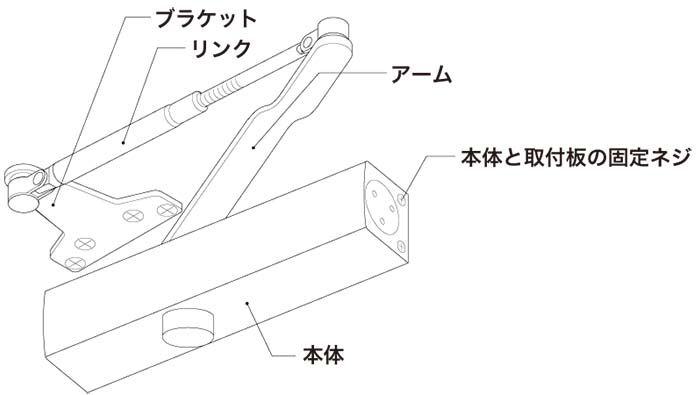
A door closer consists of a box-shaped body mounted at the top of the door, an arm and link that extend from it, and a bracket on the frame side. Opening the door compresses a spring inside the body; releasing the door lets that spring's return force pull the door shut. Highly viscous oil inside the body absorbs and slows that return force — this is the entire working principle of a door closer. In Japan you will also hear the same device called a "door check" (ドアチェック, doa chekku); it refers to the identical part.
The Four Main Functions
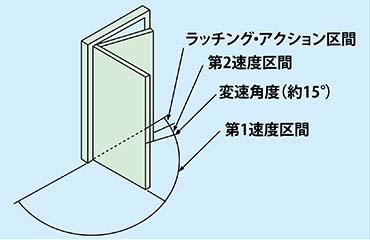
- Speed adjustment: The First Speed range (from the start of closing to partway through) and the Second Speed range (the final stretch as the door closes) are each adjusted with their own separate screw.
- Stop function: Holds the door open at a fixed angle. The exact hold angle varies by product, so check your unit's manual.
- Backcheck function: Cushions the door against being flung open too fast by a strong gust of wind. BLS DC:2023 specifies that this function must begin engaging somewhere between 70° and 85° of opening.
- Latching function: Speeds the door up for the final instant before it closes, to make sure the latch fully engages.
Standard-Mount and Parallel-Arm Types
| Type | Mounting Location | Characteristics |
|---|---|---|
| Standard-mount | On the side the door swings toward (for an outward-opening door, that means outdoors) | Simple mechanism. Because it's exposed outdoors, it tends to degrade faster in locations that catch rain. |
| Parallel-arm | Indoors, on the room side of the door | The current mainstream choice. The arm folds parallel to the door and, being mounted indoors, is much less exposed to weather degradation. |
The maker's name and model number are stamped into the side or top face of the body. Climbing a stepladder to photograph that stamp before you call anyone is, by itself, enough to sharpen the accuracy of every quote you collect afterward.
How Long Does a Door Closer Actually Last? Two Different Clocks — Cycle Count and Maintenance-Plan Timing
A generic estimate like "10 to 20 years" is nearly useless in practice, because what actually determines a door closer's lifespan is not the calendar — it's the number of times the door has opened and closed. This section lines up two separate clocks: the industry durability standard, measured in cycles, and the maintenance-cycle timing used in a building's long-term repair plan, measured in years. For an overseas investor used to residential leases that rarely specify equipment durability in numeric cycle counts at all, this level of component-level, standards-body-defined specificity is itself a notably Japanese trait — closer to how an aircraft part or an industrial machine is specified than how most Western residential fixtures are documented.
Primary-Source Quick Reference: Durability Cycles, Maintenance Intervals, and Warranty Periods
| Item | Value | Source |
|---|---|---|
| Continuous open-close cycles, hinged front door type | 200,000 cycles | BLS DC:2023, Table 3 |
| Forced continuous open-close | 70,000 cycles | BLS DC:2023, Table 3 |
| Stop-function repetitions | 10,000 cycles | BLS DC:2023, Table 3 |
| Backcheck-function repetitions | 7,000 cycles | BLS DC:2023, Table 3 |
| Continuous open-close cycles, interior door type (Type III-S) | 100,000 cycles | BLS DC:2023, Table 3 |
| Inspection/adjustment interval for fittings (unit front doors, etc.) | 12–15 years | MLIT Long-Term Repair Plan Formulation Guidelines, Form 3-2 |
| Replacement interval for fittings | 34–38 years | MLIT Long-Term Repair Plan Formulation Guidelines, Form 3-2 |
| Repainting interval for steel unit front doors (areas not exposed to rain) | 5–7 years | MLIT Long-Term Repair Plan Formulation Guidelines, Form 3-2 |
| Manufacturer product warranty (Ryobi) | 2 years from handover date (1 year for electrical components) | Ryobi Product Warranty |
| Free-repair warranty for BL-certified parts | 3+ years for hinged-door type / 2+ years for sliding-door type | BLS DC:2023, 2.2.1 |
| Replacement-parts availability after discontinuation | 10+ years | BLS DC:2023, 2.2.3.2 d) |
Sources: Better Living Foundation (一般財団法人ベターリビング), Good Housing Components Certification Standard for "Door Closers," BLS DC:2023; MLIT (国土交通省, Ministry of Land, Infrastructure, Transport and Tourism), "Long-Term Repair Plan Formulation Guidelines, Commentary, and Standard Format" (revised June 2024); and Ryobi, "Product Warranty for Door Closers, etc.". Note that some sources online describe the 200,000-cycle figure as a JIS (Japanese Industrial Standards) number — it is not; it is a value set in the Better Living Foundation's own product-certification standard, a separate, industry-specific certification scheme.
Worked Example: Dividing 200,000 Cycles by Daily Use Swings the Lifespan from About 11 to About 68 Years
Using the 200,000-cycle benchmark for hinged front doors, here is what that works out to at different levels of daily use.
- Single-occupant apartment unit entrance (8 uses/day): 200,000 ÷ 8 ÷ 365 = approx. 68 years
- Family-unit entrance (20 uses/day): 200,000 ÷ 20 ÷ 365 = approx. 27 years
- Shared building entrance or a mixed-use retail/residential door (50 uses/day): 200,000 ÷ 50 ÷ 365 = approx. 11 years
The identical product can have a lifespan that varies more than sixfold purely based on how it's used. Layer on UV exposure and temperature swings from being mounted outdoors, dust, and wind-forced opening, and the real-world lifespan shortens further. For anyone allocating a repair budget across a portfolio of units, prioritizing by "which door gets used how many times a day" is a far more accurate approach than the intuitive but misleading "the building is X years old, so it's probably due."
Under Japan's Long-Term Repair Plan Framework: Inspection/Adjustment at 12–15 Years, Full Replacement at 34–38 Years
The standard format in MLIT's Long-Term Repair Plan Formulation Guidelines (revised June 2024) sets inspection and adjustment for door fittings — unit front doors, common-area doors, and automatic doors — at a 12- to 15-year interval, and full replacement at 34 to 38 years. This is a planning concept that will be unfamiliar to most Western property investors: Japanese condominium associations are required to maintain a rolling, multi-decade capital-repair schedule (chōki shūzen keikaku, 長期修繕計画) covering every major building component, funded by a mandatory monthly reserve contribution from every owner — closer in spirit to a well-run US HOA reserve study than to the UK's more discretionary sinking-fund practice, but considerably more standardized and government-guided. Because a door closer is treated as a component of the door assembly rather than as its own line item, replacing just the closer is a separate decision from this door-replacement cycle.
For a condominium association (kanri kumiai, 管理組合, the mandatory owners' association that governs and funds shared-area maintenance in every Japanese condominium — legally closer to a US HOA or a UK residents' management company than to a purely voluntary body), whether the door itself is due for replacement soon under the long-term plan determines whether it makes sense to fix just the closer or wait and replace the whole door assembly. Installing a brand-new closer on a door that is scheduled for full replacement in five years is not necessarily the rational move.
Warranty Runs 2–3 Years; Parts Stay Available for 10 Years After Discontinuation
Ryobi's product warranty runs for 2 years from the date the building was handed over by the construction company (1 year for electrical components). The BL certification standard requires a minimum free-repair warranty of 3 years for hinged-door types and 2 years for sliding-door types. The detail that matters most, though, is parts supply: the certification standard requires manufacturers to keep supplying replacement parts for at least 10 years after a model is discontinued.
The flip side: for a model discontinued more than 10 years ago, a like-for-like replacement may no longer be possible. In that case you're looking at a compatible substitute instead, which can require reworking the bracket position or drilling new screw holes. Because the assumption of "just swap in an identical part" breaks down at that point, older buildings in particular benefit from getting a technician to look at the actual unit sooner rather than later.
How Much Can an Owner Do Themselves? Where Japanese Manufacturers Draw the Line
The conclusion up front: Japanese manufacturers do not permit owners or tenants to replace the door closer unit themselves. This is not primarily a cost question — it is a safety and warranty question, and manufacturers are unusually explicit about saying so in writing, in a way that goes further than the vaguer "consult a qualified professional" language typical of most US or UK product manuals.
What the Owner Can Do vs. What Requires a Specialist
| Task | Owner / Tenant | Specialist Contractor | Basis |
|---|---|---|---|
| Replacing the unit | Not permitted | Performed | LIXIL Q&A: "This work involves danger, so customers cannot replace it themselves" |
| Adjusting open/close speed | Possible on some products; not possible on products that require special tools | Performed | BLS DC:2023, 1.2.2(e) and 3.2(a)(6) |
| Adjusting the stop position | Possible on some products | Performed | LIXIL Q&A |
| Disassembly, parts removal, modification | Not to be done | Performed | Ryobi product warranty exclusions |
| Documenting symptoms (video, closing time, presence of oil leak) | Performed | — | — |
| Checking the model number/stamp on the unit | Performed | — | — |
The Manufacturer States Outright: "Customers Cannot Replace It Themselves"
LIXIL's own Q&A reads: "Replacing a door closer involves dangerous work, so customers cannot replace it themselves" (source: LIXIL, "I Want to Replace My Front Door's Door Closer"). The channels it directs customers to are the installing contractor or the manufacturer's own repair desk — not a general handyman, and certainly not the owner.
"Dangerous" is not corporate overstatement here. If the arm is removed from a door closer while the internal spring is still under tension, the arm can snap through the air with real force. This is work done standing on a stepladder, holding an overhead heavy component with one hand. The BL certification standard covers doors up to 50kg, which means the job can involve a door of that weight becoming momentarily unstable and unsupported.
Even "Just Adjustment" Is Built for Trained Technicians, Not Owners
Adjustment is not a free-for-all either. BLS DC:2023 requires that a standard door closer be built so that "open/close speed cannot be adjusted without special tools" (1.2.2(e)), and separately mandates that the product manual state that "speed adjustment must be performed by someone with specialized knowledge, using special tools" (3.2(a)(6)).
In other words, a certified product is engineered from the outset so an ordinary household screwdriver simply won't turn the valve. Advice circulating online about substituting a coin for the proper tool is a textbook way to strip the valve's slot or over-turn it until it pops out entirely.
Touching It Yourself Voids the Warranty
Ryobi's product warranty explicitly excludes "malfunctions caused by operating errors, inadequate adjustment, or a failure to perform proper maintenance after handover" and "malfunctions caused by the customer's own installation, repair, or modification (including removal of necessary parts)." Even within the warranty period, any visible sign that an owner has been inside the unit disqualifies it from free repair.
Trying to save a few thousand yen ends up costing a ¥30,000-plus (approx. USD 190+) replacement bill and the loss of warranty coverage at the same time — we have watched this exact pattern play out repeatedly across our own managed properties. To be candid about the trade-off: with a door closer, leaving it alone is, counterintuitively, the cheapest option available.
Three Things an Owner Can Still Do
- Document the symptom: Record about 10 seconds of video of the door closing. It captures the sound, the speed, and the stopping position all at once.
- Time the closing: Measure the seconds from 90° to fully closed three times and average them. The reference range is 5 to 8 seconds.
- Identify the model number: Photograph the stamp on the unit body. Once the maker and model are known, a parts-availability check can be handled with a single phone call.
Who Actually Pays? The Answer Changes Across Rentals, Condos, and Owned Houses
This is the single most tangled question in door-closer conversations. For the exact same symptom, both who gets to decide and who pays for it change depending on the type of building — a distinction that matters enormously to a foreign investor evaluating a Japanese rental property, since it directly determines whether a repair bill lands on the owner's P&L or the tenant's.
Judgment Table by Building Type
| Building Type | Who Decides | Who Pays | Legal Basis | Risk of Replacing Without Authorization |
|---|---|---|---|---|
| Rental property (tenant in residence) | The landlord or the management company | In principle, the landlord. If damage is caused by the tenant's intentional act or negligence, the tenant | Civil Code Art. 606(1); MLIT's Guidelines on Disputes over Restoration to Original Condition | The tenant bears the cost personally; may be asked to restore the property at move-out; using a non-specified part risks compromising the door's fire-rating performance |
| Condominium (bunjō manshon) | The condominium association (kanri kumiai) | The condominium association, funded from the common-area management fee and repair reserve fund | Standard Condominium Management Bylaws, Article 7 | May be required to restore the door as an unauthorized alteration of common property; falls outside the association's insurance and warranty coverage |
| Owned single-family house | The owner | The owner | — | Falls under the manufacturer warranty's exclusion clause; may affect the door's performance as a fire-safety component |
Rental Properties: Civil Code Article 606(1) and the Restoration Guidelines
Article 606, paragraph 1 of Japan's Civil Code (Minpō, 民法) requires a landlord to carry out repairs necessary for the tenant's use and enjoyment of the property, except where the need arises from a cause attributable to the tenant. A door closer wearing out from ordinary age and use falls, in principle, squarely within that repair obligation. For a US or UK investor, this reads as broadly analogous to an "implied warranty of habitability" or a landlord's statutory repairing covenant — but the difference is that Japanese law states it as a general, codified duty applying to essentially any fixture, rather than being anchored to specific health-and-safety standards the way US habitability law typically is.
MLIT's own "Guidelines on Disputes over Restoration to Original Condition" likewise treats the cost of restoring normal wear and age-related deterioration as the landlord's responsibility. If a door closer that has been in service for 10-plus years wears out and stops closing properly, billing that cost to the departing tenant at move-out runs against this framework. We break down exactly where that line falls in our guide to allocating normal wear-and-tear versus restoration costs — worth reading well before a move-out settlement is due, rather than scrambling through it at the last minute.
The calculation flips, however, if the tenant bent the arm by yanking the door too hard, or forced the stop position past its limit — in those cases responsibility shifts to the tenant. For the broader scope of an owner's repair obligations, see also our guide to defects in rental properties and landlord repair responsibility.
When a Tenant Can Repair It Themselves — and Why You Should Still Call First
Civil Code Article 607-2 allows a tenant to carry out repairs themselves if they have notified the landlord of the need for repair and the landlord fails to act within a reasonable time, or if there is urgent necessity. But this provision only kicks in on the premise that the tenant notified the landlord first and got no response — it is not a general license to self-repair whenever convenient.
There are three reasons to contact the management company first regardless. First, because manufacturers do not sanction self-replacement, recovering the cost from the landlord afterward is likely to become a dispute. Second, if the front door is a fire-rated component, swapping in a non-specified part can affect the entire building's legal compliance. Third, an entire building typically uses the same closer model throughout, so arranging the repair centrally is usually both faster and cheaper than each tenant handling it individually.
Condominiums: Only the "Lock and Interior Paint Surface" of the Front Door Are Private Property
This is where the most misunderstanding happens. Article 7, paragraph 2, item 2 of the Standard Condominium Management Bylaws (Single-Building Type), as revised in 2025, defines only the "lock and interior paint surface" of the front door as exclusively-owned private space (senyū bubun, 専有部分) (source: MLIT, "Standard Condominium Management Bylaws"). Unlike a US condo, where the interior finish of your own front door and often the door itself can be treated as unit property under the declaration, or a UK leasehold flat where the front door is more often demised to the leaseholder, Japan's standard bylaws treat the door closer — mechanically and legally — as common property (kyōyō bubun, 共用部分), full stop.
As a result, an individual unit owner generally cannot call a contractor and have it replaced on their own judgment. The correct sequence is to contact the condominium association or its management company first, so the work is processed as a common-property repair. The scenario worth actively avoiding is paying out of pocket under the mistaken belief that the door closer is private property, only to have the association later demand you restore it. Whether your own building's bylaws match the standard bylaws on this point can be checked directly in the "scope of exclusively-owned space" clause of your association's own management regulations.
Fire-Door Closer Inspections: A Regulatory Category Shift Took Effect in July 2025
This regulatory change is directly relevant to owners of rental apartment buildings and office buildings, and to the staff at their management companies. Part of the inspection scope for always-closed fire doors (jōji heisa-shiki bōkatobira, 常時閉鎖式防火扉, fire doors designed to remain closed at all times rather than being held open and triggered to close on alarm) moved from the periodic inspection of specified buildings into the periodic inspection of fire-protection equipment — two separate statutory inspection regimes under Japan's Building Standards Act that do not have a single unified counterpart in most US or UK fire-code inspection frameworks, where fire-door hardware inspection tends to sit inside a single combined life-safety inspection cycle (such as NFPA 80 annual inspections in the US).
What Moved, and When It Took Effect
Under MLIT Notification No. 974 of 2024 (promulgated June 28, 2024) and MLIT Notification No. 53 of 2025 (promulgated January 29, 2025), effective July 1, 2025, the periodic inspection of fire-protection equipment now covers, for the main always-closed fire doors on each floor: kinetic energy on closing, deterioration and damage to the body and frame, whether the door operates correctly, whether items have been left blocking it, and whether it is properly fixed in place (source: MLIT Housing Bureau, Building Guidance Division, reference material on "Review of the Periodic Reporting Notifications"; notification numbers per Tokyo Metropolitan Government Bureau of Urban Development, "Contents of the Periodic Investigation/Inspection System Reform").
"Kinetic energy" here means the force the door carries at the moment it closes. In plain terms, whether a door closer's closing speed is appropriate is now a formal item checked under a statutory inspection. Ignoring a door that slams isn't just a safety issue — under this regime it now creates a real risk of a citation on the statutory report.
Scope Is Limited to the "Main Doors on Each Floor"; Reporting Cycle Is Roughly Every 1–3 Years
The inspection does not cover every fire door in a building — only the main ones on each floor. In practice this means doors on evacuation routes, doors facing an atrium or void space, and doors that see heavy daily traffic and frequent opening and closing. The reporting cycle remains roughly once every 1 to 3 years, unchanged from before. We map out the full practical picture of fire-protection equipment inspection for multi-unit residential buildings in our guide to fire doors and inspection obligations in apartment buildings.
Local Governments Apply This Differently
This reform allows local variation and re-interpretation by each municipality. Tokyo, for instance, has taken its own approach: it keeps always-closed fire doors under the periodic investigation of specified buildings, as before, and does not require them to be reported under the periodic inspection of fire-protection equipment at all. At the same time, Tokyo added a new item to its specified-building periodic investigation requiring a visual or tactile check of "the condition of the door's mounting" (source: Tokyo Metropolitan Government Bureau of Urban Development, "Contents of the Periodic Investigation/Inspection System Reform"). This is a useful reminder for any overseas investor buying property across multiple Japanese municipalities: check the guidance from the specific administrative authority (tokutei gyōsei-chō, 特定行政庁, the local building-code enforcement authority) where the property is located, and confirm your approach with a qualified inspector, before assuming a national rule applies uniformly.
Repair Expense or Capital Expenditure? The Tax Treatment for Rental-Property Owners in Japan
Because replacing a door closer restores a door to its original function, it can normally be expensed as a repair cost (shūzenhi, 修繕費) for Japanese income or corporate tax purposes. But once several units are replaced in a single batch, or the replacement upgrades to a higher-spec product, you need to check whether it instead falls into the capital-expenditure (shihonteki shishutsu, 資本的支出) category — the Japanese equivalent of the repair-versus-capital-improvement distinction familiar to any US or UK landlord filing a Schedule E or a UK property-income return, though the bright-line yen thresholds below are considerably more mechanical than the facts-and-circumstances tests typically applied in those jurisdictions.
The National Tax Agency's Four Bright-Line Tests
The National Tax Agency (Kokuzeichō, 国税庁, Japan's tax authority, roughly equivalent to the US IRS or the UK's HMRC) Tax Answer No. 5402 (current as of April 1, 2025) sets out the following formal tests for distinguishing a repair expense from capital expenditure (source: National Tax Agency, "No. 5402: Determining What Does Not Qualify as a Repair Expense").
- If a single repair or improvement costs less than ¥200,000 (approx. USD 1,260), it can be expensed as a repair cost.
- If it is clear the work recurs on a cycle of roughly 3 years or less, it can be expensed as a repair cost.
- Of the amounts where it isn't clear whether an item is capital expenditure or a repair, anything under ¥600,000 (approx. USD 3,770) can be expensed as a repair cost.
- Also within that unclear category, an amount that is no more than roughly 10% of the fixed asset's acquisition cost as of the end of the previous fiscal year can likewise be expensed as a repair cost.
Worked Example: Replacing 10 Units at ¥32,000 Each, All at Once
Here is how the determination sequence actually plays out.
- Replacing just one unit: ¥32,000 (approx. USD 200) is under the ¥200,000 threshold, so it can be expensed as a repair cost.
- Replacing 10 units in a single batch: ¥32,000 × 10 = ¥320,000 (approx. USD 2,010), which exceeds the ¥200,000 threshold.
- Next, check whether this falls into the "unclear whether capital or repair" category. If it does, ¥320,000 is still under the ¥600,000 threshold, so it can be expensed as a repair cost.
- If the amount reaches ¥600,000 or more, check whether it is no more than roughly 10% of the building's acquisition cost as of the end of the previous fiscal year.
It's worth noting that if the replacement simply restores the same level of performance as before, it typically qualifies as a repair expense on that basis alone, before you even need to reach the formal tests above — those tests exist as a fallback for genuinely ambiguous cases. For an actual filing, keep the itemized quote and invoice describing the work, and confirm the treatment with your tax accountant (zeirishi, 税理士). We cover the broader logic of expensing equipment updates across a rental property in our guide to rental equipment replacement timing and expense treatment.
Checking Contractor Quotes and Understanding Regional Cost Differences
Get multiple quotes for identical work and you can find them differing by nearly double. Comparing totals alone tells you nothing useful — you need the line items broken out, so you can judge whether the labor charge itself is reasonable.
Four Items to Have Broken Out Separately on a Quote
- Callout fee: The charge for each visit. If several units are being bundled, confirm how many visits are actually being billed.
- Labor charge: Set by the number of technicians and hours worked. Ask how many hours per unit the quote assumes.
- Parts cost: The model and unit price of the closer itself. Whether it's an exact match or a compatible substitute changes the price.
- Disposal fee: The cost of disposing of the removed old unit. Insist it stay as its own line item, even if the amount is small.
Worked Example: Sanity-Checking Labor Costs Against Published Wage Data
You can sanity-check whether a labor charge is reasonable against Japan's published construction wage benchmarks. The public-works design labor unit price applicable from March 2026 comes to a nationwide, all-trades weighted average of ¥25,834 (approx. USD 163) per day, crossing ¥25,000 for the first time after 14 straight annual increases dating back to fiscal 2013 (simple-average year-over-year change: +4.5%, based on 85,670 valid data points; source: MLIT, "Public Works Design Labor Unit Prices Applicable from March 2026"). This is Japan's own government-published wage index for construction trades, and it's a useful reference point for any overseas investor unfamiliar with how granular Japanese public wage statistics get — there is no single equivalent index in most Western markets that breaks trade-level daily wages down by prefecture and occupation with this level of official detail.
Broken down by prefecture and trade: in Hiroshima Prefecture, a sash/window fitter earns ¥28,400 (approx. USD 179), an interior finisher ¥27,700 (approx. USD 174), a glazier ¥27,300 (approx. USD 172), and a roofer ¥28,600 (approx. USD 180) — all figures for an 8-hour standard working day (source: MLIT, prefecture- and trade-level wage tables, same release). For reference, a sash fitter in Okayama Prefecture earns ¥28,800 (approx. USD 181) and in Yamaguchi Prefecture ¥28,700 (approx. USD 181) — there is no meaningful gap across the wider Chūgoku region.
Using that figure, if a single technician replaces one unit in half a day, ¥28,400 ÷ 2 = ¥14,200 (approx. USD 89) is a reasonable ballpark for the labor charge alone. Add parts and the callout fee on top of that, and a total in the low ¥30,000s (roughly USD 190–210) is exactly what you'd expect from the arithmetic. Conversely, if a quote shows a labor charge alone above ¥50,000 (approx. USD 315) for replacing a single unit, it's worth asking what assumption about work hours — or what unusual site condition — is driving that number.
One caveat: this wage figure does not include overhead items such as the employer's statutory welfare-contribution burden, so an actual quote will normally run higher than a simple multiplication of the daily wage. Treat this only as a check on the order of magnitude, not an exact benchmark. As a separate reference point for the cost of ongoing building-side inspection and adjustment work, the building-maintenance labor unit price applicable from April 2026 averages ¥19,540 (approx. USD 123) nationwide across all trades, up 8.5% year over year (source: MLIT, "Building Maintenance Labor Unit Prices Applicable from April 2026").
Information Worth Gathering Before You Request Quotes
If you can supply the following details, a contractor can often give you a rough estimate before ever visiting the site. Door dimensions and weight in particular determine whether an off-the-shelf part will even fit. BLS DC:2023's Table 1 defines the applicable range for each model type as follows.
| Model Type | Applicable Door Dimensions | Applicable Door Weight |
|---|---|---|
| Type I / Type I-S (hinged front door) | Width ≤900mm × Height ≤2000mm | ≤50kg |
| Type II (hinged front door) | Width ≤850mm | ≤50kg |
| Type II-D (for elderly and accessibility considerations) | Width ≤850mm | ≤55kg |
| Type III-S (interior door) | Width ≤800mm | ≤30kg |
| Sliding-door type (steel door) | — | ≤80kg |
On top of that table, pass along three more details: the stamped model number, whether it's a parallel-arm or standard-mount type, and whether the door is fire-rated. For fire-rated doors, BLS DC:2023 requires that any unit with a hydraulic cylinder not rupture during a one-hour heat test, which narrows the field of products that qualify considerably. Skip this check and you risk a technician showing up only to say, on the spot, "this part can't go on this door" — meaning a second visit, a second callout fee, and a delay.
The Timeline to Replacement Day, and What to Prepare in Advance
When we arrange this at properties we manage, the process from the first call to a completed replacement typically wraps up in one to two weeks, provided the part is in stock. For however long the work on a single unit takes, the door stays propped open the entire time.
How to Find the Model Number, and Your Options If It's Discontinued
The model number is stamped on the side or top of the unit body, or near the base of the arm. If layers of paint have made it unreadable, photographing the unit's outer dimensions and the position of its mounting screw holes serves as a workable substitute.
If the exact model has been discontinued, you have three options. First, the manufacturer-designated successor model — the mounting-screw positions are usually carried over, making this the least disruptive route. Second, a compatible part from another manufacturer, which may require reworking the bracket. Third, replacing the entire door assembly — if the long-term repair plan already has the door itself coming up for replacement soon, this option can end up being the cheaper choice overall.
Advance Notice for Tenants and the Association, and On-Site Protection Measures
Because the front door stays open during the work, both whether someone is home and general security need thought. The following preparation keeps the actual work day running smoothly.
- Give written notice of the work date, time, and expected duration at least one week in advance.
- State clearly whether the resident needs to be home. Even when the work can be done from the shared corridor side, some units are better off with someone present, since the door will be opened and closed repeatedly.
- Ask residents to clear items from around the entrance — umbrella stands, shoes on the tataki (土間 / 三和土, the sunken, unfinished-floor entry area found just inside a traditional Japanese front door, used for removing shoes — a feature with no real US or UK equivalent, where shoes are more commonly kept on throughout the home).
- Lay down protective sheeting both where the stepladder will stand and on the wall surface at the door's hinge side.
- In a condominium, confirm the process for board approval from the association and advance notice posted on the building bulletin board.
Frequently Asked Questions
Q. My door closer slams shut. Do I need to replace it right away?
First, check for an oil leak. If there's no oil seepage, adjustment may fix it, at a cost of roughly ¥19,000–¥33,000 (approx. USD 120–210). If oil is present, repair isn't possible and you're looking at a ¥32,000–¥121,000 (approx. USD 200–760) replacement. As a diagnostic aid, measure the seconds from 90° to fully closed three times before you call anyone — it speeds up the conversation considerably. The reference range is 5 to 8 seconds.
Q. What does the replacement process look like, and how long does it take?
At properties we manage, when the part is in stock, the process from first contact to completion typically takes one to two weeks. The sequence runs: reporting the symptom and model number, an on-site inspection and quote, ordering the part, the replacement work itself, and a final operation check. If you cancel the repair after the on-site inspection, LIXIL charges a ¥7,920 (approx. USD 50) site-survey fee regardless.
Q. What should I watch out for during the replacement?
Three things. First, whether the door is fire-rated — fire doors accept only a limited range of products, and fitting a non-specified part can affect the building's legal compliance. Second, the door's dimensions and weight — a door wider than 900mm or heavier than 50kg won't fit the standard Type I closer. Third, the process in a condominium — because a door closer is common property, the work must go through the condominium association.
Q. Can an old door closer still be fixed with adjustment alone?
If there's no oil leak and both the stop function and the backcheck function still work, adjustment can sometimes improve things. But the durability standard for a front-door closer is 200,000 open-close cycles, which a shared entrance opened 50 times a day reaches in about 11 years. A model discontinued more than 10 years ago may already be out of replacement-parts supply, which means that even if adjustment buys you more time now, a like-for-like replacement may not be possible the next time it fails. In older buildings, we recommend weighing the cost difference between adjustment and replacement explicitly before deciding.
Q. In a rental property, can the tenant replace it themselves?
We would not recommend it. Manufacturers do not sanction self-replacement, and any malfunction traceable to a tenant's own hands-on work falls under the warranty's exclusion clause. Civil Code Article 607-2 does allow a tenant to carry out repairs themselves if the landlord fails to respond within a reasonable time after being notified of the need — but contacting the management company first is still the right first step. If the malfunction stems from ordinary age-related wear, the landlord's repair obligation under Civil Code Article 606(1) means the cost falls to the landlord as a matter of principle.
Citations and References
- LIXIL, "Repair Cost Guide" (修理費用の目安, as of June 2025)
- LIXIL Q&A, "I Want to Replace My Front Door's Door Closer" (玄関ドアのドアクローザを交換したい)
- LIXIL Q&A, "Estimated Repair Costs for Building Material Products" (建材商品の修理にかかる費用の概算)
- Better Living Foundation (一般財団法人ベターリビング), Good Housing Components Certification Standard "Door Closers," BLS DC:2023
- MLIT (国土交通省), "Long-Term Repair Plan Formulation Guidelines, Commentary, and Standard Format" (長期修繕計画作成ガイドライン・同コメント/長期修繕計画標準様式, revised June 2024)
- MLIT, "Standard Condominium Management Bylaws (Single-Building Type) and Commentary" (マンション標準管理規約(単棟型)・同コメント, revised 2025)
- MLIT Housing Bureau, Building Guidance Division, reference material on "Review of the Periodic Reporting Notifications" (定期報告告示の見直しについて, January 29, 2025)
- Tokyo Metropolitan Government Bureau of Urban Development, "Contents of the Periodic Investigation/Inspection System Reform" (定期調査・検査制度改正の内容)
- MLIT, "Public Works Design Labor Unit Prices Applicable from March 2026" (令和8年3月から適用する公共工事設計労務単価について, February 17, 2026)
- MLIT, Appendix: Public Works Design Labor Unit Prices by Prefecture and Trade (都道府県別・職種別 公共工事設計労務単価)
- MLIT, "Building Maintenance Labor Unit Prices Applicable from April 2026" (令和8年4月から適用する建築保全業務労務単価について, February 17, 2026)
- National Tax Agency (国税庁), Tax Answer No. 5402, "Determining What Does Not Qualify as a Repair Expense" (修繕費とならないものの判定, current as of April 1, 2025)
- MLIT, "Guidelines on Disputes over Restoration to Original Condition (Re-revised Edition)" (原状回復をめぐるトラブルとガイドライン(再改訂版))
- e-Gov Japanese Law Search, "Civil Code" (民法, Articles 606 and 607-2)
- Ryobi, "Types of Door Closers" (ドアクローザのタイプ, basic components)
- Ryobi, "Door Closer Lifespan" (ドアクローザの寿命)
- Ryobi, "Speed Adjustment Function" (速度調整機能)
- Ryobi, "How to Adjust Speed" (速度の調整方法)
- Ryobi, "Product Warranty for Door Closers / Concealed Door Closers / Sliding Door Closers / Access Panel Hardware" (ドアクローザ/コンシールドドアクローザ/引戸クローザ/点検口用機器 商品保証について)
