The large-scale redevelopment plan "Excite Yokohama 22," which began in 2009, is advancing around Yokohama Station, transforming the area day by day into a city worthy of serving as the gateway to an international metropolis. This multifaceted project—spanning high-rise construction, infrastructure improvements, and environmental and disaster-prevention measures—is having a significant impact on real estate values in the surrounding area. The 2025 official land prices already reflect this clearly in the numbers, with a year-on-year increase of 9.84%. This article reviews the progress of Excite Yokohama 22, and provides a detailed analysis—based on the latest data—of its impact on asset values in the surrounding area and the outlook going forward. We present information that will serve as valuable reference material for those considering real estate investment or the purchase of a residential property.
What Is Excite Yokohama 22?
Excite Yokohama 22 is a large-scale urban development plan for the area surrounding Yokohama Station, formulated by the City of Yokohama in December 2009. The number "22" derives from the plan's launch in Heisei 22 (2010) and its vision of building a city oriented toward the 22nd century. The project is positioned as a guiding framework for advancing city-building "befitting the gateway to an international city."
Target Areas and Development Goals
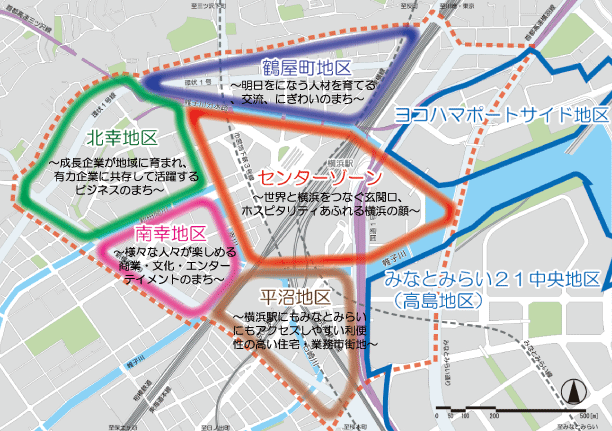
The plan's target area is comprised primarily of seven districts.
District Breakdown and Roles
| District | Approximate Location | Future Vision (Primary Role as Defined in the Plan) |
|---|---|---|
| Center Zone | Directly adjacent to Yokohama Station's east and west exits | Gateway connecting Yokohama to the world ‐ Strengthening terminal functions and hospitality |
| Minamiyuki District | Around the west exit "Sotetsu Exit" | A vibrant hub with a concentration of retail, culture, and entertainment |
| Kitayuki District | From the west exit "Kita Nishi-guchi" to Daimachi | A business district attracting growing companies |
| Tsuruyacho District | North of the Kita Nishi-guchi elevated railway | A mixed-use hub combining exchange, lodging, and residential functions (redevelopment in progress) |
| Yokohama Portside District | Along the canal from Kanako-cho to Sakae-cho | An urban residential area themed around Art & Design |
| Takashima District | Takashima / Minato Mirai 21 Central | A multifunctional mixed-use urban area encompassing offices, MICE facilities, hotels, and more |
| Hiranuma District | Around Hiranumabashi and Tobe | A residential and business hub with convenient access to both the station and MM21 |
Major Projects Currently Underway
The following are the major projects currently in progress under Excite Yokohama 22.
Source: City of Yokohama Official Website
| District | Key Projects / Facilities | Use / Scale | Progress / Schedule |
|---|---|---|---|
| Center Zone | Yokohama Station Minami East Exit District Type 1 Urban Redevelopment Project | Super high-rise mixed-use (approx. 231 m tall, approx. 215,000 m² total floor area) | Environmental assessment phase; construction scheduled to begin in fiscal year 2028 (City of Yokohama Official Website) |
| Yokohama Nishi-guchi OPEN PARK | Station plaza park conversion social experiment | Held May 23–24, 2025 (Sotetsu Group) | |
| Minamiyuki District | Yokohama Minamiyuki District Joint Reconstruction Project (CeeU Yokohama / AEON Mall Yokohama Nishi-guchi) | Retail and residential mixed-use (approx. 56,000 m² total floor area) | Commercial building opened December 2023; residential building scheduled for completion spring 2025 (Metropolitan Construction Watch) |
| Yokohama Station West Exit Major Redevelopment Concept (including Sotetsu Movie redevelopment) | Phased redevelopment of the entire west exit area | Sotetsu Movie demolition scheduled to begin in fiscal year 2027; completion targeted for the 2040s (Skyscraper & Urban Development Institute) | |
| Kitayuki District | Station Oasis (Yokohama Central Post Office Area) Redevelopment | Super high-rise mixed-use approx. 231 m tall | Preparatory association established (2024); planning under review (Building PC) |
| Tsuruyacho District | THE YOKOHAMA FRONT | Residential, hotel, and retail mixed-use (43 stories above ground, 178 m) | Residential occupancy began April 2024; hotel opened June 2024 (THE YOKOHAMA FRONT, Sotetsu Group, SkySkysky) |
| Kita Nishi-guchi Transportation Plaza / Pedestrian Deck Connection | Station-front transportation plaza and pedestrian deck | Construction completed; opened for use March 3, 2025 (City of Yokohama Official Website) | |
| Yokohama Portside District | Public Trust Yokohama Portside Town Planning Trust | Community grant program | Accepting applications for fiscal year 2025 grant projects (SMTB) |
| Block A-3 Development Plan | Retail, office, and residential mixed-use (proposed plan) | Land coordination and environmental assessment phase (City of Yokohama Official Website) | |
| Takashima (MM21 Central) District | Block 62 〈HARBOR EDGE PROJECT〉 | Luxury hotel + digital aquarium (approx. 89,000 m² total floor area) | Construction to begin July 2025; completion scheduled September 2028 (SkySkysky) |
| Blocks 60 & 61 〈Linkage Terrace Project〉 | Offices, hotel, vocational schools, etc. (approx. 131,000 m² / 25,000 m² total floor area) | Construction to begin March 2026; phased completion scheduled 2028–29 (SkySkysky) | |
| Hiranuma District | No large-scale redevelopment currently at the implementation stage (Reference: Takashima 2-chome Redevelopment (First Place Yokohama) was completed in 2007) | Maintenance and management phase (Nippon Steel Kowa Real Estate Corporate Site) |
The simultaneous progress of these multiple redevelopment projects is expected to enhance the overall appeal and value of the entire area surrounding Yokohama Station.
Rights Conversion and Joint Reconstruction: What Happens to Landowners in the Area?
Many of the individual projects moving forward within the Excite Yokohama 22 area are being carried out as Type 1 Urban Redevelopment Projects under the Urban Redevelopment Act (the rights conversion method), or as joint reconstruction projects undertaken by landowners along similar lines. The Yokohama Station Minami East Exit District Type 1 Urban Redevelopment Project is currently in the environmental assessment phase, and the Station Oasis (Yokohama Central Post Office area) redevelopment in the Kitayuki District is at the stage where a preparatory association was established in 2024. In both cases, the projects will move into full-scale implementation once a rights conversion plan has been formulated and approved.
Under the rights conversion method, pursuant to Articles 87 and 88 of the Urban Redevelopment Act, existing rights to the land and buildings are extinguished as of the rights conversion date, and in exchange landowners acquire floor space (rights floor) in the newly constructed facility building. Rather than receiving a cash payment and relocating outside the site, most rights holders continue to hold a portion of the new building constructed on the same site—this is a fundamental characteristic of urban redevelopment projects. On the other hand, under Article 71 of the Urban Redevelopment Act, landowners who do not wish to undergo rights conversion may choose to receive a cash payment and relocate outside the project district, provided they submit a request within 30 days of the public notice of the project plan or similar. Note that in projects where landowners voluntarily join together, such as the Minamiyuki District Joint Reconstruction Project (CeeU Yokohama), floor space may in some cases be allocated under a separate scheme, such as an individual equivalent-value exchange agreement, rather than through the rights conversion method under the Urban Redevelopment Act.
General Impact of Redevelopment on Asset Values
Numerous case studies have confirmed that large-scale redevelopment frequently has a significant impact on real estate values in the target area. Let us examine the specific factors that drive asset value appreciation.
Improvements to Infrastructure and Convenience
When redevelopment leads to improvements in transportation networks, public facilities, roads, and other infrastructure, the convenience of the area increases. Particularly in station-area redevelopments, improved access from the station to various facilities drives up the value of surrounding real estate.
For example, under Excite Yokohama 22, the development of the South Deck and improvements to the space above the railway tracks and passageways have made east-west movement smoother and enhanced overall circulation around the station. Such improvements to the pedestrian environment are also a factor in rising real estate values.
Yokohama Station Is Japan's Terminal with the Most Connecting Railway Operators
Yokohama Station is served by six railway operators—JR East, Tokyu Corporation, Keikyu Corporation, Sagami Railway, Yokohama Minatomirai Railway (Minatomirai Line), and the Yokohama Municipal Transportation Bureau (Yokohama Municipal Subway)—giving it the largest number of connecting railway operators of any single station in Japan. In October 2022, on "Railway Day," these six operators jointly held an event, an example of efforts by multiple operators to jointly promote the station's brand as a terminal station. The improvements to circulation brought about by Excite Yokohama 22, such as the east-west free passageway and the South Deck, also serve as infrastructure that smooths transfer demand from these many directions.
Formation of an Area Brand
As redevelopment increases the number of residents and visitors and raises the area's reputation as "comfortable and livable," the overall brand value of the district improves. Large-scale projects that enhance international recognition are particularly effective in this regard.
Excite Yokohama 22 aims to establish the area's brand as the "gateway to an international city," and real estate values around Yokohama Station are expected to rise in tandem with this positioning.
Improvements to Disaster Preparedness and Safety
Redevelopment areas adopt the latest disaster-prevention standards and technologies in their buildings and infrastructure, resulting in improved seismic resistance and disaster-prevention infrastructure. Enhanced safety is an important factor that underpins the value of residential real estate in particular.
Disaster preparedness is also a key theme in Excite Yokohama 22, and the resulting improvements to safety provide a foundation for asset values.
Expansion of Investment Demand
The future potential that accompanies redevelopment also heightens investor interest, which becomes another driver of price appreciation. In particular, the movements of domestic and international real estate investment firms directly influence land prices and property values.
In the Yokohama Station west exit area, the combination of robust domestic and international investment demand with ongoing redevelopment has led to rising transaction prices and declining yields—a sign of bullish investor sentiment.
Current State of Land Prices and Real Estate Values Around Yokohama Station
How have land prices and real estate values around Yokohama Station changed in tandem with the progress of Excite Yokohama 22? We analyze the situation based on the latest data.
Land Price Trends and Movements
As of January 1, 2025, the official land prices around Yokohama Station averaged 2,794,875 yen/m² (tsubo price: 9,239,256 yen), representing a year-on-year increase of 9.84%. Similarly, the average standard land price also rose 8.64% year-on-year to 5,236,111 yen/m² (tsubo price: 17,309,458 yen).
Land price appreciation has been particularly pronounced in the Yokohama Station west exit area. At 1-3-1 Minamiyuki, Nishi-ku—home to the commercial facility "Yokohama More's"—land prices reached 13,000,000 yen per square meter, a level more than 5,500,000 yen higher than the second-ranked location.
Looking at Kanagawa Prefecture's overall official land price change rates for 2025, residential land rose 3.4% (vs. 2.8% the previous year), commercial land 6.6% (vs. 5.4%), and industrial land 6.2% (vs. 5.9%), with the rate of increase in commercial land expanding notably.
The table below summarizes the trends in land prices around Yokohama Station.
| Year | Average Official Land Price (10,000 yen/m²) | Year-on-Year Change | Average Standard Land Price (10,000 yen/m²) | Year-on-Year Change |
|---|---|---|---|---|
| 2025 | 279.4875 | +9.84% | Not yet announced | - |
| 2024 | 254.4492 | +8.42% | 523.6111 | +8.64% |
| 2023 | 234.6830 | +5.33% | 482.0000 | +6.07% |
This data indicates that the rate of land price appreciation has been accelerating since 2023.
Real Estate Transaction Prices and Yield Trends
According to the "Land Price Level, Rent, and Yield Trend Report" compiled by the City of Yokohama as of April 1, 2024, transaction prices in the Yokohama Station west exit and Kita Nishi-guchi areas have been trending upward, driven by robust domestic and international investment demand and expectations of improved market competitiveness as multiple redevelopment projects advance.
Furthermore, based on analysis of J-REIT property yields and transaction activity, transaction yields (net income ÷ transaction price) have been moving sideways to declining (reflecting bullish investor sentiment). This suggests that investors hold strong expectations for future profitability.
Office and Retail Rent Trends
In the office market of the Yokohama Station west exit and Kita Nishi-guchi areas, the vacancy rate has declined to 3.63% (down from 3.75% in the previous survey), and recovery toward pre-COVID levels (approximately 2.0%) is progressing. Rents are moving sideways to gradually rising.
In the retail market, landlords—particularly for food and beverage tenants—have returned to a bullish posture, and virtually no vacant storefronts are to be seen. The Yokohama Station west exit area in particular maintains a high rent level, and demand for new openings remains robust.
Specific Impact of Excite Yokohama 22 on Asset Values
What specific impact is Excite Yokohama 22 having on asset values around Yokohama Station? We analyze the data gathered.
Direct Impact on Land Price Appreciation
The primary driver behind the land price appreciation around Yokohama Station—particularly in the west exit area—far outpacing the Kanagawa Prefecture average is considered to be the progress of redevelopment under Excite Yokohama 22. The high appreciation rate of 9.84% recorded in the 2025 official land prices can be seen as a manifestation of the redevelopment effect.
Particularly noteworthy is the fact that four of the top five commercial land locations in Kanagawa Prefecture were situated around the Yokohama Station west exit. This demonstrates that the development of mixed-use buildings directly connected to Yokohama Station's west exit and the surrounding infrastructure improvements are significantly driving up real estate values.
Enhanced Investment Appeal
The progress of Excite Yokohama 22 is increasing the investment appeal of the area surrounding Yokohama Station. From a real estate investment perspective, the following factors are noteworthy.
- Sustained Land Price Appreciation: Land prices have risen for five consecutive years since 2014, and further appreciation is expected as redevelopment advances.
- Price Differential with Central Tokyo: Land prices and condominium prices remain more affordable compared to central Tokyo, offering a relative sense of value.
- Enhanced Transportation Access: Advantages as a major terminal served by six rail operators, including JR, private railways, and subway lines.
- Concentration of Businesses and Commercial Facilities: A strengthened economic base through a rich supply of offices and commercial facilities.
These factors have attracted domestic and international investment capital, manifesting as rising transaction prices and declining yields.
Spillover Effects to Surrounding Areas
The impact of Excite Yokohama 22 extends beyond the immediate vicinity of Yokohama Station to surrounding areas as well. Combined with redevelopment in the Minato Mirai and Kannai districts, it is producing the effect of elevating real estate values throughout the central Yokohama area.
Notably, the development completion rate for the Minato Mirai 21 district has reached 96%, and integrated development is progressing from the Yokohama Station area through Minato Mirai and on to Kannai.
Long-Term Outlook for Asset Values
As Excite Yokohama 22 is a long-term plan extending to around 2030, its impact on asset values must also be considered from a long-term perspective.
The following points are important in assessing the long-term outlook for real estate values around Yokohama Station.
- Sustained Redevelopment Effects: Continued value enhancement driven by the phased progression of multiple projects.
- Establishment of an Area Brand: Consolidation of brand value as the gateway to an international city.
- Progress in Environmental and Disaster-Prevention Measures: Improved stability of asset values through stronger responses to climate change and disaster risk.
- Relationship with Population Trends: The balance between Yokohama City's population trends and real estate demand.
Looking at other redevelopment areas, for example, the Takanawa area of Minato Ward saw an average price increase of approximately 10% across 55 of 64 target buildings. A similar trend may be expected in the area surrounding Yokohama Station.
However, it is necessary to take into account the risk that the rate of price appreciation could slow depending on changes in the macroeconomic environment and interest rate trends.
Conclusion
Excite Yokohama 22 is having a multifaceted and significant impact on asset values around Yokohama Station. The key points brought to light in this article are as follows.
-
Accelerating Land Price Appreciation - Land prices around Yokohama Station rose 9.84% year-on-year in 2025, with particularly pronounced increases in the west exit area. This rate of appreciation far exceeds the Kanagawa Prefecture average, and the effects of Excite Yokohama 22 are clearly reflected in the numbers.
-
Improved Investment Environment - Growing interest from domestic and international investors has led to rising transaction prices and declining yields—a sign of bullish investor sentiment. Vacancy rates for offices and retail spaces are also falling, and rents are moving sideways to gradually rising.
-
Condominium Market Activation - The average price of newly built condominiums has reached approximately 85,600,000 yen for a 70 m² unit, and transactions of high-value properties are active. That said, future asset values involve multiple scenarios, and careful judgment is required.
-
Potential for Long-Term Value Growth - As Excite Yokohama 22 is a long-term plan extending to around 2030, continued value appreciation can be expected going forward. In particular, the establishment of a brand as the gateway to an international city and progress in environmental and disaster-prevention measures are considered to underpin long-term asset values.
As outlined above, Excite Yokohama 22 is clearly delivering positive effects on the real estate market around Yokohama Station; however, when making investment decisions or choosing a place to live, it is important to take a comprehensive approach that also considers the characteristics of individual properties and the broader macroeconomic environment.
Frequently Asked Questions
Q1: How long will Excite Yokohama 22 continue?
A: Excite Yokohama 22 is a long-term plan of approximately 20 years, formulated in 2009, with a target completion date of around 2030. However, completion timelines vary by individual project; for example, the redevelopment of the Kannai Station-front Minatomachi district is scheduled to open in fiscal year 2029.
Q2: Is it too late to start investing in real estate around Yokohama Station now?
A: While the effects of land price appreciation are already being felt, Excite Yokohama 22 is a long-term plan with multiple projects still scheduled for the future. Considering the relative affordability compared to central Tokyo and the potential for future development, investment opportunities still exist. That said, a detailed examination of individual property profitability and location-specific characteristics is essential.
Q3: Which side offers greater prospects for asset value appreciation—the west exit or the east exit of Yokohama Station?
A: Currently, redevelopment is more advanced on the west exit side, and land price appreciation there is more pronounced. However, development on the east side is also expected to progress going forward, as a preparatory association for the redevelopment of the Yokohama Station Minami East Exit district was established in June 2024. While spillover effects to the east exit area can be expected over the long term, the west exit area currently has a stronger track record of asset value appreciation.
Q4: How long is the land price appreciation driven by Excite Yokohama 22 expected to continue?
A: Land prices around Yokohama Station have been rising continuously since 2014, and appreciation is expected to continue for a certain period as redevelopment progresses. However, the rate of increase may fluctuate depending on macroeconomic conditions and interest rate trends. Other redevelopment areas have seen price increases of approximately 10%, and a similar trend may continue here.
Q5: I am considering purchasing a condominium. What factors should I pay attention to in order to maintain asset value?
A: Key considerations include distance from Yokohama Station, age of the building, total number of units (larger developments tend to hold their value better), the direct benefits of redevelopment (such as improved convenience), and the condition of building management. In particular, we recommend examining the property's proximity to individual Excite Yokohama 22 projects and its relationship to improvements in transportation access.
References
- City of Yokohama – Excite Yokohama 22 Official Page
- City of Yokohama – Land Price Level, Rent, and Yield Trend Report
- Kanagawa Prefecture – Regarding the Reiwa 7 (2025) Official Land Price Announcement
- Ministry of Land, Infrastructure, Transport and Tourism – Land Price Trend Report for Major Cities
- Real Estate Transaction Price Information Search Site
Redevelopment around Yokohama Station will continue going forward, and its ripple effects are expected to expand further. When making real estate investment decisions or choosing a home, we recommend taking the trends outlined in this article into account while making decisions that align with your own needs and long-term goals. At INA&Associates Co., Ltd., our specialists with deep expertise in the Yokohama area real estate market are on hand to support you with asset value analysis and investment decision-making. Please feel free to contact us.